RabbitFolklore
「 卯门生瑞气,玉兔降吉祥。 」
Seasonal Festivals and Observances
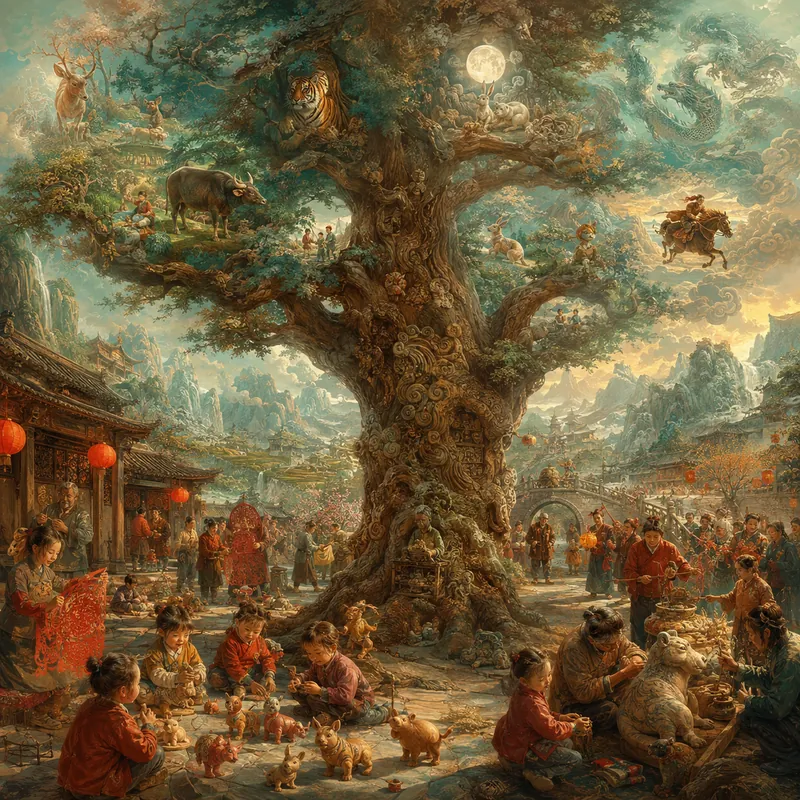
In the traditional ritual calendar, the rabbit appears across several important festivals and seasonal observances. From New Year rites intended to ward off evil, to rabbit lanterns at the Lantern Festival, rabbit-shaped offerings around Qingming, protective sachets at the Dragon Boat Festival, and the worship of the Jade Rabbit and Lord Rabbit at Mid-Autumn, the animal moves through the year in many different guises. Sometimes it serves as a guardian against misfortune; sometimes as a bearer of blessing; and sometimes as an earthly manifestation of the sacred rabbit believed to inhabit the moon.
First Lunar Month: Hanging Rabbit Heads and Praying for Blessings
Hanging Rabbit Heads on New Year’s Day — Warding Off Evil and Disaster
Among the ancient Han Chinese, there was once a widespread New Year custom known as “hanging rabbit heads” (挂兔头). On the first day of the first lunar month, people fashioned rabbit heads or snake forms from dough and suspended them above the main doorway together with bamboo tubes filled with melted snow, New Year streamers, and ritual masks, all intended to repel evil and avert misfortune. As folklorist Huang Guiqiu has noted, the “rabbit heads” were not actual animal heads but dough effigies. Song-dynasty texts already record the practice of hanging such forms at the gate on New Year’s Day. Through these symbolic images, people sought to draw the rabbit’s vitality and auspicious force into the household, transforming its perceived life-energy into a protective presence at the threshold.
Lighting Rabbit Lanterns — Welcoming the Divine and Receiving Blessings
On the fifteenth day of the first lunar month, during the Lantern Festival (元宵节, Yuánxiāo Jié), rabbit lanterns form one of the most distinctive folk traditions. Their history can be traced to the Northern and Southern Dynasties. In Ningdu County in Jiangxi, for example, colored paper was fashioned into mother-and-baby rabbit lanterns and carried in procession through villages, ancestral halls, and private homes. In Dabu, the custom known as “passing the lanterns” is said to have flourished by the Tang dynasty. Because the rabbit was regarded as an auspicious creature, every place through which a rabbit lantern passed was believed to receive blessing and good fortune. By the Song dynasty, “Jade Rabbit Lanterns” (玉兔灯) were already sold in the lantern markets of Lin’an. The practice thus brought together the Lantern Festival, the full moon, and the lunar rabbit into a single ritual image of reunion, divine protection, and family happiness.
The Fill-the-Granary Festival and the Rabbit
On the twenty-fifth day of the first lunar month, during the Fill-the-Granary Festival (填仓节, Tiāncāng Jié), some regions also observed customs connected with a rabbit deity. In parts of northern China, farming households shaped rabbits from dough and placed them inside their granaries, symbolically inviting the rabbit, conceived here as a guardian of stored grain, to bring abundance and a plentiful harvest.
Qingming: Rabbits and Cold-Food Swallows Hung from the Beams
Around the Qingming Festival (清明节, Qīngmíng Jié), parts of northern China preserved the custom of hanging “rabbits and Cold-Food swallows” (兔子寒燕) from the rafters. These Cold-Food swallows (寒燕) were steamed dough figures shaped as swallows, rabbits, and other creatures; once cooked, they were threaded together and suspended from the beams. Some were used as offerings, while others were given to children to eat. Rabbit-shaped figures were believed to aid digestion, drive away illness, and protect children as they grew. The tradition is still remembered in parts of northern Shanxi and northern Shaanxi. Around Qingming and the Cold Food Festival (寒食节, Hánshí Jié), people also made elaborately decorated steamed breads, including the well-known composition of “a snake coiling around a rabbit” (蛇盘兔), whose pairing came to signify prosperity and abundance.
Dragon Boat Festival: Rabbit Sachets
During the Dragon Boat Festival (端午节, Duānwǔ Jié), rabbit-shaped sachets formed part of the wider tradition of protective aromatic ornaments. Made from silk, satin, or cloth and filled with substances such as mugwort and realgar, these rabbit sachets could be worn on the body or hung above the doorway to ward off poison and repel evil. The rabbit’s gentle, peaceful image was thus woven into the Dragon Boat Festival’s broader concern with the expulsion of the Five Poisons (五毒). Children’s garments could likewise feature the Five Poisons together with a tiger or rabbit embroidered at the center, symbolizing the power of a protective creature to subdue harmful forces.
Mid-Autumn: Lord Rabbit and Moon Worship
No traditional festival is more closely associated with the rabbit than the Mid-Autumn Festival (中秋节, Zhōngqiū Jié). As the Jade Rabbit (玉兔, Yùtù) of the Moon Palace, the animal occupies a central place in the festival’s ritual and imaginative world.
Worshipping the Moon and the Rabbit
According to the Old Book of Tang (《旧唐书》), the Jade Rabbit was among the sacred beings associated with early Mid-Autumn moon worship. The connection itself is much older. In Qu Yuan’s Tianwen (《天问》, Questions of Heaven), the poet asks: “What benefit does it possess, that a rabbit is in its belly?” The ancient graph tu refers to the rabbit, and Wang Yi’s Han-dynasty commentary explicitly interpreted it as such. From this long-standing association between the moon and the rabbit emerged a ritual tradition in which lunar worship and reverence for the Jade Rabbit became inseparable.
Worshipping Lord Rabbit
Old Beijing developed one of the most distinctive forms of Mid-Autumn rabbit worship: devotion to Lord Rabbit (兔儿爷, Tù’eryé). Ji Kun of the Ming dynasty wrote in Remaining Manuscripts from the Pavilion of the King of Flowers (《花王阁剩稿》): “At Mid-Autumn in the capital, many fashion rabbits from clay, dress them in caps and robes, and seat them like human beings; children worship and bow before them.” By the Qing dynasty, the custom had become even more widespread. The Records of the Seasons in Yanjing (《燕京岁时记》) notes that when Mid-Autumn arrived, skilled market artisans shaped toad and rabbit figures from yellow clay for sale and called them “Lord Rabbit.” Typically represented with a rabbit’s head and a human body, Lord Rabbit holds a jade pestle and wears the attire of a military commander. He may sit upon a rocky outcrop or ride a fierce tiger, and each mount adds a further auspicious meaning: the qilin (麒麟) evokes “the qilin bringing a child” (麒麟送子), the tiger drives away evil, and the elephant signifies auspiciousness and fulfillment. Once the ritual worship was complete, the figure became a child’s toy. Each Mid-Autumn, families might invite a Lord Rabbit into the home for protection, then send him away before the following year’s festival, symbolically carrying with him illness, misfortune, and the accumulated troubles of the year.
Pulling Rabbit Lanterns
In places such as Jingxi in Guangxi, Mid-Autumn is also marked by the custom of “pulling rabbit lanterns” (拉兔子灯). These are much larger than ordinary hand lanterns and are fitted with four small wheels at the base. On the fifteenth night of the eighth lunar month, children draw them through streets and lanes. Because the rabbit is regarded as an auspicious creature, every household and alley through which the lantern passes is believed to receive blessing and good fortune.
Rabbit Days and Mao Days
Within traditional calendrical culture, Mao days (卯日), corresponding to the Rabbit, also carry particular associations. Although the rabbit does not belong to the conventional group of the six domestic animals assigned to the first six days of the lunar New Year, it nevertheless holds a distinct place within zodiac time. Mao hour (卯时, Mǎoshí), from approximately 5:00 to 7:00 in the morning, is likewise known as the “Rabbit Hour.” The ancients believed that rabbits emerged from their burrows to forage at dawn, and the hour therefore came to suggest awakening, new life, and hope.
Folk Beliefs
In Chinese folk belief, the rabbit assumes several sacred identities at once. It may appear as the white rabbit of auspicious omen, the Jade Rabbit of the Moon Palace, or a fertility emblem associated with the flourishing of descendants.
The White Rabbit as an Auspicious Omen
In ancient China, the rabbit was widely regarded as an auspicious animal, and unusual coloration heightened that meaning. White in particular carried an aura of purity, rarity, and divine revelation, so white animals were often interpreted as signs of favorable cosmic order.
The ancient Illustrations of Auspicious Responses (《瑞应图》) states: “A red rabbit is a great auspice; a white rabbit is a medium auspice.” A red-coated rabbit was thus classified among the highest-ranking omens, while a white rabbit belonged to the next category. Historical works repeatedly record white rabbits being presented to the imperial court. The Book of Han (《汉书》) notes several such offerings, and the Book of the Later Han (《后汉书》) records that peoples beyond the southern frontier of Rinan presented white pheasants and white rabbits. Similar entries appear in later dynastic histories. To discover or present a white rabbit was therefore to witness what might be understood as Heaven making auspicious order visible. White itself was associated with purity; the rabbit was linked with the moon; and the rare white rabbit, or Jade Rabbit, became an especially potent image of celestial favor. In a courtly setting, the presentation of such an animal could be read as evidence of benevolent rule and a well-ordered realm. Because wild rabbits were normally gray-brown, a genuinely white rabbit was rare enough to be treated as an exceptional natural sign.
The Jade Rabbit Pounding the Elixir
The relationship between rabbit and moon is among the most enduring symbolic pairings in Chinese culture.
Origins of the Rabbit in the Moon
The earliest surviving Chinese text to connect the rabbit explicitly with the moon is Qu Yuan’s Tianwen (《天问》, Questions of Heaven): “What virtue does the night light possess, that it dies and is born again? What benefit does it hold, that a rabbit is in its belly?” By the Han dynasty, commentators understood the animal in this passage as the rabbit. The association subsequently became deeply embedded in both literature and folk imagination. The Huainanzi (《淮南子》) preserves the belief that within the moon there is a cassia tree, beside which the Jade Rabbit pounds medicine.
The Legend of the Jade Rabbit Pounding Medicine
Legend tells of a rabbit in the moon whose body is pure white, like polished jade, and who is therefore known as the Jade Rabbit (玉兔). Kneeling beneath the cassia tree with a jade pestle in its paws, it pounds an immortal medicine capable of curing illness and granting longevity. The image gives visible form to one of humanity’s oldest desires: the longing to defeat sickness, extend life, and approach immortality. Over the centuries, the Jade Rabbit pounding medicine beneath the lunar cassia became one of the most familiar images of the moon in Chinese culture, a quiet celestial figure believed to send blessings toward the human world.
The Rabbit as a Poetic Name for the Moon
The rabbit consequently became one of the moon’s traditional literary names. The old expression “The Golden Crow sinks in the west; the Jade Rabbit rises in the east” (金乌西坠,玉兔东升) pairs the solar crow with the lunar rabbit, turning the passage of day and night into an exchange between sacred animals. Poets repeatedly drew on the image. Lu Zhaolin wrote of “the rabbit’s shadow” trembling beneath the sinking moon, while Li Shen referred to the rising “ice rabbit.” Expressions such as Rabbit Palace, Rabbit Watchtower, and Rabbit Grotto likewise became poetic circumlocutions for the moon.
Rabbit Totemism and Fertility Worship
The rabbit’s extraordinary reproductive capacity gave it another powerful layer of meaning. In early fertility symbolism, it became an emblem of fecundity, multiplying descendants, and the continuity of life. Ancient explanations sometimes imagined rabbits as conceiving through the influence of the moon, and this mysterious relationship between lunar cycles and reproduction helped transform the animal into a fertility symbol. The biological reality of rapid breeding only strengthened that association. In societies where many children and a flourishing lineage were regarded as blessings, the rabbit naturally came to embody the hope that descendants would multiply without end.
The Rabbit and the Queen Mother of the West
In early Chinese mythic imagery, rabbits were also closely associated with immortals. Representations of the Queen Mother of the West (西王母, Xīwángmǔ), the great western goddess linked with immortality, often include spirit rabbits pounding medicine. Later texts elaborated this connection between rabbits and extreme longevity. Ge Hong of the Eastern Jin wrote that tigers, deer, and rabbits could all live for a thousand years, and that when they reached five hundred their fur turned white. In this symbolic universe, the white rabbit was not simply unusual in color: it was the visible sign of great age, transformation, and accumulated spiritual potency. Rabbits thus became associated not only with fertility and new life, but also with longevity and transcendence.
Rabbit Worship among Ethnic Groups
Traditions of rabbit reverence have also appeared among different peoples and regions of China, particularly around the white rabbit as a sign of auspiciousness. Scholars have noted that encountering, obtaining, or presenting a white rabbit could all be interpreted as manifestations of heavenly favor. The rabbit’s gentle temperament also supported its association with goodness and benevolence. In the story of Cai Yong (蔡邕) of the Eastern Han, a tame rabbit was said to have appeared beside the mourning hut he built after his mother’s death, further linking the animal with filial virtue and moral refinement. Although rabbit worship among ethnic minority communities did not always develop into a fully systematized cult, rabbit imagery nevertheless appears in local stories and decorative traditions as a sign of auspiciousness, gentleness, and well-being.
Auspicious Meanings
Despite its modest size, the rabbit possesses an exceptionally rich vocabulary of auspicious meanings in Chinese folk culture. From the traditional image of “the Jade Rabbit presenting auspiciousness” (玉兔呈祥) to contemporary New Year wordplay, the animal has become a vehicle for wishes of fortune, hope, vitality, and renewal.
Auspicious Expressions for the Year of the Rabbit
Every Year of the Rabbit produces an abundant vocabulary of blessing. “The Jade Rabbit Presents Auspiciousness” (玉兔呈祥) invokes the lunar rabbit as a bearer of good fortune; “The Auspicious Rabbit Brings Blessings” (瑞兔送福) and “The Fortunate Rabbit Welcomes Spring” (福兔迎春) place it directly within the imagery of the New Year; while modern homophonic wordplay creates expressions suggesting a boundless future, great ambitions, and a prosperous road ahead. In this way, an ancient zodiac animal continues to generate new forms of auspicious language.
The Rabbit as an Auspicious Symbol
Since antiquity, the rabbit has represented auspiciousness, gentleness, longevity, and fertility. Its alert yet mild, peaceful temperament has made it one of the most approachable animals in the zodiac. In folk decorative art, the rabbit is often paired with other auspicious motifs: peonies for wealth and honor, Chinese cabbage for “hundred riches,” pomegranates for abundant descendants, and other plants rich in seeds or fruit. Each combination builds a new symbolic composition, allowing the rabbit’s own favorable associations to merge with wider traditions of blessing.
Rabbit and the Continuity of Descendants
One of the rabbit’s most important folk meanings is many children and many blessings (多子多福). Through popular wordplay and fertility symbolism, the rabbit became linked with producing offspring, multiplying descendants, and ensuring the continuity of the family line. This meaning is especially visible in paper-cutting, where rabbits are paired with pomegranates, grapes, gourds, and other many-seeded plants. Traditional designs also combine children, roosters, and rabbits to express the balance of sun and moon, yin and yang, and the endless regeneration of life. Rabbit cloth dolls, rabbit hats, rabbit shoes, and numerous rabbit paper-cuts carry similar wishes for children and prosperity. In northern Shanxi and northern Shaanxi, the well-known saying “When a snake coils around a rabbit, wealth is certain” (蛇盘兔,必定富) transforms the pairing into a particularly strong marriage and prosperity symbol.
Rabbit and Agility
The rabbit also embodies alertness, speed, and intelligence. The idiom “a cunning rabbit has three burrows” (狡兔三窟) emphasizes foresight and self-protection; Sunzi’s famous contrast between the stillness of a maiden and the speed of a fleeing rabbit makes the animal a model of sudden, decisive movement. Even the familiar saying “a rabbit will bite when cornered” carries an implicit respect for the animal’s survival instinct: gentleness does not mean helplessness. Folk stories of rabbits kicking at descending eagles likewise dramatize the idea that the apparently weak may defend themselves with astonishing force when survival is at stake.
Folk Art
The rabbit is among the most beloved subjects of Chinese folk art. Across New Year prints, paper-cutting, embroidery, clay sculpture, textile work, toys, and temple-market crafts, it moves effortlessly between the sacred and the playful.
Lord Rabbit
Lord Rabbit (兔儿爷, Tù’eryé) belongs to the distinctive tradition of painted clay sculpture in Beijing and has become one of the city’s most recognizable folk-cultural symbols. Its precise origins are difficult to establish, but references to the worship of Lord Rabbit at Mid-Autumn are already common in Ming-dynasty sources.
The Form of Lord Rabbit
Lord Rabbit combines a rabbit’s head with a human body, holds a jade pestle, and wears the armor and robes of a military commander. He may be seated on a rock or mounted on a tiger, qilin, elephant, or other creature. The resulting figure is an unusual fusion of sacred authority and popular humor: from a distance he appears martial and imposing, yet on closer inspection he remains unmistakably a rabbit, with all the animal’s gentle and endearing associations intact.
The Meaning of His Mounts
Each mount introduces an additional layer of symbolism. The qilin evokes “the qilin bringing a child”, the tiger signifies the expulsion of evil, and the elephant suggests auspiciousness and fulfillment. Lord Rabbit thus becomes not a single fixed image but a flexible visual system through which old Beijing expressed wishes for children, protection, happiness, and good fortune.
Cultural Status
Lord Rabbit occupies a special place in Beijing’s cultural memory. The renowned calligrapher Qi Gong (启功) once remarked during discussions surrounding the 2004 Olympic mascots: “If I had to vote now, I would cast my vote for Lord Rabbit.” In 2010, Lord Rabbit was selected as the Beijing Mid-Autumn Image Ambassador. Few folk images better capture the humor, warmth, and distinctive local character of old Beijing.
Rabbits in Paper-Cutting
The rabbit is equally prominent in Chinese paper-cutting. Folk artists have created countless variations on the animal, from lively zodiac rabbits to highly symbolic compositions combining children, roosters, rabbits, flowers, fruit, and auspicious characters. In traditional designs, the rabbit often appears with peonies, Chinese cabbage, pomegranates, or grapes, creating images of wealth, blessing, and abundant descendants. The motif of “snake coiling around rabbit” (蛇盘兔) is especially associated with marital blessing and prosperity, while child-and-rabbit compositions often encode ideas of yin and yang, sun and moon, and the endless renewal of life.
Rabbits in Textile Art and Embroidery
Rabbit imagery also appears widely in folk textile art and embroidery. Artisans use cloth, silk, satin, and other fabrics to create rabbit figures that express everyday hopes for happiness and prosperity. Traditions such as Huangmei cross-stitch (黄梅挑花) likewise incorporate rabbit motifs. Auspicious clouds, the character for fortune, and other symbolic elements often surround the animal, while plump, rounded rabbit forms may deliberately echo the shape of a yuanbao (元宝) ingot, reinforcing associations with wealth.
Rabbits in New Year Prints and Woodblock Art
In New Year prints (年画, niánhuà), rabbits are frequently connected with the moon, Mid-Autumn, and zodiac symbolism. Some works combine the rabbit with sundials, lunar phase diagrams, round coins with square holes, and other culturally resonant imagery. At the Mianzhu New Year Print Museum in Sichuan, images of elegant classical women accompanied by rabbit motifs reinterpret the zodiac animal through the visual language of traditional printmaking and paper-cutting, turning it into a bearer of New Year fortune.
Rabbit-Shaped Toys and Ceramics
Rabbit-shaped objects have a very long history in China. Black-jade rabbit pendants appear as early as the Shang dynasty, and rabbit-shaped bronze vessels were made during the Western Zhou. By the Han dynasty, rabbits had become increasingly common in pictorial art; under the Tang, flourishing ceramic production brought small porcelain rabbits into the world of children’s toys and decorative objects. To this day, the rabbit remains a favored form in embroidery, paper-cutting, clay sculpture, textile art, dough modeling, and papier-mâché.
The “Three Rabbits Sharing Ears” of Dunhuang
Among the most remarkable rabbit images in Chinese art is the “Three Rabbits Sharing Ears” (三兔共耳) motif found in the murals of Dunhuang (敦煌). Three rabbits run in a circle, their ears interlocked so ingeniously that each seems to possess two, although only three ears are actually depicted. The animals chase one another endlessly, creating a closed, dynamic cycle. The motif later traveled widely along the Silk Road (丝绸之路) and became one of the most distinctive examples of rabbit imagery moving across cultures. It is both a masterpiece of visual ingenuity and an important witness to the circulation of artistic symbols between China and the wider Eurasian world.
Taboos and Protective Rites
Although the rabbit is overwhelmingly regarded as auspicious, folk tradition also developed a number of taboos around it.
Pregnancy and Childbirth Taboos
Among the Han Chinese, one of the best-known taboos held that pregnant women should not eat rabbit meat. Because the rabbit’s upper lip is naturally cleft, people feared that eating rabbit meat during pregnancy might cause a child to be born with a cleft lip, popularly called a “rabbit lip.” The belief has no scientific basis, but it was once widespread. Alongside the taboo were positive protective customs: paintings of rabbits might be given to families with children as auspicious gifts, expressing hopes for peaceful growth, health, and a promising future.
Taboos of One’s Zodiac Year
People born in the Year of the Rabbit traditionally observe certain precautions during a Rabbit zodiac year of birth (本命年, běnmìngnián). These may include wearing red clothing or accessories to repel misfortune; in some traditions, avoiding rabbit-shaped ornaments, on the theory that repeating one’s own zodiac sign could intensify the year’s difficulties; avoiding high-risk activities such as water skiing, skiing, or mountain climbing; avoiding grave visits or contact with the seriously ill; and exercising greater caution in major or unfamiliar investments. Such practices belong to the realm of folk belief rather than scientific prediction.
Zodiac Conflicts
Traditional zodiac compatibility culture also assigns the Rabbit a series of supposed relationships with other signs. The Rabbit is said to be in conflict with the Rooster—the Mao–You clash (卯酉相冲); in a harm relationship with the Dragon—the Mao–Chen harm (卯辰相害); and in a punishment relationship with the Rat—the Mao–Zi punishment (卯子相刑). Folk sayings such as “When Rabbit meets Dragon, poverty lasts a lifetime” or “When Rabbit meets Rooster, tears fill the eyes” reflect old marriage taboos derived from this system. These beliefs are part of traditional custom and have no scientific basis.
Taboos on Mao Days
Some traditional customs also attach restrictions to Mao days (卯日), the calendrical days associated with the Rabbit. In certain regions, people avoided breaking ground or traveling far on such days. Like many calendrical taboos, these practices have largely weakened in modern life.
Folk Language and Sayings
The rabbit has left a rich linguistic legacy in Chinese. Unlike the rat, whose idiomatic associations are often negative, or the ox, whose symbolism is predominantly favorable, rabbit expressions tend to range from neutral to positive, emphasizing speed, alertness, vulnerability, cleverness, and the moon.
Rabbits in Idioms
Among the more favorable expressions is “moving like a fleeing rabbit” (动如脱兔), which describes extraordinary speed and appears in The Art of War (《孙子兵法》). “A cunning rabbit has three burrows” (狡兔三窟) praises foresight and the ability to protect oneself; “the rabbit rises as the falcon falls” (兔起鹘落) evokes rapid movement and swift execution; and “white rabbit and red crow” (白兔赤乌) refers to the moon and sun, and by extension to the passage of time.
Other expressions are more neutral or cautionary. “Waiting by a tree stump for a rabbit” (守株待兔) criticizes passive reliance on luck; “when the rabbit dies, the fox grieves” (兔死狐悲) refers to sympathy for one’s own kind; “the rabbit runs, the crow flies” (兔走乌飞) evokes the ceaseless movement of moon and sun; and “the Jade Rabbit rises in the east” (玉兔东升) simply describes the moon appearing in the sky. More negative expressions include “when the rabbit dies, the dog is cooked” (兔死狗烹), meaning that those who have rendered service are discarded once their usefulness ends, and “having caught the rabbit, forgetting the snare” (得兔忘蹄), referring to forgetting the means once the goal has been achieved.
Rabbits in Proverbs
Common rabbit sayings include “a rabbit does not eat the grass beside its own nest” (兔子不吃窝边草), meaning that one should not harm those close at hand; “a rabbit’s tail cannot grow long”, describing something unlikely to last; “the rabbit sees someone and its eyes turn red”, referring to jealousy; “catching a rabbit on New Year’s Eve—you can celebrate with it or without it”, meaning something too minor to affect the larger situation; and “even a rabbit will bite when cornered”, reminding us that even the mildest creature may resist when pushed too far.
Rabbit Two-Part Allegorical Sayings
Rabbit-related xiehouyu (歇后语)—two-part allegorical sayings—are especially playful. “Catching rabbits on the fifteenth day of the eighth month—you can celebrate with them or without them” describes something inconsequential; “a tumbler riding a rabbit—not a trace of steadiness” suggests instability; “someone wearing rabbit shoes—runs fast” points to speed; “a rabbit’s tail—it won’t grow long” describes something short-lived; “Lord Rabbit runs all over the mountain—still returns to the old burrow” evokes the pull of one’s habitual place; “a rabbit trying to embrace the moon—empty fantasy” mocks an impossible ambition; and “a rabbit teasing an eagle—looking for trouble” warns against provoking a far stronger opponent.
Folk Characterizations of People Born in the Year of the Rabbit
In popular zodiac personality lore, people born under the Rabbit are often described in favorable terms as gentle, kind, intelligent, perceptive, sociable, sensitive, and artistically inclined. Less favorable descriptions portray them as hesitant, overly cautious, or lacking decisiveness. A traditional verse summarizes the idealized image:
“The Mao Rabbit is gentle by nature, its intelligence unmatched beneath Heaven. Blessing and fortune attend its life, with peace and auspiciousness always near.”
Rabbits in Children’s Folklore
In the world of childhood, the rabbit is both an affectionate everyday companion and the magical immortal creature of the Moon Palace.
Rabbits in Nursery Rhymes
“Little White Rabbit” (小白兔) is among the most familiar children’s rhymes in China: “Little white rabbit, white and bright, two long ears standing upright; loves to eat carrots and greens, hopping and jumping, so very sweet.” For generations of children, this lively and gentle rabbit has been one of the first animal figures encountered in song. It stands in charming contrast to the sacred Jade Rabbit of lunar mythology.
“Little Rabbit, Be Good” (小兔子乖乖) uses the rabbit to teach children self-protection: “Little rabbit, little rabbit, open the door… No, no, I won’t open it; Mother hasn’t come home, and whoever you are, I won’t open the door.” The rhyme turns the rabbit’s caution into an accessible lesson about strangers and safety.
In the “Song of the Twelve Zodiac Animals” (十二生肖歌), the rabbit appears in fourth place: “The Rat goes first, followed by the old yellow Ox; the Tiger gives a roar, and the Rabbit trembles all over…” In this way, it is also one of the earliest zodiac animals children learn to recognize.
Rabbit Games
In “Rabbit Jump” (兔子跳), children imitate rabbits by raising their hands above their heads like long ears and jumping forward with both feet together, competing for speed or distance. “Little Rabbit Picks Mushrooms” (小兔采蘑菇) is a common role-playing game in kindergartens, in which children play rabbits gathering mushrooms in an imaginary forest, developing coordination and cooperation. “The Eagle Catches the Rabbits”, a variation of “The Eagle Catches the Chicks,” places one child in the role of the eagle, another as the mother rabbit, and the rest as young rabbits, turning the rabbit’s vulnerability and protective instinct into a collective game.
Rabbit Toys
Lord Rabbit is both a ritual image of Mid-Autumn and a child’s toy; after the offering ceremony, children could simply play with the figure. Rabbit lanterns are among the most child-centered lanterns of the Lantern Festival. A bamboo frame is bent into the shape of a rabbit, covered with colored paper, painted with round eyes and long ears, and often mounted on small wooden wheels so that children can pull it through the streets. By the Song dynasty, such lanterns had already become familiar seasonal toys. Cloth rabbits, rabbit hats, and rabbit shoes likewise brought the animal into everyday childhood, expressing hopes that children would grow lively, healthy, lovable, and safe.
Rabbits in Literature and Art
The rabbit is a recurring presence in Chinese literature and visual culture. From the Shijing and Tianwen to later poetry, painting, auspicious manuals, mathematical texts, and Dunhuang murals, the animal accumulated layers of meaning that range from the everyday to the celestial.
Rabbits in the Book of Songs
The Shijing (《诗经》, Book of Songs) preserves some of the earliest rabbit imagery in Chinese literature. Zhou Nan: Rabbit Net (《周南·兔罝》) describes the setting of nets in the wild: “Carefully the rabbit net is set; the stakes are struck with ringing blows.” Airs of Wang: The Rabbit Is at Ease (《王风·兔爰》) contrasts the rabbit’s freedom with the hardships of worldly existence: “There is the rabbit wandering free; the pheasant has fallen into the net.” Even in these early poems, the rabbit already functions as more than a simple animal: it becomes part of a moral and emotional landscape.
The Rabbit in Qu Yuan’s Questions of Heaven
Qu Yuan’s famous question—“What virtue does the night light possess, that it dies and is born again? What benefit does it hold, that a rabbit is in its belly?”—in Tianwen (《天问》, Questions of Heaven) is the earliest surviving Chinese textual record explicitly connecting the rabbit with the moon. More than two thousand years ago, the lunar markings had already inspired the imagination of a poet, laying the textual foundation for one of the most enduring images in Chinese culture.
Rabbit Poetry Across the Dynasties
Rabbit imagery appears throughout the poetic tradition. Lu Zhaolin (卢照邻) wrote of the moon’s “rabbit shadow” trembling over the river; Li Shen (李绅) called the moon an “ice rabbit” rising into brilliance; Jiang Fang (蒋防) praised the white rabbit as “bright as frost, warm as pure jade.” Song poets continued to use the rabbit both literally and metaphorically, while later painters and poets transformed the Jade Rabbit into a fully developed symbol of the lunar realm. Across the centuries, the rabbit could evoke speed, purity, moonlight, winter brightness, longevity, or the uncanny beauty of the celestial world.
Rabbit Paintings Across the Dynasties
Rabbit imagery is equally continuous in Chinese painting. Ming-dynasty works such as Tao Cheng’s (陶成) Jade Rabbit in the Moon Palace (《月宫玉兔图》) place the animal within a celestial setting, while court paintings and later Qing works integrate rabbits into auspicious compositions with flowers, elegant women, and garden settings. In folk art, the rabbit remains even more ubiquitous, appearing in embroidery, paper-cutting, clay sculpture, textile work, dough figures, papier-mâché, and countless seasonal objects.
Rabbits in Classical Texts
The Illustrations of Auspicious Responses (《瑞应图》) codified the rabbit’s omen status with the statement “A red rabbit is a great auspice; a white rabbit is a medium auspice.” The Mathematical Classic of Sunzi (《孙子算经》) preserves the famous “pheasants and rabbits in the same cage” (鸡兔同笼) problem, showing how thoroughly the rabbit had entered everyday intellectual culture. During the Han dynasty, Prince Xiao of Liang (梁孝王) even built a celebrated pleasure garden known as the Rabbit Garden (兔园), demonstrating that the animal belonged not only to myth and folk belief but also to elite leisure culture.
Final Reflections
Among the many strands of Chinese zodiac folklore, the traditions surrounding the Mao Rabbit (卯兔) are distinguished by an unusual gentleness, refinement, and sense of auspicious grace. Affection and reverence have always existed side by side: people cherish the rabbit for its mild, alert, and endearing nature, yet also approach it with the respect accorded to the immortal creature of the Moon Palace. It is an omen of good fortune, an emblem of longevity, a symbol of fertility, and—through its profound connection with the moon—one of the indispensable figures of Mid-Autumn culture. From the New Year custom of “hanging rabbit heads” to repel misfortune to the Mid-Autumn worship of Lord Rabbit, its image recurs at some of the most symbolically charged moments in the ritual year.
From the myth of the Jade Rabbit pounding the elixir (玉兔捣药) to the painted clay figure of Lord Rabbit, from the nursery rhyme “Little White Rabbit, White and Bright” to Dunhuang’s enigmatic “Three Rabbits Sharing Ears,” from the traditional blessing “The Jade Rabbit Presents Auspiciousness” to contemporary New Year wordplay, rabbit folklore reaches into nearly every domain of popular culture: seasonal observances, religious belief, auspicious symbolism, folk art, taboo and protection, childhood, literature, and visual culture. The rabbit may be worshipped as a sacred being, yet the same animal can also become a cloth doll cradled in a child’s arms. This remarkable closeness—revered as something sacred, loved as something familiar—is one of the defining qualities of Mao Rabbit culture.
The roots of that closeness lie in the rabbit’s unusually benign place within the Chinese cultural imagination. Unlike animals that became strongly associated with danger, destruction, or misfortune, the rabbit has for centuries remained a creature of gentleness, auspiciousness, purity, and numinous vitality. From the white rabbit classified as an auspicious sign in ancient omen literature to the lunar rabbit contemplated by Qu Yuan in Tianwen, its image has retained an extraordinary delicacy across time. Though the Mao Rabbit occupies only the fourth place in the zodiac, it carries some of the most enduring Chinese aspirations toward gentleness, harmony, agility, longevity, fertility, and abundant blessing. It comes to us from the Moon Palace, bearing the fragrance of cassia blossom and the quiet rhythm of the jade pestle, and casts one of the softest beams of moonlight across the spiritual landscape of Chinese culture.
----
[Language: es]
Readers’ Comments
Calendar and traditional culture enthusiasts from around the world, sharing the same moon.
Sign in or register to join the conversation. Your comment account is created automatically the first time you use a connected account.
No comments yet
Share your thoughts with readers around the world.