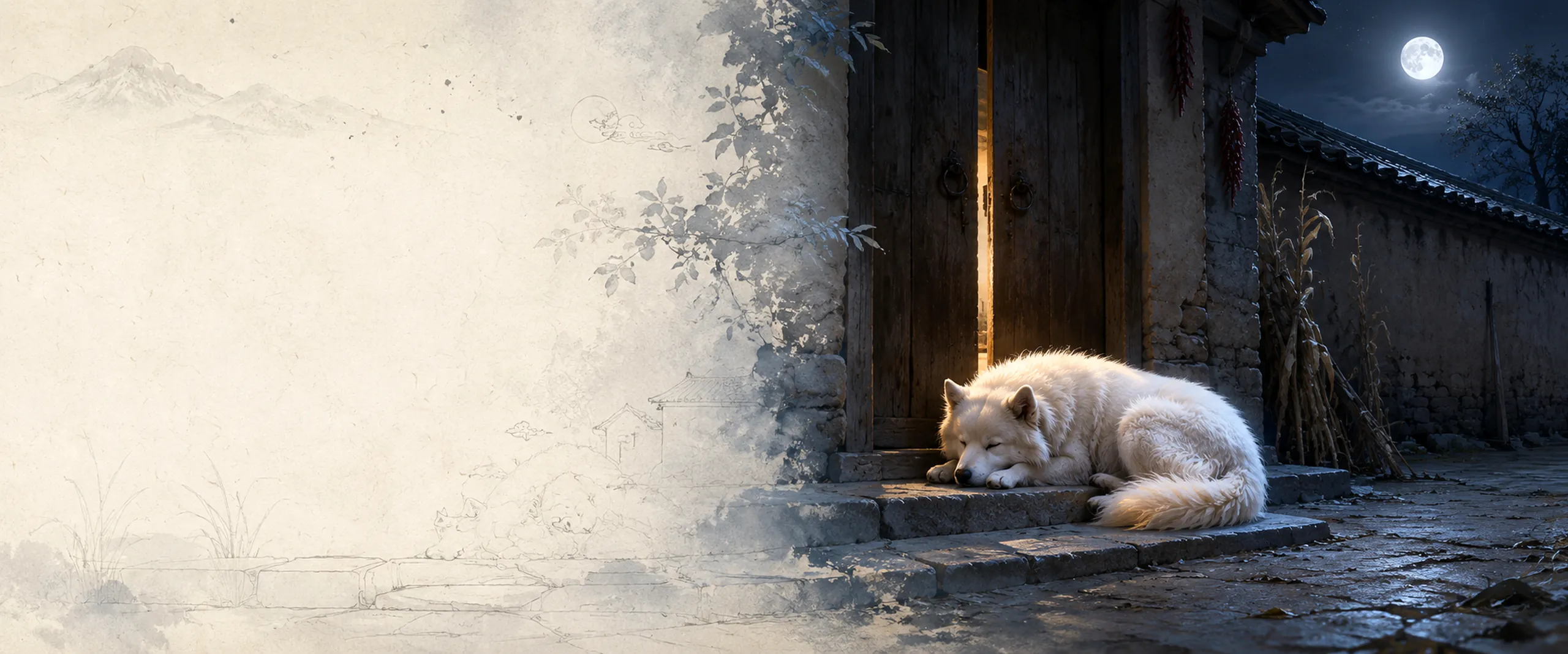
DogPersonality
「 Guard with sincerity, treat others with honor;<br>even in the dark of night, let the heart remain unchanged. 」

Xu Earth Is Yang
Xu corresponds to the eleventh of the twelve Earthly Branches and belongs to Yang Earth within the *Wuxing* (五行), the traditional Chinese system of the Five Elements or Five Phases: Wood, Fire, Earth, Metal, and Water. In Five-Element thought, Earth governs trust, support, and protection. Yang Earth resembles a city wall or fortress—massive, solid, and built to defend what lies within. Those born under the Dog sign are therefore believed to possess three innate qualities:
An Innate Quality of Loyalty
The dog has long been synonymous with the “忠臣”—the loyal retainer—and this folk characterization precisely captures what is regarded as the central quality of Dog-born people. Toward those they recognize as their own—leaders, friends, family members, or organizations—they possess an almost instinctive loyalty. Once they accept you, they will stand beside you whenever you need them, regardless of hardship, gain, or loss. Loyalty is not simply a “choice” for them; it is an “instinct.”
A Strong Sense of Justice and Desire to Protect
Xu Earth is the Earth of walls and fortifications, whose natural role is to “guard” and “protect.” Dog-born people are described in much the same way. They cannot tolerate seeing the weak bullied or unfairness occurring around them. When they encounter injustice, they instinctively want to step in and defend the person being mistreated. This “侠义心肠”—a chivalrous and justice-minded heart—makes them dependable allies.
Firm Principles and Integrity
Earth governs trust, and integrity and principle form the foundation of the Dog personality. Dog-born people possess firm moral standards and codes of conduct. They will not sell out their principles for personal gain, nor will they surrender and compromise merely because of pressure. When a line must be held, Dog-born people are among the most reliable.
Hidden Heavenly Stems: Wu, Xin, and Ding
The Earthly Branch Xu (戌) contains three hidden Heavenly Stems (*canggan*, 藏干)—Heavenly Stems understood within this traditional system as being symbolically contained within an Earthly Branch: Wu Earth (戊土), Xin Metal (辛金), and Ding Fire (丁火). This complex structure of “Earth generating Metal, and Fire generating Earth” is believed to give Dog-born people deeper inner characteristics:
Wu Earth as the primary qi: Wu Earth represents the earth of high mountains, imposing and substantial. Dog-born people take this as their foundation, giving them extraordinary stability and capacity to bear burdens. They are the kind of people who can “hold things up even if the sky comes crashing down.”
Xin Metal as the middle qi: Xin Metal represents the metal of pearls and jade, refined yet sharp. Dog-born people are not merely “honest and straightforward.” Deep within, they also possess acute judgment and penetrating insight. They can see through disguises and detect lies.
Ding Fire as the residual qi: Ding Fire represents the light of lamps and candles, warm and bright. Although Dog-born people may appear serious on the outside, they possess profound warmth within. Their way of expressing love is through “protection”: they act to shield the people they love rather than relying on sweet words.
Strengths of the Xu Dog Personality
The loyalty attributed to Dog-born people is regarded as unmatched among the twelve zodiac signs.
Loyal and Dependable
A partner who never betrays: Dog-born people possess a kind of “unwavering loyalty unto the end” toward those they recognize as their own. No matter what difficulties you encounter or what circumstances you fall into, they will not abandon you. In their personal dictionary, “betrayal” simply does not exist. They would rather suffer a loss themselves than fail someone who trusted them.
Able to keep a secret: Dog-born people are natural “experts at confidentiality.” Tell them a secret, and they will take it to the grave. They will not reveal it because of carelessness or a desire to show off. This quality of trustworthiness makes them among the safest people with whom to entrust private matters.
They step up when it matters: In ordinary situations, Dog-born people may be quiet and unobtrusive. But at critical moments, they are often the ones who step forward and shoulder responsibility. It is not because they want attention, but because they think, “Someone needs to do this, so I will.”
Upright and Uncompromising
A powerful sense of justice: Dog-born people cannot tolerate unfairness or injustice. When they see someone being bullied or falsely accused, they instinctively stand with the weaker side. Even if the other party is their own friend, they will “帮理不帮亲”—side with what is right rather than with personal ties.
Unafraid of power: Dog-born people do not flatter someone merely because that person has status or authority. They respect strength, but they do not submit to coercive power. In their eyes, “right is right, and wrong is wrong.” Status and power do not change the standard of right and wrong.
Consistency between words and actions: Dog-born people tend to be the same on the inside and outside. They do not act one way in front of someone and another behind their back. They say what they mean and do what they promise. This consistency between words and deeds makes them among the most reassuring members of a team.
Diligent and Grounded
Willing to work without complaint: Dog-born people are considered among the least concerned with “losing out” in the twelve zodiac signs. They do not mind doing more work or receiving less in return, so long as the task has meaning and they can answer to their own conscience.
Focused and meticulous: Dog-born people work with concentration and care. They do not pursue speed so much as quality. They believe in “慢工出细活”—fine work comes from patient effort—and are willing to spend considerable time and energy polishing what they do.
Persistent over the long term: Dog-born people possess extraordinary endurance. They may not be suited to a sprint, but they are natural “marathon champions.” Over long periods, they can maintain steady effort without rushing, becoming restless, or giving up.
Keen Intuition
Dog-born people are believed to possess an unusually strong “sixth sense.” They can often judge instinctively whether someone is “a good person” or “worth trusting.” They may not be able to explain why they dislike someone, yet later developments often seem to confirm their first impression. This intuition is believed to help them avoid many wrong turns in relationships and reinforces their confidence in their own judgments.
Weaknesses of the Xu Dog Personality
Stubbornness
Clinging rigidly to what they believe is right: Once Dog-born people accept a principle or viewpoint, they can be very difficult to persuade otherwise. They may find a hundred reasons to defend their position, even when those reasons are no longer suited to the situation. This stubbornness can become an obstacle when flexibility is required.
Resistance to change: Dog-born people prefer stability and dislike disruption. They tend to choose “the old road that has already been proven” rather than “the new road that has not yet been tried.” In a rapidly changing age, this desire for security can sometimes leave them behind.
Poor at compromise: In the Dog-born value system, “principle” matters more than “interest.” They would rather give up a benefit than compromise on an issue of principle. This black-and-white way of thinking can sometimes put them at a disadvantage in the complexity of real life.
Interfering Too Much
They worry about others too much: Dog-born people often feel an impulse that makes it difficult for them not to intervene. When they see someone making a mistake or heading in the wrong direction, they feel compelled to “correct” or “warn” them. This concern is often well-intentioned, but it can also be perceived as meddling.
Blurred boundaries: Dog-born people may not clearly distinguish between “this is someone else’s matter” and “this is my matter.” They can become anxious, worried, and deeply involved in someone else’s problems, sometimes more invested than the person directly concerned. This boundary-crossing concern can create pressure for others.
Good intentions can produce bad results: Dog-born people almost always begin from a good place, but a good intention does not necessarily produce a good outcome. Their excessive intervention can sometimes make matters more complicated or turn a situation that still had room for negotiation into something rigid.
Difficulty Expressing Emotion
Emotionally reserved: Dog-born people carry love in their hearts but may struggle to say it aloud. They are accustomed to expressing care through action—doing things for you, solving problems for you, shielding you from hardship. But they are not good at saying “I love you,” “I miss you,” or “I care about you.” This lack of verbal emotional expression can sometimes make people close to them feel insufficiently loved.
Not skilled at lightening the atmosphere: Dog-born people are serious and earnest. They may not be good at telling jokes or enlivening a room. In social situations that call for a relaxed and cheerful mood, they can appear somewhat “dull.” This does not mean that they lack emotion; they simply do not always know how to express it lightly.
Easily misunderstood: Because they are not skilled at expression, the silence of Dog-born people is often mistaken for “coldness” or “lack of concern.” In reality, behind that silence is often a mind asking, “How can I help you?”
To understand the underlying structure of the Dog personality, one must first return to the deeper attributes of the Earthly Branch Xu (戌).
Wood Dog (Jia-Xu Years · 1874, 1934)
Its *nayin* is Fire on the Mountain, and it is traditionally known as the “Self-Guarding Dog.” Wood Dogs are gentle in temperament and kind-hearted, and are regarded as the warmest and most humane among those born under the Dog sign.
Core personality traits: Generous and gentle—while retaining the Dog’s loyalty and integrity, Wood Dogs possess an added softness and tolerance associated with Wood. They are neither as hard-edged as Metal Dogs nor as intense as Fire Dogs, and their expression is more restrained and considerate; deeply loyal in affection—Wood Dogs place great value on relationships. They do not easily form deep bonds, but once they recognize someone, they treat that person with sincerity and remain loyal without abandoning them; somewhat indecisive—Wood Dogs are more likely than other Dog types to hesitate and may struggle to choose when making important decisions.
Destiny characteristics: They are described as clever and intelligent, proud and high-spirited. Their early years are ordinary, while middle age brings success. Husband and wife may experience mutual conflict, and children are a source of strength. Those born in spring enjoy both fortune and longevity; those born in summer have more than enough food and clothing; those born in autumn enjoy honor and prosperity; those born in winter live in stability.
Fire Dog (Bing-Xu Years · 1886, 1946)
Its *nayin* is Roof-Top Earth, and it is traditionally known as the “Self-Sleeping Dog.” Fire Dogs are regarded as the most passionate and energetic among those born under the Dog sign.
Core personality traits: Warm and outgoing—while retaining the Dog’s loyalty and uprightness, Fire Dogs possess an added warmth and vitality associated with Fire. They are less “somber” than other Dog types and are more willing to approach people and express their emotions openly; strong capacity for action—Fire Dogs possess powerful initiative and execution. Once they decide to act, they begin immediately and do not delay. In situations requiring quick action, they are a dependable force; impatient temperament—among the five Dog types, Fire Dogs are considered the most impatient. They dislike waiting and enduring delay and may make insufficiently considered decisions because they want results too quickly.
Destiny characteristics: They are described as intelligent, straightforward in heart and speech, and strong in temperament. Throughout life they are said not to remain close to benefactors of high standing, yet they possess authority and courage. Men are described as strong-willed, women as soft-hearted. Those born in spring live at ease; those born in summer enjoy fortune and longevity; those born in autumn are highly talented; those born in winter enjoy strong financial fortune.
Earth Dog (Wu-Xu Years · 1898, 1958)
Its *nayin* is Flatland Wood, and it is traditionally known as the “Dog Entering the Mountain.” Earth Dogs are regarded as the steadiest and most trustworthy among those born under the Dog sign.
Core personality traits: Steady and sincere—while retaining the Dog’s loyalty and integrity, Earth Dogs possess an added groundedness and solidity associated with Earth. They are considered the most down-to-earth of the Dog types; honest and trustworthy—Earth governs trust, and Earth Dogs are regarded as impeccable in matters of integrity. They keep their word and embody “一诺千金”—a promise worth a thousand pieces of gold—making them among the most trustworthy members of a team; relatively conservative—Earth Dogs dislike risk and major change and prefer to remain within familiar and secure territory.
Destiny characteristics: They are described as heroic and generous, with abundant food and clothing throughout life. They receive little support from extended family, husband and wife may experience mutual conflict, and children are a source of strength. Those born in spring enjoy both fortune and longevity; those born in summer live at ease; those born in autumn are clever and quick-witted; those born in winter are diligent and frugal.
Metal Dog (Geng-Xu Years · 1910, 1970)
Its *nayin* is Hairpin-and-Bracelet Metal, and it is traditionally known as the “Dog of Temples and Monasteries.” Metal Dogs are regarded as the most decisive and sharp-edged among those born under the Dog sign.
Core personality traits: Decisive and bold—among the five Dog types, Metal Dogs are considered the most resolute. They possess exceptional judgment and decisiveness and can quickly identify the crucial point in complicated situations before making a decision; exceptionally strong sense of justice—Metal Dogs have an intense intolerance of wrongdoing and very little patience for injustice. They do not merely “dislike what they see”; they are willing to step in and take action; upright and uncompromising—Metal Dogs say what they think and act directly, without unnecessary maneuvering. This straightforward style can sometimes offend others, but it also earns them respect; stubbornly self-assured—the confidence of Metal Dogs can sometimes become arrogance. They may trust their own judgment too much and find it difficult to accept other people’s opinions.
Destiny characteristics: They are described as intelligent and refined, exceptionally wise, and efficient in their actions. Throughout life they remain close to people of rank and often receive help from benefactors. Yet their temperament is strong, and their fortunes may rise and fall. They are said to be unsuited to official careers and more likely to excel in specialized scholarship, technical fields, or skilled arts.
Water Dog (Ren-Xu Years · 1922, 1982)
Its *nayin* is Great Sea Water, and it is traditionally known as the “Family-Guarding Dog.” Water Dogs are regarded as the wisest and most adaptable among those born under the Dog sign.
Core personality traits: Exceptionally quick-witted—Water Dogs possess not only the Dog’s loyalty and integrity but also Water’s agility and intelligence, making them the most strategically minded of the Dog types; highly adaptable—Water Dogs are neither as stubborn as Metal Dogs nor as conservative as Earth Dogs and can adjust their strategies flexibly according to different circumstances; strongly family-oriented—among the five Dog types, Water Dogs are considered the most devoted to family. They are loyal not only to friends and organizations but regard “protecting the family” as one of life’s foremost responsibilities; sometimes overly smooth—the “flexibility” of Water Dogs can sometimes make others feel that their adherence to principles is insufficiently firm.
Destiny characteristics: They are described as intelligent, well provided with food and clothing, calm in temperament, and able to live in ease and comfort. They receive help from many benefactors throughout life, with a stable early period, prosperity in middle age, and very favorable later years. Women are described as affectionate and should guard against disputes and troublesome words.
Summary of Personality Differences Among the Five-Element Dogs
| Dimension | Wood Dog | Fire Dog | Earth Dog | Metal Dog | Water Dog |
| --------------------------- | ------------------- | -------------------------- | ---------------------- | ----------------------------- | ----------------------- |
| Core temperament | Generous and gentle | Passionate and bold | Steady and sincere | Decisive and upright | Wise and tactful |
| Interpersonal relations | Deeply loyal | Warm and outgoing | Honest and trustworthy | Upright and uncompromising | Devoted to family |
| Career traits | Gentle and steady | Strong capacity for action | Practical and reliable | Bold in taking responsibility | Outstanding strategy |
| Primary weakness | Overly indecisive | Impatient temperament | Overly conservative | Stubborn and self-assured | Sometimes overly smooth |
Childhood and Adolescence (Ages 1–20)
Children born under the Dog sign display integrity and responsibility beyond their years from an early age. They do not like to lie—even when a “white lie” might seem necessary, they are reluctant to do so. In their teachers’ eyes, they are the “easiest students to manage”: they do not cause trouble, do not get into mischief, and complete their homework conscientiously. Among classmates, they may not be the most popular, but they are often the “most trustworthy.” Others are willing to tell secrets to Dog-born classmates because they know those secrets “will not be shared.” The weakness of this stage is excessive seriousness and insufficient liveliness.
Youth (Ages 20–35)
After entering society, Dog-born people earn the trust of supervisors and colleagues through loyalty and diligence. They are not the kind of people who excel at social maneuvering, flattery, or cultivating useful connections, but through solid work and dependable character, they gradually become core members of a team. They do not change jobs frequently. Once they recognize an organization as their own, they are inclined to remain for a long time, protecting the team as though “guarding a home.” In love, they are serious and devoted. They do not begin relationships lightly, but once they do, they approach them with a lifetime in mind. The weaknesses of this stage are difficulty presenting themselves, which may slow career advancement, and excessive seriousness in love, with relatively little romantic flair.
Middle Age (Ages 35–50)
Upon reaching middle age, Dog-born people often become the team’s irreplaceable “定海神针”—the stabilizing pillar that keeps everything steady. Through years of sustained effort, they accumulate deep professional ability and broad interpersonal trust. Supervisors depend on them, and subordinates rely on them. Within the family, they carry the household on solid shoulders. They may not be skilled with words, but every action tells their family, “I’m here; you don’t need to be afraid.” Their loyalty and protective nature give the family a profound sense of stability. The weakness of this stage is that they may occasionally become too stubborn and interfere too much in family affairs.
Later Life (Age 50 and Above)
In later life, Dog-born people radiate a quiet and dependable strength. They are no longer as inclined as in youth to “interfere in everything” and gradually learn that “when it is time to let go, one should let go.” Yet their instinct to protect never disappears. It merely changes from “charging at the front” to “holding the rear.” They become the family’s “last line of defense”: ordinarily they do not interfere in the younger generation’s choices, but when a serious problem arises, they step forward without hesitation and shoulder the burden. The wisdom of this stage lies in understanding that “the highest form of protection is not shielding others from every storm, but helping them gain the ability to shelter themselves.”
The Inner Needs of Dog-Born People
They need to be trusted: The deepest need of Dog-born people is “to be trusted.” They spend their lives trying to become someone worthy of trust. When you trust them, they feel that “my persistence has meaning.”
They need to be understood: The “stubbornness,” “meddling,” and “seriousness” of Dog-born people are often rooted in goodwill. They want things to become better and want the people around them to do better. When someone understands their “良苦用心”—the deep and well-intentioned concern behind their actions—they are more willing to remove their armor and reveal their gentleness.
They need stability: Dog-born people dislike change and uncertainty. What they need is a stable environment and a stable relationship—something that allows them to know, “This will not change; this is something I can safely protect.”
Golden Rules for Getting Along with Dog-Born People
Keep your promises: Dog-born people place enormous importance on integrity. If you promise something and fail to do it, they may feel deeply disappointed and may even lose trust in you.
Respect their integrity: Do not try to persuade them to “be more flexible on matters of principle.” They will not compromise for profit or abandon principles for the sake of relationships. This is their bottom line and one of the qualities most worthy of respect.
Offer sincerity rather than technique: Dog-born people possess keen intuition and can often see through falseness and calculation. Sincere and heartfelt interaction with them is more valuable than any social technique.
Accept their concern: The tendency of Dog-born people to “meddle” is, at its core, a form of care. If you can accept that concern and respond with gratitude, they feel deeply satisfied and reassured.
Best Zodiac Partners for the Dog
In traditional Chinese zodiac marriage culture, the Dog and Rabbit form a “Six Harmony” pairing (*liuhe*, 六合), a traditional relationship of especially strong compatibility between two zodiac signs, and are regarded as the best marital match. The Dog also forms a “Three Harmony” combination (*sanhe*, 三合)—a traditional grouping of three zodiac signs considered mutually harmonious—with the Tiger and Horse, making these pairings harmonious as well. With the Dragon, Rooster, and Goat, there are varying degrees of zodiac clash and harm—*xiangchong* (相冲) and *xianghai* (相害)—traditional forms of incompatibility that are believed to require greater adjustment within relationships.
Although all belong to the Xu Dog, differences in Heavenly Stems and *nayin* (纳音) classifications are believed to produce subtle variations in temperament. *Nayin* is a traditional classificatory system that assigns a specific elemental designation to each pairing within the sixty-term sexagenary cycle of Heavenly Stems and Earthly Branches. According to these sixty combinations, Dog years fall into five types:
| Type | Heavenly Stem & Earthly Branch | Nayin Five Element | Years | Traditional Name |
| ------------- | ------------------------------ | -------------------------- | ---------- | ------------------------------ |
| Wood Dog | Jia-Xu (甲戌) | Fire on the Mountain | 1874, 1934 | Self-Guarding Dog |
| Fire Dog | Bing-Xu (丙戌) | Roof-Top Earth | 1886, 1946 | Self-Sleeping Dog |
| Earth Dog | Wu-Xu (戊戌) | Flatland Wood | 1898, 1958 | Dog Entering the Mountain |
| Metal Dog | Geng-Xu (庚戌) | Hairpin-and-Bracelet Metal | 1910, 1970 | Dog of Temples and Monasteries |
| Water Dog | Ren-Xu (壬戌) | Great Sea Water | 1922, 1982 | Family-Guarding Dog |
Readers’ Comments
Calendar and traditional culture enthusiasts from around the world, sharing the same moon.
Sign in or register to join the conversation. Your comment account is created automatically the first time you use a connected account.
No comments yet
Share your thoughts with readers around the world.