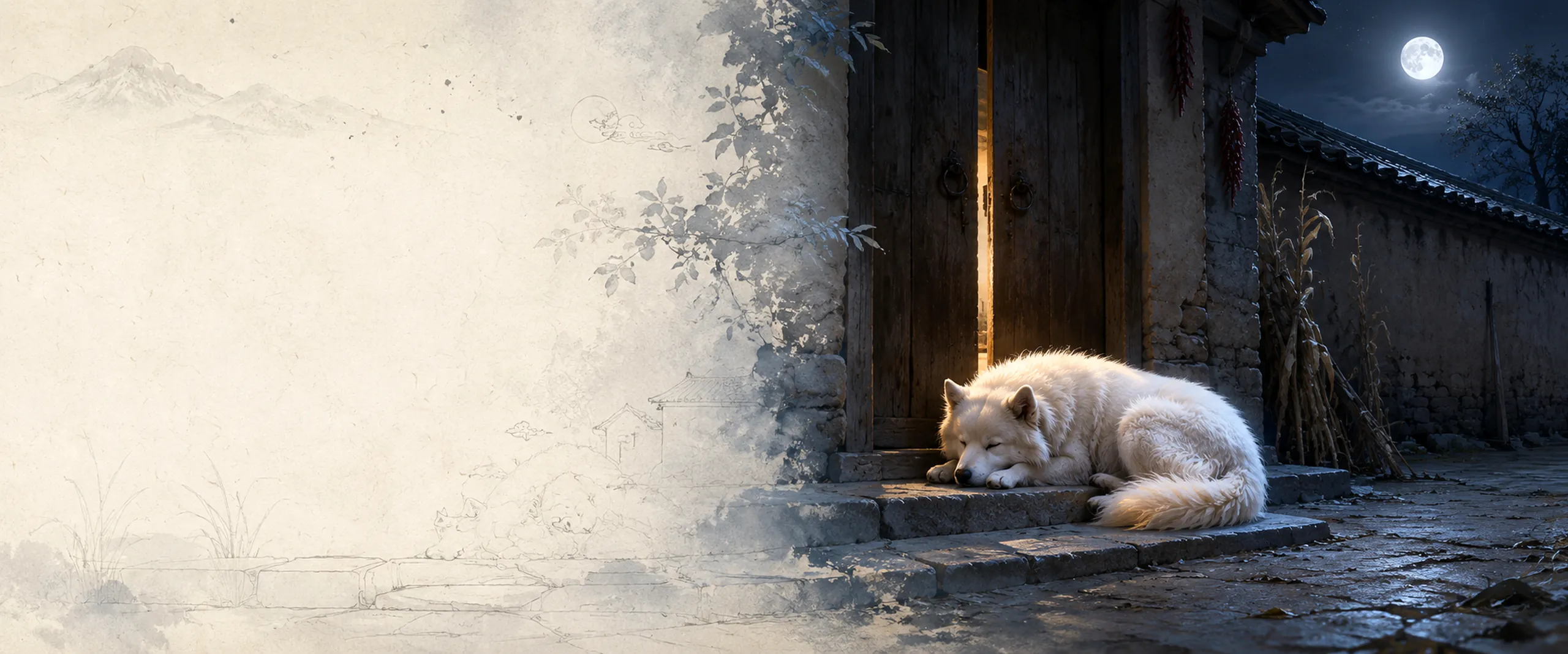
DogOrigin
「 Guard with sincerity, treat others with honor;<br>even in the dark of night, let the heart remain unchanged. 」
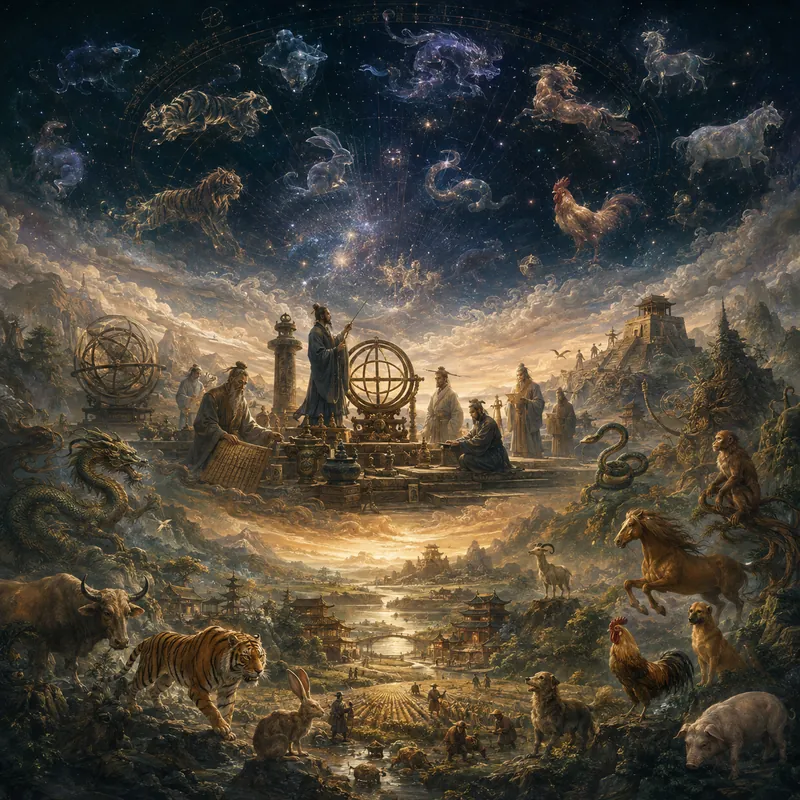
Xu —— The Eleventh Earthly Branch
In oracle-bone inscriptions, the character “戌” (Xu) resembles a broad-bladed axe-like weapon: the upper section forms the axe blade, the lower section the handle, and the entire shape is heavy and imposing. This weapon was its original meaning. By the Shang and Zhou periods, “戌” had been borrowed to represent the eleventh of the twelve earthly branches, and its original meaning as a weapon gradually faded.
By the Eastern Han, Xu Shen explained the character “戌” in the *Shuowen Jiezi* (《说文解字》) as follows: “戌,灭也。九月,阳气微,万物毕成,阳下入地也。” This means that “戌” is the “灭” of extinction and represents the ninth lunar month. At this time, Yang qi has already weakened, all things have fully matured, and Yang qi sinks downward into the earth. The ninth lunar month is already deep autumn: trees wither, grasses die back, and nature enters a state of storage and silence. This is precisely the season symbolized by “戌”—“Yang qi enters the earth, and all things reach completion.” Xu Shen also wrote: “五行,土生於戊,盛於戌。” Within the Five Elements, “戌” belongs to Yang Earth. From a philosophical perspective, “戌” corresponds to the ninth lunar month, the final month of autumn, and to the direction west by northwest. By the end of autumn represented by “戌,” the growth cycle of all things has been completed and the earth lies in austere stillness—a natural embodiment of “all things reaching completion and Yang descending into the earth.”
Dog —— Evolution of the Character and Philological Extensions
The character “犬” (Dog) is one of the oldest pictographs in the Chinese writing system. It already appears in Shang oracle-bone inscriptions, where it resembles the side view of a Dog, characterized by a slender belly and a curled tail. The oracle-bone form of “犬,” with its large ears, long body, and curled tail, vividly depicts the animal’s appearance. The character “狗” appeared somewhat later. “狗” is a phono-semantic compound, formed from “犬” (犭) as its semantic element and “句” (gōu) as its phonetic component. Xu Shen of the Eastern Han distinguished between the two in the *Shuowen Jiezi*: “狗,犬也。大者为犬,小者为狗。” In other words, in ancient conceptions there was originally a distinction of size between “犬” and “狗”: “犬” referred to larger Dogs, while “狗” referred to smaller ones. Over time, however, the two gradually became synonymous and today are essentially interchangeable.
Multiple graphic forms of the character “犬” have been found in oracle-bone inscriptions, the earliest mature writing system of China. This shows that as early as the Shang dynasty, Dogs were already common animals in the everyday lives of Chinese people and their image was deeply familiar. The pairing of “戌” and the Dog gave rise to a cultural image rich in auspicious meaning within traditional Chinese culture. Among the people, the Year of the Dog is often called the “Golden Dog”, giving rise to auspicious expressions such as “金狗贺岁”, “金狗旺财”, and “金狗纳福.” Because the Dog’s bark “汪汪” is homophonically associated with “旺”, the Dog is regarded as a symbol of flourishing wealth. The saying “狗来富” is widely circulated among the people. Spring Festival couplets such as “犬守太平世” likewise continue the auspicious symbolism of the Dog as guardian and protector.
Three Explanations for the Pairing of Xu and the Dog
The Time-of-Day Theory
Xu hour runs from 7:00 p.m. to 9:00 p.m. and is also called “黄昏”, dusk. By this time, darkness has fallen and night has begun; people, tired after a day’s labor, gradually return home and prepare to rest. The ancients observed that Dogs were at their most vigilant during these hours—they raised their ears, opened their eyes wide, and faithfully guarded the gate and courtyard, protecting their owners’ safety. From the Dog’s habit of “keeping watch at night,” the ancients associated Xu hour with the Dog. Liu Xianting of the Qing dynasty, in the *Guangyang Zaji* (《广阳杂记》), quotes Li Changqing’s Ming-dynasty *Songxiaguan Zhuiyan* (《松霞馆赘言》): “戌时方夜,而犬则司夜之物也,故戌属犬。” At Xu hour, night has just fallen and Heaven and Earth lie in dim twilight—it is precisely the time when Dogs guard the household through the night and faithfully perform their duty. Dogs possess especially keen sight and hearing at night; they see far, hear clearly, and are the most capable “night guards.” “戌” symbolizes the ending and storage of all things, while Dogs guard the night and protect the household—the two naturally correspond within the logic of time.
The Month Theory
“戌” corresponds to the ninth lunar month, the month of deep autumn. At this time, the weather turns cool, the forests shed their leaves, and all things enter the season of storage. The ancients regarded the ninth month as the time when “Yang qi is weak and all things have reached completion.” Dogs also begin shedding and replacing their coats during this period in preparation for winter, closely linking their life cycle with the seasonal characteristics of the Xu month.
The Lunar-Mansion Theory
The ancients paired the Twenty-Eight Lunar Mansions in the heavens with animals. Among them, the second mansion of the western group, Lou Mansion, belongs to Metal within the Five Elements, and the animal paired with it is the Dog, hence the name “娄金狗.” The Lou-Metal Dog is one of the Twenty-Eight Lunar Mansions, and its celestial position corresponds to the direction of the earthly branch “戌,” west by northwest. Thus, the pairing of Xu and the Dog arose not only from observation on earth but was also confirmed, in traditional thought, by the stars in the heavens.
Records in Classical Texts
The Qin Bamboo-Slip *Rishu*
In 1975, the *Daozhe* section of the bamboo-slip *Rishu* (《日书·盗者》), excavated from Qin Tomb No. 11 at Shuihudi in Yunmeng County, Hubei, recorded pairings related to the twelve zodiac animals. The tomb is dated to the era of Qin Shi Huang, in the third century BCE. In this list, the animal paired with “戌” is “old Goat”, not the Dog. The Shuihudi Qin slips read: “戌,老羊也”—that is, from the late Warring States period into the Qin dynasty, the animal corresponding to the Xu position was still the Goat rather than the Dog. Yet in Type A of the Qin bamboo-slip *Rishu* excavated at Fangmatan in Tianshui, Gansu, the animal paired with “戌” had already become the Dog. This shows that in different regions of China during the same period, zodiac pairings had already diverged—some regions still paired Xu with the old Goat, while others had already paired it with the Dog. Similar records are found in the Han bamboo-slip *Rishu* from Kongjiapo in Suizhou, Hubei. Together, these discoveries demonstrate that from the late Warring States period into the Qin dynasty, although the twelve-animal zodiac had already begun to take shape, the animal corresponding to the Xu position had not yet been fully standardized. The transition from “old Goat” to “Dog” precisely reflects the dynamic evolution of animal selection during the formation of the zodiac.
The Dog in Texts from the Pre-Qin through Han and Tang Periods
Dogs appear frequently in pre-Qin classical texts. The *Shijing · Zhaonan · Ye You Si Jun* (《诗经·召南·野有死麕》) contains the line “无使尨也吠”—“尨” refers to a shaggy Dog. This is one of the earliest Dog images in pre-Qin poetry. The *Zhouli* (《周礼》) records an official post specifically responsible for Dogs, the “犬人”, charged with raising and preparing Dogs for sacrifice. The Eastern Jin poet Tao Yuanming wrote the immortal line “狗吠深巷中,鸡鸣桑树颠”, in which barking Dogs become an emblematic image of reclusive rural life. The Tang poet Liu Changqing wrote the famous line “柴门闻犬吠,风雪夜归人”: on a cold night filled with wind and snow, a single bark is both proof of the Dog’s faithful vigilance and a warm signal of a traveler returning home. Chapter Five of Laozi’s *Daodejing* (《道德经》) contains the celebrated line “天地不仁,以万物为刍狗.” “刍狗” refers to Dogs woven from straw and used as sacrificial objects, showing that straw Dogs were already important ritual implements in the pre-Qin period.
The Eastern Han *Lunheng*
The earliest transmitted text to record a complete list of the same twelve zodiac animals used today is Wang Chong’s Eastern Han *Lunheng* (《论衡》). Wang Chong writes explicitly in the *Lunheng · Wushi Pian* (《论衡·物势篇》): “戌,土也,其禽犬也。” He also states: “戌,犬也。” Wang Chong records all twelve animals in the *Lunheng*, and the pairing of “戌” with the Dog is already completely identical to the modern system. This shows that by the Eastern Han period, in the first century CE, the Dog’s position within the twelve-animal zodiac had become fully fixed. The *Lunheng* marks the final standardization of the zodiac system—from “戌,老羊也” in the Shuihudi Qin slips to “戌,犬也” in the *Lunheng*, the Dog successfully replaced the Goat and took the eleventh position in the zodiac.
Zodiac Figurines and Dog-Shaped Artifacts
The Tradition of Zodiac Figurines from the Northern and Southern Dynasties to the Tang Dynasty
The twelve zodiac figurines, also known as divine figurines of the Twelve Branches, were distinctive burial objects in ancient Chinese funerary culture. Judging from existing archaeological evidence, the earliest appearance of zodiac figurines as burial objects in tombs dates to the Northern and Southern Dynasties. Twelve zodiac figurines made of pottery and rendered in a relatively realistic style were excavated from the Northern Wei Cui clan tombs at Linzi in Shandong. During the Sui and Tang dynasties, officials were commonly buried with zodiac figures possessing animal heads and human bodies to guard their tombs. The twelve heads represented the animals paired with the twelve earthly branches, including the Xu-Dog. Their placement followed a fixed order: three were positioned in each of the eastern, southern, western, and northern sectors of the tomb chamber, beginning with the Rat and ending with the Pig, arranged clockwise according to Zi south, Wu north. These zodiac figurines were intended to allow the twelve deities to take turns guarding the tomb occupant, bringing peace and auspiciousness and driving away evil and misfortune. Sui- and Tang-dynasty zodiac figurines were mostly made of pottery, though a small number were also made of iron, stone, or porcelain.
Tang-Dynasty Painted Pottery Zodiac Figurines
Painted pottery zodiac figurines unearthed from a Tang tomb at Hansenzhai in Xi’an are now held by the National Museum of China. Each has an animal head and human body, with the twelve heads representing the twelve zodiac animals. The bodies are human in form, wearing open-collared, broad-sleeved robes whose hems fall to the feet, with both hands clasped before the chest. Amid their refined bearing appears a touch of comic charm. The Xu-Dog figurine has a Dog’s head and human body and wears the attire of a civil official.
Xu-Dog from the Tang Tomb of Shi Sili
Among a group of twelve time figurines excavated from the tomb of Shi Sili, dated to the third year of Tianbao, 744 CE, at Guojiatan in Xi’an, the Xu-Dog figure has a slender neck and long muzzle. Its appearance differs from that of ordinary domestic Dogs and was probably modeled after the hunting Dogs favored by Tang imperial and aristocratic elites. This group of pottery figurines is regarded as a representative example of Tang-dynasty twelve-time figurines.
Tang-Dynasty Stone Zodiac Figurine —— Dog
The Palace Museum holds a Tang-dynasty stone zodiac figurine of a Dog. The figure has a Dog’s face and human body, wears a cross-collared long robe, clasps its hands before its chest, and reveals its feet slightly above a circular base. The folds of the robe are simple and fluid, while the texture of the stone produces a plain and archaic style. Tang zodiac figurines were generally made of pottery, and only a small number of stone examples have been discovered in Shaanxi and Beijing, making this piece particularly rare.
Mural of Hunting Dogs from the Tomb of Crown Prince Yide
The Tomb of Crown Prince Yide is a Tang imperial burial site, and its murals include images of hunting Dogs. Tang imperial and aristocratic elites were passionate about hunting, and hunting Dogs were among their most important companions in the chase.
Han Dynasty —— Green-Glazed Pottery Dog
The Shaanxi History Museum houses a Han-dynasty green-glazed pottery Dog measuring 31.5 centimeters high and 30.8 centimeters long. The Dog is covered entirely in green glaze and depicted in a static pose: its body is compact, its head raised as it stands, both ears bend forward, its gaze is directed straight ahead, and its mouth is open as if about to bark. Its four limbs are short yet strong and agile, giving the figure a naturalistic beauty. During the Han dynasties, social stability and economic prosperity encouraged the growing use of pottery models as burial objects, and pottery Dogs frequently found in Han tombs are a direct manifestation of this custom.
Song-Dynasty Brown-Glazed Clay Dog
The Nanjing Museum holds a Song-dynasty brown-glazed clay Dog. Porcelain zodiac figurines became more numerous in the Song dynasty. In contrast to the powerful hunting-Dog imagery of the Tang, Dog-shaped artifacts of the Song more often portray gentle and endearing domestic Dogs.
Giuseppe Castiglione’s *Ten Fine Hounds* of the Qing Dynasty
The Qianlong Emperor of the Qing dynasty was deeply fond of raising Dogs. Court painters of the time depicted the imperial Dogs in their works. The most famous are the ten paintings collectively known as 《十骏犬图》, created by the Italian missionary Giuseppe Castiglione. Combining Chinese and Western painting styles, Castiglione portrayed ten famous Dogs kept around Qianlong, each bearing a distinctive name: “苍水虯”“斑锦彪”“金翅猃”“蓦空鹊”“墨玉璃”“茹黄豹”“睒星狼”“霜花鹞”“雪爪卢” and “苍猊犬.” The *Ten Fine Hounds* represent the culmination of Dog imagery in Qing court painting.
Dog-Head Bronze Statue from the Yuanmingyuan
The Dog-head bronze statue of the Yuanmingyuan formed part of the Haiyantang hydraulic clock system created during the Qianlong reign of the Qing dynasty, with the Italian missionary Giuseppe Castiglione presiding over the design and the Frenchman Michel Benoist supervising the work. Twelve animal-headed human-bodied statues were arranged in an “eight” shape on both sides of the fountain pool in front of Haiyantang. At each traditional hour, the corresponding animal head would spout water to announce the time. During Xu hour, from 7:00 p.m. to 9:00 p.m., the Dog head sprayed a column of water from its mouth. In 1860, Anglo-French forces burned the Yuanmingyuan, and the twelve zodiac bronze statues were looted and dispersed overseas. The Dog-head bronze statue, like several of the other animal heads, remains missing to this day.
Origins and Domestication of the Dog
The Dog belongs to the class Mammalia, order Carnivora, and family Canidae. The distant ancestors of Dogs were wolves and jackals. From approximately 40,000 to 15,000 years ago, ancient humans had already begun domesticating Dogs. The Dog was the first domestic animal to be domesticated by humans, earlier than the Horse, Ox, Goat, Pig, Rooster, and others. China is one of the earliest regions in the world where Dogs were domesticated. Archaeological discoveries confirm that the history of Dog keeping in China can be traced back to the Neolithic period. At the Nanzhuangtou site in Xushui, Hebei, dating to around 10,000 years ago, the earliest Dog remains discovered in China were found.
Dog Bones at Prehistoric Sites
Dog remains have been unearthed at prehistoric sites across China. At the Cishan site in Wu’an, Hebei, approximately seven to eight thousand years ago, Dog remains were discovered, providing important evidence for early Dog keeping in northern China. Dog remains were also unearthed at the Peiligang site in Xinzheng, Henan, approximately seven to eight thousand years ago. At the Hemudu site in Yuyao, Zhejiang, approximately 7,000 years ago, fossils of domestic Dogs were found, providing important evidence for early Dog keeping in the Yangtze River region. These archaeological discoveries show that as early as 7,000 to 10,000 years ago, Dogs were already living alongside the early peoples of China.
“Dog” in Oracle-Bone Inscriptions
Multiple forms of the character “犬” have been found in oracle-bone inscriptions, the earliest mature writing system of China. The oracle-bone forms depict a Dog with large ears, a long body, and a curled tail, vividly capturing the animal’s appearance. This shows that Dogs were already extremely common in everyday life during the Shang dynasty. Oracle-bone divination texts also contain the record “侑燎于父丁百犬”—a single sacrifice could use as many as one hundred Dogs, an astonishing number. This shows that during the Shang dynasty, Dogs were not only companions in human life but also important sacrificial animals.
Dog Burials
Archaeological practice has revealed a custom of Dog burials in Shang- and Zhou-period tombs. Dogs were buried within tombs primarily so that they could ward off demons and supernatural threats and protect the deceased. The ancients believed that Dogs could guard tomb occupants from ghosts and spirits, and this idea continued all the way into the Tang-dynasty burial custom of the twelve zodiac figurines.
Among the myths and legends surrounding the Xu-Dog, their richness in number and depth of meaning are distinctive even among the twelve zodiac animals. From the founding-ancestor myth of Panhu to the astronomical myth of the Celestial Dog devouring the moon, from the Wind Lord as a deity governing the wind to the zodiac legend of the Cat and Dog rivalry, the Dog’s mythological image spans creation, totemism, astronomy, folk custom, and many other domains.
Creation and Heroic Narratives
The Legend of Panhu
This is the oldest and most exalted myth concerning the Dog, and also one of the most widely circulated Dog-totem myths among China’s ethnic minorities.
The Birth of Panhu —— A Golden Insect Becomes a Dog
According to the *Hou Hanshu · Nanman Zhuan* (《后汉书·南蛮传》), during the time of Gaoxin, one of the Five Emperors, also known as Emperor Ku, an elderly woman at the royal court suffered from an ear ailment. When a physician treated her, he extracted from her ear an object about the size of a silkworm cocoon. The woman placed it inside a hu, a gourd, and covered it with a pan, a plate. Before long, the object unexpectedly transformed into a Dog—its body patterned in five colors and shining brilliantly. Because it had emerged from a gourd and had been covered by a plate, it was named “Panhu.”
Panhu Renders Great Service —— Taking the Enemy General’s Head
At the time, Gaoxin was facing rebellion from the Rongwu tribe. The Rongwu came fiercely, and despite repeated campaigns Gaoxin could not defeat them. With no other choice, Gaoxin proclaimed throughout the realm that whoever could obtain the enemy leader’s head would receive his daughter in marriage and be rewarded with land. Upon hearing this command, Panhu left the royal court, crossed the great river, and entered the Rongwu military camp. Taking advantage of the enemy commander’s lack of vigilance, Panhu suddenly attacked and bit off the commander’s head in a single bite. Carrying the severed head in its mouth, Panhu returned before Gaoxin and completed the mission.
Panhu Marries the Princess —— Producing Descendants
When Gaoxin saw Panhu return with the enemy commander’s head, he was delighted. But then he reconsidered—Panhu was a Dog; how could he allow his daughter to marry a Dog? Gaoxin wanted to go back on his word. His daughter, however, said to him: “大王既然已经向天下宣告,如今反悔,岂不是失信于天下?” Persuaded by his daughter, Gaoxin gave her in marriage to Panhu. Carrying the princess on his back, Panhu entered the southern mountains and lived in a stone cave. Panhu and the princess became husband and wife and had twelve children—six sons and six daughters. These twelve children later intermarried and multiplied, forming a tribe. Panhu’s descendants later migrated toward the southeast and became the ancestors of today’s Miao, Yao, She, and other ethnic groups.
The Cultural Significance of the Panhu Legend
The Panhu legend is recorded in differing levels of detail in Guo Pu’s commentary on the *Shanhaijing*, the *Xuanzhongji* (《玄中记》), and Gan Bao’s *Soushenji* (《搜神记》). The legend remains widely circulated today in regions inhabited by the Miao, Yao, She, and other ethnic minorities. Among these peoples, the Dog is regarded as an ancestor deity and receives special reverence. In She communities of southeastern China, remnants of Dog-totem worship still survive today. The tradition of “the Dog as totem” is precisely a direct expression of these peoples regarding Panhu as the ancestor of their clan.
Quanrong and the Kingdom of Goufeng
The Panhu legend does not stand alone. On the northwestern frontier in remote antiquity, there was a tribe known as the Quanrong. The Quanrong kingdom was also called the “Kingdom of Goufeng,” and its origins were closely connected with the Panhu myth. Because Panhu gained merit by killing the Rong king, he was enfeoffed in the sea southeast of Kuaiji. His male descendants were Dogs and his female descendants beautiful women, and this became the kingdom of Goufeng. The Quanrong were a tribe that used the Dog as its totem. Their descendants, the Pumi people, still retain customs of revering Dogs. The Yao likewise regard Panhu, the Dragon-Dog said to possess five-colored fur and a Dog’s head with a human body, as an ancestor because of his military achievement. To this day, one branch of the Yao is still known as the “Dog Yao.” The existence of these Dog-totem tribes shows that the Dog was not merely a human companion but also the spiritual ancestor and core of belief for certain peoples.
The Legend of the Celestial Dog
The Celestial Dog (天狗) is one of the most famous Dog images in Chinese mythology.
The Celestial Dog in the *Shanhaijing* —— An Auspicious Beast that Wards Off Evil
The earliest record of the Celestial Dog appears in the *Shanhaijing · Xishanjing* (《山海经·西山经》): “又西三百里,曰阴山。浊浴之水出焉,而南流于番泽。其中多文贝,有兽焉,曰天狗,其状如狸而白首,其音如榴榴,可以御凶。” The Celestial Dog of the *Shanhaijing* is a beast shaped like a civet cat with a white head. Its cry sounds like “榴榴”, and it can ward off malevolent forces, avert disasters, and dispel harm—it is an auspicious beast.
The Celestial Dog of the Tang Dynasty —— A Fierce and Powerful Divine Hound
Tang-dynasty records of the Celestial Dog differ from those of the *Shanhaijing*. According to historical accounts, Emperor Xuanzong of Tang kept many hunting Dogs, among which the most famous breed was called “Celestial Dog.” The great poet Du Fu wrote the *Tiangou Fu* (《天狗赋》), praising it with the lines “夫何天狗嶙峋兮,气独神秀。色似狻猊,小如猿狖” and “猛健无与比.” In the Tang dynasty, the Celestial Dog was a real breed of powerful Dog whose incomparable ferocity and strength gave it a mythic aura.
The Celestial Dog Devours the Moon
“The Celestial Dog devours the moon” is the most famous folk legend surrounding the Celestial Dog in China. Whenever a lunar eclipse occurs, ordinary people traditionally say “the Celestial Dog swallows the sun” or “the Celestial Dog swallows the moon.” This legend may be connected with ancient theories of mutual generation and conquest among the Five Elements. The ancients believed: “Xu-Dog resides in the west, and the west belongs to Metal; the Moon-Rabbit is Mao, resides in the east, and the east belongs to Wood.” According to Five-Elements theory, Metal conquers Wood—therefore the Metal Dog of the west can devour the Wood Rabbit of the east, that is, the Moon. Behind this seemingly simple legend lies the ancients’ profound understanding of astronomical phenomena and Five-Elements philosophy. The legend of the Celestial Dog devouring the moon is already recorded in the *Shanhaijing · Dahuang Xijing* (《山海经·大荒西经》). The ancients believed “the deity of Xu is the Dog,” and from this arose the Celestial Dog legend.
The Dog as a Wind Deity
The *Shanhaijing* records a divine beast with a human face and Dog’s body: “狱法之山,有兽‘状如犬而人面’,‘其行如风,见则天下大风’.” This passage describes a divine beast with a human head and Dog’s body—it moves as swiftly as the wind, and whenever it appears, great winds sweep across the realm. The mountain is called Yufa; the character “狱” itself has two “犬” surrounding a “言”—this Yufa Mountain is the great stronghold of the divine Dog. This story is essentially a legend of the Dog as a wind deity. The ancients assigned explicit divine offices to different weather phenomena—Wind was a “Lord,” Thunder a “Duke,” Rain a “Master,” and Lightning a “Mother.” The Wind Lord himself possessed the form of a Celestial Dog. The *Fengsu Tongyi* (《风俗通义》) also records: “戌之神为风伯,故以丙戌日祭於西北。” The Xu position lies in the northwest, while the Wind Lord, the deity of wind, is likewise associated with the northwest—Xu hour belongs to the Dog, the Xu direction lies in the northwest, and the Wind Lord takes canine form. The three form a perfect correspondence.
Legends of Zodiac Ranking
The Cat and Dog Rivalry
This is the classic legend of how the Dog became one of the zodiac animals. It is the most widely circulated and has one of the liveliest and most entertaining plots.
The Jade Emperor Selects the Zodiac —— Animals Must Have Rendered Service to Humanity
According to legend, the Jade Emperor ordered that twelve animals be selected and appointed as zodiac deities, requiring that each chosen animal must have been useful to humanity. Every animal wanted to become a zodiac deity and tried to display its strengths, hoping to prove before the Jade Emperor that it was a capable helper of humankind. The Cat and Dog were both animals closely connected with humans. They argued endlessly over which of them had made the greater contribution. The Cat claimed that the Dog ate too much, spent all day lying by the gate, and contributed little. The Dog argued that the Cat was greedy, possessed no real skill, did little more than frighten small Mice, and likewise made little contribution. Unable to settle their dispute, they went together before the Jade Emperor for judgment.
The Jade Emperor Questions Them —— The Cat’s Lie and the Dog’s Honesty
The Jade Emperor asked the Dog: “How much do you eat at one meal?” The Dog answered honestly: “I guard the gate and courtyard every day, and eat one basin at each meal.” The Jade Emperor then asked the Cat: “How much do you eat at one meal?” The Cat had a sudden clever thought and said: “I recite scriptures and catch Mice; one small lamp-cup of food at each meal is enough for me.” In reality, the Cat ate only good food and certainly did not eat just one lamp-cup. The Cat merely cleverly told the Jade Emperor that it could catch Mice and support itself—making its contribution appear greater than the Dog’s.
The Dog Angrily Chases the Cat —— The Two Become Enemies
After listening to the Cat and Dog, the Jade Emperor concluded that the Cat ate little but accomplished much and therefore contributed more than the Dog. Hearing this, the Dog became furious—it believed the Cat had won through a dishonorable lie, so it cursed and chased after the Cat, trying to bite it. Knowing itself to be in the wrong, the Cat ran without stopping and, even after reaching home, did not dare show itself, hiding here and there and refusing to come out.
The Dog Hurries into the Queue —— Selected in Eleventh Place
Taking advantage of the Cat’s hiding, the Dog hurried off with the Rooster to the Celestial Palace to queue for selection as a zodiac deity. The Rooster flew and ran, placing itself ahead of the Dog. The Cat, hidden in the shadows, waited a long time without seeing the Dog and only after coming out learned that the Dog had already gone to the zodiac selection. It rushed to the Celestial Palace and lined up behind the Pig. Yet the little Rat had hidden in the Ox’s horn and seized first place in the zodiac. As a result, the Cat failed to become a zodiac deity. From then on, the Cat hated the Rat and bit every Rat it saw. Although the Dog became a zodiac animal, being honest and upright, it never forgave the Cat and chased it whenever they met.
Another Version —— The Jade Emperor, Ashamed, Appoints the Dog
Another legend holds that when the Jade Emperor selected the twelve zodiac animals, he originally did not consider the Dog. Yet the Dog faithfully guarded houses and courtyards in the human world without ever neglecting its duty. When the Jade Emperor saw the Dog’s loyalty, he felt deeply ashamed and therefore appointed the Dog as the “Xu-Dog,” making it one of the twelve zodiac animals. Although this version is less widely circulated than the Cat-and-Dog rivalry story, it emphasizes even more clearly the Dog’s defining virtue of loyalty.
Folk Beliefs and Folk Customs
The Righteous Dog Saves Its Master
Chinese folk tradition contains a great many stories of “righteous Dogs saving their masters.”
Huang’er Delivers a Letter: The Jin-dynasty poet Lu Ji kept a Dog named Huang’er. While serving as an official in Luoyang, Lu Ji missed his home and wrote a letter, tied it around Huang’er’s neck, and sent the Dog to deliver it to his family in Wu Commandery, thousands of *li* away. Huang’er successfully delivered the letter, then returned to Luoyang carrying a reply—after traveling several thousand *li* in all, Huang’er remained completely unharmed.
Heilong Saves His Master: Legend tells of a hunter who was chased by a Tiger while hunting in the mountains. His Dog, Heilong, threw itself fearlessly at the Tiger and fought it. The master was ultimately saved, but Heilong suffered severe injuries.
These stories of righteous Dogs rescuing their masters are folk expressions of the Dog’s virtues of loyalty and courage, and also form part of the popular foundation for the Dog’s inclusion among the twelve zodiac animals.
The Dog in Literature and Historical Records
Ji Xiaolan Praises the Dog
The great Qing scholar Ji Xiaolan highly praised the Dog’s spirit of loyalty and righteousness in the *Yuewei Caotang Biji* (《阅微草堂笔记》): “余谓犬之为物,不烦驱策,而警夜不失职,宁忍寒饿,而恋主不他往,天下为僮仆者,实万万不能及。其足使人愧,正不在能语不能语耳。” Ji Xiaolan’s meaning is that Dogs require no driving or urging to remain vigilant at night and never neglect their duty; they would rather endure cold and hunger than abandon their master for another household. Among all the servants under Heaven, scarcely any could compare with the Dog. The Dog is enough to make human beings feel ashamed—and the issue has nothing to do with whether it can speak or not. Ji Xiaolan’s praise is a classic summation of the Dog’s virtue of loyalty and lies at the spiritual core of Xu-Dog culture.
As zodiac culture spread, it incorporated elements of local cultures, and the image of the Dog took on different forms across East Asian societies.
Japan
Japan’s twelve zodiac animals are basically the same as China’s—Rat, Ox, Tiger, Rabbit, Dragon, Snake, Horse, Goat, Monkey, Rooster, Dog, and Pig. The Dog likewise occupies eleventh place. In Japan, the Dog is sometimes written as “犬”, with the same meaning. Japan, North Korea, and South Korea use lunar calendrical traditions related to China’s, and Chinese zodiac culture began spreading to the Korean Peninsula and Japan in ancient times.
Vietnam
In Vietnam’s twelve-animal zodiac, the Dog likewise occupies eleventh place. Vietnam’s zodiac system is basically the same as China’s—the only difference is that the Cat replaces the Rabbit. Apart from this, the order of Rat, Ox, Tiger, Dragon, Snake, Horse, Goat, Monkey, Rooster, Dog, and Pig is exactly the same as in China.
Korean Peninsula
The twelve zodiac animals of the Korean Peninsula—North Korea and South Korea—are exactly the same as those of China. In Korean culture, the Dog is likewise a symbol of loyalty and guardianship.
Thailand
In Thailand’s zodiac system, the Elephant replaces the Dog. This is a typical case of localized transformation during the spread of zodiac culture. In Thai culture, the Elephant holds an exceptionally exalted position and therefore replaces the Dog’s place.
Commonalities and Differences
The Dog occupies eleventh place in most East Asian zodiac systems, while Thailand replaces the Dog with the Elephant without changing the position. This shared ranking reflects the Dog’s broad importance throughout the East Asian cultural sphere. Yet differences exist in the details: China emphasizes the Dog’s virtue of loyalty, the founding-ancestor myth of Panhu, and the auspicious homophonic association between the Dog’s bark “汪” and “旺”; Japan and the Korean Peninsula largely continue Chinese Dog-culture traditions; Vietnam likewise follows them, though its replacement of the Rabbit with the Cat is its most distinctive feature; Thailand replaces the Dog with the Elephant, reflecting the Elephant’s exalted position in local culture. These differences precisely demonstrate the vitality and adaptability of zodiac culture in cross-cultural transmission.
Viewed across the origins and evolution of the Xu-Dog zodiac, one theme emerges throughout: among all twelve zodiac animals, the Dog was the first animal domesticated by humans and is also the only zodiac animal to possess a myth of a “founding ancestor”—the legend of Panhu bestowed upon the Dog the exalted status of founding a people and establishing a lineage.
Characters and texts tell us that because the Dog guards the household at night during Xu hour, and because Xu belongs to Yang Earth, the Dog forms a perfect correspondence in behavior and rhythm with the earthly branch “戌” and its meaning of “Yang qi entering the earth and all things reaching completion.” Particularly thought-provoking is the historical evolution of the animal corresponding to the Xu position in the Qin bamboo-slip *Rishu*, from “old Goat” to “Dog”—the Shuihudi Qin slips pair Xu with the old Goat, while the Fangmatan Qin slips already use the Dog. This shows that before the political unification of the Qin and Han empires, the zodiac identity of the Xu position underwent a long process of cultural selection. It was not until Wang Chong’s Eastern Han *Lunheng* that the pairing of Xu with the Dog finally became fixed—the Dog, through the merit of its loyal night watch, took the eleventh zodiac position from the Goat.
Archaeology reveals the ten-thousand-year journey through which Dogs and the early peoples of China lived and developed side by side. From Dog bones at the Nanzhuangtou site in Xushui, Hebei, dating to ten thousand years ago, to the vividly formed character “犬” in Yinxu oracle-bone inscriptions; from the custom of Dog burials in Shang and Zhou tombs to the lifelike realism of Han green-glazed pottery Dogs—the Dog has always been one of the closest companions in the lives of the early peoples of China. The oracle-bone divination record “侑燎于父丁百犬”, describing the sacrifice of Dogs, shows that Dogs were both companions in life and guardians after death—an idea that continued into the Tang-dynasty burial custom of zodiac figurines.
What truly gives the Xu-Dog its soul is the vast world of myths and legends. In these narratives born among the people, the Dog is Panhu—the ancestor deity born from an ear ailment, who took the enemy commander’s head, married a princess, and gave rise to an entire people; it is the Celestial Dog—the auspicious beast of the *Shanhaijing* that “可以御凶”, and also the astronomical interpreter of the folk belief in “the Celestial Dog devouring the moon”; it is the Wind Lord—a deity of wind with a human face and Dog’s body, moving as swiftly as a gale; it is the zodiac deity admitted through honesty and praised for loyalty and righteousness; and it is the righteous Dog of stories such as Huang’er delivering letters and Heilong saving his master. The Dog’s image moves from ancestor to auspicious beast, from wind deity to faithful servant. This rich range of identities spanning myth and reality, the sacred and the secular, makes the Dog one of the zodiac animals with the deepest cultural meanings.
When the Dog zodiac traveled beyond the Central Plains to Japan, Vietnam, and the Korean Peninsula, it retained in different cultures its honored eleventh-place position and its symbolism of loyalty. In Thailand, however, it was replaced by the Elephant, because the Elephant holds an incomparable position of honor in Thai culture. This perhaps suggests that the vitality of a cultural symbol lies not in whether it is reproduced without change, but in whether the emotions and values it carries can cross geographic boundaries. The Xu-Dog is precisely such a symbol. It comes from beside the campfires of remote antiquity, wagging its tail and standing guard before the gate, leaving in the lifeblood of Chinese civilization its most loyal and warmest figure.
----
Readers’ Comments
Calendar and traditional culture enthusiasts from around the world, sharing the same moon.
Sign in or register to join the conversation. Your comment account is created automatically the first time you use a connected account.
No comments yet
Share your thoughts with readers around the world.