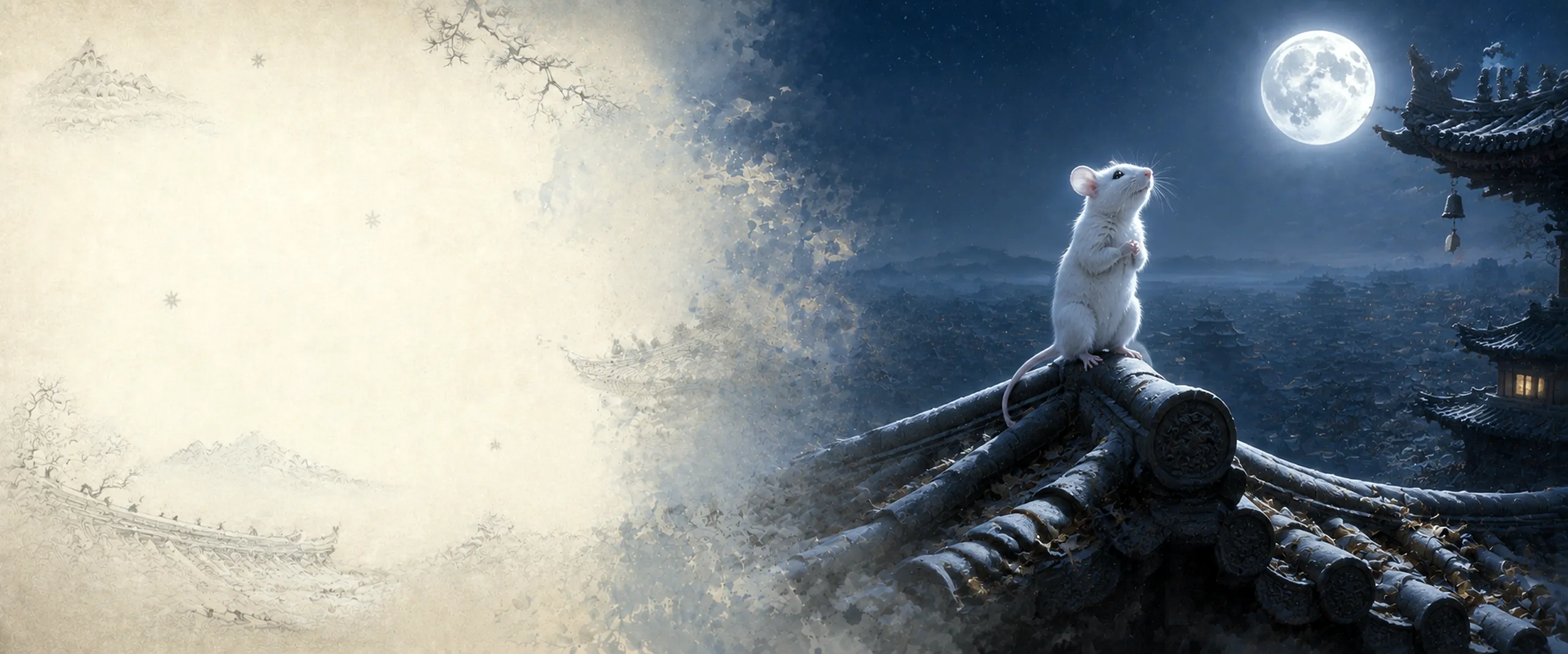
RatPersonality
「 Notice change in the smallest details,<br>and seize the moment before it speaks. 」

Zi Water Is Yang
Zi is the first of the Twelve Earthly Branches and corresponds to Yang Water within the traditional system of the Five Phases (Wuxing, 五行). Water is associated with wisdom, movement, and adaptability. Yang Water is likened to great rivers surging forward—vast, powerful, and difficult to restrain. For this reason, those born under the Rat sign are traditionally said to possess three innate gifts.
Exceptional Insight
Zi Water is clear and penetrating, like the moon reflected in a cold, still pool, able to see through appearances and reach directly toward what lies beneath. Rat people are often thought capable of discerning another person’s true intentions or identifying the central contradiction within a situation in remarkably little time. While others are still puzzled, they may already understand what is happening—this is the celebrated quickness of the Rat.
Extraordinary Adaptability
Water has no fixed form; it takes the shape of whatever contains it. Likewise, Rat people are believed to be remarkably capable of finding their place and discovering a means of survival in almost any environment. Just as rats can survive and reproduce even under extremely difficult conditions, those born under the Rat are traditionally credited with one of the strongest capacities for surviving adversity among the twelve zodiac signs.
A Restless Spirit
Yang Water flows ceaselessly and does not readily remain still. Rat people are therefore described as energetic and mentally active, always planning, calculating, and searching for new opportunities. They may find it difficult to stop completely and simply enjoy the present, because somewhere deep within them there always seems to be a voice urging them to “keep moving forward.”
Hidden Stem: Gui Water
Within the Earthly Branch Zi lies only one hidden Heavenly Stem (藏干)—Gui Water (癸水), which is Yin Water. This hidden stem is traditionally understood to give Rat people another, deeper layer of character.
Gui Water is the water of rain and dew: it nourishes all things without drawing attention to itself. Rat people may appear clever and agile on the surface, yet beneath that exterior lies a sensitive softness. They care deeply about interpersonal relationships and are unusually perceptive of subtle shifts in warmth, distance, and emotional atmosphere.
Gui Water is a source of wisdom: Gui Water is associated with intelligence. Rat people are therefore regarded not merely as clever, but as particularly capable of putting intelligence into practice. Rather than speaking only of ideals, they tend to plan, execute, evaluate, and adjust step by step.
Gui Water is the root of sensitivity: beneath the outer shell of Yang Water lies an inner core of Yin Water. Rat people may appear socially adept and outwardly unconcerned, yet inwardly they can be extremely sensitive, easily prompted into extensive reflection by even slight changes in their surroundings.
Strengths of the Zi Rat
People born under the Rat are renowned above all for their intelligence. The Rat is the smallest animal in the twelve-animal zodiac, yet it stands first among them—a position traditionally attributed to its extraordinary cleverness.
Intelligent and Quick-Witted
Exceptionally fast learners: Rat people possess a natural sensitivity to new things. Whether encountering new knowledge, new skills, or unfamiliar social situations, they are often able to learn quickly and find their footing with remarkable speed.
Extremely quick reactions: in situations requiring rapid decisions, Rat people often make judgments almost immediately. Their minds are likened to high-speed processors, capable of handling multiple streams of information while simultaneously considering several possible outcomes.
A talent for drawing broader conclusions: their strength lies not simply in memory, but in their ability to connect and integrate knowledge. From one detail they can infer a larger pattern; from a small amount of learning they may discover many practical applications.
Socially Skilled
Socially versatile: Rat people know how to present themselves differently in different company. They may be modest and courteous before elders, lively and conversational among peers, and measured yet approachable with subordinates. They have an instinct for finding the social posture best suited to the occasion.
Highly attentive to social cues: Rat people are particularly sensitive to changes in other people’s emotions. When an atmosphere becomes awkward, they may introduce a timely joke; when someone is dispirited, they often know how to offer comfort at precisely the right moment.
Connections are resources: in the Rat’s worldview, friends are not merely sources of emotional companionship but also important resources in life. Rat people tend to cultivate their social networks carefully, maintaining relationships that may become useful when circumstances change.
Industrious and Ambitious
Naturally industrious: among the twelve zodiac signs, Rat people are among those least comfortable with idleness. They enjoy being busy, enjoy feeling productive, and may even thrive under pressure—because to them, pressure often signifies growth.
Careful financial planners: Rat people are traditionally considered naturally sensitive to money. They know how to earn it, but perhaps more importantly, how to preserve it. Many develop a detailed financial philosophy of their own.
Instinctive opportunity seekers: Rat people often discover possibilities where others see nothing unusual. When a new industry or field has only just begun to emerge, they are often among the first to sense its potential and move decisively into it.
Resilient and Tenacious
Rats are among the world’s most adaptable and resilient mammals—a biological characteristic that traditional zodiac culture metaphorically reflects in the personality attributed to Rat people.
They rarely give up easily: small though the Rat may be, it possesses remarkable resilience. No matter how many setbacks they encounter, Rat people are said to possess an unusual ability to rise again from the ruins.
They come alive in adversity: in favorable circumstances, a Rat person may simply appear to be “an intelligent ordinary person.” Under adversity, however, they may reveal astonishing reserves of energy. The traditional idea that “when circumstances become difficult, one seeks change” aptly describes their approach to life.
Weaknesses of the Zi Rat
Timid and Suspicious
The Chinese idiom “timid as a rat” (胆小如鼠) succinctly captures what traditional zodiac culture regards as one of the Rat’s greatest weaknesses.
Excessive caution: Rat people may deliberate too long when making decisions, repeatedly considering what lies ahead and behind. They imagine every possible risk and weigh gains against losses again and again. At times, such caution may cause them to miss the best opportunity.
Deep suspicion: their intelligence makes them unusually quick to detect other people’s hidden motives and calculations. The consequence is that they may find it difficult to trust anyone completely. Even with their closest partner, they may preserve a final defensive line deep within themselves.
A lack of security: Rat people are always inclined to leave themselves another way out. The traditional expression “a cunning hare has three burrows” (狡兔三窟) aptly captures this survival philosophy. Yet an excessive pursuit of security can sometimes make them appear less sincere or less fully committed.
Vanity and Calculating Tendencies
Concern for appearances: Rat people care greatly about how others see them. They long for recognition, praise, and admiration. At times, vanity may push them to attempt things beyond their actual means or capabilities.
Too calculating: careful management is a virtue, but taken too far it becomes excessive concern over minor gains and losses. Rat people may sometimes damage a relationship over a trivial advantage—winning money while losing goodwill.
Jealousy: deep within the Rat personality may lie a concealed tendency toward comparison. When others are doing better, Rat people may offer congratulations outwardly while inwardly feeling a renewed urge to compete.
Impatience for Immediate Results
Preference for short-term rewards: Rat people are adept at seizing immediate opportunities, but may sometimes neglect long-term planning. They can be more inclined toward “making quick money” than toward “building something great.”
Insufficient perseverance: Rat people often begin new undertakings with enthusiasm and momentum, but when they encounter a bottleneck—or discover a more tempting new direction—they may abandon the original path midway and change course.
A limited strategic horizon: the Rat’s intelligence often shines most clearly at the level of tactical execution and detailed maneuvering, while broader strategic vision may be less developed. They can be excellent executors and strategists without necessarily becoming exceptional leaders.
Lack of Steadiness
Rapidly shifting interests: Rat people are intensely curious about new things, but that curiosity can arrive quickly and disappear just as quickly. They may begin several projects at once, only to complete none of them fully.
Difficulty committing to deep cultivation: because Rat people often learn quickly, they may find it difficult to remain within one field for ten or twenty years, patiently refining their craft to its deepest level.
To understand the fundamental character of the Rat, we must first return to the deeper attributes of the Earthly Branch Zi (子).
Wood Rat — Jiazi Years: 1924, 1984
Its Nayin classification is Metal in the Sea, and it is traditionally known as the “Rat on the Rooftop.” Wood Rat people are described as bold and courageous. In their early years they often need to rely largely upon themselves and may encounter considerable hardship, yet significant achievements are expected later in life; theirs is the pattern of late-blooming success.
Core personality traits: independent and self-respecting, unwilling to curry favor with the powerful—the Wood Rat places great importance on personal dignity and public image and is often regarded with respect. Such people understand rules and institutions, uphold traditional principles, and are reluctant to violate their convictions for personal gain. They are socially well regarded and enjoy harmonious family relationships. Their independence and self-respect traditionally produce two consequences: advancement within officialdom may be difficult, yet their relations with ordinary people are strong, their social connections are good, material needs are generally met, and family life is harmonious. Outwardly easygoing yet inwardly principled, they may sometimes appear selfish and at other times accommodating; while adhering to their principles, they can also be highly flexible in pursuing their goals. They seek security and often carry an underlying sense of worry, which is itself one reason they work so hard.
Traditional destiny characteristics: childhood may bring hardship, while food and clothing become sufficient in middle age. Men are said to attract good wives; outwardly they may live at ease while inwardly carrying many concerns, with alternating joys and worries. Support from siblings is limited, family ties may be cool, and much must be accomplished through one’s own efforts. Independence is strong, the personality can be stubborn, and unfinished endeavors are particularly unfavorable. The temperament is complex, with many fluctuations across the course of life.
Fire Rat — Bingzi Years: 1936, 1996
Its Nayin classification is Water in the Ravine, and it is traditionally known as the “Rat in the Field.” Fire Rat people are described as intelligent, quick-witted, capable, and socially adept. They possess abundant energy and the courage to face difficulties and danger.
Core personality traits: energetic and capable of bringing tasks to completion—the Fire Rat possesses abundant vitality and initiative and is often able to carry undertakings through successfully. With sustained effort, unexpected achievements may follow. Kind to friends but strict with themselves, they are warm and friendly toward others while holding themselves to demanding standards; this distinction allows them both to maintain friendships and to continue pushing themselves forward. They place great importance on family bonds, show considerable filial devotion toward their parents, maintain deep ties with siblings, and may willingly labor throughout life for the sake of family. Their speech, however, can be sharp and may offend others. Though usually quiet in temperament, once they begin expressing an opinion they may become eloquent and unstoppable, while showing strong resistance to what others say; this can easily lead to offense. In love, they are persistent and devoted, and may continue giving even when affection is one-sided without blaming the other person.
Traditional destiny characteristics: often intelligent and attractive, astute in dealing with affairs, and naturally investigative in temperament. They are inclined to challenge new undertakings, frequently encounter benefactors, and may receive opportunities for advancement, becoming capable and useful people. They are traditionally said to have no lifelong shortage of food or clothing. For men, ties with parents may be limited, relationships with siblings may be strained, and occupations may change frequently. The spouse is considered favorable, and admiration from attractive women may be plentiful throughout life, producing a destiny characterized by strong emotions and recurring worries.
Earth Rat — Wuzi Years: 1948, 2008
Its Nayin classification is Thunderbolt Fire, and it is traditionally known as the “Rat in the Granary.” Earth Rat people are described as gentle and steady by nature, mild in temperament, and comfortable with allowing life to unfold naturally.
Core personality traits: sincere and modest—they approach work seriously and practically and are often able to obtain assistance and support from others. They generally maintain good interpersonal relationships, do not deliberately create enemies, and cooperate well with others. Their self-respect, however, is strong and can sometimes lead to misunderstanding among those who do not know them well; once others understand their true character, misunderstandings tend to dissolve and harmony can be restored. They are realistic and pragmatic, with a strong sense of family. One weakness is a tendency to judge others by their own standards and ideas. Stability and harmony within the household are especially important to them.
Traditional destiny characteristics: gentle in temperament and inclined to take life as it comes, with adequate material provision throughout life. In developing a career, they are advised to learn extensively from the experience of their predecessors.
Metal Rat — Gengzi Years: 1960, 2020
Its Nayin classification is Earth on the Wall, and it is traditionally known as the “Rat on the Beam.” Metal Rat people are described as possessing a powerful sense of self and a high sensitivity to the outside world, with an innate tendency toward self-interest.
Core personality traits: hardworking but willing to use uncompromising means—they may at times pursue personal goals without excessive concern for method, placing considerable importance on material life and wealth. Quick-tempered and prone to jealousy, they may be impatient, stubborn, proud, ambitious, and inclined to set their sights high. Yet they are also socially skilled and capable of attracting attention, often becoming persuasive speakers or gifted orators who enjoy being the focus of others’ notice. Their ability to save money is comparatively weak: despite valuing material life, they may be more willing than the other four Rat types to spend everything they have at once. If they can learn to control anger and possessiveness appropriately, their potential for future development is regarded as virtually limitless.
Traditional destiny characteristics: intelligent and refined, exceptionally wise, efficient, clear-minded, and broad in manner. Benefactors often appear, and difficulties may frequently turn toward favorable outcomes. Yet their vision may be short-term and their fortunes subject to repeated rises and falls. Traditionally they are not considered especially suited to official careers; greater development may be found in specialized scholarship, technical arts, commerce, or service industries.
Water Rat — Renzi Years: 1912, 1972
Its Nayin classification is Mulberry Wood, and it is traditionally known as the “Rat on the Mountain.” Water Rat people are described as highly perceptive, with a talent for authority, strategy, and calculation.
Core personality traits: exceptionally strategic and adept in the exercise of authority—they possess strong reasoning ability and high intelligence. Early life may be relatively ordinary, while achievement becomes more pronounced in middle age. After this point, they are said to become more serious in their endeavors, alter their approach to life, encounter the assistance of benefactors, develop commercial talent, and potentially accomplish major undertakings. Their thinking can be conservative and inclined toward security. In practical action, they may prefer moving with the current rather than against it; traditionally, this is interpreted as an expression of their careful calculation and exceptional alertness. Their excessive vigilance may incline them toward solitude, however, potentially costing them friendships and ultimately working against their interests. Later life is considered especially favorable. They act according to opportunity; women are traditionally described as prone to excessive talking, with the warning that too many words may lead to mistakes. Happiness comes through remaining content with one’s proper place.
Traditional destiny characteristics: people of the Renzi–Mulberry Wood configuration are described as comparatively independent and subjective, sometimes strongly self-centered and willing to use uncompromising means to reach their goals, which can result in poor interpersonal relationships. Under extreme circumstances, they are cautioned against sudden reversals; careful consideration and the cultivation of calm thinking are advised in all matters. They are also regarded as deeply emotional.
Summary of Personality Differences Among the Five Rat Types
The Five Phases distinctions are expressed primarily in the following areas:
| Dimension | Wood Rat | Fire Rat | Earth Rat | Metal Rat | Water Rat |
| --------------------------- | --------------------------- | -------------------------------- | ---------------------------------------- | ----------------------------------- | ------------------------------------------- |
| Core temperament | Bold and independent | Astute and energetic | Gentle and steady | Strong-willed and self-assertive | Perceptive and strategic |
| Interpersonal relations | Well-liked, image-conscious | Kind to friends, sharp in speech | Sincere and modest, easily misunderstood | Socially skilled, attention-drawing | Highly vigilant, solitary, may lose friends |
| Family orientation | Harmonious family life | Strong devotion to family bonds | Strong sense of family | Values material enjoyment | Stable later life |
| Career pattern | Late-blooming success | Supported by benefactors | Practical and steady | Hardworking but weak at saving | Achievement after middle age |
| Primary weakness | Cool family ties | Sharp speech | Excessive self-respect | Quick temper | Difficult interpersonal relations |
The essence of the Five Phases distinction: the Earthly Branch Zi is Yang Water, the fundamental phase shared by all Rat people—resourceful, intelligent, eager to learn, strategic, reflective, restless, and inclined toward movement and change. The Heavenly Stem then acts like a different pigment added to this underlying field of Water: Jia Wood brings boldness and independence; Bing Fire introduces vitality and persistence; Wu Earth lends warmth and pragmatism; Geng Metal adds sharpness and a stronger sense of self; and Ren Water intensifies strategic intelligence and conservatism. It is precisely this complex structure of Water as the foundation, modified by the Heavenly Stem, that gives the Zi Rat its rich personality—different within similarity, yet similar within difference.
Childhood and Adolescence — Ages 1–20
Children born under the Rat often seem “mature beyond their years.” They may begin speaking early, react quickly, and frequently be among those most eager to raise their hands in class. Their curiosity is intense: they want to ask “why” about everything, and their learning ability often stands out among their peers.
Yet equally noticeable are their little schemes and clever shortcuts. To avoid effort or reduce the amount of homework they must do, they may invent all kinds of ingenious methods. The principal weakness of this stage is insufficient patience and a dislike of repetitive tasks.
Young Adulthood — Ages 20–35
Once they enter society, the Rat’s advantages come fully into play. They are adept at cultivating connections and often become both the social mediator and the information hub within a team. They possess a keen instinct for making money and are willing to experiment with different industries and career paths.
In relationships, they pursue novelty and may fall in love quickly, yet their restless nature can also lead them to change partners frequently. The principal weakness of this stage is restlessness and instability, accompanied by an insufficiently clear sense of long-term direction.
Middle Age — Ages 35–50
By middle age, the Rat’s shrewdness reaches maturity. They learn to manage finances and investments, while their careers gradually enter a more stable period of advancement. Their attachment to family also becomes stronger, and they begin to enjoy the pleasure of creating and maintaining a warm, comfortable home.
Their attitude toward life becomes increasingly pragmatic. They understand careful budgeting and the importance of preparing for future difficulties before they arise. The principal weakness of this stage is excessive caution, which may cause them to miss greater opportunities because they are unwilling to take risks.
Later Life — Age 50 and Above
In later life, Rat people usually slow their pace and begin to enjoy life more fully. Having accumulated a degree of wealth and a broad network of relationships, they are no longer as relentlessly driven as they were in youth.
Their more easygoing qualities gradually come to the surface. They care for their children without excessive interference and often become the archetype of the open-minded elder. They learn the wisdom of the Chinese expression “it is sometimes a blessing not to see everything too clearly” (难得糊涂) and become less inclined to calculate every minor gain and loss.
The wisdom of this stage lies in understanding what to keep and what to let go: many of the things they fought so hard to obtain in youth no longer seem quite so important in later years.
The Rat’s Inner Needs
They need security: all the Rat’s cleverness, calculation, and suspicion ultimately arise from a longing for security. If you can make them feel that “I am safe beside you,” they will gradually lower their defenses and reveal a more sincere side of themselves.
They need recognition: Rat people care deeply about the acknowledgment of others. A single sincere compliment can make them happy for a long time, while ignoring or belittling their efforts may remain in their minds for far longer than expected.
They need space: Rat people dislike being controlled or constrained. In intimate relationships, excessive clinginess or a strong desire to control them may leave them feeling suffocated and cause them to withdraw.
Golden Rules for Getting Along with a Rat
Be sincere: Rat people possess exceptional powers of observation. Pretenses, manipulative tactics, and hidden agendas are difficult to conceal from them. Rather than attempting elaborate strategies, honesty is the better approach.
Offer trust: when you trust them, they are likely to return that trust many times over.
Be gentle with their sensitivity: Rat people are emotionally perceptive and highly sensitive to cold words, subtle changes of tone, and small shifts in attitude. A little more warmth and a little less sharpness can make a considerable difference.
Plan together: Rat people enjoy living with goals and plans. Creating a long-term vision together can make a relationship feel more stable and secure.
Best Zodiac Partners for the Rat
In traditional Chinese zodiac compatibility culture, the Rat and the Ox form a Liuhe (六合), or “Six Harmonies,” pairing, traditionally regarded as the Rat’s most favorable marriage match. The Dragon and Monkey form Sanhe (三合), or “Three Harmonies,” relationships with the Rat and are likewise considered highly compatible. The Horse, Goat, and Rabbit, by contrast, stand in different traditional relationships of clash or harm with the Rat, and greater adjustment is therefore considered necessary.
Although all are Zi Rats, differences in the Heavenly Stem and in Nayin (纳音)—the traditional “corresponding sound” elemental classification used within the sixty stem-branch combinations—are believed to create subtle distinctions in temperament. This is why people born under the same Rat sign may nevertheless differ greatly: some are bold and decisive, some gentle and reserved, and some quick-tempered.
Within the sixty combinations of the traditional sexagenary cycle (Ganzhi, 干支), Rat years occur in five forms, each associated with a different Nayin classification:
| Type | Stem-Branch | Nayin Phase | Years | Traditional Name |
| ------------- | ----------- | ------------------- | ---------- | ------------------- |
| Wood Rat | Jiazi (甲子) | Metal in the Sea | 1924, 1984 | Rat on the Rooftop |
| Fire Rat | Bingzi (丙子) | Water in the Ravine | 1936, 1996 | Rat in the Field |
| Earth Rat | Wuzi (戊子) | Thunderbolt Fire | 1948, 2008 | Rat in the Granary |
| Metal Rat | Gengzi (庚子) | Earth on the Wall | 1960, 2020 | Rat on the Beam |
| Water Rat | Renzi (壬子) | Mulberry Wood | 1912, 1972 | Rat on the Mountain |
Important note: two different elemental frameworks intersect here: the standard Five Phases attribution and the Nayin Five Phases attribution. For example, in a Jiazi year, the Heavenly Stem Jia is Wood, hence the designation “Wood Rat” under the standard Five Phases approach; its Nayin classification, however, is “Metal in the Sea,” and it may therefore also be called a “Metal Rat” in some folk traditions. Different schools of Chinese destiny interpretation place different emphasis on these systems. The following discussion considers both perspectives together.
Readers’ Comments
Calendar and traditional culture enthusiasts from around the world, sharing the same moon.
Sign in or register to join the conversation. Your comment account is created automatically the first time you use a connected account.
No comments yet
Share your thoughts with readers around the world.