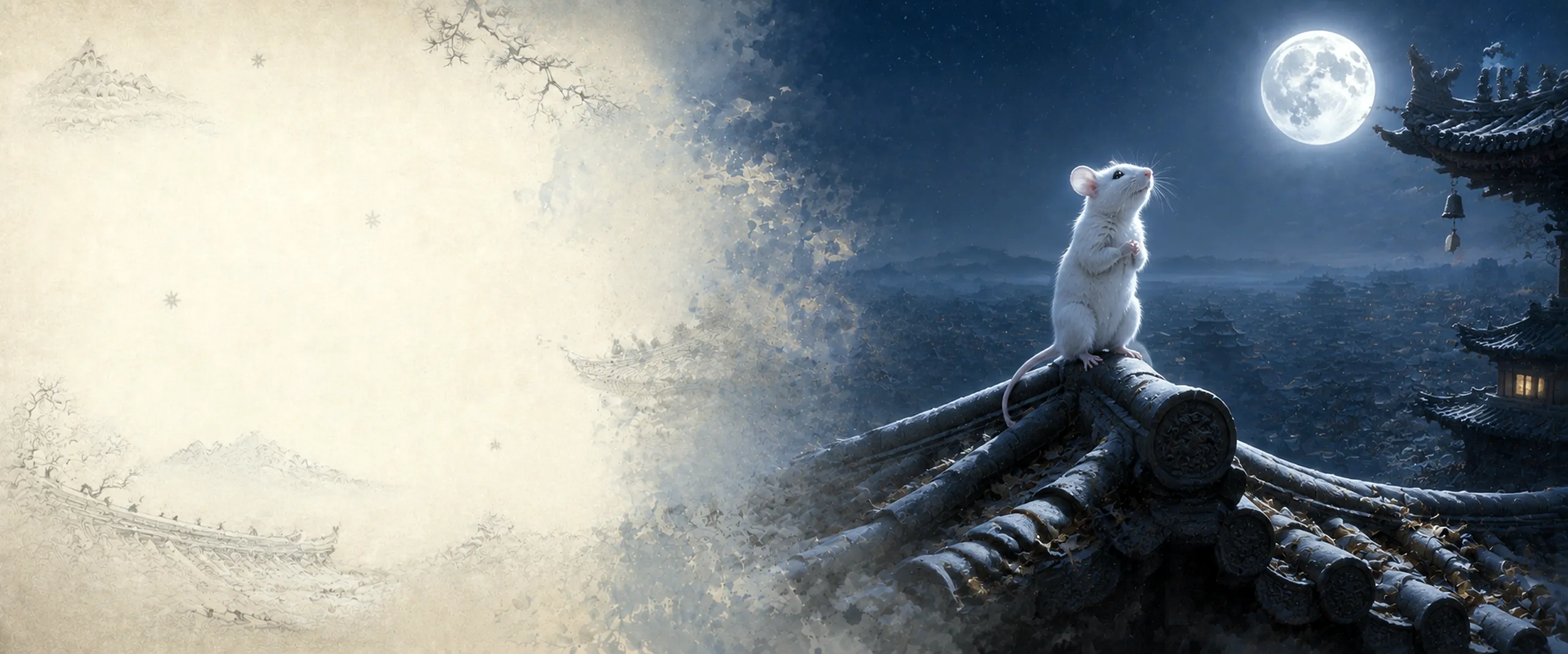
RatFolklore
「 子时鼠得令,民俗蕴乾坤。 」
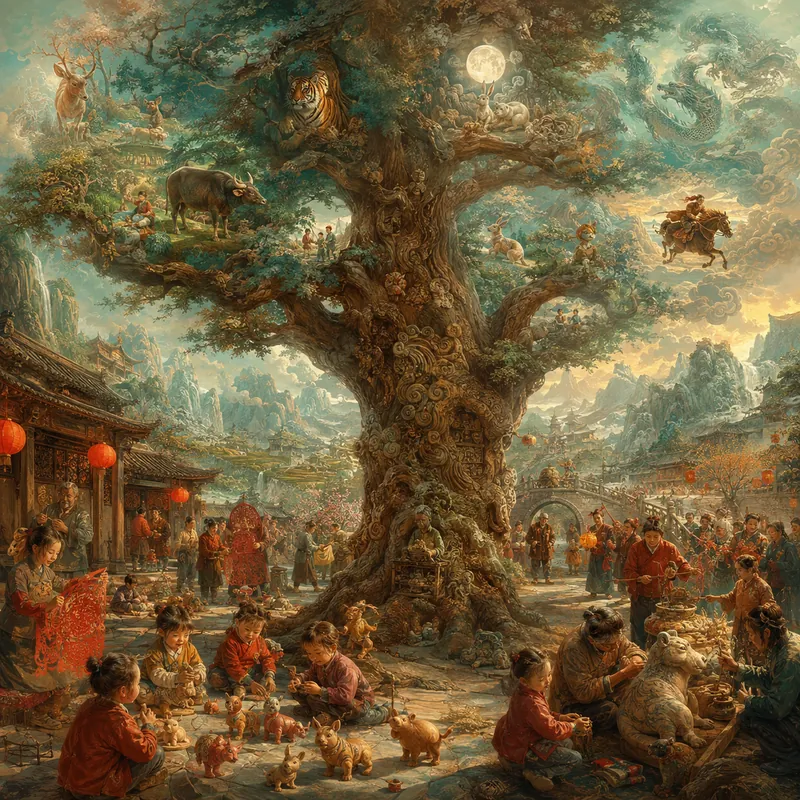
Seasonal Festivals and Observances
Across the entire cycle of Chinese New Year customs, three days are traditionally associated directly with rats. The first lunar month is the period in which Rat-related folk practices are most concentrated, with communities across China developing a remarkable variety of seasonal customs centered on themes such as the Wedding of the Rat’s Daughter, filling the granary, and driving away rats.
The Wedding of the Rat’s Daughter
The “Wedding of the Rat’s Daughter” (老鼠嫁女), also known as the “Rat Wedding” or “Marriage of the Rats,” is the most widespread and influential Rat-related folk custom in China. Rooted in popular legend, the ritual imagines rats holding a wedding and is performed in the hope of securing peace in the coming year and reducing damage caused by rodents. It embodies a complex range of attitudes toward rats—appeasement, reverence, ritual offering, and even a playful fairy-tale imagination.
Different Dates in Different Regions
The precise date of the Rat Wedding varies considerably across China:
Seventh day of the first lunar month: In some regions, this is regarded as the day on which the rat marries off its daughter. Folk painter Yang Xin noted that families would retire early that evening and put away their shoes, lest the bustle of the rat wedding result in shoes mysteriously disappearing.
Tenth day of the first lunar month: Many regions identify this as the Rat Wedding day. In Pingyao County, Shanxi, flatbreads were placed beside walls on this day in what was called “congratulating the rat on the marriage of its daughter.”
Midnight on the fourteenth day of the first lunar month: Some communities regarded this as the time of the Rat Wedding.
Sixteenth day of the first lunar month: In parts of suburban Shanghai, the Rat Wedding was said to occur on this date. Families fried sesame candy in the evening as wedding sweets for the rats.
Seventeenth day of the first lunar month: In Ningyuan, Hunan, the seventeenth was observed as the “Wedding of the Rat’s Daughter.” Chests and cupboards were not to be opened for fear of disturbing the rats. On the previous evening, children placed sweets, peanuts, and other foods in dark corners and struck pot lids, winnowing baskets, and other large household objects to “urge the bride to finish her preparations.” The following morning, rat holes were sealed in the belief that the rodents would thereafter disappear for good. The Yucheng Gazetteer (《虞城志》) likewise records that lamps were extinguished on the night of the seventeenth so that the rats might hold their wedding undisturbed.
Twenty-fifth day of the first lunar month: In many northern regions, Rat Wedding rituals were held on the evening of the twenty-fifth.
Thirtieth day of the twelfth lunar month—New Year’s Eve: In folk traditions of the Jiangnan region south of the lower Yangtze, rats were regarded as harmful and inauspicious creatures and therefore had to be “married off” on New Year’s Eve to ensure peace and good fortune in the coming year. Late at night, some women made offerings at places frequented by rats, lighting incense and candles on the ground, setting out foods that rats were known to steal, and murmuring prayers as though conducting a genuine bridal send-off.
Regional Variations in the Ritual
Northern China: On the evening of the twenty-fifth day of the first lunar month, families kept their lamps extinguished and sat silently together on the heated kang platform. In the darkness they ate flour-based foods shaped like “rat paws” and “scorpion tails,” along with roasted soybeans. Darkness and silence were intended to make things easier for the rats and avoid disturbing the wedding festivities. Eating “rat paws” expressed the hope that the rats’ paws would begin to itch and send them quickly on their way; eating “scorpion tails” was meant to protect the rats from scorpion stings as they emerged from their holes for the wedding. The crisp crackling of roasted soybeans even suggested the sound of firecrackers celebrating the marriage.
Taiwan: In Taiwanese tradition, the third day of the first lunar month is regarded as Xiaonian, a “Little New Year,” and the evening is traditionally said to be the time when rats marry. Folk papercuts depicting the “Rat Wedding” reflect this belief. Lamps are therefore left unlit late at night, rice and salt are scattered on the floor, and people go to bed early so as not to interfere with the rats’ celebration.
Jianghan Plain, Hubei: The evening of Xiaonian is regarded as the day of the Rat Wedding and is popularly known as “Adding to the Rat’s Bridal Chest” (鼠添箱). Families place flower-decorated flour cakes in dark corners. Pounding rice and grinding flour are forbidden, and adults and children alike are expected to remain quiet. Disturbing the rats, it is believed, will cause them to make trouble throughout the coming year.
Cultural Meaning of the Rat Wedding
The Wedding of the Rat’s Daughter has been interpreted as a continuation of ancient forms of totemic belief. Taking the “rat wedding” as its central motif, it represents a distinctively Chinese manifestation of a much broader family of “mouse marriage” tales found around the world. By offering food and symbolically reenacting a wedding, people hoped to reduce damage caused by rats.
The custom thus reflects the agrarian practice of ritually sending away misfortune through courtesy and appeasement, while at the same time embodying hopes for fertility and the continuation of life. The Wedding of the Rat’s Daughter is therefore more than a folk celebration: it carries a profound cultural longing for abundant offspring, flourishing generations, and life without end.
The Filling the Granaries Festival and Worship of the Granary Deity
The twenty-fifth day of the first lunar month is traditionally celebrated as the Filling the Granaries Festival (填仓节), also known as the Heavenly Granary Festival (天仓节). The festival is closely connected with rats.
Origins of the Filling the Granaries Festival
“Filling the granary” means literally to fill one’s storehouses with grain. In ancient agrarian society, it was an important festival of prayer for a plentiful harvest. For ordinary people, few hopes were more fundamental than having enough grain at home and never suffering hunger. The presence of rats in a household could paradoxically suggest that there was surplus grain to attract them. For this reason, rats came to be regarded as manifestations of the Granary Deity, embodying the simple but profound hope for sufficient food, clothing, and material security.
Filling the Granaries Rituals
Folk painter Yang Xin described a custom in which, after nightfall, lamps were lit in the courtyard and food prepared for the rats was placed in the center. The entire family then circled the grain bin several times, beating and striking objects as they went, symbolically calling forth an abundant harvest for the year.
In southern Fujian, the fifteenth day of the first lunar month is observed as a granary-filling festival. Offerings are made to the Grain Deity, while prayers are offered that the rats will leave to marry off their daughters and thus spare the stored grain.
Belief in the Granary Deity
Because rats were frequently found in granaries and fields, they came to be revered as the Granary Deity. In former times, grain merchants in many regions made offerings to this deity, identified with the rat itself. In Beijing and elsewhere, granaries and grain depots maintained tablets dedicated to the Granary Deity, and elaborate sacrificial rites were held during the Filling the Granaries Festival.
The worship of the rat as a granary deity reflects the profound concern for food security and material abundance that lay at the heart of traditional agricultural society.
Steaming Blind Rats
In parts of Qinghai there is a folk custom known as “Steaming Blind Rats” (蒸瞎老鼠).
Every year on the fourteenth day of the first lunar month, families shape dough into twelve rats, deliberately leaving them without eyes, and steam them in baskets. During the Lantern Festival, these dough rats are placed on the offering table, lamps are lit and incense burned, and prayers are made that real rats will eat only grass roots and leave the crops unharmed, thereby ensuring a good harvest. Similar rites are also performed on the first Zi day of the first lunar month.
The symbolism is explicit: leaving the dough rats without eyes expresses the hope that real rats will become “blind” and therefore unable to see the crops. Steaming and eating the dough rats symbolically eliminates the rodent threat and protects the harvest. It is a classic folk practice based on the logic of sympathetic magic.
Rat-Smoking Fires and “Striking the Rat’s Eyes”
Rat-Smoking Fires among the Korean Ethnic Community
On the first Zi day of the first lunar month, Korean communities in China traditionally perform a custom known as “rat-smoking fires.” Farm children scatter straw along the ridges between fields and set it alight, both burning away weeds and driving field mice from the farmland. The practice helps control rodents and insects, while the resulting ash can fertilize the soil. Because Zi corresponds to the Rat, lighting a rat-smoking fire on a Zi day also carries a symbolic significance that offers psychological reassurance.
Striking the Rat’s Eyes
The twenty-fifth day of the first lunar month is regarded as a Rat Day and is popularly known in parts of southern Zhejiang as “Striking the Rat’s Eyes” (打老鼠眼). Families cook black beans and scatter them around the interior of the house, symbolically striking the rats’ eyes. The rite is believed to ward off rodent infestation.
Warming Oneself by the Rat Fire
On the evening of the twelfth day of the first lunar month, another “Rat Day,” some communities observe the custom of warming themselves by a rat fire. Because the fire is made from leaves of the bailing tree, it is also called the “Bailing Fire.” The practice carries the auspicious implication of overcoming calamity and is believed to ward off epidemics and evil influences.
People are encouraged to move about rather than remain at home throughout the day. Children roam from street to street and household to household, warming themselves at the fires of many families—the “fires of a hundred households”—in the hope of avoiding the “hundred illnesses” and remaining free from disaster throughout the year.
Feeding Rats on New Year’s Eve
In traditional households of Jiangnan, an old New Year’s Eve custom called for scattering food for rats. The Qing-dynasty work Jiaoxuan Suilu (《蕉轩随录》) records the practice of placing wine and fruit in an empty room on New Year’s Eve as offerings for rats.
Folk legend held that New Year’s Eve was an auspicious date for rat weddings. Children in many households placed steamed buns decorated with flowers and grasses behind doors and in corners, calling the practice “sending off the bride.” One poem on the Rat Wedding reads:
“On this auspicious day, even rats observe the rites of men; Who could say that, when the bride departs, she has no home?”
The practice of feeding rats on New Year’s Eve was known as “honoring the rats.” Yet genuine reverence was hardly the whole story. Rats caused extensive damage, and people feared that hungry rodents on New Year’s Eve might gnaw through festive foods and clothing, spoiling the auspicious mood when the doors were opened to welcome good fortune on New Year’s Day.
Folk Beliefs
Within Chinese folk belief, the rat possesses multiple divine identities. It is the Deity of Zi, associated with fertility and the continuation of life; the Granary Deity, associated with wealth and stored grain; and, in some regions, a Rat Immortal or Mine Deity.
The rat could therefore be regarded simultaneously as a granary deity or wealth spirit, a fertility deity, and a symbol of theft and disease. It was both a supernatural being worthy of sacrifice and offerings and a pest subjected to curses and ritual expulsion. This duality is perhaps the most distinctive feature of Chinese beliefs surrounding the rat.
Worship of the Deity of Zi
Origins of the Deity of Zi
Because the Rat corresponds to the earthly branch Zi (子) in the Chinese zodiac, the saying “the Rat is the Deity of Zi” arose. The Tang-dynasty writer Liu Zongyuan wrote in one of his fables: “The rat is the deity of Zi, and therefore he cherished rats.”
Chinese folk tradition also preserves the creation myth of “the rat biting open Heaven.” According to this story, the rat gnawed through the primordial enclosure separating Heaven and Earth, allowing qi to circulate and giving rise to yin and yang. It thereby became the deity of Zi that opened the cosmos and enabled the generation of the myriad things.
Fertility and the Blessing of Many Children
Rats reproduce with extraordinary speed. In a society that valued the continuation and flourishing of the family line, this biological fertility naturally gave rise to the worship of the Rat as an emblem of many children and abundant blessings.
Since antiquity, one of the Rat’s principal auspicious meanings has therefore been the flourishing of descendants from generation to generation. In eras when large families were regarded as a blessing, the Zi Rat became an especially powerful symbol of fertility and family prosperity, appearing repeatedly in folk beliefs and visual culture.
Those Born in the Year of the Rat Should Not Keep Cats
The Qingbai Leichao (《清稗类抄》) records:
“There was a man surnamed He in Yancheng who believed that his zodiac sign was the Rat. He therefore kept no cats, and whenever he saw a rat, he forbade others to catch it. In time the rats multiplied greatly, leaping about and coming and going by day without fear of people.”
The account illustrates a long-standing folk taboo against people born in the Year of the Rat keeping cats. Since cats are the natural enemies of rats, keeping one could symbolically mean introducing into the household an animal that “overcomes” one’s own zodiac sign.
Worship of the Granary Deity
The Rat as Granary Deity
For ordinary people in ancient China, one of life’s greatest hopes was simply to have enough grain at home to avoid hunger. Rats in the house could paradoxically indicate that there was surplus grain worth stealing, and they therefore came to be regarded as manifestations of the Granary Deity.
In agricultural society, rats’ habits of burrowing and storing food could even transform a large rat population into a symbolic sign of household abundance.
Worship during the Filling the Granaries Festival
The Yanjing Jiuxuzhi: Suiling Pian (《燕京旧俗志·岁令篇》) states:
“The Lord of the Great Consumption Star is worshipped alongside this deity because, according to tradition, he governs the rats within the granary.”
The passage captures the rat’s contradictory identity in traditional agricultural society: it was simultaneously the destroyer of stored grain and a supernatural guardian associated with the granary. Grain merchants in former times therefore worshipped the Granary Deity during the Filling the Granaries Festival—and that deity was identified with the rat.
Rats and Wealth
Because rats habitually hide and hoard objects, folk imagination transformed this behavior into another divine identity: the rat became the “Deity of Storage” (藏神), symbolizing the gathering and accumulation of wealth.
In older popular belief, rats also represented fertility and abundant descendants. The appearance of a so-called “money rat” in the home could therefore be interpreted as an auspicious sign heralding financial fortune.
The Rat Kingdom of the Western Regions and Rat-Deity Worship
Few places in Chinese historical records appear to have accorded rats greater reverence than the legendary Rat Kingdom of the Western Regions.
The Great Tang Records on the Western Regions
According to Xuanzang’s Great Tang Records on the Western Regions (《大唐西域记》), widespread rat worship existed in the kingdom of Khotan, in what is now the Hotan region of Xinjiang. From the king down to ordinary people, all showed reverence toward the rats. Travelers passing rat burrows were expected to dismount, pay their respects, and present offerings in prayer.
In Khotan, “from the sovereign above to the common people below, all performed sacrifices and rites in order to seek blessings and protection.” People approaching rat holes would dismount and bow before them, presenting offerings to the Rat Deity that included clothing, bows and arrows, flowers, and various delicacies. It was believed that “if no offerings were made, calamity would follow.”
The Rat Deity Painting
The Rat Deity Painting, also known as the Divine Rat Painting, was unearthed from the remains of a temple at Dandan-Uiliq and is now held by the British Museum. It depicts a half-length deity with the head of a rat, wearing a crown and surrounded by an oval halo, seated serenely between two attendants.
The painting provides material evidence for the existence of Rat-deity worship in the Western Regions during the Tang period.
The Legend of the Rat King’s Military Aid
Xuanzang’s Great Tang Records on the Western Regions also preserves a legend in which a Rat King comes to the aid of an army. When the Xiongnu ruler prepared to plunder the kingdom of Qusadanna, its king, unable to devise a defense, burned incense and prayed to the rats of the desert.
That night, the Rat King appeared to him in a dream and instructed him to attack at dawn. The king followed the command and discovered that the rats had gnawed through the straps and cords securing the Xiongnu army’s saddles, uniforms, bows, and other equipment. Unable to fight effectively, the invading army was decisively defeated.
In gratitude for the Rat King’s life-saving assistance, the ruler established a shrine to the rats, and the worship continued for generations.
Miners’ Rat Worship and the “Four Great Families” and “Five Great Gates”
Rat Worship among Northeastern Miners
Coal miners in northeastern China traditionally revered the rat as the “Rat Immortal” (鼠仙). Killing rats was taboo, and miners would share portions of their meals with rats underground.
In the Mentougou mining district west of Beijing, miners respectfully referred to the rat as the “Mine Deity” (窑神) or “Divine Lord Rat” (神鼠爷). Miners were grateful for rats’ sensitivity to dangers such as gas leaks and passed down related beliefs and taboos through generations. In the mining region of Gejiu, Yunnan, there was even a “Rat Temple.”
The “Four Great Families” and “Five Great Gates”
For thousands of years, Chinese folk religion has preserved forms of animal veneration commonly known as the “Four Great Families” and “Five Great Gates.” These beliefs reflect reverence and fear toward animals such as foxes, weasels, hedgehogs, rats, and snakes.
Such creatures were widely believed to possess extraordinary spiritual powers and to convey the will of Heaven or the supernatural world. Once again, the rat occupied a place among them.
Rat Worship among Ethnic Minorities
Rat worship also possesses deep cultural roots among many of China’s ethnic minority communities.
Bai: Legends concerning rat clans tell of the fourth daughter of an ancestral deity marrying a great rat and giving rise to descendants.
De’ang: In ancient belief, the Rat King ruled over animals including cattle, horses, tigers, leopards, and elephants. It was the Rat King who gave grain seeds to humankind, allowing people to begin cultivating crops.
Dai: Myths tell how the ancestors obtained grain seeds from the Rat King.
Tujia: Among Tujia communities in the Enshi region, traditions include the folk tale The Rat Marries Off His Daughter, days devoted to rat worship, taboos concerning cave rats, and beliefs involving rat sorcery. These traditions preserve layers of fertility worship, ancestor worship, avoidance of rats, appeasement of rats, and reverence toward them.
Mongol: Mongolian folk literature also preserves stories explaining how the rat came to occupy the first position among the twelve zodiac animals.
Auspicious Symbolism
Although rats are often disliked in everyday life, Chinese folk culture has endowed them with a surprisingly rich range of auspicious meanings.
Accumulating Wealth and Abundance
Within traditional auspicious symbolism, the Zi Rat, as the zodiac animal presiding over a year, is first and foremost associated with the accumulation of wealth and material abundance.
People traditionally believed that a Year of the Rat might bring favorable conditions and new opportunities, making it an auspicious year for investment and commerce and a time when wealth could more readily be earned and accumulated.
The words shu (鼠, “rat”) and shu (数, “to count”) are homophonous in Chinese, giving rise to stories of “rats counting money.” The Qing scholar Yu Yue recorded in Chaxiangshi Congchao (《茶香室丛钞》) that Guangdong was said to have a kind of rat known as the “money-counting rat.” Its cries resembled the sound of someone counting coins, and hearing such a rat “counting money” was believed to foretell that the household would soon become wealthy.
Many Children and Abundant Blessings
Because of their exceptional reproductive capacity, rats have since antiquity also symbolized flourishing descendants and abundant offspring.
In the late-Qing painter Ren Yu’s Album of the Twelve Zodiac Animals, the painting devoted to the Rat depicts five rats competing for melon seeds inside a jar. Through the combined imagery of the melon, its seeds—zi (子)—and the rats, the painting subtly conveys wishes for many children, abundant blessings, accumulated wealth, and a flourishing household.
In traditional architectural carving and handicrafts, rats—or squirrels used as visual substitutes—were frequently paired with gourds, grapes, pomegranates, and other many-seeded plants to express the same wish for abundant descendants.
Alertness and Intelligence
One of the Rat’s principal symbolic qualities is spiritual alertness, often extended metaphorically to describe a person who is clever, perceptive, and quick-witted.
With their keen sense of smell and agile movements, rats were endowed in popular imagination with an almost mysterious ability to anticipate good and bad fortune. Their vigilance, speed, and ability to arrive before others were celebrated, and the rat came to be regarded as a creature responsive to the subtle workings of the myriad things and to the treasures bestowed by Heaven and Earth.
Reverence for the Zi Rat could therefore symbolize the worship of the sun, the pursuit of light, and admiration for alertness and agility.
Auspicious Expressions for the Year of the Rat
Whenever a Year of the Rat arrives, popular attitudes toward the animal often soften. The familiar hostility of “everyone shouting to beat the rat” gives way to a warmer and more playful tone.
Alongside New Year prints and papercuts with titles such as “Abundance in the Year of the Rat,” “The Fortunate Rat Arrives at the Door,” and “The Clever Rat Welcomes Spring,” expressions such as “Auspicious Rat Welcomes Spring,” “Jade Rat Brings Wealth,” “Fortunate Rat Presents Auspiciousness,” “Golden Rat Offers Good Fortune,” and “Great Fortune in the Year of the Rat” have become popular seasonal greetings.
Chinese wordplay makes especially creative use of the homophone between shu (“rat”) and other similarly pronounced words. A humorous modern saying remarks that whereas people once spoke of the “Five Rats Causing Havoc in the Eastern Capital,” today the five rats no longer cause havoc: instead, “May auspiciousness be yours, may happiness be yours, and may joy be yours.”
Rat-year couplets likewise display this taste for wordplay. One colloquial couplet reads:
“The rooster calls in search of its trough, and the silver trough is full—the Hai Pig brings auspicious blessings; The cat prowls from its hole, and the golden cavern opens wide—the Zi Rat brings peace.”
Because the phrase for “auspicious blessing” echoes the sound of “a full belly,” the image of a well-fed pig naturally becomes a blessing for prosperity in the Year of the Pig.
Folk Art
Rat culture is an important theme in the folk arts associated with Chinese festivals and the New Year. Images of rats appear throughout New Year prints, papercuts, embroidery, peasant painting, textile crafts, shadow puppetry, dough sculpture, and many other traditional forms.
Rat Wedding New Year Prints
New Year prints and papercuts depicting the “Wedding of the Rat’s Daughter” or “Rat Wedding” have traditionally been regarded as auspicious images among Han Chinese communities and pasted on walls and windows during festivals.
Regional Styles of New Year Prints
Rat Wedding prints are found throughout both northern and southern China. In the north, they are especially associated with Shaanxi, Shanxi, Shandong, and Henan; in the south, they are common in Sichuan, Hunan, Fujian, Jiangsu, and other regions.
Mianzhu, Sichuan: The Mianzhu New Year print Wedding of the Rat’s Daughter depicts a lively procession of rats carrying banners and parasols, beating gongs, playing suona horns, and carrying a bridal sedan chair.
Tantou, Hunan: The Tantou print Newly Engraved Complete Edition of the Rat Wedding from Tantou Town in Southern Chu was greatly admired and collected by Lu Xun. In the opening essay, Dogs, Cats, and Rats, of his collection Dawn Blossoms Plucked at Dusk, Lu Xun recalled two prints beside his childhood bed. One depicted Zhu Bajie seeking a bride, which he found less than elegant; the other showed a rat wedding, which he found delightful, with bridegroom, bride, attendants, guests, and servants alike portrayed with pointed cheeks and slender legs, dressed in brilliant red and green.
Cultural Meaning of Rat Wedding Prints
Through Rat Wedding prints, people could indirectly express their desire to send rats out of the household.
Rats were certainly hated, yet their extraordinary reproductive capacity made them impossible to eradicate. Disgust could therefore become fear, fear could become reluctant courtesy, and courtesy could even take the form of flattering titles such as “Granary Deity” or “Granary King.” Beneath this outward respect, however, remained the wish to “marry” the rats away—ideally straight into the mouth of a cat.
This complex and contradictory psychology forms the deepest social foundation of the Rat Wedding print tradition.
Rat Papercuts
Images of rats are ubiquitous in traditional Chinese papercutting. Rural women ingeniously created designs showing a rat biting through a covered bowl or forcing the bowl open from within.
Shaanxi papercuts frequently feature motifs such as Rat Gnawing a Pumpkin and Covered Bowl. These depict rats biting through or lifting a bowl placed upside down over them and rushing outward. The covered bowl symbolizes Heaven and Earth, while the rat within breaks through primordial chaos and emerges into the light.
The Rat Wedding is likewise a major theme in papercutting. The Rat Lantern papercut of Zhongyang, Shanxi, is a representative example. Rats in these works are often exaggerated and anthropomorphized, their humorous forms reflecting the tastes and psychological expectations of ordinary people.
Rat Nursery Rhymes
“Little rat, climbs the lampstand, Steals the oil, but can’t get down.”
This nursery rhyme is widely known throughout China. The rat it portrays is lively and endearing, standing in sharp contrast to the despised animal of everyday life. It reflects popular affection for the rat’s clever and nimble side. A Yuan-dynasty Cizhou-ware lobed water vessel painted with the motif “Rat Stealing Oil” represents a ceramic embodiment of this familiar folk image.
Rat Wedding nursery rhymes: A children’s song from Zhenjiang tells of seeing a rat marrying off its daughter, accompanied by turtles playing flutes, soft-shelled turtles beating drums, shrimps dancing ahead of the procession, and fish arriving to watch the lanterns and escort the bride.
Another Wedding of the Rat’s Daughter rhyme tells of yellow rats and black rats marrying off their daughters, fireflies carrying lanterns, frogs beating drums, and finally a wedding guest whose name is revealed to be the tabby cat.
A Beijing nursery rhyme, The Rat Wedding, similarly imagines a little red child in a red hat, four rats carrying a red sedan chair, a cat holding a lantern, and a yellow dog clearing the way until the procession reaches the Temple of the City God.
The Rat in Zodiac Songs: In the traditional Song of the Twelve Zodiac Animals, the rat appears first:
“The rat leads at the head, Followed by the old yellow ox; The tiger lets out a mighty roar, And the rabbit trembles all over; The dragon swims through Heaven, The snake twists upon the earth; The monkey turns somersaults, And the golden rooster crows upon the hill…”
Rat Poetry and Painting
Poetry about rats: The Jin-dynasty poet Guo Pu composed the Praise of Five Rats (《五鼠赞》), describing five kinds of “rats”—the flying squirrel, ting rat, wu rat, small mouse, and shi rat—each with its own special abilities, advantages, and shortcomings. At the turning of the year, literati likewise composed poems and couplets that added new stories and allusions to the cultural world of the Rat.
Paintings of rats: Before the Yuan dynasty, rats rarely entered the refined pictorial world of either scholar-painters or court artists. Folk art was different. Rat imagery appealed strongly to popular taste and therefore enjoyed a broad social foundation, particularly in New Year prints and papercuts, where exaggerated and anthropomorphic rats appeared repeatedly.
In modern times, Qi Baishi—best known for his paintings of shrimp—also produced numerous works featuring rats. His hanging scroll depicting squirrels and lychees in color is one representative example.
Taboos and Apotropaic Rites
Popular attitudes toward rats have always been complex: reverence exists alongside taboo, and ritual offerings alongside attempts at expulsion.
Avoiding the Omen of a Falling Rat
In old Shanghai, there was a custom associated with avoiding the omen known as “a rat falling into empty space.” When a rat went out searching for food and accidentally fell from a height, the incident was considered an ominous sign. Those who witnessed it were believed to risk illness or even death and therefore had to perform a ritual remedy.
The prescribed method was to beg for white rice from households along the street, creating “rice from a hundred families.” The rice was then cooked and eaten at home to neutralize the misfortune.
The taboo reflects a broader folk fear of accidents and abnormal occurrences. A rat unexpectedly falling was regarded as a disruption of the natural order and therefore as an omen requiring ritual resolution.
Festival for Sending Away Rats
Among the Maonan people of Guizhou, the first day of the twelfth lunar month is observed as a “Festival for Sending Away Rats.” The ritual resembles the symbolic expulsion of a plague deity: sending the rats away is believed to avert misfortune.
The custom reflects both the helplessness caused by rodent damage and the hope that ritual action might remove the threat.
Taboos for People Born in the Year of the Rat
“Clashing with the Rat”: In Chinese folk belief, a calendrical day may be said to “clash with the Rat,” meaning that people born under the Rat sign should avoid undertaking certain important activities on that day. The expression may also indicate an inauspicious influence associated with the northern direction, requiring those born in the Year of the Rat to exercise particular caution.
Zodiac-year taboos: One’s own zodiac year, or benmingnian, has traditionally been regarded as a potentially unfavorable year. A popular saying warns: “In one’s zodiac year, one offends Tai Sui; with Tai Sui overhead, without joy there will be misfortune.” People born in the Year of the Rat therefore observe various customs during their zodiac year. At the same time, traditions such as “the rat biting open Heaven” and the Rat’s association with attracting wealth and blessings introduce a more auspicious dimension, tempering anxiety with confidence.
Taboo against keeping cats: People born under the Rat sign have traditionally been advised not to keep feline animals as pets. The taboo derives from the simple observation that cats are the natural enemies of rats: for a Rat-born person to keep a cat would symbolically mean keeping an animal specifically destined to overcome one’s own zodiac creature.
Zodiac incompatibility: Traditional belief also holds that zodiac animals may stand in relationships of mutual generation or restraint. In some folk interpretations, people born in the Year of the Rat are said to be especially incompatible with those born in the Years of the Ox and Horse.
Apotropaic Practices during One’s Zodiac Year
To help those born under the Rat enjoy favorable fortune during a Rat year, relatives may give them red underwear, red belts, red cords, and other red accessories as the year approaches. These are intended to attract good fortune, repel harmful influences, and avert disaster. In traditional Chinese culture, red symbolizes auspiciousness and vigorous yang energy and is widely believed to possess protective power.
Wearing ornaments depicting zodiac animals considered harmonious with the Rat is another common practice. In some folk systems, the Rat’s compatible zodiac animals are said to include the Monkey, Dragon, and Ox, and ornaments depicting these animals may therefore be worn. Other traditions identify the Pig, Goat, and Ox as particularly auspicious companions for the Rat, with metal pendants in these forms believed to avert misfortune and improve one’s fortunes.
Cross-Cultural Perspectives
As zodiac culture spread beyond China, it absorbed local traditions and acquired new meanings. Rat folklore therefore developed distinct characteristics in different parts of East Asia.
Japan
The Japanese zodiac follows the same order as the Chinese system, with the Rat likewise occupying the first position. In Japanese culture, however, the rat acquired an especially explicit auspicious meaning as a symbol of good fortune, associated with luck, fertility, and abundant descendants.
One source of this symbolism lies in Japanese mythology and the story of Ōkuninushi. A rat is said to have helped Ōkuninushi escape from danger, and the animal consequently came to be regarded as an auspicious spirit capable of rescuing people in times of peril.
Its prolific reproductive capacity also made the rat an emblem of abundant harvests and growing wealth. Japanese zodiac stamps have even depicted an elegant white rat carrying a gold coin in its mouth.
Japan also preserves tales resembling the Chinese “Wedding of the Rat’s Daughter,” although these traditions are not as widespread as their Chinese counterparts.
Korea
The zodiac of the Korean Peninsula is identical in sequence to that of China, with the Rat again occupying the first position.
Korean culture preserves the association between the Rat and Zi, while emphasizing the animal as a symbol of intelligence and quick-wittedness. In Korean folktales, rats are sometimes portrayed as clever creatures that escape danger through ingenuity.
Compared with many modern Chinese associations, Korean folk representations often preserve more of the positive symbolism inherited from traditional agricultural society, particularly the idea that the presence of rats may herald abundance and a good harvest.
Vietnam
The Rat likewise occupies the first position in the Vietnamese zodiac, and its broader folk image closely resembles the Chinese tradition of the Zi Rat.
Vietnamese folklore also contains stories resembling the “Wedding of the Rat’s Daughter,” while seasonal customs display affinities with Rat traditions among Zhuang, Dai, and other communities in Guangxi and Yunnan.
Notably, although the Vietnamese zodiac replaces the Rabbit with the Cat, the Rat’s position at the head of the zodiac has remained unchanged.
Southeast Asia
In Theravada Buddhist countries such as Thailand and Myanmar, zodiac systems differ from the Chinese model. Nevertheless, the cultural legacy of the Rat as the first zodiac animal has continued through overseas Chinese communities.
During the Lunar New Year, Chinese communities in these regions have preserved customs associated with the Rat Wedding, the Filling the Granaries Festival, and related traditions, while simultaneously adapting them to local cultural environments. The result is a distinctive body of overseas Rat folklore shaped by both Chinese inheritance and local influence.
Shared Traditions and Regional Differences
Across much of the East Asian cultural sphere, the Rat retains its position as the first zodiac animal, but its folk meanings vary in emphasis.
China highlights the Rat’s dual divine identities as the Deity of Zi and the Granary Deity, together with the profound contradictions embedded in its cultural image. Japan places greater emphasis on the rat as a symbol of good fortune and wealth. Korea highlights intelligence and alertness. Vietnam largely preserves traditions closely related to Chinese Rat folklore, while Southeast Asian communities display distinctive blends of Chinese and local cultural practices.
These differences vividly demonstrate the vitality and adaptability of zodiac folklore as it moves across cultural boundaries.
Final Reflections
The folk culture of the Zi Rat forms one of the most distinctive chapters in the Chinese zodiac tradition. Human attitudes toward rats have always been complicated: hatred and helplessness coexist with affection, admiration, and even worship. The rat has been regarded not only as a symbol of prosperity, intelligence, fertility, and abundant descendants, but even as the Deity of Zi and the Granary Deity. Its image consequently appears throughout clothing, toys, papercuts, embroidery, and countless other forms of folk art—large or small, realistic or abstract, yet always carrying hopes for happiness, auspiciousness, and a better life.
From the Wedding of the Rat’s Daughter in the first lunar month to the Filling the Granaries Festival on the twenty-fifth day; from Qinghai’s Steaming Blind Rats to Shanghai’s rites for averting the omen of a falling rat; from Rat-deity worship in the Western Regions to northeastern miners’ veneration of the Rat Immortal—Rat folklore extends across almost every major sphere of traditional folk culture: seasonal observances, religious belief, auspicious symbolism, folk art, taboos, and apotropaic ritual.
The rat could be both a deity receiving sacrifices and offerings and a pest subjected to curses and ritual expulsion. This contradictory impulse—to revere the rat and hate it at the same time—is precisely what makes the folk culture of the Zi Rat so compelling.
The roots of this contradiction lie in the complex and intimate relationship between rats and human society. In an agricultural world, the rat was both a destroyer of stored grain and evidence that there was grain worth stealing; it could spread disease, yet its astonishing reproductive capacity made it one of nature’s most powerful symbols of fertility. Unable to eliminate rats completely, people instead transformed the problem through ritual: they “married” the rats away, appeased them, worshipped them, and turned them into gods. Culture thus became a means of negotiating a reality that could not be fully controlled.
Rat folklore is therefore a mirror reflecting the traditional Chinese philosophy of survival in the face of unpredictable natural forces—a philosophy at once resigned and ingenious, fearful and humorous.
As folk painter Yang Xin observed, Chinese people have long invested the twelve zodiac animals with their hopes and aspirations for life in the coming year. Small though the Zi Rat may be, it carries an enduring cultural longing for wisdom, abundance, fertility, and auspicious fortune.
From the creation myth of “the rat biting open Heaven” to contemporary New Year blessings built around playful puns on the word shu, Rat folklore has continually evolved over thousands of years while retaining a remarkable cultural resilience. It reminds us that, viewed through the prism of folk tradition, even the smallest rat can refract the spiritual world of an entire civilization.
----
Readers’ Comments
Calendar and traditional culture enthusiasts from around the world, sharing the same moon.
Sign in or register to join the conversation. Your comment account is created automatically the first time you use a connected account.
No comments yet
Share your thoughts with readers around the world.