DogFolklore
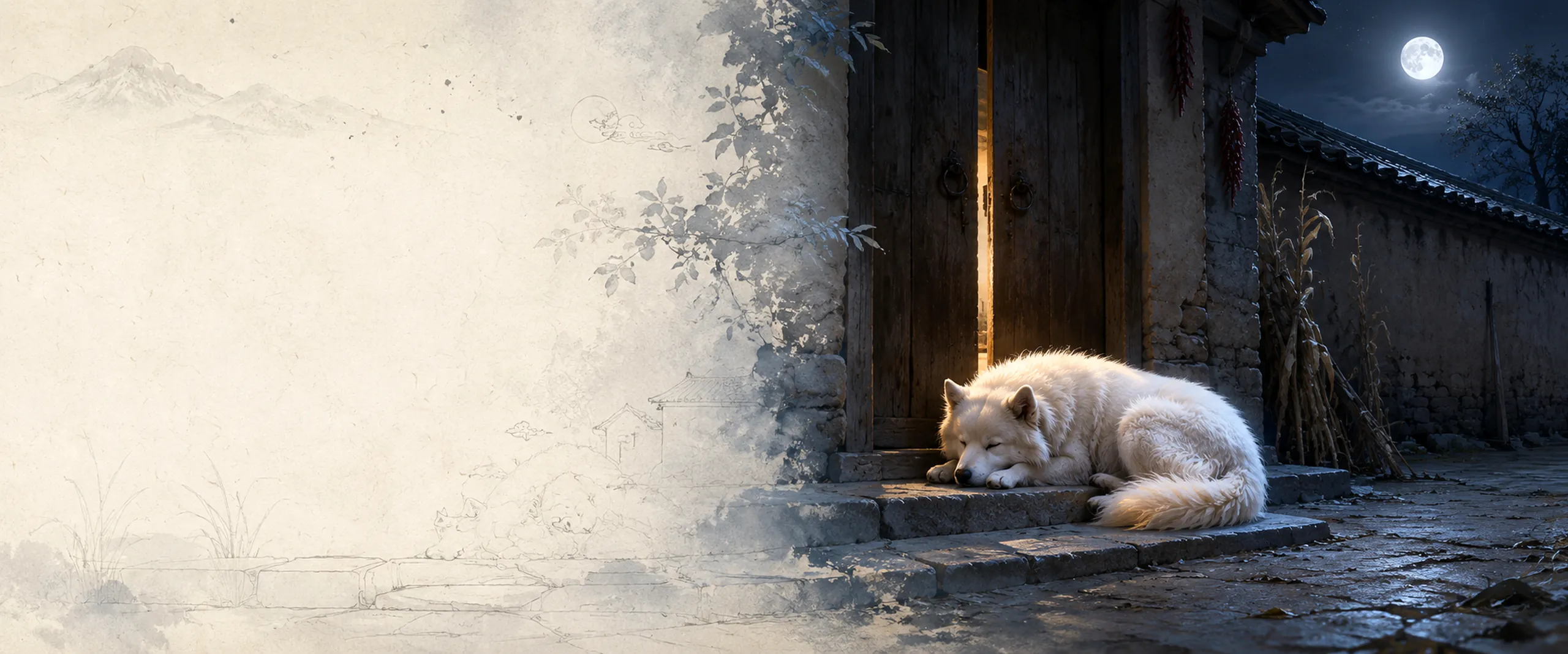
「 戌时犬守夜,忠心护家门。 」
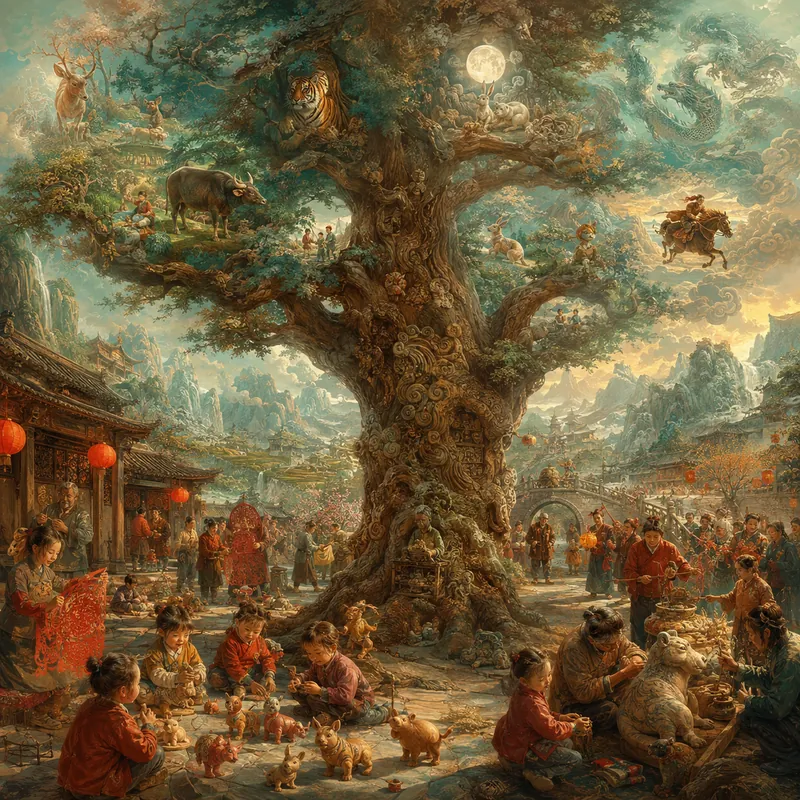
Seasonal Festivals and Observances:
The Dog occupies a distinctive place in the traditional ritual calendar—from Dog Day on the second day of the first lunar month to dog-sacrifice festivals among ethnic minorities, from the Mongolian custom of shooting the straw dog to the Miao Dog-Carrying Festival, Dog-related celebrations span numerous cultural spheres among both the Han people and ethnic minorities.
Second Day of the First Lunar Month · Dog Day
In traditional Chinese folk culture, the first through sixth days of the first lunar month are respectively the days of the Rooster, Dog, Goat, Pig, Ox, and Horse—Nüwa created the six domestic animals in six days and only created human beings on the seventh. According to the Book of Divination (《占书》): “正月一日为鸡,二日为狗,三日为羊,四日为猪,五日为牛,六日为马,七日为人。”
The second day of the first lunar month is “Dog Day” (犬日). On this day, killing dogs is forbidden as a sign of respect. The weather on Dog Day is also used to divine the fortunes of dogs for the coming year—if the second day is clear, it indicates that dogs will be strong and healthy and free from illness or disaster; if the weather is cloudy or rainy, it indicates that dogs may fall ill or encounter misfortune.
Mongolian · Shooting the Straw Dog
The Mongols observe a festival custom known as “shooting the straw dog” (射草狗). This is a traditional Mongolian sacrificial rite in which grass is bound into the shape of a dog and people shoot it with bows and arrows in order to dispel calamities and pray for peace. The custom is closely connected with ancient Mongolian hunting culture and shamanic belief and reflects the Dog’s complex position among nomadic peoples as an animal both revered and put to practical use.
Bouyei · Dog Sacrifice
The Bouyei have a festival custom of “dog sacrifice” (祭狗). They regard the Dog as a benefactor and protective deity of their people, and on certain festival days they hold rites to express gratitude for the Dog’s kindness and pray for the Dog deity’s protection. These ceremonies generally include presenting offerings, burning incense and praying, and performing dog-sacrifice dances.
Miao · Dog-Carrying Festival
The Miao possess the distinctive folk custom known as the “Dog-Carrying Festival” (抬狗节). It originates in an ancient legend according to which a dog once found a life-saving source of water for the Miao ancestors. To thank the Dog for saving their lives, Miao people carry a dog in procession on a designated day, singing and dancing in celebration and gratitude. The Dog-Carrying Festival is a concentrated expression of the Miao tradition of remembering kindness and repaying beneficence.
Qiang · Mountain Sacrifice and the Dog
Among the Qiang, the Dog also plays an important role in major rituals such as the Mountain Sacrifice Festival. The Qiang believe that Dogs can communicate with the divine, and dogs are therefore often used as sacrificial victims or offerings in ritual activities, in prayers that the mountain gods will protect people and livestock and grant abundant harvests.
Xu Hour and Dog Hour
Among the twelve traditional double-hours, Xu hour (戌时) corresponds to 7:00–9:00 p.m. and is also known as “dusk.” By then darkness has deepened; after a full day of work, people prepare to close their doors and rest, while the Dog lies before the entrance and guards the household compound. Zhong Fulan, president of the Shanghai Folk Culture Society and professor at East China Normal University, has noted that the zodiac sequence is sometimes explained through the vivid expression “Xu Dog” (戌狗): Xu hour is precisely the time when dogs keep night watch, which may explain why the Dog ranks eleventh. Ancient people linked the Dog’s night-watch time with Xu hour, and Xu hour consequently also came to be called “Dog Hour” (狗时).
Folk Beliefs:
The Dog occupies an exceptionally exalted place in Chinese folk belief—it is at once an ancestral totem through Panhu, a deity of the winds, and a celestial sacred beast embodied in the myth of the Heavenly Dog devouring the Moon.
The Legend of Panhu
The legend of Panhu (盘瓠) is the most widely circulated and influential Dog-totem myth among China’s ethnic minorities. The interpretation of Panhu worship as a form of canine totemism has become a broad scholarly consensus.
The Birth of Panhu
According to Gan Bao’s Jin-dynasty Soushen Ji (《搜神记》), during the time of Gaoxin—Emperor Ku—an elderly woman in the palace suffered from an ear ailment. When a physician treated her, he removed from her ear something the size of a silkworm cocoon. The old woman placed it inside a gourd vessel (瓠) and covered it with a dish (盘). Before long, the object unexpectedly transformed into a Dog, its body patterned in five colors. Because it had emerged from a gourd and had been covered by a dish, it was named Panhu (盘瓠).
Panhu’s Achievement
At the time, Rongwu was powerful and repeatedly invaded the frontier, and Gaoxin’s forces were unable to defeat it despite repeated campaigns. Gaoxin therefore proclaimed throughout the realm that whoever could obtain the enemy general’s head would receive a thousand pieces of gold, a fief of ten thousand households, and the emperor’s own daughter in marriage. Hearing this, Panhu crossed the great river and entered the Rongwu camp, where he bit off the enemy general’s head in a single attack, carried it back in his mouth, and presented it to Gaoxin.
Panhu Marries the Princess
When Gaoxin saw that Panhu was a Dog, he wished to break his promise. But his daughter told him: “The king has already proclaimed this to all under Heaven. If he now goes back on his word, would that not mean losing the trust of the realm?” Persuaded by his daughter, Gaoxin allowed her to marry Panhu. Panhu carried the princess into the southern mountains, where they had six sons and six daughters. Their children intermarried, multiplied, and became a people. The descendants of Panhu became the ancestors of ethnic groups including today’s Miao, Yao, and She.
Contemporary Survivals of Panhu Worship
The Panhu myth and the rites derived from it—including sacrificing to King Pan, dancing for King Pan, fulfilling vows to King Pan, and the King Pan Festival—form a complete system of Panhu worship. Most branches of the Yao believe that King Pan—the divine Dog—is their ancestor. The She people still believe that their ancestor was a Dog, and the Panhu legend remains extremely widespread among them, familiar to virtually every household, adult and child alike. One important taboo arising from this totemic belief is the prohibition against eating dog meat. The Yao keep Dogs for guarding homes and hunting, allow them to grow old naturally, and prohibit members of the community from killing and eating them.
The Dog as a Wind Deity
Record in Fengsu Tongyi
Ying Shao’s Eastern Han Fengsu Tongyi (《风俗通义》) explicitly records: “戌之神为风伯,故以丙戌日祭于西北。” The Dog was therefore regarded as a deity presiding over the wind.
Evidence from Oracle-Bone Inscriptions and the Shanhai Jing
Oracle-bone inscriptions contain records of killing dogs and sacrificing them to the wind deity in order to stop violent winds. The Shanhai Jing·Beishan Jing describes a sacred beast on Mount Yufa: “状如犬而人面”, and “其行如风,见则天下大风”. The passage describes a divine creature with a human head and canine body. The graph “狱” places the character for speech between two 犬, and this mountain is presented as a stronghold of divine Dogs. The character 飙 was originally written 猋, preserving the special relationship between Dogs and wind.
Killing Dogs to Stop the Wind
The direction associated with Xu is west by northwest, roughly corresponding to the direction from which winter cold waves sweep across the Chinese mainland. Faced with piercing northwestern winds, people hoped they would cease, giving rise to the idea of “killing a Dog to stop the wind.” The Mozi also records that “burning the hide of a black Dog and scattering its ashes causes the wind to rise,” indicating that the ancients believed Dogs could not only stop wind but also summon it.
The Heavenly Dog Devours the Moon
“The Heavenly Dog devours the Moon” (天狗食月) is one of the best-known astronomical myths in Chinese folk tradition.
Origin of the Legend
According to the legend, Hou Yi received an elixir as a reward from the Jade Emperor after shooting down the suns, but his wife Chang’e secretly consumed it and became an immortal, floating toward the Moon. Their black Dog saw what happened, drank the remaining liquid, and grew larger and larger until it swallowed Chang’e and the Moon in a single bite. When the Jade Emperor learned what had happened, he ordered the Dog to spit out Chang’e and the Moon and conferred upon it the title of Heavenly Dog, charging it with guarding the Southern Gate of Heaven.
Protective Customs
Whenever a lunar eclipse occurred, people believed that the Heavenly Dog was swallowing the Moon, and different regions developed corresponding rites to counteract it. A proverb from Ningbo, Zhejiang says: “天狗吃月亮,地下放炮仗”; one from Taizhou, Zhejiang says: “破鼓好救月”; and one from Huaihua, Hunan says: “天狗吃月,脸盆子敲缺”. People believed that making an enormous noise would frighten the Heavenly Dog and cause it to spit the Moon back out. This custom remained widespread in many rural areas into modern times.
The Dog as the “Supremely Yang Domestic Animal”
According to the Liyun tradition, the Dog belongs to the category of “supremely yang domestic animals” (至阳之畜) and can stimulate yang energy, thereby nourishing and fostering all things. The Ming physician Li Shizhen wrote in the Bencao Gangmu that Dogs could ward off all manner of evil spirits and sorcery. For this reason, Chinese people have regarded Dogs as auspicious animals for centuries.
The Stone Dogs of Leizhou
On the Leizhou Peninsula in Guangdong, there exists a distinctive “stone Dog culture”. The worship of the thunder deity among ancient Yue, Li, and Liao peoples gradually merged with Dog-totem worship among Yao and Zhuang peoples, becoming a shared totemic tradition recognized by the ancestral Baiyue populations of Leizhou. Stone Dogs are found throughout towns and villages of the peninsula in a wide variety of forms and constitute a living survival of southern Dog-totem worship.
Auspicious Meanings:
The Dog occupies a central place in Chinese folk culture of auspiciousness. The barking sound “wang-wang” (汪汪) is homophonically associated with “prosperity” (旺) and thus became a symbol of flourishing success; “Dog” (狗) is also homophonically linked with 苟, giving rise in folk speech to playful expressions such as “great fortune in the Dog year” (狗年大吉 / 苟年大吉).
Auspicious Expressions with “Wang”
A Dog barks “wang-wang-wang,” homophonically suggesting “旺旺旺”, or prosperity upon prosperity. For this reason, a common Dog name is “Wangcai” (旺财). It does not simply mean attracting and accumulating wealth, but also carries broader auspicious meanings of prosperity in fortune and success in one’s career. A folk saying goes: “猫来财、狗来富贵”.
Blessings for the Dog year are especially abundant: “旺狗贺岁,欢乐祥瑞”; “旺狗汪汪,事业兴旺”; “旺狗打滚,财源滚滚”; “旺狗高跳,吉星高照”; “旺狗撒欢,如意平安”; “旺狗祈福,阖家幸福”; “金犬玉狗,旺到福到”; “旺旺吠财,狗年福来”; and “狗年旺旺,旺(万)事如意”.
Auspicious Expressions for the Year of the Dog
Every Dog year, the animal is often referred to as the “Golden Dog” (金狗), giving rise to auspicious expressions such as “The Golden Dog celebrates the New Year,” “The Golden Dog brings wealth,” and “The Golden Dog receives blessings.” Other popular blessings include “Great fortune in the Dog year”—playing on 狗 and 苟—“Prosperity in the Dog year,” “Great fortune in a prosperous year,” “The Heavenly Dog guards auspiciousness,” “The Heavenly Dog protects peace,” “Dog fortune reaches the heavens,” and “Dogs close, Dogs beloved.”
When a Dog Comes, Prosperity Follows
There is a folk saying and custom known as “when a Dog comes, prosperity follows” (狗来富). If a Dog suddenly appears at someone’s home, the owner may happily adopt it, regarding its arrival as an omen that wealth is coming. In popular Chinese tradition, a Xu Dog year may be called a “year of flourishing wealth” (旺财年). According to traditional belief, a Dog year is expected to be peaceful and harmonious because Dogs are regarded as guardians of the household and defenders of justice.
Auspicious Symbolism of the Dog
The Dog carries multiple auspicious meanings in Chinese culture: loyalty and dependability—the Dog’s devotion to its master is regarded as an important embodiment of Chinese moral virtues; diligence and vigilance—the Dog keeps watch at night and sounds the alarm with tireless conscientiousness; prosperity and flourishing success—“wang-wang” echoes “旺旺,” suggesting a thriving career; guardianship and peace—the Dog protects the household and can ward off evil and disaster; gratitude and repayment of kindness—the Dog’s loyalty is viewed as a model of remembering and repaying beneficence.
Dog Color and Wealth
The Za Wuxing Shu (《杂五行书》) holds that a Dog’s coloring is closely related to its owner’s fortune: a white Dog with a black head will cause its owner to become wealthy; a black Dog with white ears will make the owner precious and honored; a black Dog with both front feet white will bring flourishing prosperity to the owner’s descendants; and a yellow Dog with a white tail means the owner will never lack food or clothing.
Auspicious Homophony between “Dog” and “Gou”
“Dog” (狗) and 苟 are homophones. Although 苟 carries meanings such as 苟且 and 苟活, folk culture plays on the sound by interpreting “狗年大吉” as “苟年大吉”—expressing the wish that even in difficult circumstances, one should preserve oneself and remain blessed with good fortune.
Folk Art:
The Dog is an enduring subject in Chinese folk art. From New Year prints to paper-cutting, from clay sculpture to embroidery, from ceramics to shadow puppetry, the Dog appears in forms that are both loyal and endearing.
Dogs in New Year Prints
Yangliuqing New Year Print Eight Hundred, a Thousand Autumns: in the Qing-edition Yangliuqing print 《八百千秋》, a plump child smiles sweetly, stroking a pug with the left hand while raising a cypress branch in the right. The image plays on the homophony between “pug” (叭) and “eight” (八), and between “cypress” (柏) and “hundred” (百). Together with peonies, coral, and other symbols of wealth and honor, these elements form the auspicious phrase “Eight Hundred, a Thousand Autumns,” expressing hopes for happiness and longevity.
Zhang Xian Shoots the Heavenly Dog: the story of “Zhang Xian shooting the Heavenly Dog” (张仙射天狗) is widespread in folk New Year prints. Zhang Xian is shown with five long strands of beard, dressed in a yellow riding jacket and standing among a group of playing children. He draws his bow and shoots toward a Heavenly Dog flying through the clouds to steal children. Such paper-horse deity images were often pasted behind household doors to protect young children in the family.
Heavenly Dog Maosha: in Yunnan there circulates a paper-horse deity image called 《天狗毛煞》, archaic and fierce in appearance, presenting the Dog as a menacing spirit. Its origin lies in the folk story of the Heavenly Dog devouring the Moon. In ancient times, whenever a lunar eclipse occurred, people regarded it as an ominous sign and feared the Moon might be eaten by the Heavenly Dog. Villagers therefore spontaneously gathered to beat bowls and basins in support of the Moon and frighten the Dog away.
Dogs in Paper-Cutting
In Yuxian window paper-cuts, Dogs are beautified to such an extent that their coloring departs completely from natural reality, using bright and vivid colors wherever possible to make the animal beautiful and lively. Dogs in folk paper-cutting take many forms: loyal watchdogs, playful pet Dogs, and auspicious Dogs of good fortune. The late Beijing paper-cutting artist Shen Peinong created the work 《福到狗年》, using simple lines and vivid colors to convey the festive atmosphere of the Dog year.
Dogs in Clay Sculpture
Painted Clay Dogs of Fengxiang: the painted clay Dogs of Fengxiang, Shaanxi, are representative works of northern clay sculpture, with simple forms, brilliant colors, and a bright, pleasing style.
Painted Pottery Dogs of Shandong: Shandong’s painted pottery Dogs are likewise fine examples of folk clay sculpture, vivid in form and charmingly naive in expression.
Beijing Painted Clay Pugs: the late Beijing clay sculptor Han Zengqi once created a pair of painted clay pugs, colored in yellow and green, with black eyes rimmed in white. Their expressions are simple, clumsy, and charmingly rustic, perfectly conveying the air of household pets.
Huaiyang Nini Dogs of Henan: the “Nini Dogs” (泥泥狗) of Huaiyang, Henan, possess strong local character. All are painted on a deep black ground and decorated with colorful ornamental patterns. Despite their name, they are not simply Dogs but a range of strange birds and beasts difficult to classify—ancestral Dogs, human-faced Monkeys, double-headed beasts, unicorns, divine frogs, four-legged snakes, nine-headed geese, and more. Each has a whistle and sounds when blown.
Painted Clay Zodiac Dogs of Xunxian: painted clay zodiac Dogs from Xunxian, Henan, are important folk handicrafts sold at the traditional first-lunar-month fair.
Dogs in Peasant Painting
Ansai, Shaanxi · Jade Dog Welcomes Spring: the Shaanxi Ansai peasant painting 《玉犬迎春》, by Gao Jin’ai and Chen Haili, has a simple yet expansive composition and a rustic, lively quality. The Dog’s eyes transform into flying butterflies, while its body is decorated with flowers and plants, integrating Dog, butterfly, and vegetation naturally and ingeniously. The harmonious colors imbue the work with cultural meanings of spring and prosperity.
Shaanxi · Dog of Wealth and Honor: Chen Shanqiao’s Shaanxi peasant painting 《富贵狗》 depicts a richly decorated Dog lifting one foot and looking upward, as though chasing birds in the sky. The image contains numerous auspicious patterns, with strong, forceful colors and sharply articulated strokes that convey both the Dog’s fluffy coat and its agile movement.
Dogs in Shadow Puppetry
The traditional shadow puppet 《天狗》 from Qingyang, Gansu, depicts a strong and agile Heavenly Dog accompanying Erlang Shen, Yang Jian, in battles across the clouds. Its long, graceful form conveys alertness and agility.
Dogs in Ceramics
Artifacts such as the blue-glazed Dog-shaped water dropper of the Qing dynasty and the celadon Dog enclosure of the Western Jin dynasty demonstrate the Dog’s presence in traditional ceramic art. Dog motifs already appeared as decoration on Neolithic pottery.
Dogs in Textile Arts
Cloth Dog products are also an important category of folk handicraft. Small Dogs sewn from fabric are lovable in appearance and serve both as children’s toys and as festival decorations.
Taboos and Protective Rites:
Although the Dog is an auspicious creature, certain taboos and avoidances also exist in folk tradition.
Taboos in One’s Zodiac Year
One’s zodiac year is traditionally regarded as an inauspicious year. A folk saying goes: “本命年犯太岁,太岁当头坐,无喜必有祸。”
Special rules for people born under the Dog during their zodiac year include: avoid wearing Dragon-shaped ornaments—the earthly branch represented by the Dog is Xu Earth, while the Dragon represents Chen Earth, and Xu and Chen are in opposition. People born under the Dog are therefore advised not to wear or display ornaments in the shape of a Dragon; avoid placing the bed in the southeast of the bedroom—the southeast corresponds to Chen among the earthly branches, and Chen clashes with Xu, making this direction unfavorable for Dog-born people; avoid cooperating or forming partnerships with people born under the Dragon or Rooster—the Dog is Xu Earth, which clashes with Chen Dragon and is harmed by You Rooster. In one’s zodiac year, particular attention should therefore be paid to people born under the Dragon; avoid holding joyous celebrations during one’s zodiac year, especially for people born in a Bingxu year.
Zodiac Conflicts
In traditional zodiac marriage culture, people born under the Dog are associated with the following relationships: clashing sign—Chen Dragon (Xu–Chen clash); punishing signs—Chou Ox and Wei Goat (Xu–Chou–Wei three punishments); harming sign—You Rooster (Xu–You harm); breaking sign—Wei Goat (Xu–Wei break). Years in which Dog-born people are said to offend Tai Sui include Dog, Dragon, Ox, Goat, and Rooster years.
“Dog Clash, Inauspicious to the South”
In traditional date-selection culture, on days marked “Dog clash, inauspicious to the south” (冲狗煞南), people born under the Dog are advised not to hold celebratory events. Groundbreaking, construction, moving, trading, encoffining, and burial are also considered unsuitable, and people whose zodiac year is affected by the clash are expected to avoid the day where possible.
Yao Prohibition against Eating Dog Meat
The Yao revere Panhu, the Dragon-Dog totem, and believe the Dog to be a protective being of the clan. One major taboo arising from this totemic worship is the prohibition against eating dog meat. The Yao keep Dogs for guarding homes and hunting, allow them to age naturally, and prohibit killing and eating them within the community.
She Dog-Totem Taboos
The She likewise regard Panhu as their ancestral progenitor, and many still believe their ancestor was a Dog. The She therefore widely observe taboos against beating Dogs or eating dog meat.
Protective Practices for One’s Zodiac Year
To avert misfortune during one’s zodiac year, people born under the Dog may: wear ornaments representing compatible zodiac animals—the Rabbit, Tiger, and Horse are considered compatible with the Dog; wear red clothing—such as red belts, socks, and underwear; avoid traveling southeast—the direction associated with the conflicting Chen Dragon.
Folk Language and Sayings:
The Dog has left an exceptionally rich imprint on Chinese folk language. Unlike the overwhelmingly negative language surrounding the Rat, expressions involving the Dog are mixed in tone—some are laudatory, emphasizing loyalty and righteousness, while others are derogatory, associating the Dog with lowliness and fawning behavior.
The Dog in Idioms
Laudatory expressions, emphasizing loyalty and righteousness: 犬马之劳—to offer one’s service willingly; 犬守夜—to fulfill one’s duty conscientiously; 义犬—a metaphor for a loyal and righteous person.
Derogatory expressions, more numerous: 鸡鸣狗盗—insignificant skills; 狗仗人势—to bully others by relying on one’s master’s power; 狗尾续貂—to append something inferior to something fine; 狗血喷头—to be cursed or scolded severely; 狗急跳墙—to act desperately when cornered; 狼心狗肺—to be cruel-hearted; 猪狗不如—to be morally worse than pigs and Dogs; 狐朋狗友—disreputable companions; 狗眼看人低—to look down on others in a snobbish way; 狗嘴里吐不出象牙—a bad person cannot say anything good.
Neutral expressions: 狗拿耗子—to meddle in matters that are none of one’s business; 狗皮膏药—something deceptive or fraudulent.
Dog Proverbs and Sayings
Many Dog-related sayings circulate in folk speech. “儿不嫌母丑,狗不嫌家贫”—a child does not despise an ugly mother, and a Dog does not despise a poor home, a metaphor for unwavering loyalty. “狗是忠臣,猫是奸臣”—the Dog is the loyal minister, the cat the treacherous one, emphasizing canine loyalty. “狗来富,猫来穷”—a Dog entering the household is an auspicious sign of wealth. “打狗看主人”—when dealing with someone, consider the power behind them. “狗改不了吃屎”—one’s nature is hard to change. “一人得道,鸡犬升天”—when one person gains power, those connected to them rise as well. “嫁鸡随鸡,嫁狗随狗”—traditionally describing a wife following her husband after marriage. “挂羊头卖狗肉”—to advertise one thing and sell another; the name does not match the reality.
Dog Xiehouyu
Dog-related xiehouyu (歇后语) are humorous and lively: “A Dog catches mice—meddling in other people’s business”; “A Dog bites Lü Dongbin—not recognizing a kind heart”; “Ivory cannot come out of a Dog’s mouth—nothing good to say”; “Dog-tail grass—it will not grow long”; “Dog-skin plaster—it cannot be peeled off”; “A desperate Dog jumps over a wall—it has no choice”; “A Dog’s eyes judge people—always looking downward”; “A lapdog climbs into a sedan chair—it does not know how to appreciate favor”; “Throwing a meat bun at a Dog—it goes and never returns.”
Folk Characterizations of People Born under the Dog
In popular zodiac personality culture, people born under the Dog receive characteristic evaluations. Positive traits: loyal and upright, diligent and grounded, highly responsible, trustworthy, and deeply committed to personal bonds. Negative traits: stubborn, excessively serious, and insufficiently flexible. A folk verse says: “戌狗性忠良,一生守四方。忠诚传万代,富贵自名扬。”
The Dog in Children’s Folklore:
In the world of children, the Dog is a loyal and lovable companion, a model watchdog, and one of the most familiar figures in nursery rhymes and games.
Dogs in Nursery Rhymes
The Dog in the Song of the Twelve Zodiac Animals: one nursery rhyme describes the zodiac as follows: “鼠牛虎,钻山洞;兔龙蛇,爬大山;马羊猴,练跨步;鸡狗猪,比跳高。” The Dog ranks eleventh. Another song says: “十是公鸡十一是狗,十二老猪跟着走。” Another goes: “狗 狗 狗,机灵眼睛汪汪吼。一生忠诚听使唤,东西南北随主走。”
“Wang-Wang Dog”: “汪汪狗,汪汪狗,看家护院是能手。见了主人摇尾巴,见了坏人汪汪吼。” The rhyme turns the Dog’s household-guarding behavior into a children’s song, teaching children to recognize the Dog’s loyal nature.
Games Involving Dogs
“Dog Catches the Thief”: a traditional children’s game imitating a Dog guarding the household. One child plays the “thief,” another the “Dog,” and the others play the “owners.” The Dog must protect the owners’ home from being robbed. The game develops vigilance and quick reactions.
“Old Wolf, Old Wolf, What Time Is It?”: although the central figure of this game is the wolf rather than the Dog, the Dog, as the domesticated descendant of the wolf, has a potential cultural connection with the game.
Dog Toys
Nini Dog: the Nini Dogs of Huaiyang, Henan, are among children’s favorite clay toys. They are painted on a deep black ground with colorful decorative patterns, and each contains a whistle that sounds when blown.
Cloth Dogs: small Dog dolls sewn from fabric, lovable in appearance, are among the earliest media through which children become familiar with Dogs.
Clay Dogs: common toys at temple fairs, produced in a wide variety of forms.
The Dog in Literature and Art:
The Dog is an exceptionally important subject in Chinese literature and art. From the Shijing to Tang and Song poetry, from the Soushen Ji to paintings of Dogs across the dynasties, writers and artists have endowed the Dog with rich cultural meanings.
The Dog in the Shijing
The Shijing·Zhaonan·Yeyousijun contains the line “无使尨也吠”—尨 refers to a shaggy Dog. This is one of the earliest canine images in pre-Qin poetry, depicting a hunting scene in the wild in which a hunter is accompanied by a hound.
Dogs in Tang and Song Poetry
Liu Changqing, Seeking Lodging at the Master of Furong Mountain in the Snow: the Tang poet Liu Changqing wrote one of the most famous poetic lines involving a Dog: “日暮苍山远,天寒白屋贫。柴门闻犬吠,风雪夜归人。” On a cold, snowy night, a single bark breaks the silence—it is both proof of the Dog faithfully performing its duty and a warm signal that a traveler is returning home. The poem connects the sound of a Dog barking with the warmth of homecoming and became one of the most moving canine images in the history of Chinese poetry.
Su Shi, Ode to the Dog: the great Song writer Su Shi wrote: “画驯识宾客,夜悍为门户。” In only ten characters, he vividly captures the Dog’s character—gentle by day in recognizing guests, fierce by night in guarding the gate.
Other poetic lines on Dogs: Tao Yuanming’s Returning to Dwell in the Countryside includes the famous line “狗吠深巷中,鸡鸣桑树颠”. In Tao Yuanming’s poetry, the bark of the Dog becomes a symbol of the tranquility and serenity of rural life.
Soushen Ji and Dogs in Tales of the Strange
The Panhu legend: Gan Bao’s Eastern Jin Soushen Ji contains a detailed account of the legend of Panhu. The story is not only an ancestral myth among Chinese ethnic minorities but also one of the most important canine images in the Chinese tradition of tales of the strange.
Stories of righteous Dogs saving their masters: ancient Chinese tales of the strange contain many stories of “righteous Dogs rescuing their masters”. The Dog’s loyalty to its owner was repeatedly celebrated by writers and became an important bearer of Chinese moral virtue.
Dog Paintings across the Dynasties
Dogs in Song painting: “Among animals, the Dog is difficult to paint, yet Song painters were exceptionally skilled at painting Dogs.” Song artists observed Dogs with extraordinary precision, capturing both form and spirit, and the Song dynasty became a high point in the art of painting Dogs in China.
Giuseppe Castiglione’s Ten Fine Hounds: the Italian missionary Giuseppe Castiglione (郎世宁) won the favor of the Qianlong Emperor in part because of his skill in painting Dogs. At court he created 《十骏犬图》, depicting ten celebrated hounds: “苍水虬,” “斑锦彪,” “金翅猃,” “蓦空鹊,” “墨玉璃,” “茹黄豹,” “睒星狼,” “霜花鹞,” “雪爪卢,” and “苍猊犬.” Castiglione blended Chinese and Western painting traditions, rendering each Dog’s physical form and expression with vivid lifelikeness.
Ji Xiaolan’s Praise of the Dog
The Qing scholar Ji Xiaolan highly praised the Dog’s loyalty and righteousness in his Yuewei Caotang Biji: “余谓犬之为物,不烦驱策,而警夜不失职,宁忍寒饿,而恋主不他往,天下为僮仆者,实万万不能及。其足使人愧,正不在能语不能语耳。” This passage is a classic summation of the Dog’s quality of loyalty and one of the central expressions of the spirit of Xu Dog culture.
Dogs in Cultural Relics
From Dog-pattern decorations on Neolithic pottery to canine figures on Han pictorial stones and bricks, from Western Jin celadon Dog enclosures to Qing blue-glazed Dog-shaped water droppers, the Dog’s image runs throughout the history of ancient Chinese material culture. These objects reveal the refined craftsmanship and changing aesthetics of different periods while also carrying the deep cultural meanings of the Dog as a totem of loyalty, guardianship, and auspiciousness.
Final Reflections:
The folk culture of the Xu Dog (戌狗) forms one of the most loyal, dependable, and powerfully protective chapters in Chinese zodiac tradition. People’s attitude toward the Dog combines closeness with reverence: they cherish its loyal and dependable companionship in daily life while also venerating its sacred, numinous power to expel evil. The Dog is not only a descendant of the ancestral progenitor Panhu and the Heavenly Dog, deity of the winds, but also the guardian spirit of the “supremely yang domestic animal” and an auspicious emblem of prosperity in wealth and fortune. From Dog Day on the second day of the first lunar month to dog-sacrifice festivals among various ethnic minorities, from the Mongolian custom of shooting the straw dog to the Miao Dog-Carrying Festival, Dog-related observances span numerous cultural spheres among both the Han people and ethnic minorities.
From the ancestral myth of Panhu founding a people to the astronomical explanation of the Heavenly Dog devouring the Moon, from the folk saying “when a Dog comes, prosperity follows” to the auspicious homophony of “wang-wang brings wealth,” from the blessings of fortune and longevity in the New Year print Eight Hundred, a Thousand Autumns to the childlike simplicity and charm of the Nini Dog, from the poetic atmosphere of “at the brushwood gate, the barking of Dogs is heard” to the consummate brushwork of Castiglione’s Ten Fine Hounds, Dog folklore encompasses almost every sphere of folk culture: seasonal observances, folk belief, auspicious symbolism, folk art, taboos and protective rites, folk language, children’s folklore, literature, and the arts. The Dog is both a sacred being to which people sacrifice and make offerings and a cloth companion held in children’s arms. This sense of closeness—revered like a deity, loved like a companion—is precisely what makes the folk culture of the Xu Dog so compelling.
The roots of this closeness lie in the Dog’s unique dual identity within Chinese culture. In mythology, the Dog is Panhu—the ancestral deity born from an ear ailment, who took an enemy general’s head, married a princess, and became the progenitor of an entire people; it is the wind deity of the Shanhai Jing, “moving like the wind”; and it is the celestial sacred beast of “the Heavenly Dog devouring the Moon.” In folk tradition, the Dog is the messenger of wealth embodied in “when a Dog comes, prosperity follows” and the auspicious sign of “wang-wang brings wealth”; within moral ideals, it is the model of loyalty expressed in “a Dog does not despise a poor home”; and in art, it is an enduring subject through which painters across the centuries have expressed feeling and affection. From Ji Xiaolan’s heartfelt praise—“其足使人愧”—to the folk wisdom of “儿不嫌母丑,狗不嫌家贫”, the cultural image of the Dog has always borne the Chinese nation’s aspirations toward loyalty, trustworthiness, guardianship, and gratitude. Though the Xu Dog stands only eleventh in the zodiac, it bears the Chinese nation’s deepest longing for loyalty, protection, prosperity, and gratitude—coming toward us from beside the campfires of remote antiquity, tail wagging as it keeps watch at the gate, it has left the most loyal and warmest presence within the living pulse of Chinese civilization.
----
[Language: es]
Readers’ Comments
Calendar and traditional culture enthusiasts from around the world, sharing the same moon.
Sign in or register to join the conversation. Your comment account is created automatically the first time you use a connected account.
No comments yet
Share your thoughts with readers around the world.