Minor Cold Farming
「小寒大寒,冻成一团。」
During 小寒 (Xiǎohán, Lesser Cold), most of China enters the coldest period of the year. The traditional “三九” phase of “数九寒天” usually falls during Lesser Cold, bringing deep freezing to northern regions and penetrating damp cold to the south. On the North China Plain, winter wheat remains in deep overwintering under insulating snow cover and all field work ceases. Across the Yangtze River basin, rapeseed and winter wheat remain in deep overwintering; drainage management continues while the pressure of cold and frost protection increases. In South China, winter crops move from vigorous growth toward maturity and harvest, citrus harvesting continues, and cold protection becomes a central concern. In Northeast China, the ground is deeply frozen, agricultural activity remains fully in the traditional “猫冬” period, greenhouse vegetables continue supplying the market, and pastoral areas focus entirely on keeping livestock safely through the winter. In Northwest China, winter wheat remains in deep overwintering and winter orchard management continues. In the temperate Southern Hemisphere, midsummer is underway, and summer crops in southeastern Australia and Argentina enter the flowering-to-grain-filling stage, making field management especially critical. Across the tropical Northern Hemisphere, the dry season continues and management of dry-season crops remains ongoing; in the tropical Southern Hemisphere, the rainy season is fully established and field management of rice and maize expands broadly.
Global Agriculture
Temperate Regions of the Northern Hemisphere
Phenological Signs
Most of China enters the coldest period of the year, and the severe cold of “三九” usually falls during Lesser Cold. Northern regions are deeply frozen beneath thick snow cover, while the south endures penetrating damp cold, frequent frost, and occasional snowfall across the Jiangnan region. Northern Japan remains under severe cold and heavy snow, while South Korea enters its coldest period of the year.
Farming Activities
On the North China Plain, winter wheat remains in deep overwintering. During the severe cold of “三九”, fields are covered by snow, reflected in the saying “小寒大寒,冻成冰团”, and this snow layer helps insulate the soil and protect the crop from freezing. All agricultural field activity stops completely.
Across the Yangtze River basin, rapeseed and winter wheat remain in deep overwintering and growth is largely suspended. Drainage channels need to remain clear, while the pressure of cold and frost protection increases because cold, damp conditions can easily cause root rot and seedling death.
In South China, winter crops move from vigorous growth toward maturity and harvest. Winter potatoes enter the tuber-enlargement stage and require stronger water and nutrient management together with late-blight control. Winter maize advances from grain filling toward maturity and needs an adequate water supply, while winter vegetables reach peak harvest. Citrus harvesting continues, and cold and frost protection becomes a priority through insulating covers and pre-frost irrigation.
Across Northeast China, the ground is deeply frozen and temperatures fall to −25 to −35°C. Agricultural activity remains fully in the “猫冬” period, greenhouse vegetables continue supplying the market, and the severe cold of “三九” creates the most difficult greenhouse-management conditions of the year, demanding stronger insulation and cold protection. In pastoral areas, the same period is the hardest of the year for livestock, making safe overwintering the overriding concern.
In Northwest China, winter wheat remains in deep overwintering, while orchard management continues through winter pruning, orchard sanitation, and trunk whitewashing.
Phenological Signs
Western Europe enters a period of deep-winter cold. Temperatures fall further in France and Germany, snowfall increases, and winter wheat remains in deep overwintering. Ukraine’s chernozem region remains snow-covered under continuing severe cold.
Farming Activities
In France and Germany, winter wheat remains in deep overwintering and agricultural field activity stops completely. Winter wheat in Ukraine’s black-soil region likewise remains in deep overwintering.
Phenological Signs
The winter-wheat belt of Kansas, Nebraska, and neighboring regions enters a period of severe deep-winter cold. Farmland across the U.S. Midwest remains snow-covered, while severe cold continues across Canada.
Farming Activities
Winter wheat across the United States remains in deep overwintering. Winter orchard management continues in California’s Central Valley, while farmland across the Midwest remains in the winter slack period.
Temperate Regions of the Southern Hemisphere
Phenological Signs
Midsummer is underway and temperatures rise to 28–35°C under hot conditions. Harvesting of winter wheat, barley, rapeseed, and other cool-season crops is fully complete. Summer crops enter the flowering-to-grain-filling stage, and the fields remain deep green.
Farming Activities
Summer crops such as maize, sorghum, and sunflower enter flowering and grain filling, requiring strengthened water and nutrient management. Panicle-stage or grain-filling fertilizer, dominated by potassium, is applied where needed, while adequate water supply becomes critical because drought during flowering and grain filling can reduce grain number per ear and lower thousand-grain weight. Maize borers, aphids, leaf-spot diseases, and other pests and diseases enter important control periods. Summer pasture management also continues, with vigorous forage growth requiring stronger grazing management and rotational grazing to prevent overgrazing.
Phenological Signs
Midsummer temperatures rise to 28–35°C, and summer crops enter the flowering-to-grain-filling stage.
Farming Activities
Summer crops enter flowering and grain filling and require stronger water and nutrient management together with pest and disease control.
Tropical and Subtropical Regions
Phenological Signs
The dry season continues under cool and dry conditions. The dry-season agricultural slack period continues across Thailand, Myanmar, Laos, and neighboring regions, while India remains in the dry season. In southernmost China, winter crops advance from vigorous growth toward maturity.
Farming Activities
Dry-season slack and land maintenance continue, while dry-season crops still require irrigation, fertilization, and pest and disease control. In southernmost China, winter crops move from vigorous growth toward maturity and harvest: winter potatoes remain in tuber enlargement and need strengthened water and nutrient management, winter maize advances from grain filling toward maturity, and winter vegetables reach peak harvest.
Phenological Signs
The rainy season is fully underway, with abundant rainfall and high humidity. In central-western Brazil, soybean and maize crops enter key growth stages, while maize in southern Africa moves from stem elongation toward heading.
Farming Activities
Management of rice and other rainy-season crops advances broadly. Rice enters the tillering-to-stem-elongation stage and requires stronger water and nutrient management through tillering fertilizer or jointing-stage topdressing, maintenance of shallow water, and pest and disease control, with rice blast, sheath blight, and rice planthoppers entering important control windows. In Brazil, soybeans enter flowering and pod set and require strengthened water and nutrient management, including flowering-and-pod fertilizer dominated by potassium, together with reliable water supply and control of soybean rust. Brazilian maize advances from stem elongation toward tasseling and requires stronger water and nutrient management through jointing-stage or panicle-stage topdressing, as well as control of maize borers and leaf-spot diseases. In southern Africa, maize likewise enters the stem-elongation-to-heading stage.
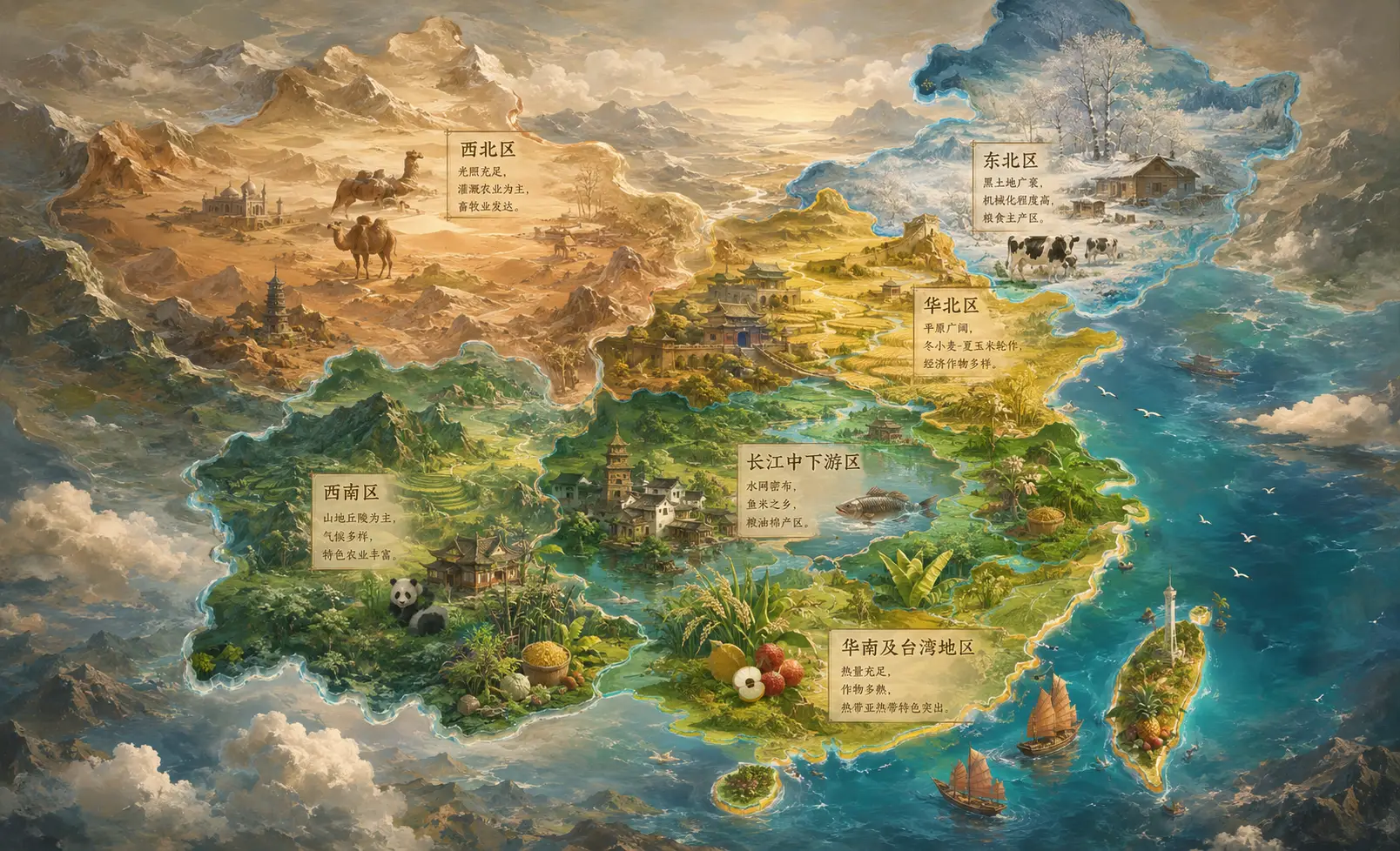
China’s Six Major Agricultural Regions
| Agricultural Region | Major Provinces | Keywords |
|---|---|---|
| Northeast | Heilongjiang, Jilin, Liaoning, eastern Inner Mongolia | “三九” severe cold, greenhouse management, grain storage, livestock overwintering |
| Northwest | Xinjiang, Gansu, Ningxia, western Inner Mongolia, Qinghai | Winter-wheat overwintering, winter pruning, orchard sanitation and trunk whitewashing, farmland improvement |
| North China | Hebei, Shanxi, Beijing, Tianjin, Shandong, northern Henan | Winter-wheat overwintering, “三九” severe cold, winter slack season, input preparation |
| Middle and Lower Yangtze | Hubei, Hunan, Jiangxi, Anhui, Jiangsu, northern Zhejiang, Shanghai | Rapeseed overwintering, winter-wheat overwintering, drainage and waterlogging prevention, cold protection |
| Southwest | Sichuan, Chongqing, Guizhou, Yunnan, southeastern Tibet | Rapeseed overwintering, winter-wheat overwintering, winter-potato management, drainage and waterlogging prevention |
| South China and Taiwan | Guangdong, Guangxi, Hainan, southern Fujian, Taiwan Province | Winter-crop management, citrus harvest, cold protection, tropical fruit |
Heilongjiang, Jilin, Liaoning, eastern Inner Mongolia
During Lesser Cold, Northeast China remains deeply frozen and the severe cold of “三九” arrives in full force. Temperatures fall to −25 to −35°C, with some areas dropping below −40°C. The frozen-soil layer reaches its maximum thickness, exceeding 2 meters in northern Heilongjiang, and snow cover becomes deep. The saying “小寒大寒,冻成冰团” captures this period as one of the coldest of the year.
The severe cold of “三九” brings deep freezing. The harshest phase of “三九” usually occurs during Lesser Cold, as reflected in the saying “一九二九不出手,三九四九冰上走.” Lesser Cold often coincides with the height of this severe cold. Outdoor agricultural activity stops completely, the ground is deeply frozen, and rivers are fully icebound.
Agricultural activity shifts entirely indoors. Farmers continue managing stored grain, regularly checking temperature and humidity, preventing moisture, insects, and rodents, and preparing sales as the Spring Festival approaches, when grain marketing enters a favorable period. Off-season purchasing of seeds, fertilizers, pesticides, agricultural film, and other inputs continues, as does winter servicing of farm machinery. Farmers also determine the next year’s crop structure and cultivar choices according to market conditions, policy direction, and climate trends. Lesser Cold is the coldest period in Northeast China and the time when “猫冬” is at its most complete.
The most difficult period of winter management in pastoral areas. In eastern Inner Mongolia, livestock management enters its hardest stage of the year. The severe cold of “三九” imposes the greatest physical stress on animals and corresponds to the highest mortality risk. Shelter temperatures must therefore be protected by reinforcing sheds, increasing bedding depth, and blocking drafts, with indoor temperatures kept above 5°C. Newborn lambs and weak animals require special warming measures through group separation, additional bedding, and, when necessary, heat lamps.
Supplementary feeding must be carefully calculated, with the proportion of high-energy feeds increased. Maize, sorghum, and other energy-rich feeds should account for more than 60% of the ration, while protein sources such as soybean meal and cottonseed meal should also be increased so that livestock receive enough energy and protein to withstand severe cold. Weak livestock, pregnant females, and young animals need additional feed and higher nutritional support. Blizzards are among the most common extreme-weather threats during Lesser Cold, so farmers must guard against “白灾” by closely monitoring forecasts and storing emergency feed in advance. The quality of winter livestock management directly affects overwintering survival and pastoral income in the following year.
The most difficult period for greenhouse-vegetable management. During Lesser Cold, greenhouse vegetables enter their most demanding management period because the severe cold of “三九” creates the hardest conditions of the year. Insulation must be strengthened through second-layer curtains or thermal covers at night, reinforcement of greenhouse frames against wind and snow, and strict prevention of cold-air intrusion. Night temperatures should remain above 12°C because lower temperatures inhibit crop growth.
During extreme cold, temporary heating equipment such as hot-air furnaces or electric heaters may be needed to keep greenhouse night temperatures above 8–10°C, while heat-loving crops such as tomatoes and cucumbers should remain above 12°C. Because daylight remains very short, growers need to maximize natural light by opening thermal covers promptly, cleaning greenhouse films to improve light transmission, and using artificial supplementary lighting when necessary. Humidity should be reduced through short periods of ventilation around midday when outside temperatures are relatively higher, helping prevent gray mold and other diseases. Low-temperature, high-humidity conditions also favor gray mold and downy mildew, requiring close monitoring and timely control.
Xinjiang, Gansu, Ningxia, western Inner Mongolia, Qinghai
During Lesser Cold, Northwest China remains in a critical winter-management stage. Winter wheat is in deep overwintering, while winter orchard management continues through the severe cold of “三九.”
Winter wheat remains in deep overwintering. During the severe cold of “三九”, wheat fields are covered by snow, as described in “小寒大寒,冻成冰团”, and this snow layer provides insulation against freezing. Winter irrigation is fully complete and the pre-freeze watering has thoroughly recharged the soil. Farmers should inspect fields regularly during this severe-cold period, checking both snow coverage and signs of freezing injury. Where snow cover is insufficient, snow may be redistributed manually or straw applied as insulation.
Winter orchard management continues. Despite the severe cold of “三九”, winter orchard work continues. Winter pruning proceeds through Lesser Cold and Greater Cold, with growers working in the orchards even under harsh conditions; “三九严寒修剪忙” aptly describes this winter rhythm in Northwest China. Orchard sanitation and trunk whitewashing also continue. The severe cold of “三九” is a critical period for fruit-tree frost protection, especially for young trees and late-autumn shoots, which require straw wrapping, plastic-film covering, or soil mounding to prevent freezing injury or death.
Basic farmland improvement is fully complete. All farmland improvement work was finished before Winter Solstice. By Lesser Cold, the land is deeply frozen and construction or improvement work in the fields has stopped completely.
Hebei, Shanxi, Beijing, Tianjin, Shandong, northern Henan
During Lesser Cold, winter wheat remains in deep overwintering across North China and agricultural field activity stops completely under the severe cold of “三九.”
Winter wheat remains in deep overwintering. Wheat fields are covered by snow during “三九”, providing insulation and protection against freezing. Winter irrigation is fully complete and pre-freeze watering has thoroughly recharged the soil. This is the most critical phase of winter-wheat overwintering: fields with adequate snow cover can pass through the severe cold more safely, while fields without snow face a much greater risk of freezing injury. Farmers therefore need to inspect wheat fields regularly throughout “三九” for signs of damage.
Agricultural activity stops completely during “三九.” There is no outdoor field work across North China during Lesser Cold and farmers fully enter the winter slack season. Indoor work nevertheless continues through grain-storage management, with grain sales entering a busy period as the Spring Festival approaches, continued off-season purchasing of agricultural inputs, winter servicing of farm machinery, and preparation of the next year’s planting plans.
Lesser Cold is also part of the seasonal food culture following the dumpling traditions of Winter Solstice and leading into Lesser Cold and Greater Cold. The saying “小寒大寒,冻成冰团” expresses the depth of the cold, while folk custom includes eating warming foods such as mutton and chicken soup.
Winter orchard management continues. Apple, pear, and other orchards continue winter pruning despite the severe cold, laying the groundwork for the following year’s harvest, while orchard sanitation and trunk whitewashing also continue.
Vegetable management. Greenhouse vegetables continue supplying the market, but “三九” is the most difficult management period of the year. Temperatures should be maintained at 25–28°C during the day and 12–15°C at night, with additional insulation covers, strict protection against cold-air intrusion, and temporary heating equipment prepared when necessary.
Hubei, Hunan, Jiangxi, Anhui, Jiangsu, northern Zhejiang, Shanghai
During Lesser Cold, the middle and lower Yangtze remains in a critical winter-management phase. Rapeseed and winter wheat are in deep overwintering, and both drainage management and cold protection become equally important during the severe cold of “三九.”
Rapeseed remains in deep overwintering. Growth stops completely and plants enter deep dormancy. The three-level drainage system of main ditches, cross-field ditches, and perimeter ditches must remain open and functional so that excess water drains efficiently after rainfall. Although precipitation declines during “三九”, cold and damp conditions remain the greatest threat to overwintering rapeseed, so drainage management cannot be relaxed.
Cold protection also becomes critical. During years of extreme low temperatures, straw or plastic-film covering may be used to conserve heat, with particular attention given to cold upland areas and low-lying fields. Weak stands that did not receive pre-winter topdressing around Winter Solstice should be supplemented during Lesser Cold, using mainly organic or compound fertilizer to promote root development and improve cold tolerance. The quality of overwintering management directly affects survival and yield the following year.
Winter wheat remains in deep overwintering. During the severe cold of “三九”, drainage management continues, while cold protection and management of weak stands proceed in parallel.
Drainage and cold protection are equally important. Across the Yangtze basin, cold and damp conditions during “三九” can cause freezing injury and waterlogging injury at the same time, creating greater damage to crops. Farmers therefore need both to maintain effective drainage and to use insulating covers where necessary.
Winter-vegetable management. Winter vegetables remain either in active growth or harvest and require continued water and nutrient management, pest and disease control, and protection through insulating covers before frost.
Sichuan, Chongqing, Guizhou, Yunnan, southeastern Tibet
During Lesser Cold, Southwest China remains in a critical winter-management stage. Rapeseed and winter wheat remain in deep overwintering, while winter-potato management continues through the key tuber-enlargement period.
Rapeseed remains in deep overwintering. Growth largely stops during “三九.” Drainage and waterlogging prevention continue, while cold protection becomes especially important in high-altitude areas where low temperatures represent the main threat to overwintering rapeseed. Weak stands may also receive pre-winter fertilizer.
Winter wheat remains in deep overwintering. During the severe cold of “三九”, drainage management continues while cold protection and management of weak stands proceed in parallel.
Winter potatoes remain in the critical tuber-enlargement stage. Underground tubers continue to develop and enlarge despite the severe cold. Inter-row cultivation and earthing up are carried out together with fertilization to encourage tuber enlargement and prevent tubers from becoming exposed at the soil surface and turning green. Thicker soil cover during “三九” can also help raise soil temperature and protect tubers against freezing.
A tuber-development fertilizer dominated by potassium is applied at a rate of 8–10 kg of potassium sulfate per *mu*. Late blight is less common under the severe cold of “三九”, but fields still require monitoring, with mancozeb or metalaxyl used where needed. Before low temperatures arrive, plastic-film or straw covering should be applied for insulation, since “三九” is the most critical period for protecting winter potatoes against cold.
Guangdong, Guangxi, Hainan, southern Fujian, Taiwan Province
#### (1) Mainland South China
Winter crops move from vigorous growth toward maturity. During Lesser Cold, temperatures in South China remain relatively mild despite the severe cold of “三九”, allowing winter crops to continue normal growth. Winter potatoes advance from tuber enlargement toward maturity and require stronger water and nutrient management, particularly tuber-development fertilizer dominated by potassium, continued late-blight control, and timely harvesting as early cultivars begin to mature.
Winter maize advances from grain filling toward maturity and requires adequate water because drought during grain filling can reduce thousand-grain weight. Maize borers, aphids, leaf-spot diseases, and other pests and diseases still require control, while early cultivars begin to be harvested. Winter vegetables reach peak harvest, with choy sum, Chinese kale, spinach, lettuce, and other leafy vegetables entering the market in large quantities. Winter crops form an important part of South China’s winter agriculture, and Lesser Cold is a critical stage for both yield formation and harvest.
Citrus harvesting continues. “砂糖橘”, “贡柑”, navel oranges, and “沃柑” remain under active harvest. With the Spring Festival approaching, citrus enters a busy marketing season, and farmers take advantage of clear weather to pick, grade, pack, and sell the fruit. Citrus harvesting and marketing are among the most important agricultural activities in South China during Lesser Cold.
Cold and frost protection becomes a priority. Although South China is warmer than the north, the severe cold of “三九” can still bring low temperatures and frost, threatening winter crops and tropical fruit trees. Protective measures include plastic-film or straw covering, which can raise surface temperatures by 2–3°C; pre-frost irrigation to increase soil heat capacity; smoke-frost protection in orchards to raise near-ground temperatures by 2–3°C; and application of anti-freeze agents to fruit trees to strengthen cold resistance.
#### (2) Taiwan
Rice: Rice harvesting is fully complete across Taiwan and fields remain in either the winter slack period or winter-cropping stage.
Vegetables: During Lesser Cold, winter vegetables across Taiwan reach peak harvest.
Fruit trees: Citrus harvesting continues, while banana harvesting approaches completion.
Tea: Winter management continues in tea gardens across central and southern areas such as Nantou and Chiayi, as well as northern producing regions such as Wenshan and Sanxia.
Fisheries: Fishing continues in waters around Taiwan during Lesser Cold. The northeast monsoon remains active and maritime operations require continued attention to safety.
Farmer’s proverbs and folk customs: Taiwanese folk tradition preserves the saying “小寒大寒,無風也寒”, describing how cold the Lesser Cold and Greater Cold period feels even without wind. Another saying, “小寒不寒,清明泥潭”, suggests that if Lesser Cold is not cold, the following Qingming period may be especially rainy. There is also the seasonal food custom “小寒吃羊肉,大寒吃萝卜”, with mutton traditionally eaten during Lesser Cold as a warming food against winter cold.
Global Extreme Weather · Risks & Responses
Temperate Northern Hemisphere: Extreme Cold and Freezing Injury—the Greatest Threat During “三九”
Lesser Cold is the coldest period across much of the temperate Northern Hemisphere, and extreme low temperatures occur frequently during “三九.” Although winter wheat becomes highly cold-tolerant in deep overwintering, temperatures below −20°C can still kill seedlings, especially in fields without snow cover and in late-sown weak stands. Snow remains the best natural protection: for every additional 1 cm of snow depth, surface temperature may rise by approximately 0.5–1°C. Fields without adequate snow cover can be insulated with straw or plastic film before a cold wave arrives.
Protected agriculture requires especially strong cold protection because “三九” is the most difficult greenhouse-management period of the year. Thermal covers, temporary heating equipment, and strict protection against cold-air intrusion are essential. Fruit trees are also highly vulnerable to freezing injury during this period, especially young trees, which may require straw wrapping, trunk whitewashing, and soil mounding. In pastoral areas, livestock mortality risk is at its highest, making reinforced shelters, deeper bedding, increased high-energy feed, and separate care for weak animals especially important. Farmers need to monitor weather forecasts closely and complete full protective preparations before severe cold arrives.
Temperate Northern Hemisphere: Blizzards and Snow Disasters
Heavy snow and blizzards may occur frequently across northern regions during Lesser Cold. Snow can collapse greenhouses and therefore requires prompt removal, create “白灾” in pastoral areas and make emergency feed reserves necessary, and disrupt the transport of agricultural products, requiring storage and marketing arrangements to be made in advance.
Temperate Northern Hemisphere: Cold, Damp Weather—Combined Freezing and Waterlogging Risk in the Yangtze Basin
The middle and lower Yangtze and Southwest China remain under persistent cold, damp conditions during Lesser Cold, and the severe cold of “三九” increases the combined risk of freezing injury and waterlogging. Drainage and cold protection must therefore receive equal attention: the three-level drainage system should remain open so that fields drain quickly after rainfall, while insulating covers should be used where needed. Stored grain also requires continued protection against moisture and mold.
Temperate Southern Hemisphere: Summer Drought and Heat Stress
In early January, at the height of Southern Hemisphere summer, summer crops enter flowering and grain filling and therefore require large amounts of water. Insufficient rainfall may cause summer drought and reduce yield, while prolonged high temperatures can cause heat stress, pollen loss of viability, and lower grain set. Farmers in southeastern Australia and Argentina need to follow forecasts closely, irrigate promptly during drought, and apply foliar fertilizer before extreme heat to strengthen crop stress resistance.
Tropical Regions: Alternating Drought and Flood Risk
Across the tropical Northern Hemisphere—including Southeast Asia and India—the dry season continues and dry-season crops need protection against drought. Across the tropical Southern Hemisphere—including Brazil and Africa—the rainy season is fully underway, requiring protection against flooding caused by heavy rainfall while strengthening field management of rice and maize and guarding against rainy-season diseases and pests such as rice blast, sheath blight, and soybean rust.
----
Readers’ Comments
Calendar and traditional culture enthusiasts from around the world, sharing the same moon.
Sign in or register to join the conversation. Your comment account is created automatically the first time you use a connected account.
No comments yet
Share your thoughts with readers around the world.