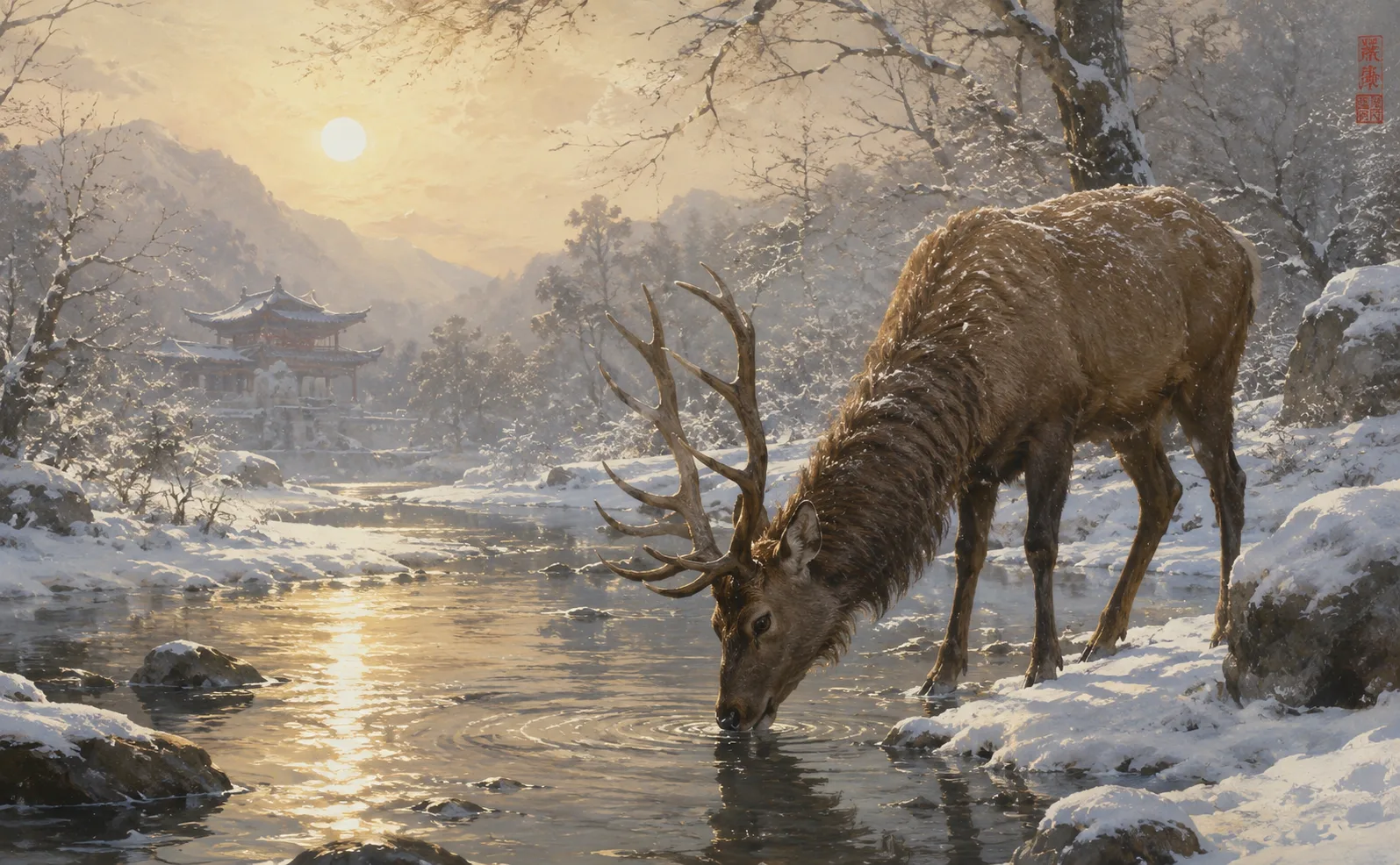
Winter Solstice Customs
「冬至大如年」
The customs of the Winter Solstice revolve around “sacrifice” and “welcoming” — sacrifice means offering the most solemn rites to Heaven, Earth, and the ancestors, giving thanks for the protection of the past year and praying for abundance in the year ahead; welcoming means greeting the first stirring of yang qi with the most reverent heart and welcoming the light that is about to return and grow day by day. The Winter Solstice was one of the earliest of the Twenty-Four Solar Terms to be measured and established, and it was also one of the most important festivals of ancient China, hence the saying “冬至大如年” — the Winter Solstice is as important as the New Year. Its customs can be summarized in seven characters: 祭、贺、数、吃、藏、测、团 — sacrifice, congratulate, count, eat, store, measure, and reunite. “Sacrifice” refers to worshipping Heaven and the ancestors: the Son of Heaven offered sacrifices to the Supreme Deity of Heaven at the Circular Mound in the southern suburbs, while ordinary people honored their forebears in ancestral halls and at family graves. “Congratulate” means celebrating and saluting winter: officials ceased their duties and did not conduct government affairs, resuming work only after an auspicious time had been chosen, while ordinary people changed into new clothes and exchanged formal greetings as they would during the New Year. “Count” refers to counting the Nine Nines to dispel the cold: the Winter Solstice marks the beginning of the “nines,” and people used *Nine-Nines Cold-Dispelling Charts* to record the days, waiting through eighty-one long days for the arrival of spring. “Eat” means eating dumplings and tangyuan: in the north, people say “冬至不端饺子碗,冻掉耳朵没人管” — if you do not hold a bowl of dumplings at the Winter Solstice, no one will care if your ears freeze off; in the south, “家家捣米做汤圆,知是明朝冬至天” — every household pounds rice to make tangyuan, for tomorrow is the Winter Solstice. “Store” refers to forcing flowers and storing ice: in Jiangnan, flowers were encouraged to bloom in warm rooms in preparation for the New Year, while the imperial court stored winter ice in icehouses for summer use. “Measure” refers to measuring the sun’s shadow: ancient people used the gnomon and measuring scale to determine the solar terms, one of their earliest scientific practices. “Reunite” refers to Winter Solstice balls, also called Winter Festival balls: families rolled the balls together and offered them to their ancestors, symbolizing reunion and the addition of another year to one’s age. Among these seven categories, worshipping Heaven and the ancestors focuses on state ritual and family ethics; winter congratulations on social interaction and seasonal celebration; counting the nines on recording time and patiently awaiting spring; dumplings and tangyuan on food, nourishment, and family reunion; forcing flowers and storing ice on the use of natural resources and practical wisdom; and measuring the sun’s shadow on scientific observation and the correspondence between Heaven and humanity. Together they form a complete map of Winter Solstice customs, extending from Heaven and Earth to human society, from ritual to everyday life, and from science to folk tradition.
Regional Customs of This Solar Term
| Region | Signature Customs | Notable Features |
|---|---|---|
| Beijing — Temple of Heaven | Sacrifice to Heaven at the Winter Solstice — Circular Mound ceremony | Ming and Qing emperors personally went to the Temple of Heaven at the Winter Solstice to worship Heaven; it was a “great ceremony of the state” of the highest ritual rank |
| Nationwide | Ancestor worship at the Winter Solstice | Ancestors are commemorated around the Winter Solstice in gratitude for their protection; “冬至大如年” |
| Northern China | Eating dumplings | “冬至不端饺子碗,冻掉耳朵没人管”; traditionally attributed to the physician Zhang Zhongjing |
| Southern China — Jiangsu, Zhejiang, Shanghai, Fujian, Guangdong, etc. | Eating tangyuan / Winter Solstice balls | “家家捣米做汤圆,知是明朝冬至天”; the round shape symbolizes reunion and growing another year older |
| Suzhou | Winter Solstice Eve dinner and winter-brewed wine | In Suzhou, the Winter Solstice is celebrated like the New Year, with osmanthus winter wine and a special evening feast |
| Chaoshan | Ancestor worship and eating Winter Festival balls | The Chaoshan “Winter Festival” includes ancestor worship and sweet glutinous-rice balls symbolizing the addition of another year to one’s age |
| Hangzhou | Forcing flowers / wearing chrysanthemums | Flowers are encouraged to bloom in warm rooms around the Winter Solstice and brought to market in early spring as part of welcoming the New Year |
| Nationwide — especially among scholars and refined gentlemen | Nine-Nines Cold-Dispelling Charts — writing or painting the nines | One stroke is filled in each day for eighty-one days, recording winter sunshine, rain, wind, and snow |
| Nationwide | Counting the nines — Winter Nine-Nines songs | Beginning on the Winter Solstice, nine periods of nine days are counted until eighty-one days have passed and the cold is considered ended |
| Imperial court / Northern China | Storing ice | During the sanjiu cold period after the Winter Solstice, ice was stored in icehouses for use in summer |
| Fujian — Zhangzhou, Quanzhou, etc. | Rolling Winter Festival balls and worshipping ancestors | Families roll red and white glutinous-rice balls, offer them to the ancestors, and then eat them, symbolizing growing another year older |
| Taiwan | Ancestor worship and eating tangyuan | People worship ancestors at the Winter Solstice, eat tangyuan to “add a year”, and share them with neighbors |
| Nationwide | Giving shoes and socks | “冬至赠履袜,迎福践长” — give footwear and socks at the Winter Solstice to welcome good fortune and step into lengthening days; the gift also wishes elders warmth and longevity |
| Nationwide | Painting plum blossoms to dispel the cold | A bare plum branch with eighty-one petals is drawn; one petal is colored each day until spring has deepened |
Winter Solstice Customs
Sacrificing to Heaven at the Winter Solstice
Popular Regions:
Activities:
The Winter Solstice sacrifice to Heaven was the highest-ranking state sacrificial ceremony in ancient China. The ancients believed that “at the Winter Solstice, one yang is born”, making it the turning point at which the yang qi of Heaven and Earth first begins to stir. For this reason, the Supreme Deity of Heaven was worshipped on this day in prayers for peace throughout the realm and favorable winds and rains. Successive dynasties regarded the Winter Solstice sacrifice to Heaven as a “great ceremony of the state,” personally presided over by the Son of Heaven.
The ceremony was exceptionally solemn and elaborate. According to the *Rites of Zhou · Offices of Spring*, the Zhou dynasty already had an institution requiring the “sacrifice to the Supreme Deity of Heaven at the Circular Mound” on the Winter Solstice. During the Ming and Qing dynasties, the emperor personally went to the Temple of Heaven on the Winter Solstice and held the sacrifice at the Circular Mound Altar. The Winter Solstice sacrifice to Heaven ranked above even Spring Festival ancestor worship: the emperor performed the great rite of three kneelings and nine prostrations, presented jade, silk, and sacrificial offerings, while ritual music and dance were performed and civil and military officials accompanied the ceremony. The *Collected Statutes of the Great Ming* records the Winter Solstice rites in detail: the emperor observed purification for three days before the Winter Solstice, then before dawn on the day itself led the officials to the Circular Mound in the southern suburbs and completed the entire ceremony before sunrise. The Qing dynasty continued this institution, and after the Shunzhi Emperor entered the pass, he personally sacrificed at the Temple of Heaven on the Winter Solstice.
In addition to the emperor’s sacrifice to Heaven, local officials also held sacrificial rites on the Winter Solstice. Officials of prefectures, subprefectures, and counties worshipped Heaven and Earth at their local Altars of Soil and Grain. Although these ceremonies were smaller than the great rites of the Temple of Heaven, they likewise expressed reverence for the spirits of Heaven and Earth. The *Qing Jia Lu* records: “郡人最重冬至节。先日,亲朋各以食物相馈遗,提筐担盒,充斥道路,俗呼‘冬至盘’。节前一夕,俗呼‘冬至夜’。是夜,人家更速燕饮,谓之‘节酒’……至日,官府、民间各相庆贺,一如元旦之仪。” The people of the prefecture regarded the Winter Solstice as particularly important. On the preceding day, relatives and friends exchanged food gifts, carrying baskets and boxes until the roads were crowded; these were popularly called “Winter Solstice trays.” The evening before the festival was called “Winter Solstice Eve,” when households invited one another to feasts and drinks known as “festival wine.” On the day itself, officials and ordinary people exchanged congratulations just as they would on New Year’s Day.
Historical Origins:
The tradition of sacrificing to Heaven at the Winter Solstice can be traced to the Zhou dynasty. The Duke of Zhou measured the sun’s shadow in Luoyang and regarded the Winter Solstice as the day when “the sun’s shadow is longest,” therefore establishing it as the beginning of the year and conducting grand sacrifices to Heaven and Earth. The *Records of the Grand Historian · Treatise on the Feng and Shan Sacrifices* records that Emperor Wu of Han accepted the proposal of Gongsun Qing and, in the fifth year of Yuanding, 112 BCE, conducted a suburban Winter Solstice sacrifice at Ganquan Tai Zhi. Thereafter, successive dynasties continued the practice until it became an established institution. Beijing’s Temple of Heaven was first constructed in the eighteenth year of Yongle of the Ming dynasty, 1420, as the dedicated site where Ming and Qing emperors worshipped Heaven. The Hall of Prayer for Good Harvests, originally called the Great Sacrificial Hall, and the Circular Mound Altar were both built for Winter Solstice worship. Throughout the Temple of Heaven complex, the architecture embodies the ideas that “Heaven is round and Earth is square” and that Heaven and humanity correspond to one another: inside the Hall of Prayer for Good Harvests, four inner Dragon-Well Pillars symbolize the four seasons; twelve middle Golden Pillars symbolize the twelve months; twelve outer eave pillars symbolize the twelve double-hours of the day; and the combined twenty-eight pillars symbolize the Twenty-Eight Lunar Mansions. This sacrificial tradition, extending across three thousand years, closely united the Winter Solstice with the worship of Heaven and Earth and became a concentrated expression of the Chinese civilizational ideal of “revering Heaven and following the ancestors.”
How to Take Part:
During the Winter Solstice, visitors can go to Beijing’s Temple of Heaven Park to learn about the culture of sacrificial worship. The Temple of Heaven is the only fully preserved ancient architectural complex dedicated to the worship of Heaven and is open to visitors. Around the Winter Solstice, reconstructed sacrificial performances are occasionally held there; local cultural-event information can be consulted in advance.
Recommended Places:

Eating Winter Solstice Dumplings
Popular Regions:
Activities:
“冬至不端饺子碗,冻掉耳朵没人管。” — if you do not hold a bowl of dumplings at the Winter Solstice, no one will care if your ears freeze off. In northern China, eating dumplings on the Winter Solstice is one of the most deeply rooted traditional customs. On this day, families sit together making dumplings, and once the steaming dumplings emerge from the pot, everyone shares this warm “Winter Solstice meal.” Dumplings resemble human ears, and folk tradition says that eating them can prevent the ears from being frostbitten. Their shape also resembles ancient silver ingots, giving them an additional meaning of abundant wealth. More interestingly, the word *jiaozi* is homophonically associated with “交子”, meaning a moment of transition: Beginning of Winter marks the junction between autumn and winter, while the Winter Solstice is the crucial point when “yin reaches its extreme and yang begins to arise.” Eating dumplings therefore carries the meaning of “old and new succeeding one another, with peace and smooth passage.”
There are many traditions surrounding dumpling fillings. Mutton dumplings are the classic warming choice for resisting the cold; pork and Chinese-cabbage dumplings are homely and comforting; while chive-and-egg dumplings are lighter and refreshing. In Shanxi, northern Shaanxi, and other places, eating “mutton bianshi”, meaning mutton dumplings, on the Winter Solstice is a traditional way to nourish the body in winter. The whole family gathers around the work surface, rolling wrappers, filling and folding dumplings, then lowering them into the pot, where the plump white dumplings tumble in boiling water. This steaming scene is one of the most vivid and warm memories of winter life in northern China.
Historical Origins:
The custom of eating dumplings at the Winter Solstice is traditionally associated with the Eastern Han physician Zhang Zhongjing. According to legend, while serving as an official in Changsha, Zhang saw that the people of Nanyang were suffering from hunger and cold and that many had frostbitten ears. He therefore boiled mutton together with cold-dispelling medicinal ingredients, removed and chopped them, then wrapped the mixture in dough shaped like ears, calling them “jiao’er.” After people ate the jiao’er, their bodies warmed and their injured ears gradually recovered. From then on, people imitated the preparation every Winter Solstice until it became a custom. The name “jiao’er” later evolved into “jiao’er” or “jiaozi.” Although this account may not necessarily be historical fact, it ingeniously connects the custom of eating dumplings at the Winter Solstice with the traditional Chinese medical principle of winter nourishment. By the Tang dynasty, dumplings had already become a common food, and intact examples have been excavated from Tang tombs at Turpan in Xinjiang.
How to Take Part:
On the Winter Solstice, seasonal dumplings can be enjoyed in northern restaurants, or families can knead dough, roll wrappers, prepare fillings, and cook dumplings together at home. Northern dumpling restaurants are particularly busy on this day, so advance reservations or off-peak dining are advisable. Mutton-filled dumplings correspond most closely to the traditional concept of Winter Solstice nourishment.
Recommended Places:
Ancestor Worship at the Winter Solstice
Popular Regions:
Activities:
The Winter Solstice is an important day for ancestor worship among the people. In traditional Chinese society, Winter Solstice ancestor rites held a status equal in importance to ancestor worship during the Spring Festival. Families set up offering tables in ancestral halls at home or before ancestral graves, burn incense and candles, present the three sacrificial animals, burn paper money, and conduct solemn rites of worship. Winter Solstice ancestor worship both commemorates the departed and contains the auspicious meaning that “at the Winter Solstice one yang is born, and descendants inherit the protection of their ancestors.”
Southern China places particular emphasis on Winter Solstice ancestor worship. In Fujian, Guangdong, Zhejiang, and other regions, its solemnity is no less than that of Qingming. Family members return from all directions to their ancestral homes and gather in the ancestral hall, bowing in order of age and seniority before the ancestral tablets. After the rites, the entire clan shares the “remaining offerings” from the sacrifice, a practice called “distributing blessings.” In Shaoxing, Zhejiang, Winter Solstice ancestor worship is called “doing the Winter Solstice,” and rice cakes must be included among the offerings, symbolizing rising higher year after year. In Chaoshan, every household prepares the three sacrificial animals and fruit, first worshipping the ancestors and then holding a family feast; this is called the “Winter Festival.” A saying goes: “冬至大如年,先生不放假,学生不祭祖” — the Winter Solstice is as important as the New Year; if the teacher does not grant a holiday, the students cannot worship their ancestors. In earlier times, private schools therefore also closed on the Winter Solstice so that students could return home for ancestral rites.
Historical Origins:
The custom of Winter Solstice ancestor worship originated in the Zhou dynasty. Because the Zhou treated the Winter Solstice as the beginning of the year, worshipping the ancestors at the year’s beginning was a natural ritual. The *Book of Rites · Royal Regulations* records: “天子诸侯宗庙之祭,春曰礿,夏曰禘,秋曰尝,冬曰烝。” — the ancestral-temple sacrifices of the Son of Heaven and the feudal lords were called *yue* in spring, *di* in summer, *chang* in autumn, and *zheng* in winter. The Winter Solstice sacrifice was the zheng sacrifice, an important element of the four seasonal rites. After the Han dynasty, Winter Solstice ancestor worship expanded from aristocratic families to ordinary people. The Song-dynasty *Dongjing Meng Hua Lu* records that on the Winter Solstice, “京师最重此节……虽至贫者,一年之间,积累假借,至此日更易新衣,备办饮食,享祀先祖” — the capital attached the utmost importance to this festival; even the poorest spent the year saving and borrowing so that on this day they could change into new clothes, prepare food and drink, and make offerings to their ancestors. The custom closely united seasonal time with family ethics and expresses the deep Chinese cultural principle of “honoring the departed and remembering distant ancestors.”
How to Take Part:
During the Winter Solstice, ancestor rites can be observed in traditional villages. Some ancestral halls open to the public allow visitors to watch respectfully from a distance. Winter Solstice worship is especially solemn in Chaoshan, Fujian, Zhejiang, and other southern regions; visitors should check arrangements in advance through local cultural and tourism authorities and respect the dignity of the rites.
Recommended Places:
Forcing Flowers
Popular Regions:
Activities:
Jiangnan has long had the Winter Solstice custom of forcing flowers. This means moving flowering plants with unopened buds into warm rooms or underground chambers around the Winter Solstice so that they bloom ahead of season during the severe cold of late winter and early spring, to welcome the New Year, enjoy as ornamentals, or sell at market. The flowers most commonly forced include plum blossoms, peonies, crabapple blossoms, and narcissus. By the twelfth lunar month, various forced flowers appear in the flower markets, adding a touch of spring to the stillness of winter.
The techniques of Hangzhou and Suzhou were especially refined. The Qing work *Wu Jun Suihua Jili* records: “冬至日,花农以纸糊之,置花木于室中,以炉火温之,令其先时开放,谓之‘催花’。” — on the Winter Solstice, flower growers enclosed the plants with paper, placed them indoors, and warmed them with stove fire so that they would bloom ahead of their natural season, a practice called “forcing flowers.” By the Qing dynasty, this had become an important folk economic activity in Suzhou, Hangzhou, and surrounding regions. Flower growers around Tiger Hill in Suzhou and Xixi in Hangzhou passed down forcing techniques through generations. Bringing flowers into warm storage at the Winter Solstice and opening the market in early spring formed an important annual production cycle for Jiangnan flower growers. The custom not only satisfied the refined winter pleasure of flower-viewing among scholars but also brought vitality to the winter market.
Historical Origins:
Flower-forcing techniques were already highly developed by the Song dynasty. The *Dongjing Meng Hua Lu* records “forcing flowers in winter months” at flower markets in Bianjing under the Northern Song. In Southern Song Hangzhou, the custom became even more widespread around the Winter Solstice. During the Ming and Qing periods, the technique passed from the imperial court into popular society, and growers in Suzhou and Hangzhou accumulated extensive experience. Flower forcing uses the principle of plant vernalization, controlling temperature and light to cultivate flowers out of season during winter. It represents Chinese ingenuity in applying natural laws and transforming the environment. The flower chambers of Beijing’s Forbidden City were also famous. The Qing court had a tradition of forcing flowers around the Winter Solstice to welcome the New Year, and many of the plum blossoms and narcissus displayed in the palace were raised in these chambers. The custom reflects the Jiangnan wisdom and aesthetic sensibility of creating the feeling of spring in the depths of winter.
How to Take Part:
Around the Winter Solstice, flower markets in Suzhou, Hangzhou, and other Jiangnan cities offer opportunities to learn about forcing techniques and purchase out-of-season flowers such as wintersweet, narcissus, and peonies for the home. Narcissus can also be cultivated in water at home by placing the bulbs in a shallow dish, adding water, and keeping them somewhere warm; after several weeks, one can enjoy one of winter’s earliest touches of spring.
Recommended Places:
Eating Tangyuan
Popular Regions:
Activities:
In southern China, eating tangyuan, also known as Winter Solstice balls or Winter Festival balls, is a custom transmitted for a thousand years. Tangyuan are made with glutinous-rice flour wrappers filled with sweet fillings such as red-bean paste, sesame, and peanuts, or savory fillings such as fresh pork. They are rolled into round balls and boiled in water. Their smooth, rounded shape symbolizes reunion and completeness, making them an indispensable food when families gather on the Winter Solstice.
The preparation of Winter Solstice balls is particularly elaborate in Jiangsu, Zhejiang, and Shanghai. The Qing-dynasty *Qing Jia Lu* by Gu Lu records: “比户以粉圆祀先,或以馈赠。” — household after household used flour balls to worship their ancestors or presented them as gifts. The tangyuan eaten by Suzhou families on Winter Solstice Eve are called “Winter Solstice balls,” made with glutinous-rice flour wrappers and fillings such as red-bean paste, sesame, fresh pork, or shredded radish. There is a saying: “冬至团子年节糕” — Winter Solstice balls for the Winter Solstice, New Year cakes for the New Year. In Zhangzhou, Quanzhou, and other parts of Fujian, every household rolls red and white “Winter Festival balls” on the Winter Solstice, creating a particularly attractive contrast. In Taiwan, the Winter Solstice is called the “Winter Festival,” and people believe that eating Winter Solstice tangyuan means “adding another year” to one’s age, hence the saying “冬至圆仔呷落加一岁.” In Chaoshan, Guangdong, eating sweet balls, meaning sweet tangyuan, is a fixed seasonal custom: glutinous-rice flour is rolled into balls, boiled, and served with sugar, symbolizing a life filled with sweetness.
In Jiangnan, there is a folk saying that “after eating Winter Solstice tangyuan, you have grown another year older.” Reunion and the addition of another year to one’s age are the central cultural meanings of Winter Solstice tangyuan. The whole family sits together rolling, boiling, and eating the round balls, welcoming the first stirring of yang qi through this ritual of completeness and using the warmth of food to dispel the chill of the long night.
Historical Origins:
The custom of eating tangyuan at the Winter Solstice can be traced back at least to the Song dynasty. The Southern Song *Wulin Jiushi* records that people of Lin’an ate “milk-sugar balls” on the Winter Solstice, showing that round dumpling-like foods were already associated with the festival. During the Ming and Qing periods, the custom became even more widespread throughout southern China. The Qing-dynasty *Qing Jia Lu* gives detailed records of the preparation and consumption of Suzhou Winter Solstice balls. Tangyuan are made from glutinous rice, which is warm in nature and nourishes the center and qi, making it suitable for winter and reflecting the dietary wisdom of “not eating foods out of season.” The saying that “eating Winter Solstice tangyuan makes you a year older” ingeniously connects food customs with the turning of the seasonal year.
How to Take Part:
On the Winter Solstice, freshly rolled or ready-made tangyuan can be purchased at markets throughout southern China and cooked at home. Families can also make them together: mix glutinous-rice flour with water into a dough, roll it into balls, fill them with red-bean paste, sesame, or other fillings, and boil until cooked. Long-established restaurants in Jiangsu, Zhejiang, and Shanghai often offer special Winter Solstice balls during the festival period.
Recommended Places:
Counting the Nines to Dispel the Cold
Popular Regions:
Activities:
Counting the nines, also called the “Winter Nine-Nines,” is a traditional Chinese way of calculating the progression of the cold season and anticipating the arrival of spring. Beginning when the Winter Solstice “enters the nines,” every nine days are counted as one “nine.” After all nine nines have passed — a total of eighty-one days — spring is expected to arrive. Counting the nines may be regarded as one of ancient China’s longest games of time: through strokes written one by one and petals colored one by one, people transformed the hardest days of winter into a period filled with anticipation.
There are three principal methods of counting the nines:
Writing the nines — During the Daoguang reign of the Qing dynasty, the imperial phrase “亭前垂柳珍重待春风” consisted of nine characters, each containing nine strokes, for a total of eighty-one. Beginning on the Winter Solstice, one stroke was traced in red each day. Completing one character meant that one “nine” had passed; once all nine characters and all nine nines were completed, spring had arrived. The characters were not merely marks of time but also a leisurely spiritual companion through winter. Folk society also used auspicious nine-stroke phrases such as “春前庭柏,风送香盈室”, as well as more direct versions like “原是活财神来到咱家.”
Painting the nines — The Ming work *Dijing Jingwu Lüe* records: “冬至日,画素梅一枝,为瓣八十有一,日染一瓣,瓣尽而九九出,则春深矣,曰‘九九消寒图’。” On the Winter Solstice, a bare plum branch was drawn with eighty-one petals; one petal was colored each day, and when every petal had been filled and the nine nines had passed, spring was deep. This was called the “Nine-Nines Cold-Dispelling Chart.” The Yuan poet Yang Yunfu wrote: “试数窗间九九图,余寒消尽暖回初。梅花点遍无余白,看到今朝是杏株。”
Filling the nines — The Qing work *Qingbai Leichao* records a more detailed method of recording the weather: “宣宗御制词,有‘亭前垂柳珍重待春风’二句,句各九言,言各九画,其后双钩之,装潢成幅,曰《九九销寒图》。题‘管城春色’四字于其端。南书房翰林日以阴晴风雪注之,自冬至始,日填一画,凡八十一日而毕事。” Emperor Xuanzong composed the phrase “亭前垂柳珍重待春风,” with nine characters of nine strokes each; the outlines were double-traced and mounted as a hanging work called the *Nine-Nines Cold-Dispelling Chart*, with the four characters “管城春色” written at the top. Academicians of the Southern Study recorded cloud, sunshine, wind, and snow upon it each day, beginning at the Winter Solstice and completing one stroke daily until all eighty-one days were finished. Folk society also had a simpler weather-recording rhyme: “上阴下晴雪当中,左风右雨要分清;九九八十一全点尽,春回大地草青青。”
Historical Origins:
The custom of counting the nines originated very early and may be traced back to the Northern and Southern Dynasties. According to tradition, Zong Lin’s *Jingchu Suishiji* of the Southern Liang already recorded “俗用冬至日数及九九八十一日,为寒尽” — customarily, people count from the Winter Solstice through nine nines, eighty-one days in all, after which the cold is considered ended — though this account remains uncertain. Among the sources presently visible, the earliest clear reference to counting the nines is the Tang poet Xue Neng’s line: “九九已从南至尽,芊芊初傍北篱新。” The Qing *Imperially Commissioned Complete Collection of Ancient and Modern Books* cited Xue Neng’s poem as evidence of the custom. During the Song dynasty, counting the nines gradually became widespread among the people, and by the Ming and Qing it had become a recognized method of marking time both officially and popularly. By observing how phenological changes corresponded to the successive nines, the ancients compiled the Nine-Nines Song, which has survived to the present.
Counting the nines arose from people’s longing for spring. In ancient times, when heating conditions were limited, the long winter was particularly difficult to endure, and counting the passing days offered psychological comfort. The Nine-Nines Cold-Dispelling Chart made time visible: one stroke each day, one petal each day, transforming abstract time into concrete writing and painting and allowing people to wait for spring within the bitter cold. As Xu Ke wrote in the Qing *Qingbai Leichao*: “日填一画,凡八十一日而毕事。” — one stroke was filled in each day, and after eighty-one days the task was completed. The act of waiting itself became a ritual, and a kind of faith.
How to Take Part:
On the Winter Solstice, one can make a Nine-Nines Cold-Dispelling Chart at home, either the plum-blossom version, drawing a bare plum branch with eighty-one petals and coloring one each day, or the calligraphy version, writing an auspicious nine-character phrase of nine strokes per character and tracing one stroke each day. Printable templates can also be used, filling in one stroke daily. Persisting for all eighty-one days and witnessing the arrival of spring is one of the most vivid ways to experience the ancient practice of counting the nines and waiting for spring.
Recommended Places:
Giving Shoes and Socks
Popular Regions:
Activities:
Giving shoes and socks at the Winter Solstice is a traditional Chinese seasonal etiquette. Cao Zhi wrote in his *Rhapsody on Presenting Socks and Shoes at the Winter Solstice*: “伏见旧仪,国家冬至,献履贡袜,所以迎福践长。” — according to the old ritual, on the national Winter Solstice one presented shoes and offered socks in order to welcome fortune and step into lengthening days. The custom was passed down among the people through generations: on the Winter Solstice, younger family members offered shoes and socks to their elders, wishing them lasting fortune and longevity; women also sewed new footwear and socks for family members with their own hands as an expression of care.
The phrase “迎福践长” contains a deeper meaning. “Welcoming fortune” means receiving blessings, while “stepping into lengthening days” means walking with the gradually increasing daylight toward brightness and warmth. After the Winter Solstice, the days begin to lengthen, giving the presentation of shoes and socks this auspicious symbolism. During the Three Kingdoms period, Cao Zhi cited an older Han ritual in his *Rhapsody on Presenting Socks and Shoes at the Winter Solstice*, indicating that the rite of presenting footwear had already formed by the Han dynasty at the latest. By the Song dynasty, giving shoes and socks at the Winter Solstice had become even more widespread. Today, although few families still sew footwear by hand, buying elders a pair of warm cotton shoes or wool socks on the Winter Solstice remains a simple way of expressing filial care.
Historical Origins:
The custom has a long history. The *Miscellaneous Records of the Western Capital* states: “刺绣鸳鸯,作鸳鸯履,以冬至日进上。” — embroidered mandarin ducks were made into mandarin-duck shoes and presented on the Winter Solstice — showing that the Han imperial court already had a ritual of presenting footwear on this day. Cao Zhi’s *Rhapsody on Presenting Socks and Shoes at the Winter Solstice* summarized the custom’s meaning as “welcoming fortune and stepping into lengthening days.” Cui Shi’s Han-dynasty *Monthly Ordinances for the Four Classes of People* also records: “冬至之日,荐黍羔,先荐玄冥,以及祖祢……其进酒肴及谒贺君师、耆老,如正旦。” On the Winter Solstice, millet and lamb were first offered to Xuanming and to the ancestors, while wine and food were presented and rulers, teachers, and elders were visited and congratulated just as on New Year’s Day. The presentation of footwear and socks thus combined with formal visits to elders and became an important part of Winter Solstice congratulatory etiquette. The custom perfectly unites clothing, filial piety, and seasonal symbolism, expressing the Chinese festive wisdom of “using objects to embody auspicious meaning.”
How to Take Part:
On the Winter Solstice, one can buy an elder a warm pair of cotton shoes or wool socks and accompany the gift with words of blessing, thereby experiencing the old custom of “welcoming fortune and stepping into lengthening days.” Winter footwear can also be sewn or personally selected for family members as an expression of care.
Recommended Places:
Storing Ice
Popular Regions:
Activities:
Storing ice means harvesting ice in winter, preserving it, and using it in summer. It was an important seasonal production activity in ancient China. The *Book of Songs · Bin Feng · July* already contains the lines “二之日凿冰冲冲,三之日纳于凌阴” — in the twelfth month, ice is cut with ringing blows; in the first month, it is brought into the icehouse. During the sanjiu period after the Winter Solstice, the ice reaches its greatest thickness and strength, making this the best time for harvesting and storage.
During the Ming and Qing dynasties, ice harvesting from the icehouses inside and outside Beijing began in the sanjiu period after the Winter Solstice and ended during the sijiu period. Ice workers selected stretches of water with the clearest water and thickest ice, cut the frozen surface into regular blocks with ice chisels, dragged them ashore with ropes, and transported them into icehouses, where thick layers of straw and earth were used as insulation until summer. Remains of Qing-dynasty icehouses survive today around Beihai and Shichahai in Beijing. In ancient times, storing ice was a kind of state-run public service. In summer, the emperor bestowed ice upon officials as an expression of imperial favor. The Tang poet Du Fu wrote: “每年暑月,赐冰于群臣。” — every year in the hot months, ice was bestowed upon the officials. During the Ming and Qing dynasties, Beijing contained dozens of official icehouses supplying the imperial household, officials, and sacrificial ceremonies in summer. Commercial icehouses also existed among the people, supplying ice to restaurants and dining establishments.
Historical Origins:
China’s system of ice storage has a history of more than three thousand years. The *Rites of Zhou · Offices of Heaven · Ling Ren* records the Zhou official known as the Ling Ren, specifically responsible for ice administration, whose duty was “掌冰,正岁十有二月,令斩冰,三其凌” — to manage ice, order it cut in the twelfth month, and store it in icehouses for summer use. This institution continued from the Zhou dynasty through the Qing, spanning more than three millennia. The sanjiu period after the Winter Solstice, when ice was at its thickest and strongest, was the ideal time for cutting and storing it, reflecting the ancient wisdom of “following Heaven and responding to the proper time.” Only after the twentieth century, with the development of artificial ice-making technology, did natural ice storage gradually disappear.
How to Take Part:
After the Winter Solstice, visitors can explore historic icehouse remains around Beihai and Shichahai in Beijing and learn about ancient ice-storage culture. Icehouse sites around Beijing’s Xiyuan, Beihai, and other areas have been designated as protected cultural sites and are open to visitors. In winter, one can also observe ice harvesting on northern rivers and lakes; some scenic areas still stage demonstrations.
Recommended Places:
Winter Solstice Foods
Popular Regions:
Activities:
The Winter Solstice is associated with a rich variety of seasonal foods across China. Beyond the two principal traditions of northern dumplings and southern tangyuan, many regions have their own specialties. In Ningbo, Zhejiang, people eat Winter Solstice balls: glutinous-rice flour is rolled into balls and boiled until they float, then cooked together with shredded meat, rice cakes, green vegetables, and other ingredients to make what is called “Winter Solstice gengfan.” In Zhangzhou, Quanzhou, and other parts of Fujian, families prepare Winter Festival balls — red and white glutinous-rice balls that are first offered to the ancestors and then shared, symbolizing completeness and reunion. In Taiwan, people eat Winter Festival balls, also in red and white; red symbolizes good fortune, white symbolizes auspiciousness, and eating them means “adding another year.”
In Sichuan and Chongqing, there is a custom of eating mutton soup at the Winter Solstice: “冬至吃羊肉,暖和一冬天。” — eat mutton at the Winter Solstice and stay warm all winter. In Guizhou and other regions, people traditionally ate dog meat at the Winter Solstice, though this has become less common. In Nanjing, Jiangsu, Winter Solstice balls are eaten with the saying “吃了冬至团,一冬不腰酸” — eat a Winter Solstice ball and your lower back will not ache all winter. In Tengzhou, Shandong, and surrounding areas, people eat mutton and drink mutton soup. In Yinchuan, Ningxia, the Winter Solstice food is “tounao”, a thick soup made with mutton, starch noodles, chives, and other ingredients to ward off the cold and warm the body.
Historical Origins:
The formation of regional Winter Solstice food traditions is closely connected with local climate, produce, history, and culture. The Winter Solstice is the moment when “yin reaches its extreme and yang begins to arise,” and people resist severe cold and replenish yang qi by eating warm and nourishing foods. Mutton is warm in nature, as is glutinous rice, making both well suited to traditional Winter Solstice nourishment. The saying “冬至大如年” reflects the importance of the Winter Solstice within the ancient festival system, and the extraordinary variety of foods eaten across different regions is one of the most vivid expressions of that tradition.
How to Take Part:
On the Winter Solstice, regional specialties can be enjoyed across China: dumplings in the north, tangyuan in the south, Winter Solstice balls in Zhejiang, mutton soup in Sichuan, and many others. Simple seasonal foods can also be prepared at home and shared with family.
Recommended Places:
Measuring the Sun’s Shadow
Popular Regions:
Activities:
The Winter Solstice was one of the earliest of the Twenty-Four Solar Terms to be measured and established, and the method used was measuring shadows with a gnomon and scale. The ancients placed a vertical pole, the gnomon, on level ground and measured the length of its shadow at noon using the scale. They discovered that the noon shadow is longest on the Winter Solstice and shortest on the Summer Solstice. The story of the Duke of Zhou “measuring the shadow” in Luoyang became one of the classic records of how the Winter Solstice was determined.
The Dengfeng Observatory, built by Guo Shoujing during the Yuan dynasty, is one of the oldest surviving astronomical observation structures in China. Its “Heaven-Measuring Ruler” can still accurately measure the length of the Winter Solstice shadow. At noon on the Winter Solstice, sunlight passes across the observatory’s crossbeam and the resulting shadow on the measuring surface reaches its longest value of the year. In Luoyang, Dengfeng, and other regions, astronomy enthusiasts and visitors still travel to observatories around noon on the Winter Solstice to watch the year’s longest shadow being measured. Measuring the Winter Solstice shadow was one of the earliest scientific practices and reflects the ancient Chinese capacity for precise observation of celestial phenomena and profound understanding of natural laws. Without sophisticated instruments, people used the simple principle of casting a shadow with an upright pole to determine accurately the temporal nodes of the Twenty-Four Solar Terms, an important contribution of Chinese civilization to the history of world astronomy.
Historical Origins:
The tradition of measuring shadows with a gnomon and scale can be traced to the Western Zhou dynasty. The *Rites of Zhou · Offices of Earth · Grand Minister of the Multitudes* records: “以土圭之法测土深,正日景,以求地中。” — using the method of the earth gnomon, measure the depth of the land, correct the sun’s shadow, and thereby seek the center of the land. The historical account of the Duke of Zhou measuring shadows in Luoyang was widely cited in later texts. The *Book of Documents · Canon of Yao* contains the passages “日中星鸟,以殷仲春”, “日永星火,以正仲夏”, “宵中星虚,以殷仲秋”, and “日短星昴,以正仲冬”; here “the day is short” refers to the Winter Solstice. In the early Western Zhou, the Duke of Zhou erected an earth gnomon at Yangcheng, today’s Gaocheng in Dengfeng, Henan, and measured a Summer Solstice shadow of one chi and five cun and a Winter Solstice shadow of one zhang and three chi, using these measurements to determine the location of the “Center of Heaven and Earth.” During the Yuan dynasty, Guo Shoujing built the Dengfeng Observatory and raised the precision of gnomon-shadow measurement to a new level.
How to Take Part:
At noon on the Winter Solstice, visitors can go to astronomical heritage sites such as the Dengfeng Observatory to learn how gnomon-shadow measurement works. A simple experiment can also be carried out at home: place a vertical pole on level ground and measure the length of its shadow at noon, then compare the result with the measurement on the Summer Solstice. Some science museums and observatories organize educational shadow-measurement activities during the Winter Solstice.
Recommended Places:
Winter Solstice Congratulations
Popular Regions:
Activities:
Winter congratulations, also called “saluting winter,” are an important form of social etiquette on the Winter Solstice. Before the Tang dynasty, the Winter Solstice even held a status higher than the Spring Festival: officials ceased work and did not conduct government affairs, resuming duties only after an auspicious time had been chosen. By the Tang and Song periods, the Winter Solstice had become a major festival celebrated by both government and the people. The Song-dynasty *Dongjing Meng Hua Lu* records: “十一月冬至,京师最重此节。虽至贫者,一年之间,积累假借,至此日更易新衣,备办饮食,享祀先祖。官放关扑,庆贺往来,一如年节。” — in the eleventh month came the Winter Solstice, and the capital regarded it as the most important festival. Even the poorest saved and borrowed throughout the year so that on this day they could change into new clothes, prepare food and drink, and make offerings to their ancestors. Officials permitted public festivities, and people visited one another with congratulations just as during the New Year.
The etiquette of Winter Solstice congratulations centered on paying respects to elders. Younger people greeted their seniors and wished them “peace and health at the Winter Solstice”; relatives and friends exchanged visits and greetings; colleagues sent one another “Winter Solstice cards.” Zhou Mi’s Southern Song *Wulin Jiushi* records: “冬至,朝廷大朝会,庆贺排当,并如元正仪。” — on the Winter Solstice, the court held a grand audience, with congratulatory arrangements following the same ritual as New Year’s Day. These customs closely connected the seasonal significance of the Winter Solstice with the ethical order of society, responding to the transformation of Heaven and Earth at the turning point when “yin reaches its extreme and yang begins to arise” through warmth between human beings.
Historical Origins:
The custom of Winter Solstice congratulations can be traced to the Zhou dynasty. Because the Zhou regarded the Winter Solstice as the beginning of the year, celebrating the Winter Solstice was effectively a form of New Year greeting. In the Han dynasty, the scale of Winter Solstice celebrations was “just like the first day of the year.” During the Wei and Jin periods, Cao Zhi’s *Rhapsody on Presenting Socks and Shoes at the Winter Solstice* combined Winter Solstice congratulations with the presentation of footwear. During the Tang and Song dynasties, the custom reached its height. After the Yuan dynasty, although the Winter Solstice gradually lost its position to the Spring Festival, the saying “冬至大如年” — the Winter Solstice is as important as the New Year — has continued to the present. The custom reflects the Chinese cultural tradition of valuing ethical relationships and social harmony.
How to Take Part:
On the Winter Solstice, one can greet and pay respects to family elders and send congratulations to relatives and friends. Some traditional villages still hold collective winter-saluting ceremonies, which can be observed by visitors. One can also use the occasion to visit respected elders and experience the atmosphere of the old custom.
Recommended Places:
Closing Note
The formation of Winter Solstice customs represents one of the highest expressions of the ancient Chinese ability to transform “Heavenly timing” into “human affairs” at the cosmic turning point when “yin reaches its extreme and yang begins to arise.” The Winter Solstice was one of the earliest of the Twenty-Four Solar Terms to be established. As early as the Spring and Autumn period, the Chinese were already using an earth gnomon to observe the sun and determine the precise timing of the Winter Solstice. It is the day with the shortest daylight and the longest night of the year, known to the ancients as “日短至”, the point at which the day reaches its shortest. Yet “冬至一阳生” — at the Winter Solstice, one yang is born. Within the deepest darkness, yang qi begins to stir and a new cycle has already begun. This natural philosophy of “when something reaches its extreme, it reverses” made the Winter Solstice one of the solar terms most deeply associated with hope in the Chinese imagination.
Across its long history, the Winter Solstice had already become a festival of almost New Year-like importance during the Western Zhou, and the status expressed in “冬至大如年” continues to the present. During the Han dynasty, holidays were granted for Winter Solstice congratulations, when people “presented wine and food and visited rulers, teachers, and elders with congratulations.” By the Tang and Song periods, the expression “冬至亚岁” — the Winter Solstice is second only to the New Year — had become widely known. Dumplings, tangyuan, wontons, and mutton all became part of the extraordinary diversity of regional Winter Solstice foods: dumplings in the north, tangyuan in the south, winter-brewed wine in Gusu, and ginger duck in southern Fujian. Winter Solstice ancestor worship is a concentrated expression of the Chinese principle of “honoring the departed and remembering distant ancestors,” and also the most vivid annotation of the saying “the Winter Solstice is as important as the New Year.”
When a plate of steaming dumplings sends clouds of warmth across the Winter Solstice table, and when a bowl of tangyuan rises round and full in a Jiangnan home, the customs of the Winter Solstice become more than simply traditions at the deepest point of the season. They become a ritual of hope, completed through food, through which Chinese people affirm that the long night will eventually pass, and the light will surely return.
——
Readers’ Comments
Calendar and traditional culture enthusiasts from around the world, sharing the same moon.
Sign in or register to join the conversation. Your comment account is created automatically the first time you use a connected account.
No comments yet
Share your thoughts with readers around the world.