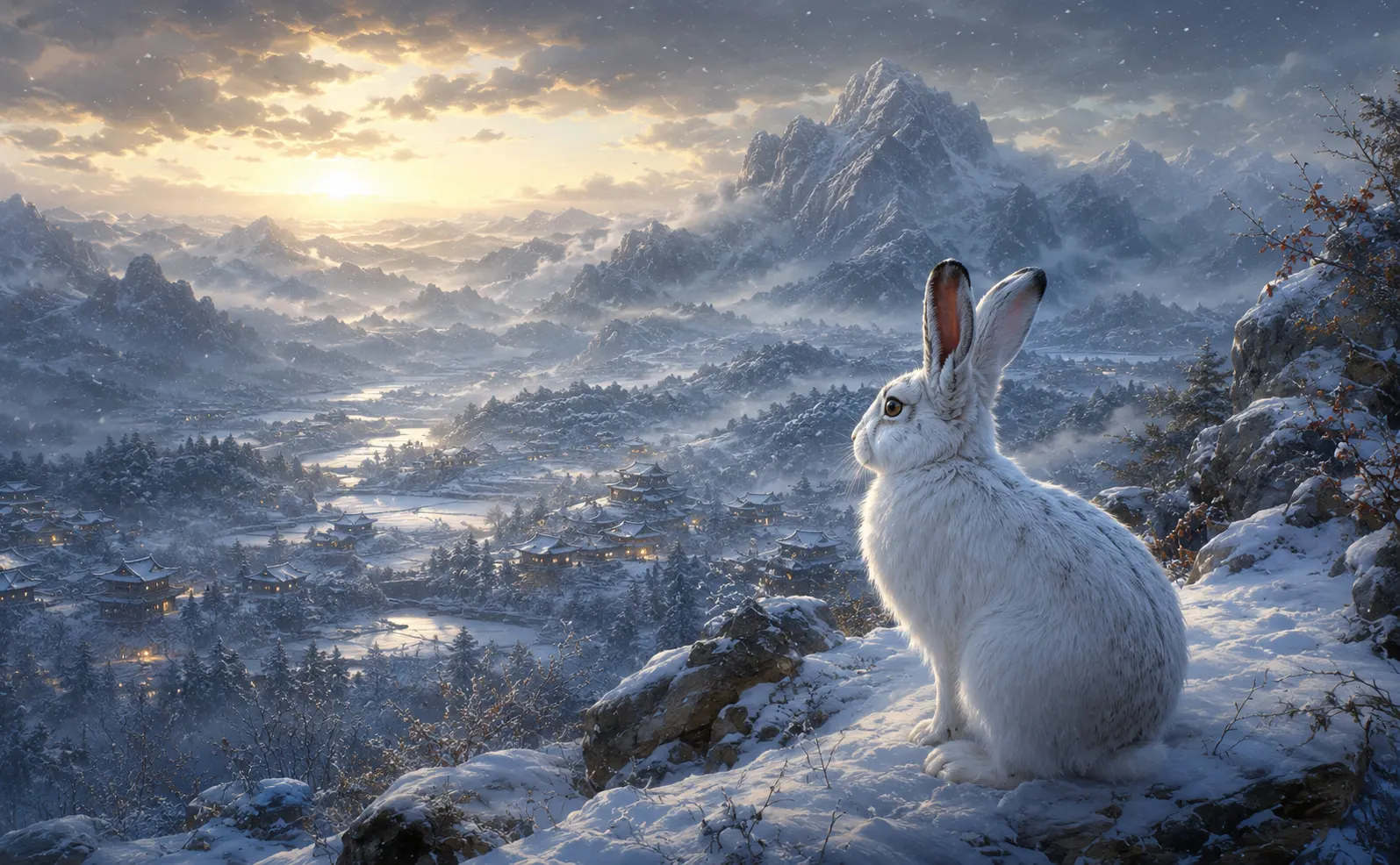
Minor Cold Poetry
「忽吹微雨过,便觉小寒生。」
Poetry of Minor Cold takes extreme cold with spring quietly hidden within it as its underlying tone. Lu You’s “忽吹微雨过,便觉小寒生” writes how the chill of Minor Cold arrives suddenly; Yuan Zhen’s “小寒连大吕,欢鹊垒新巢” records the seasonal change of magpies beginning to build their nests. Poets write of wild geese turning northward, magpies beginning to nest, and pheasants beginning to call, capturing signs of stirring yang qi through the three seasonal phases of Minor Cold. Minor Cold may be cold, yet the poetic heart turns toward warmth—“莫怪严凝切,春冬正月交”. Within the deepest cold, poets are already writing the prelude to spring.
Minor Cold Poetry
咏廿四气诗 · 小寒十二月节
Original Verse:
小寒连大吕,欢鹊垒新巢。
拾食寻河曲,衔柴绕树梢。
霜鹰近北首,雊雉隐丛茅。
莫怪严凝切,春冬正月交。
Modern Translation:
Minor Cold corresponds to Dalü, one of the twelve ancient pitch standards, and joyful magpies begin building new nests. They gather food and search along bends in the river, carrying twigs in their beaks and circling the treetops. Hawks beneath the frosty sky approach the northern hills, while calling pheasants hide among dense reeds. Do not blame the bitter cold for cutting so deeply—for the meeting of spring and winter is already approaching around the turn into the first lunar month.
Commentary:
Yuan Zhen’s poem on Minor Cold comes from his 咏廿四气诗 and is distinguished by its precise observation of seasonal phenomena. “小寒连大吕” links the solar term to the ancient musical system: Minor Cold falls in the twelfth lunar month and corresponds to “大吕”, one of the twelve pitch standards, giving the line rich cultural resonance. “欢鹊垒新巢” corresponds to “鹊始巢”, “magpies begin to nest,” one of the three seasonal phases of Minor Cold. The magpies sense the stirring of yang qi and begin constructing new nests, while the character “欢”, “joyful,” captures their liveliness. The second couplet, “拾食寻河曲,衔柴绕树梢”, further describes the concrete actions of nest-building: searching for food by river bends, carrying twigs, and circling treetops, all observed in close detail. The third couplet, “霜鹰近北首”, writes of hawks in the frosty sky approaching the northern hills, while “雊雉隐丛茅” describes calling pheasants hidden among clumps of reeds. One is a hawk, one a pheasant; one visible, one concealed, revealing different states of birdlife during Minor Cold. The final couplet, “莫怪严凝切,春冬正月交”, says not to blame the bitter cold for cutting so deeply, because the meeting of spring and winter is already near the turn of the first lunar month. Within the severe cold, the message of spring is already contained. The entire poem records the subtle changes of Heaven and Earth during Minor Cold through detailed seasonal observation.
小寒
Original Verse:
小寒节气近严冬,雪压千山玉作峰。
冻雀饥鸦争暖树,寒梅瘦竹各成容。
炉添兽炭香犹在,酒泛羊羔味更浓。
莫道今年春信晚,东君已遣绿先封。
Modern Translation:
Minor Cold has brought the year close to the depths of winter. Snow presses upon a thousand mountains, turning them into peaks carved from jade. Frozen sparrows and hungry crows compete for warm trees, while winter plum and slender bamboo each reveal their own form. Beast-shaped charcoal is added to the brazier, its fragrance still lingering; in the cup, rich yanggao wine gives off an even fuller taste. Do not say that news of spring is late this year—the Lord of Spring has already sent the first trace of green to be stored within the earth.
Commentary:
Wang Ji sets this poem against Minor Cold and writes of life and warmth within severe winter. “小寒节气近严冬” establishes Minor Cold as one of the coldest periods of the year, while “雪压千山玉作峰” describes the magnificent sight of a thousand mountains covered in snow, rising like peaks carved from jade. The second couplet, “冻雀饥鸦争暖树”, writes of birds competing for warmer trees in the bitter cold, revealing the struggle for survival; “寒梅瘦竹各成容” shows winter plum and slender bamboo each displaying its own character. The contrast between “争”, “compete,” and “成”, “take form,” reveals the tension of life within the cold. The third couplet, “炉添兽炭香犹在”, writes of adding charcoal indoors while warmth and fragrance remain, while “酒泛羊羔味更浓” describes the richness of drinking yanggao wine. Outside, the world is frozen; inside, the brazier is warm and the wine fragrant, creating a vivid contrast between interior and exterior. The final couplet, “莫道今年春信晚,东君已遣绿先封”, says not to complain that spring’s message has come late—the Lord of Spring has already sent green life ahead to be stored within the earth. This optimism—that winter has arrived, yet spring is not far away—is precisely the spiritual core of Minor Cold.
小寒
Original Verse:
小寒初渡梅花岭,万壑千岩雪未消。
短日荒荒人寂寂,北风猎猎马萧萧。
岁华冉冉愁仍去,乡思迢迢梦转遥。
不用登临伤往事,且将樽酒慰今朝。
Modern Translation:
At the beginning of Minor Cold, as I cross Meihua Ridge, snow still lies unmelted across countless valleys and rocky peaks. The winter day is short and dim, with hardly a trace of human presence; the north wind blows fiercely, and the horses neigh mournfully. The years pass slowly, yet sorrow still has not gone; thoughts of home stretch across a great distance, while even dreams seem to grow farther away. There is no need to climb high and grieve over the past—better to use a cup of wine to console the present day.
Commentary:
Huang Zuo sets this poem against Minor Cold and writes of year-end desolation and homesickness. “小寒初渡梅花岭” identifies both the solar term and the place—Meihua Ridge—while “万壑千岩雪未消” describes the deep mountain snow still unmelted across countless valleys and cliffs. The second couplet, “短日荒荒人寂寂”, writes of the winter day still being short after the Winter Solstice, the light dim and desolate, and human traces scarce; “北风猎猎马萧萧” describes the north wind blowing fiercely and horses neighing in the cold. The third couplet, “岁华冉冉愁仍去”, writes of the slow passage of the years while sorrow remains, while “乡思迢迢梦转遥” writes of homesickness stretching across immense distances as dreams themselves seem to recede farther away. The distance between dream and reality conveys both the powerlessness and helplessness of longing. The final couplet, “不用登临伤往事,且将樽酒慰今朝”, says that since the past cannot be recovered and thoughts of home cannot reach their destination, there is no need to climb high and grieve over what has gone; better simply to console the present with wine. After deep reflection at the year’s end, the poem ultimately returns to the openness of living for the day at hand.
小寒
Original Verse:
小寒天气觉春生,雪后园林景倍清。
梅蕊欲开香暗度,柳条将绿色初呈。
人闲自觉岁时好,客至从教笑语盈。
莫惜樽前一杯酒,明朝花发更关情。
Modern Translation:
Even in the weather of Minor Cold, I can already sense spring beginning to rise; after the snow, the garden landscape appears even clearer and brighter. Plum buds are about to open, and their fragrance passes quietly through the air; willow branches are about to turn green, their first trace of color just beginning to show. In moments of leisure, one naturally feels the beauty of the season; when guests arrive, let laughter and conversation fill the room. Do not begrudge the cup of wine before us—for when the flowers open tomorrow, they will stir the heart still more deeply.
Commentary:
Zhang Lei sets this poem against Minor Cold, yet everywhere within the severe cold he sees signs of spring. “小寒天气觉春生” opens by saying that although it is Minor Cold, spring can already be felt beginning to rise, continuing the same natural rhythm expressed in the idea that “the first yang is born at the Winter Solstice.” “雪后园林景倍清” describes the garden after snow as especially clear and pure. The second couplet, “梅蕊欲开香暗度”, writes plum buds about to open and fragrance quietly passing through the air, while “柳条将绿色初呈” describes willow branches about to turn green, with their first fresh color just appearing. The paired words “欲”, “about to,” and “将”, “soon to,” together with “暗”, “quietly,” and “初”, “first,” capture the delicate moment when all things stand on the verge of new growth. “人闲自觉岁时好” writes how, in leisure, one becomes more aware of the beauty of the season, while “客至从教笑语盈” describes friends arriving and the room filling with laughter. The final couplet, “莫惜樽前一杯酒,明朝花发更关情”, urges one not to begrudge the cup of wine at hand, because when the flowers bloom tomorrow, they will move the heart still more deeply. Throughout the severe cold of Minor Cold, the poem is filled with optimism and anticipation, making it an unusually bright work among winter poems.
小寒
Original Verse:
小寒时节雪初晴,积素凝华照眼明。
野老不知春信至,梅花先报岁寒情。
酒添琥珀香初泛,诗写琼瑶韵自清。
且喜闲身无个事,围炉静坐听松声。
Modern Translation:
During Minor Cold, the snow has just cleared, and the accumulated whiteness gleams with such brilliance that it dazzles the eyes. The old man of the countryside does not yet know that news of spring has arrived, but the plum blossom has already announced the feeling hidden within the year’s cold. Amber-colored wine releases its first fragrance, while poems written like luminous jade carry a naturally clear resonance. I am simply glad to be at leisure with nothing to attend to, sitting quietly beside the brazier and listening to the sound of the pines.
Commentary:
Li Yu takes the clearing after snow during Minor Cold as his background and writes of the refined pleasures of quiet living and the plum blossom as the first messenger of spring. “小寒时节雪初晴” identifies the season and weather, while “积素凝华照眼明” describes the brilliance of accumulated snow illuminating the eyes. The words “照眼明”, “bright before the eyes,” capture the strong reflected light after snowfall. “野老不知春信至” writes that the old villager has not yet sensed the arrival of spring’s message, while “梅花先报岁寒情” says that the plum blossom has already announced the spring hidden within the cold season. At Minor Cold, the plum is beginning to bud and prepare to bloom, making it one of the most symbolic flowers at the meeting of winter and spring. “酒添琥珀香初泛” writes the refined pleasure of drinking, while “诗写琼瑶韵自清” writes the clear elegance of composing poetry. The final couplet, “且喜闲身无个事,围炉静坐听松声”, rejoices in having nothing to do, requiring only that one sit quietly by the brazier and listen to the voice of the pines. Throughout the year’s cold, the poem expresses the distinctive refinement, leisure, and ease of the cultivated life.
小寒
Original Verse:
小寒时节近残年,雪压梅花白玉妍。
腊酒初开香满室,围炉共话夜如年。
不因岁暮情偏切,应为春回意更坚。
莫道严冬无好景,冰花犹自斗婵娟。
Modern Translation:
Minor Cold has brought the year close to its end, and snow presses upon the plum blossoms, making them beautiful as white jade. Newly opened year-end wine fills the room with fragrance; gathered around the brazier in conversation, the winter night seems as long as a year. It is not merely because the year is ending that feeling grows especially intense; rather, the return of spring should make one’s resolve still firmer. Do not say that severe winter holds no beautiful scenery—the frost flowers themselves still compete in beauty with the bright moon.
Commentary:
Zhou Zizhi sets this poem against Minor Cold and writes of firmness and optimism amid the bitter cold at the end of the year. “小寒时节近残年” establishes Minor Cold as approaching the end of the lunar year, while “雪压梅花白玉妍” describes snow pressing upon the plum blossoms and making their white-jade beauty even more striking. The second couplet, “腊酒初开香满室”, writes of year-end wine newly opened and filling the room with fragrance, while “围炉共话夜如年” describes sitting around the brazier in conversation through a winter night so long that it seems like an entire year—one of the distinctive forms of slow time in winter. The third couplet, “不因岁暮情偏切”, says that emotion does not become especially intense merely because the year is ending, while “应为春回意更坚” writes that the return of spring should instead make one’s resolve still stronger. The final couplet, “莫道严冬无好景,冰花犹自斗婵娟”, says not to claim that severe winter has no beautiful scenery: frost flowers upon the window still compete in beauty with the moon, “婵娟.” Throughout the bitter cold, the poem preserves a positive and uplifting spirit, giving the reader a sense of strength.
—-
Readers’ Comments
Calendar and traditional culture enthusiasts from around the world, sharing the same moon.
Sign in or register to join the conversation. Your comment account is created automatically the first time you use a connected account.
No comments yet
Share your thoughts with readers around the world.