GoatOrigin
「 Gentleness is not weakness;<br>stillness can hold its own strength. 」
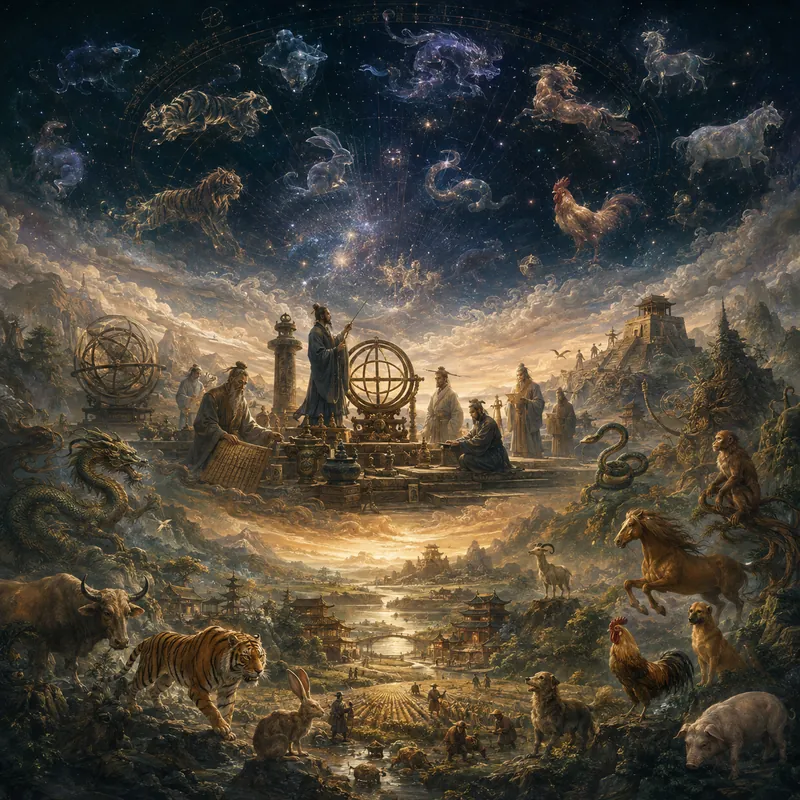
Wei —— The Eighth Earthly Branch
In oracle-bone inscriptions, the character “未” (Wei) resembles a tree—its branches and leaves are luxuriant and flourishing, but it has not yet borne fruit. Its original meaning is “not” or “not yet,” and by extension “future” or “yet to come.”
By the Eastern Han dynasty, Xu Shen explained the character “未” in the *Shuowen Jiezi* (《说文解字》) as follows: “未,味也。六月,滋味也。” This means that “Wei” represents the sixth lunar month, when all things grow toward maturity and acquire flavor. It is also explained phonetically as “未者,昧也”, meaning that the qi of Yin and Yang has not yet become clearly distinguished. “Wei” is the eighth of the twelve earthly branches. In the Five Elements it belongs to Yin Earth, and directionally it corresponds to southwest by south. The sixth lunar month corresponding to “Wei” is also the season when fruit ripens and the Five Grains approach harvest—“Wei” thus contains both the sense of waiting because something is “not yet mature” and the hope of being “about to mature.”
Goat —— Evolution of the Character and Philological Extensions
Evolution of the Character
The character “羊” (Goat) is one of the oldest and most typical pictographic characters in Chinese writing. It had already appeared in Shang-dynasty oracle-bone inscriptions, where it resembles a frontal depiction of a Goat’s head: the upper part shows two curved horns, the middle the Goat’s face, and the lower part its mouth. The creators of the character selected the Goat’s most distinctive features—its head and two horns—to represent the animal as a whole. From oracle-bone inscriptions and bronze inscriptions through small-seal, clerical, and regular script, although “羊” evolved from a concrete pictorial form toward abstraction, it consistently retained the basic features of a Goat’s head.
Xu Shen of the Eastern Han explained in the *Shuowen Jiezi · Yang Bu* (《说文解字·羊部》): “羊,祥也。” He also wrote: “羊,柔善也。” Xu Shen connected “羊” with “祥”—in ancient writing, “羊” and “祥” were close in sound and interchangeable in meaning, and “羊” was the original character underlying the “祥” of “auspiciousness.” This phonetic explanation shows that as early as the Eastern Han period, the Goat was already regarded as a symbol of auspiciousness. More than a hundred Chinese characters use “羊” as a component or radical, covering many aspects related to Goats—from kinds of Goat such as 羚 and 羝, to parts associated with the animal such as 羶 and 羗, and behaviors or related concepts such as 群 and 義.
Cultural Extensions of “Wei-Goat”
The pairing of “Wei” and the Goat gave rise to one of the most auspicious cultural images in traditional Chinese culture—“三阳(羊)开泰.” Because “羊” and “阳” are homophones, the original phrase “三阳开泰” was associated with an image of three Goats. “三阳开泰” originally referred to a hexagram image in the *Zhouyi* (《周易》), signifying the passing of winter and arrival of spring, the waning of Yin and growth of Yang, and the revival of all things—an auspicious omen. Because “羊” and “阳” sound the same, people began writing “三阳开泰” as “三羊开泰”, using images of three Goats to represent good fortune and the arrival of luck. This auspicious motif is extremely common in folk New Year paintings, paper-cutting, and carving.
Three Explanations for the Pairing of Wei and the Goat
The Time-of-Day Theory
Wei hour runs from 1:00 p.m. to 3:00 p.m. and is also known as “Ridi.” At this time, the sun has moved westward but the weather remains hot, and Goat herds begin their afternoon foraging. The ancients observed that grass eaten by Goats during Wei hour would grow better by the following day, helping the grass regenerate. This natural phenomenon of “Goats eat grass, and the grass grows again” led people to connect the Goat with “Wei.” The Tang scholar Kong Yingda wrote in his commentary on the *Liji · Yueling* (《礼记·月令》): “未者,言万物之成,有味也。羊以未时食,故配未。” This means that “Wei” represents the maturity of all things and their acquisition of flavor. Goats eat during Wei hour, and therefore “Wei” is paired with the Goat.
The Yin-Yang and Five-Element Theory and the Directional Theory
From the perspective of Yin-Yang attributes, “Wei” belongs to Yin Earth. The Goat is a gentle animal, and its forefeet have four toes—an even number and therefore Yin—corresponding with the Yin earthly branch “Wei.” In the directional correspondences of the twelve earthly branches, “Wei” corresponds to southwest by south. The Yin-Earth nature of “Wei” and the Goat’s gentleness and softness thus echo one another.
The Distinction Between Small and Large
Another explanation holds that the Goat’s eighth position in the twelve-animal zodiac is related to the meaning of the character “未.” “未” means “not” or “never,” symbolizing smallness and scarcity. The Goat is a medium-sized animal—not especially large and not especially small among the twelve zodiac animals. It is smaller than the Ox, Horse, and Tiger, but larger than the Rat, Rabbit, and Rooster, fitting precisely the idea of the Doctrine of the Mean represented by “Wei”: “neither too large nor too small, just right.”
Records in Classical Texts
The Qin Bamboo-Slip *Rishu*
In 1975, the *Daozhe* section of the bamboo-slip *Rishu* (《日书·盗者》), unearthed from Qin Tomb No. 11 at Shuihudi in Yunmeng County, Hubei, recorded pairings related to the twelve zodiac animals. The tomb has been dated to the era of Qin Shi Huang, in the third century BCE. In the *Rishu*, however, the animal corresponding to “Wei” is the Horse rather than the Goat. This differs from the modern standard pairing of “Wei-Goat.”
Type A of the Qin bamboo-slip *Rishu* unearthed at Fangmatan in Tianshui, Gansu, likewise contains relevant records. In the Fangmatan Qin slips, the animal corresponding to “Wei” appears as both the Goat and the Horse. The Han bamboo-slip *Rishu* from Kongjiapo in Suizhou, Hubei, also pairs “Wei” with the Horse. The animal corresponding to the Wei position therefore differs among bamboo slips from different regions—some pair it with the Horse, others with the Goat. This shows that from the late Warring States through the Qin period, the twelve-animal zodiac system had not yet been fully unified. It also demonstrates that the pairing of “Wei” with the Goat was fixed only later, after undergoing a transformation from “Horse” to “Goat.” The underlying reason for this transformation may have been that the Yin-Earth nature represented by “Wei” corresponded more closely with the Goat’s gentle temperament and herbivorous habits.
The Goat in Pre-Qin Texts
The Goat appears frequently in classical pre-Qin texts. The *Shijing · Xiaoya · Wuyang* (《诗经·小雅·无羊》) is one of the most famous pastoral poems of ancient China: “谁谓尔无羊?三百维群。谁谓尔无牛?九十其犉。” It vividly portrays great herds of cattle and Goats. The *Zhouli* (《周礼》) records a specialized office known as the “Yangren,” responsible for raising and preparing Goats for sacrifice. The *Liji · Wangzhi* (《礼记·王制》) records: “天子社稷皆太牢,诸侯社稷皆少牢”—the “Tailao” sacrifice used the three sacrificial animals of Ox, Goat, and Pig, with the Goat ranking immediately after the Ox as an important ritual offering and occupying a significant place within the ritual system.
The Eastern Han *Lunheng*
The earliest transmitted text to record the same twelve zodiac animals as those used today is Wang Chong’s Eastern Han *Lunheng* (《论衡》). Wang Chong explicitly writes in the *Lunheng · Wushi Pian* (《论衡·物势篇》): “未,羊也。” “丑、未,亦土也,丑禽牛,未禽羊也。” Wang Chong records all twelve animals in the *Lunheng*, and the pairing of “Wei” with the Goat is already completely identical to the modern system. This shows that by the Eastern Han period, in the first century CE, the pairing of “Wei” and the Goat had reached its final standardized form.
Zodiac Figurines and Goat-Shaped Artifacts
The Tradition of Zodiac Figurines from the Northern Wei to the Tang Dynasty
The twelve zodiac figurines, also known as divine figurines of the Twelve Branches, were distinctive burial objects in ancient Chinese funerary culture. Large numbers of pottery zodiac figurines with animal heads and human bodies have been unearthed from Tang tombs. Among them, the Wei-Goat figurine has a Goat’s head and human body and wears the attire of a civil official. The Tang-dynasty *Tang Huiyao* (《唐会要》) records ritual regulations governing the burial of zodiac figurines. In the directional correspondences of the twelve earthly branches, “Wei” corresponds to southwest by south, and Goat figurines were usually placed in this direction.
Neolithic Period —— The Earliest Goat Images
Goat-shaped pottery of the Majiayao culture in Gansu, approximately 5,000 years ago: Goat-shaped painted pottery vessels have been unearthed from Majiayao culture sites and constitute important representatives of Goat imagery from the Neolithic period.
Shang and Zhou Periods —— The Four-Goat Square Zun and Bronze Goats
Four-Goat Square Zun, late Shang dynasty, unearthed in Ningxiang, Hunan, in 1938: This is one of the most famous Goat-shaped objects among Chinese bronzes. The vessel is square in form, with a curled-horn Goat cast at each of its four corners. The Goats’ heads project beyond the body of the vessel, while their bodies merge with the vessel itself. The craftsmanship is exquisite and the overall presence monumental. The Four-Goat Square Zun is now housed in the National Museum of China and is a national-treasure-level cultural relic.
Shang-dynasty bronze Goat zun, unearthed in Xiangtan, Hunan: The vessel takes the form of a standing large-horned Goat, with a powerful body and coiling horns, and is a representative work among Chinese bronze Goat zun vessels.
Western Zhou bronze lei with Goat-head decoration: Bronze *lei* vessels decorated with Goat heads are representative examples of Goat-form ornament from the Western Zhou period.
Han Dynasty —— Pictorial Stones and Pottery Goats
Goats on Han-dynasty pictorial stones: Large numbers of Goat images appear on Han-dynasty pictorial stones unearthed in Shandong, Henan, and other regions, including Goats in sacrificial scenes and in scenes of everyday life.
Han-dynasty pottery Goats: Large numbers of pottery Goats have been unearthed from Han tombs, including models of Goat pens and Goat herds, providing important material evidence for Han Goat culture.
Tang Dynasty —— Sancai Goats and Zodiac Figurines
Tang sancai Goats: Sancai Goat figures have been unearthed from Tang tombs. Their vivid forms and brilliant glaze colors make them representative works of Tang ceramic sculpture.
Tang-dynasty painted pottery zodiac figurines: Large numbers of pottery zodiac figurines with animal heads and human bodies have been unearthed from Tang tombs. Among them, the Wei-Goat figurine has a Goat’s head and human body and wears the attire of a civil official.
The Goat-Head Bronze of the Old Summer Palace
The Goat-head bronze of the Old Summer Palace formed part of the hydraulic clock system at Haiyantang, designed during the Qianlong reign of the Qing dynasty under the direction of the Italian missionary Giuseppe Castiglione and supervised by the French missionary Michel Benoist. Twelve statues with animal heads and human bodies were arranged in the shape of the character “八” on both sides of the fountain pool in front of Haiyantang. At each traditional two-hour period, the corresponding animal head spouted water from its mouth to mark the time. During Wei hour, from 1:00 p.m. to 3:00 p.m., the Goat-head bronze projected a column of water from its mouth. In 1860, Anglo-French forces burned the Old Summer Palace, and the twelve zodiac bronzes were looted and dispersed overseas. The whereabouts of the Goat-head bronze remain unknown to this day.
Cultural Meanings of Goat Artifacts
In ancient Chinese artifacts and works of art, the image of the Goat underwent a rich evolution—from sacrificial animal to auspicious beast, and from practical object to ritual vessel. The Goat’s cultural image moved from the solemn sacrificial presence seen on Shang and Zhou ritual bronzes, to the everyday domestic animal portrayed on Han pictorial stones, and then to the sumptuous, full-bodied forms of Tang sancai Goats. Throughout these transformations, the Goat remained an indispensable subject in ancient Chinese art.
The Origins and Domestication of the Goat
The Goat belongs to the class Mammalia, order Artiodactyla, and family Bovidae. The types of Goat distributed within China mainly include sheep and goats. China was one of the earliest regions in the world to domesticate Goats. Archaeologists have discovered Goat bones at late Neolithic sites in Gansu, Shaanxi, Henan, and other regions, demonstrating that Goats had already been domesticated by humans approximately 5,000 to 7,000 years ago. According to zooarchaeological research, China’s sheep may have had two origins: one from the domestication of native wild sheep in China, and another introduced into China from Western Asia through Central Asia. Goats, by contrast, are considered a species independently domesticated within China.
Goat Bones at Prehistoric Sites
Dadiwan site, Gansu, approximately 7,000 years ago: Goat bones were unearthed here, constituting early physical evidence for Goats in northwestern China. Jiangzhai site, Shaanxi, approximately 6,000 years ago: Goat bones were unearthed, demonstrating the presence of Goats in the Guanzhong region by the late Neolithic period. Yinxu site, Henan, late Shang dynasty: Large quantities of Goat bones were unearthed, mainly used for sacrifice and food.
The Goat’s Important Place in the Agricultural Economy
The Goat played multiple roles in the agricultural economy of ancient China. It was an important source of meat and milk, a provider of raw material for textiles in the form of wool, and an important sacrificial animal in ritual ceremonies. In the sacrificial rites of the Shang and Zhou periods, the Goat was an important component of the “Shaolao” sacrifice, second only to the Ox of the “Tailao.” The Goat’s inclusion in the twelve-animal zodiac and its eighth-place ranking are closely connected with its multiple economic values and cultural status within agricultural society.
The Goat’s Biological Characteristics and Their Relationship to Zodiac Culture
The Goat’s inclusion in the twelve-animal zodiac and its eighth-place ranking are closely connected with its biological characteristics. Goats are gentle in temperament and do not harm other animals, making them symbols of peace and gentleness. Goats like to live in herds, symbolizing unity and cooperation. They feed on grass and do not compete with other domestic animals for food, embodying a disposition free from worldly contention. According to legend, a young lamb kneels before its mother while suckling, which the ancients regarded as a symbol of “filial piety.”
Among the myths and legends surrounding the Wei-Goat, none is more moving than the self-sacrificing feat of “stealing the Five Grains to save humanity.” This legend has been called “China’s version of Prometheus.” From the Goat deity stealing grain to the lamb kneeling to nurse, from “三羊开泰” to the Great Immortal of Goat Power, the Goat’s mythological image spans sacrifice, auspiciousness, filial piety, and many other domains.
Creation and Heroic Narratives
The Goat Steals the Five Grains —— Sacrificing Itself to Save Humanity
This is the most exalted and self-sacrificing myth associated with the Goat.
Famine in the Human World —— The Jade Emperor Hides the Seeds
According to legend, in remote antiquity there were no Five Grains in the human world, and people could survive only on wild fruits and vegetables, living lives of great hardship. The heavenly deities enjoyed delicious food in Heaven but refused to bestow grain seeds upon the mortal world. One day, a divine general in Heaven learned of humanity’s plight—this divine general was the Goat deity. Seeing ordinary people suffering terribly from hunger, the Goat deity could not bear it. It learned that a bag of Five-Grain seeds was hidden in the Celestial Palace, reserved by the Jade Emperor specifically for the immortals and forbidden to humans. After an inner struggle, the Goat deity decided to steal the Five-Grain seeds and give them to humanity.
Stealing the Seeds and Descending to Earth —— Covering Its Entire Body
Late one night, when all was silent, the Goat deity secretly slipped into the Jade Emperor’s granary. It found the sack containing the Five-Grain seeds and used all its strength to bite it open. Seeds poured out through the hole. With no time to think further, the Goat deity quickly rolled over the Five-Grain seeds, covering its entire body with them. Carrying the seeds all over its body, the Goat deity quietly descended from Heaven to the human world. It shook the seeds from its body onto the ground, and from that time onward humanity possessed the Five Grains—rice, broomcorn millet, foxtail millet, wheat, and beans.
Sacrificing Itself for Righteousness —— Banished to the Human World
The Jade Emperor soon discovered that the Five-Grain seeds had been stolen and flew into a rage. He ordered a thorough investigation, and it was quickly discovered that the Goat deity was responsible. The Jade Emperor summoned the Goat deity and sternly demanded: “Why did you violate the laws of Heaven and steal the Five-Grain seeds of the celestial realm to send them down to the human world?” Unafraid, the Goat deity replied: “The people of the human world suffer from hunger and cold. I truly could not bear to watch them starve to death. Heaven has endless delicacies—why can none be shared with the people below?” The Jade Emperor became furious and ordered the Goat deity banished to the human world, where generation after generation it would provide food and clothing for humanity, using its own body to atone for its crime. From then onward, the Goat deity became the Goat of the mortal world, and humanity obtained meat, milk, hide, and wool from its body. The Goat endured all of this without complaint—it knew that it had sacrificed itself for humankind and that its death had meaning.
The Theft of the Five Grains and Prometheus
The story of “the Goat stealing the Five Grains” closely parallels the Greek myth of Prometheus stealing fire. Prometheus stole heavenly fire and brought it to humanity, for which he suffered eternal torment; the Goat stole heavenly grain and brought it to humanity, after which generations of its kind were sacrificed for human benefit. The shared theme of the two legends is that a god or divine beast violates heavenly law and sacrifices itself out of compassion for humanity. The difference is that Prometheus was bound to the Caucasus Mountains and had his body pecked by an eagle, while the Goat benefited humanity through the sacrifice of its entire species generation after generation.
Folk Belief and Folk Customs
The Goat as a Virtuous Livestock Animal
The ancients regarded the Goat as a “virtuous livestock animal.” It possessed not only practical economic value, but also elevated moral qualities. The Goat’s “virtue” is embodied in several respects: it is gentle in temperament and does not harm any other animal, making it a symbol of peace; Goats like to move in herds, symbolizing unity and cooperation; and according to legend, young lambs kneel before their mothers while suckling as an expression of gratitude. This detail of “the lamb kneeling to nurse” was regarded by the ancients as a symbol of filial piety. The story became extremely widespread among the people: when a young lamb drinks its mother’s milk, its hind legs bend and its forelegs kneel on the ground, as though bowing to thank its mother. The ancients regarded this as proof of the Goat’s filial heart and therefore often used “the lamb kneeling to nurse” to teach children to honor their parents.
Three Goats Bring Auspicious Renewal
Within the auspicious culture of ancient China, the Goat was regarded as an auspicious beast. “羊” and “祥” were connected, and the Goat itself represented auspiciousness. The *Ruiying Tu* (《瑞应图》) records: “羊,祥也。” The appearance of a Goat was regarded as an omen of good fortune. “三阳开泰” is one of the best-known auspicious expressions in traditional Chinese culture. It derives from the *Zhouyi* (《周易》): the Tai hexagram consists of Qian below and Kun above, symbolizing harmonious interaction between Heaven and Earth and the smooth flourishing of all things. After the winter solstice each year, Yang energy begins to rise; by the first lunar month, Yang grows steadily stronger while Yin gradually declines, precisely the season of “三阳开泰.” Because “羊” and “阳” are homophones, people transformed “三阳开泰” into “三羊开泰”, using an image of three Goats to represent auspiciousness, fulfillment, and the arrival of good fortune. This auspicious motif is extremely common in folk New Year paintings, paper-cutting, and jade carving: three Goats raise their heads and gaze into the distance, some holding ears of grain in their mouths and others standing on hillsides, symbolizing “good fortune and success in all things.”
The Goat as a Ritual Sacrificial Animal
In ancient China, the Goat was an important sacrificial animal in ritual ceremonies. The *Liji · Wangzhi* (《礼记·王制》) records: “天子社稷皆太牢,诸侯社稷皆少牢”—in the “Tailao”, the Ox came first, followed by the Goat and Pig; the “Shaolao” used the Goat and Pig, without the Ox. Within sacrificial ritual, the Goat was regarded as a medium connecting Heaven and Earth. People believed that the Goat’s flesh and blood could be offered to the deities and that the Goat’s sacrifice could be exchanged for divine protection. The Goat’s role as a sacrificial animal has a profound inner connection with the legend of “the Goat stealing the Five Grains”: the Goat stole the Five Grains for humanity, and humanity in turn offered the Goat’s flesh and blood to Heaven and Earth in gratitude for the gifts bestowed from above.
Worship of the Goat Deity
In Chinese folk belief, the Goat was regarded as a deity of auspiciousness. In the past, in northern rural areas, people worshipped the Goat deity every year on the sixth day of the sixth lunar month, traditionally said to be the Goat deity’s birthday, praying for flourishing Goat herds and abundant harvests of the Five Grains. In some places, when constructing a new house or moving into a new home, people also buried a Goat’s head in a corner of the building to protect the household and ward off evil.
The Goat in Literature and Historical Records
The Great Immortal of Goat Power in *Journey to the West*
In the Chinese classical novel *Journey to the West* (《西游记》), there appears a figure known as the Great Immortal of Goat Power. He is one of the three national preceptors of the Kingdom of Chechi and, together with the Great Immortal of Tiger Power and the Great Immortal of Deer Power, competes in magical powers against Tang Monk and his disciples. Although the Great Immortal of Goat Power is ultimately defeated by Sun Wukong, the magical abilities he displays in the novel—including “guessing objects through a board” and “praying for rain”—show that in Ming-dynasty folk imagination, the Goat had already acquired divinity at the level of a “Great Immortal.”
Folk Legends of the Goat —— Regional Variants
Many other folk legends concerning Goats circulate throughout China. In northern regions, there is the story of “the Goat deity delivering blessings,” in which the Goat deity gives sheepskin coats to poor households during the twelfth lunar month to protect them from the cold. In southern regions, there are legends of the “shepherd girl,” telling of a kind-hearted girl who gains happiness because she treats her flock well. Although these stories vary from region to region, they share a common theme: the Goat is a symbol of kindness, auspiciousness, sacrifice, and devotion.
As zodiac culture spread, it incorporated elements from the local cultures of different countries, and the image of the Goat developed different forms across East Asia.
Japan
Japan’s twelve zodiac animals are exactly the same as China’s—Rat, Ox, Tiger, Rabbit, Dragon, Snake, Horse, Goat, Monkey, Rooster, Dog, and Pig. The Goat likewise occupies eighth place. In Japanese culture, the Goat is regarded as a symbol of gentleness and peace. Because Japan has no native wild sheep, Japanese understandings of the Goat came largely from cultural texts transmitted from China.
Vietnam
In Vietnam’s twelve-animal zodiac, the Goat likewise occupies eighth place. Vietnam’s zodiac system is fundamentally the same as China’s—the only difference is that the Cat replaces the Rabbit. In Vietnamese culture, the Goat is likewise an auspicious symbol and is closely connected with agricultural production.
Korean Peninsula
The twelve zodiac animals of the Korean Peninsula—North Korea and South Korea—are exactly the same as China’s. In Korean culture, the Goat symbolizes gentleness, kindness, and auspiciousness. Goats appear in many Korean folk stories.
Commonalities and Differences
The Goat occupies eighth place in the zodiac systems of all East Asian countries, and this shared ranking reflects the widespread importance attached to the Goat throughout the East Asian cultural sphere. Yet differences exist in the details: China emphasizes the Goat’s qualities as a “virtuous livestock animal,” the auspicious meaning of “三羊开泰,” and the sacrificial spirit of the Goat deity stealing grain; Japan and the Korean Peninsula largely continue Chinese traditions surrounding Goat culture; Vietnam combines the Goat with its own local agricultural culture. These differences precisely demonstrate the vitality and adaptability of zodiac culture in cross-cultural transmission.
Viewed across the origins and evolution of the Wei-Goat zodiac, one theme emerges throughout: among all twelve zodiac animals, the Goat is the animal endowed with the greatest degree of “moral” meaning—it is not merely livestock, but a “virtuous livestock animal.”
Characters and texts tell us that because the Goat forages in the afternoon during Wei hour, and because its gentle nature belongs to Yin Earth, it forms a dual correspondence in both flavor and character with the meanings of “flavor” and “maturity” embodied by the earthly branch “Wei.” It is worth noting that the animal corresponding to the Wei position in the Qin bamboo-slip *Rishu* underwent an evolution from “Horse” to “Goat”: the Shuihudi Qin slips pair Wei with the Horse, the Fangmatan Qin slips contain both Goat and Horse, and the Kongjiapo Han slips pair Wei with the Horse. This shows that before the Qin-Han political unification, the zodiac attribution of the Wei position underwent a long process of cultural selection. Only with Wang Chong’s Eastern Han *Lunheng* was “Wei” definitively paired with the Goat. The underlying reason for this transformation may have been that the Yin-Earth nature represented by “Wei” corresponded more closely with the Goat’s gentleness and softness.
Archaeology reveals the long history through which the Goat and Chinese civilization developed alongside one another. From Goat bones of the Neolithic period to sacrificial remains of the Shang and Zhou dynasties, from Goat-shaped pottery of the Majiayao culture in Gansu to the Four-Goat Square Zun from Ningxiang in Hunan, the Goat’s place in Chinese history continually rose—from a source of meat to a ritual sacrificial animal, from an economic resource to a cultural symbol. As the principal animal of the “Shaolao” sacrifice, the Goat ranked immediately after the Ox within the sacrificial system, forming together with the myth of “the Goat stealing the Five Grains” a closed logic of sacrifice—gratitude—sacrifice once again.
What truly gives the Wei-Goat its soul is the vast world of myths and legends. In these narratives born among the people, the Goat is the self-sacrificing deity banished to the human world for stealing the seeds of the Five Grains for humanity; it is the model of filial piety embodied in “the lamb kneeling to nurse”; it is the auspicious beast of “三羊开泰”; and it is the Great Immortal of Goat Power who competes in magic with Sun Wukong in *Journey to the West*. The Goat’s image moves from sacrifice to auspiciousness and from the divine altar to the human world. This cultural character, uniting the divine and the mortal, endowed the Goat with the noble spirit of “sacrificing oneself for others” and “repaying resentment with virtue.”
When the Goat zodiac traveled beyond the Central Plains to Japan, Vietnam, and the Korean Peninsula, it retained both its honored eighth-place position and its auspicious meaning within different cultures. This perhaps suggests that the vitality of a cultural symbol lies not in whether it is reproduced without alteration, but in whether the moral and emotional meanings it carries can transcend geographic boundaries. The Wei-Goat is precisely such a symbol. It comes walking from the hillsides of remote antiquity, carrying the Five Grains in its mouth and draped in auspiciousness, leaving in the spiritual fields of the Chinese people its gentlest and kindest figure.
---
Readers’ Comments
Calendar and traditional culture enthusiasts from around the world, sharing the same moon.
Sign in or register to join the conversation. Your comment account is created automatically the first time you use a connected account.
No comments yet
Share your thoughts with readers around the world.