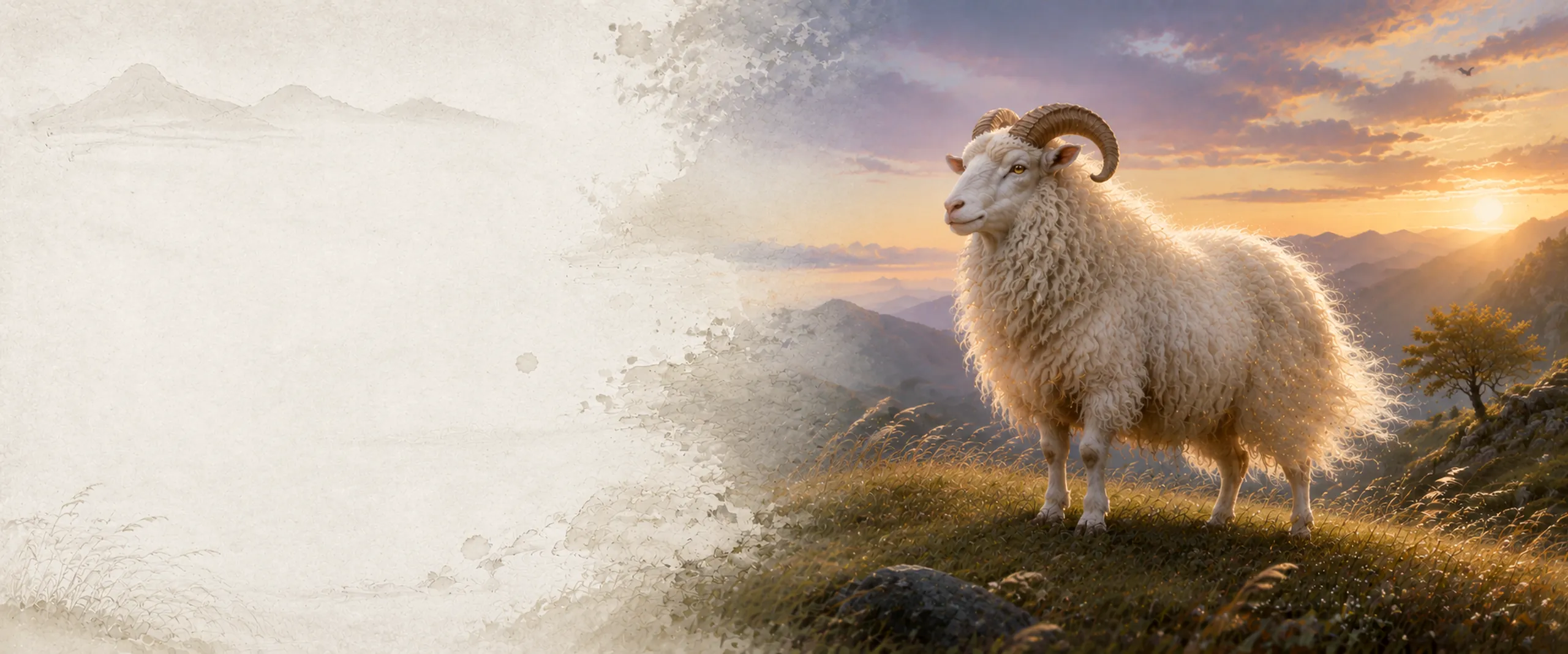
GoatFolklore
「 三阳开泰运,未羊送福来。 」
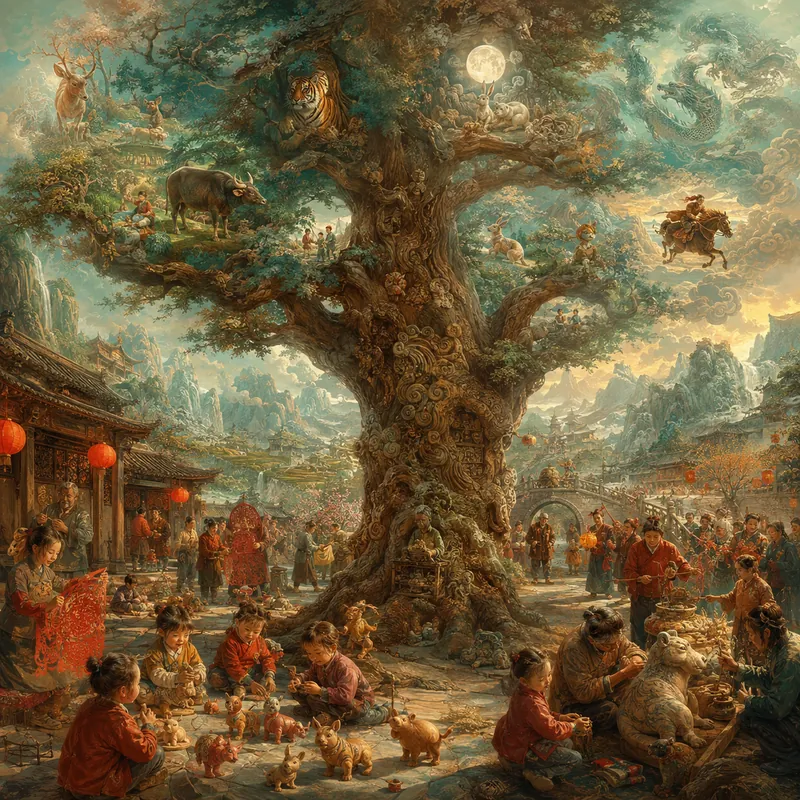
Seasonal Festivals and Observances:
Goat Day and the Fourth Day of the First Lunar Month
In traditional Chinese folk culture, the first through sixth days of the first lunar month are respectively associated with the Chicken, Dog, Goat, Pig, Ox, and Horse. According to legend, Nüwa created the six domestic animals over six days and created humankind only on the seventh. The Book of Divination (《占书》) records: “正月一日为鸡,二日为狗,三日为羊,四日为猪,五日为牛,六日为马,七日为人。”
The fourth day of the first lunar month is “Goat Day” (羊日). On this day, killing goats is forbidden as a gesture of respect toward the animal. The weather on Goat Day is also used to divine the fortunes of goats for the year ahead: clear weather on the fourth day foretells strong, healthy animals, freedom from disease and calamity, and flourishing reproduction; rain or overcast skies suggest that goats may fall ill or encounter misfortune. On this day, people pray that ancestors and deities will bless the entire family with peace in the new year, favorable winds and timely rains, abundant harvests, flourishing livestock, and auspicious fulfillment.
Planting Goats on a Wei Day
Ancient folk tradition included the unusual custom of “planting goats on a Wei day” (未日种羊). According to old texts, the planting of goats was carried out at the beginning of winter, and the earthly branch of the day on which the goat bones were buried had to be Wei (未). The “planted” goats could then be harvested in the third lunar month of spring—specifically on the first day of that month whose earthly branch was Wei. On that day, people played the hu-jia reed pipe and recited incantations, whereupon “young goats” were believed to break through the soil and emerge from the ground. This custom reflects the profound faith ancient people placed in the correspondence between “Wei” and the Goat, while also revealing a distinctive understanding of natural rhythms: agricultural activity was combined with the earthly branches and zodiac animals to form an integrated system of agrarian calendrical culture.
Thanking the Goat after the Autumn Harvest
After the autumn harvest and the winter storage of crops, people held grand sacrificial ceremonies to express gratitude to the Divine Goat for bringing grain seeds to humankind. Such ancestral agricultural rites performed after autumn harvesting and winter storage continue to be observed in some rural communities today. The grand Goat sacrifice was said to have alarmed the Jade Emperor, reminding him once again that the Five Grains had appeared in the human world.
This ritual derives from the legend of the “Divine Goat Stealing Grain.” The Divine Goat stole the seeds of the Five Grains from the Heavenly Palace and delivered them to humankind, only to incur the anger of the Jade Emperor and be executed. Grateful for the gift of grain, people held memorial rites every year after the autumn harvest. The custom of thanking the Goat after harvest closely joins gratitude with abundance and is one of the most ceremonially charged seasonal observances in the folk culture of the Wei Goat.
Sending the Goat
In some parts of northern China, there is a folk custom known as “Sending the Goat” (送羊). It usually takes place in the sixth or seventh lunar month, when a maternal grandfather or maternal uncle gives a nephew a goat made of dough or a live goat, wishing him healthy growth and a long life. The custom draws upon the homophonic association between “goat” (羊) and “auspiciousness” (祥), symbolizing the delivery of good fortune and blessing. “Sending the Goat” is widely practiced in Hebei, Shanxi, Shandong, and other regions and offers a concentrated expression of kinship ethics within Wei Goat folklore.
Sacrificing a Yellow Goat to the Kitchen God
The Goat also plays an important role in the Kitchen God sacrifice on the twenty-third day of the twelfth lunar month. “Sacrificing a Yellow Goat to the Kitchen God” (黄羊祭灶) is one of the important forms of this popular rite. According to folk belief, the Kitchen God ascends to Heaven on this day to make his annual report, and people offer a yellow goat while praying that he will “speak good things in Heaven and return to the palace bringing auspiciousness.” The sacrifice draws upon the homophonic relationship between 羊 and 祥, presenting an auspicious gift with which to send the Kitchen God heavenward.
Wei Hour and the Hour of the Goat
Among the traditional twelve double-hours, Wei hour (未时) corresponds to 1:00–3:00 p.m. and is also known as Riyi (日昳), Rizhe (日仄), Riyang (日央), and Ridie (日跌); its elegant designation is the “Hour of the Goat” (羊时). At this time, goats begin their afternoon grazing. The ancients observed that grass eaten by goats during Wei hour seemed to grow better the following day—the natural phenomenon expressed in the idea that “the goat eats the grass, and the grass grows again.” This observation helped reinforce the association between the Goat and Wei.
Goat Days and Wei Days
In traditional folk culture, Wei days (未日)—Goat days—are often marked by sacrifices and prayers associated with the animal. Because of the fixed correspondence between “Wei” and the Goat, the Wei day is regarded as the Goat’s “birth-sign day,” and worship conducted on such a day is believed to be especially efficacious. In some ethnic-minority regions, Wei days also carry distinctive calendrical significance.
Folk Beliefs:
The Goat possesses an exalted sacred status in Chinese folk belief. It is at once the Divine Goat totem that stole grain to save humankind, the judicial sacred beast Xiezhi that distinguishes deceit from righteousness, and a sacrificial animal serving as a medium between Heaven and the human world. In ancient thought, the Goat was the embodiment of 祥, auspiciousness itself, and a sacred creature capable of linking humanity with the divine.
The Divine Goat Totem
In Chinese folk legend, the Goat is a figure of greatness comparable to Prometheus in Greek mythology: Prometheus was punished by Zeus for stealing heavenly fire and giving it to humankind, while the Goat sacrificed its life for righteousness after stealing the seeds of the Five Grains and bringing them to the human world.
According to legend, at the beginning of remote antiquity there was no grain in the human world, and people lived on wild grasses, struggling even to fill their stomachs. One autumn, a Divine Goat from the Heavenly Palace happened to descend into the mortal world and discovered the hardship of human life and the people’s ignorance of grain cultivation. Moved by compassion, the Divine Goat promised to bring them grain seeds. It discovered that grain grew only in the imperial fields of Heaven, so while the guardian deity of those fields dozed, it secretly entered, gathered the Five Grains, carried them down to the human world, and taught people how to cultivate them.
From then on, humankind possessed the seeds of the Five Grains and began a life of farming from generation to generation, becoming self-sufficient in food and clothing. After the autumn harvest, people held a grand ceremony to thank the Divine Goat for bringing them grain. The sacrifice attracted the attention of Heaven, and once the Jade Emperor discovered what had happened, he directed his anger toward the Divine Goat, ordering it to be slaughtered in the human world and commanding people to eat its flesh. Soon, at the place where the Divine Goat was executed, grass first began to grow and later lambs emerged. From that time onward, goats multiplied in the human world, living on grass and selflessly giving their meat, milk, hides, and wool to humankind.
Xiezhi
Xiezhi (獬豸) is a sacred beast of ancient Chinese legend, described in the saying “large ones are like oxen, small ones like goats.” It is able to distinguish truth from falsehood and separate evil from goodness. As late as the Qing dynasty, the official robes of investigating censors bore Xiezhi imagery.
The form of Xiezhi is closely associated with the Goat: it resembles a goat but bears a single horn, and it can discern right from wrong. When it sees people in dispute, it uses its horn to strike the party at fault. Xiezhi therefore became a symbol of justice and the rule of law. Ancient judicial officials had Xiezhi embroidered on their robes, expressing the ideals of strict enforcement and penetrating discernment. Belief in the Xiezhi as a sacred Goat elevated the animal beyond the agricultural-sacrificial sphere into the philosophical realm of judicial justice.
The Legend of the Five Goats
Guangzhou is also known as the “City of Goats” (羊城), a name originating in a beautiful legend. According to tradition, Guangzhou once suffered a devastating drought, and large numbers of people died from hunger. At that moment, five immortals suddenly descended, riding celestial goats of different colors. They scattered ears of rice throughout the city and promised that Guangzhou would never again suffer famine. The five celestial goats were then left behind as sacred beasts to suppress evil influences. Today, the Five-Goat Stone Statue in Guangzhou’s Yuexiu Park is the artistic embodiment of this legend and one of the city’s most iconic sculptures.
The Goat as a Sacrificial Animal
In the sacrificial rites of the pre-Qin period, the Goat was one of the “Six Sacrificial Animals” (六牲)—Horse, Ox, Goat, Chicken, Dog, and Pig—and therefore held an important place in ritual institutions. The Zuozhuan records: “祭以特羊,殷以少牢。” This refers to the use of goats as offerings. In ritual sacrifice, Shaolao (少牢) consisted of Goat and Pig, without an Ox, while Tailao (太牢) placed the Ox first, followed by Goat and Pig. The Goat thus played an important role as a medium linking Heaven, Earth, human beings, and the gods.
In Shang oracle-bone writing, 羊 and 祥 were interchangeable. The Eastern Han Yuanjia knife inscription “大吉羊” and the Song-dynasty Bogu Tu phrase “辟除不羊” both use the Goat in the sense of auspiciousness. To offer a Goat to the gods was therefore itself a ritual act of presenting “auspiciousness” to the divine.
Goat Worship among Ethnic Groups
Among many of China’s ethnic groups, the Goat likewise possesses a highly sacred status.
Mongols: goats and sheep hold an important place in Mongol culture. They are major sacrificial animals used in important ceremonies such as worship at obao and sacrifices to Heaven. Wool, hides, meat, and milk form important pillars of both the material and spiritual life of the Mongols.
Tibetans: goats and sheep are likewise important sacrificial animals in Tibetan culture. The image of the Goat appears on Tibetan wind-horse prayer flags, and the animal is regarded as a numinous creature capable of connecting Heaven and Earth.
Yi: the Yi people have customs of Goat sacrifice, and the animal plays an important role in Yi religious ceremonies.
Auspicious Meanings:
The Goat occupies a supreme position in Chinese folk culture of auspiciousness. 羊 is interchangeable with 祥 and is homophonically associated with 阳, making the Goat one of the most fundamental symbols of good fortune in Chinese culture. “Three Yang Bring Forth Tai” is the most deeply rooted auspicious motif in Goat culture.
Three Yang — or Three Goats — Bring Forth Tai
“Three Yang Bring Forth Tai” (三阳开泰), also written “Three Goats Bring Forth Tai” (三羊开泰), is a traditional Chinese auspicious motif originating in the Tai hexagram of the Yijing. The philosophical concept behind “Three Yang Bring Forth Tai” derives from the Tai hexagram among the sixty-four hexagrams of the Zhouyi. The tenth lunar month corresponds to the Kun hexagram, a state of pure Yin; the eleventh month to the Fu hexagram, with one Yang line arising below; the twelfth month to the Lin hexagram, with two Yang lines arising below; and the first lunar month to the Tai hexagram, with three Yang lines arising below, symbolizing the departure of winter, the arrival of spring, the shifting balance of Yin and Yang, and the revival of all things.
Because 羊 and 阳 are homophones, the motif uses three goats to stand for the “three Yang,” symbolizing the increasing strength of Yang energy and the renewal of the myriad things. When “Three Yang Bring Forth Tai” is visualized as an auspicious image, it takes the form of three goats beneath the sun. This homophonic association led images of three goats to appear repeatedly in folk New Year prints and paper-cutting. The motif is common on Ming- and Qing-dynasty ceramics, Nanjing Yunjin brocade, and other crafts. It contains both the cultural meaning of the Goat as an auspicious emblem and, through the Tai hexagram’s idea of Heaven and Earth coming into harmonious interaction, a seasonal worldview of dispelling evil and welcoming good fortune.
In folk art, especially ornamental design, 羊 and 阳 are linked by sound, while 羊 and 祥 are also homophonically associated, so the image of three goats is frequently used as a symbol of auspiciousness. Chapter 91 of Journey to the West contains the line: “设此三羊,以应开泰之言,唤做‘三阳开泰’,破解你师之否塞也”.
“Auspicious Goat” Means “Auspiciousness”
In Shang-dynasty divinatory inscriptions, 羊 and 祥 were interchangeable, so “吉羊” meant “吉祥”, auspiciousness. In ancient Chinese auspicious culture, the Goat was the original character associated with 祥. The Eastern Han Yuanjia knife inscription “大吉羊” and the Song Bogu Tu phrase “辟除不羊” both use Goat to signify auspiciousness. Dong Zhongshu of the Western Han wrote: “羊,祥也,故吉礼用之。”
Within Han Chinese culture, the Goat has since ancient times symbolized harmony and celebration, goodness and benevolence, hence the long-standing expression “auspicious Goat” (吉羊). Even today, New Year blessings in a Year of the Goat still prominently include expressions such as “May the Auspicious Goat Bring Fulfillment” and “May the Auspicious Goat Bring Blessings.”
Auspicious Expressions for the Year of the Goat
In every Year of the Goat, blessings are especially gentle and auspicious: “Three Yang (Goats) Bring Forth Tai”—winter departs, spring arrives, and all things are renewed; “May the Auspicious Goat Bring Fulfillment” (吉羊如意)—may all be auspicious and as one wishes; “Filled with Joy” (喜气洋洋)—an atmosphere of happiness and harmony; “Great Fortune in the Year of the Goat,” “May the Year of the Goat Bring Blessings,” “Auspiciousness in the Year of the Goat”; “羊眉吐气”, a homophonic play on 扬眉吐气, meaning to hold one’s head high with pride; and “羊羊得意”, a homophonic play on 洋洋得意, meaning to be triumphantly pleased.
The Goat as an Auspicious Symbol
The Goat carries multiple auspicious meanings in Chinese culture: kindness and gentleness—its mild temperament symbolizes benevolence and amiability; auspicious fulfillment—羊 and 祥 are interchangeable, making “吉羊” equivalent to “吉祥”; beauty—the Shuowen Jiezi says: “美,甘也,从羊,从大”, giving rise to the idea that “a great Goat is beauty” (羊大为美); filial devotion—the “lamb kneeling to suckle” symbolizes honoring one’s parents and remembering a mother’s nurturing care; abundance—the Goat is one of the six domestic animals, and possessing goats signifies a well-provided life.
The Written Association of the Goat with “Beauty,” “Goodness,” and “Righteousness”
Within the Chinese writing system, many characters associated with 羊 carry favorable meanings. 美—“a great Goat is beauty,” expressing the pleasurable impression of a plump and fine Goat; 善—羊 serves as a semantic component in the character for goodness; 義—formed from 羊 and 我, with the Goat contributing connotations of righteousness and justice; 鲜—formed from “fish” and “Goat,” representing freshness and savor, with the deliciousness of mutton taken by the ancients as a supreme measure of taste. The Shuowen Jiezi explains 羊 as “羊,祥也。” and 美 as “美,甘也。从羊,从大。” These philological examples fully demonstrate the Goat’s elevated place in Chinese culture.
Folk Art:
The Goat is one of the most common auspicious subjects in Chinese folk art. From New Year prints to paper-cutting, and from embroidery to sculpture, the image of the Goat appears gentle, warm, and fortunate.
Goats in New Year Prints
“Three Yang Bring Forth Tai” New Year prints: this is the most classic Goat theme in New Year-print art. Three goats appear beneath the sunlight, conveying the departure of winter, the arrival of spring, and the renewal of the myriad things. This auspicious motif brings an added sense of celebration to countless homes.
Goats in Yangjiabu New Year prints: the Yangjiabu New Year-print tradition of Weifang, Shandong, contains many works centered on goats. Its “Three Yang Bring Forth Tai” prints use bright colors and simple forms and are representative of northern Chinese New Year-print aesthetics.
Goats in Paper-Cutting
Goat imagery is equally varied in folk paper-cutting. Common themes include “Three Yang Bring Forth Tai” and “May the Auspicious Goat Bring Fulfillment,” with lively forms and auspicious meanings. Images of three goats are frequently paired with auspicious clouds, the sun, and other favorable motifs to create a complete “Three Yang Bring Forth Tai” composition. The gentle, endearing paper-cut Goat is deeply loved by ordinary people.
Goats in Embroidery
Guang embroidery, Three Yang Bring Forth Tai: among Guang embroidery (广绣), one of the Four Great Embroidery Traditions of the Qing dynasty, there is a work entitled Three Yang Bring Forth Tai. A red sun and auspicious clouds are embroidered in the upper left, while three goats stand on grassland at the center. The work renders the favorable meaning of “Three Yang Bring Forth Tai” through superb embroidery and is a representative Goat-themed piece.
Goats in folk embroidery: in folk embroidery, goats are often paired with peonies, auspicious clouds, the character 福, and other favorable motifs, forming designs such as “May the Auspicious Goat Bring Fulfillment” and “Three Yang Bring Forth Tai.” Goat imagery in embroidery is gentle and endearing and frequently appears on children’s clothing, bellybands, aprons, and other everyday objects.
Goats in Sculpture
Four-Goat Square Zun (四羊方尊): the late Shang-dynasty bronze Four-Goat Square Zun is one of the most celebrated Goat-shaped objects in Chinese bronze art. Its body is square, with a curled-horn Goat cast at each corner. The craftsmanship is exquisite and the overall presence magnificent. In the Bronze Age, people often “stored ritual within vessels,” and the Four-Goat Square Zun was an exceptionally prestigious bronze ritual vessel.
Five-Goat Stone Statue of Guangzhou: the Five-Goat Stone Statue in Yuexiu Park is one of Guangzhou’s defining urban monuments. Based on the legend of the “Five Goats Carrying Grain,” it is among the most representative artistic expressions of Goat culture in the visual identity of a Chinese city.
Goats in Textile Art and Yunjin Brocade
“Three Yang Bring Forth Tai” is a frequently used textile and embroidery motif. In Nanjing Yunjin brocade, the composition takes three goats as its central subject, accompanied by auspicious clouds, a red sun, and other elements, making it one of the classic patterns of Yunjin art. Guang embroidery, one of the Four Great Embroidery Traditions of the Qing dynasty, likewise contains works entitled Three Yang Bring Forth Tai.
Goats on Zodiac Stamps
The Goat zodiac stamps issued by China Post are an important modern artistic expression of Goat culture. Their designs integrate paper-cutting, New Year prints, woodblock carving, and other folk-art traditions, bringing traditional Goat culture into modern stamp design.
Taboos and Protective Rites:
Although the Goat is an auspicious creature, some folk taboos and misunderstandings have also formed around it. The best known is the saying “Nine out of ten Goats are incomplete” (十羊九不全).
Origins of “Nine out of Ten Goats Are Incomplete”
Spread of the saying: folk tradition includes the expression “nine out of ten Goats are incomplete,” claiming that women born under the Goat have difficult destinies and leading some people to avoid having children in a Goat year. Chinese folk belief has sometimes held that people born in the Year of the Goat are unfortunate, and the saying “nine out of ten Goats are incomplete” became widely known. Many people have therefore rushed to have children in Horse years, causing overcrowding in some hospitals and driving up the prices of postpartum caregivers.
Possible historical sources: several explanations have been proposed for the origin of the saying.
The Empress Dowager Cixi theory: one view holds that it arose from popular resentment toward Cixi’s rule in the late Qing dynasty. Because she was born under the Goat, political approval and disapproval came to be projected onto evaluations of the zodiac sign.
Record in Jing Hua Yuan (《镜花缘》): the writer Ma Boyong has pointed out that the Qing novel Jing Hua Yuan already contained the saying “俗传女命北以属羊为劣,南以属虎为凶”, indicating that as early as the Jiaqing period of the Qing dynasty, folk belief in some areas regarded women born under the Goat as unfortunate.
Connection with physiognomy: Ma Boyong has also suggested that the notion of people born under the Goat having difficult lives may be connected with physiognomy. “Folklorist Liu Ruiming conducted specialized research showing that ‘four whites visible in the eyes’ was regarded as an inauspicious facial feature, and a conceptual transfer later occurred between this appearance and the Goat.”
Record in the Ming novel Jin Ping Mei (《金瓶梅》): the Ming novel also contains a related account. After Li Ping’er dies from illness, a yin-yang diviner gives Ximen Qing a written judgment saying that in a previous life she killed a ewe and in the present life had therefore been reborn as a woman under the Goat sign.
Folk Experts Correct the Misconception
Wuhan folklorist Liu Qianding stated firmly: “There is absolutely no need to concern oneself with the origin of the claim that those born under the Goat have hard lives, because this is unquestionably superstition.” In his view, the twelve zodiac animals constitute a form of cultural identity within Chinese civilization, but their negative accretions should be discarded and the system need not be mystified.
Experts point out that the Goat symbolized auspiciousness and beauty in ancient times and had an exceptionally close relationship with humankind; claims that the Year of the Goat brings misfortune are even less reasonable. Lists of famous Chinese and foreign figures born in Goat years include no shortage of outstanding individuals—from cultural figures to political leaders—whose achievements differ in no essential way from those of anyone else.
Zodiac Conflicts
Within traditional zodiac marriage culture, people born under the Goat are said to be in conflict with the Ox, the Chou–Wei clash (丑未相冲), and in a harm relationship with the Rat, the Zi–Wei harm (子未相害). Folk sayings include “Ox and Goat do not reach the end together” (牛羊不到头) and “When Goat and Rat meet, all comes to an end” (羊鼠相逢一旦休), expressing the belief that marriages between Goat and Ox or Goat and Rat are inauspicious.
Taboos of One’s Zodiac Year
People born under the Goat observe several special practices during their own Goat year: avoid major changes—moving house, changing jobs, or making large investments is discouraged; pay attention to health—one’s zodiac year is considered a time for greater care of the body; wear red—red belts, red socks, and red underwear are commonly worn.
Restoring the Goat’s Auspicious Reputation
In Liu Qianding’s words, “Our ancestors would never have chosen an animal with an inauspicious meaning as a zodiac sign.” Within Chinese culture, the Goat is an exceptionally positive symbol of good fortune. Several famous sacred beasts of antiquity, including the Qilin, Xiezhi, and Yiyang, are said to have been modeled on the form of the Goat. Favorable ancient characters such as 美, 鲜, 羡 derive in their etymological formation from the pictorial form of the Goat, and even the character 祥 itself uses 羊 to express both sound and meaning. It can therefore be said that the Goat truly is an incomparably auspicious sacred creature.
Folk Language and Sayings:
The Goat has left a rich imprint on Chinese folk language. Unlike the overwhelmingly derogatory language surrounding the Rat, expressions concerning the Goat are predominantly laudatory, reflecting the affection and reverence Chinese people have long held for the animal.
The Goat in Idioms
Laudatory / neutral expressions: 三阳(羊)开泰—winter departs, spring arrives, and all things are renewed; 羊羔跪乳—a metaphor for honoring one’s parents and remembering a mother’s nurturing care; 羊毛出在羊身上—a metaphor for the causal relationship between things; 亡羊补牢—to repair the pen after losing a goat, meaning to remedy a mistake in time; 顺手牵羊—to take something conveniently along the way; 羊肠小道—a narrow and winding path.
The Goat in Proverbs and Sayings
Many Goat-related sayings circulate among the people. “羊毛出在羊身上”—what comes from somewhere ultimately returns there; “挂羊头卖狗肉”—to hang a goat’s head while selling dog meat, meaning that reality does not match the name; “替罪羊”—a scapegoat, someone made to bear another’s fault; “羊群里跑出骆驼来”—a camel emerging from a flock of goats, a metaphor for an outstanding person; “多如牛毛,少如羊毛”—contrasting abundance with scarcity; “羊有跪乳之恩,鸦有反哺之义”—the Goat has the grace of kneeling to suckle, and the crow has the righteousness of feeding its parents, a metaphor for gratitude and filial devotion; “留得青山在,不怕没柴烧;留得羊群在,不怕没羊毛”—if the green mountains remain, one need not fear having no firewood; if the flock remains, one need not fear having no wool, meaning that preserving the foundation is what matters most.
Goat Xiehouyu
Goat-related xiehouyu (歇后语) are playful and humorous: “A Goat enters the tiger’s mouth—there is no return”; “Goats in the pen—too many to count”; “A Goat’s tail—it cannot grow long”, similar to the saying about a rabbit’s tail; “Goat horns caught in a fence—both curved and pointed”; “Goat intestines—twisting and winding”; “Three Goats Bring Forth Tai—auspiciousness and fulfillment.”
Folk Characterizations of People Born under the Goat
In popular zodiac personality culture, people born under the Goat are given characteristic evaluations. Positive traits: gentle and kind, sensitive and thoughtful, artistically inclined, considerate, generous, and tolerant. Negative traits: indecisive, excessively soft, and lacking decisiveness. A folk verse says: “未羊性温良,一生福寿长。心存善念在,自有好风光。”
The Goat in Children’s Folklore:
In the world of childhood, the Goat is a gentle and lovable companion as well as the protagonist of the filial story of the “lamb kneeling to suckle.”
Goats in Nursery Rhymes
Little Mountain Goat: “小山羊,小绵羊,山地草原是牧场。牧场处处美如画,画里藏有大灰狼。生肖羊,虽善良,善良更需有提防。狼会装成狼外婆……”
The Goat in the “Song of the Twelve Zodiac Animals”: “鼠第一牛第二虎第三兔第四龙第五蛇第六马第七羊第八猴第九鸡第十狗十一猪十二……”; and “一是老鼠吱吱叫,二是牛儿尾巴摇。三是老虎威风到,四是白兔蹦蹦跳。五是飞龙像座桥,六是蛇会圈圈绕。七是马儿最会跑,八是羊儿吃青草。”
The nursery rhyme “The Lamb Kneels to Suckle”: “小羊羔,跪着吃奶,感谢妈妈养育恩。” This song turns the allusion of the kneeling lamb into a children’s rhyme, teaching children to honor their parents and remember their mother’s nurturing care.
Goat Games
“The Old Wolf Catches the Little Goats”: a traditional children’s game imitating the scene of a wolf hunting goats. One child plays the “old wolf,” while several others play “little goats.” The wolf chases them, and any little goat that is caught becomes the old wolf. The game echoes the nursery-rhyme line about the “big gray wolf hidden in the picture” and helps children develop agility and teamwork.
“The Goats Cross the River”: a group game for children. Several children stand in a line, imitating a flock crossing a river. Each child behind holds the clothes of the child in front as they move forward together. The game trains coordination and group awareness.
Goat Toys
Cloth Goat: a small Goat doll sewn from fabric, gentle and endearing in appearance, and one of the earliest media through which children become familiar with the animal.
Clay Goat: a common temple-fair toy, with a warm, lovable form and soft colors.
Felted-Wool Goat: a small Goat doll made from wool felt, soft to the touch and greatly loved by children.
The Goat in Literature and Art:
The Goat is one of the most important subjects in Chinese literature and art. From the Shijing to Tang poetry and Song verse, from the Four-Goat Square Zun to Goat paintings across the dynasties, writers and artists have endowed the animal with elevated cultural meaning.
The Goat in the Shijing
The Shijing: Shaonan contains a poem entitled “Gaoyang” (《羔羊》). The Mao Commentary on the Shijing explains it in the words: “召南之国,化文王之政,在位皆节俭正直,德如羔羊也。” This compares the rulers of Shaonan, diligent in government, to the “lamb.” The poem reads: “羔羊之皮,素丝五紽。退食自公,委蛇委蛇。” By placing the lamb alongside the virtue of the gentleman, the poem established the Goat’s elevated position in Chinese literary culture.
Shijing: Xiaoya: Wuyang (《诗经·小雅·无羊》) is one of ancient China’s most famous pastoral poems: “谁谓尔无羊?三百维群。” It vividly depicts the abundant scene of cattle and goats gathered in great herds.
Su Wu Tending Sheep
“Su Wu Tending Sheep” (苏武牧羊) is one of the most famous Goat-related stories in Chinese history. The Han minister Su Wu was sent as an envoy to the Xiongnu, whose ruling elite used threats and inducements to force him to surrender, but he preferred death to yielding. The Xiongnu sent him to the region of the North Sea, present-day Lake Baikal, to tend sheep, declaring that he would be allowed to return only when the rams gave birth. Su Wu lived day after day among the flock, enduring hardship and remaining steadfast through adversity; after nineteen years among the Xiongnu, he was finally released and returned to Han. After Su Wu’s death, Emperor Xuan of Han included him among the Eleven Meritorious Officials of the Qilin Pavilion, honoring his integrity. The story of Su Wu tending sheep closely connects the Goat with the virtues of loyalty, perseverance, and unyielding resolve.
Goat Poetry across the Dynasties
In the vast ocean of Chinese poetry, verses about goats are countless.
Tang dynasty: Wang Wei, Weichuan Tianjia: “斜阳照墟落,穷巷牛羊归。” The returning cattle and goats create a scene of pastoral contentment. Du Fu also wrote verses involving goats, using the animal to evoke the moral character of the gentleman.
Song dynasty: works by Su Shi that take goats as their subject are often related to agrarian life.
Goat Paintings across the Dynasties
Paintings devoted to the Goat appear throughout Chinese art history.
Giuseppe Castiglione, Kaitai Tu (《开泰图》): the Qing court painter Lang Shining (郎世宁, Giuseppe Castiglione) painted Kaitai Tu with “Three Yang Bring Forth Tai” as its theme. Three goats play in the sunlight, and the work combines Chinese and Western painting styles, making it a classic of Goat imagery.
“Auspicious Goat” paintings across the dynasties: paintings centered on the “Auspicious Goat” (吉羊) appear in many periods, with the animal portrayed as gentle, lively, or sacred.
Goats in Cultural Relics
Four-Goat Square Zun—late Shang dynasty, unearthed in 1938 at Ningxiang, Hunan: one of the most famous Goat-shaped bronzes in China, with a curled-horn Goat cast at each of its four corners. It is now held by the National Museum of China and is regarded as a national-treasure-level cultural relic.
Shang bronze Goat zun: a bronze ritual vessel modeled in the shape of a Goat and an important material witness to Goat culture in the Shang dynasty.
Goats in Han pictorial stones: numerous Goat images appear on Han-dynasty pictorial stones, including animals in sacrificial scenes and in depictions of daily life.
Tang sancai Goat: sancai-glazed Goat figures have been excavated from Tang tombs, characterized by vivid forms and brilliant glazes.
The Goat in Myth and Legend
In mythology, the Goat is no longer the weak creature of ordinary life but becomes a sacred beast. Legends such as those of Xiezhi and the Five Goats Carrying Grain elevate the Goat to the rank of divine creature and immortal being. The Goat is also regarded as a mount for immortals, implying that people considered it a creature capable of “spiritual communication”, linking the human world with immortals and deities.
The Goat and Contracts
The ancients also regarded the Goat as a witness to the making of contracts, representing fairness and justice. During the Spring and Autumn and Warring States periods, when two states formed an alliance, they often “disemboweled a Goat to seal the covenant” (刳羊而约), slaughtering a Goat in order to establish the agreement. If either side violated the covenant, or if an oath had been taken insincerely or dishonestly, Heaven and the gods were believed to impose severe punishment.
Final Reflections:
The folk culture of the Wei Goat (未羊) forms one of the most gentle, jade-like, and auspiciously radiant chapters in Chinese zodiac tradition. People’s attitude toward the Goat combines affection with reverence: they cherish its gentle and benevolent image while honoring its sacred spirit of self-sacrifice for righteousness. The Goat is not only the heroic Divine Goat that stole grain and sacrificed itself to save humankind, nor merely the judicial sacred beast Xiezhi that distinguishes deceit from truth; it is also the original character associated with “auspiciousness” (祥), the embodiment of beauty, and a symbol of goodness. From Goat Day on the fourth day of the first lunar month to Sacrificing a Yellow Goat to the Kitchen God on the twenty-third day of the twelfth month, from the rites of gratitude performed after the autumn harvest to the agrarian wisdom embodied in “planting goats on a Wei day,” the Goat appears at many of the crucial points of the traditional ritual calendar.
From the self-sacrificing legend of the “Divine Goat Stealing Grain” to Guangzhou’s origin story of the “Five Goats Carrying Grain,” from the auspicious image of “Three Yang Bring Forth Tai” to the New Year blessing “May the Auspicious Goat Bring Fulfillment,” from the bronze ritual splendor of the Four-Goat Square Zun to the exquisite craftsmanship of Guang embroidery’s Three Yang Bring Forth Tai, Goat folklore encompasses almost every sphere of traditional culture: seasonal observances, folk belief, auspicious symbolism, folk art, taboos and protective rites, children’s traditions, literature, and the arts. The Goat is both a sacred being people worship and make offerings to and a cloth companion held in children’s arms. This sense of closeness—revered like a god, loved like a companion—is precisely what makes the folk culture of the Wei Goat so compelling.
The roots of this intimacy lie in the fact that the Goat has always carried some of the most beautiful meanings in Chinese culture. Within the Chinese writing system, 羊 is the original character associated with 祥; 美 reflects the idea that “a great Goat is beauty”; 善 contains Goat; and 義 contains Goat—the Goat’s cultural image has always been closely bound to kindness, beauty, and righteousness. From the gentlemanly virtue described as “德如羔羊” in Shijing: Gaoyang, to the filial story of the “lamb kneeling to suckle,” from Su Wu’s steadfast loyalty while tending sheep to the auspicious blessing of “Three Yang Bring Forth Tai,” the Goat has consistently retained a character that is both gentle and elevated. Though the Wei Goat stands only eighth in the zodiac, it carries the Chinese nation’s deepest aspirations toward kindness, beauty, righteousness, and auspiciousness—coming from the hillsides of remote antiquity with the Five Grains in its mouth and auspiciousness draped across its body, it has left the gentlest and kindest presence in the spiritual landscape of the Chinese people.
----
[Language: es]
Readers’ Comments
Calendar and traditional culture enthusiasts from around the world, sharing the same moon.
Sign in or register to join the conversation. Your comment account is created automatically the first time you use a connected account.
No comments yet
Share your thoughts with readers around the world.