PigOrigin
「 Great virtue carries all things;<br>those who know contentment find lasting joy. 」
Hai —— The Twelfth Earthly Branch
The character “亥” (Hai) is one of the most ancient characters in Chinese writing, and its original meaning is connected with the Pig. In oracle-bone inscriptions, “亥” has two forms. One is a pictograph of a Pig—the head faces upward, the body is rounded, and the tail is short, making it extremely similar in form to the character “豕”, meaning Pig. The other form adds strokes indicating a phonetic component to the Pig-shaped base. From a philological perspective, “亥” was very likely a variant or differentiated form of “豕”. “亥” is pronounced *hài*, the same as “孩” and “咳,” preserving ancient linguistic information within its phonetic system.
By the Eastern Han, Xu Shen explained the character “亥” in the *Shuowen Jiezi* (《说文解字》) as follows: “亥,荄也。十月,微阳起,接盛阴。” This means that “亥” is “荄”, the root of grasses and trees. It represents the tenth lunar month, when faint Yang qi begins to stir and meets the flourishing Yin qi. He also wrote: “亥,豕也。” Xu Shen explicitly states that “亥” is the Pig. The *Shuowen Jiezi* further records: “亥,古文亥为豕,与豕同。” This means that in ancient script, the character “亥” was simply the character “豕” and was identical to it. This shows that in ancient writing, “亥” and “豕,” the Pig, were originally one and the same character. Only later did they differentiate into two forms—one used for the earthly branch “亥,” and the other for the animal “豕.”
The Qing scholar Zhu Junsheng stated even more explicitly in the *Shuowen Tongxun Dingsheng* (《说文通训定声》): “亥,豕之古文也。” He believed that “亥” was simply the ancient written form of “豕.” This judgment further confirms, from the standpoint of philology, the deep historical relationship between “亥” and the Pig.
From a philosophical perspective, “亥” corresponds to the tenth lunar month, the first month of winter, and is the last month within the twelve-month cycle. “亥” occupies the final position among the twelve earthly branches, symbolizing the end of the year and the storage of all things. Its direction is north by northwest, and within the Five Elements it belongs to Yin Water. “亥” carries both the meaning of completion, as the end of the year, and the meaning of beginning, as Yang qi starts to germinate here. It is thus a philosophical symbol rich in dialectical meaning.
Pig —— Evolution of the Character and Philological Extensions
In Chinese writing, the Pig is primarily referred to by three characters: “豕,” “猪,” and “豚.” Each emphasizes a different aspect and reflects the different ways in which the ancients understood the animal.
“豕” is the general term for Pig. It is one of the earliest Pig-shaped characters to appear in oracle-bone inscriptions. The oracle-bone form of “豕” resembles the side view of a Pig, with a plump body, short tail, and slightly open mouth, rendered in a vivid and lifelike manner. “豕” is a pictograph that directly depicts the animal’s outward form. Xu Shen explained it in the *Shuowen Jiezi*: “豕,彘也。竭其尾,故谓之豕。” In other words, “豕” means Pig, and because a Pig has a short tail, it is called “豕.”
The character “猪” appeared later than “豕.” It is a phono-semantic compound, formed from “犬” (犭) as the semantic component and “者” as the phonetic component. Xu Shen explained in the *Shuowen Jiezi*: “猪,豕而三毛丛居者。” This means that a Pig is a “豕” whose hairs grow in clusters of three. The use of “犬” as the semantic radical in “猪” may reflect the way ancient character-makers grouped Pigs within the broad category of animals associated with Dogs—after all, both Pigs and Dogs were among the earliest animals domesticated by humans.
The character “豚” is both associative and phono-semantic, formed from “月”, meaning flesh, and “豕”, meaning Pig, with “月” also carrying the sense of meat. The *Shuowen Jiezi* explains: “豚,小豕也。” That is, “豚” means a young Pig. The character appears frequently in pre-Qin texts and is one of the earliest specialized terms for a Piglet. Mencius wrote “鸡豚狗彘之畜”—here “豚” means young Pig, and it appears first among the Six Domestic Animals, demonstrating the Pig’s central role in the ancient agricultural economy.
The pairing of “亥” and the Pig formed a cultural image of profound philosophical meaning within traditional Chinese culture. Hai is the last of the twelve earthly branches, and the Pig is the last of the twelve zodiac animals. The Hai-Pig therefore represents both the ending of the year and the imminent beginning of a new cycle. It is both the one that concludes and the one that opens—it is the endpoint and also the starting point. In addition, “猪” and “诸” are homophonous, giving rise to auspicious associations such as “诸事顺利”, “may all affairs go smoothly,” and “万事如意”, “may everything go as wished.” The folk saying “猪入门,百福臻”—“when the Pig enters the door, a hundred blessings arrive”—helped make the Pig a symbol of wealth and good fortune.
Three Explanations for the Pairing of Hai and the Pig
The Time-of-Day Theory
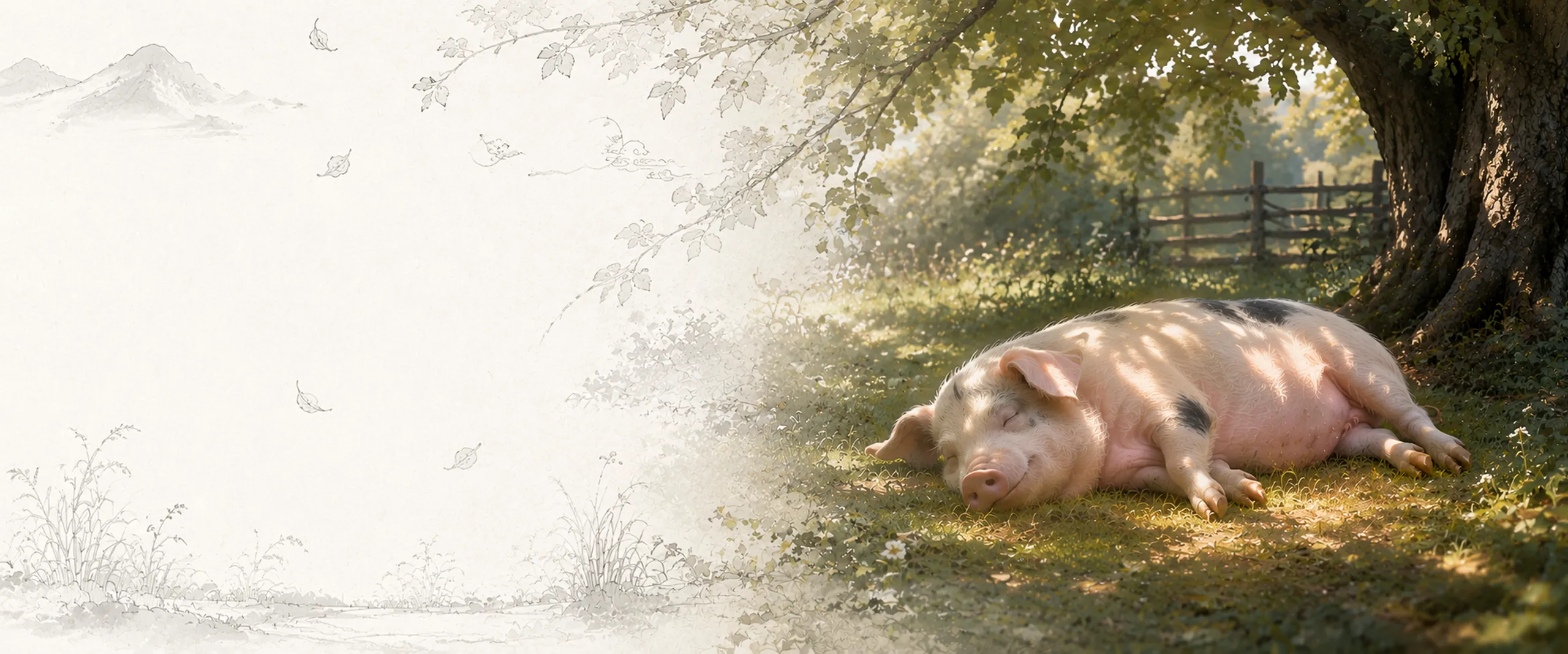
Hai hour runs from 9:00 p.m. to 11:00 p.m. and is also called “人定.” By this time, the night is deep, people exhausted from the day have already gone to sleep, and all sounds have fallen silent. The ancients observed that Pigs sleep most deeply during these hours and snore most loudly. After eating and drinking their fill, Pigs enter a deep sleep at Hai hour—their snores thunderous, their rest especially sound and peaceful. “人定” means that the night is deep and people have become still; it is precisely the time when all things settle into rest. The Pig’s deep sleep during Hai hour thus forms a natural correspondence with the hour known as “人定.” The ancients linked the time when Pigs fell asleep with Hai hour, and Hai hour therefore became “Pig hour.” Li Changqing of the Ming dynasty wrote in the *Songxiaguan Zhuiyan* (《松霞馆赘言》): “亥时,猪则饮食之外无一所知,故亥属猪。” This means that besides eating and sleeping, the Pig knows nothing else, and is therefore paired with Hai.
Philological Origins
From the standpoint of philology, the pairing of “亥” and the Pig is among the oldest and most firmly grounded of all zodiac pairings. In oracle-bone inscriptions, “亥” and “豕” were originally one and the same character, both pictographs of the Pig. As time passed, “亥” and “豕” gradually differentiated—one became a character used specifically for the earthly branch, while the other became a character used specifically for the animal. Yet the historical relationship between them was preserved. The pairing of “亥” with the Pig thus became one of the zodiac correspondences with the strongest philological evidence.
The Yin-Yang and Five-Elements Theory
From the perspective of Yin-Yang and the Five Elements, “亥” belongs to Yin Water. Biologically, Pigs do indeed like water—they enjoy rolling in mud and water during summer, are naturally able to swim, and are among the domestic animals most strongly associated with water. The Ming scholar Lang Ying wrote in the *Qixiu Leigao* (《七修类稿》): “亥为阴水,猪为水畜。” The Pig is the domestic animal with the strongest “water nature,” and is therefore paired with Hai-Water. The Han-dynasty *Shiji · Lüshu* (《史记·律书》) also states: “亥者,该也。言万物藏于下也。” This accords with the Pig’s tendency toward stillness and lying down.
Records in Classical Texts
The Qin Bamboo-Slip *Rishu*
In 1975, the *Daozhe* section of the bamboo-slip *Rishu* (《日书·盗者》) was excavated from Qin Tomb No. 11 at Shuihudi in Yunmeng County, Hubei. The tomb is dated to the era of Qin Shi Huang in the third century BCE. The *Rishu* records the animal corresponding to “亥” as “豕”, the Pig. The Shuihudi Qin slips read: “亥,豕也.” Type A of the *Rishu* excavated from the Qin bamboo slips of Fangmatan in Tianshui, Gansu, likewise pairs “亥” with “豕.” The Fangmatan slips read: “亥,豕矣.” In the Han bamboo-slip *Rishu* from Kongjiapo in Suizhou, Hubei, the animal paired with “亥” is also “豕.” Together, these discoveries prove that at least by the late Warring States period in the third century BCE, the pairing of “亥” with the Pig had already become widely circulated and firmly established across different regions of China. The pairing of “亥” and the Pig is one of the most stable of the twelve zodiac correspondences—from the Qin bamboo slips of the Warring States period to the Eastern Han *Lunheng*, and from the Neolithic period through the Ming and Qing dynasties, this pairing never changed.
The Pig in Pre-Qin Texts
Pigs appear with great frequency in pre-Qin classical texts. The *Shijing · Xiaoya · Jianjian Zhi Shi* (《诗经·小雅·渐渐之石》) contains the line “有豕白蹢,烝涉波矣”—a white-hoofed Pig wading through water—one of the most vivid literary descriptions of the animal from the pre-Qin period. The *Yijing · Daxu* (《易经·大畜》) contains the phrase “豮豕之牙”, referring to the tusks of a castrated Pig, and constitutes an early textual record of livestock-breeding techniques. Mencius wrote in the *Mengzi · Liang Hui Wang I* (《孟子·梁惠王上》): “鸡豚狗彘之畜,无失其时,七十者可以食肉矣。” “豚” means a young Pig and “彘” a mature Pig. Mencius places the Pig first among the Six Domestic Animals, showing that by the Warring States period, it was already one of the most important sources of meat in everyday life. The *Liji · Wangzhi* (《礼记·王制》) records: “天子社稷皆太牢,诸侯社稷皆少牢。” In the Tailao sacrifice, Ox held the first position, and the Pig was one of the three sacrificial animals—Ox, Goat, and Pig—giving it an important place within the ritual system.
The Eastern Han *Lunheng*
The earliest transmitted text to record the same twelve zodiac animals used today is Wang Chong’s Eastern Han *Lunheng* (《论衡》). Wang Chong writes explicitly in the *Lunheng · Wushi Pian* (《论衡·物势篇》): “亥,水也,其禽豕也。” He also states: “亥,豕也。” Wang Chong records all twelve animals in the *Lunheng*, and the pairing of “亥” with “豕,” the Pig, is already completely identical to the modern system. This shows that by the Eastern Han period, in the first century CE, the Pig’s position within the twelve-animal zodiac was firmly beyond doubt.
Zodiac Figurines and Pig-Shaped Artifacts
The Tradition of Zodiac Figurines from the Northern and Southern Dynasties to the Tang Dynasty
The twelve zodiac figurines, also known as divine figurines of the Twelve Branches, were distinctive burial objects in ancient Chinese funerary culture. Large numbers of twelve-animal zodiac pottery figurines with animal heads and human bodies have been excavated from Tang tombs. The Hai-Pig figurine has a Pig’s head and human body and wears the clothing of a civil official. The zodiac figurines followed a fixed arrangement within tombs: three were placed in each of the four directions—east, south, west, and north—beginning with the Rat and ending with the Pig, arranged clockwise according to Zi south, Wu north. The Hai-Pig figurine was usually positioned in the direction corresponding to north by northwest, the directional position of Hai among the twelve earthly branches. These figurines were intended to allow the twelve deities to guard the tomb occupant in turn, bringing peace and auspiciousness while driving away evil and misfortune.
Sui-Dynasty Celadon Zodiac Pig Figurine
A Sui-dynasty celadon zodiac Pig figurine unearthed in 1955 at Guizishan in Wuchang, Wuhan, Hubei, stands 16.5 centimeters high. It has a human body and animal head, wears clothing, holds a *hu* tablet, and sits cross-legged. Its form is highly lifelike, its glaze greenish yellow, and its craftsmanship refined.
Tang-Dynasty Painted Pottery Zodiac Figurines
A group of Tang-dynasty painted pottery zodiac figurines unearthed in 1955 from a Tang tomb at Hansenzhai in Xi’an, Shaanxi, is now held by the National Museum of China. The figurines stand 40 to 42 centimeters high and all have animal heads and human bodies, with the heads respectively representing the twelve zodiac animals. Their bodies are human in form, dressed in open-collared, broad-sleeved robes whose hems fall to the feet, with both hands clasped before the chest. Their refined bearing carries a touch of humorous charm. The Hai-Pig figurine has a Pig’s head and human body, with the facial features rendered in fine detail: the snout projects forward, both ears stand upright, and the overall image is vivid.
Zodiac Pig Figurine from the Astana Tombs in Turpan, Xinjiang
Unearthed in 1972 from Tomb No. 215 at the Astana Cemetery in Turpan, Xinjiang, together with a Rooster-headed human-bodied figurine, this Pig figurine stands approximately 80 centimeters high and is made of painted clay. It has a Pig’s head and human body, wears a long cross-collared, broad-fronted, wide-sleeved robe, and clasps both hands together within the sleeves. This artifact reflects the fusion of Central Plains culture and the culture of the Western Regions.
Pig-Head Bronze Statue from the Yuanmingyuan
The Pig-head bronze statue of the Yuanmingyuan formed part of the Haiyantang hydraulic clock system created during the Qianlong reign of the Qing dynasty, with the Italian missionary Giuseppe Castiglione presiding over the design and the Frenchman Michel Benoist supervising the work. Twelve animal-headed human-bodied statues were arranged in an “eight” shape on both sides of the fountain pool in front of Haiyantang. At each traditional hour, the corresponding animal head would spout water to announce the time. During Hai hour, from 9:00 p.m. to 11:00 p.m., the Pig head sprayed a column of water from its mouth. In 1860, Anglo-French forces burned the Yuanmingyuan and the twelve zodiac bronze statues were looted and dispersed overseas. The Pig-head bronze statue spent more than a century abroad. In 2000, it was purchased and returned to China by the China Poly Group and is now held by the Poly Art Museum in Beijing.
Neolithic Period —— The Earliest Pig Images
Pottery Pig from the Zengpiyan site in Guilin, Guangxi, approximately 9,000 years ago: A pottery Pig was unearthed there and is one of the earliest Pig-shaped artifacts discovered in China.
Hemudu Culture pottery Pig, approximately 7,000 years ago, unearthed from the Hemudu site in Yuyao, Zhejiang: This hand-modeled pottery Pig measures 6.3 centimeters long and 4.5 centimeters high and closely resembles a charming Wild Boar, with a rounded body, short limbs, projecting snout, and upright bristles. According to research, it may have been a children’s toy or a portable ornament. In addition, a group of Pig-pattern pottery bowls was excavated from the Hemudu site, with different Pig motifs carved on the two outer sides of each bowl. The images fall somewhere between Wild Boars and domestic Pigs, indicating that the early inhabitants were in the process of domesticating Pigs.
Hongshan Culture Jade Pig-Dragon from Inner Mongolia, approximately 5,000 years ago: Large numbers of Jade Pig-Dragons have been unearthed from Hongshan Culture sites. The Jade Pig-Dragon is a jade object with a Pig’s head and serpent-like body. Its head displays obvious Pig features—large ears and a projecting snout—while the body curls into a C shape. The Jade Pig-Dragon may have been an object of totemic worship among the early peoples of the Hongshan Culture, a sacred symbol of a “Pig deity,” and also one of the important sources of the Chinese Dragon totem.
Shang and Zhou Periods —— Pigs on Bronze Vessels
Shang-dynasty Pig zun, unearthed in Xiangtan, Hunan: The Shang bronze Pig *zun* is among the finest bronze Pig-shaped vessels yet discovered. The entire vessel is shaped like a Wild Boar, with a projecting snout, exposed tusks, raised bristles, and thick, powerful legs. Its form is vivid and realistic and possesses great artistic value.
Pig bones from Shang sacrificial pits at Yinxu, Anyang, Henan: Large numbers of complete Pig skeletons have been found in sacrificial pits at Yinxu, showing that in Shang ritual practice, the Pig was an important sacrificial animal second only to the Ox.
Han Dynasty —— Pottery Pigs and Pigsty Models
Han-dynasty pottery Pigs: Thousands of pottery Pigs have been unearthed from Han tombs across China, shown standing, lying down, or eating, vividly reflecting the development of Pig raising during the Han dynasty.
Han-dynasty Pigsty models: Large numbers of Pigsty models have also been unearthed from Han tombs—circular pottery structures containing Pigs, feeding troughs, and roofs. These models provide a realistic picture of household Pig-raising economies during the Han period.
An Eastern Han pottery sow with Piglets unearthed in 1956 outside the South Gate of Changsha, Hunan, depicts a heavily fattened sow with a sagging belly and visible teats, rendered with an endearingly clumsy appearance. The Pig’s expression is extraordinarily vivid and lifelike—the mouth slightly open, the head extended forward, as though searching for food.
Wei, Jin, Northern and Southern Dynasties —— Celadon Pigs
A Western Jin Yue ware celadon Pigsty is shaped as an oval enclosure containing several pottery Pigs. Pigsties were among the common celadon funerary objects of the Six Dynasties period. The Six Dynasties also saw the appearance of celadon Pig-shaped writing implements, such as Pig-shaped water droppers for inkstones.
Tang-Dynasty Sancai Pig Figurines
Pig images also appear among Tang sancai objects, most often modeled as domestic Pigs.
Origins and Domestication of the Pig
The Pig belongs to the class Mammalia, order Artiodactyla, and family Suidae. The wild ancestor of the domestic Pig is the Wild Boar. China is one of the earliest countries in the world to have domesticated the Pig. Archaeological evidence shows that the history of Pig raising in China can be traced back to the early Neolithic period approximately 9,000 years ago. The Pig was the earliest meat-producing animal to be domesticated among the Six Domestic Animals. Unlike herbivores such as Oxen and Goats, Pigs are omnivorous, inexpensive to raise, highly reproductive, fast-growing, and yield large quantities of meat. These biological characteristics made them one of the most ideal sources of meat for humans.
Pig Bones at Prehistoric Sites
Pig bones have been unearthed from dozens of Neolithic sites across China, with the earliest dating to approximately 9,000 years ago. At the Zengpiyan site in Guilin, Guangxi, around 9,000 years ago, domestic Pig bones were unearthed and constitute some of the earliest domestic Pig remains discovered in China. The Cishan site in Wu’an, Hebei, around 7,800 years ago, yielded large quantities of Pig bones, showing that Pigs were already important domestic animals in Neolithic northern China. Pig bones were also discovered at the Peiligang site in Xinzheng, Henan, around 7,800 years ago. At the Hemudu site in Yuyao, Zhejiang, around 7,000 years ago, domestic Pig fossils provide important evidence for early Pig raising in the Yangtze River region. Pig bones were unearthed at the Banpo site in Xi’an, Shaanxi, around 6,000 years ago, while large quantities were also found at the Yinxu site in Anyang, Henan, dating to the late Shang dynasty, providing strong evidence for the advanced state of Pig husbandry during the Shang. These archaeological discoveries show that the symbiotic relationship between Pigs and the early peoples of China has continued for nearly ten thousand years.
From Altar to Dining Table —— The Evolution of the Pig’s Ritual Status
In ancient China, the Pig’s status underwent an evolution from altar to dining table. From the Neolithic period through the Shang and Zhou dynasties, the Pig occupied a central place in sacrifice. At Neolithic ritual sites, Pigs were common sacrificial animals. During the Shang and Zhou periods, the Pig was one of the three sacrificial animals of Tailao and an indispensable sacred presence in ritual. In sacrificial ceremonies, the Pig was regarded as a medium connecting Heaven and Earth. During the Spring and Autumn and Warring States periods, as animal husbandry developed and the population grew, the Pig gradually moved from altar to dining table. Mencius’ phrase “鸡豚狗彘” places the Pig first among the Six Domestic Animals, showing that it had become the most important source of meat at the time. After the Han and Tang dynasties, Pig raising became a pillar of household economy. In traditional Chinese agricultural society, the character “家”, “home,” is literally formed by a Pig under a roof—“家” consists of “宀”, a house, and “豕”, a Pig. Only when “豕” is beneath the roof does the character “家” come into being. Where there is a Pig, there is a home. The Pig was a symbol of household wealth and a fundamental basis of stability and livelihood in agricultural civilization. The Pig’s central position within the structure of the Chinese character “家” is perhaps the clearest proof of its cultural importance within Chinese civilization.
Among the myths and legends surrounding the Hai-Pig, both their abundance and the vividness of their plots rank among the foremost of the twelve zodiac animals. From the legendary story of Marshal Tianpeng’s banishment to the mortal world, to the classic image of Zhu Bajie journeying westward in search of the scriptures; from the auspicious folk saying “猪入门,百福臻” to the philosophical symbolism of Hai-Pig as both ending and beginning, the Pig’s mythological image spans the celestial and human realms, the sacred and the secular.
Creation and Heroic Narratives
Divine Pigs in the *Shanhaijing*
The *Shanhaijing* records several extraordinary Pig-like creatures.
Bingfeng: The *Shanhaijing · Haiwai Xijing* (《山海经·海外西经》) records: “并封在巫咸东,其状如彘,前后皆有首,黑。” Bingfeng is a strange beast shaped like a Pig, with a head at both the front and rear and an entirely black body. It is one of the most famous Pig-shaped divine beasts in the *Shanhaijing*.
Haozhi: The *Shanhaijing · Xishanjing* (《山海经·西山经》) records: “竹山,有兽焉,其状如豚而白毛,毛大如笄而黑端,名曰豪彘。” Haozhi is a beast shaped like a young Pig, with white fur whose tips are black. It is regarded as the prototype or mythologized form of the Porcupine.
Fengxi: The *Shanhaijing* also records “封豨,” a giant Wild Boar later slain by Hou Yi. In the famous Chinese myth of Hou Yi Shooting the Suns, Hou Yi not only shot down nine of the suns in the sky but also killed the giant Wild Boar Fengxi that was bringing calamity to the human world. The story of Hou Yi slaying Fengxi reflects the long struggle between early humans and Wild Boars—the Wild Boar was once one of their most dangerous enemies before later being domesticated into the domestic Pig.
Marshal Tianpeng Is Banished
This is the most famous legend about how a Pig came to become a Pig, and it forms the mythological origin of Zhu Bajie’s background in *Journey to the West*.
Marshal Tianpeng —— Commander of the Celestial River
Legend says that in remote antiquity, the Pig’s former identity was Marshal Tianpeng, who governed the Celestial River in Heaven. Marshal Tianpeng was a high-ranking divine general of the celestial court, commanding the naval forces of the Celestial River and wielding great authority. He was powerfully built, highly skilled in martial arts, and deeply trusted by the Jade Emperor. Yet Marshal Tianpeng possessed one fatal weakness—he was lustful and fond of drink. Although he carried out his official duties diligently, his private conduct was undisciplined, and he often made mistakes after drinking.
Drunken Misconduct —— Harassing Chang’e
Legend says that one year on the fifteenth day of the eighth lunar month, Marshal Tianpeng attended the Heavenly Court’s Peach Banquet. The feast offered everything imaginable—fine celestial wine, exquisite food, and delicacies of every kind. Marshal Tianpeng drank freely until he was thoroughly intoxicated. Emboldened by drink, he made his way to Guanghan Palace, where he saw Chang’e dancing gracefully in the Moon Palace. Captivated by her beauty, Marshal Tianpeng approached her under the influence of alcohol and harassed her. Humiliated and furious, Chang’e reported him to the Jade Emperor. When the Jade Emperor learned what had happened, he flew into a rage and ordered Marshal Tianpeng stripped of his divine office and cast down into the mortal world, never again to return to Heaven.
Mistaken Rebirth into a Pig —— Taking on a Pig’s Body
After being banished to the mortal world, Marshal Tianpeng was supposed to be reborn as a human. Yet his luck was poor, and in his hurried journey toward reincarnation he took the wrong path—crashing straight into the belly of a sow. When Marshal Tianpeng awoke again, he discovered that he had become a Pig, with a long snout, large ears, round body, and short tail. From that moment onward, Marshal Tianpeng bore the form of a Pig.
Zhu Bajie —— The Story of Gao Village
Later, this Pig cultivated supernatural powers and became a spirit, occupying Gao Village and taking the daughter of Old Gao as his wife. When Tang Monk passed through Gao Village on his journey westward to obtain the Buddhist scriptures, Sun Wukong subdued the Pig spirit. Tang Monk accepted him as a disciple and gave him the name “Zhu Bajie.” “Bajie,” the Eight Precepts, refers to eight rules: not killing, not stealing, not engaging in sexual misconduct, not lying, not drinking alcohol, not indulging in excessive sleep, not engaging in divisive speech, and not using abusive language. Zhu Bajie followed Tang Monk westward, protecting him throughout the journey. Although he frequently displayed his habits of gluttony and lust, he also repeatedly distinguished himself in battle. After the scriptures were successfully obtained, the Tathagata Buddha appointed him “净坛使者,” the Altar Cleanser.
The Cultural Meaning of Zhu Bajie
Zhu Bajie is the most famous Pig figure in the history of Chinese literature. Although gluttonous, lazy, and lustful, he is also honest, straightforward, and compassionate. He is a complex and deeply human character—“呆子”, “the fool,” is his label, while “净坛使者” is his final destination. The image of Zhu Bajie endowed the Pig with an unprecedented literary charm and human radiance within Chinese culture.
Legends of Zodiac Ranking
The Rich Man’s Son Is Punished by Becoming a Pig
This is a classic and widely circulated legend explaining why the Pig occupies the final position in the zodiac.
The Only Son of a Wealthy Family
Legend says that long ago, there was a wealthy couple who had a son late in life. The boy was handsome, with fine features, and a physiognomist who examined him said that he was destined for wealth and extraordinary good fortune. The couple were delighted and thereafter doted on their precious son even more. Spoiled from childhood, the boy became accustomed to having clothes brought to him and food placed before him, developing an ingrained habit of laziness. As he grew older, not only did he refuse to strive or study, he became even more idle and aimless.
The Jade Emperor Is Furious —— Punished to Become a Pig and Eat Coarse Bran
After his parents died one after the other, the lazy only son no longer had anyone to restrain him and became even more reckless. He sold off the entire family estate and spent every day eating, drinking, and entertaining himself. Within only a few years, he had squandered the family’s vast fortune. Once the household fell into decline, he refused either to work or learn a trade and eventually starved to death by the roadside. After he died, his soul drifted into the underworld. King Yama opened his register of life and death and, upon reading it, became furious: “你生来富贵,竟因懒惰而饿死!天地之间岂能容你?” He reported the man’s offenses to the Jade Emperor. After reading the report, the Jade Emperor angrily declared: “这样的人,就罚他为猪、吃粗糠,永世不得再享人福!”
The Heavenly Official Mishears —— “Eat Coarse Bran” Becomes “Become a Zodiac Animal”
After issuing the decree, the Jade Emperor sent a heavenly official to the underworld to carry it out. Unfortunately, this official had rather poor hearing and misheard “罚为猪、吃粗糠”, “punish him by making him a Pig and feeding him coarse bran,” as “罚为猪、当属相”, “punish him by making him a Pig and making him a zodiac animal.” When the heavenly official reached the underworld, he announced the Jade Emperor’s decree. King Yama found it somewhat strange, but since the order had been transmitted by a heavenly official, he could only carry it out.
The Pig Becomes a Zodiac Animal —— Last Place
Thus, the lazy son of the wealthy family was transformed into a Pig and placed in the final position of the twelve-animal zodiac. Although he became a zodiac animal, he still ate coarse bran every day and slept on muddy ground. This was the Jade Emperor’s punishment for his laziness—even after becoming a zodiac animal, he still had to endure hardship.
The Hai-Pig Competes for a Zodiac Place
This is another legend about how the Pig entered the twelve-animal zodiac and is circulated in northeastern China.
The Pig Registers Late —— Too Clever for Its Own Good
Legend says that when the Jade Emperor selected the twelve zodiac animals, all the animals hurried eagerly to register. The Pig also knew about the selection but thought to itself: “I walk slowly, so I can never outrun those fast animals. I might as well sleep comfortably first and set out just before dawn—then perhaps I can arrive ahead of everyone else!” Thinking itself clever, the Pig lay down and fell asleep. But it overslept. When it finally woke, the sun was already high in the sky. The Pig hurried to the gates of Heaven and discovered that all the other animals had already registered, leaving only the final position vacant. It rushed forward and arrived just in time to take twelfth place.
The Pig Reflects —— Grateful for the Opportunity
Although the Pig ranked last, it did not become discouraged. It was deeply grateful to the Jade Emperor for giving it the opportunity to become a zodiac animal. The Pig sincerely reflected before him: “我虽然跑得慢、长得胖,但我一定努力为人类服务。” From then onward, the Pig became the most contented and cheerful member of the twelve zodiac animals. Although this legend is less widely circulated than the story of Marshal Tianpeng, it vividly portrays the Pig as honest, contented, and optimistic.
Folk Beliefs and Folk Customs
The Pig as a God of Wealth
In Chinese folk belief, the Pig has been endowed with symbolic meanings of wealth and good fortune.
“猪入门,百福臻”
The folk saying “猪入门,百福臻” is widely circulated. It means that when a Pig enters the household, all forms of blessing arrive with it. This is connected with the homophony between “猪” and “诸”—“a Pig enters the door” becomes “all blessings enter the door,” signifying that everything will go as wished.
The Pig as a “Water Animal”
In *feng shui*, the Pig is called a “water animal” and belongs to Hai-Water. Water governs wealth, and the Pig’s identity as a “water animal” therefore gives it the auspicious meaning of attracting wealth and treasure. Folk expressions include “金猪拱门” and “金猪纳福.”
The Auspicious Meaning of Pig’s Trotters
Because “蹄”, trotter, is homophonous with “题”, as in “题名,” Pig’s trotters symbolize “金榜题名,” achieving success in the imperial examinations. During the imperial examination era, families with scholars would eat Pig’s trotters before the candidate departed for the examination, drawing upon the auspicious sound of “题名.” This custom is still preserved in some regions today.
The Hai Deity and the Pig Deity
In Chinese folk belief, the Pig is regarded as the “Hai Deity” or “Pig Deity.” In some regions, people make offerings to the Hai Deity during the tenth lunar month, the Hai month, praying for abundant harvests of the Five Grains and flourishing livestock in the coming year. The formation of belief in the Hai Deity is closely connected with the Pig’s central position in agricultural society. People were grateful that the Pig provided humans with meat, fat, and hides, and thus deified and worshiped it. This belief also formed part of the social foundation for the Pig’s inclusion among the twelve zodiac animals.
As zodiac culture spread, it incorporated elements of local cultures, and the image of the Pig took on different forms across East Asian societies. The most striking difference is Japan’s cultural variant in which the Wild Boar replaces the domestic Pig.
Japan
Japan’s twelve zodiac animals are basically the same as China’s—Rat, Ox, Tiger, Rabbit, Dragon, Snake, Horse, Goat, Monkey, Rooster, Dog, and Wild Boar. In Japan, the twelfth zodiac animal is written “猪”, but in Japanese this character refers to the Wild Boar, while the domestic Pig is called “豚.” This forms a striking contrast with the Chinese use of the domestic Pig as the zodiac animal. In the Japanese zodiac, “猪” specifically means the Wild Boar—イノシシ (*inoshishi*)—rather than the domestic Pig—ブタ (*buta*). This difference derives from Japan’s historical and cultural background. Pig husbandry developed relatively late in Japan, and domestic Pigs were not introduced on a large scale until the modern period. In ancient Japan, when zodiac culture was taking shape, Wild Boars were far more common and familiar than domestic Pigs. In Japanese culture, the Wild Boar symbolizes courage, fearlessness, and strength. It is one of the fiercest beasts of the Japanese mountains and forests, and hunters regarded killing a Wild Boar as a sign of bravery. Accordingly, in Japanese belief, people born in a Wild-Boar year are considered bold, decisive, and unafraid of difficulties. In China, “猪” generally means the domestic Pig, but in Japan the character specifically refers to the Wild Boar, while “豚” denotes the domestic Pig. This linguistic convention has profoundly shaped Japanese understanding of the zodiac Hai-Pig—in Japan, the Hai-Pig is a fierce and courageous Wild Boar, rather than an endearingly plump domestic Pig.
Vietnam
In Vietnam’s twelve-animal zodiac, the Pig likewise occupies twelfth place. Vietnam’s zodiac system is basically the same as China’s—the only difference is that the Cat replaces the Rabbit. Vietnam uses the domestic Pig as its zodiac animal.
Korean Peninsula
The twelve zodiac animals of the Korean Peninsula—North Korea and South Korea—are exactly the same as those of China. In Korean culture, the Pig is likewise a symbol of good fortune and wealth.
Commonalities and Differences
The Pig occupies the twelfth position in the zodiac systems of East Asian countries, and this shared ranking reflects its widespread importance throughout the East Asian cultural sphere. Yet major differences exist in the details. China emphasizes the Pig’s associations with honest abundance, the auspicious saying “猪入门,百福臻,” and the philosophical symbolism of Hai-Pig as both ending and beginning. Japan replaces the domestic Pig with the Wild Boar, emphasizing courage and fearlessness. Vietnam and the Korean Peninsula largely continue Chinese Pig-culture traditions. Japan’s replacement of the domestic Pig with the Wild Boar is one of the most representative examples of localization in the transmission of zodiac culture. It demonstrates that culture does not remain unchanged as it spreads, but is adjusted and transformed according to local natural environments, social conditions, and cultural traditions.
Viewed across the origins and evolution of the Hai-Pig zodiac, one theme emerges throughout: among all twelve zodiac animals, the Pig has the oldest and most conclusive relationship with written language. The shared origin of “亥” and “豕” in oracle-bone inscriptions makes the Hai-Pig one of the zodiac pairings supported by the strongest philological evidence.
Characters and texts tell us that because the Pig sleeps deeply during Hai hour and, as a “water animal,” belongs to Water, it forms a dual correspondence in behavior and the Five Elements with the earthly branch “亥” and its meanings of Yin Water and storage. Even more remarkable is that from “亥,豕也” in the Warring States Qin bamboo-slip *Rishu* to “亥,水也,其禽豕也” in the Eastern Han *Lunheng*, the pairing of “亥” with the Pig has never wavered over more than two thousand years of history. It is the most stable pairing among the twelve zodiac animals, without exception.
Archaeology reveals the ten-thousand-year journey through which Pigs and the early peoples of China lived and developed side by side. From the pottery Pig of the Zengpiyan site in Guangxi dating to nine thousand years ago, to the Pig-pattern pottery bowls of the Hemudu Culture that depict animals somewhere between Wild Boars and domestic Pigs; from the Hongshan Culture Jade Pig-Dragon with its Pig’s head and serpent’s body to the complete Pig skeletons in the sacrificial pits of Yinxu—only when “豕” is beneath the roof does the character “家” come into being. The Pig was not only the earliest domesticated meat-producing animal but also the very soul of the cultural concept of “home.” Within the structure of the Chinese character “家,” the Pig acquired a cultural status that no other zodiac animal can match.
What truly gives the Hai-Pig its soul is the vast world of myths and legends. In these narratives born among the people, the Pig is Marshal Tianpeng, banished to the mortal world for harassing Chang’e; it is Zhu Bajie of *Journey to the West*, the seemingly foolish yet deeply human Altar Cleanser; it is the wealthy young man punished with rebirth as a Pig because of laziness; it is the honest, contented, and grateful final member of the zodiac; it is Bingfeng and Haozhi, the extraordinary Pig-like beasts of the *Shanhaijing*; it is Fengxi, the destructive Wild Boar slain by Hou Yi; and it is the symbol of wealth embodied in the saying “猪入门,百福臻.” The image of the Pig moves from Heaven to the human world, from divine general to ordinary domestic animal, from destructive beast to auspicious star. This richness of identities spanning myth and reality, the sacred and the secular, makes the Pig one of the most culturally diverse members of the twelve-animal zodiac.
When the Pig zodiac traveled beyond the Central Plains to Japan, Vietnam, and the Korean Peninsula, it retained its honored twelfth-place position across different cultures. Vietnam and the Korean Peninsula continued the domestic-Pig tradition, while Japan replaced it with the Wild Boar, because the Wild Boar’s courage and fearlessness correspond more closely to Japanese imaginings of strength. This perhaps suggests that the vitality of a cultural symbol lies not in whether it is reproduced without change, but in whether the values and imagination it carries can cross geographic boundaries. The Hai-Pig is precisely such a symbol. It comes strolling from the enclosures of remote antiquity, clothed in Hai-Water and treading upon the season of storage, leaving in the lifeblood of Chinese civilization its fullest and most abundant figure. Although it stands last among the twelve zodiac animals, it carries the most profound philosophical meaning within the zodiac cycle: an ending exists precisely so that a new beginning may emerge.
---
Readers’ Comments
Calendar and traditional culture enthusiasts from around the world, sharing the same moon.
Sign in or register to join the conversation. Your comment account is created automatically the first time you use a connected account.
No comments yet
Share your thoughts with readers around the world.