Spring Equinox Farming
「春分麦起身,一刻值千金。」
During 春分 (Chūnfēn, Spring Equinox), temperatures across most of China rise steadily and overwintering crops enter vigorous growth. On the North China Plain, winter wheat moves fully into peak jointing, while spring irrigation reaches its annual maximum; management of water and fertilizer now directly influences the number of kernels per ear. Across the Yangtze River basin, rapeseed shifts from full flowering toward early pod formation, while early-rice transplantation begins successively. In South China, early-rice transplantation reaches its peak, and spring peanuts and maize enter orderly seedling management. Across Northeast and Northwest China, frozen ground thaws rapidly and spring-wheat sowing reaches its height.
In the temperate Southern Hemisphere, the autumn equinox has arrived. Autumn-sown crops in southeastern Australia and Argentina emerge successively and enter the crucial stage of seedling management. In the tropical Northern Hemisphere, the dry season is nearing its end and water storage and land preparation enter their final phase. Across the tropical Southern Hemisphere, the rainy season has ended, and Brazilian soybeans and African maize move into large-scale harvest.
Global Agriculture
Temperate Regions of the Northern Hemisphere
Phenological Signs
Swallows return from Southeast Asia to China’s Yangtze River basin and begin carrying mud to build their nests. Spring thunder becomes more frequent, and thunderstorms increase. Across the Yellow River basin, average daily temperatures rise above 10°C, apricot blossoms enter full bloom, willows are fully leafed out, and the countryside is covered in fresh green. In Japan’s Kantō region, cherry blossoms reach full bloom; in Seoul, South Korea, peach blossoms open; and on Jeju Island, the sea of rapeseed flowers reaches its height.
Farming Activities
Winter wheat across the North China Plain enters peak jointing. Stems elongate rapidly—by 2–3 centimeters per day—while young ears differentiate and develop at an accelerating pace. Water and nutrient demand reaches its annual maximum. Fields short of moisture require immediate spring irrigation at 40–50 cubic meters per *mu*, while weak stands receive 拔节肥 (*jointing fertilizer*), generally 8–10 kilograms of urea per *mu*. Overly vigorous fields require strict water and fertilizer control to prevent lodging.
Across the Yangtze River basin, rapeseed moves from full flowering into early pod formation, while early-rice seedling raising enters its final push. In southern Jiangnan, early rice begins transplantation once seedlings reach the “三叶一心” stage—*three fully developed leaves and one central emerging leaf*. In South China, early-rice transplantation reaches its peak, and spring peanuts and maize enter the crucial period of seedling management.
In northern Chinese orchards, peaches, pears, and apples successively enter full bloom, requiring growers to watch late-frost forecasts closely. Across Northeast China, frozen soil melts rapidly, spring preparation enters its final sprint, and large-scale 种子包衣 (*seed coating*) expands.
Phenological Signs
Temperatures across Western Europe stabilize between 8°C and 15°C, and winter-wheat jointing accelerates. Orchards in France and Germany enter flowering, with apricot and peach blossoms opening successively and cherry blossoms filling city parks. Across Central Europe, temperatures rise to 8–12°C, snow disappears completely, and river levels stabilize. Hibernating animals emerge one after another, bird activity becomes frequent across the countryside, and turtle-dove calls echo through the fields.
Farming Activities
Winter wheat in France and Germany enters peak jointing, and farmers begin spring field management—applying mainly nitrogen-based jointing fertilizer and controlling seedling-stage diseases. Across Ukraine’s chernozem belt, winter wheat fully enters peak jointing and spring irrigation begins on a broad scale. Nourished by spring moisture, the fertile black soils display vigorous crop growth.
In Bordeaux, Rheinhessen, and other wine regions, grape buds begin to stir. Spring soil loosening and fertilization expand fully, while newly constructed vine trellises are installed. Northern Europe reaches the end of its frozen season; greenhouse vegetables begin transplantation into open fields and spring-farming preparations start in earnest.
Phenological Signs
Across the winter-wheat belt of Kansas, Nebraska, and neighboring states, temperatures rise to 12–15°C, fields turn green rapidly, and crops enter vigorous growth. In California’s Central Valley, the peak of almond blossom has passed and petals begin to fall, while apricot and peach trees enter full bloom. Peach and pear blossoms reach full bloom in the southeastern United States, and Midwest pastures return fully to green. In Ontario, Canada, maple-syrup collection enters its final phase and new maple buds begin to move.
Farming Activities
Winter wheat across Kansas, Nebraska, and other producing regions enters peak jointing, and water and nutrient management reaches its annual maximum. Farmers irrigate and topdress precisely according to crop vigor and soil moisture to ensure full young-ear development.
California’s Central Valley orchards move from full bloom into early fruit set. Growers watch late-frost forecasts closely, and some orchards begin flower thinning. In the U.S. Midwest, spring planting enters its final countdown: large seeders complete final calibration, seed treatment is finished, and farmers judge the sowing date according to soil temperature, which must remain steadily above 8–10°C. Spring cultivation and sowing are fully underway across the southeastern United States. The Canadian Prairies remain frozen, but warming is clear and farmers begin spring preparations.
Phenological Signs
Snow has completely disappeared from Turkey’s Anatolian Plateau and winter wheat enters rapid growth. Apricot blossom reaches its peak along Iran’s Caspian coast, while citrus groves along the eastern Mediterranean are filled with flowers and fragrance. Winter wheat in Morocco and Algeria enters jointing, covering the fields in vivid green.
Farming Activities
Winter wheat in Turkey, Iran, and other parts of the Middle East enters peak jointing. Spring irrigation expands fully, and farmers fertilize precisely according to soil moisture. Along the Mediterranean coasts of Israel, Morocco, and other parts of North Africa, winter wheat enters jointing and farmers begin spring field management—topdressing, irrigation, and pest and disease control proceeding together. Grape harvesting in South Africa’s Cape region approaches its end, while vineyards that have completed harvest begin autumn pruning.
Temperate Regions of the Southern Hemisphere
Phenological Signs
It is the autumn equinox. Average daily temperatures fall to around 15–20°C, day and night are equal in length, and the air becomes clear and crisp. Wheat fields have been entirely harvested, leaving the land bare or newly tilled. Pastures turn fully yellow, making the colors of autumn unmistakable. Dense morning fog often settles over valleys, daylight begins to grow shorter than night, and the feeling of autumn deepens.
Farming Activities
Autumn-sown crops—winter wheat, barley, and rapeseed—emerge successively after being planted in mid- to late March and enter the crucial stage of seedling management. Farmers 查苗补缺 (*inspect emergence and fill gaps*), resowing where stands are missing; irrigate when drought threatens in order to support seedling growth and tillering; and control seedling-stage pests and diseases such as aphids and cutworms.
The condition of autumn-sown crops at the seedling stage directly influences overwintering ability and the following year’s yield, making precise management essential. Vineyard harvest is largely complete and autumn pruning expands fully—removing surplus shoots, adjusting the vine framework, and regulating the next year’s crop load. Pruned branches are collected, shredded, and incorporated into the soil to increase organic matter. Fields following the winter-wheat harvest are fully tilled and rested in preparation for the next crop.
Phenological Signs
Temperatures fall to around 18–22°C and autumn officially settles in. Grasslands yellow further and the countryside gains richer layers of color. Soybean leaves turn fully yellow and fall, while pods reach complete maturity. Morning dew becomes more frequent and daylight begins to shorten below the length of night.
Farming Activities
Autumn sowing of winter wheat, barley, and rapeseed expands fully. Farmers plow the soil, apply basal fertilizer—mainly compound fertilizer—sow, and roll the fields, much like spring planting in the Northern Hemisphere.
At this time, soil temperature and moisture are crucial to emergence. Autumn-sown crops need to establish sufficient roots and tillers before winter arrives if they are to overwinter safely. Soybeans enter full-scale harvest, with large combines moving across the fields. Harvested soybeans are dried and shipped for export. Maize harvesting proceeds at the same time, and the Pampas enters its busiest harvest season of the year. Vineyard picking nears its end and autumn pruning begins successively.
Phenological Signs
Temperatures fall to around 10–15°C and the atmosphere becomes distinctly autumnal. Pasture growth slows further across both the North and South Islands, and some grazing lands turn fully yellow. Grape harvesting is completely finished, while kiwifruit harvesting reaches its peak. Morning frost begins appearing in low-lying areas, and daylight becomes noticeably shorter than night.
Farming Activities
Farmers on both islands fully launch autumn pasture management—overseeding cool-season ryegrass and white clover, applying autumn fertilizer, adjusting stocking density, and storing hay for winter. Autumn-sown pasture grasses take advantage of autumn rainfall and mild temperatures to grow rapidly and build winter feed reserves.
Autumn vineyard pruning expands fully, and its quality directly influences grape quality in the following year. Kiwifruit orchards enter peak harvest: gold and green fruit are picked, graded, and packed in concentrated volumes. The export season continues at full strength. New Zealand kiwifruit is well known worldwide, and this is the prime season for supplying Northern Hemisphere markets.
Phenological Signs
Grape harvesting in the Central Valley enters its final phase, while orchard leaves change color fully. Apples and pears enter peak harvest, fully mature and richly colored. Daylight is now shorter than night and the atmosphere is unmistakably autumnal.
Farming Activities
Grape harvesting across the Central Valley approaches its end, and wineries enter the closing stretch of the busiest crushing season of the year. Apple- and pear-producing areas move into peak harvest, with picking, sorting, and packing lines operating at full speed and large volumes exported to Northern Hemisphere markets. Autumn orchard management expands fully—pruning, fertilization, and pest and disease control proceed in parallel to lay the foundation for growth and fruiting in the following year.
Tropical and Subtropical Regions
Phenological Signs
The dry season is about to end. Air humidity rises noticeably and occasional thunderstorms appear, signaling the approach of the rainy season. Average daily temperatures in Thailand, Myanmar, Laos, and neighboring areas remain above 30°C, but the increasing humidity begins to change how the heat feels. Wheat across northern India’s Ganges Plain reaches maturity, with full golden ears. In southernmost China, rice seedbeds form expanses of fresh green while transplantation enters full swing.
Farming Activities
Water storage and land preparation enter their final phase. Farmers intensify the filling of reservoirs and ponds, repair irrigation channels, clear ditches, and service pumping equipment in preparation for rice cultivation after the rainy season arrives.
Dry-season rice harvesting is fully complete across Thailand, Vietnam, and Cambodia, and farmers plow the land while waiting for the rains. Wheat in northern India’s Ganges Plain enters maturity, and farmers begin preparing harvesting tools and storage facilities. Cutting, sun-drying, threshing, and storage will be completed in concentrated fashion over the coming month.
In southernmost China, early-rice transplantation reaches its peak. After seedlings are moved into the main fields, farmers maintain a 3–5-centimeter shallow water layer to encourage 返青 (*post-transplant recovery and return to green*) and tillering.
Phenological Signs
The rainy season officially ends. Rainfall declines rapidly and clear, dry weather becomes more common as the climate shifts from hot and humid toward drier conditions. Across central-western Brazil, soybean leaves turn fully yellow and fall, while pods reach complete maturity. In southern Africa, maize enters maturity and cobs are full and golden. Northern Australian sugarcane matures and is harvested, gradually clearing the fields. Oil-palm fruit harvesting in Indonesia and Malaysia approaches its end.
Farming Activities
Harvest season expands fully. Across central-western Brazil, soybeans enter peak large-scale harvest, with massive combines operating day and night across golden fields. The harvested crop is dried and shipped for export to China and Europe.
Brazil’s second-season maize enters seedling management. Farmers sow maize immediately after soybean harvest, making use of the residual soil moisture left at the end of the rainy season to secure emergence. In Zambia, Tanzania, Zimbabwe, and other parts of southern Africa, maize enters full-scale harvest. Farmers seize clear weather to cut, dry, and store the crop. In Queensland, northern Australia, sugarcane enters full harvest and sugar mills are busy crushing cane. Oil-palm harvesting in Indonesia and Malaysia approaches its end, output begins to decline, and growers start preparing for the next harvest cycle.
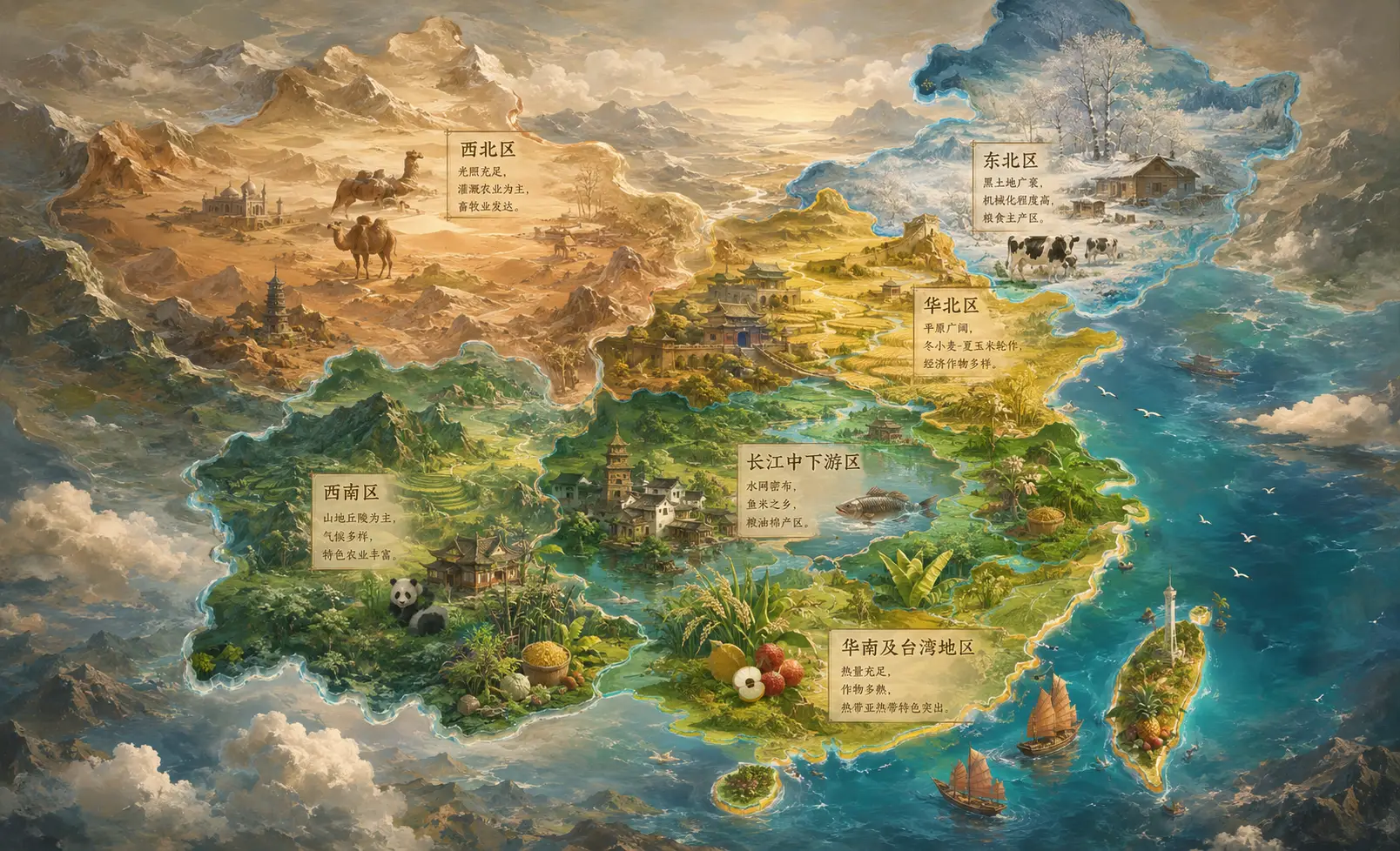
China’s Six Major Agricultural Regions
| Agricultural Region | Major Provinces | Keywords |
|---|---|---|
| Northeast | Heilongjiang, Jilin, Liaoning, eastern Inner Mongolia | Frozen-soil thaw, spring-preparation sprint, machinery calibration, seed coating |
| Northwest | Xinjiang, Gansu, Ningxia, western Inner Mongolia, Qinghai | Spring-wheat sowing, winter-wheat jointing, spring irrigation, lambing |
| North China | Hebei, Shanxi, Beijing, Tianjin, Shandong, northern Henan | Winter-wheat jointing, spring-irrigation peak, topdressing, pest and disease control |
| Middle and Lower Yangtze | Hubei, Hunan, Jiangxi, Anhui, Jiangsu, northern Zhejiang, Shanghai | Rapeseed pod formation, early-rice transplantation, wheat jointing, ditch clearing and waterlogging prevention |
| Southwest | Sichuan, Chongqing, Guizhou, Yunnan, southeastern Tibet | Early-rice transplantation, stripe-rust control, potato emergence, spring-tea picking |
| South China and Taiwan | Guangdong, Guangxi, Hainan, southern Fujian, Taiwan Province | Early-rice transplantation, seedling recovery, peanut and maize seedling management, fruit retention |
Heilongjiang, Jilin, Liaoning, eastern Inner Mongolia
During the Spring Equinox, frozen ground across Northeast China begins to thaw rapidly. The upper 10–20 centimeters of soil have already thawed, while deeper layers remain frozen. Daytime highs may reach 5–10°C, snow melts across broad areas, and the ground becomes muddy. Agricultural work remains centered on “备”—*preparation*—but has entered its final sprint.
Final sprint of spring preparation. Spring sowing across Northeast China usually begins from early to mid-April—around April 15–20 in Heilongjiang and April 5–10 in Liaoning. At the Spring Equinox, only two to three weeks remain before planting, so every preparation must now be completed.
Large-scale seed coating expands, combining insecticides, fungicides, and micronutrient fertilizers. Coated seeds must be dried before being bagged for later use. Fertilizer procurement and storage are fully in place, and fertilization plans are drawn up according to soil-test results for each field.
Large tractors, seeders, and sprayers complete their final calibration. This includes testing the single-seed placement rate of seeders at at least 98%, calibrating fertilizer furrow depth to an error no greater than ±0.5 centimeters, and checking nozzle output on sprayers.
Monitoring frozen-soil thaw. The Spring Equinox is the period when Northeast farmers watch thaw depth especially closely. The depth of thaw directly influences sowing time. Maize and soybeans can be planted only when soil temperature remains steadily above 8–10°C. Farmers dig into the soil daily to check thaw depth and combine these observations with weather forecasts to identify the best planting window.
Lambing continues in pastoral areas. Lambing still continues in eastern Inner Mongolia but is approaching its end. Most of the year’s expected newborn lambs have already arrived, and herders shift their emphasis from assisting births to caring for young animals—strengthening supplemental feeding, administering vaccines, and preventing common spring diseases.
Protected agriculture. Greenhouse vegetable production remains at peak levels in southern Liaoning. Rising temperatures make overheating inside greenhouses increasingly likely, so daytime ventilation must be strengthened. Strawberries enter the peak of their second fruiting cycle, requiring stronger water and nutrient management to extend the harvest period.
Xinjiang, Gansu, Ningxia, western Inner Mongolia, Qinghai
At the Spring Equinox, Northwest China enters the busiest stage of spring sowing. Spring-wheat planting reaches its peak, while winter wheat in southern Xinjiang enters peak jointing and reaches its maximum water and nutrient demand.
Peak spring-wheat sowing. Across the Hexi Corridor in Gansu and Yellow River irrigation districts of Ningxia, spring-wheat sowing reaches its seasonal height around the Spring Equinox. Farmers race against time: sowing can begin once the upper 2–4 centimeters of soil have thawed, and the window for 顶凌播种 (*sowing while deeper ground remains frozen*) usually lasts only 10–15 days.
Seed is placed 3–5 centimeters deep at row spacing of 15–20 centimeters, and fields are immediately rolled after sowing to conserve moisture. Spring-wheat acreage sown reaches its annual maximum during the Spring Equinox. The Hexi Corridor is one of China’s major spring-wheat producing regions, making sowing quality directly relevant to the year’s harvest.
Spring irrigation expands fully. After sowing, spring wheat in Gansu, Ningxia, and western Inner Mongolia requires prompt irrigation known as “蒙头水”—*an initial irrigation applied after sowing to secure germination and emergence*. Water demand is high, and farmers coordinate irrigation in the order crops were sown—those planted first receive water first—so that every field is irrigated in time. The Yellow River is the main water source. Around the Spring Equinox, its flow begins increasing, creating favorable conditions for spring irrigation.
Peak jointing of winter wheat in southern Xinjiang. Winter wheat in the Tarim Basin enters peak jointing. Stems lengthen rapidly while young ears accelerate their differentiation and development. This is the decisive period for kernel number per ear and brings urgent demand for water and nutrients.
Farmers carry out spring irrigation at 50–60 cubic meters per *mu* and apply 8–10 kilograms of urea plus 3–5 kilograms of potash fertilizer per *mu* as jointing fertilizer. Cold tolerance drops sharply at jointing, while southern Xinjiang still faces the risk of cold waves around the Spring Equinox, making close attention to forecasts essential.
Lambing approaches its end. Along the northern slopes of the Tianshan and in the Ili Valley, lambing nears completion. Herders shift their attention from receiving newborns to restoring ewe condition and caring for lambs. Young animals begin grazing and gradually require increased supplemental feed.
Orchard management. Buds on apples, fragrant pears, grapes, and other fruit crops in southern Xinjiang swell noticeably during the Spring Equinox, and some early cultivars enter budbreak. Growers begin applying lime-sulfur before buds open in order to destroy overwintering pests and pathogens. 葡萄开墩 (*digging overwintered vines back out from beneath their soil covering*) begins around the Spring Equinox and must be completed before bud growth begins.
Hebei, Shanxi, Beijing, Tianjin, Shandong, northern Henan
At the Spring Equinox, North China enters the most critical stage of winter-wheat management. Peak jointing arrives across the region and spring irrigation reaches its maximum.
Management at peak winter-wheat jointing. Winter wheat across the North China Plain enters full peak jointing. Stems grow rapidly—by 2–3 centimeters per day—while young ears accelerate their differentiation and development inside the stem.
Peak jointing is the most critical period for determining kernel number per ear, and demand for water and nutrients reaches its annual maximum.
Key management points include:
Weak stands, with yellow leaves and few tillers, require prompt jointing fertilizer at 8–10 kilograms of urea per *mu* together with irrigation.
Strong stands can delay irrigation appropriately to promote deeper rooting.
Overly vigorous fields require strict control of both water and fertilizer. If necessary, growers apply plant growth regulators such as paclobutrazol or chlormequat chloride to shorten the lower internodes and prevent lodging.
Farmers call this stage:
“一水一肥定产量。”
*One irrigation and one application of fertilizer determine the yield.*
The precision of management during peak jointing can directly affect final yield by 10%–20%.
Peak spring irrigation. The Spring Equinox is the height of spring irrigation in North China. Millions of *mu* of wheat fields across Shandong, Hebei, Henan, and neighboring areas enter concentrated irrigation. Farmers need to complete all spring-irrigation work from late March to early April.
In recent years, North China has promoted water-saving systems such as drip irrigation, sprinkler irrigation, and small-border irrigation, greatly improving water-use efficiency. Traditional flood irrigation, however, remains dominant in some areas.
Pest and disease control enters a critical phase. As temperatures rise, wheat pests and diseases become active.
Key targets include:
Wheat sharp eyespot—brown lesions appear at the stem base and severe infections can cause lodging. Control agents include validamycin or triadimefon.
Wheat spider mites—white spots appear on leaves, while severe infestation can cause yellowing. Abamectin is used for control.
Aphids—leaves curl and yellow, while honeydew interferes with photosynthesis. Control agents include imidacloprid or lambda-cyhalothrin.
Farmers should inspect their fields at least once each week and intervene promptly when pests or diseases appear.
Orchards move from flowering to fruit set. Apples, pears, peaches, and other fruit trees in North China enter flowering or early fruit set around the Spring Equinox. Peaches and apricots reach full bloom, while apples and pears enter initial or full flowering.
Growers must pay attention to:
Pollination conditions—warm, sunny weather favors bee activity; cloudy or rainy weather may require supplementary artificial pollination.
Late frost—if nighttime temperatures are forecast below -2°C, growers need to irrigate orchards or use smoke protection.
Flower and fruit thinning—some orchards begin removing excess blossoms in order to reduce nutrient consumption and ensure adequate fruit size.
Vegetable sowing and transplantation. Open-field vegetable sowing in North China reaches its peak. Spinach, lettuce, radish, peas, carrots, and other crops can already be planted. Greenhouse tomatoes, cucumbers, and peppers enter peak flowering and fruiting, requiring stronger water, nutrient, and pest-management programs. Early-spring protected potatoes begin planting.
Hubei, Hunan, Jiangxi, Anhui, Jiangsu, northern Zhejiang, Shanghai
During the Spring Equinox, the middle and lower Yangtze enters the busiest stage of agricultural work. Early-rice transplantation begins successively, rapeseed enters early pod formation, and winter wheat reaches peak jointing. These three major tasks overlap, filling the fields with activity.
Early-rice seedling raising concludes and transplantation begins. In southern Jiangnan—including Jiangxi, southern Hunan, and southern Zhejiang—early-rice seedlings generally reach the “三叶一心” to “四叶一心” stages by the Spring Equinox and begin large-scale transplantation into the main fields.
Before transplanting, paddies require careful preparation: fields are flooded to a depth of 5–8 centimeters, harrowed level so height differences across the surface remain under 3 centimeters, and supplied with sufficient basal fertilizer at 20–25 kilograms of compound fertilizer per *mu*.
Planting density depends on variety and soil fertility. Conventional varieties are generally transplanted at 15,000–18,000 hills per *mu*, while hybrid rice may be planted somewhat less densely. After transplantation, a shallow water layer of 3–5 centimeters is maintained to encourage seedling recovery and low-position tillering.
In northern Jiangnan—including Anhui, southern Jiangsu, and northern Zhejiang—early rice remains in the nursery stage and is expected to be transplanted around Qingming.
Management at the beginning of rapeseed pod formation. Across the Yangtze River basin, rapeseed shifts from full flowering into early pod formation. Petals gradually fall and young pods begin expanding.
Pod formation is a decisive phase for rapeseed yield, as both pod number and seed filling directly determine final production.
Key management measures include:
Applying 荚肥 (*pod fertilizer*), mainly potash, with 3–5 kilograms of potassium chloride per *mu* to support fuller seeds.
Controlling pests and diseases. Sclerotinia stem rot is the most important rapeseed disease, and the period around the Spring Equinox is its peak infection window. Carbendazim or procymidone-type control is applied.
Monitoring lodging risk. The above-ground weight of rapeseed rises sharply during pod formation, making the crop vulnerable to wind and heavy rain.
Peak jointing of winter wheat. Winter wheat in the middle and lower Yangtze reaches peak jointing. Stems elongate rapidly and young-ear differentiation accelerates. Farmers apply 5–8 kilograms of urea per *mu* according to crop condition to strengthen stems and support young-ear development. Cold tolerance falls sharply at jointing, making 倒春寒 (*late spring cold*) an important risk.
Clearing ditches to prevent waterlogging. Spring rainfall continues to increase around the Spring Equinox and field humidity remains high. Farmers must continue checking drainage systems and ensure that the “三沟”—main, central, and perimeter ditches—remain unobstructed. Drainage pressure is greatest on rice-stubble land used in rice–wheat or rice–rapeseed rotations, where groundwater levels are high.
Vegetable and tea-garden management. Greenhouse solanaceous crops throughout the Yangtze basin enter peak flowering and fruit set and require tighter temperature, humidity, and light management. In the tea regions of Jiangnan—Zhejiang, Anhui, and Jiangxi—spring buds grow rapidly. Only 10–15 days remain before the picking of 明前茶 (*tea harvested before Qingming*), and tea growers enter their final stage of preparation: garden clearing is complete, 催芽肥 (*bud-promoting fertilizer*) has been applied, and tea-processing equipment has been fully calibrated.
Sichuan, Chongqing, Guizhou, Yunnan, southeastern Tibet
At the Spring Equinox, agricultural activity expands fully across Southwest China. Early-rice transplantation reaches its peak in low, warm valleys; winter wheat in the Sichuan Basin reaches peak jointing; control of stripe rust enters its decisive battle; and the first scattered picking of spring tea begins.
Early-rice transplantation expands fully. In southern Yunnan—including Xishuangbanna and Honghe—and the Panxi region of Sichuan, early rice enters peak large-scale transplantation. Density varies by variety but generally stands at 12,000–15,000 hills per *mu*. After transplantation, a 3–5-centimeter shallow water layer is maintained to promote recovery and tillering. Heat resources are abundant in Yunnan’s low, warm valleys, allowing transplanted rice to grow quickly.
The decisive battle against wheat stripe rust. Winter wheat in the Sichuan Basin is at peak jointing during the Spring Equinox, while stripe-rust control enters its decisive phase.
Spores travel north and east on southwesterly air currents. Because the Sichuan Basin serves as a national “锈病源头” (*source region for rust disease*), the strength of control here directly affects the security of northern wheat-producing regions.
Agricultural authorities in Sichuan launch comprehensive “带药侦查” (*field scouting with treatment products already in hand*) around the Spring Equinox. Plant-protection personnel inspect each wheat field, and any infected leaf found is followed immediately by localized spraying.
Farmers should inspect their fields at least twice a week. When yellow stripe-like spore pustules appear, they should report and spray immediately. The decisive stripe-rust control period generally lasts 2–3 weeks from the Spring Equinox to Qingming.
Potato seedling management. Spring potatoes across major producing areas of Yunnan, Guizhou, and Sichuan emerge successively around the Spring Equinox. Once emergence occurs, farmers promptly inspect stands and fill gaps, carry out the first intertillage and soil loosening, and apply 苗肥 (*seedling fertilizer*) at 5–8 kilograms of urea per *mu*. Seedling-stage management directly influences tuber number and final yield.
The first scattered spring-tea picking. In low-altitude tea districts of Sichuan, Guizhou, and Yunnan, the first spring tea begins to be picked in small quantities around the Spring Equinox. The true harvest peak comes around Qingming, but a limited quantity of early buds is already ready, formally opening the season of 明前茶 (*pre-Qingming tea*).
Rapeseed and broad beans. Rapeseed in Sichuan and Guizhou enters early pod formation and requires pod fertilizer together with control of sclerotinia. Broad beans enter peak pod formation and require sufficient water.
Guangdong, Guangxi, Hainan, southern Fujian, Taiwan Province
#### (1) Mainland South China
Peak early-rice transplantation. Across South China, early-rice seedlings generally reach the “四叶一心” stage—*four developed leaves and one central emerging leaf*—around the Spring Equinox and enter peak large-scale transplantation.
After transplantation, farmers maintain a shallow water layer of 3–5 centimeters to promote 返青 and tillering. Recovery usually takes 5–7 days. Immediately after transplantation, seedlings pass through a short “缓苗期” (*transplanting-shock period*), when leaves become slightly yellow and growth pauses. They then resume growth, produce new roots, and turn green again.
In southern Hainan, where temperatures are high, some early-rice fields have already entered peak tillering.
Water and nutrient management after transplantation. The first 3–5 days after transplantation are the key period for seedling recovery. A shallow 3–5-centimeter water layer should be maintained continuously—fields must neither dry out nor be flooded too deeply.
After recovery, farmers begin applying 分蘖肥 (*tillering fertilizer*) at 5–8 kilograms of urea per *mu* to stimulate low-position tillers. Tillering is the critical phase determining the number of productive panicles and therefore requires both shallow water and adequate nutrition.
Seedling management of spring peanuts and maize. Spring peanuts and maize enter a critical seedling stage around the Spring Equinox.
Farmers carry out 查苗补缺 (*stand inspection and gap filling*), immediately resowing or transplanting wherever seedlings are missing.
Spring peanuts receive their first intertillage 10–15 days after emergence, at a depth of 5–8 centimeters, helping remove weeds, loosen soil, and encourage root growth.
Spring maize receives seedling fertilizer at the 3–4-leaf stage, generally 3–5 kilograms of urea per *mu*.
Seedling pests must also be controlled. Cutworms, mole crickets, and other underground pests feed on young plants and require prompt treatment.
Fruit retention and summer-shoot management in tropical orchards. Mangoes in Hainan and Guangxi enter young-fruit development and require attention to 保果 (*fruit retention*). Growers apply fruit-retention agents such as gibberellin or 2,4-D, control mango gall midges and thrips, and thin overly dense young fruit to ensure size and quality.
Early lychee varieties enter fruit development and require stronger water and fertilizer supply. Citrus in Guangdong and Guangxi enters spring-shoot emergence and flower-bud development. Nitrogen application must be controlled so vigorous spring shoots do not interfere with flowering and fruit set.
Vegetables and aquaculture. Open-field vegetables in South China enter rapid growth. Choy sum, Chinese kale, lettuce, spinach, and other leafy vegetables grow quickly and require timely topdressing, mainly with quick-acting nitrogen, as well as timely harvesting before bolting, after which eating quality declines.
As temperatures rise, pests and diseases enter a high-incidence period. Diamondback moth, aphids, downy mildew, and powdery mildew require stronger control.
In aquaculture, fish enter rapid growth. Feed is increased gradually, while water-quality management and disease prevention are strengthened.
#### (2) Taiwan
Rice: The first rice crop in central Taiwan—including Changhua, Yunlin, and the Chianan Plain—enters young-panicle differentiation, a decisive stage for determining the number of grains per panicle. Fields maintain a shallow water layer of 3–5 centimeters, and 穗肥 (*panicle fertilizer*), mainly potash, is applied at 5–8 kilograms of potassium chloride per *mu*.
In the south, particularly the Kaohsiung–Pingtung region, rice moves from peak tillering toward young-panicle differentiation and requires broadly similar management. In the north, including Taoyuan and Hsinchu, seedlings remain in nurseries and transplantation is expected around Qingming.
Vegetables: Vegetable sowing and transplantation expand fully across Taiwan during the Spring Equinox. In central areas, watermelon, cucumber, muskmelon, and other cucurbits reach peak sowing and seedling raising. In the south, ginger and 越瓜 enter peak transplantation. Tomatoes move from peak fruiting toward the end of harvest and require strong water, nutrient, and pest-management programs.
Fruit trees: Spring pruning of citrus is completed by the Spring Equinox. Application of spring fertilizer expands fully, mainly nitrogen, to promote spring shoots and flower-bud differentiation. Mangoes in southern Taiwan enter flowering and young-fruit development and require flower and fruit retention. Lychees enter flowering, making pollination conditions important.
Tea: Spring-tea buds in central and southern tea regions such as Nantou and Chiayi grow rapidly, and some low-altitude tea gardens begin limited picking around the Spring Equinox. Tea growers accelerate their final preparations before the main spring harvest, including recruitment of tea pickers and calibration of processing equipment.
Spring tea is Taiwan’s most important production season, and its quality and yield directly influence annual tea-industry income.
Fisheries: During the Spring Equinox, the diversity and quantity of catches in surrounding Taiwanese waters continue to increase. The spring fishing season enters a busy period, with mackerel, Spanish mackerel, pomfret, and other species still being caught. Coastal fishing vessels go to sea more frequently and catch quality remains good.
Farmer’s proverbs and customs: Taiwanese folk tradition preserves the saying:
“春分有雨到清明,清明下雨無路行。”
*If it rains at the Spring Equinox, the wet weather may continue until Qingming; when Qingming itself is rainy, the roads become too muddy to travel.*
Conversely:
“春分無雨莫耕田,秋分無雨莫種園。”
*If there is no rain at the Spring Equinox, do not rush to cultivate the fields; if there is no rain at the Autumn Equinox, do not rush to plant the garden.*
The saying expresses the idea that a rainless Spring Equinox may signal spring drought, requiring farmers to arrange cultivation with care.
In Taiwan, the Spring Equinox is also traditionally associated with 祭祖 (*ancestor worship*) and 扫墓 (*grave sweeping*), close in timing to Qingming. Folk practice includes the seasonal arrangement expressed as “春分祭祖、清明扫墓”—*“honor the ancestors at the Spring Equinox, sweep the graves at Qingming.”*
Global Extreme Weather · Risks & Responses
Temperate Northern Hemisphere: 倒春寒 — the Greatest Threat at the Spring Equinox
Although temperatures generally rise around the Spring Equinox, cold air can still surge suddenly southward and produce 倒春寒 (*a late cold spell after spring warming*).
A late cold spell at the Spring Equinox is more damaging than one at Awakening of Insects because crops are already in vigorous growth:
Winter wheat is at peak jointing, with young ears developing and extremely sensitive to low temperatures.
Rapeseed is at early pod formation, and young pods may freeze and fall below 0°C.
Fruit trees are in flower or fruit set, and flowers and young fruit may be killed below -2°C.
A severe 倒春寒 bringing nighttime temperatures suddenly down to -2 to -5°C can reduce wheat yields by 20%–30%, cause total crop failure in orchards, and lead to extensive pod drop in rapeseed.
The Chinese farmer’s proverb says:
“春分不暖,秋分不凉。”
*If the Spring Equinox is not warm, the Autumn Equinox will not be cool.*
The saying expresses the traditional belief that if the season is not as warm as it should be at the Spring Equinox, the climate is behaving abnormally and the agricultural season ahead may face greater challenges.
Temperate Northern Hemisphere: 桃花汛 and Waterlogging Risk
Around the Spring Equinox, the middle and lower Yangtze enters the 桃花汛 (*“peach-blossom flood”*), when increasing spring rains raise river levels.
Moderate spring rain supports crop growth, but prolonged heavy rain may cause:
Field waterlogging, leading to oxygen deficiency and root rot in winter wheat and rapeseed.
Disrupted pollination in rapeseed, as cloudy and rainy weather reduces bee activity and may lead to “花而不实”—*flowers without effective fruiting*.
Damage to protected agriculture, with greenhouses at risk of being crushed by heavy rain or lifted by strong winds.
Farmers therefore need to inspect drainage systems comprehensively around the Spring Equinox and ensure “雨止沟干”—*“when the rain stops, the ditches should run dry.”*
Temperate Southern Hemisphere: Autumn Drought Risk
Around the Southern Hemisphere’s autumn equinox in mid- to late March, weather is often sunny and dry with little precipitation.
Newly emerged autumn-sown crops—winter wheat, barley, and rapeseed—can suffer poor seedling growth under prolonged drought, producing weak plants with reduced overwintering ability and lower yield potential for the following year.
For farmers in Australia and Argentina, “autumn drought” is one of the greatest concerns around the equinox. A timely autumn rain is crucial to healthy seedling development in newly planted crops.
Tropical Regions: Challenges of the Rainy-Season Transition
In the tropical Northern Hemisphere—including Southeast Asia and India—the climate is shifting from the dry season toward the rains.
Two extremes may occur:
The rainy season arrives late: drought is prolonged, reservoirs fail to store enough water, and rice cannot be planted on schedule.
The rainy season arrives early: heavy rain disrupts the farming rhythm, while recently harvested crops may not have enough time to dry before being stored.
In the tropical Southern Hemisphere—including Brazil and Africa—the dry season begins. Harvested grain needs to be dried and stored during this period. If abnormal rainfall occurs, stored crops may mold and deteriorate.
A Shared Global Trend: the “Compression” of Spring
Against the background of global climate warming, spring in temperate regions of the Northern Hemisphere is becoming progressively shorter. Spring begins earlier, summer also arrives earlier, and the season in between is being “compressed.”
Data cited from the China Meteorological Administration indicate that over the past 50 years, the length of spring across most of China has shortened by 5–10 days.
This means that the agricultural window of spring is becoming increasingly tight. Spring cultivation, spring sowing, and spring field management must all be completed within a shorter span of time, placing greater demands on the pace and efficiency of agricultural production.
---
Readers’ Comments
Calendar and traditional culture enthusiasts from around the world, sharing the same moon.
Sign in or register to join the conversation. Your comment account is created automatically the first time you use a connected account.
No comments yet
Share your thoughts with readers around the world.