Grain Rain Farming
「谷雨前后,种瓜点豆。」
During Grain Rain, precipitation increases markedly across most of China while temperatures continue to rise steadily. The old saying “清明断雪,谷雨断霜”—snow ends by Qingming, frost by Grain Rain—captures the seasonal shift: frost weather has now largely come to an end. Across the North China Plain, winter wheat moves into the booting-to-heading stage, spring-maize sowing expands fully, and spring irrigation enters its final push. In the Yangtze River basin, early-rice transplantation reaches its peak while rapeseed at the pod-setting stage reaches its maximum demand for water and nutrients. In South China, early rice progresses from peak tillering toward young-panicle differentiation, while spring peanuts and spring maize enter vigorous growth. Across Northeast and Northwest China, spring sowing begins on a broad scale and spring-wheat planting reaches its seasonal peak. In the temperate Southern Hemisphere, late autumn is underway: autumn-sown crops in southeastern Australia and Argentina enter a crucial stage of seedling management, while vineyard pruning approaches completion. In the tropical Northern Hemisphere, the rainy season becomes fully established and large-scale rice sowing and seedling raising begins; in the tropical Southern Hemisphere, the dry season deepens, soybean harvesting in Brazil and maize harvesting in Africa come fully to an end, and fields begin entering fallow.
Global Agriculture
Temperate Regions of the Northern Hemisphere
Phenological Signs
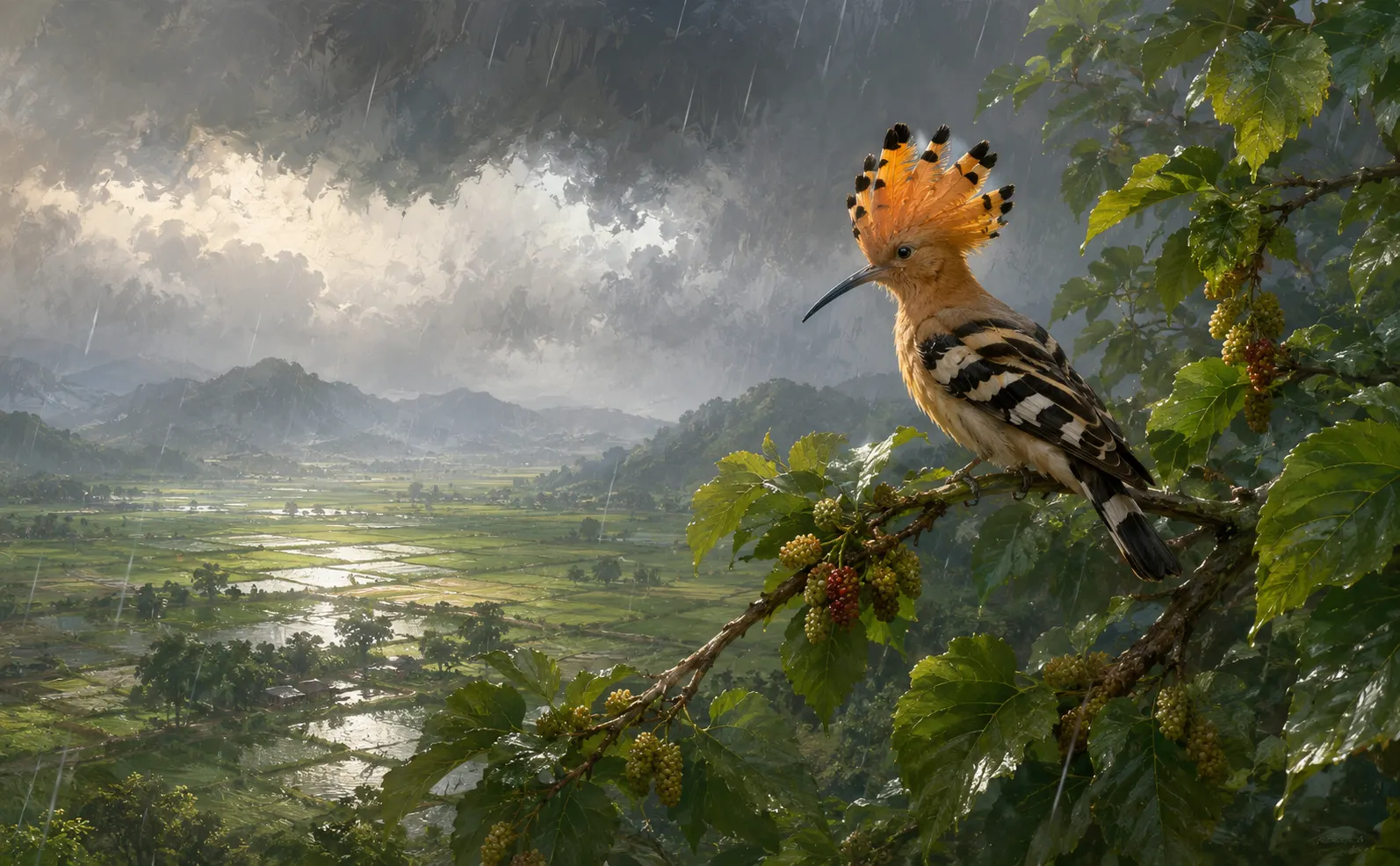
In the middle and lower reaches of China’s Yellow River, peonies enter full bloom. Traditionally known as “谷雨花”—the *flower of Grain Rain*—they bring vivid color to the countryside. Across the Yangtze River basin, duckweed begins spreading over the water, cuckoos call as if urging farmers back to their fields, and hoopoes settle in mulberry trees, signaling the approach of the silkworm-rearing season. In Japan’s Kantō region, cherry blossoms fall and fresh leaves unfold, ushering in the season known as 葉桜 (hazakura), when the cherry trees have turned from blossom to leaf. In southern South Korea, azaleas reach full bloom and the countryside is steeped in spring.
Farming Activities
Winter wheat across the North China Plain enters the booting-to-heading stage, spring-maize sowing expands fully, and spring irrigation enters its final sprint; wheat fields with inadequate soil moisture need prompt irrigation. Across the Yangtze River basin, early-rice transplantation reaches its peak, while rapeseed at the pod-setting stage receives 荚肥 (*pod fertilizer*), generally 3–5 kilograms of potassium chloride per *mu*, together with continued control of sclerotinia and persistent efforts to keep drainage ditches clear and prevent waterlogging. In the tea regions of Jiangnan, spring-tea picking enters its second major peak with the harvest of 雨前茶 (*tea picked before Grain Rain*), keeping tea growers continuously occupied. In South China, early rice progresses from peak tillering toward young-panicle differentiation, while spring peanuts and spring maize enter vigorous growth and require increasingly precise field management. Northern orchards move into the fruit-set stage, with apples, pears, and peaches beginning young-fruit development; growers strengthen fruit thinning and pest and disease control. Across Northeast China, spring sowing begins fully as maize, soybeans, and rice are planted in succession, with farmers making concentrated use of clear weather. In Northwest China, spring-wheat sowing reaches its peak and 顶凌播种 (*sowing while deeper soil remains frozen*) expands on a broad scale.
Phenological Signs
Temperatures across Western Europe stabilize between 12°C and 18°C, winter-wheat jointing accelerates, and orchards move from full bloom toward fruit set. Apple and pear blossoms open profusely in France and Germany, while the countryside becomes lush and green. Across Central Europe, temperatures rise to 10–15°C, forests return fully to green, and birds enter an active breeding period. Water levels along the Danube remain stable, and farmland throughout the river basin takes on the full character of spring.
Farming Activities
Winter wheat in France and Germany moves from jointing into booting, and farmers continue spring field management through applications of 拔节肥 (*jointing fertilizer*) and disease control, with wheat rust and powdery mildew entering key treatment windows. Across Ukraine’s chernozem belt, winter wheat reaches the same jointing-to-booting stage and spring irrigation advances on a large scale, supporting vigorous growth in the fertile black soils. In Bordeaux, Rheinhessen, and other wine-producing regions, grape buds develop rapidly, new shoots begin to extend, and spring soil loosening, fertilization, and pest and disease control proceed together. In Northern Europe, spring-wheat sowing expands fully as farmers make use of suitable clear-weather windows.
Phenological Signs
Across the winter-wheat belt of Kansas and Nebraska, temperatures rise to 15–20°C, wheat enters vigorous growth and begins heading. In California’s Central Valley, young almond fruit develops rapidly, while apricot and peach orchards enter fruit set. Across the southeastern United States, peach and pear trees also move into fruit set and the countryside becomes deeply green. In Ontario, Canada, maple trees fully unfold their leaves, and the colors of spring shift from tender green toward a deeper shade.
Farming Activities
Winter wheat in Kansas, Nebraska, and neighboring producing areas moves into the booting-to-heading stage, requiring increasingly precise water and nutrient management; fields with inadequate soil moisture need prompt irrigation, while weak stands receive 孕穗肥 (*booting fertilizer*). Orchards in California’s Central Valley enter fruit set, with young fruit expanding rapidly as growers intensify thinning, pest and disease management, and the application of 坐果肥 (*fruit-setting fertilizer*), primarily potash. Across the U.S. Midwest, spring planting reaches its peak as maize and soybean sowing expands over large areas and large seeders operate day and night. In the Southeast, spring cultivation and planting also reach their height, with cotton, peanuts, and other crops sown on a broad scale. Across Canada’s Prairie Provinces, spring-wheat planting expands fully as farmers move quickly to make use of the seasonal window.
Phenological Signs
Winter wheat on Turkey’s Anatolian Plateau moves from jointing into booting and the countryside is covered in fresh green. Along Iran’s Caspian coast, fruit trees enter fruit set and young fruit begins to develop. In Morocco and Algeria, winter wheat reaches the booting stage as spring settles fully over the landscape.
Farming Activities
Winter wheat across Turkey, Iran, and other parts of the Middle East enters booting, and spring irrigation expands fully while farmers adjust fertilization precisely to crop condition. Along the Mediterranean coasts of Israel, Morocco, and other parts of North Africa, winter wheat likewise enters booting, with topdressing, irrigation, and pest and disease control advancing simultaneously. In South Africa’s Cape region, autumn vineyard pruning approaches completion as growers prepare the vines for the following year’s growth.
Temperate Regions of the Southern Hemisphere
Phenological Signs
Late autumn has arrived. Average daily temperatures fall to around 10–15°C and the weather becomes cool and dry. Pastures are fully yellow, trees begin shedding leaves in large numbers, and autumn colors deepen across the landscape. Morning frosts occur frequently, daylight is clearly shorter than night, and the season carries the unmistakable weight of late autumn.
Farming Activities
Autumn-sown crops—winter wheat, barley, and rapeseed—enter a crucial stage of seedling growth, when farmers inspect stands and fill gaps, irrigate when necessary, and control seedling-stage pests and diseases. Management at this stage directly determines whether strong plants can become established before winter and is therefore critical to yield in the following year. Autumn pruning in vineyards approaches completion, with pruned branches shredded and incorporated into the soil to increase organic matter. Pastoral farmers build up hay reserves for winter, while autumn pasture management enters its final stage.
Phenological Signs
Temperatures fall to around 10–15°C and late autumn becomes fully established. Grasslands turn completely yellow and the countryside takes on a more subdued palette. Soybean harvesting is fully complete, while maize harvesting enters its final stage. Morning frosts become frequent, daylight is shorter than night, and the sense of late autumn deepens.
Farming Activities
Autumn-sown crops—winter wheat, barley, and rapeseed—enter the critical seedling-management stage after emergence, requiring stand inspection and gap filling, timely irrigation, and control of seedling-stage pests and diseases. Maize harvesting approaches completion and large combines carry out their final passes, while soybean harvest is already finished and farmers concentrate on drying, threshing, storage, and sale. Autumn vineyard pruning enters its final stage, and apple and pear harvesting is completely finished as orchards begin preparing for winter dormancy.
Phenological Signs
Temperatures fall to around 5–10°C and the chill of late autumn grows stronger. Pasture growth largely comes to a halt on both the North and South Islands, with grasslands turning fully yellow. Grape harvesting is completely finished and kiwifruit harvesting enters its final stage. Morning frosts become frequent, while some high-altitude areas begin to receive their first snow.
Farming Activities
Autumn pasture management enters its final phase: overseeding has been completed, autumn fertilizer has been fully applied, and hay reserves are in place. Kiwifruit harvesting approaches its end while the export season remains active, continuing to supply large volumes to Northern Hemisphere markets. Autumn pruning in vineyards is fully completed, leaving the vines prepared for growth in the coming year.
Phenological Signs
Orchard foliage across the Central Valley changes color completely, giving the landscape a distinctly late-autumn character. Apple and pear harvesting is finished and all fruit has been moved into storage. Morning frosts become frequent and daylight remains shorter than night.
Farming Activities
Apple and pear harvesting is fully complete, and export packing lines process their final orders. Autumn orchard management is also brought to completion, with pruning, fertilization, and pest and disease control all in place to prepare for growth and fruiting in the following year. Autumn pruning in vineyards is fully finished, and wineries bring the crushing season to a complete close.
Tropical and Subtropical Regions
Phenological Signs
The rainy season becomes fully established, bringing more frequent rainfall and a marked rise in humidity. Thailand, Myanmar, Laos, and neighboring regions receive abundant early-season rain, and the land begins to recover from the dryness of the preceding months. Pre-monsoon rainfall continues to increase along the southern and eastern coasts of India, with the Southwest Monsoon on the verge of its full onset. In southernmost China, early-rice fields form broad expanses of green and enter vigorous growth.
Farming Activities
Large-scale rice sowing and seedling raising gets underway. Across Southeast Asia, rainy-season rice is broadly sown and raised in nurseries from mid- to late April in preparation for transplantation once the rains become fully established. Vietnam’s Mekong Delta, Thailand’s central plain, and Cambodia’s Tonlé Sap Plain enter peak rice-sowing periods. Along the southern and eastern coasts of India, rice sowing and seedling raising expand fully as farmers accelerate preparations ahead of the Southwest Monsoon. In southernmost China, early rice enters young-panicle differentiation, while spring maize and spring peanuts move into vigorous growth and require increasingly precise field management.
Phenological Signs
The dry season deepens and clear, dry conditions persist, with rainfall almost disappearing entirely. Across central-western Brazil, fields lie exposed and vegetation enters dry-season dormancy. Maize harvesting in southern Africa is fully finished, leaving the fields open and bare. Sugarcane harvesting in northern Australia is likewise complete and cane fields have been cleared. The air becomes drier and the difference between daytime and nighttime temperatures widens.
Farming Activities
Harvesting of summer crops is entirely complete, and farmers focus on drying, threshing, storage, and sale. The dry season provides the best conditions for drying grain, as clear skies and minimal rainfall allow crops to be fully dried before safe storage. Harvested fields enter fallow while awaiting the next rainy season, although areas with irrigation may begin growing dry-season crops such as wheat, barley, and rapeseed. In central Brazil, second-season maize enters active growth management, with topdressing, irrigation, and pest and disease control proceeding together. In northern Australia, sugar mills enter the final stage of their crushing season.
China’s Six Major Agricultural Regions
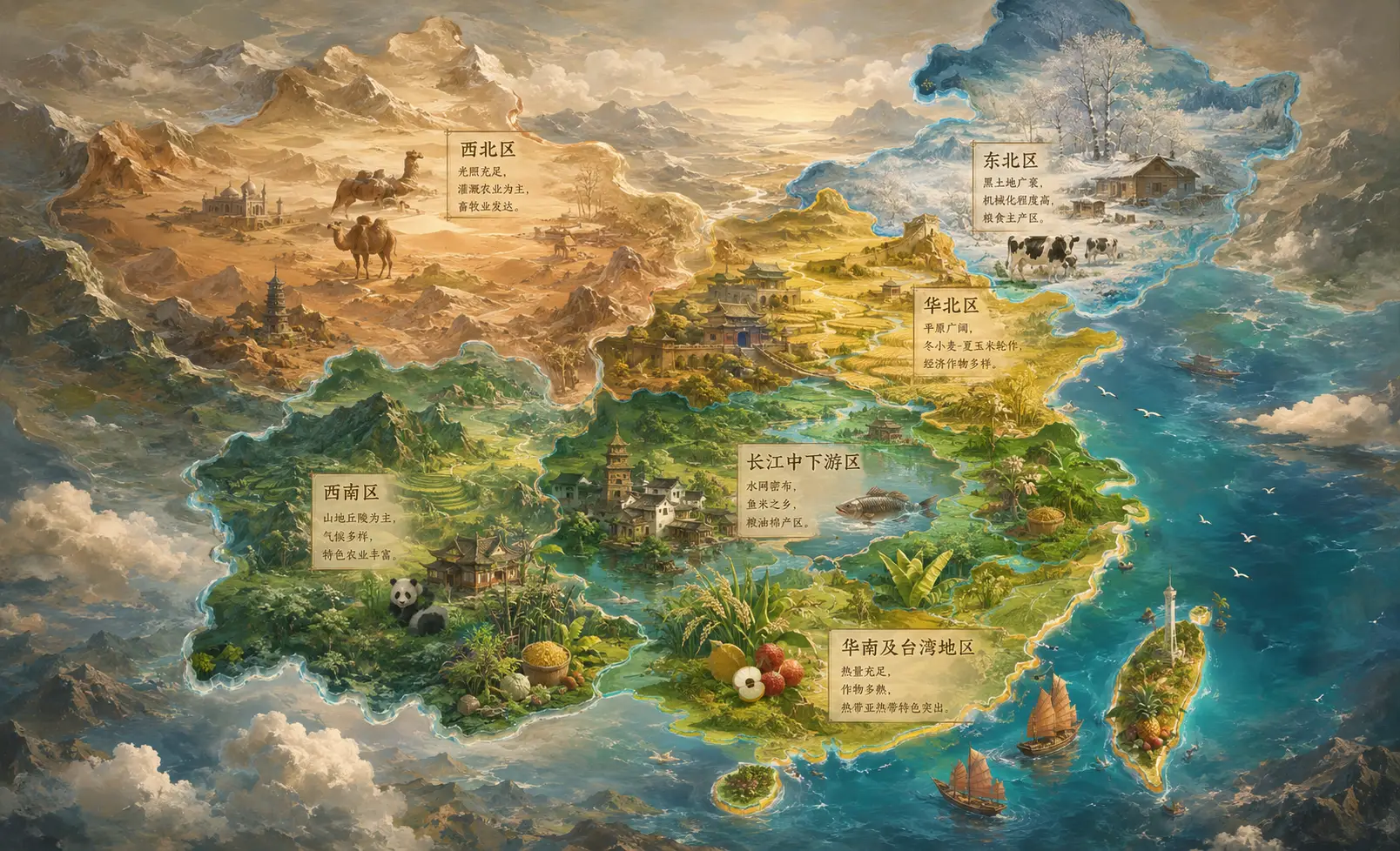
| Agricultural Region | Major Provinces | Keywords |
|---|---|---|
| Northeast | Heilongjiang, Jilin, Liaoning, eastern Inner Mongolia | Spring sowing begins, maize sowing, soybean sowing, rice seedling raising |
| Northwest | Xinjiang, Gansu, Ningxia, western Inner Mongolia, Qinghai | Spring-wheat sowing, winter-wheat booting, cotton planting, spring irrigation |
| North China | Hebei, Shanxi, Beijing, Tianjin, Shandong, northern Henan | Winter-wheat booting, spring-maize sowing, spring irrigation, pest and disease control |
| Middle and Lower Yangtze | Hubei, Hunan, Jiangxi, Anhui, Jiangsu, northern Zhejiang, Shanghai | Early-rice transplantation, rapeseed pod setting, spring-tea harvesting, ditch clearing and waterlogging prevention |
| Southwest | Sichuan, Chongqing, Guizhou, Yunnan, southeastern Tibet | Completion of early-rice transplantation, stripe-rust control, spring-tea picking, potato seedling management |
| South China and Taiwan | Guangdong, Guangxi, Hainan, southern Fujian, Taiwan Province | Early-rice panicle differentiation, peanut and maize growth, fruit retention, aquaculture |
Heilongjiang, Jilin, Liaoning, eastern Inner Mongolia
Around Grain Rain, frozen ground across Northeast China has thawed completely and spring sowing begins in earnest. Daytime highs may reach 10–15°C, while soil temperatures remain steadily above 8–10°C, bringing maize, soybeans, rice, and other major crops into their optimal sowing window.
Spring sowing expands fully. Spring planting reaches its peak around Grain Rain across Heilongjiang, Jilin, Liaoning, and neighboring areas, with maize and soybean sowing spreading over large acreages. Maize is generally planted from mid- to late April, while soybean sowing comes somewhat later, from late April into early May. Farmers seize every stretch of clear weather for concentrated fieldwork, and large seeders often operate day and night, completing sowing, fertilization, and rolling in a single pass. Sowing depth is adjusted according to 墒情 (*soil-moisture conditions*): when moisture is adequate, seed is placed 3–5 centimeters deep; when conditions are drier, planting depth is increased appropriately so as to secure a full and even stand. Large-scale mechanized planting across Heilongjiang’s state-farm system unfolds fully during Grain Rain, with a single seeder capable of covering several hundred *mu* in one day.
Rice seedling raising enters a crucial stage. Rice nurseries across Northeast China reach an important turning point around Grain Rain. Seedlings have developed two to three leaves and enter the “离乳期”—the stage when they shift from relying primarily on nutrients stored in the endosperm to drawing nutrition through their own root systems. Nursery management must therefore become more precise: daytime temperatures are maintained at 20–25°C, nighttime temperatures should not fall below 10°C, seedbeds are kept moist, and common early-spring diseases such as damping-off and seedling rot must be prevented. Seedling age is generally controlled at 30–35 days, with transplantation into the main field taking place at the “三叶一心” stage, usually around mid-May.
Monitoring soil moisture. Grain Rain is one of the decisive periods for spring sowing in Northeast China, and soil moisture directly determines planting quality and emergence rates. Farmers closely monitor field conditions; where moisture is inadequate, they may irrigate before sowing to create sufficient moisture or adopt drought-resistant planting measures such as deeper sowing and firm rolling.
Pasture management. Pastures in eastern Inner Mongolia return fully to green, and livestock move from pen feeding back to grazing. Herders need to control grazing intensity so that tender new grass is not overgrazed before pastures recover, while gradually extending grazing time to allow animals to adapt to fresh forage. The quality of spring grazing management directly affects pasture productivity throughout the year.
Protected agriculture. Peak greenhouse-vegetable production continues in southern Liaoning. Rising temperatures make greenhouse overheating increasingly likely, so daytime ventilation and cooling need to be strengthened. Open-field vegetables such as spinach, Chinese chives, and lettuce enter rapid growth around Grain Rain.
Xinjiang, Gansu, Ningxia, western Inner Mongolia, Qinghai
Around Grain Rain, Northwest China enters the busiest stage of spring sowing: spring-wheat planting reaches its peak, winter wheat in southern Xinjiang enters booting-to-heading with the highest water and nutrient demand of the year, and cotton sowing expands fully.
Peak spring-wheat sowing. Across the Hexi Corridor in Gansu and the Yellow River irrigation districts of Ningxia, spring-wheat planting reaches its maximum around Grain Rain. The 顶凌播种 window is fully open and farmers race against time to finish the work. Seed is placed 3–5 centimeters deep at row spacing of 15–20 centimeters, followed immediately by rolling to preserve soil moisture. Spring-wheat acreage reaches its annual peak at this time, making sowing quality directly relevant to the year’s grain production.
Management from booting to heading in winter wheat. Winter wheat in the Tarim Basin of southern Xinjiang moves into the booting-to-heading stage around Grain Rain. Young-ear development enters its final phase and heading and flowering begin, making this a decisive stage for both kernels per ear and thousand-kernel weight. Water and nutrient demand reaches its annual maximum, so farmers irrigate promptly at 50–60 cubic meters per *mu* and apply 孕穗肥 (*booting fertilizer*) consisting of 5–8 kilograms of urea plus 3–5 kilograms of potash fertilizer per *mu*. Weather conditions during heading and flowering are particularly important: persistent rain can disrupt pollination and reduce seed set, while hot, dry winds may deactivate pollen and lower kernel number.
Cotton sowing expands fully. Xinjiang is China’s largest cotton-producing region, and Grain Rain is a critical planting period. Cotton-growing areas in both southern and northern Xinjiang begin sowing as temperatures rise, once soil temperature remains steadily above 12–14°C. Seed is planted 2–3 centimeters deep, generally using under-film drip irrigation systems that lay plastic mulch, sow seed, and install drip lines in a single operation, thereby conserving moisture, raising soil temperature, and encouraging early growth. Cotton acreage reaches its annual planting peak around Grain Rain, and sowing quality directly affects farm income for the year.
Spring irrigation expands fully. In Gansu, Ningxia, and western Inner Mongolia, spring wheat needs prompt “蒙头水” after sowing to ensure germination and emergence. Grain Rain is a concentrated spring-irrigation period, requiring farmers to coordinate the order of irrigation and make full use of Yellow River water resources.
Orchard management. Apples, fragrant pears, grapes, and other fruit trees in southern Xinjiang move from leaf expansion into flowering during Grain Rain. Growers must complete spring pruning before full leaf expansion, apply pre-flowering fertilizer—mainly phosphorus and potassium—to support flowering and fruit set, and monitor aphids, spider mites, pear psylla, and other pests after leaves emerge.
Specialty crops. Potato planting in Dingxi, Gansu, reaches its peak around Grain Rain; goji in Ningxia enters a key period for spring pruning and fertilization; and processing-tomato planting expands fully across Xinjiang.
Hebei, Shanxi, Beijing, Tianjin, Shandong, northern Henan
Around Grain Rain, North China enters one of the busiest periods of the agricultural year. Winter wheat advances into the booting-to-heading stage while spring-maize sowing reaches its peak.
Management from booting to heading in winter wheat. Winter wheat across the North China Plain enters booting-to-heading: young-ear development reaches its final stage and heading and flowering begin. This period is decisive for both kernel number and thousand-kernel weight, and the crop’s demand for water and nutrients becomes extremely urgent. Fields with inadequate soil moisture need prompt irrigation at 40–50 cubic meters per *mu*, while weak stands receive 5–8 kilograms of urea per *mu* as booting fertilizer. Weather during heading and flowering also requires close attention: persistent cloudy and rainy conditions may interfere with pollination, while hot, dry winds can deactivate pollen and reduce kernel number. Farmers therefore follow forecasts closely and, before a hot dry wind arrives, may apply foliar fertilizer such as monopotassium phosphate to improve crop stress resistance.
Peak spring-maize sowing. Spring maize across the North China Plain reaches its planting peak around Grain Rain. Sowing generally takes place from mid- to late April, and the period around Grain Rain provides one of the best windows because soil temperature remains steadily above 10°C and soil moisture is generally suitable. Seed is planted 3–5 centimeters deep at row spacing of 60–70 centimeters, followed by rolling to preserve moisture. Spring-maize acreage reaches its annual peak at this time as farmers make concentrated use of favorable weather.
Final sprint of spring irrigation. Spring irrigation across North China enters its last major push. Wheat fields that have not yet been irrigated need to complete the work quickly in order to secure adequate moisture through booting and heading. Spring irrigation is generally brought to an end around Grain Rain.
Pest and disease control. Rising temperatures push wheat pests and diseases into a high-incidence period. The main targets include wheat powdery mildew, identified by white powdery growth on leaves and treated with triadimefon; wheat rust, treated with triadimefon or tebuconazole; aphids, treated with imidacloprid; and wheat midge, a major pest during heading whose adults lay eggs in wheat ears and whose larvae feed on developing kernels, controlled with lambda-cyhalothrin. Farmers should inspect their fields at least once a week and treat infestations promptly.
Fruit-set management in orchards. Apple-, pear-, and peach-growing areas enter the fruit-set stage. Growers thin overly dense, malformed, or pest-damaged young fruit, generally leaving 1–2 fruits per apple cluster and 1–3 fruits per pear cluster; apply fruit-setting fertilizer, mainly potash, to encourage development; and strengthen control of apple ring rot, pear scab, peach aphids, oriental fruit moth, and other pests and diseases entering their treatment windows.
Vegetable sowing and transplantation. Open-field vegetable planting reaches its peak, with spring radish, spring Chinese cabbage, spring cabbage, and other major vegetables sown or transplanted. Greenhouse tomatoes, cucumbers, and peppers enter peak harvest and require stronger water, nutrient, pest, and disease management.
Hubei, Hunan, Jiangxi, Anhui, Jiangsu, northern Zhejiang, Shanghai
Around Grain Rain, the middle and lower Yangtze enters the busiest stage of the agricultural year, as peak early-rice transplantation, rapeseed pod setting, and the second major spring-tea harvest overlap.
Peak early-rice transplantation. In southern Jiangnan—including Jiangxi, southern Hunan, and southern Zhejiang—early-rice seedlings reach the “四叶一心” to “五叶一心” stages around Grain Rain and enter the peak of large-scale transplantation. After transplanting, farmers maintain a shallow water layer of 3–5 centimeters to promote 返青 (*post-transplant recovery*) and low-position tillering. In northern Jiangnan—including Anhui, southern Jiangsu, and northern Zhejiang—nursery seedlings likewise enter peak transplantation around Grain Rain after 炼苗 (*seedling hardening*) has been completed. Large-scale transplantation generally finishes between Grain Rain and 立夏 (Lìxià, Beginning of Summer).
Management of rapeseed during peak pod setting. Rapeseed across the Yangtze River basin enters peak pod formation. Young pods expand rapidly and seeds accelerate their development and filling, making this the most decisive stage for final yield: both pod number and seed plumpness directly affect production. Farmers apply 荚肥 (*pod fertilizer*), primarily potash, at 3–5 kilograms of potassium chloride per *mu* to support seed filling; control sclerotinia, the crop’s most important disease, which reaches a high-incidence period around Grain Rain and is treated with carbendazim or dedicated sclerotinia-control products; and guard against lodging, as the increasing weight of the above-ground canopy makes the crop vulnerable to strong winds and heavy rain. Rapeseed begins moving toward maturity around Grain Rain, and some early-maturing cultivars start turning yellow.
The second peak of spring-tea harvesting. Tea-growing regions of Jiangnan—including Zhejiang, Anhui, and Jiangxi—enter the second major spring-tea harvest around Grain Rain, with the picking of 雨前茶 (*tea harvested before Grain Rain*) expanding fully. Although it is not as delicate as 明前茶, Rain-Before tea has a fuller body and richer aroma and is highly valued by tea drinkers. Tea growers remain continuously occupied as picking, processing, and sales follow one another in rapid succession. After Grain Rain, the spring-tea harvest gradually moves toward its end.
Clearing ditches and preventing waterlogging. Spring rainfall continues increasing during Grain Rain and field humidity remains high. Farmers need to keep drainage systems under close inspection and ensure that the “三沟”—main, central, and perimeter ditches—remain clear. Rice-stubble fields face the greatest drainage pressure and require particular attention to prevent waterlogging. Rainfall increases still further after Grain Rain, and ditch clearing and waterlogging prevention continue into the plum-rain season.
Greenhouse and open-field vegetables. Greenhouse fruiting vegetables across the Yangtze basin enter peak harvest, with tomatoes, cucumbers, and peppers continuing to reach the market. Open-field crops such as stem lettuce, celery, garlic, and spring cabbage enter rapid growth and harvest, requiring strengthened water and nutrient management together with pest and disease control.
Sichuan, Chongqing, Guizhou, Yunnan, southeastern Tibet
Around Grain Rain, agricultural activity expands fully across Southwest China. Early-rice transplantation in warm lowland valleys comes completely to an end, winter wheat in the Sichuan Basin enters booting-to-heading, stripe-rust control reaches its final decisive stage, and peak spring-tea harvesting continues.
Early-rice transplantation concludes fully. In southern Yunnan—including Xishuangbanna and Honghe—and in the Panxi region of Sichuan, early-rice transplantation is fully completed around Grain Rain. After transplantation, a shallow water layer of 3–5 centimeters is maintained to promote recovery and tillering. The warm lowland valleys of Yunnan have abundant heat resources, so transplanted rice grows rapidly, with some fields already moving from peak tillering toward young-panicle differentiation.
Final battle against wheat stripe rust. Winter wheat in the Sichuan Basin is at booting-to-heading around Grain Rain, while stripe-rust control enters its final decisive stage. The pathogen’s spores spread rapidly and can cause serious damage, making Grain Rain the last major control window. If the disease is not effectively contained at this point, large quantities of spores may be carried by southwesterly air currents into northern wheat-growing areas. Agricultural authorities in Sichuan therefore launch broad control operations, with plant-protection personnel entering individual wheat fields to scout and spray. Farmers should inspect their own fields at least twice a week and immediately report and treat yellow stripe-like spore pustules. The decisive control period generally runs from Qingming to Grain Rain; after Grain Rain, disease-control pressure gradually begins to ease.
Peak spring-tea harvesting continues. Tea-growing areas across Sichuan, Guizhou, and Yunnan remain in peak harvest around Grain Rain. Low-altitude tea districts are at the height of picking, while middle- and high-altitude gardens successively enter harvest. Famous tea regions such as Mount Emei and Mengding Mountain in Sichuan, Duyun in Guizhou, and Pu’er in Yunnan remain extremely busy. After Grain Rain, the spring-tea harvest gradually moves toward its end.
Potato seedling management. Spring potatoes in the major producing areas of Yunnan, Guizhou, and Sichuan enter a critical seedling-management stage. Farmers carry out a second intertillage at 5–8 centimeters deep together with weeding and topdressing, apply 苗肥 (*seedling fertilizer*) at 5–8 kilograms of urea per *mu* to promote stem and leaf growth and tuber formation, and strengthen disease and pest control. Late blight—the most important potato disease—enters a key prevention window around Grain Rain. Seedling condition directly influences tuber number and final yield.
Rapeseed and broad beans. Rapeseed in Sichuan and Guizhou moves from peak pod setting toward maturity and requires continued control of sclerotinia. Broad beans enter maturity and farmers begin preparing for harvest.
Guangdong, Guangxi, Hainan, southern Fujian, Taiwan Province
#### (1) Mainland South China
Management of early rice during young-panicle differentiation. Early rice across South China enters young-panicle differentiation around Grain Rain. The young panicle begins differentiating and developing within the stem, making this a crucial stage for determining grain number per panicle. Fields should maintain a shallow water layer of 3–5 centimeters without interruption, while 穗肥 (*panicle fertilizer*), primarily potash, is applied at 5–8 kilograms of potassium chloride per *mu* to support young-panicle development. Farmers also carry out 晒田控苗 (*draining and drying the paddy to regulate crop growth*) after unproductive tillers have been adequately controlled, leaving the field drained for 7–10 days to encourage deeper rooting and young-panicle development. Because young-panicle differentiation is central to rice yield formation, the precision of management at this stage directly affects both kernel number and final production.
Growth management of spring peanuts and maize. Spring peanuts enter peak flowering and pegging. Large numbers of flowers open, and the fertilized pegs extend into the soil to form pods. Management includes a third intertillage at 5–8 centimeters deep, application of 结荚肥 (*pod-setting fertilizer*) at 10–15 kilograms of compound fertilizer per *mu* to promote pod development, and control of leaf spot, aphids, cotton bollworm, and other pests and diseases. Spring maize moves into jointing-to-tasseling; stems elongate rapidly and tassels begin to emerge, requiring stronger water and nutrient management and the application of 穗肥 (*panicle fertilizer*) at 8–10 kilograms of urea per *mu*.
Fruit retention and summer-shoot management in tropical orchards. Mangoes in Hainan and Guangxi enter young-fruit development and require continued 保果 (*fruit-retention management*), including fruit-retention sprays, thinning of overly dense young fruit, and control of mango gall midges and thrips. Early lychee cultivars enter fruit development and require stronger water and nutrient supply, while middle- and late-season cultivars enter the young-fruit stage and need attention to fruit retention. Citrus in Guangdong and Guangxi moves from flowering toward young-fruit development, and nitrogen application must be controlled so vigorous summer shoots do not interfere with fruit set.
Vegetables and aquaculture. Open-field vegetables across South China enter rapid growth and peak harvest. Choy sum, Chinese kale, lettuce, and spinach grow quickly and need to be harvested promptly. Rising temperatures bring pests and diseases into a high-incidence period, requiring stronger control of diamondback moth, aphids, downy mildew, and powdery mildew. In aquaculture, fish enter rapid growth, feed amounts are increased gradually, and water-quality management and disease prevention become increasingly important.
#### (2) Taiwan
Rice: The first rice crop in central Taiwan—including Changhua, Yunlin, and the Chianan Plain—enters heading around Grain Rain. Young panicles emerge from the stems and begin flowering and pollination. A shallow water layer of 3–5 centimeters should be maintained through heading, with close attention to panicle-stage pests and diseases such as rice blast, sheath blight, and stem borers. In the south, particularly the Kaohsiung–Pingtung region, rice moves from heading into grain filling and requires similar management. In northern Taiwan, including Taoyuan and Hsinchu, nursery transplantation is largely complete and rice enters the early tillering stage.
Vegetables: Vegetable sowing and transplantation continue across Taiwan during Grain Rain. In central areas, watermelon, cucumber, muskmelon, and other cucurbits remain at the peak of sowing and seedling raising; in the south, ginger and 越瓜 remain in peak transplantation. Tomato harvesting enters its final stage.
Fruit trees: Mangoes in southern Taiwan enter young-fruit development and require attention to fruit retention and mango gall midge control. Lychees also enter the young-fruit stage and require fruit-retention management together with control of fruit borers. Citrus moves from flowering into young-fruit development, and nitrogen applications need to be controlled to prevent excessive summer-shoot growth from interfering with fruit set.
Tea: Spring tea in central and southern tea regions—including Nantou and Chiayi—moves from peak picking toward the end of the harvest around Grain Rain, while northern tea districts such as Wenshan and Sanxia reach peak spring-tea harvesting. Spring is the most important production season in Taiwan’s tea industry, and after Grain Rain the harvest gradually moves toward its close.
Fisheries: Catches in waters around Taiwan continue to increase during Grain Rain. The spring fishing season remains busy, with mackerel, Spanish mackerel, pomfret, and other species continuing to be landed. Coastal fishing vessels go to sea frequently, and catch quality remains good.
Farmer’s proverbs and folk customs: Taiwanese folk tradition preserves the saying “穀雨前,好種棉”—before Grain Rain is the best time to sow cotton—and “穀雨後,好種豆”—after Grain Rain is a good time to sow beans. Grain Rain is also regarded in Taiwan as the symbolic last solar term of spring. A folk custom known as “穀雨補老母” involves married daughters returning to their parental homes during Grain Rain to visit their mothers, expressing filial care and affection.
Global Extreme Weather · Risks & Responses
Temperate Northern Hemisphere: the Final Threat of Late Frost—Now Greatly Reduced
The traditional saying “清明断雪,谷雨断霜” holds that snow ends by Qingming and frost by Grain Rain. By this point, frost weather has largely disappeared, although late frost remains possible in high-latitude areas and mountainous regions. The risk of 倒春寒 (*late spring cold*) during Grain Rain is lower than during Awakening of Insects or the Spring Equinox, but if such a cold spell does occur it can still seriously damage winter wheat at booting-to-heading, because young ears are sensitive to low temperatures and can suffer frost injury below 0°C, as well as fruit trees at fruit set, whose young fruit may be damaged and shed at temperatures below -1°C. The farmer’s proverb “谷雨寒,麦穗短”—*if Grain Rain is cold, wheat ears will be short*—expresses the traditional observation that cold conditions at this time may reduce kernel number in winter wheat.
Temperate Northern Hemisphere: Increasing Severe Convective Weather—the Principal Threat of Grain Rain
As warm, moist air strengthens further during Grain Rain, severe convective weather becomes markedly more frequent, bringing thunderstorms, showers, strong winds, and hail. Such weather can affect agriculture in several ways: hail may damage fruit-tree blossoms and young fruit, break greenhouse structures, and knock rapeseed pods from the plants; strong winds may lodge rapeseed and wheat or overturn greenhouses; and heavy rain may leave fields waterlogged. Farmers therefore need to follow weather forecasts closely, reinforce greenhouses ahead of strong winds or hail, harvest mature crops early where possible, and check drainage systems before severe weather arrives.
Temperate Northern Hemisphere: Spring-Drought Risk in Northern China
Rainfall remains relatively limited across North and Northwest China during Grain Rain, leaving spring drought as a major threat. Winter wheat is at its seasonal peak of water demand during booting and heading, while newly sown spring maize requires sufficient moisture for emergence. Persistent drought can therefore seriously affect both winter-wheat yield and spring-maize emergence rates. Farmers need to make full use of available irrigation water, arrange irrigation in a rational order, and give priority to water for winter wheat during booting and for spring maize during emergence.
Temperate Southern Hemisphere: Autumn Drought and Early-Frost Risk
Late autumn in the Southern Hemisphere—around mid- to late April—is often dry, with little rainfall. Autumn-sown crops require adequate moisture during the seedling stage, and prolonged drought may produce weak stands. At the same time, higher-latitude regions begin facing early frost, and an unusually early first frost may damage crops that have not yet fully matured. Farmers in southern Australia and New Zealand therefore need to monitor frost forecasts closely and take protective measures where necessary.
A Shared Global Trend: the Changing “Temperament” of Spring Rain
Against the background of global climate warming, the distribution of spring rainfall in southern China continues to change. Total spring precipitation has altered relatively little, but its “concentration” keeps increasing: more rainfall is being delivered by a small number of heavy events, with longer dry intervals in between. As a result, the traditional Grain Rain experience embodied in “雨生百谷”—rain giving life to the hundred grains—is itself changing. The fine, evenly distributed spring rains of traditional seasonal experience are increasingly being replaced by a more extreme pattern: either little or no rain, or intense downpours when rain does arrive. This means that spring drought and flooding may alternate within the same season, irrigation and drainage systems face increasingly demanding requirements, and the climatic knowledge preserved in the traditional solar terms must be applied flexibly in combination with actual contemporary weather conditions.
----
Readers’ Comments
Calendar and traditional culture enthusiasts from around the world, sharing the same moon.
Sign in or register to join the conversation. Your comment account is created automatically the first time you use a connected account.
No comments yet
Share your thoughts with readers around the world.