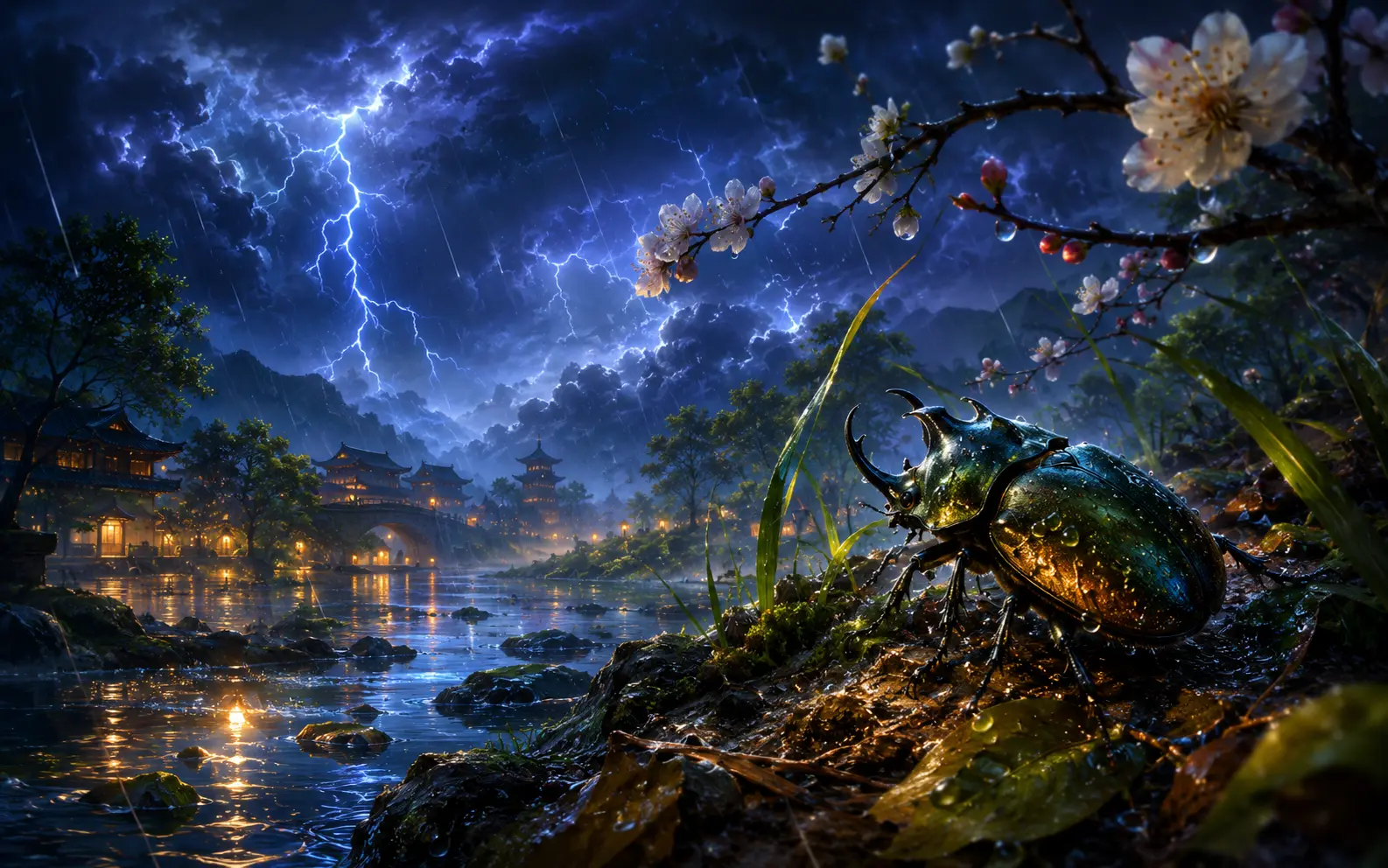
Awakening of Insects Poetry
「微雨众卉新,一雷惊蛰始。」
Poetry of Awakening of Insects centers on the first stirring of spring thunder and the revival of all things. Wei Yingwu’s “微雨众卉新,一雷惊蛰始” opens the prelude to the farming season; Yuan Zhen’s “阳气初惊蛰,韶光大地周” writes of yang energy surging through Heaven and Earth. Peach blossoms open like Sichuan brocade, and the aging hawk gives way to the spring dove, as poets capture the subtle changes of the three phenological phases of Awakening of Insects. The Song poet Zhang Yuangan’s “一声大震龙蛇起,蚯蚓虾蟆也出来” fully conveys the force with which all things revive at this solar term. In the poets’ writing, the thunder of Awakening of Insects is both a force of nature and a command urging people to begin cultivation.
Awakening of Insects Poetry
观田家(节选)
Original Verse:
微雨众卉新,一雷惊蛰始。
田家几日闲,耕种从此起。
丁壮俱在野,场圃亦就理。
归来景常晏,饮犊西涧水。
Modern Translation:
After the light rain, the flowers and plants are renewed, and a single clap of spring thunder marks the arrival of Awakening of Insects. From this point onward, farming households have few idle days, for plowing and sowing now begin. The young and able-bodied are all at work in the fields, while threshing grounds and vegetable plots are also put in order. By the time they return from work, it is often already late, and they must still lead the calves to drink from the western stream.
Commentary:
With concise strokes, this poem sketches a picture of farm life during Awakening of Insects. “微雨众卉新” describes visually the revival of all things after spring rain, and the character “新” fully conveys the brightness and vitality of vegetation after being nourished by the rain. “一雷惊蛰始” turns to hearing and writes the defining phenological feature of the season: the sudden sound of spring thunder not only awakens insects hidden in hibernation, but also rouses the sleeping earth. “田家几日闲,耕种从此起” makes clear the agricultural meaning of Awakening of Insects as the starting point of spring cultivation. The latter half unfolds through concrete details of farm work. “丁壮俱在野” describes all the young and able-bodied laboring in the fields, while “归来景常晏,饮犊西涧水” forms a warm scene at the close of the day, showing the plain condition of rural life: arduous, yet closely dependent upon nature. It reveals both the poet’s familiarity with agricultural work and his sympathy for farmers.
秦楼月·浮云集
Original Verse:
浮云集,轻雷隐隐初惊蛰。
初惊蛰,鹁鸠鸣怒,绿杨风急。
玉炉烟重香罗浥,拂墙浓杏燕支湿。
燕支湿,花梢缺处,画楼人立。
Modern Translation:
Floating clouds gather, and faint, low thunder begins to sound: Awakening of Insects has arrived. With the beginning of the season, doves call sharply, and green willows sway in the urgent wind. Thick smoke rises from the jade incense burner and dampens the fragrant silk robes; beside the wall, the dense apricot blossoms are wet and vivid, like rouge. Amid that moist rouge-red color, in a gap among the flowering branches, someone stands quietly in a painted tower.
Commentary:
This lyric uses delicate brushwork to portray both the phenological signs and the human atmosphere of Awakening of Insects. The opening “浮云集,轻雷隐隐初惊蛰” begins with the broad scene of gathering clouds and sounding thunder. The repeated “隐隐” captures the restrained quality of the first spring thunder—faintly heard, not yet exploding in full force. “鹁鸠鸣怒,绿杨风急” then writes the “惊” of Awakening of Insects from two angles, birdcall and wind: doves cry urgently, green willows are struck by quick winds, and everything seems suddenly stirred awake.
In the second half, the brush moves from outdoors to indoors. “玉炉烟重香罗浥” writes the damp haze of incense smoke within the room, while “拂墙浓杏燕支湿” describes the apricot blossoms outside the wall, vivid and moist after the spring rain, like rouge. The final line, “花梢缺处,画楼人立”, is the deliberate blank space of the entire lyric: in a gap among the dense blossoms, a figure stands silently in a painted tower. Who is this person? What are they looking at? What are they thinking? The poet does not say, leaving behind only a restrained and far-reaching image.
惊蛰
Original Verse:
惊蛰已数日,闻蛙初此时。
能如喜风月,不必问官私。
Modern Translation:
Several days have already passed since Awakening of Insects, and only now do I begin to hear the frogs calling. If one can delight in the breeze and moonlight like this, why bother asking after the public and private affairs of officialdom?
Commentary:
Though brief, this five-character quatrain contains two levels: phenological observation and reflection on life. The opening “惊蛰已数日” establishes the time clearly—it is several days after Awakening of Insects, not the day itself. “闻蛙初此时” records that only at this point do the frogs begin to call, a very precise observation of seasonal change. After Awakening of Insects, temperatures rise and hibernating animals such as frogs gradually awaken and begin to cry, but not necessarily on the very day of the solar term; the character “初” is therefore used with great accuracy. The final two lines, “能如喜风月,不必问官私”, move from nature to human life. From the simple act of hearing frogs, the poet develops a detached reflection: if one can enjoy the natural world as one enjoys breeze and moonlight, why trouble oneself with the scheming and disputes of official life? Using the pleasures of nature to dissolve the burdens of the mundane world is a familiar philosophical tendency in Song poetry.
惊蛰
Original Verse:
惊蛰一声雷,春来几度梅。
花枝如可折,莫待晓风催。
Modern Translation:
A single clap of spring thunder sounds at Awakening of Insects; spring has already come, and the plum blossoms have bloomed through several rounds. If a flowering branch can still be gathered, do not wait until the morning wind urges you before reaching for it.
Commentary:
This poem begins with the spring thunder of Awakening of Insects, yet what it truly writes is the feeling of “do not wait” before beautiful things. “惊蛰一声雷” opens with the most typical phenological sign of the season, while “春来几度梅” moves from thunder to flowering: the plum blossoms have already opened several times, suggesting that spring has already advanced some distance and is no longer at its very beginning. The final two lines, “花枝如可折,莫待晓风催”, draw on the meaning of Du Qiuniang’s “花开堪折直须折,莫待无花空折枝”, but within the setting of Awakening of Insects they acquire a more concrete seasonal quality. After this solar term, spring warmth and flowering accelerate; if one does not seize the season in time, the blossoms may be missed beneath the morning wind. The language is concise, yet the poem establishes a subtle correspondence between natural phenology and the human need to cherish what is present.
惊蛰
Original Verse:
春来日日雨兼风,桃李凋残扫地空。
只有数枝红杏在,强留颜色待惊雷。
Modern Translation:
Since spring arrived, wind and rain have come day after day; peach and plum blossoms have been battered and scattered, leaving the ground desolate and bare. Only a few branches of red apricot blossoms remain, forcing themselves to hold on to their color as they wait for the thunder of Awakening of Insects.
Commentary:
This poem sets wind and rain against awakening thunder to express the distinctive significance of Awakening of Insects. The first two lines describe how spring wind and rain have ravaged the peach and plum blossoms. The five characters “凋残扫地空” push the devastation of fallen spring flowers to an extreme, leaving behind a scene of complete disorder. The final two lines suddenly turn. “只有数枝红杏在” describes the few red apricot branches that have survived the wind and rain, while “强留颜色待惊雷” gives them a resilient will: they “force themselves to retain” their last color for one reason only—to wait for that clap of spring thunder. This suggests that true vitality does not lie in the flowers that bloom early, but in the strength released after thunder has awakened the world. The poem writes hope within decline and the power of awakening within wind and rain; its meaning is restrained yet profound.
春日杂兴 · 其五
Original Verse:
雨过花梢蝶梦惊,春来草木尽知名。
一声雷动蛰虫起,万里风高云卷轻。
Modern Translation:
The spring rain has just passed; the tips of the flowering branches tremble, startling a butterfly from its sweet dream. With spring’s arrival, the grasses and trees seem each to reveal their own distinct appearance. A single clap of thunder sounds, and the hibernating insects rise; across the vast sky, the wind moves high and the clouds roll lightly away.
Commentary:
This poem uses delicate brushwork to portray the phenological changes of Awakening of Insects. “雨过花梢蝶梦惊” links the sound of raindrops falling from the tips of flowers with the interruption of a butterfly’s dream, an especially ingenious conception that gives the natural scene an almost fairy-tale quality. In “春来草木尽知名”, the phrase “知名” is particularly striking, as though every plant and tree possessed its own name and face, each displaying its own beauty in spring. “一声雷动蛰虫起” directly addresses the theme of Awakening of Insects, and the character “起” captures the dynamic process of life moving from sleep to awakening. The final line, “万里风高云卷轻”, raises the viewpoint toward the distant sky: winds move and clouds unfold across Heaven and Earth, creating a broad and open atmosphere. Together with the insects and blossoms below, it forms a three-dimensional symphony of Awakening of Insects between sky and ground.
Closing Note
Poetry of Awakening of Insects begins with a clap of thunder. Tao Yuanming of the Jin dynasty wrote, “仲春遘时雨,始雷发东隅.” At that instant, thunder suddenly sounds; creatures hidden in hibernation awaken abruptly in the darkness, while sleeping vegetation stretches sharply beneath the soil. Before Awakening of Insects, everything is silent; after Awakening of Insects, everything is awake. The character “惊” fully captures the temperament of this solar term: it is not a gentle awakening, but a command from Heaven and Earth that cannot be resisted.
In Tang poetry, Awakening of Insects contains both the urgency of agricultural work and the abundance of spring. “微雨众卉新,一雷惊蛰始。田家几日闲,耕种从此起”—Wei Yingwu writes the most immediate reality of life on the day of Awakening of Insects: once the thunder falls, farmers have no more idle days. Yuan Zhen’s vision is broader: “阳气初惊蛰,韶光大地周.” Spring light spreads across the earth, and peach blossoms unfold as brilliantly as Sichuan brocade. Bai Juyi writes, “震蛰虫蛇出,惊枯草木开”—the same clap of thunder awakens insects and snakes and also rouses withered vegetation.
In Song poetry, Awakening of Insects becomes somewhat more restrained. Fan Chengda writes “轻雷隐隐初惊蛰”: the thunder is distant and controlled, faintly heard, almost present and absent at once. Lu You, by contrast, writes the grandeur of “雷动风行惊蛰户,天开地辟转鸿钧”, as though one clap of thunder were enough to open an entirely new Heaven and Earth. The Song poet Qiu Yuan captures the urgency of “一阵催花雨,数声惊蛰雷”: thunder urges the flowers to bloom. Zhao Fan writes “惊蛰已数日,闻蛙初此时”, hearing the first frogcall only after the solar term has passed.
From Tao Yuanming’s “始雷发东隅” to Wei Yingwu’s “一雷惊蛰始”, from Yuan Zhen’s “阳气初惊蛰” to Fan Chengda’s “轻雷隐隐初惊蛰”—poets across the ages heard the same spring thunder, yet wrote different echoes. In that thunder, farmers heard the call to cultivation, poets heard the stirring of life, and hibernating creatures heard the summons to awaken. When poems of Awakening of Insects are opened upon the desk, those sleeping words come alive once more—just as beneath the earth, all things are waiting for that one call to resound through the clouds.
—-
[Language: es]
Readers’ Comments
Calendar and traditional culture enthusiasts from around the world, sharing the same moon.
Sign in or register to join the conversation. Your comment account is created automatically the first time you use a connected account.
No comments yet
Share your thoughts with readers around the world.