Minor Snow Farming
「小雪雪满天,来年必丰年。」
During 小雪 (Xiǎoxuě, Lesser Snow), temperatures fall further across most of China. Snow begins to appear in northern regions, while the chill intensifies in the south. On the North China Plain, winter wheat enters the overwintering stage, growth largely ceases, and winter irrigation is fully complete. Across the Yangtze River basin, rapeseed enters overwintering, while winter-wheat management from emergence through tillering continues and keeping drainage channels clear to prevent waterlogging becomes a central task. In South China, sowing of winter crops such as potatoes and vegetables reaches its peak, and the late-rice harvest is fully complete. In Northeast China, the ground is frozen and agricultural activity has fully entered the traditional “猫冬” period, while greenhouse-vegetable production moves into its busiest season. In Northwest China, winter wheat enters overwintering, basic farmland improvement continues, and winter orchard management becomes fully established. In the temperate Southern Hemisphere, early summer has arrived: winter wheat in southeastern Australia and Argentina enters maturity and harvest, while management of emerging summer crops proceeds steadily. Across the tropical Northern Hemisphere, the dry season is established and field management of dry-season crops continues; in the tropical Southern Hemisphere, the rainy season is in its early stage, with rice sowing and the harvest of dry-season crops advancing at the same time.
Global Agriculture
Temperate Regions of the Northern Hemisphere
Phenological Signs
Temperatures fall noticeably across most of China. Snow begins to appear in northern regions, while the chill becomes stronger in the south. Lesser Snow marks, on climatic average, the beginning of snowfall across the Yellow River basin—“小雪封地”, when the ground begins to freeze. Snowfall also begins in northern Japan, while South Korea enters early winter.
Farming Activities
On the North China Plain, winter wheat enters the overwintering stage and growth largely ceases as the plants move into dormancy. Strong plants established before winter, with 3–5 tillers and a well-developed root system, form the basis of safe overwintering and a good harvest the following year. Winter irrigation is fully complete; the pre-freeze watering has thoroughly moistened the soil, and the frozen surface layer now acts as protection for the crop through winter.
Across the Yangtze River basin, rapeseed enters overwintering, growth slows markedly, and plants become dormant or semi-dormant. The main priority is drainage: because winters in the region are damp and cold, excessive soil moisture poses the greatest threat to overwintering rapeseed and can cause root rot and seedling death. Farmers therefore keep a three-level drainage system of main ditches, cross-field ditches, and perimeter ditches open and functional, regularly clearing channels and shaping the beds so that excess water can drain quickly. Winter-wheat management from emergence through tillering also continues, including stand inspection, gap filling, seedling-stage pest and disease control, pre-winter weed management, and the development of strong plants.
In South China, sowing of winter crops such as potatoes and vegetables reaches its peak as winter-fallow fields left after the late-rice harvest are brought back into production. Winter cropping forms an important part of regional agriculture during the cold season. In Northeast China, the ground is fully frozen and agricultural work has entered the “猫冬” period, while greenhouse vegetables enter peak production. Cucumbers, tomatoes, leafy vegetables, and other crops move into harvest and require close temperature control at 25–28°C during the day and 12–15°C at night, together with effective insulation and cold protection. In Northwest China, winter wheat enters overwintering and growth largely stops; winter irrigation is fully complete, farmland improvements such as autumn fertilization, land leveling, and maintenance of irrigation infrastructure continue, and winter orchard management becomes fully established through orchard sanitation, winter pruning, autumn fertilization, and trunk whitewashing for protection against cold and pests.
Phenological Signs
Temperatures continue to decline across Western Europe and winter wheat enters overwintering. The cold grows stronger in France and Germany, where the first snowfalls begin to appear, while Central Europe enters a distinctly colder phase.
Farming Activities
In France and Germany, winter wheat enters the overwintering stage, growth largely ceases, and the plants move into dormancy. Winter wheat in Ukraine’s chernozem region likewise enters overwintering.
Phenological Signs
Across the winter-wheat belt of Kansas, Nebraska, and neighboring areas, winter wheat enters overwintering. Farmland across the U.S. Midwest begins to freeze and moves into the winter slack period, while Canada is already in the depths of the cold season.
Farming Activities
Winter wheat across the United States enters overwintering. Orchard harvesting in California’s Central Valley is fully complete and orchards shift into winter management. In the Midwest, field activity largely stops and farmers turn to machinery maintenance, agricultural-input purchasing, and planning for the following year’s crops.
Temperate Regions of the Southern Hemisphere
Phenological Signs
Early summer has arrived and temperatures rise to 22–28°C. Winter wheat, barley, rapeseed, and other autumn-sown crops enter maturity and harvest, while emerging summer crops give the fields a fresh green appearance.
Farming Activities
Autumn-sown crops such as winter wheat, barley, and rapeseed enter maturity and harvest. Ears turn fully yellow, grains become plump and hard, and farmers take advantage of clear weather to harvest, dry, and store the crop. Management of emerging summer crops proceeds steadily: maize, sorghum, sunflower, and other summer crops enter the seedling stage and require stand inspection, gap filling, thinning and final plant establishment, inter-row cultivation and weeding, and control of seedling-stage pests and diseases. Summer pasture management also begins.
Phenological Signs
Early summer brings temperatures of 22–28°C. Winter wheat, barley, rapeseed, and other autumn-sown crops enter maturity and harvest, while summer crops emerge.
Farming Activities
Autumn-sown crops enter maturity and harvest and farmers take advantage of clear weather to bring them in. Management of emerging summer crops proceeds steadily.
Tropical and Subtropical Regions
Phenological Signs
The dry season continues under clear and dry conditions. Thailand, Myanmar, Laos, and neighboring areas enter the dry-season agricultural slack period, while India remains in the dry season. In southernmost China, sowing of winter crops becomes fully established.
Farming Activities
Farming enters the dry-season slack and land-maintenance period, with farmers carrying out field rehabilitation, irrigation-infrastructure maintenance, and machinery servicing. Field management of dry-season crops continues through irrigation, fertilization, and pest and disease control. In southernmost China, winter-crop sowing becomes fully established, with winter potatoes, winter maize, winter vegetables, and other crops planted across large areas.
Phenological Signs
The rainy season is in its early stage and rainfall increases. Central-western Brazil enters the wet season and the landscape turns green, while southern Africa also moves into the rainy season.
Farming Activities
Rice sowing and the harvest of dry-season crops proceed in parallel. With the onset of the rains, large-scale rice sowing and seedling raising begin, while the harvest of dry-season crops approaches completion. Soybean sowing becomes fully established in Brazil as farmers take advantage of the rainy-season planting window and favorable soil moisture, while maize sowing expands broadly across southern Africa.
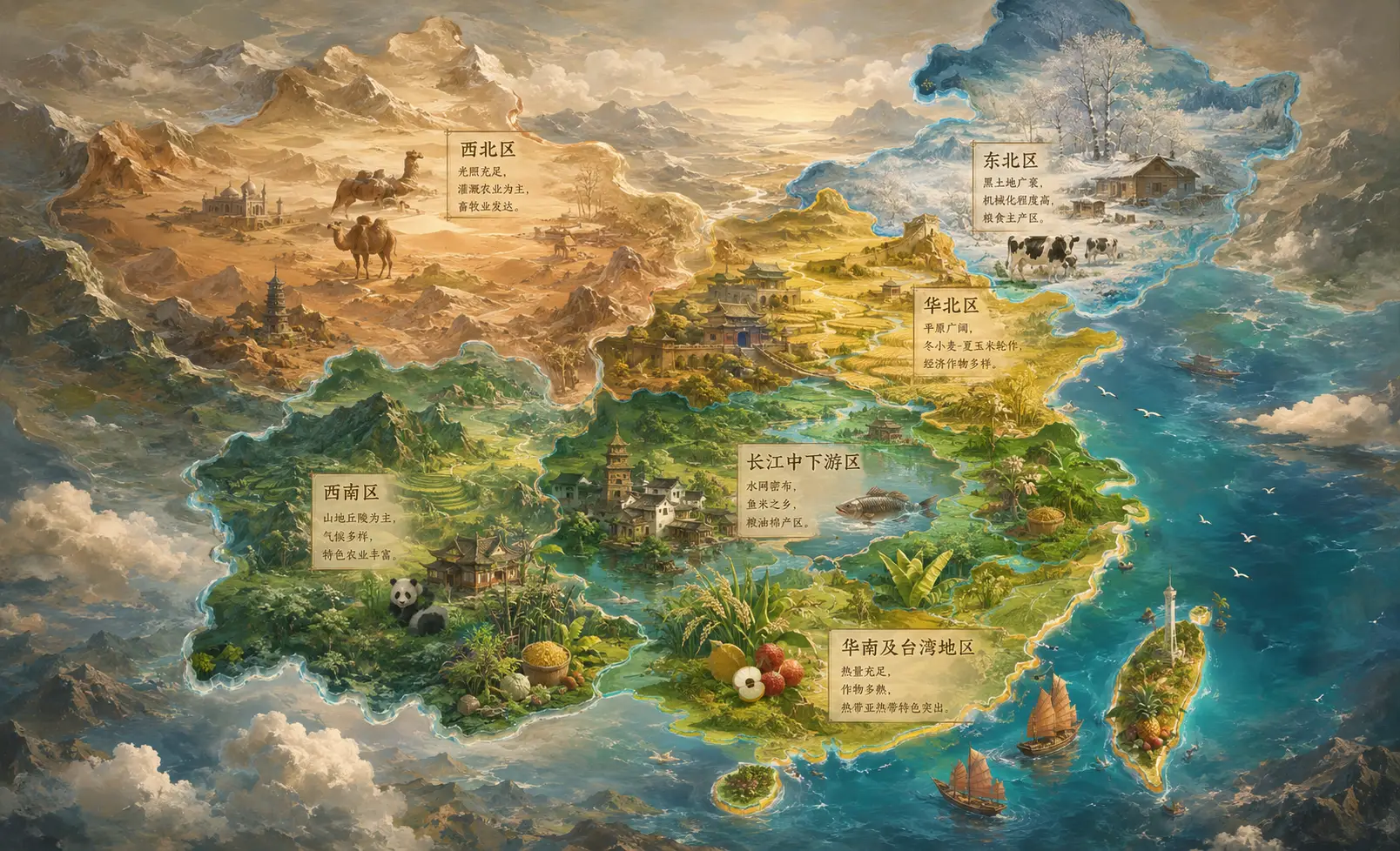
China’s Six Major Agricultural Regions
| Agricultural Region | Major Provinces | Keywords |
|---|---|---|
| Northeast | Heilongjiang, Jilin, Liaoning, eastern Inner Mongolia | “猫冬”, greenhouse production, grain storage, machinery maintenance |
| Northwest | Xinjiang, Gansu, Ningxia, western Inner Mongolia, Qinghai | Winter-wheat overwintering, winter pruning, orchard sanitation and trunk whitewashing, farmland improvement |
| North China | Hebei, Shanxi, Beijing, Tianjin, Shandong, northern Henan | Winter-wheat overwintering, pre-freeze irrigation, winter slack period, input preparation |
| Middle and Lower Yangtze | Hubei, Hunan, Jiangxi, Anhui, Jiangsu, northern Zhejiang, Shanghai | Rapeseed overwintering, winter-wheat overwintering, drainage and waterlogging prevention, winter vegetables |
| Southwest | Sichuan, Chongqing, Guizhou, Yunnan, southeastern Tibet | Rapeseed overwintering, winter-wheat overwintering, winter-potato seedlings, drainage and waterlogging prevention |
| South China and Taiwan | Guangdong, Guangxi, Hainan, southern Fujian, Taiwan Province | Peak winter planting, winter potatoes, winter vegetables, winter field management |
Heilongjiang, Jilin, Liaoning, eastern Inner Mongolia
During Lesser Snow, the ground across Northeast China is fully frozen, temperatures fall to −10 to −20°C, snowfall becomes more frequent, and the landscape turns white. Field activity has effectively ceased, while the traditional “猫冬” period continues.
The “猫冬” period continues. Agricultural work remains largely indoors. Grain already in storage is checked regularly for temperature and humidity and protected against moisture, insects, and rodents, while farmers adjust the timing of sales according to market-price trends. Seeds, fertilizers, pesticides, agricultural film, and other inputs are purchased during the off-season, when prices are relatively low, in preparation for spring sowing. Large agricultural machines are fully inspected and serviced during winter, with particular attention to engines, hydraulic systems, seeding mechanisms, and other key components, ensuring that equipment is in good condition when spring fieldwork begins. Farmers also formulate the following year’s cropping structure and cultivar choices according to market conditions, policy direction, and soil status. Although there is little field work during the “猫冬” period, these indoor preparations are equally important because they affect the quality of spring sowing and the year’s overall harvest.
Winter management in pastoral areas. In eastern Inner Mongolia, livestock management enters a critical winter stage. All animals are moved into housed feeding, shelters are reinforced, bedding is increased, and drafts are kept out. Supplementary feeding becomes fully established, with herders carefully calculating feed reserves and daily rations to ensure that livestock can endure the long winter safely. Weak animals, pregnant females, and young livestock require particular care, with higher feeding levels and improved nutrition. Attention must also be paid to “白灾”, when blizzards cover grazing land and prevent animals from feeding; close monitoring of forecasts and advance reserves of emergency feed are therefore essential in case heavy snow blocks access routes. Management quality during Lesser Snow directly affects overwinter survival and pastoral income in the following year.
Greenhouse vegetables enter peak production. Around Lesser Snow, greenhouse cucumbers, tomatoes, leafy vegetables, and other crops enter fruiting or harvest. Because winter days are short, insulation covers need to be opened at appropriate times to extend available light. Temperatures should be maintained at 25–28°C during the day and 12–15°C at night, with careful insulation and cold protection. Humidity also requires close management because winter greenhouses are prone to high moisture levels; timely ventilation is needed to reduce humidity and limit diseases such as gray mold. Under low-temperature, high-humidity conditions, gray mold and downy mildew are particularly likely to develop, so monitoring and disease control must be strengthened. Greenhouse vegetables are an important source of winter income in Northeast China, and management quality directly affects both yield and quality.
Xinjiang, Gansu, Ningxia, western Inner Mongolia, Qinghai
During Lesser Snow, Northwest China enters a critical stage of winter management. Winter wheat moves into overwintering, winter orchard management becomes fully established, and basic farmland improvement continues.
Winter wheat enters overwintering. Growth largely ceases and the crop enters dormancy. Strong plants formed before winter, with 3–5 tillers and a well-developed root system, provide the basis for safe overwintering and a good harvest the following year. Winter irrigation is fully complete; the pre-freeze watering has thoroughly recharged the soil, and the frozen surface layer now forms a protective cover. Farmers need to inspect wheat fields periodically and check overwintering conditions, taking remedial measures such as straw or plastic-film covering if freezing injury appears.
Winter orchard management becomes fully established. Orchard sanitation is the first and one of the most important steps: dead branches, fallen leaves, diseased fruit, infected branches, and weeds are removed and either burned together or deeply buried to reduce overwintering pests and pathogens and lower pest and disease pressure in the following year. Winter pruning is carried out from leaf fall until bud break, removing dead, diseased, crossing, and overcrowded branches and adjusting tree structure. Young trees are pruned mainly for training, including open-center and spindle forms, while mature trees are pruned primarily for renewal and rejuvenation by renewing fruiting wood, controlling tree height, and improving ventilation and light penetration. Pruning wounds are treated with healing agents to prevent pathogen entry. Winter pruning is one of the most important orchard operations and directly affects yield and fruit quality in the following year.
Tree trunks are also whitewashed for protection against cold and pests. The whitewash consists of quicklime + sulfur + salt + water and is applied to the lower 1–1.5 meters of the trunk. It reflects sunlight, reduces day–night temperature differences, helps prevent sunscald and frost cracking, and kills overwintering insect eggs hidden in bark crevices. Autumn fertilization is completed before leaf fall, with organic fertilizer used as the main source of nutrients to restore tree vigor and build reserves for growth and fruiting in the following year. The quality of winter orchard management directly affects fruit-tree performance in the next season.
Basic farmland improvement continues. Autumn fertilization makes use of the slack season to apply farmyard manure or compound fertilizer in preparation for spring sowing or winter-wheat green-up. Land leveling is carried out to improve irrigation conditions, while irrigation canals, wells, reservoirs, and other water-conservancy facilities are repaired in preparation for spring irrigation. Shelterbelt establishment also continues, with winter tree planting used to reduce wind, stabilize sand, and improve the agricultural environment.
Hebei, Shanxi, Beijing, Tianjin, Shandong, northern Henan
During Lesser Snow, winter wheat across North China enters overwintering, winter irrigation is fully complete, and agricultural activity as a whole moves into the winter slack period.
Winter wheat enters overwintering. Growth largely ceases and plants enter dormancy. Strong pre-winter seedlings with 3–5 tillers and a well-developed root system provide the basis for safe overwintering and a good harvest in the following year. Winter irrigation is fully complete; the pre-freeze watering has thoroughly moistened the soil, and the frozen surface layer now acts as a protective cover. This irrigation is a key measure for winter-wheat survival because it increases the soil’s heat capacity, slows the decline in ground temperature, protects seedlings through winter, and stores moisture for spring green-up. Firming of excessively vigorous wheat fields has also been completed, helping suppress premature stem elongation and improve cold resistance.
Agricultural work enters the winter slack period. Autumn harvesting and sowing are fully complete, winter wheat has entered overwintering, and field activity largely stops. Farmers use the winter to manage stored grain through regular checks for moisture, insects, and rodents and to adjust sales according to market trends; purchase seeds, fertilizers, pesticides, and other inputs during the lower-priced off-season; carry out comprehensive maintenance of agricultural machinery to ensure good condition for spring cultivation; and prepare the following year’s planting plans according to market conditions, policy direction, and soil status. Although there is little field work during this period, indoor preparation remains equally important.
Winter orchard management. Apple, pear, and other orchards enter winter management through orchard sanitation, winter pruning, trunk whitewashing, and autumn fertilization. Dead branches, fallen leaves, diseased fruit, and infected branches are removed to reduce overwintering pests and pathogens. Winter pruning removes dead, diseased, and crossing branches and adjusts tree structure, with young trees shaped and mature trees renewed and rejuvenated. Trunk whitewashing provides protection against cold and pests, while autumn fertilization is completed before leaf fall, mainly with organic fertilizer, to restore tree vigor.
Vegetable management. Greenhouse vegetables enter peak production. Cucumbers, tomatoes, leafy vegetables, and other crops reach fruiting or harvest and require close temperature control at 25–28°C during the day and 12–15°C at night, together with adequate insulation and cold protection.
Hubei, Hunan, Jiangxi, Anhui, Jiangsu, northern Zhejiang, Shanghai
During Lesser Snow, the middle and lower Yangtze enters a critical winter-management stage. Rapeseed and winter wheat move into overwintering, and keeping drainage channels clear to prevent waterlogging becomes the central task.
Rapeseed enters overwintering. Growth slows markedly and plants enter dormancy or semi-dormancy. The highest priority is drainage: a three-level system of main ditches, cross-field ditches, and perimeter ditches needs to remain fully functional, with respective minimum depths of 80 cm, 60 cm, and 40 cm, so that water drains quickly once rain stops. Winters across the Yangtze basin are damp and cold, and excessive soil moisture poses the greatest threat to overwintering rapeseed, potentially causing root rot and seedling death. Fields must therefore be regularly cleared and shaped to maintain unobstructed drainage.
Missing plants should still be resown or transplanted promptly, but work cannot be delayed too long because late replacement seedlings may fail to overwinter safely. Weak stands may receive a pre-winter topdressing based mainly on organic or compound fertilizer to promote root development and improve cold resistance, at a rate of 5–8 kg of compound fertilizer per *mu* or 500–800 kg of farmyard manure per *mu*. In colder highland areas or exceptional years, straw or plastic-film covering may also be used for insulation and frost protection. The quality of overwintering management directly affects survival and yield in the following year.
Winter wheat enters overwintering. Growth largely ceases and plants enter dormancy or semi-dormancy. Management centers on maintaining drainage, applying pre-winter fertilizer to weak stands where necessary, and checking for missing plants.
Drainage and waterlogging prevention are the overriding priority. During Lesser Snow, the Yangtze basin is in its cold, damp winter phase, making drainage the primary management task for both rapeseed and winter wheat. The standard three-level system consists of a main ditch more than 80 cm deep and 40–50 cm wide, connecting the field with drainage channels; a cross-field ditch more than 60 cm deep and 30–40 cm wide, linking the main and perimeter ditches; and a perimeter ditch more than 40 cm deep and 20–30 cm wide, surrounding the field and intercepting surface runoff. Keeping all three levels connected and functional is fundamental to safe overwintering.
Winter-vegetable management. Chinese cabbage, radish, lettuce, spinach, celery, and other winter vegetables enter active growth and require continued water and nutrient management, pest and disease control, and preparation for cold protection through insulating covers.
Winter orchard management. Citrus and other orchards enter winter management. Postharvest pruning and fertilization are carried out to restore tree vigor, orchards are cleaned of dead branches, fallen leaves, diseased fruit, and infected wood to reduce overwintering pests and diseases, winter pruning proceeds after leaf fall, and trunks are whitewashed for protection against cold and pests.
Sichuan, Chongqing, Guizhou, Yunnan, southeastern Tibet
During Lesser Snow, agricultural activity across Southwest China enters a critical winter-management stage. Rapeseed and winter wheat move into overwintering, while management of emerging winter potatoes proceeds steadily.
Rapeseed enters overwintering. Growth slows and plants become dormant or semi-dormant. Management centers on maintaining clear drainage through main ditches, cross-field ditches, and perimeter ditches so that fields drain quickly after rain, as winter conditions in Southwest China are damp and cold and waterlogging poses the greatest threat to overwintering rapeseed. Missing plants are replaced where necessary, weak stands receive pre-winter fertilizer to promote root development and cold resistance, and in high-altitude areas straw or plastic-film covering can be used for frost protection.
Winter wheat enters overwintering. Growth largely stops and plants become dormant or semi-dormant. Drainage management, topdressing of weak stands, and stand inspection remain the main tasks.
Winter-potato seedling management proceeds steadily. Potatoes planted from late October through early November begin to emerge and enter the seedling stage. Farmers inspect stands and replace missing plants, carry out the first inter-row cultivation to loosen the soil and promote root development, apply 5–8 kg of urea per *mu* as a seedling-stage topdressing, and control seedling-stage pests such as cutworms and aphids. Winter potatoes are an important cash crop in Southwest China during the cold season, and the quality of seedling management directly affects final yield.
Guangdong, Guangxi, Hainan, southern Fujian, Taiwan Province
#### (1) Mainland South China
Winter-crop sowing reaches its peak. Around Lesser Snow, winter planting expands across large areas of fields left free after the late-rice harvest. Winter potatoes are planted using early-maturing, high-yielding, disease-resistant cultivars at a depth of 8–10 cm, with row spacing of 60–70 cm, followed by plastic-film covering to conserve heat and moisture. Winter maize is planted using early-maturing, density-tolerant cultivars at a depth of 3–5 cm with 60 cm row spacing. Winter vegetables—including Chinese cabbage, radish, flowering Chinese cabbage, Chinese kale, spinach, and other leafy and root vegetables—are sown on a broad scale. Winter production is an important part of South China’s cold-season agriculture, and both planting area and sowing quality directly affect farm income.
The late-rice harvest is fully complete. Grain is safely stored and the autumn harvest comes entirely to an end. Paddy fields are then plowed and prepared for winter crops.
Winter-crop field management becomes fully established. Once winter crops emerge, management shifts to stand inspection, gap filling, thinning and final plant establishment, inter-row cultivation and weeding, seedling-stage topdressing, and pest and disease control. Because rainfall decreases during winter in South China, timely irrigation is needed to meet crop water requirements, while drainage channels must also remain clear because occasional heavy rain can still occur.
Tropical-fruit management. Citrus enters maturity and harvest. Early cultivars such as “十月橘” and “砂糖橘” reach peak harvest from mid- to late November through December, and farmers take advantage of clear weather to pick, grade, pack, and market the fruit. Banana harvesting approaches completion, while lychee and longan enter winter management through postharvest pruning to restore tree vigor, winter fertilization based mainly on organic fertilizer to promote flower-bud differentiation, and orchard sanitation to remove fallen leaves and overwintering pests and diseases.
#### (2) Taiwan
Rice: Rice harvesting across Taiwan is fully complete and fields enter either the winter slack period or winter-cropping stage.
Vegetables: Around Lesser Snow, sowing and transplanting of winter vegetables continue across Taiwan.
Fruit trees: Citrus enters maturity and harvest, while banana harvesting approaches completion.
Tea: Tea gardens in central and southern areas such as Nantou and Chiayi enter winter management, as do northern tea-growing areas such as Wenshan and Sanxia.
Fisheries: Fishing continues in waters around Taiwan, but the northeast monsoon strengthens and greater attention is required for safety at sea.
Farmer’s proverbs and folk customs: Taiwanese folk tradition preserves the saying “小雪小到”, meaning that the weather has turned cold around Lesser Snow but has not yet reached its coldest point. Another saying, “小雪封地,大雪封河”, describes the ground beginning to freeze during Lesser Snow. This is also traditionally a season for preserving vegetables: “小雪腌菜,大雪腌肉” refers to the custom of pickling winter vegetables during Lesser Snow and curing meat during Greater Snow, making use of the lower temperatures.
Global Extreme Weather · Risks & Responses
Temperate Northern Hemisphere: Cold Waves and Freezing Injury—the Greatest Threat Around Lesser Snow
During Lesser Snow, northern regions enter a period of frequent cold waves, and sudden temperature drops can cause severe freezing injury. Winter-wheat seedlings, although already entering overwintering, remain vulnerable to extreme cold, and temperatures below −15°C may cause seedling death. Before a cold wave arrives, straw or plastic-film covering is one of the most effective protective measures and can raise surface temperature by approximately 2–3°C. In protected agriculture, greenhouses need to be insulated thoroughly and protected from cold-air intrusion; before a cold wave, structures should be reinforced, thermal covers added, and temporary heating equipment prepared. Fruit trees become more cold-hardy after entering dormancy, but young trees and late-autumn shoots still require protection through trunk whitewashing, straw wrapping, and similar measures. In pastoral areas, livestock need reinforced shelters, additional bedding, and effective cold protection, while herders must remain alert to “白灾”. Close attention to weather forecasts and advance preparation are essential.
Temperate Northern Hemisphere: Snowfall and Snow Disasters
Snow begins to appear across northern regions during Lesser Snow, which marks the climatic-average onset of snowfall in the Yellow River basin. Snow can be beneficial to agriculture: as the proverb “小雪雪满天,来年必丰年” suggests, snow cover insulates wheat fields, reduces freezing injury, increases soil moisture, and helps suppress overwintering pests. Heavy snow, however, can collapse greenhouses, damage structures, expose crops to freezing injury, and block roads used for transporting agricultural products. Farmers therefore need to reinforce greenhouses and prepare for snow removal to protect winter production.
Temperate Northern Hemisphere: Cold, Damp Weather—the Greatest Threat in the Yangtze Basin
During Lesser Snow, the middle and lower Yangtze and Southwest China remain under cold, damp conditions characterized by low temperatures, high humidity, and limited sunshine. For rapeseed and winter wheat, excessive soil moisture can cause root rot and seedling death, making drainage the overriding priority: the three-level drainage system must remain fully connected and functional so that fields drain quickly after rain. For harvested autumn grain, storage areas need protection from moisture and mold, with regular monitoring of grain-pile temperature and humidity. Open-field vegetables grow more slowly under cold, damp conditions, while greenhouse crops require stronger ventilation and humidity control to reduce disease pressure. Farmers therefore need to maintain effective field drainage and careful moisture control in storage.
Temperate Southern Hemisphere: Heavy Rain During Harvest and Hot, Dry Winds
In early summer in the Southern Hemisphere, around late November, winter wheat enters the harvest period and faces two major risks: heavy rain during harvest, which can cause sprouting and mold in wheat ears, and hot, dry winds, which can interrupt grain filling under conditions of high temperature, low humidity, and strong wind. Farmers in southeastern Australia and Argentina need to monitor forecasts closely and take advantage of clear-weather windows to harvest and bring grain safely into storage.
Tropical Regions: Alternating Drought and Flood Risk
Across the tropical Northern Hemisphere—including Southeast Asia and India—the dry season is established and attention needs to be paid to drought effects on dry-season crops. Across the tropical Southern Hemisphere—including Brazil and Africa—the rainy season is in its early stage, requiring farmers to guard against flooding caused by heavy rainfall while also taking advantage of favorable soil moisture to sow within the seasonal planting window.
-----
Readers’ Comments
Calendar and traditional culture enthusiasts from around the world, sharing the same moon.
Sign in or register to join the conversation. Your comment account is created automatically the first time you use a connected account.
No comments yet
Share your thoughts with readers around the world.