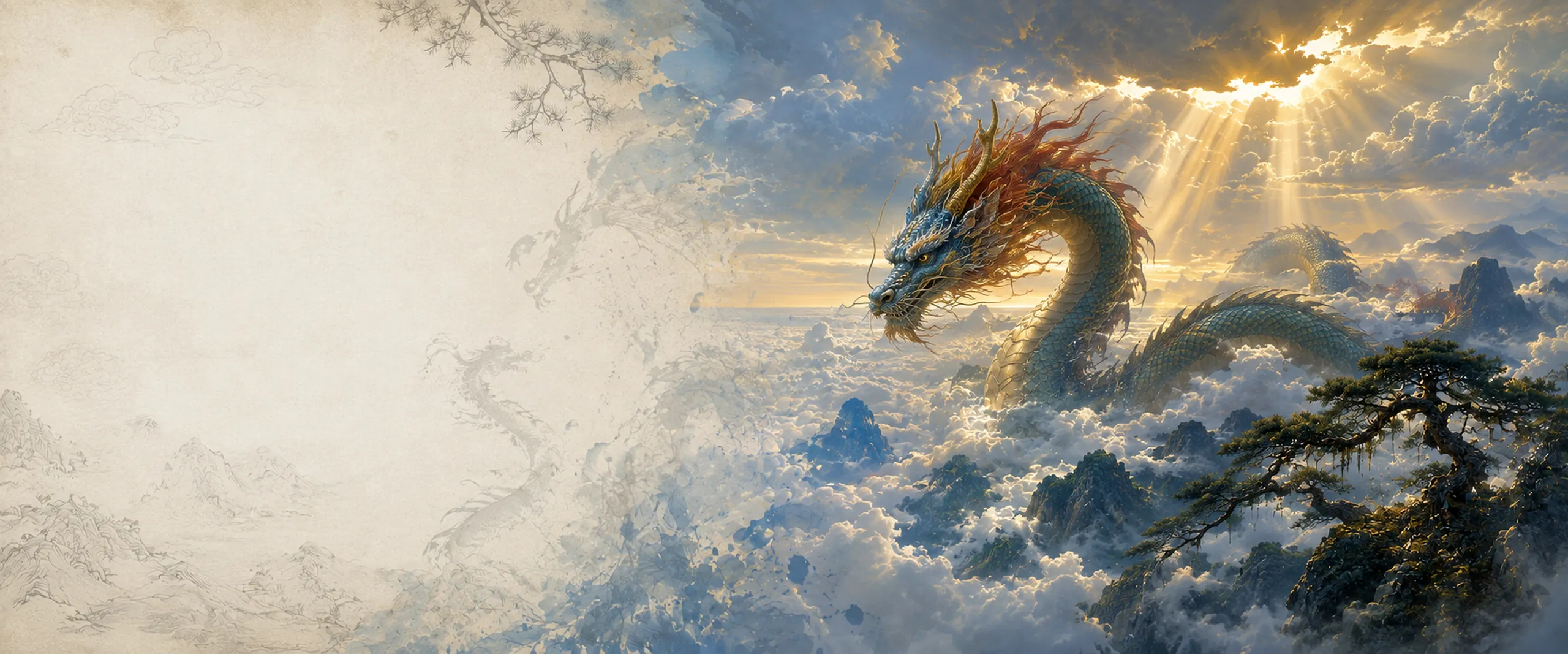
DragonPersonality
「 When the dragon appears in the field, its virtue spreads afar;<br>when the dragon flies in heaven, great deeds take form. 」

Chen Earth Is Yang
Chen corresponds to the fifth of the twelve Earthly Branches and belongs to Yang Earth within the *Wuxing* (五行), the traditional Chinese system of the Five Elements or Five Phases: Wood, Fire, Earth, Metal, and Water. In Five-Element thought, Earth governs trust, support, and solidity. Yang Earth resembles great mountains and towering peaks—majestic, imposing, and extraordinary in presence. Those born under the Dragon sign are therefore believed to possess three innate qualities:
An Innate Air of Nobility
The Dragon is the only mythical creature among the twelve zodiac animals and symbolizes supreme dignity and nobility. Dragon-born people are believed to possess a natural “regal aura”—they move with force, speak with authority, and carry a penetrating gaze. Without any need for deliberate display, their calm self-confidence and unquestionable dignity allow them to become the center of attention in almost any setting.
Grand Vision and Perspective
Chen is regarded as a reservoir, possessing the capacity to contain a hundred rivers. Dragon-born people are broad-minded, and their vision is rarely confined to immediate petty gains. Instead, they look toward the future and plan with the larger picture in mind. They are natural strategists, capable of seeing horizons others cannot see and envisioning blueprints others have not imagined.
An Unceasing Drive for Advancement
In traditional culture, the Dragon is symbolized by “飞龙在天”—the flying dragon in the heavens, forever moving upward and never ceasing. Dragon-born people spend their lives pursuing greater achievement and more distant goals. They are never satisfied with the present and are always thinking about “what the next step should be.”
Hidden Heavenly Stems: Wu, Yi, and Gui
The Earthly Branch Chen (辰) contains three hidden Heavenly Stems (*canggan*, 藏干)—Heavenly Stems understood within this traditional system as being symbolically contained within an Earthly Branch: Wu Earth (戊土), Yi Wood (乙木), and Gui Water (癸水). This complex structure of “Earth generating Wood, and Wood generating Water” is believed to give Dragon-born people deeper inner characteristics:
Wu Earth as the primary qi: Wu Earth represents the earth of great mountains, majestic and substantial. Dragon-born people take this as their foundation, giving them exceptional capacity for bearing responsibility and maintaining stability. They can shoulder heavy burdens without feeling overwhelmed and withstand pressure without collapsing.
Yi Wood as the middle qi: Yi Wood represents flowers and grasses, supple yet upward-growing. Dragon-born people are not composed only of hardness—deep within them also lies a longing for beauty and elegance. They possess a natural appreciation for art, beauty, and a high-quality life.
Gui Water as the residual qi: Gui Water represents rain and dew, nourishing yet profound. Although Dragon-born people may appear strong on the outside, they possess a rich emotional world within. It is not that they do not understand tenderness—they simply reserve that tenderness for those closest to them.
Strengths of the Chen Dragon Personality
Among the twelve zodiac signs, few are believed to rival the Dragon in sheer presence.
Extraordinary Bearing
Powerful aura: A Dragon-born person can stand silently in a room and still create a sense of invisible pressure. Their gaze is firm, their movements composed and assured. This natural authority is not acquired through training but is regarded as innate.
Broad-mindedness: Chen is a reservoir, carrying the capacity to contain a hundred rivers. Dragon-born people do not dwell on trivial matters or remain preoccupied with temporary gains and losses. Their hearts are compared to the sea, able to contain changing winds and storms.
Generosity: Dragon-born people are considered highly generous and rarely stingy with money or resources. They enjoy sharing and helping others—in their view, having the ability to help is an honor of the strong.
Lofty Ambitions
Great aspirations: Dragon-born people are believed to possess large dreams and ambitions from an early age. They are unwilling to settle for an ordinary life or minor achievements. What they want is a “grand and stirring life”—if they are going to do something, they want to do it at the highest level.
Strategic vision: Dragon-born people are skilled at thinking from a broad perspective. They are not easily trapped by immediate details and are capable of stepping back to see the whole. This ability to “view the landscape from a high place” gives them a natural advantage when making long-term plans.
Willingness to challenge the impossible: Dragon-born people believe that “nothing is impossible.” When faced with a task that appears unattainable, they do not retreat; instead, their fighting spirit grows stronger. This spirit of daring to dream and daring to act enables them to push beyond limits others cannot cross.
Confidence and Decisiveness
Powerful self-confidence: Dragon-born people are regarded as possessing one of the strongest levels of self-confidence among the twelve zodiac signs. They believe they can accomplish almost anything—even when others doubt them, they remain unshaken. This confidence may sometimes be mistaken for arrogance, yet it is also what carries them through countless difficult moments.
Decisive action: Dragon-born people are not inclined to hesitate endlessly over decisions. They can quickly identify the essential issue within complex information, make a judgment, and act immediately. This swift and forceful style often allows them to seize opportunities before others.
Willingness to take responsibility: Dragon-born people do not readily shirk responsibility. Whether the outcome is success or failure, they are prepared to bear the consequences. This willingness to “own what one does” makes them leaders whom others may find worth following.
Personal Charisma
Charismatic presence: Dragon-born people possess a difficult-to-define magnetism. Their confidence, enthusiasm, and broad bearing naturally draw and influence those around them. They are the kind of people others want to approach and follow.
Skilled at inspiring others: Dragon-born people are not only capable leaders but also powerful motivators. They can ignite other people’s determination with passionate words and transmit conviction through their own unwavering belief. Working alongside a Dragon-born person can make others feel that “all of this is worth it.”
Humorous and engaging: Although Dragon-born people may appear imposing, they are not without humor. In the right setting, they can use well-timed wit to dissolve tension and make those around them feel relaxed and cheerful.
Weaknesses of the Chen Dragon Personality
Pride
Difficulty accepting opposing views: Dragon-born people possess absolute confidence in their own judgment and may find criticism or advice difficult to accept. Even when another person’s opinion is correct and beneficial, they may reject it out of concern for “face” (*mianzi*, 面子), the culturally significant idea of social dignity and public standing. This attitude of “only I am supreme” can sometimes cause them to miss important opportunities.
Fondness for grand achievements: Dragon-born people are attracted to grand narratives and may sometimes overlook the importance of detail. They pursue “great undertakings” but may stumble over small matters. “千里之堤,溃于蚁穴” (“A thousand-li embankment can collapse because of an ant hole”)—focusing too heavily on the grand picture while neglecting detail is a common mistake attributed to them.
Strong concern for face: Dragon-born people place great importance on their image and reputation. They may prefer to endure unnecessary losses rather than “lose face” in front of others. This excessive attachment to social dignity can sometimes lead them to make irrational decisions.
Impatience
Lack of patience: Dragon-born people want what they desire as quickly as possible and find waiting and delay difficult to tolerate. In undertakings that require long-term accumulation, this impatience can become a serious weakness.
Prone to giving up midway: Dragon-born people often begin with tremendous enthusiasm and seemingly unstoppable momentum. Yet once they encounter setbacks or discover that a task is more complicated than expected, they may lose interest and turn toward the next “larger” goal. The expression “虎头蛇尾”—literally, “a tiger’s head but a snake’s tail,” describing a strong beginning followed by a weak ending—is considered a major danger in their career.
Emotion-driven behavior: When happy, Dragon-born people can be impassioned and generous; when unhappy, they may become dark and intimidating. These dramatic emotional swings can exhaust both themselves and those around them.
Stubbornness
Reluctance to compromise: Dragon-born people tend to believe their way is the best way. In situations requiring cooperation and concession, they may find it difficult to lower themselves or give ground. This uncompromising attitude can easily create friction in relationships.
Excessive desire for control: Dragon-born people are accustomed to controlling the situation. In a team, they want everything to proceed according to their vision; in daily life, they may expect family members to follow their arrangements. This strong desire for control can sometimes leave those around them feeling suffocated.
Difficulty admitting fault: Even when Dragon-born people know they are wrong, they may find it difficult to say “I’m sorry.” It is not that they refuse to recognize their mistake; rather, they struggle to say it aloud. This stubbornness can sometimes cause relationships that could have been repaired to break completely.
Although all belong to the Chen Dragon, differences in Heavenly Stems and *nayin* (纳音) classifications are believed to produce subtle variations in temperament. *Nayin* is a traditional classificatory system that assigns a specific elemental designation to each pairing within the sixty-term sexagenary cycle of Heavenly Stems and Earthly Branches. According to these sixty combinations, Dragon years fall into five types:
| Type | Heavenly Stem & Earthly Branch | Nayin Five Element | Years | Traditional Name |
| ---------------- | ------------------------------ | ------------------ | ---------- | ------------------------------ |
| Wood Dragon | Jia-Chen (甲辰) | Covered Lamp Fire | 1904, 1964 | Dragon Hidden in the Deep Pool |
| Fire Dragon | Bing-Chen (丙辰) | Earth in the Sand | 1916, 1976 | Rain-Bringing Dragon |
| Earth Dragon | Wu-Chen (戊辰) | Great Forest Wood | 1928, 1988 | Dragon Soaring to the Heavens |
| Metal Dragon | Geng-Chen (庚辰) | White Wax Metal | 1940, 2000 | Dragon Moving Through Water |
| Water Dragon | Ren-Chen (壬辰) | Long-Flowing Water | 1952, 2012 | Rain-Bringing Dragon |
Wood Dragon (Jia-Chen Years · 1904, 1964)
Its *nayin* is Covered Lamp Fire, and it is traditionally known as the “Dragon Hidden in the Deep Pool.” Wood Dragons combine gentleness with determination and are regarded as the most scholarly and refined among the five Dragon types.
Core personality traits: Gentle yet principled—Wood Dragons are less openly forceful than other Dragons. Their temperament is comparatively mild, and they know how to take other people’s feelings into account. Yet when matters of principle arise, they are uncompromising: gentleness is their outward manner, while principles form their bottom line; understated talent—Wood Dragons possess deep learning and cultivation but do not like to display or advertise themselves. Their talent is like a dragon hidden in a deep pool, rarely revealed, but astonishing once it appears; deeply loyal in relationships—Wood Dragons place great value on emotional bonds. They do not easily form deep attachments, but once they recognize someone as truly important, they treat that person sincerely and remain steadfast.
Destiny characteristics: They are described as clever and intelligent, proud and high-spirited, with an ordinary early life and success in middle age. Husband and wife may experience mutual conflict, while the children are a source of strength. Those born in spring enjoy both fortune and longevity; those born in summer have more than enough food and clothing; those born in autumn enjoy honor and prosperity; those born in winter live in stability.
Fire Dragon (Bing-Chen Years · 1916, 1976)
Its *nayin* is Earth in the Sand, and it is traditionally known as the “Rain-Bringing Dragon.” Fire Dragons are the most passionate and action-oriented among those born under the Dragon sign.
Core personality traits: Bursting with passion—the enthusiasm of Fire Dragons burns like a fierce flame, blazing and unstoppable. They bring passion to their careers, love to life, and sincerity to friendships; wherever they go, they bring liveliness and vitality; willing to embrace change—Fire Dragons are never satisfied with the status quo and are always searching for new challenges and opportunities. They believe that “if one does not change, one falls behind,” and therefore remain constantly on the move; impatient by nature—what Fire Dragons tolerate least is “slowness.” They want everything to progress quickly, and slow rhythms or inefficient delays can make them anxious or even irritable.
Destiny characteristics: They are described as intelligent, straightforward in heart and speech, and strong in temperament. Throughout life they are said not to remain close to benefactors of high standing, yet they possess authority and courage. Men are described as strong-willed, women as soft-hearted. Those born in spring live at ease; those born in summer enjoy fortune and longevity; those born in autumn are highly talented; those born in winter enjoy strong financial fortune.
Earth Dragon (Wu-Chen Years · 1928, 1988)
Its *nayin* is Great Forest Wood, and it is traditionally known as the “Dragon Soaring to the Heavens.” Earth Dragons are the steadiest and most practical among those born under the Dragon sign.
Core personality traits: Calm and substantial—while retaining the Dragon’s grandeur and confidence, Earth Dragons possess an additional steadiness associated with Earth. They are neither as irritable as Fire Dragons nor as inwardly restrained as Wood Dragons, finding a balanced point between forcefulness and stability; practical and progressive—although Earth Dragons harbor great ambitions, they also value grounded effort. They believe that “a ten-thousand-foot tower rises from level ground,” and that grand ideals must be built upon a solid foundation; highly trustworthy—Earth governs trust, and Earth Dragons are regarded as impeccable in matters of integrity. They do what they say and treat promises as priceless, making them among the most trustworthy leaders of the twelve zodiac signs.
Destiny characteristics: They are described as capable of both compassion and strength, warm-hearted yet firm in temperament. Although they encounter many benefactors in life, they also encounter many petty or malicious people. Wealth is abundant, middle age is arduous, and later life is highly auspicious. Women are capable household managers and possess financial fortune.
Metal Dragon (Geng-Chen Years · 1940, 2000)
Its *nayin* is White Wax Metal, and it is traditionally known as the “Dragon Moving Through Water.” Metal Dragons are the sharpest and most decisive among those born under the Dragon sign.
Core personality traits: Unconcealed brilliance—the talent and ability of Metal Dragons are like a sword drawn from its sheath, impossible to ignore. They dare to express their views and fight for what they want. This sharpness is both an advantage and one of the reasons they may offend others; exceptional execution—Metal Dragons possess not only great ambitions but also the force to turn those ambitions into reality. They are the kind of people who “say it, do it, and make it happen,” never dragging their feet and never giving up halfway; strength that may become brittle—the “hardness” of the Metal Dragon is both its greatest strength and its greatest weakness. They must learn the wisdom of balancing firmness with flexibility, understanding that sometimes bending is necessary in order to go farther.
Destiny characteristics: They are described as intelligent and refined, exceptionally wise, and efficient in their actions. Throughout life they remain close to people of rank and often receive help from benefactors. Yet their temperament is strong, and their fortunes may rise and fall. They are said to be unsuited to official careers and more likely to excel in specialized scholarship, technical fields, or skilled arts.
Water Dragon (Ren-Chen Years · 1952, 2012)
Its *nayin* is Long-Flowing Water, and it is traditionally known as the “Rain-Bringing Dragon.” Water Dragons are the most strategic and adaptable among those born under the Dragon sign.
Core personality traits: Intelligent and strategic—Water Dragons possess not only the Dragon’s grandeur and courage but also the wisdom and agility of Water. They are not reckless fighters who rely only on brute force; they know how to win through intelligence and defeat opponents through strategy; highly adaptable—Water Dragons are unlike Metal Dragons, who would “rather break than bend.” They know how to assess the moment, when to advance and when to retreat. This flexibility allows them to move with ease through complex environments; excellent interpersonal relations—among the five Dragon types, Water Dragons are believed to enjoy the best social relationships. They combine the Dragon’s presence and charisma with Water’s softness and tolerance, making others feel comfortable in their company.
Destiny characteristics: They are described as intelligent, well provided with food and clothing, calm in temperament, and able to live in ease and comfort. They receive help from many benefactors throughout life, with a stable early period, prosperity in middle age, and very favorable later years. Women are described as affectionate and should guard against disputes and troublesome words.
Summary of Personality Differences Among the Five-Element Dragons
| Dimension | Wood Dragon | Fire Dragon | Earth Dragon | Metal Dragon | Water Dragon |
| --------------------------- | --------------------- | ----------------------- | ------------------------- | --------------------------- | -------------------------- |
| Core temperament | Gentle but principled | Passionate and forceful | Steady and practical | Sharp and decisive | Wise and tactful |
| Interpersonal relations | Loyal and devoted | Draws attention | Highly trustworthy | Commands respect and awe | Excellent social relations |
| Career traits | Understated talent | Embraces change | Practical and progressive | Strong execution | Exceptional strategy |
| Primary weakness | Overly conservative | Impatient temperament | Lacks flexibility | Too rigid and easily broken | Sometimes overly smooth |
Childhood and Adolescence (Ages 1–20)
Dragon-born children often display an unusual presence from an early age. They are confident, brave, and strongly opinionated—eager to speak in class, willing to take on challenges on the playground, and naturally inclined to become leaders among their peers. They dislike being ordered around and do not enjoy restriction. When criticized by teachers, they may argue their case and refuse to admit defeat even if punished. Their dreams are often larger and more distant than those of children their age—while other children may still be wondering “what they want to be when they grow up,” a Dragon-born child may already be thinking, “How am I going to change the world?” The weaknesses of this stage are arrogance, resistance to discipline, and a tendency to clash with teachers.
Youth (Ages 20–35)
After entering society, Dragon-born people reach the “golden period” of their lives. With extraordinary confidence and courage, they quickly distinguish themselves in the workplace—taking on projects others hesitate to accept and challenging fields others dare not enter. They are not satisfied with slowly “waiting their turn” and accumulating seniority; what they seek is a breakthrough that allows them to “rise to the heavens in a single step.” In love, they pursue intense, unforgettable romance, but often overlook the value of steady companionship over time. The weaknesses of this stage are overreaching ambition, insufficient groundedness, and a tendency to stumble through excessive eagerness for quick success.
Middle Age (Ages 35–50)
Upon reaching middle age, Dragon-born people begin to learn how to “conceal their edge.” After experiencing the rises and falls of youth, they gradually understand that “not every battle is worth fighting, and not every opponent deserves attention.” In their careers, they shift from the “fierce general charging into battle” to the “commander planning from behind the lines.” Within the family, they also begin to learn how to listen and compromise, becoming less inclined than in youth toward a “one-person rule.” The weakness of this stage is that they may still find it difficult to let go of “face,” sometimes making irrational decisions merely to protect their image.
Later Life (Age 50 and Above)
In later life, Dragon-born people continue to retain the Dragon’s grandeur and dignity. Although they no longer display their sharpness as openly as in youth, the aura that inspires respect without anger remains powerful. They learn to express concern in gentler ways—not “You must listen to me,” but “I suggest you do it this way.” They become highly respected elders within the family—their children respect them, and their grandchildren feel close to them. The wisdom of this stage lies in understanding that “true strength is not conquering others, but conquering one’s own pride.”
The Inner Needs of Dragon-Born People
They need to be respected: The most important need of Dragon-born people is “respect.” They can tolerate many things but cannot tolerate being belittled, ignored, or humiliated. Respect their abilities, their opinions, and their achievements—this is the foundation of getting along with the Dragon.
They need to be appreciated: Dragon-born people need to hear praise and affirmation. They invest tremendous effort in maintaining their “regal image,” and a sincere “You really did an amazing job” can make them feel that “all the effort was worthwhile.”
They need followers: Dragon-born people are natural leaders and need others who are willing to follow them and believe in them. They do not enjoy being questioned or challenged—when someone doubts their decisions, they may feel distrusted and disrespected.
Golden Rules for Getting Along with Dragon-Born People
Show sufficient respect: In any setting, leave Dragon-born people enough room to preserve their dignity. Even when you disagree, express your view in a tactful way.
Offer sincere praise: Dragon-born people have a strong need for genuine recognition. When they achieve something, do not withhold your appreciation.
Do not challenge them lightly: If you disagree with a Dragon-born person, express it gently rather than confronting them head-on.
Remain loyal: Loyalty is what Dragon-born people value most. Once they feel that “you betrayed me,” they may never trust you again.
Best Zodiac Partners for the Dragon
In traditional Chinese zodiac marriage culture, the Dragon and Rooster form a “Six Harmony” pairing (*liuhe*, 六合), a traditional relationship of especially strong compatibility between two zodiac signs, and are regarded as the best marital match. The Dragon also forms a “Three Harmony” combination (*sanhe*, 三合)—a traditional grouping of three mutually harmonious signs—with the Monkey and Rat, making these pairings harmonious as well. With the Dog, Rabbit, and Dragon, there are varying degrees of zodiac clash and harm (*xiangchong* 相冲 and *xianghai* 相害), traditional forms of incompatibility that are believed to require greater adjustment within relationships.
The personality portrait of the Chen Dragon forms one of the most majestic and regal chapters in Chinese zodiac personality culture. Dragon-born people spend their lives embodying the spirit of “飞龙在天,” expressing the life stance of one “born to rule.” They refuse to be satisfied with the ordinary, reject mediocrity, and are forever pursuing a higher and more distant sky.
The mountain-like dignity of “Chen Earth as Yang” and the generative interplay of Earth, Wood, and Water within the “hidden Heavenly Stems Wu, Yi, and Gui” together form the philosophical foundation of the Dragon personality—combining the grandeur and solidity of great mountains, the suppleness and elegance of flowers and grasses, and the nourishing depth of rain and dew. They are not incapable of softness; they are simply accustomed to strength. They do not lack the need for companionship; they simply dislike showing weakness too easily.
From the gentle principles of the Wood Dragon to the passionate force of the Fire Dragon, from the steady practicality of the Earth Dragon to the sharp decisiveness of the Metal Dragon, and finally to the wisdom and tact of the Water Dragon—the five forms of the Chen Dragon each possess their own character, yet all share the core qualities of confidence, decisiveness, great ambition, and extraordinary bearing. They are natural leaders and exceptional strategists, among those in the twelve zodiac signs who best understand how to “turn dreams into reality.”
In getting along with a Dragon-born person, the most precious gift is not material generosity but sincere respect and steadfast willingness to stand beside them. When a Dragon-born person chooses to walk with you, they are entrusting you with the side of themselves that trusts most deeply—and that trust deserves to be cherished. Although the Chen Dragon stands fifth in the zodiac cycle, it raises one of the loftiest monuments within the cycle through its most magnificent bearing. Through their very existence, Dragon-born people affirm that the height most worth climbing in this world is often hidden within that single moment when the “flying dragon is in the heavens.”
----
Readers’ Comments
Calendar and traditional culture enthusiasts from around the world, sharing the same moon.
Sign in or register to join the conversation. Your comment account is created automatically the first time you use a connected account.
No comments yet
Share your thoughts with readers around the world.