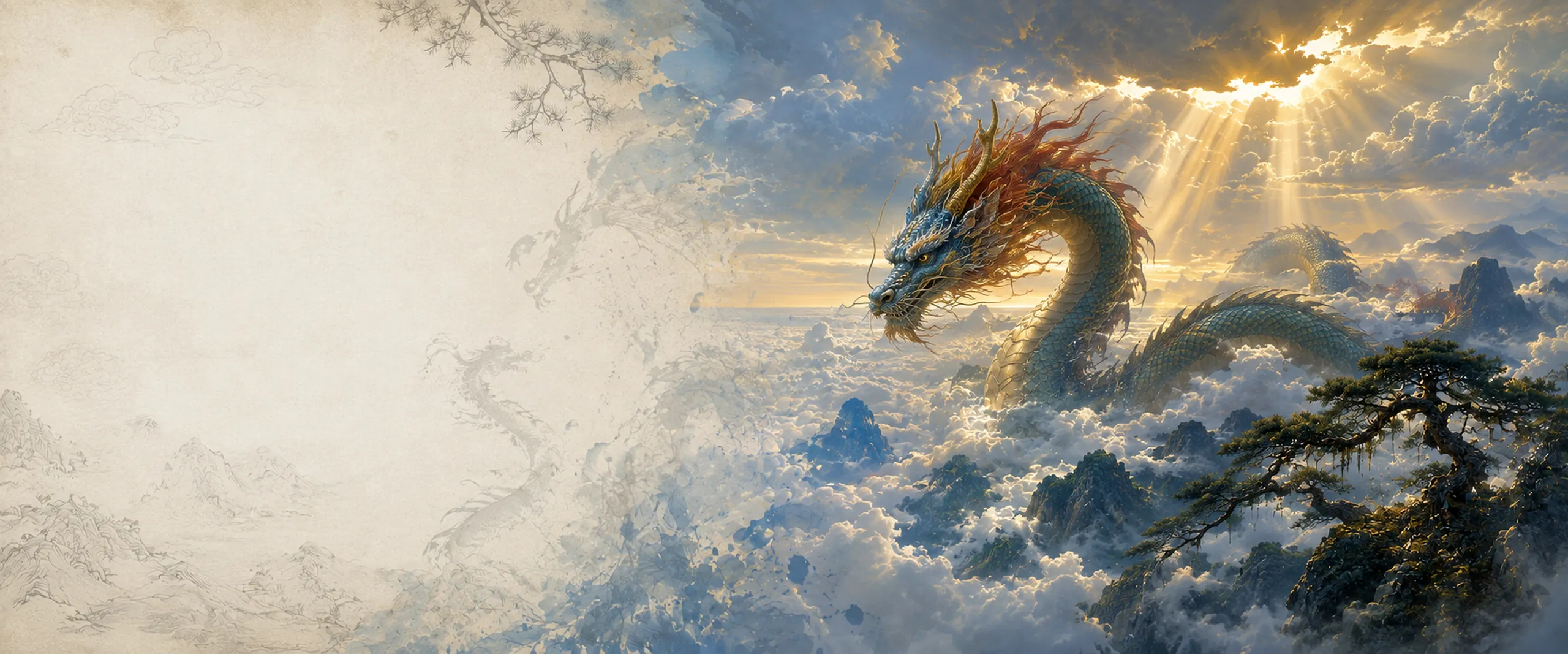
DragonOrigin
「 When the dragon appears in the field, its virtue spreads afar;<br>when the dragon flies in heaven, great deeds take form. 」
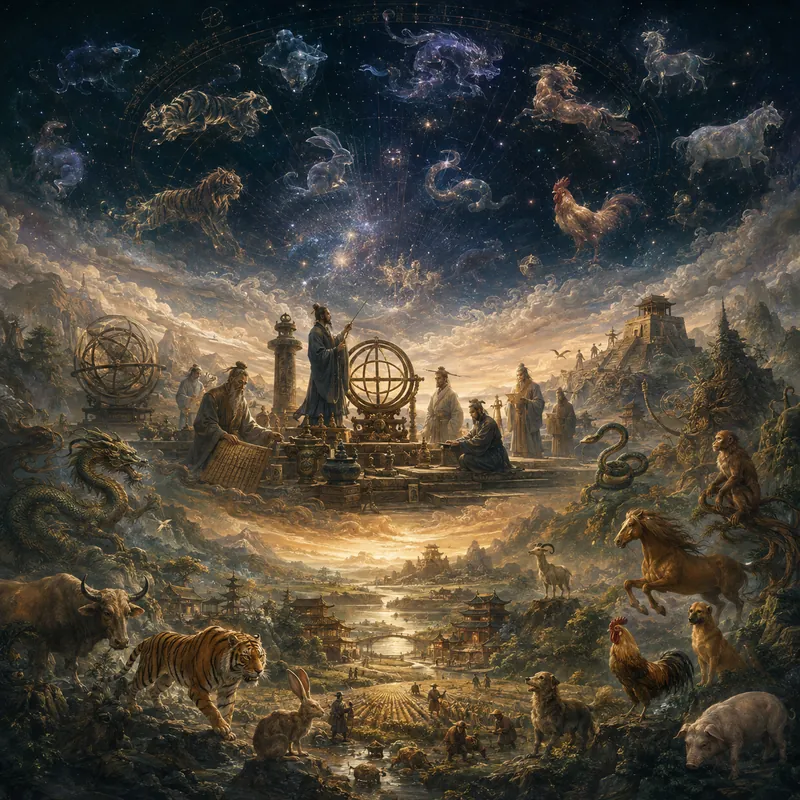
Chen —— The Fifth Earthly Branch
In oracle-bone inscriptions, the overall form of “辰” (Chen) resembles a shell sickle tied to a finger—a large clam shell fastened to the finger with cord. “辰” was the original form of “蜃”, meaning a large clam. In ancient times, before metal agricultural implements existed, early peoples ground hard clam shells, or “Chen,” into tools for weeding and cultivating the soil. Because agricultural work was closely connected with astronomy and the calendar, the agricultural implement “Chen” gradually came to be borrowed as a term for the sun, moon, and stars, as well as for units of timekeeping.
By the Eastern Han dynasty, Xu Shen explained it in the *Shuowen Jiezi* (《说文解字》): “辰,震也。三月阳气动,雷电振,民农时也。” “Chen” was interpreted through “Zhen,” meaning “to shake,” because in the third lunar month, or Chen month, spring thunder reverberates, the myriad things revive, and the busy farming season begins. “Chen” was further extended to serve as a collective term for the sun, moon, and stars—the word “星辰” derives from this usage—and could also refer specifically to the Pole Star, as in “北辰.” “Chen” is simultaneously the fifth of the twelve earthly branches, corresponds to the third lunar month, or late spring, and belongs to Yang Earth within the Five Phases.
The original oracle-bone meaning of “Chen” was an agricultural implement, but it was later extended to mean stars and celestial bodies and then units of time. From a tool for labor upon the earth, to the sun, moon, and stars in the heavens, and finally to time itself, the evolution of the character “Chen” fully reflects the ancient wisdom of “observing celestial phenomena to determine the seasons.”
Dragon —— Evolution of the Character and Philological Extensions
Evolution of the Character
The character “龙” (Dragon) is one of the oldest and most mythologically charged pictographs in Chinese writing, first appearing in Shang-dynasty oracle-bone inscriptions and bronze inscriptions. The oracle-bone form resembles an animal with a beast’s head and serpent’s body, with a large mouth, elongated body, curved tail, and an ornament resembling the character “辛” atop its head. Its form combines features from several animals, further embellished through imagination.
The bronze-inscription form closely resembles the oracle-bone form, except that sharp teeth appear inside the Dragon’s mouth. Warring States scripts and Qin small-seal script changed much more substantially: the portion resembling the Dragon’s head and mouth in oracle-bone and bronze inscriptions became “月”, that is, “肉,” while additional components were added on the right. The small-seal form “龍” became more elaborate and was divided into left and right components. Han clerical script squared the form on the basis of small-seal script, producing the traditional character “龍.” After the Sui dynasty, popular forms wrote “Dragon” as “尨”, which was later simplified further into “龙”, today’s simplified character.
Xu Shen of the Eastern Han records in the *Shuowen Jiezi · Long Bu* (《说文解字·龙部》): “龙,鳞虫之长。能幽,能明,能细,能巨,能短,能长;春分而登天,秋分而潜渊。” This means that the Dragon is the foremost among scaled creatures: it can hide or reveal itself, become small or enormous, short or long; at the Spring Equinox it ascends to Heaven, and at the Autumn Equinox it descends into the abyss. This is precisely a portrayal of the Dragon’s mysterious and ever-changing divine nature.
The Profound Astronomical Connection Between “Chen” and the Dragon
The pairing of “Chen” and the Dragon follows an even deeper logic within ancient Chinese astronomy. The Seven Mansions of the Azure Dragon—Jiao, Kang, Di, Fang, Xin, Wei, and Ji—collectively comprise the seven eastern lunar mansions, whose arrangement resembles an immense Dragon. Every year during the third lunar month, or Chen month, the Seven Mansions of the Azure Dragon rise above the eastern horizon at dusk—precisely the sign that spring cultivation is beginning. The ancients connected this celestial phenomenon with “Chen” time and with the Dragon, forming an integrated astronomical–agricultural–mythological cultural system around the “Chen-Dragon” pairing. “Chen” is at once a traditional time period, Chen hour, a month, Chen month, and a celestial designation, Dachen; the Dragon is at once a celestial phenomenon, the Azure Dragon, a mythic being, the divine Dragon, and a zodiac animal, the Chen-Dragon. The union of Chen and the Dragon is a classic example of how the Chinese integrated astronomy, calendrical systems, and mythology into a single cultural framework.
Three Explanations for the Pairing of Chen and the Dragon
The Time-of-Day Theory
Chen hour runs from 7:00 to 9:00 in the morning and is also known as “meal time.” During Chen hour, qi and blood are believed to flow into the stomach meridian, making it an appropriate time for breakfast. At Chen hour, mist rises and clouds begin to gather; the ancients believed this was precisely when divine Dragons summoned clouds and rain and rode through mist and vapor. Chen hour was therefore also known as “Dragon hour.” The morning scene represented by “Chen”—clouds and rosy vapors rising as the myriad things awaken—naturally corresponds with the Dragon’s divine power to summon clouds and bring rain, and thus “Chen” was paired with the “Dragon.”
The Celestial-Body Theory
The original meaning of “Chen” came to serve as a collective term for the sun, moon, and stars. Ancient texts record that the star Dachen, specifically Fang, one of the Twenty-Eight Lunar Mansions, together with the two neighboring stars before and behind it, formed an arc resembling the curved blade of the agricultural implement “Chen”; hence “Chen” also became the name of a celestial mansion. The ancients connected the Dragon stars in Heaven—the Seven Mansions of the Azure Dragon—with “Chen” time on earth. The Dragon stars appeared in the East at dusk during spring, precisely when agricultural cultivation began. Pairing the Dragon with “Chen” therefore contains a profound connection between celestial phenomena and the agricultural calendar.
The Five Phases Theory
Within the Five Phases, “Chen” belongs to Yang Earth, but hidden within Chen are Wu Earth, its primary qi, Yi Wood, and Gui Water. Chen is regarded as a reservoir of Water, symbolizing fields, gardens, and marshes. The *Zuozhuan* (《左传》) contains the phrase “深山大泽,龙蛇生焉”—Dragons are the foremost among aquatic creatures, while Chen is the place of the water reservoir. Pairing the chief of aquatic creatures with the land of the water reservoir is therefore entirely natural.
Records in Classical Texts
The Qin Bamboo-Slip *Rishu*
In 1975, the *Daozhe* section of the bamboo-slip *Rishu* (《日书·盗者》), unearthed from Qin Tomb No. 11 at Shuihudi in Yunmeng County, Hubei, recorded pairings associated with the twelve zodiac animals. Yet one item in this list is particularly unusual—the position of “Chen” is missing, omitted in the original manuscript. Another version shows that the animal paired with “Chen” was unexpectedly “虫”, rather than the Dragon. This precisely demonstrates that from the late Warring States into the Qin period, although the twelve-animal zodiac had already begun to take shape, the animal corresponding to “Chen” had not yet been standardized. The Dragon’s emergence as the fixed counterpart of “Chen” was established only gradually afterward.
The same phenomenon appears in the Qin bamboo slips excavated at Fangmatan in Tianshui, Gansu. Records concerning the position of “Chen” in the Fangmatan Qin slips are likewise unstable. Similar records also appear in the Han bamboo-slip *Rishu* from Kongjiapo in Suizhou, Hubei.
The Eastern Han *Lunheng*
The earliest transmitted text to record the same twelve zodiac animals as those used today is Wang Chong’s Eastern Han *Lunheng* (《论衡》). In the *Lunheng · Wushi Pian* (《论衡·物势篇》), Wang Chong explicitly records the correspondences between the twelve zodiac animals and the twelve earthly branches. This shows that by the Eastern Han period, in the first century CE, the pairing between the Dragon and “Chen” had finally become fixed. Scholars have pointed out that the political unification of the Han dynasty promoted the integration of thought and culture; the Dragon not only acquired a standardized form, but also ultimately came to occupy the position of “Chen” within the zodiac system.
The “Huanlong Clan” and “Yulong Clan” in the *Zuozhuan*
The *Zuozhuan* (《左传》) records that Emperor Shun had a subordinate skilled in raising Dragons, who was called the “豢龙氏”, or Huanlong Clan, and was granted the surname Dong. By the Xia dynasty, one of the descendants of Tang Yao named Liu Lei learned the art of raising Dragons from the Huanlong family, was highly valued by King Kong Jia of Xia, and was granted the title “御龙氏”, or Yulong Clan, with orders to tend the royal Dragons. Although these accounts belong to the realm of legend, they show that in ancient conceptions, Dragons were not always remote and unattainable divine beasts—in remote antiquity, Dragons could be regarded as real animals capable of being domesticated and raised.
Zodiac Figurines and Dragon-Shaped Artifacts
The Tradition of Zodiac Figurines from the Northern Wei to the Tang Dynasty
The twelve zodiac figurines, also known as divine figurines of the Twelve Branches, were distinctive burial objects in ancient Chinese funerary culture. The Tang-dynasty *Tang Huiyao* (《唐会要》) records ritual regulations governing burial with zodiac figurines. The Chen-Dragon figurine generally took the form of an animal-headed human body—a human figure with a Dragon’s head, dressed in official robes and holding a court tablet in both hands, embodying the solemn image of the Dragon as a zodiac divinity. Large numbers of twelve-animal pottery figurines with animal heads and human bodies have been unearthed from Tang tombs. Among them, Chen-Dragon figurines have Dragon heads and human bodies, wear open-collared, wide-sleeved robes, and hold court tablets with both hands before the chest.
The Dragon-Head Bronze of the Old Summer Palace
The Dragon-head bronze of the Old Summer Palace formed part of the hydraulic clock system at Haiyantang, designed during the Qianlong reign of the Qing dynasty under the direction of the Italian missionary Giuseppe Castiglione and supervised by the French missionary Michel Benoist. Twelve statues with animal heads and human bodies were arranged in two diverging rows in the shape of the character “八” beside the fountain pool before Haiyantang. At each traditional two-hour period, the corresponding animal head spouted water from its mouth to mark the time. During Chen hour, from 7:00 to 9:00 in the morning, the Dragon-head bronze projected a column of water from its mouth. In 1860, Anglo-French forces burned the Old Summer Palace, and the twelve zodiac bronzes were looted and dispersed overseas.
Neolithic Period —— The Earliest Dragons
Stone-piled Dragon from Chahai, Liaoning (approximately 8,000 years ago): Measuring 19.7 meters in total length, it was constructed from piled stones, with its head raised and mouth open, its body curved and back arched. This is currently the earliest Dragon image discovered in China. The stone-piled Dragon at Chahai clearly possessed a ritual function, demonstrating that as early as 8,000 years ago, a primitive religion centered on the Dragon as a totem had already taken shape.
Modeled Dragon from Xinglongwa, Inner Mongolia (approximately 8,000–7,500 years ago): Its Dragon head was replaced by a pig’s head, while its body was formed from piled stones.
Shell-mosaic Dragon from Xishuipo, Puyang, Henan (approximately 6,400 years ago): Formed from freshwater shells and placed alongside a Tiger. Archaeologists discovered large quantities of bone and jade objects associated with Dragons in the tomb. Dragon and Tiger appeared side by side, jointly participating in the burial of the highest ruler of the time.
Pebble-arranged Dragon from Jiaodun, Hubei (approximately 6,000 years ago): With a deer’s head, fish’s tail, serpent’s body, and beast’s claws, it has been called the “first Dragon of the Yangtze River basin.”
Jade Dragon from Lingjiatan, Anhui (approximately 5,300 years ago): A representative example of Neolithic jade Dragons.
C-shaped jade Dragon of the Hongshan culture from Chifeng, Inner Mongolia (approximately 5,000 years ago): Its body coils into a C shape and combines features such as deer eyes, a serpent’s body, pig’s nose, and horse’s mane. It is the largest and highest-ranking artifact among Hongshan culture jade objects.
Shang and Zhou Periods —— Dragons on Bronzes and Jades
During the Shang and Zhou periods, Dragon motifs evolved from concrete to abstract forms, with shapes and patterns gradually becoming more unified and widely used in the decoration of bronze vessels and jade objects.
Coiled jade Dragon from the Tomb of Fu Hao at Anyang, late Shang dynasty: Unearthed from the Tomb of Fu Hao at Yinxu in Anyang, Henan, it is a representative Shang-dynasty jade Dragon.
Sanxingdui bronze climbing Dragon, late Shang dynasty: Unearthed at Sanxingdui in Sichuan, it has a slender body, a head resembling that of a sheep, and whiskers.
Bronze basin with coiled-Dragon motif, Shang–Zhou period: On bronze vessels unearthed at Yinxu, Dragon motifs and their many variations became an almost ubiquitous form of decoration.
Qin and Han Periods —— Standardization of the Dragon Form
During the Qin and Han periods, the form of the Dragon became largely standardized and reached a new level in its visual development, becoming a model for later variations of Dragon motifs.
T-shaped silk painting from the Han tombs at Mawangdui, Changsha, Western Han: The silk painting contains images of Dragons and constitutes important material evidence for Han-dynasty representations of the Dragon.
Cultural Meanings of Dragon Artifacts
Across Chinese artifacts and artworks, the Dragon’s image underwent a long evolution from totem to divine beast, from divine beast to symbol of royal authority, and from symbol of royal authority to national cultural symbol. Prehistoric peoples created Dragon-shaped objects mainly for ritual purposes; during the Shang and Zhou periods, Dragon motifs became important decorations on ritual vessels; after the Qin and Han dynasties, the Dragon became associated with royal authority; today, the Dragon has become a cultural symbol and spiritual emblem of the Chinese nation.
The Debate Over the Dragon’s Prototype
There have long been multiple theories concerning the visual origins of the Dragon. Wang Fu of the Eastern Han recorded the classic theory of the “nine resemblances” in the *Qianfu Lun* (《潜夫论》): “角似鹿、头似驼、眼似鬼、项似蛇、腹似蜃、鳞似鱼、爪似鹰、掌似虎、耳似牛”. The Dragon’s image was thus formed by combining characteristics from many different animals and reshaping them through imagination and artistic transformation.
Some scholars, however, have proposed a bolder hypothesis—that the prototype of the Dragon may have been the crocodile. The 6,400-year-old shell-mosaic Dragon unearthed from the Xishuipo site at Puyang, Henan, bears a strong resemblance to later Dragons. Some scholars believe that this “Dragon” looks more like a crocodile. To ancient peoples, the Tiger was the fiercest animal on land, while the crocodile was the most ferocious overlord of the water; “riding the Dragon and commanding the Tiger” was thus the deed of a hero.
Others believe that the Dragon’s prototype was the serpent. The oracle-bone form of “Dragon” resembles a creature with a beast’s head and serpent’s body. C-shaped jade Dragons unearthed extensively at Niuheliang in Liaoning, Chifeng in Inner Mongolia, and elsewhere have large heads, long coiled bodies, and no legs—some identify them as pigs, hence the term “jade pig-Dragon,” while others interpret them as serpents. Whatever its prototype may have been, the Dragon’s form is unquestionably a fusion of features from multiple animals.
The Earliest Dragon —— The Stone-Piled Dragon of 8,000 Years Ago
In 1986 and 1994, two pottery fragments bearing Dragon motifs made in relief were excavated from Hongshan culture strata at the Chahai site in Fuxin, Liaoning, dating to approximately 8,000 years ago. Even more remarkable was the discovery at the site of a Dragon-shaped structure formed from piled stones—19.7 meters in total length, with head raised, mouth open, body curved, and back arched. This is currently the earliest physical prototype of a Dragon image discovered in China. The stone-piled Dragon at Chahai clearly possessed a ritual function, demonstrating that as early as 8,000 years ago, a primitive religion centered on the Dragon as a totem had already formed.
Neolithic Dragons —— Spread Across the Chinese Land
In the early twentieth century, the Xinglongwa site in Inner Mongolia, dating to approximately 8,000–7,500 years ago, yielded a modeled Dragon whose head was represented by a pig’s head and whose body was constructed from stones. In 1998, the Xishuipo site at Puyang, Henan, dating to approximately 6,400 years ago, yielded a combined Dragon-and-Tiger motif made from freshwater shells. In 1993, the Neolithic Jiaodun site in Hubei, dating to approximately 6,000 years ago, produced a pebble-arranged Dragon—with its head toward the east and tail toward the west, a deer’s head, fish’s tail, serpent’s body, and beast’s claws—which archaeologists called the “first Dragon of the Yangtze River basin.” In 2002, a turquoise Dragon-shaped object was discovered at the Erlitou site in Luoyang, Henan, dating to approximately 3,700 years ago; the entire object was assembled from more than 2,000 pieces of turquoise.
This wealth of archaeological evidence demonstrates that Dragon worship was distributed extraordinarily widely across the Chinese land—from the Hongshan culture of the north to the Yangshao culture of the Central Plains and the Qujialing culture of the south, Dragon imagery extended across thousands of kilometers and thousands of years.
Dragon Totemism and the Integration of Peoples
According to legend, after the Yellow Emperor defeated Chiyou and unified the realm, he took one element from the totemic emblem of each tribe, combined features from several different animals, rearranged them, and embellished them through imagination to form the image of the Dragon. This totem symbolized the unification of the state. The cultural identity expressed in the phrase “descendants of the Dragon” evolved step by step from prehistoric Dragon-totem worship.
The myths and legends surrounding the Chen-Dragon are unmatched among the twelve zodiac animals in both number and influence. From Yinglong, the war deity of the *Shanhaijing*, to the True Dragon Son of Heaven embodied by emperors; from folk legends of the nine sons of the Dragon to the belief system of the Dragon Kings of the Four Seas, the Dragon’s mythological image runs through almost every sphere of Chinese mythology.
Creation and Heroic Narratives
Yinglong in the *Shanhaijing*
The *Shanhaijing* (《山海经》) records a Dragon with two wings—Yinglong (应龙). Yinglong is the only primordial creator deity in ancient mythology that does not take human form. Its original name was Gengchen (庚辰), and it was born in the most ancient age.
In remote antiquity, war broke out between the tribes of the Yellow Emperor and Chiyou. Unable to defeat Chiyou, the Yellow Emperor called upon Yinglong for assistance. After receiving the command, Yinglong used its power over water to gather and store water, ultimately capturing and killing Chiyou and Kuafu. The battle took a tremendous toll on Yinglong. After slaying Chiyou and Kuafu, it no longer had the strength to fly back to Heaven and quietly withdrew to the mountains and marshes of the south.
When Yu the Great controlled the floods, he again called upon Yinglong to save the people. Yinglong led divine Dragons from every direction in helping to tame the waters—it drew a line with its tail, guiding the floodwaters toward the sea. Yinglong’s seclusion caused the South to enjoy favorable winds and timely rains. Yinglong appears repeatedly in the *Shanhaijing* and later texts and may be regarded as the Dragon with the most distinguished military achievements in Chinese mythology.
“Old Dragon Ji” in the *Zhuangzi*
The *Zhuangzi* (《庄子》) contains the phrase “有老龙吉”. Old Dragon Ji is an accomplished sage in the writings of Zhuangzi, and the presence of the character “Dragon” in his name indicates that, in the conceptions of pre-Qin philosophers, the Dragon had already acquired symbolic meanings of transcendence beyond the ordinary world.
Zodiac Ranking Legends
The Dragon Borrows the Rooster’s Horns —— The Contest for Zodiac Rank
A lively folk legend explains why the Dragon occupies fifth place among the twelve zodiac animals.
According to legend, in remote antiquity the Dragon had no horns and lived on the earth. The Dragon wanted to rely on its own abilities to become a zodiac animal and king of the beasts and continually sought to replace the Tiger. The Dragon and Tiger therefore began fighting. They were evenly matched, and their struggle was so difficult to resolve that it disturbed the Jade Emperor, who decided to summon them to the Celestial Palace to judge the dispute.
Although the Dragon considered itself courageous and powerful, it felt that without horns on its head it did not look sufficiently majestic and imposing. It therefore borrowed a crown from the Rooster—namely the rooster’s comb, or “horns”—to dress itself up, becoming imposing, handsome, and magnificent. The Dragon’s new appearance moved the Jade Emperor, who named it the “image ambassador” of the animal kingdom and awarded it an additional zodiac seat as a reward.
On the day when the Jade Emperor selected the zodiac animals, the Dragon King also joined the competition. The Dragon was the fifth animal to arrive at the Celestial Palace, corresponding exactly to “Chen,” the fifth of the twelve earthly branches. From then onward, it became known in the zodiac as the “Chen-Dragon.”
Folk Beliefs and Customs
Dragon Kings and the Summoning of Clouds and Rain
The Dragon’s most important function in Chinese folk belief is governing rainfall. Dragons can ride clouds and mist, summon clouds and bring rain, and control the weather. Heavy rain is usually accompanied by lightning and thunder, and the pronunciation of “Dragon” was therefore believed to derive from the “隆隆” rumbling sound of thunder.
In folk legends, the Dragon Kings of the Four Seas respectively govern the waters of the eastern, southern, western, and northern seas. Dragon King temples are found throughout the country. In years of drought, people prayed to the Dragon Kings for rain; in years of flooding, they prayed for clear weather. The Dragon’s function of summoning clouds and bringing rain made it one of the deities most closely connected with agricultural production.
The True Dragon Son of Heaven
After the Han dynasty, the Dragon became increasingly closely associated with royal authority. Wang Chong of the Eastern Han records in the *Lunheng · Jiyao* (《论衡·纪妖》): “龙,人君之象也”—the Dragon became the symbol of emperors and imperial power. During the imperial era, rulers were called “True Dragon Sons of Heaven,” and objects associated with the emperor were modified with the word “Dragon”—Dragon robe, Dragon throne, Dragon carriage, Dragon banner, and so forth. From “the image of the ruler” to the “True Dragon Son of Heaven,” the Dragon completed its transformation from mythological divine beast into political symbol. The Dragon was at once a god in Heaven and a king on Earth—this dual identity granted it a supreme position within Chinese culture.
The Nine Sons of the Dragon
“The Dragon has nine sons” is a famous motif in Chinese folk legend. The ancients regarded nine as the highest of numbers, and the “nine” in “the Dragon has nine sons” carries the meaning of “many.” Specific lists of the Dragon’s nine sons only appeared in various forms during the Ming dynasty. The earliest surviving documentary account appears in an evidentiary response written under imperial order by Li Dongyang during the Hongzhi reign of the Ming. A commonly cited list of the nine sons of the Dragon includes: Qiuniu (囚牛), fond of music and often carved on the heads of stringed instruments; Yazi (睚眦), fond of killing and often carved on swords and blades; Chaofeng (嘲风), fond of danger and often carved on palace roof corners; Pulao (蒲牢), fond of roaring and often carved on bells; Suanni (狻猊), fond of sitting and often carved on Buddhist thrones; Bixi (赑屃), fond of bearing heavy loads and often carved beneath steles; Bi'an (狴犴), fond of litigation and often carved on prison gates; Fuxi (负屃), fond of literature and often carved beside inscriptions on steles; and Chiwen (螭吻), fond of swallowing and often carved along roof ridges. The legend of the Dragon’s nine sons enriched the Dragon’s mythological genealogy—the Dragon was no longer a solitary divine beast, but the progenitor of an extensive divine clan.
Dragons in Buddhism —— The Eight Classes of Devas and Dragons
With the introduction of Buddhism, the Dragon was incorporated into Buddhist cultural systems as well. The Buddhist “Eight Classes of Devas and Dragons” are eight categories of supernatural beings who protect the Dharma, among which the Dragon beings form an important group. The Buddhist Dragon Kings, or Nāgas, merged with indigenous Chinese Dragon culture, creating an even richer body of Dragon-divinity beliefs.
As zodiac culture spread, it absorbed elements from the local cultures of different countries, and the image of the Dragon developed distinct forms across East Asia.
Japan
Japan’s twelve zodiac animals are exactly the same as China’s—Rat, Ox, Tiger, Rabbit, Dragon, Snake, Horse, Goat, Monkey, Rooster, Dog, and Pig. The Dragon likewise occupies fifth place. In Japanese culture, the Dragon is an important spiritual beast and is regarded as a symbol of auspiciousness and power. Interestingly, during Japanese zodiac handover ceremonies, because no living Dragon can be found, Japanese people instead use a seahorse as a substitute—because the Japanese term for seahorse literally means “the Dragon’s illegitimate child” (竜の落とし子). This detail vividly demonstrates the localized adaptation of zodiac culture during its transmission.
Vietnam
In Vietnam’s twelve-animal zodiac, the Dragon likewise occupies fifth place. Vietnam’s zodiac system is fundamentally the same as China’s—the only difference is that the Cat replaces the Rabbit. Apart from this, the ordering of Rat, Ox, Tiger, Dragon, Snake, Horse, Goat, Monkey, Rooster, Dog, and Pig is exactly the same as in China. In Vietnamese culture, the Dragon is likewise a symbol of power, nobility, and auspiciousness.
Korean Peninsula
The twelve zodiac animals of the Korean Peninsula—North Korea and South Korea—are exactly the same as China’s. The Dragon likewise holds an important position in Korean culture, where it is regarded as a spiritual creature and a symbol of auspiciousness.
Commonalities and Differences
The Dragon occupies fifth place in the zodiac systems of all East Asian countries, a shared ranking that reflects the widespread reverence accorded to the Dragon throughout the East Asian cultural sphere. Yet differences exist in the details: China emphasizes the Dragon’s “supreme status of nine and five,” its political symbolism in the True Dragon Son of Heaven, and the creation myth of Yinglong as a war deity; Japan, because of its distinctive understanding of the “Dragon’s offspring,” developed the curious phenomenon of using a seahorse in place of a Dragon; Vietnam and the Korean Peninsula have largely inherited Chinese traditions surrounding the Dragon. These differences precisely demonstrate the vitality and adaptability of zodiac culture in cross-cultural transmission.
Viewed across the origins and evolution of the Chen-Dragon zodiac, one extraordinarily distinctive phenomenon emerges: among all twelve zodiac animals, the Dragon is the only creature that does not actually exist—yet it is precisely this “nonexistent creature” that occupies the most exalted position in Chinese culture. Characters and texts tell us that Chen became associated with the Dragon because spring thunder reverberates and the agricultural season begins—the instability of the “Chen” position in the Qin bamboo-slip *Rishu* precisely demonstrates that the Dragon’s ascent to its zodiac seat was the result of a long process of cultural selection. Only with the record in the Eastern Han *Lunheng* did the “Chen-Dragon” pairing finally become fixed.
Archaeology reveals an even deeper truth. From the stone-piled Dragon of the Chahai site 8,000 years ago to the shell-mosaic Dragon and Tiger at Xishuipo in Puyang 6,400 years ago, from the jade Dragon of Lingjiatan 5,300 years ago to the turquoise Dragon of Erlitou 3,700 years ago, the Dragon’s image has extended continuously across the Chinese land without interruption. This continuity across thousands of years demonstrates that the Dragon was not an accidental invention of a particular time or place, but a cultural gene deeply rooted in the collective memory of the Chinese nation. The Dragon’s prototype may have been the crocodile, the serpent, or a fusion of several different animals, but whatever its origin, the Dragon has already become the shared spiritual totem of the “descendants of the Dragon.”
What truly gives the Chen-Dragon its soul is the vast world of myths and legends surrounding it. In these narratives born among the people, the Dragon is Yinglong, the war deity who captured and killed Chiyou and assisted Yu the Great in controlling the floods; the Dragon Kings of the Four Seas, who summon clouds, bring rain, and govern the weather; the political symbol of the “True Dragon Son of Heaven”; and the progenitor of the immense family of the nine sons of the Dragon. The Dragon moved from the sacred altar to the imperial throne, from mythology into history—this extraordinary vitality spanning myth and reality is something no other zodiac animal can equal.
When the Dragon zodiac traveled beyond the Central Plains to Japan, Vietnam, and the Korean Peninsula, it acquired new forms within different cultures—Japan even uses a seahorse in place of a Dragon during zodiac rituals—yet it has always retained its honored position as the fifth of the twelve zodiac animals. This perhaps suggests that the vitality of a cultural symbol lies not in whether it is “real,” but in whether it possesses sufficient inclusiveness and symbolic power. The Chen-Dragon is precisely such a symbol. It comes from remote antiquity, traversing eight thousand years of time and space, endlessly circling through the spiritual sky of the Chinese nation—it is at once a fictional creation of the imagination and the most real of cultural presences.
----
Readers’ Comments
Calendar and traditional culture enthusiasts from around the world, sharing the same moon.
Sign in or register to join the conversation. Your comment account is created automatically the first time you use a connected account.
No comments yet
Share your thoughts with readers around the world.