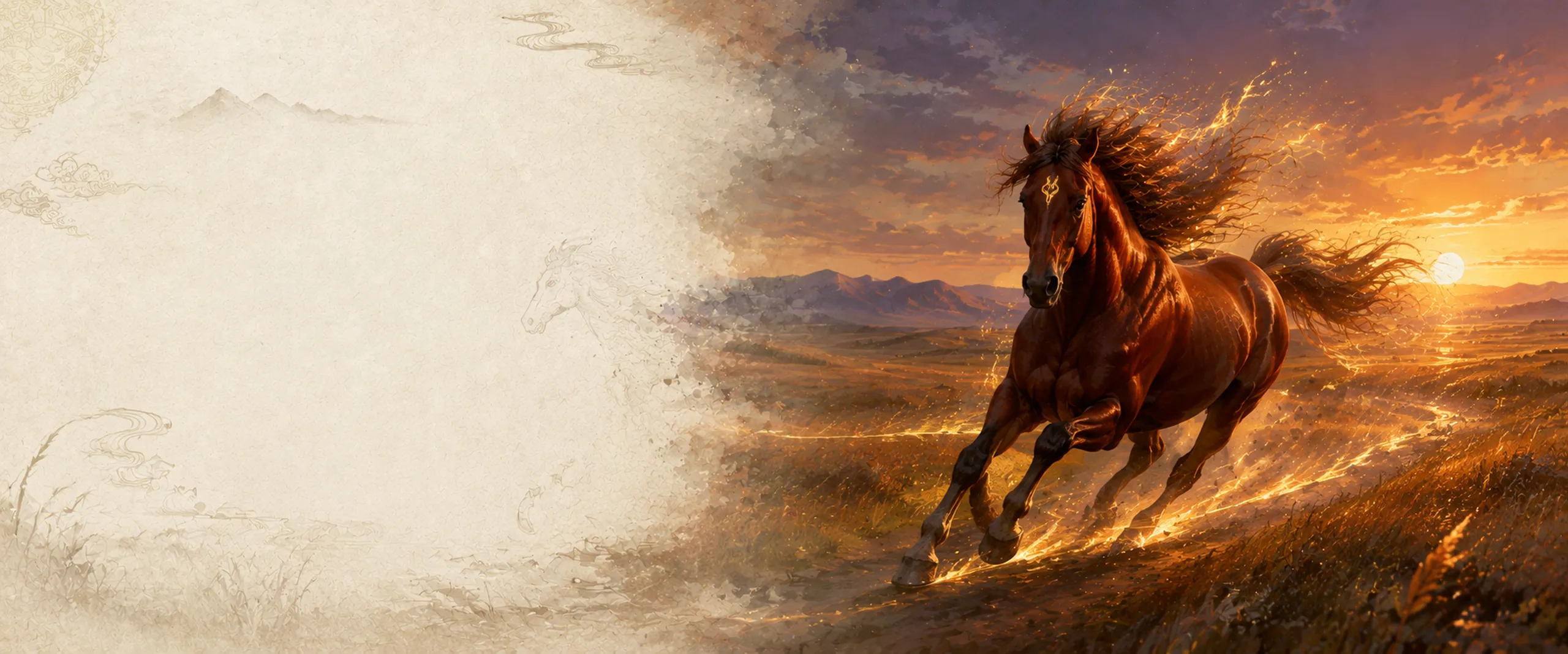
HorsePersonality
「 Like a heavenly horse, the mind ranges far and free;<br>press onward, and let no bright season go to waste. 」
Wu Fire Is Yang
Wu corresponds to the seventh of the twelve Earthly Branches and belongs to Yang Fire within the *Wuxing* (五行), the traditional Chinese system of the Five Elements or Five Phases: Wood, Fire, Earth, Metal, and Water. In Five-Element thought, Fire governs ritual propriety, illumination, and intensity. Yang Fire resembles the blazing sun high in the sky, radiating brilliant light and tremendous heat in all directions. Those born under the Horse sign are therefore believed to possess three innate qualities:
Passion That Never Goes Out
Wu Fire is Yang Fire, and the vitality of Horse-born people is like a fiercely burning flame—always vigorous, always radiant. They are filled with love for life, curiosity about new things, and hope for the future. Even after setbacks or blows, they can quickly rekindle their fighting spirit, because within them burns a fire that refuses to go out.
An Innate Spirit of Freedom
The horse is the runner of the open grasslands, and this image is deeply reflected in the personality associated with Horse-born people. They instinctively dislike restriction and yearn for freedom. Any form of confinement or constraint can make them feel suffocated. What they need is not a secure “cage,” but a vast “grassland.” This devotion to freedom is one of the strongest driving forces throughout their lives.
A Forward-Charging Drive for Progress
The force of Yang Fire moves upward and outward and is difficult to restrain. Once Horse-born people determine a direction, they charge ahead without hesitation. They believe that “action is better than empty talk,” and any hesitation or delay feels like wasted time. “一马当先”—to take the lead like the foremost horse—is one of their guiding principles in life.
Hidden Heavenly Stems: Ding and Ji
The Earthly Branch Wu (午) contains two hidden Heavenly Stems (*canggan*, 藏干)—Heavenly Stems understood within this traditional system as being symbolically contained within an Earthly Branch: Ding Fire (丁火) and Ji Earth (己土). This structure of “Earth arising from Fire” is believed to give Horse-born people deeper inner characteristics:
Ding Fire as the primary qi: Ding Fire represents the light of lamps and candles, warm and bright. Horse-born people may appear passionate and uninhibited on the surface, yet within them lies a gentle and delicate side. They are not reckless people who know only how to charge forward—they also care about the feelings of others and pay attention to how others see them. This “gentle fire” balances their more intense side.
Ji Earth as the residual qi: Ji Earth represents cultivated fields and garden soil, stable and practical. Although Horse-born people pursue freedom and change, they are not without roots. Deep within them also lies a need for stability and belonging. They are not people destined to wander forever—they simply need to find a balance between “running” and “settling down.”
Strengths of the Wu Horse Personality
The optimism associated with Horse-born people is said to rank first among the twelve zodiac signs.
Optimistic and Cheerful
Innate positive energy: Horse-born people tend to look toward the brighter side of things. Even when they encounter difficulty, they believe that “there will be a way to solve it.” This optimism is not presented as blind faith, but as something rooted in confidence in their own abilities and hope for the future. Spend time with a Horse-born person, and you may find yourself naturally affected by their enthusiasm.
Highly infectious enthusiasm: The passion and happiness of Horse-born people can spread to others. When a team falls into low spirits, the arrival of a Horse-born person may rekindle everyone’s motivation. They are the kind of people who “use their own light to illuminate others.”
They do not hold grudges or dwell on things: Horse-born people do not keep worries and resentment buried in their hearts. They quickly forget yesterday’s unhappiness and spend far more time thinking about tomorrow’s possibilities. This habit of “looking forward” allows them to live with greater lightness than many of their peers.
Exceptional Ability to Act
Remarkable execution: Horse-born people are the kind who “think of something and immediately do it.” They do not waste too much time in hesitation and inner conflict—act, make mistakes, adjust, and continue moving forward. This ability to iterate rapidly gives them a natural advantage in fields where opportunities must be seized quickly.
Skilled at responding to change: Wu Horse people do not fear change—they enjoy it and may even actively seek it. While others become anxious because of uncertainty, Horse-born people may already have adjusted themselves and prepared to sprint along a new track.
Highly efficient at work: Horse-born people are not inclined to drag out their work. Once they begin, they move swiftly and decisively and tend to carry tasks through in one energetic flow. They are natural “high-efficiency executors.”
Socially Skilled
Natural socializers: Horse-born people are passionate, cheerful, humorous, and engaging, allowing them to blend into almost any social setting quickly. They enjoy making new friends and sharing their experiences and ideas. Their social circles are often much larger than those of the average person.
Strong expressive ability: Horse-born people possess excellent verbal communication skills. Their speech is vivid, interesting, and infectious—even an ordinary matter can become entertaining when told by them. They are natural storytellers.
Generous and open-handed: Horse-born people are extremely generous toward friends. They do not calculate every small gain or loss; whether with money or time, they are willing to share and give. This generosity brings them wide friendship and trust.
Quick Thinking
Fast reactions and agile minds: Horse-born people think extremely quickly. In situations requiring rapid responses, such as debate, negotiation, or impromptu speaking, they often perform exceptionally well. Their minds are like fast horses—swift, flexible, and responsive.
Wide-ranging interests: Horse-born people are interested in many things and generally learn quickly. Although they may not always be the type to cultivate a single field deeply, they often become “jacks of all trades”—knowing a little about many things and willing to try almost anything.
Weaknesses of the Wu Horse Personality
Lack of Patience
Giving up halfway: The enthusiasm of Horse-born people can arrive quickly and fade just as quickly. At the beginning, they may be full of passion and seemingly unstoppable, but once they encounter a bottleneck or notice a more attractive “new direction,” they may abandon their current efforts and turn toward a different goal. This tendency toward “虎头蛇尾”—a tiger’s head but a snake’s tail, meaning a strong beginning followed by a weak ending—is one of the greatest obstacles in their careers.
Difficulty persisting: Horse-born people are better at sprinting than running marathons. They are suited to fields that require bursts of energy but may struggle with undertakings that depend on long-term accumulation. “三分钟热度”—literally, “three minutes of enthusiasm,” referring to short-lived passion—is one of the weaknesses they most need to overcome.
Unable to tolerate repetition: Horse-born people dislike monotonous and repetitive work. They need novelty and change in order to maintain motivation. If a job is exactly the same day after day, without variation or excitement, they can feel suffocated.
Impulsiveness
Hasty decision-making: Horse-born people make decisions quickly, but sometimes too hastily. They may act before carrying out sufficient research or reflection, and the result can often be that “the faster one runs, the harder one falls.”
Straightforward speech: Horse-born people tend to say whatever comes to mind. This frankness is an advantage in some situations but may offend others in different contexts. They do not deliberately mean to hurt people—the problem is simply that “the mouth moves faster than the brain.”
Large emotional swings: The emotions of Horse-born people can resemble a roller coaster—elated when happy and dejected when discouraged. They may find it difficult to maintain emotional stability, and these fluctuations can sometimes affect their judgment and decisions.
Difficulty Settling Down
Difficulty settling: Horse-born people may struggle to remain for a long time in one relationship, one job, or one place. They are always looking for “a better option,” yet may overlook the meaning of “cherishing the person before you.” This pursuit of novelty can sometimes cause them to miss what truly matters.
Avoiding responsibility: Horse-born people dislike being tied down by long-term obligations. They are more inclined to “travel light,” with the option of withdrawing if problems arise. In relationships and roles that require enduring responsibility, this attitude can easily lead to conflict and dissatisfaction.
Poor listeners: Horse-born people enjoy expressing themselves so much that it can be difficult for them to quiet down and listen to others. They may think they are communicating when in fact they are simply engaging in “one-way output.” This habit of insufficient listening can make others feel that Horse-born people care only about themselves.
Although all belong to the Wu Horse, differences in Heavenly Stems and *nayin* (纳音) classifications are believed to produce subtle variations in temperament. *Nayin* is a traditional classificatory system that assigns a specific elemental designation to each pairing within the sixty-term sexagenary cycle of Heavenly Stems and Earthly Branches. According to these sixty combinations, Horse years fall into five types:
| Type | Heavenly Stem & Earthly Branch | Nayin Five Element | Years | Traditional Name |
| --------------- | ------------------------------ | -------------------- | ---------- | ------------------- |
| Wood Horse | Jia-Wu (甲午) | Metal in the Sand | 1894, 1954 | Horse in the Clouds |
| Fire Horse | Bing-Wu (丙午) | Heavenly River Water | 1906, 1966 | Traveling Horse |
| Earth Horse | Wu-Wu (戊午) | Fire in the Heavens | 1918, 1978 | Horse in the Stable |
| Metal Horse | Geng-Wu (庚午) | Roadside Earth | 1930, 1990 | Horse in the Hall |
| Water Horse | Ren-Wu (壬午) | Willow Wood | 1942, 2002 | Horse in the Army |
Wood Horse (Jia-Wu Years · 1894, 1954)
Its *nayin* is Metal in the Sand, and it is traditionally known as the “Horse in the Clouds.” Wood Horses are regarded as the gentlest among those born under the Horse sign and are believed to possess exceptional artistic appreciation.
Core personality traits: Gentle and elegant—while retaining the Horse’s vitality and passion, Wood Horses possess an additional softness and delicacy associated with Wood. Their expression is less intense than that of Fire Horses and tends to be more restrained and measured; artistically inclined—Wood Horses possess a strong sensitivity to beauty and are believed to have distinctive talent and taste in literature, music, painting, and other arts; kind-hearted and deeply affectionate—Wood Horses value emotional bonds and do not easily hurt others. Even in competition, they tend to prefer fairness rather than winning by any means necessary; indecisive—Wood Horses are more likely than other Horse types to hesitate, repeatedly weighing whether to “do” or “not do” something and thereby missing many of the best moments for action.
Destiny characteristics: They are described as clever and intelligent, proud and high-spirited. Their early years are ordinary, while middle age brings success. Husband and wife may experience mutual conflict, and children are a source of strength. Those born in spring enjoy both fortune and longevity; those born in summer have more than enough food and clothing; those born in autumn enjoy honor and prosperity; those born in winter live in stability.
Fire Horse (Bing-Wu Years · 1906, 1966)
Its *nayin* is Heavenly River Water, and it is traditionally known as the “Traveling Horse.” Fire Horses are regarded as the most passionate and action-oriented among those born under the Horse sign and as the type that most fully embodies the spirit of the Horse.
Core personality traits: Bursting with passion and energy—the enthusiasm of Fire Horses is compared to Heavenly River Water, flowing endlessly and never running dry. They seem to possess inexhaustible energy and may complete in a single day what others require three days to finish; willing to take risks—Fire Horses have a powerful adventurous spirit and do not fear failure. To them, “failure” is merely a small episode on the road to success. This courage makes them natural pioneers; impatient temperament—among the five Horse types, Fire Horses are considered the most impatient. They cannot wait, cannot endure delay, and cannot tolerate things dragging on. This quick temper can make them appear insufficiently thoughtful in communication and practical affairs; leadership ability—Fire Horses possess a natural leadership temperament. They dare to charge ahead, take risks, act boldly, and assume responsibility, enabling them to lead teams through repeated breakthroughs.
Destiny characteristics: They are described as intelligent, straightforward in heart and speech, and strong in temperament. Throughout life they are said not to remain close to benefactors of high standing, yet they possess authority and courage. Men are described as strong-willed, women as soft-hearted. Those born in spring live at ease; those born in summer enjoy fortune and longevity; those born in autumn are highly talented; those born in winter enjoy strong financial fortune.
Earth Horse (Wu-Wu Years · 1918, 1978)
Its *nayin* is Fire in the Heavens, and it is traditionally known as the “Horse in the Stable.” Earth Horses are regarded as the steadiest and most practical among those born under the Horse sign.
Core personality traits: Calm and generous—while retaining the Horse’s vitality and passion, Earth Horses possess an added steadiness and practicality associated with Earth. They are neither as impulsive as Fire Horses nor as indecisive as Wood Horses and find a good balance between action and reflection; responsible and trustworthy—Earth governs trust, and Earth Horses possess a strong sense of responsibility and integrity. They do what they say and do not easily break their word, making them dependable “backbones” within a team; relatively conservative—Earth Horses do not like excessive risk-taking or dramatic change and prefer to progress steadily along an established path rather than rashly shift toward a new direction. This conservatism can sometimes cause them to miss opportunities.
Destiny characteristics: They are described as heroic and generous, with abundant food and clothing throughout life. They receive little support from extended family, husband and wife may experience mutual conflict, and children are a source of strength. Those born in spring enjoy both fortune and longevity; those born in summer live at ease; those born in autumn are clever and quick-witted; those born in winter are diligent and frugal.
Metal Horse (Geng-Wu Years · 1930, 1990)
Its *nayin* is Roadside Earth, and it is traditionally known as the “Horse in the Hall.” Metal Horses are regarded as the most decisive and sharp-edged among those born under the Horse sign.
Core personality traits: Decisive and sharp—among the five Horse types, Metal Horses are considered the most resolute. They possess strong judgment and can quickly identify the core of a complicated situation and make a decision. They do not believe in “endless hesitation”—either do it or do not do it; there is no middle ground; highly talented—Metal Horses are naturally intelligent and exceptionally capable and may achieve outstanding success in their professional fields. They are unwilling to remain ordinary and continually pursue excellence and first place; skilled at presenting themselves—Metal Horses understand how to make others notice their abilities. They are confident and comfortable under attention and can perform with ease in situations where they need to display themselves; overly high opinion of themselves—Metal Horses may sometimes overestimate their own ability and underestimate the difficulty of a task. Once confidence goes too far, it becomes arrogance, making them difficult to approach and difficult for others to cooperate with.
Destiny characteristics: They are described as intelligent and refined, exceptionally wise, and efficient in their actions. Throughout life they remain close to people of rank and often receive help from benefactors. Yet their temperament is strong, and their fortunes may rise and fall. They are said to be unsuited to official careers and more likely to excel in specialized scholarship, technical fields, or skilled arts.
Water Horse (Ren-Wu Years · 1942, 2002)
Its *nayin* is Willow Wood, and it is traditionally known as the “Horse in the Army.” Water Horses are regarded as the most strategic and adaptable among those born under the Horse sign.
Core personality traits: Intelligent and strategic—Water Horses possess not only the Horse’s vitality and passion but also Water’s agility and wisdom. They are regarded as the most strategically minded of the Horse types and know how to win through planning rather than relying solely on brute force; highly adaptable—Water Horses are neither as openly sharp as Metal Horses nor as headlong as Fire Horses. They can flexibly adjust their strategies according to different environments and different people, advancing when it is time to advance and retreating when it is time to retreat; excellent interpersonal relations—among the five Horse types, Water Horses are believed to enjoy the best social relationships. They combine the Horse’s charm and vitality with Water’s tolerance and gentleness, allowing others to feel comfortable around them; considerable ambition—although Water Horses may appear gentle and tactful on the outside, they often conceal substantial ambition within. They understand the art of “藏锋”—concealing one’s edge—and do not reveal their true intentions too early.
Destiny characteristics: They are described as intelligent, well provided with food and clothing, calm in temperament, and able to live in ease and comfort. They receive help from many benefactors throughout life, with a stable early period, prosperity in middle age, and very favorable later years. Women are described as affectionate and should guard against disputes and troublesome words.
Summary of Personality Differences Among the Five-Element Horses
| Dimension | Wood Horse | Fire Horse | Earth Horse | Metal Horse | Water Horse |
| --------------------------- | ----------------------- | ------------------------- | ----------------------- | ------------------------ | -------------------- |
| Core temperament | Gentle and elegant | Passionate and decisive | Steady and practical | Decisive and sharp | Wise and tactful |
| Interpersonal relations | Affectionate and gentle | Highly enthusiastic | Steady and trustworthy | Talents openly displayed | Socially adept |
| Career traits | Artistic temperament | Pioneering and innovative | Practical and stable | Pursues excellence | Exceptional strategy |
| Primary weakness | Indecisive | Overly impatient | Relatively conservative | Overestimates the self | Conceals too much |
Childhood and Adolescence (Ages 1–20)
Horse-born children are energetic from an early age and seem unable to stay still for long. They are active, curious, and eager to express themselves—in the classroom they are often among the first to answer questions, while on the playground they are among the fastest runners. They enjoy making friends and dislike being kept inside at home. Their attention is easily distracted, and their enthusiasm for something may arise quickly and disappear just as quickly. The weakness of this stage is excessive restlessness and lack of concentration.
Youth (Ages 20–35)
After entering society, Horse-born people reach the “golden age” of their lives. With remarkable energy and optimism, they quickly distinguish themselves in the workplace. They do not fear failure and dare to experiment with different careers and fields. Passionate, cheerful, and socially skilled, they tend to enjoy good relations with both colleagues and superiors. In love, they pursue romance and passion, but may also be easily attracted by “novelty” and struggle to settle for the long term. The weaknesses of this stage are restlessness and changeability, lack of focus in their goals, and mistakes caused by impulsiveness.
Middle Age (Ages 35–50)
Upon reaching middle age, Horse-born people begin to learn how to “slow down.” After experiencing the rises and falls of youth, they gradually understand that “not every road is worth running”—choice matters more than effort. In their careers, they begin to cultivate one field more deeply rather than changing jobs and directions as frequently as they did when young. Within the family, they also learn to assume responsibility rather than living by the attitude of “as long as I myself am fed, nothing else matters.” The weakness of this stage is that the impulse to “run away” may still remain. When responsibilities become too heavy and pressure too great, their deep instinct to escape may still surface.
Later Life (Age 50 and Above)
In later life, Horse-born people learn how to settle down. They are no longer the young nomads who were “always on the road,” but have found a pasture of their own and made it home. Their state of mind becomes more peaceful than in youth—they no longer chase every opportunity or envy the excitement in other people’s lives and instead begin to enjoy their own rhythm. They show great affection and patience toward their children and grandchildren, using the wisdom and experience accumulated over a lifetime to guide the family. The wisdom of this stage lies in understanding that “the meaning of running is not how far one runs, but knowing when it is time to stop.”
The Inner Needs of Horse-Born People
They need freedom: The most important need of Horse-born people is “freedom.” Any attempt to control, restrain, or confine them can provoke strong resistance. Give them enough space and autonomy, and they will respond in their best state.
They need to be appreciated: Horse-born people long for recognition and praise from others. A simple “You’re really good at this” can give them greater motivation, while sincere appreciation can strengthen their confidence.
They need novelty: What Horse-born people fear most is “boredom” and “repetition.” If a relationship, job, or environment loses its freshness, they may want to leave. Maintaining change and vitality is one of the keys to sustaining a relationship with them.
Golden Rules for Getting Along with Horse-Born People
Give them freedom: Do not try to control Horse-born people. The more tightly you bind them, the stronger their desire to break free. Give them trust and space, and they may choose to remain.
Accept their pace: Horse-born people act quickly, speak quickly, and decide quickly. Do not expect them to slow down; instead, you may need to learn how to adapt to their speed.
Maintain vitality: Horse-born people enjoy interesting people and experiences. If you are constantly complaining or negative, they may feel that things are “too heavy” and choose to distance themselves.
Do not dwell on small matters: Horse-born people tend not to focus on minor details and may sometimes appear careless. Learning to tolerate their broad-brush style rather than treating every small matter too seriously can make relationships easier.
Best Zodiac Partners for the Horse
In traditional Chinese zodiac marriage culture, the Horse and Goat form a “Six Harmony” pairing (*liuhe*, 六合), a traditional relationship of especially strong compatibility between two zodiac signs, and are regarded as the best marital match. The Horse also forms a “Three Harmony” combination (*sanhe*, 三合)—a traditional grouping of three zodiac signs considered mutually harmonious—with the Tiger and Dog, making these pairings harmonious as well. With the Rat and Ox, there are varying degrees of zodiac clash and harm—*xiangchong* (相冲) and *xianghai* (相害)—traditional forms of incompatibility that are believed to require greater adjustment within relationships.
The personality portrait of the Wu Horse forms one of the most uninhibited, passionate, and life-filled chapters in Chinese zodiac personality culture. Horse-born people spend their lives running, giving weight to the four characters “活出精彩”—to live a vivid and remarkable life. They refuse to settle for mediocrity, refuse to remain stagnant, and are forever pursuing better scenery ahead.
The blazing sunlight of “Wu Fire as Yang” and the structure of “Earth arising from Fire” within the “hidden Heavenly Stems Ding and Ji” together form the philosophical foundation of the Horse personality—combining the passion and brilliance of the blazing sun, the warmth and delicacy of lamplight, and the practicality and rootedness of cultivated earth. They are not incapable of exhaustion; they simply always find a reason to set out again. They are not without vulnerability; they simply choose to answer life’s difficulties with a smile.
From the gentle elegance of the Wood Horse to the passionate decisiveness of the Fire Horse, from the steady practicality of the Earth Horse to the sharp decisiveness of the Metal Horse, and finally to the wisdom and tact of the Water Horse—the five forms of the Wu Horse each possess their own character, yet all share the core qualities of passion, freedom, strong initiative, optimism, and openness. They are natural socializers and highly efficient executors, among those in the twelve zodiac signs who best understand how to “turn ideas into reality.”
In getting along with a Horse-born person, the most precious gift is not material generosity but sincere trust and enough room for freedom. When a Horse-born person chooses to walk with you, they are entrusting you with their freest self—and that trust deserves to be cherished. Although the Wu Horse stands seventh in the zodiac cycle, it leaves one of the boldest hoofprints upon the cycle through its most heroic and uninhibited bearing. Through their very existence, Horse-born people affirm that the things most worth pursuing in this world are often hidden within the very moment when one begins to run.
---
Readers’ Comments
Calendar and traditional culture enthusiasts from around the world, sharing the same moon.
Sign in or register to join the conversation. Your comment account is created automatically the first time you use a connected account.
No comments yet
Share your thoughts with readers around the world.