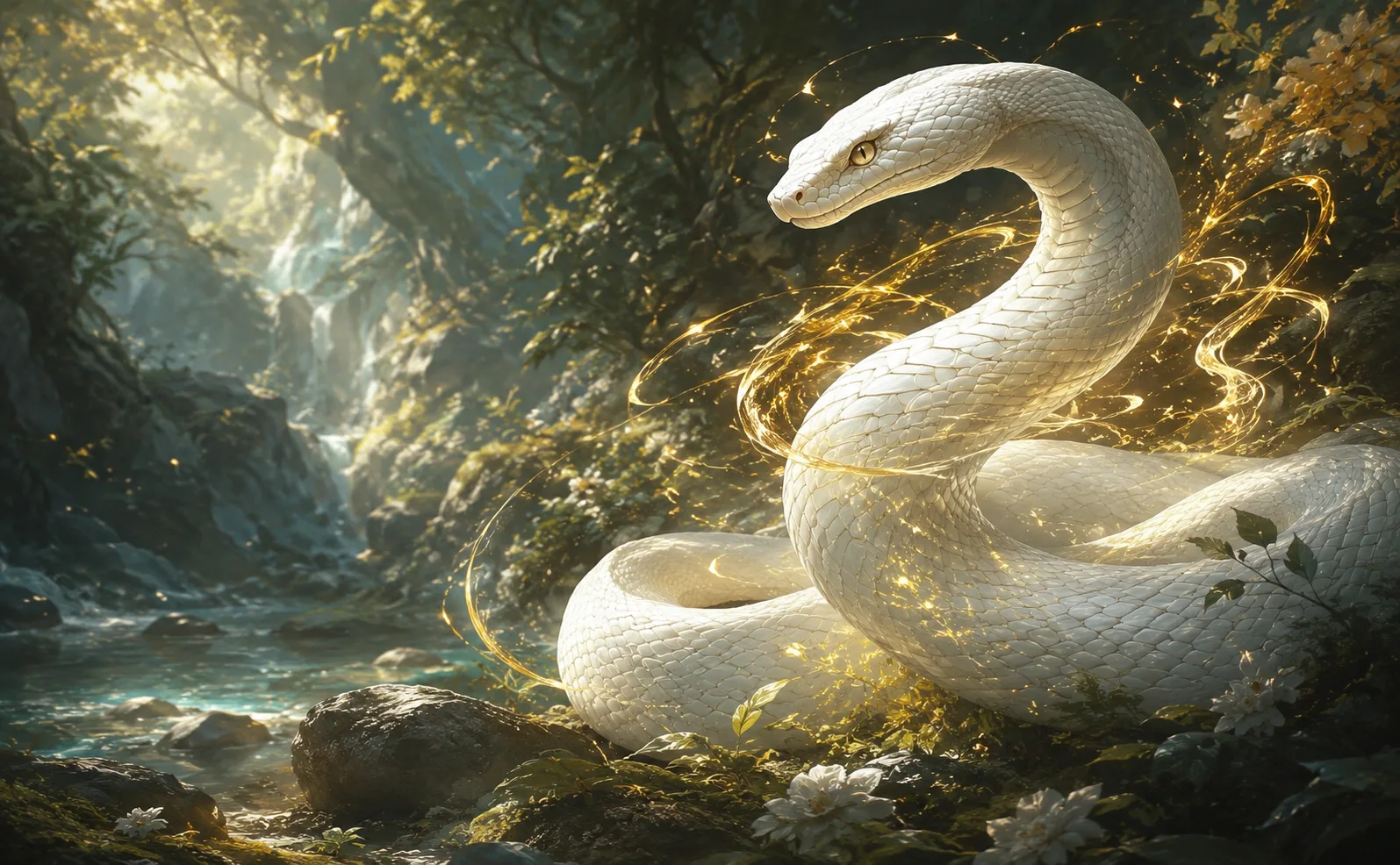
SnakeFolklore
「 灵蛇知蜕皮,小龙换新甲。 」
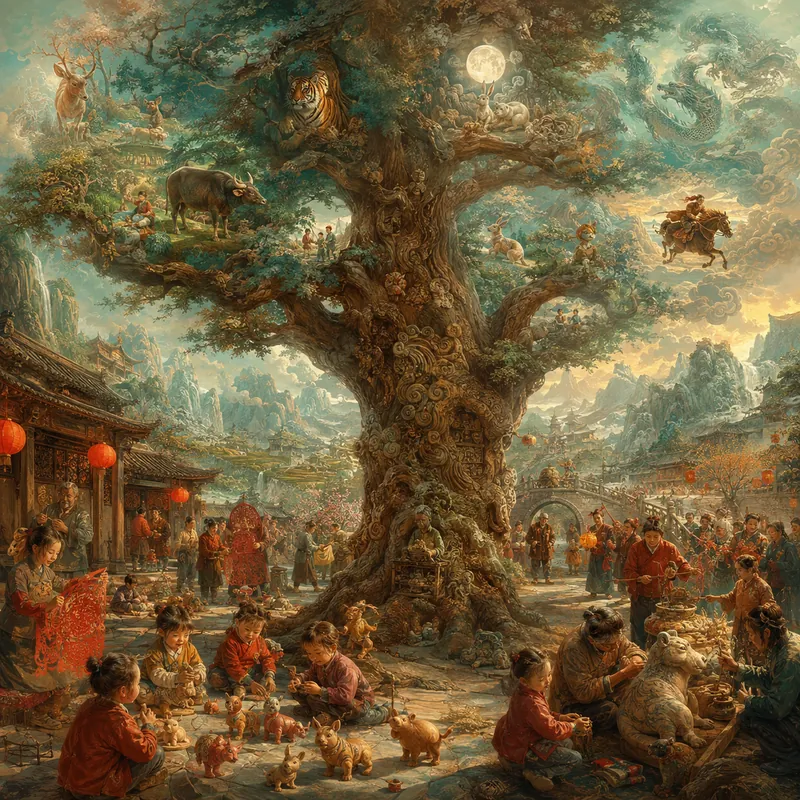
Seasonal Festivals and Observances:
Fujian Snake-Lantern Processions (Sixth to Twenty-First Days of the First Lunar Month)
In Fujian, traditions of snake reverence have long been especially prominent. The Shuowen Jiezi (《说文解字》) states: “东南越,蛇种”, and local communities have historically regarded snakes with profound awe. Each year, from the sixth to the twenty-first day of the first lunar month, many parts of Fujian hold grand Snake-Lantern Processions (游蛇灯).
A snake lantern consists of three parts—the head, body, and tail—and is richly decorated, shimmering with color and light as it moves. Processions wind through streets and lanes, the illuminated snake undulating forward like an enormous serpent of light swimming through the night, symbolizing favorable weather and the fulfillment of auspicious wishes. This tradition has continued for centuries in southern Fujian and remains one of the region’s grandest Spring Festival folk celebrations.
Snake King Festival and Snake King Temples
The people of Fujian have long revered snakes, building Snake King Temples (蛇王庙) and holding a Snake King Festival (蛇王节) to worship the snake deity and pray for peace and abundant harvests. Images of the Snake King are enshrined within the temples, where devotees burn incense, make offerings, and petition the deity to protect the local community and ensure plentiful grain.
In some parts of Fujian, snakes occasionally crawl into private homes, and elderly residents usually forbid anyone from killing them, explaining that the snakes have been sent by the ancestors to inspect the household and ensure its safety. If someone encounters several snakes intertwined by the roadside, they may quickly tear a button from their clothing and throw it toward them as an expression of repentance, then walk away as though nothing had been seen. According to folk belief, the snakes are mating, and to witness the act is regarded as profoundly improper.
Yixing, Jiangsu: “Rice-Flour Snakes” (Ninth Day of the Ninth Lunar Month)
In the Yixing region of Jiangsu, people believe that the Double Ninth Festival on the ninth day of the ninth lunar month is the snake’s birthday. On this day, households make “rice-flour snakes” (米粉蛇) in a variety of forms, symbolizing many children and abundant descendants.
The making of rice-flour snakes is an intricate craft. Rice flour is shaped into snakes—some coiled, others winding—and the figures are steamed, placed on an offering table to worship the snake deity, and later shared and eaten. By combining snake worship with the Double Ninth Festival’s themes of respect for the elderly and wishes for longevity, the custom invests the snake with the auspicious meaning of many children and many blessings.
Khmu Worship of Hui (Third Month, and Sixth to Twelfth Months of the Dai Calendar)
The Khmu people (克木人) of Xishuangbanna in Yunnan frequently worship Hui (虺), a snake deity. They believe that all things in the world are governed by Hui, who protects crops and also controls human illness.
From the sixth through the twelfth months of the Dai calendar, Hui is worshipped at irregular intervals, while a regular ceremony is held in the third month; otherwise, people believe Hui will bring trouble upon the human world. On the day of worship, the entire village ceases work, signs are placed at every entrance to the settlement, and all movement into and out of the village is strictly forbidden. Although the Khmu themselves cannot clearly explain what Hui actually is, they have continued to regard it with deep reverence.
De’ang Worship of the Snake Tree (Twentieth Day of the Twelfth Lunar Month)
Among the De’ang people (德昂族) of Yunnan, a large tree near the village is selected as the Snake Tree (蛇树) and enclosed by a surrounding wall. Every year on the twentieth day of the twelfth lunar month, the De’ang worship the tree. During the ceremony, a Buddhist ritual specialist chants scriptures before it, while the people kneel before the snake deity and pray for peace in the village and prosperity for both people and livestock.
Snake Days and Si Days
Within traditional folk culture, Si days (巳日)—Snake days—carry particular significance. In some regions, rituals and prayers associated with the snake are performed whenever a Si day occurs. Because “Si” is bound to the Snake within the zodiac system, the Si day is regarded as the snake’s “birth-sign day,” and worship conducted on such a day is believed to be especially efficacious. In traditional calendrical culture, Si hour (巳时), from 9:00 to 11:00 in the morning, is also known as the “Snake Hour.” As temperatures rise and morning mist disperses, snakes become more active, and the ancients therefore associated the animal with this period of the day.
Folk Beliefs:
The snake holds an exceptionally elevated position in Chinese folk belief. It is at once an ancestral totem, embodied in the human-headed, snake-bodied forms of Fuxi and Nüwa; one of the Five Great Immortals, where it is known as the Liu Immortal; and part of one of the Four Divine Creatures, through the tortoise-and-snake composite form of Xuanwu.
Snake Totemism
The snake is one of the earliest totems of the Chinese nation. In primitive society, many tribes took the snake as their totem and revered it as an ancestral deity.
Fuxi and Nüwa with human heads and snake bodies: in traditional Chinese culture, the human-headed, snake-bodied forms of Fuxi (伏羲) and Nüwa (女娲) are regarded as representations of the ancestors of humankind. Legend describes them as “人面蛇身,一日中七十变”. On excavated Han-dynasty pictorial stones, Fuxi and Nüwa appear as half-human, half-serpentine beings whose lower snake bodies coil intimately around one another. This image of a “human head and snake body” offers powerful evidence that people in remote antiquity revered snakes as divine beings.
Snake totem of the Yellow Emperor’s maternal clan: according to written sources, the maternal clan of the Yellow Emperor (黄帝) used the snake as its totem. His mother’s clan was the Jiao clan, and “Jiao” referred to the snake and was anciently interchangeable with “Qiao.” Legend holds that the Yellow Emperor was buried at Qiaoshan, which is taken to indicate that he revered the snake as a totem.
Wen Yiduo’s theory that “the Dragon originated from the snake”: more than fifty years ago, Wen Yiduo (闻一多) argued that the Dragon originated from the snake. He proposed that during China’s clan-commune period, a clan whose totem was the snake successively absorbed numerous other clans and, in the process, incorporated elements of their respective totems. Thus emerged a Dragon totem “with a great snake as its principal body, combined with the horse’s head, mane, and tail, the deer’s antlers, the dog’s claws, and the fish’s scales and whiskers.”
"Are there no snakes?"
In ancient writing, the character for “snake” was written as 它, while 虫 represented the crouched form of a viper. The Shuowen Jiezi states: “它(蛇),虫也。从虫而长,象冤曲垂尾形。上古艸居患它,故相问无它乎。” Early people lived in caves or grass huts, and snakes were among the most difficult natural threats to guard against. For this reason, a common greeting in antiquity was “无它(蛇)乎?”—rather like the later Chinese greeting “Have you eaten?” at a time when the basic question of food and subsistence had not yet been resolved. The greeting vividly reflects the severity of snake infestations in remote antiquity.
The “Liu Immortal” among the Five Great Immortals
In Chinese folk belief, the snake is grouped together with the fox, weasel, hedgehog, and rat as one of the Five Great Immortals (五大仙), also known as the Five Great Gates (五大门). Within this system, the snake is called the Liu Immortal (柳仙). These animals are commonly believed to possess extraordinary spiritual powers and to embody the will of Heaven and the supernatural world. In northeastern China, the Five Great Gates are often summarized as “狐黄白柳灰”, in which “柳” refers specifically to the snake, a creature endowed in folklore with numinous and mysterious powers.
Xuanwu
Within the ancient Chinese system of the Four Symbols / Four Divine Creatures, Xuanwu (玄武) is one of the four great sacred beasts alongside the Azure Dragon, Vermilion Bird, and White Tiger. Xuanwu represents the north, winter, and Water, and takes the form of a tortoise entwined with a snake. Among the Han-dynasty tiles bearing images of the Four Spirits, the northern Xuanwu is depicted precisely as a tortoise-and-snake composite. The great Daoist deity Xuantian Shangdi (玄天上帝) is likewise shown standing upon a tortoise and snake, enhancing his solemn and commanding presence.
Snake Worship among Ethnic Groups
Snake worship is widespread among China’s ethnic groups.
Tujia: the earliest totem worshipped by the Tujia of Xiushan was the snake, which people revered as a divine being. The snake is understood both as an embodiment of the gods and as an auspicious creature. Tujia belief holds that if a woman dreams of a snake, she will give birth to a “Dragon child”; if a man dreams of a snake, he will become wealthy, rise in office, and turn misfortune into good fortune. The Tujia still preserve the saying “the foundation snake must not be killed.” When a snake is seen inside or around the house, people may regard it as the transformed spirit of a deceased ancestor returning home, and therefore set out incense, paper offerings, candles, and the three sacrificial animals to worship it sincerely. Historical sources are also cited as evidence that the Ba people were a “snake stock.”
Yi: snake worship has a long history among the Yi. In Yi ritual scriptures, the dragon—or snake—is the deity most highly revered by the people. Yi folklore also contains myths of marriage between humans and snakes and transformations between human and serpentine forms. Among the Yi of Chuxiong in Yunnan, deep in the Ailao Mountains, snake worship customs remain relatively intact: after a young couple becomes engaged, the bride’s family selects an auspicious day to carve a wooden snake as part of her dowry and places it on the bridal bed. The Yi believe that a couple’s first child belongs to the snake deity, and after the child is born, a chicken must be sacrificed to that deity.
Dong: among some Dong clans in Longsheng, folk tradition preserves a story in which a young woman marries the “Flower Snake Gentleman” and gives birth to a son and a daughter who become the progenitors of a growing population, reflecting remnants of snake-totem worship. Capturing and eating snakes is forbidden.
Dai: the snake totem is one strand within the Dai people’s diverse totemic culture, expressed in numerous folk legends concerning snakes and dragons as well as in snake-pattern tattoos. Dai historical records describe the tribal deity as a Meng deity with a human body and snake tail.
Indigenous peoples of Taiwan: rich traditions of snake-totem culture have been preserved among Taiwan’s Indigenous societies, especially among the Paiwan and Rukai peoples of the southern mountains. From creation myths to the decoration of utensils, from architectural carving to tattoo designs, the snake totem permeates many aspects of social life. The Paiwan not only refrain from eating or harming snakes but also preserve their images through carving and painting on houses, ancestral posts, ritual implements, weapons, drinking vessels, and other objects.
Auspicious Meanings:
The snake occupies an important position in Chinese auspicious culture. Its shedding of skin symbolizes regeneration and renewal, its coiled body symbolizes wealth and accumulation, and its lithe movement symbolizes wisdom and alertness. From “the numinous snake presents auspiciousness” to “the golden snake dances wildly,” the snake carries a rich and varied repertoire of favorable meanings.
Auspicious Expressions for the Year of the Snake
Every Year of the Snake brings forth a particularly rich vocabulary of blessing: “The Numinous Snake Presents Auspiciousness” (灵蛇献瑞)—the snake brings good fortune; “The Golden Snake Presents Treasure” (金蛇献宝)—symbolizing wealth and luck; “The Golden Snake Dances Wildly” (金蛇狂舞)—evoking an atmosphere of exuberance, joy, and unrestrained energy; “The Snake Leaps the Dragon Gate” (蛇跃龙门)—signifying a breakthrough in one’s career and the attainment of success, analogous to “the fish leaps the Dragon Gate”; “The Pearl of the Numinous Snake” (灵蛇之珠)—a metaphor for exceptional talent or something exceedingly precious; “巳巳如意”, a homophonic play on “事事如意”, meaning that everything proceeds as one wishes; as well as “Great Fortune in the Year of the Snake” and “May the Year of the Snake Bring Blessings.”
The Snake as an Auspicious Symbol
Within traditional Chinese culture, the snake is often regarded as a symbol of wisdom, auspiciousness, and prosperity. It is used as an auspicious emblem through which people seek good fortune and blessings.
Shedding—symbol of regeneration and renewal: the snake’s ability to shed its skin symbolizes continual self-renewal and rebirth. The ancients regarded this shedding as a mysterious power of “returning to life after death” and “renewing oneself.” The process represents the cyclical turning and transcendence of life. In the motif “Snake Coiling Around a Rabbit,” the snake’s ability to cast off its skin and attain renewal becomes a symbol of “fortune, emolument, and longevity” (福禄寿).
Coiling—symbol of wealth and accumulation: the snake’s body coils into circular forms and is therefore regarded in folk culture as a symbol of stored wealth. Its coiled shape resonates with the character 盘, which also carries meanings connected with stocktaking and inventories, subtly suggesting the gathering and accumulation of wealth.
Lithe movement—symbol of wisdom and alertness: the snake’s supple agility reflects its capacity for adaptation and represents the rhythm of life. The ancients believed that the snake was not only a wise creature among animals but also an embodiment of divine power, possessing the ability to foresee the future. People born in the Year of the Snake are accordingly believed to possess distinctive intelligence and boldness.
“A Snake Coils Around a Rabbit, and Wealth Is Assured”
“Snake Coiling Around a Rabbit” (蛇盘兔) is one of the best-known auspicious motifs in Chinese folk culture. The snake can shed its skin and attain regeneration, making it a symbol of fortune, prosperity, and longevity; the rabbit, meanwhile, is associated with abundant offspring. The combination therefore became widely favored as a symbol of fertility worship, signifying the continuation and renewal of life. Folk tradition preserves the auspicious saying “A snake coils around a rabbit, and wealth is assured” (蛇盘兔,必定富)—the union of snake and rabbit promises a prosperous and fulfilling life. Paper-cuts depicting this motif are especially representative of the northern Yellow River region.
The Numinous Snake Holding a Pearl
“The Numinous Snake Holding a Pearl” (灵蛇衔珠) is a celebrated auspicious allusion from ancient China. According to legend, a snake brought a luminous pearl to repay the kindness of someone who had saved its life; the “Pearl of the Numinous Snake” therefore became a symbol of remembering kindness and repaying beneficence, and of goodness being rewarded with goodness. The allusion is recorded in the Huainanzi: Lanming Xun (《淮南子·览冥训》).
Folk Art:
The snake is one of the recurring subjects of Chinese folk art. From paper-cutting to New Year prints, from textile work and embroidery to clay sculpture and printmaking, its image appears at once mysterious and approachable.
Snakes in Paper-Cutting
Snakes take many forms in folk paper-cutting: some are fierce and imposing, some endearingly naïve, and others supple and animated.
“Snake Coiling Around a Rabbit” paper-cuts: as noted above, “Snake Coiling Around a Rabbit” is one of the representative paper-cut motifs of the northern Yellow River region.
Cartoon numinous-snake paper-cuts: Yang Yi, a representative inheritor of Chongqing’s intangible cultural heritage paper-cutting tradition, can transform a sheet of red xuan paper into a cartoon-style numinous snake paper-cut with only a few movements of the scissors in a little over ten minutes. In modern paper-cutting, the snake has moved away from its traditional mysterious and awe-inspiring appearance toward a more endearing and accessible image.
The hidden snake: Shiyan paper-cutting artist Liao Zheren has observed that snakes are difficult to represent directly in paper-cutting, and therefore conceals the snake among peony blossoms, combining intaglio and relief-style cutting techniques to delineate the outlines of its scales and reveal the graceful softness of its body.
Snakes in Liaoning paper-cutting: in Liaoning folk paper-cutting, snakes may appear either “cute” or “majestic.” Works such as The Auspicious Snake Welcomes Spring, The Snake Spits Out a Golden Pearl—Abundance Year after Year, and Snake Coiling Around a Rabbit are representative Year-of-the-Snake paper-cuts.
Snakes in New Year Prints
In traditional New Year prints such as those of Wuqiang, snake imagery is often combined with auspicious themes such as “the numinous snake presents auspiciousness.” Folk prints frequently pair snakes with peonies, ruyi scepters, yuanbao ingots, and other auspicious motifs, symbolizing wealth, honor, good fortune, and the fulfillment of every wish.
Snakes in Textile Art and Embroidery
Blue-calico zodiac snake: the “Yuanxinlan” team at the Nantong Blue Calico Museum designed a zodiac Snake series using blue-and-white printed cloth as the principal fabric, enriched with traditional patterns and delicate Chinese knots.
Textile numinous snake: Qingdao textile-art inheritor Wang Lei created the “Top Scholar Snake” (状元蛇), transforming the snake into a cartoon-like, endearingly naïve figure. Red fabric forms the main body, while a yellow zhuangyuan hat symbolizing scholarly distinction rests cleverly upon its head, and a small persimmon decorates the tail.
Batik snake: the Dajiao Miao Arts and Crafts Research Institute in Guizhou applies traditional batik and embroidery techniques to cultural-creative products carrying auspicious Year-of-the-Snake meanings.
Xiqin embroidered zodiac snake: at the Xiuping Embroidery Cooperative in Qianyang County, Shaanxi, inheritor Wang Xiuping leads local embroiderers in producing zodiac-themed works of Xiqin embroidery, combining traditional snake imagery with the folk culture of western Shaanxi and established embroidery techniques.
Tujia brocade “snake flower”: Tujia brocades from western Hunan feature a motif known as the “snake flower.”
Snake patterns on Yao garments: snake motifs appear along the hems of Yao clothing in Jinxiu, Guangxi.
Snakes in Clay Sculpture and Toys
Gaomi clay whistles: the traditional “clay whistles” (泥叫) of Gaomi, Shandong, include snake figures among their many forms.
Shaodong palm-leaf woven snakes: snakes are a common subject in the palm-weaving tradition of Shaodong, Hunan.
Paper snake toys: in the 1980s, people in Yiwu, Zhejiang, invented paper snake toys.
Zodiac Stamps and Prints Featuring Snakes
1989 Year-of-the-Snake stamp: in 1989, the Ministry of Posts and Telecommunications issued China’s first Snake zodiac stamp for the Jisi Year of the Snake (己巳蛇年). Its design combined the techniques and color language of folk paper-cutting and woodblock New Year prints. The snake’s body coils in a spiral and is decorated with blooming peonies, lotus flowers, autumn chrysanthemums, and winter plum blossoms, while a lingzhi fungus emerges from its mouth, symbolizing peace through all four seasons and auspicious fortune.
Zodiac prints: zodiac printmaking often renders the snake through techniques derived from folk paper-cutting. An exaggerated snake raises its head and curls its tail, twisting sinuously beside intertwined flowering branches, while warm red tones dominate the composition.
Taboos and Protective Rites:
Although the snake is regarded as a numinous creature, its aggressive nature and venom have also generated numerous taboos surrounding both snakes and people born under the Snake sign.
Taboos Concerning Encounters with Snakes
“To see a snake and not strike it is already three parts a sin”: folk tradition preserves the saying “见蛇不打三分罪”, according to which failing to kill a snake when one encounters it amounts to tolerating evil. Yet this belief directly contradicts the taboo that “the household snake must not be killed.” The contradiction itself reveals the complexity of popular attitudes toward snakes: they are simultaneously hated and revered.
The household snake must not be killed: in many regions, a snake entering the home is regarded as a good omen, associated with ideas such as “Dragon and Phoenix Present Auspiciousness.” It must not be beaten to death casually with a stick; rather, it should simply be guided outside, or the household may invite calamity in the following year. The Tujia still preserve the belief that “the foundation snake must not be killed.” In the Jinhua region, there is likewise a custom according to which “a snake appearing in the house is called a household snake; it must not be captured or killed. One should burn incense and pray, and it will leave of its own accord.”
Taboo concerning mating snakes: if someone sees several snakes intertwined by the roadside, they may quickly pull off a button and throw it toward them as an act of repentance before walking away. The snakes are believed to be mating, and for a human being to witness the act is regarded as a grave violation of propriety.
Taboos of One’s Zodiac Year
One’s zodiac year of birth (本命年, běnmìngnián) is traditionally regarded as an inauspicious year. A folk saying goes: “本命年犯太岁,太岁当头坐,无喜必有祸”.
For people born in the Year of the Snake, customs associated with the zodiac year include: wearing red—people tie red belts and wear red clothing in the hope of turning toward good fortune, avoiding disaster, and dispelling misfortune; avoiding marriage—a longstanding saying holds that marrying during one’s zodiac year may obstruct marital harmony and impede one’s career; avoiding major changes—moving house, changing jobs, or making large investments is discouraged; and paying particular attention to safety—people born under the Snake are believed to be more susceptible to accidents during their zodiac year.
Clarification of the claim that “red should be avoided in the Year of the Snake”: some have claimed that a Snake year is a “Fire Snake year” and that red clothing should therefore be avoided. Experts, however, have pointed out that “whether it is a Water Snake year or a Fire Snake year, neither has any substantive relationship with everyday life,” and that allowing a taboo against Fire—or red—to interfere with ordinary life “reflects a lack of basic scientific spirit.”
Zodiac Conflicts
Within traditional zodiac marriage culture, people born under the Snake are said to be in conflict with the Pig—the Si–Hai clash (巳亥相冲)—and in a harm relationship with the Tiger—the Si–Yin harm (巳寅相害). Folk sayings include “When Snake meets Pig, tears fill the eyes” and “Tiger and Snake violate compatibility.” These ideas, of course, belong to the realm of folk custom and have no scientific basis.
Year-of-the-Snake Taboos
The Year of the Snake regarded as an inauspicious year: in ancient China, people sometimes regarded Snake years as unlucky. After zodiacal year-counting came into use, disasters and poor harvests were believed to occur more frequently in Snake and Dragon years. Because harvests were thought to be poor and the climate irregular in Snake years, people attributed the suffering and misfortune caused by such natural disasters to the snake itself.
“The year lies with Dragon and Snake” (岁在龙蛇): in the eyes of fortune-tellers in the past, Snake and Dragon years could also affect human health. The numerological expression “岁在龙蛇” reflects this belief. Related material appears in the Book of the Later Han: Biography of Zheng Xuan (《后汉书·郑玄传》).
Folk Protective Practices
To counter the perceived inauspiciousness of one’s zodiac year, people born under the Snake may wear ornaments representing compatible zodiac animals—the Rooster and Ox are regarded as compatible with the Snake; maintain an even and composed state of mind—the zodiac year is considered a time for stillness rather than major action; and take care in speech and conduct, avoiding unnecessary conflict with others.
Folk Language and Sayings:
The snake has left an exceptionally rich imprint on Chinese folk language. Unlike the Rat, which is overwhelmingly disparaged, or the Ox, which is predominantly praised, the linguistic image of the snake is sharply divided between positive and negative meanings: condemnation appears in expressions such as “venomous snakes and ferocious beasts” and “the heart of a snake and scorpion,” while praise appears in expressions such as “the pearl of the numinous snake” and “the brush moves like dragons and snakes.”
Snakes in Idioms
Laudatory expressions emphasizing spiritual power and the beauty of calligraphy include: “the Pearl of the Numinous Snake” (灵蛇之珠)—a metaphor for extraordinary talent or a precious object; “the brush moves like dragons and snakes” (笔走龙蛇)—describing vigorous, animated calligraphy; “a startled snake enters the grass” (惊蛇入草)—describing the powerful movement of cursive script; and “the recompense of the snake and sparrow” (蛇雀之报)—a metaphor for repaying kindness received.
Derogatory expressions, by far the most numerous, include: “adding feet to a painted snake” (画蛇添足)—doing something unnecessary and thereby spoiling the result; “a tiger’s head and a snake’s tail” (虎头蛇尾)—starting strongly but failing to carry something through; “seeing a snake in the reflection of a bow in a cup” (杯弓蛇影)—becoming needlessly suspicious and frightening oneself; “a snake-and-scorpion heart” (蛇蝎心肠)—a cruel and vicious disposition; “venomous snakes and ferocious beasts” (毒蛇猛兽)—violent and brutal people; “snake head and rat eyes” (蛇头鼠目)—a mean or unsavory appearance; “dragons and snakes mixed together” (龙蛇混杂)—good and bad people mingled together; “beating the grass and startling the snake” (打草惊蛇)—acting incautiously and alerting the other side; and “虚与委蛇”—going through the motions of social engagement without sincerity.
Neutral expressions include “even a powerful Dragon cannot suppress the local snake” (强龙不压地头蛇), meaning that an outsider may find it difficult to overpower established local forces.
Snakes in Proverbs
Numerous proverbs involving snakes circulate in folk speech: “Human greed is never satisfied—the snake wants to swallow an elephant” (人心不足蛇吞象), describing insatiable greed; “Once bitten by a snake, one fears a well-rope for ten years” (一朝被蛇咬,十年怕井绳), meaning that one harmful experience can create lasting fear; “Strike a snake at its seven-inch point” (打蛇打七寸), meaning that one must seize the crucial point; “A snake can shed its skin, but its nature does not change” (蛇会脱皮,本性不移), meaning that fundamental character is difficult to alter; “The snake bites the rat, the eagle seizes the snake—one thing subdues another” (蛇咬鼠、鹰叨蛇,一物降一物), meaning that everything has its natural counterforce; “A snake crawls without sound, a treacherous scheme leaves no trace” (蛇爬无声,奸计无影), describing plots that are difficult to detect; and “A snake crawls into a bamboo tube—there is no room to turn back” (蛇钻竹筒,没有回头的余地), meaning that no retreat remains.
Snake Xiehouyu
Snake-related xiehouyu (歇后语) are lively and humorous.
Emphasizing the snake’s danger: “A venomous snake’s fangs and a hornet’s sting—all are poison”; “A venomous snake flicks its tongue—its words injure others”; “A venomous snake sees sulfur—its whole body goes limp.”
Emphasizing snake behavior: “A snake eats an eel—they compare their lengths”; “A snake swallows an elephant—it does not know its own measure (what an enormous appetite)”; “A snake enters a tube—its crooked nature remains”; “A snake enters a winding cave—the retreat is difficult”; “A snake drills into a hole—it watches the front and forgets the rear”; “A fly on a snake’s head—food and clothing come by themselves.”
Emphasizing cunning: “Born under the Snake—it coils around and will not let go”; “Born under the Snake—it opens its mouth and releases poison”; “A venomous snake climbs a bamboo pole—both twisted and slippery,” with wordplay on 绞 / 狡 and 滑.
Others: “Mistaking a hemp rope for a snake—making a fuss over nothing”; “Fail to kill the snake—endless trouble remains”; “A frozen venomous snake—it can come back to life.”
Folk Characterizations of People Born under the Snake
Within popular zodiac personality culture, people born under the Snake are given characteristic evaluations. Positive traits include profound intelligence, mysterious elegance, keen intuition, thoughtfulness, and artistic sensibility; negative traits include suspicion, jealousy, excessive caution, and insufficient openness. A folk verse summarizes the idealized image: “巳蛇性灵巧,智慧世无双。神秘多气质,富贵自悠长。”
The Snake in Children’s Folklore:
In the world of childhood, the snake has a particularly complex image: it can be frightening, yet also endearing, animated, and playful.
Snakes in Nursery Rhymes
Modern snake nursery rhymes: contemporary children’s songs transform the once-feared snake into an agile and lovable creature: “小青蛇啊小花蛇,蛇儿长,蛇儿妙,春天里做游戏。身体灵活像波涛。蛇虽冰冷却友好,森林里面它逍遥。” Such rhymes help children overcome their fear of snakes.
“The Great Dragon and the Little Snake” (《大龙与小蛇》): this nursery rhyme uses the contrast between “great” and “small” to present differences of scale between things in an immediate and easily understood way.
Year-of-the-Snake nursery rhyme: “说蛇年,话吉祥,蛇的身子细又长,小朋友们要记牢。没有手来没有脚……”
Folk ballad “Song of the Snake Gentleman” (《蛇郎歌》): the Wucheng district of Jinhua, Zhejiang, preserves the folk ballad 《蛇郎歌》.
Snake Games
“Zodiac animal game”: in the courtyards of old Beijing, children played games based on the zodiac animals. Each child first announced their sign and humorously added one or two words to the animal’s name—for example, a child born under the Snake might be called “Beautiful Woman Snake” (美女蛇). The children then divided into two groups and addressed one another by these nicknames.
Modern early-learning games: contemporary early-childhood education includes finger games such as “A little snake crawls and crawls, stretching out its tongue—hiss, hiss, hiss”, as well as block-matching games.
Snake Toys
Endearing textile snakes: modern textile toys anthropomorphize the zodiac snake and turn it into plush figures popular with both adults and children. Among the Maonan of Pingtang, the “cute snake” doll contains mugwort associated with blessing and protection, expressing the hope that everyone who owns one may begin the new year with the good fortune of “巳巳如意”.
Paper snake toys: in the 1980s, people in Yiwu, Zhejiang, invented paper snake toys.
Jointed bamboo snake: Taiwan’s traditional “jointed bamboo snake” is one of its old-fashioned toys.
The Snake in Literature and Art:
The snake is one of the most important themes in Chinese literature and art. From the Shijing to the Chuci, from the Shanhaijing to The Legend of the White Snake, from Lu Xun’s From the Hundred-Grass Garden to the Three-Flavour Study to snake paintings across the dynasties, the animal has assumed an extraordinarily rich range of cultural forms in the hands of writers and artists.
Snakes in the Shijing
The Shijing (《诗经》) contains early references to snakes. In Xiaoya: Sigan (《诗经·小雅·斯干》), the line “维虺维蛇,女子之祥” treats the appearance of a hui-snake in a dream as an auspicious sign of the birth of a daughter. This shows that in the pre-Qin period, dreaming of a snake was not necessarily an evil omen but could instead be understood as “a favorable sign for a girl.”
Snakes in the Chuci
In Tianwen of the Chuci (《楚辞·天问》), Qu Yuan asks: “雄虺九首,倏忽焉在” and “一蛇吞象,厥大何如”. Through the image of the snake, Qu Yuan exposes the greedy desires of certain people.
Snakes in the Shanhaijing
The Shanhaijing (《山海经》) presents mysterious serpentine figures such as the “Xuan Snake” and Zhuyin. Snakes appear repeatedly throughout the book’s worlds of seas and mountains—ancient, endowed with strange powers, limitless in supernatural ability, and perhaps even imagined as passages linking our world with other realms. Green Snake, Xiangliu, the Rain Master, Qiangliang, two-headed snakes, and many other fantastical serpentine beings populate its pages. Ancient gods such as Fuxi, Nüwa, and Gonggong are likewise often depicted with “human heads and snake bodies,” possessing extraordinary wisdom and power as guardians of mountains, rivers, lakes, and seas.
The Legend of the White Snake
The Legend of the White Snake (《白蛇传》) is one of China’s four great folk love stories. It tells of the white snake Bai Suzhen (白素贞), who takes human form and enters the mortal world to repay a kindness, eventually becoming the wife of the mortal Xu Xian. The story originated in an incident involving a giant snake in Luoyang during the Tang dynasty, took its preliminary form in Feng Menglong’s Ming-dynasty Jingshi Tongyan (《警世通言》), and reached mature form in the Qing dynasty. The Legend of the White Snake endows the snake with human emotions and admirable qualities: Bai Suzhen remembers kindness and repays it, and courageously pursues love. In Liaoning, the story is represented in many different artistic forms.
Snakes in Supernatural Fiction across the Dynasties
The Eastern Jin collection of supernatural tales Soushen Ji (《搜神记》), compiled by Gan Bao, contains numerous stories of snake ghosts and snake spirits. The Tang collection of marvel tales Boyizhi (《博异志》), compiled by Gushenzi, also includes snake stories. From the Tang tale Li Huang (《李黄》) to Lu Xun’s From the Hundred-Grass Garden to the Three-Flavour Study (《从百草园到三味书屋》), the story of the “Beautiful Woman Snake” (美女蛇) has circulated for more than a thousand years. The Song encyclopedic collection Taiping Guangji (《太平广记》), compiled by Li Fang and others, likewise contains numerous records concerning snakes.
Snake Poetry and Rhapsodies across the Dynasties
Fu Xuan’s Inscription on the Numinous Snake (《灵蛇铭》) of the Jin dynasty: the Jin writer Fu Xuan composed a work entitled Inscription on the Numinous Snake. Snakes in Li Bai’s writing: Li Bai used the expression “笔走龙蛇” to evoke the dancing energy of wild cursive calligraphy.
Liu Bang Slays the Snake
The Shiji: Basic Annals of Gaozu (《史记·高祖本纪》) records that when Liu Bang was serving as a pavilion chief and escorting laborers to Mount Li, a large snake blocked the road ahead. “高祖醉,曰:‘壮士行,何畏!’乃前,拔剑击斩蛇。蛇遂分为两,径开。” Later, someone saw an old woman weeping at the place where the snake had been slain. She said that her son was the son of the White Emperor, who had transformed into a snake and blocked the road, only to be killed by the son of the Red Emperor. Liu Bang used the slaying of the snake to display extraordinary courage, and the future emperor established his authority through the deed. The story links the snake with imperial destiny and constitutes an exceptionally important strand of Chinese snake culture.
Snake Paintings across the Dynasties
From ancient times to the present, the snake has played an important role in Chinese civilization and everyday life. As one of the oldest animal deities, it inspired both reverence and worship among early peoples and appeared throughout folk art. Across the history of snake imagery, motifs centered on the animal—such as coiled snakes, Snake Coiling Around a Rabbit, and Snake Holding a Frog—have appeared in paper-cutting, New Year prints, embroidery, and other forms of folk art.
Final Reflections:
The folk culture of the Si Snake (巳蛇) constitutes one of the most complex and internally tension-filled chapters in Chinese zodiac tradition. People’s attitude toward the snake combines reverence with familiarity: they fear its venom yet worship its numinous power; they regard it as a harmful creature in the saying “To see a snake and not strike it is already three parts a sin,” yet also enshrine it as the household-protecting spirit that “must not be killed.” The snake is not only one of the earliest totems of the Huaxia peoples, but also the ancestral form embodied by Fuxi and Nüwa, the Liu Immortal among the Five Great Immortals, and the serpentine half of Xuanwu, the tortoise-and-snake composite among the Four Divine Creatures.
From the flowing brilliance of the Snake-Lantern Processions of southern Fujian to the fertility symbolism of Yixing’s rice-flour snakes, from the rigorous prohibitions surrounding Khmu worship of Hui to the devout kneeling of the De’ang before their Snake Tree, snake folklore reaches into nearly every sphere of traditional culture: seasonal observances, folk belief, auspicious symbolism, folk art, taboos and protective rites, children’s traditions, literature, and the arts. The snake is at once a venomous creature people curse and drive away and a divine being they worship and make offerings to. This contradictory mentality—hating it even as one reveres it—is precisely what gives the folk culture of the Si Snake its distinctive fascination.
The roots of this contradiction lie in the complex and profound relationship of coexistence between snakes and human beings. The snake is a lethal threat, its venom inspiring instinctive fear; yet it is also a symbol of life, for the shedding of its skin signifies regeneration and renewal. It is both the terrifying “nine-headed male hui” of the Shanhaijing and the numinous Bai Suzhen of The Legend of the White Snake, who “remembers kindness and repays it.” From the warning against greed embodied in “Human greed is never satisfied—the snake wants to swallow an elephant” to the gratitude symbolized by “the Pearl of the Numinous Snake,” from the needless excess of “adding feet to a painted snake” to the calligraphic beauty of “the brush moves like dragons and snakes,” the snake’s linguistic image is likewise divided between praise and condemnation, rich in contradiction and multiplicity. Though the Si Snake stands only sixth in the zodiac, it carries some of the Chinese people’s deepest reflections on wisdom, numinous power, regeneration, and mystery. Winding toward us from the grasses of remote antiquity, bearing the secret of renewal through shedding and the ancestral radiance of Fuxi and Nüwa, it has left the most complex and most profound imprint upon the Chinese spiritual world.
----
[Language: es]
Readers’ Comments
Calendar and traditional culture enthusiasts from around the world, sharing the same moon.
Sign in or register to join the conversation. Your comment account is created automatically the first time you use a connected account.
No comments yet
Share your thoughts with readers around the world.