
Beginning of Spring Farming
「立春一年端,种地早盘算。」
At 立春 (Lìchūn, Beginning of Spring), the agricultural year begins to stir across China, although the pace of awakening differs sharply from region to region. On the North China Plain, winter wheat stands at the closing edge of its overwintering period, and 保墒耙地 (*harrowing to conserve soil moisture*) spreads across the fields. In the Yangtze River basin, rapeseed enters stem elongation and winter wheat begins to 返青 (*resume green growth after winter*), while clearing ditches and draining excess water becomes the most urgent work before spring rains intensify. Farther south, early-rice sowing and seedling raising are already fully underway. Northeast and Northwest China, by contrast, remain largely frozen, and the work of the season lies less in active cultivation than in preparation: repairing machinery, purchasing seed, and readying land for spring farming.
The same solar moment belongs to a different season elsewhere in the world. Across the temperate Southern Hemisphere, late summer is turning toward early autumn: winter wheat in southeastern Australia and Argentina enters the harvest period, while vineyards move into picking season. In the tropical Northern Hemisphere, the dry season approaches its end, and farmers are busy storing water and preparing land. In the tropical Southern Hemisphere, the rainy season is already in its middle to later stages, and Brazilian soybeans reach the crucial phase of pod formation and seed filling.
Global Agriculture
Temperate Regions of the Northern Hemisphere
Phenological Signs
South of the Yellow River, the earth begins a daily rhythm of thaw and refreeze: the surface softens beneath the daytime sun, then freezes again after nightfall. Beneath the soils of the Yangtze River basin, overwintering insects begin to leave their state of “deep dormancy,” while earthworms start moving again. Across southern China, ice has largely disappeared from rivers and lakes; farther north, cracks begin to spread across frozen river surfaces. In southern Japan, the earliest plum trees begin to form buds, while rapeseed on South Korea’s Jeju Island enters its first flowering stage.
Farming Activities
On the North China Plain, winter wheat reaches the critical threshold before spring regrowth, and farmers begin 保墒耙地 (*moisture-conserving harrowing*) on a broad scale. The purpose is to lock in the water accumulated through winter before the frozen ground has completely thawed. Across the Huang-Huai-Hai Plain, some 60 million *mu* of wheat fields thus enter the opening stage of spring management. Seedling raising for early rice begins successively in China’s Yangtze River basin, southern Japan, and South Korea, with seed soaking, germination, and seedbed leveling advancing together. In South China, early-rice sowing and seedling production are already fully underway, and seedbeds are covered with film to retain warmth and guard against lingering cold. In northern Chinese orchards, winter pruning comes to an end while lime-sulfur spraying proceeds in parallel. In Northeast China, machinery inspection and seed procurement begin across the region.
Phenological Signs
Across vineyards in Western Europe, fine cracks begin to appear on the soil surface—the first visible sign that frozen ground is loosening. Ice floes start moving along the middle reaches of the Danube, and river navigation gradually resumes. In British gardens, overwintering ladybirds begin to stir beneath bark warmed by the sun. In Germany’s Black Forest, fir trees begin exuding resin as sap starts to flow again.
Farming Activities
Winter wheat in France and Germany remains in its overwintering stage, but the quiet of winter is already giving way to preparation. Farmers begin walking the fields and servicing machinery in readiness for spring management once the crop resumes growth. In Ukraine’s chernozem belt, winter wheat reaches the threshold of spring recovery, and moisture-conservation work begins first in southern areas. In Bordeaux, Rheinhessen, and other wine regions, winter pruning comes to an end while pre-bud spraying proceeds alongside it. Northern Europe remains frozen, where agricultural work is still centered on greenhouse vegetable seedlings and machinery maintenance.
Phenological Signs
Along the Great Lakes, the edge of the ice cover begins to retreat, leaving open water where waterfowl start to gather. In orchards along the U.S. West Coast, bees occasionally venture out of their hives on brief “test flights.” Ice in the middle Mississippi begins to loosen and drift downstream, a seasonal phenomenon locally called the “Ice Run.” In Ontario, Canada, maple trees begin to stir, signaling that maple-syrup season is approaching.
Farming Activities
Across winter-wheat regions such as Kansas and Nebraska, farmers begin inspecting fields to assess how well the crop has survived the winter and prepare plans for water and fertilizer management once spring growth resumes. In California’s Central Valley, orchard winter pruning is largely complete; almond and apricot trees enter the flower-bud swelling stage, while pre-bud spraying moves forward at the same time. Across the U.S. Midwest, farms enter the logistical stage before spring planting—ordering seed, purchasing fertilizer, and servicing machinery. The Canadian Prairies remain frozen, and agricultural work is still focused on stockpiling inputs and preparing equipment.
Phenological Signs
On Turkey’s Anatolian Plateau, snow begins to melt away, exposing moist brown soil beneath. Along Iran’s Caspian coast, apricot trees enter the flower-bud swelling stage. In South Africa’s Cape region, grapevines move from dormancy toward the stage before bud break.
Farming Activities
Winter wheat in Turkey, Iran, and other parts of the Middle East gradually resumes growth, and spring irrigation begins. In South Africa’s Cape vineyards, the season has already turned toward harvest.
Temperate Regions of the Southern Hemisphere
Phenological Signs
Here, the period corresponding to China’s Beginning of Spring falls in late summer and early autumn. Wheat fields have turned fully golden, grapes enter the ripening stage, and sugar accumulates rapidly within the fruit. Perennial pasture grasses begin heading and setting seed, while annual grasses gradually dry and yellow. The contrast between day and night becomes more pronounced, and light morning mist often settles over the valleys.
Farming Activities
Winter wheat and barley enter the ripening-to-harvest stage. Farmers race against late-summer rain, with combines working day and night in an effort to finish harvesting and drying before heavy storms arrive. If prolonged rainfall sets in, wheat heads may begin sprouting on the plant, causing serious losses. Vineyards are likewise deep into the ripening and picking season. In regions such as the Hunter Valley and Yarra Valley, grape sugar and acidity reach their ideal balance, leaving winegrowers with a harvest window of only one to two weeks. Once the crop is in, fields are cleared and deep-plowed in preparation for winter crops to be sown in April and May.
Phenological Signs
The grasslands begin to lose the deep green of midsummer and take on a yellow-green cast. The difference between daytime and nighttime temperatures widens, and morning dew often settles across the grass. Some early-maturing crops begin to show signs of ripeness, giving the fields a mingled palette of green and gold.
Farming Activities
Winter wheat enters the height of harvest. Across Argentina’s great grain heartland, broad golden fields stretch over the plain as large combine harvesters move through them. At the same time, farmers begin planning deep tillage and fallow management for autumn-sown crops. Argentina’s apple- and pear-growing regions also enter harvest, and orchard crews and packing lines remain busy.
Phenological Signs
On both the North and South Islands, pasture growth is nearing the end of its most vigorous summer phase, while grass in some high-elevation pastures begins to yellow. Grapes have accumulated sugars and flavor compounds to their best levels. Kiwifruit enter their final stage of enlargement, and their skins begin taking on the characteristic coloration of each variety.
Farming Activities
After a full summer of abundant pasture, cattle and sheep are in strong condition. Graziers begin planning for autumn—overseeding cool-season ryegrass and white clover, adjusting rotational grazing cycles, and storing hay for winter. Vineyards in Marlborough and Central Otago enter the peak harvest period, with Sauvignon Blanc, Pinot Noir, and other varieties picked in succession. Kiwifruit orchards move into their final pre-harvest management stage, and growers carefully check fruit maturity.
Phenological Signs
In the Central Valley, grapes enter the ripening stage: skins deepen in color and berries soften. Blueberries and cherries approach the end of harvest, while their leaves begin to change. Apples and pears are in the final phase of fruit enlargement.
Farming Activities
Across the Central Valley, Cabernet Sauvignon, Carménère, and other grape varieties enter the harvest period. The blueberry and cherry seasons approach their close, and export packing lines work through their final orders. Apple- and pear-growing regions begin preparing for the autumn harvest.
Tropical and Subtropical Regions
Phenological Signs
The dry season is nearing its end. Weather is hot and dry, with average daily temperatures above 30°C. River levels in Thailand, Vietnam, and Cambodia fall to their lowest point of the year, and some smaller channels dry enough to expose their beds. Across northern India’s Ganges Plain, wheat is in grain filling, with ears swelling and kernels becoming full. In the far south of China, vegetation has already returned to green, and early-rice seedbeds form tender expanses of new growth.
Farming Activities
Farmers in Thailand, Vietnam, and Cambodia hurry to repair irrigation channels and clear reservoirs and ponds before the rains return. In Vietnam’s Mekong Delta, dry-season rice is already maturing, and farmers rush to harvest and dry the grain. Dry-season rice harvesting advances at the same time in Cambodia and Thailand. Across northern India, wheat fills rapidly in the warm weather at the end of the dry season, when water demand is high and irrigation systems may run around the clock. In southern India and along the eastern coast, scattered pre-monsoon rains begin to appear ahead of the full rainy season in May. In southernmost China, early-rice sowing and seedling raising are fully underway, while spring maize and spring peanuts go into the ground in succession.
Phenological Signs
The rainy season is already in its middle to later stages, with abundant rainfall and high humidity. Across central-western Brazil, soybean fields are dense and dark green, and pods are filling. Maize in southern Africa reaches the grain-filling stage, with ears becoming fuller day by day. In northern Australia, sugarcane grows rapidly through its internode elongation stage, turning fields intensely green. In Indonesia and Malaysia, oil-palm fruits begin changing color as they ripen, with heavy clusters hanging around the trunks.
Farming Activities
In Mato Grosso, Goiás, and other parts of central-western Brazil, soybeans are in the crucial period of pod formation and seed filling. Moisture and sunlight at this stage directly shape final yield per hectare. Farmers monitor soil moisture closely, while persistent heavy rain raises the risk of diseases such as soybean rust; once lesions are found, spraying must begin immediately to contain the outbreak. At the same time, planting of Brazil’s second-season maize—the dry-season crop sown after soybeans—moves forward, making the soybean harvest a race to free the land. Across Zambia, Tanzania, Zimbabwe, and other parts of southern Africa, maize enters grain filling, when water demand reaches its annual peak. Field management turns toward disease and pest surveillance, with leaf spot and maize borers among the principal threats. In Queensland, sugarcane is in the rapid elongation stage and benefits greatly from abundant rainfall, while sugar mills service their equipment ahead of the coming crushing season. In Indonesia and Malaysia, oil-palm fruit ripens into the first major harvest peak of the year, pushing palm-oil production to a seasonal high.
China’s Six Major Agricultural Regions
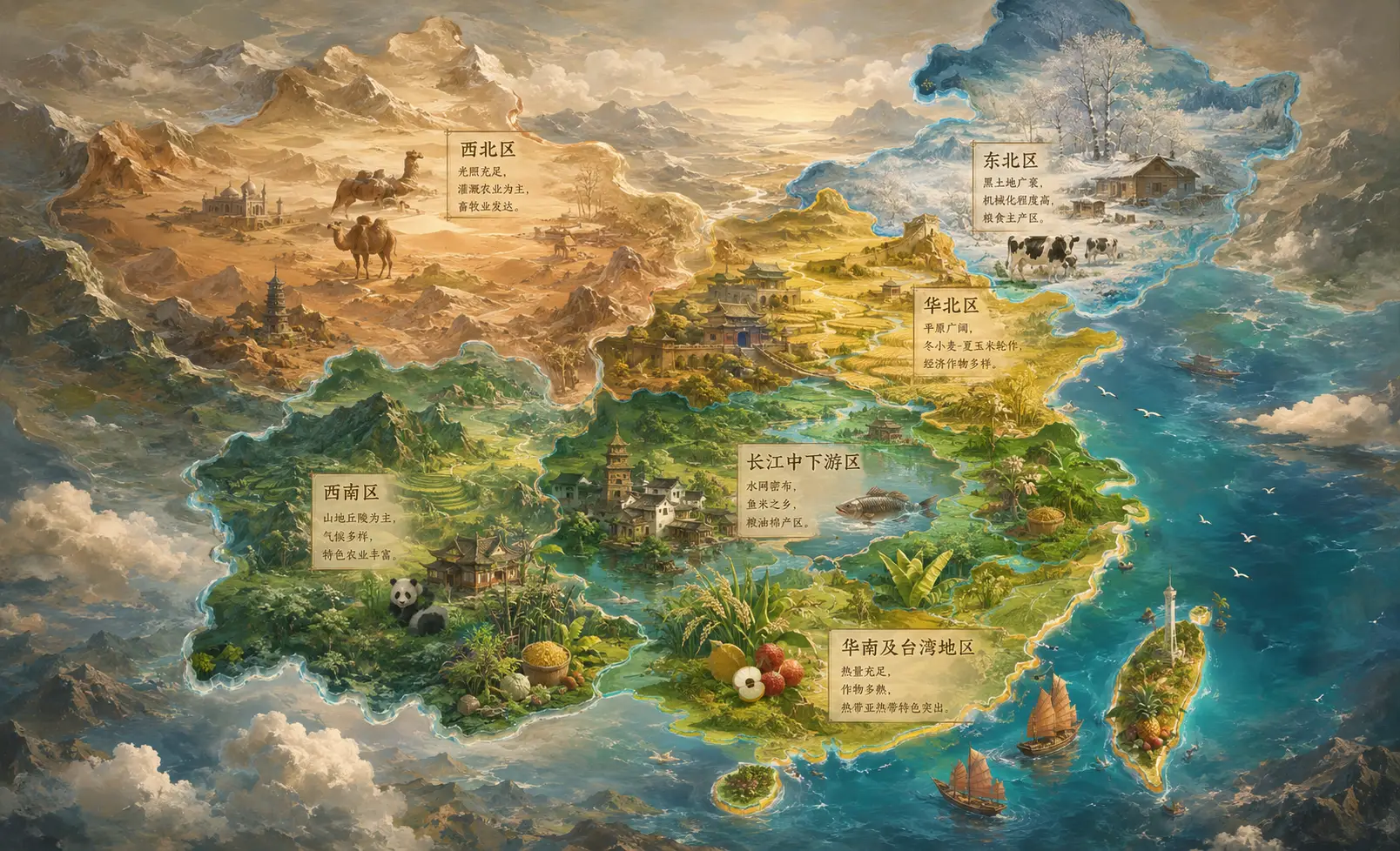
| Agricultural Region | Major Provinces | Keywords |
|---|---|---|
| Northeast | Heilongjiang, Jilin, Liaoning, eastern Inner Mongolia | 备耕 (*spring preparation*), machinery maintenance, agricultural-input reserves, livestock cold protection |
| Northwest | Xinjiang, Gansu, Ningxia, western Inner Mongolia, Qinghai | Spring-wheat land preparation, spring irrigation, livestock cold protection, 白灾 prevention |
| North China | Hebei, Shanxi, Beijing, Tianjin, Shandong, northern Henan | 顶凌耙地 (*harrowing partly frozen ground*), manure transport and composting, winter-wheat overwintering, 保墒 |
| Middle and Lower Yangtze | Hubei, Hunan, Jiangxi, Anhui, Jiangsu, northern Zhejiang, Shanghai | 清沟理墒 (*ditch clearing and field-moisture regulation*), rapeseed topdressing, wheat 返青, greenhouse cold protection |
| Southwest | Sichuan, Chongqing, Guizhou, Yunnan, southeastern Tibet | Early-rice seedbeds, seed selection and sunning, stripe-rust monitoring, potato planting |
| South China and Taiwan | Guangdong, Guangxi, Hainan, southern Fujian, Taiwan | Early-rice sowing, spring-maize planting, fruit-tree pruning, tea-garden management |
Heilongjiang, Jilin, Liaoning, eastern Inner Mongolia
At the Beginning of Spring, Northeast China still lies deep within winter. Frozen soil is generally 1–2 meters thick, and around Mohe in Heilongjiang it can exceed 2.5 meters. Open-field farming is almost entirely at a standstill. At this stage, the agricultural year is shaped by two words: “备” (preparation) and “防” (protection).
In 备耕 (*preparation for spring cultivation*), seed, fertilizer, agricultural film, pesticides, and other production inputs enter a period of concentrated purchasing and storage. Farmers and cooperatives check inventories and contact suppliers, making sure everything needed for spring work is in place before the thaw. Large tractors, seeders, rotary tillers, and other machinery have stood idle through the long winter and now require thorough servicing—changing engine oil, checking tire pressure, calibrating seeders, and testing hydraulic systems. In Heilongjiang’s state-farm system, machinery maintenance usually begins around the Beginning of Spring so field work can start as soon as the ground thaws in late March. Maize and soybean seed must also undergo germination testing, with a qualifying standard of at least 85%; seed that falls below this level must be replaced or supplemented promptly.
Crop residues require attention as well. Northeast China produces vast quantities of maize stalks, and the period around the Beginning of Spring is the final window for either returning them to the soil or removing them from the fields. Stalks intended for shredding and incorporation should be dealt with before thawing, while baled residues taken from the field may be used as livestock feed, biomass fuel, or papermaking material.
In pastoral areas of eastern Inner Mongolia, the cold remains severe. Livestock shelters still need reinforcing, bedding must be replenished, and cold drafts must be kept out. By this point in winter, feed reserves are steadily diminishing, so daily rations must be calculated carefully to ensure that weak animals, young stock, and pregnant livestock make it safely through the period known as “春乏” (*spring exhaustion, when winter feed reserves and animal condition are under strain*). Weather forecasts must also be watched closely for the threat of 白灾 (*“white disaster”*), when heavy snow blankets grazing land and prevents livestock from feeding.
Protected agriculture follows a different rhythm. In southern Liaoning and other areas, greenhouses enter a productive season. Tomatoes, cucumbers, strawberries, and other crops are fruiting, requiring careful temperature management, humidity control, and protection against gray mold. As daylight lengthens after the Beginning of Spring, insulation quilts are uncovered at appropriate times to extend the hours of light.
Xinjiang, Gansu, Ningxia, western Inner Mongolia, Qinghai
Northwest China is a region of sharp contrasts at the Beginning of Spring. In Gansu and Ningxia, preparations for spring cultivation have already begun; farther north in Xinjiang and across the Qinghai-Tibet Plateau, deep winter still holds.
For spring wheat, this is the crucial season of land preparation. Gansu, Ningxia, and western Inner Mongolia are major production areas, and sowing generally takes place from early to mid-March. Around the Beginning of Spring, farmers plow to a depth of 20–25 centimeters, apply generous basal fertilizer—farm manure together with compound fertilizer—level the fields, and make use of winter snowmelt or carry out early spring irrigation to establish adequate soil moisture before sowing.
The expression “春小麦播在冰上”—literally, *“spring wheat is sown on ice”*—is a vivid description of farming in the arid Northwest. Once only the top 2–3 centimeters of soil have thawed, farmers begin 顶凌播种 (*sowing while the deeper soil remains frozen*), making use of moisture locked in the frozen ground to support seedling emergence.
In the southern Tarim Basin and southern Gansu, winter wheat has already begun to 返青 (*return to green*). Fresh green leaves emerge among yellowed winter plants. Farmers walk the fields to assess overwinter survival rates—normally expected to exceed 95%—prepare to reseed places with missing plants or broken rows, and apply spring-recovery fertilizer according to crop condition.
North of the Tianshan Mountains and across the Qinghai-Tibet Plateau, meanwhile, the priority remains cold protection. Livestock shelters must be reinforced, winter forage allocated carefully, and fodder transported before snow closes the roads. In Xinjiang’s Altay region, people say “立春雪封山”—*“at the Beginning of Spring, snow still seals the mountains.”* Here, keeping transport routes open for pastoral communities is itself an essential part of agricultural work.
Orchards are nearing the end of winter pruning. Apples, pears, grapes, and other fruit trees must be pruned before sap begins to move—around late February in southern Xinjiang and sometimes into early March farther north. Dead, diseased, and crossing branches are removed, tree structure is adjusted, and pruning cuts are treated to prevent pathogens from entering.
In Ningxia and the Hexi Corridor of Gansu, solar greenhouses contain another season entirely. Tomatoes, peppers, cucumbers, and other vegetables are being raised as seedlings or transplanted. In Dingxi, Gansu, seed potatoes are brought out of storage, cut into pieces, and sprouted in preparation for April planting.
Hebei, Shanxi, Beijing, Tianjin, Shandong, northern Henan
For dryland farming in North China, the Beginning of Spring is a true “关键转折期” (*critical turning point*). The frozen earth has not yet fully released winter, but it has begun to loosen its grip. Agricultural work returns with the thaw.
The first important task is 顶凌耙地—a traditional practice of *harrowing while the upper soil has begun to thaw but the ground beneath remains frozen*. After the Beginning of Spring, the topsoil may thaw to a depth of 3–5 centimeters during the day and freeze again at night. This brief alternation creates the ideal window for shallow harrowing.
Using disc or spike-tooth harrows at a depth of 4–6 centimeters breaks the soil capillaries and can reduce spring soil-water evaporation by 40%–50%. Farmers compare the effect to “building an invisible reservoir.” Once this moment is missed and the soil fully thaws, much of the moisture has already escaped, and the effect of 保墒 (*soil-moisture conservation*) is greatly reduced.
The old farming proverb says:
“立春耙耱保墒,等于修了一座水库。”
*Harrow at the Beginning of Spring to conserve moisture, and it is like building a reservoir.*
At the same time, farmyard manure accumulated over winter—livestock manure, urine, and composted crop residues—is carried out to the field margins and piled into small heaps to continue fermenting until spring plowing. Chemical fertilizers such as urea, diammonium phosphate, and compound fertilizer are also purchased and stored, while fertilization plans are drawn up according to field yield targets and soil fertility.
Winter wheat on the North China Plain remains in dormancy, but the pace of warming after the Beginning of Spring already shapes what comes next. If temperatures rise gradually to an average of 0–3°C, wheat seedlings pass safely through winter and tiller vigorously after spring recovery. If the season turns unusually warm, with temperatures rising above 5°C, wheat may resume growth too early. Late February, however, can still bring strong cold air southward, leaving tender new growth vulnerable to frost injury.
Hence the saying:
“立春暖,倒春寒。”
*A warm Beginning of Spring may be followed by a late-spring cold spell.*
This 倒春寒 (*a sudden return of severe cold after spring warming*) is one of the season’s most important agricultural risks. Farmers therefore inspect soil moisture and crop condition regularly after the Beginning of Spring. Fields that have grown too vigorously may be rolled once or twice to restrain upper growth, strengthen lower growth, and reduce the risk of lodging later.
Before spring cultivation begins in earnest, farmers also turn to water infrastructure. Wells are inspected and dredged, irrigation channels repaired and sealed against seepage, and storage ponds cleared and expanded. Hebei and Shandong preserve another proverb:
“立春修渠,春灌不愁。”
*Repair the canals at the Beginning of Spring, and spring irrigation will bring no worry.*
Orchards, too, are at a threshold. Apples, pears, and peaches remain dormant, and pruning must be finished before the 伤流期 (*the period when sap begins flowing from fresh cuts*). Growers scrape away old loose bark and diseased tissue, burn the debris to destroy overwintering insect eggs and pathogen spores, and prepare lime-sulfur mixture at 3–5° Baumé for whole-orchard spraying before bud break.
Inside greenhouses and plastic houses, the season has already moved ahead. Tomatoes, peppers, eggplants, and other solanaceous vegetables begin seedling production, with seedbeds maintained at 25–28°C by day and 15–18°C by night. Spinach, rapeseed greens, lettuce, and other leafy vegetables transplanted under cover enter rapid growth and require stronger water and nutrient supply.
Hubei, Hunan, Jiangxi, Anhui, Jiangsu, northern Zhejiang, Shanghai
The agricultural proverb says:
“立春雨水到,早起晚睡觉。”
*When Beginning of Spring arrives, the rains follow; farmers rise early and sleep late.*
The line captures the rhythm of the region. Temperatures rise toward 5–10°C, rainfall becomes noticeably more frequent, and overwintering crops begin to awaken.
The first priority is 清沟理墒—*clearing field ditches and regulating soil moisture*. Spring in the middle and lower Yangtze is wet, and standing water, or waterlogging, is often the greatest threat to overwintering crops. Farmers therefore clear the three-part drainage system—the main ditch, central ditch, and perimeter ditch—keeping them connected and deep enough to remove water quickly from the fields. Traditional standards call for depths of at least 80, 60, and 40 centimeters respectively.
The goal is simple: after rain, no water should remain standing in the field; once the rain stops, the ditches should quickly drain dry.
Two agricultural sayings emphasize the point:
“立春修沟,粮棉不愁。”
*Clear the ditches at the Beginning of Spring, and grain and cotton will bring no worry.*
“麦田沟相通,下雨不挨冻。”
*When the ditches in the wheat fields connect, rain will not leave the crop suffering from cold and waterlogging.*
This is especially important in wheat and rapeseed fields following paddy rice, where groundwater lies close to the surface and every ditch must connect freely.
The Yangtze basin is China’s largest rapeseed-producing region, and around the Beginning of Spring the crop moves from the 莲座期 (*rosette stage*) into the 抽薹期 (*stem-elongation or bolting stage*). The main stem lengthens, flower buds begin to form, and farmers apply 薹肥 (*bolting fertilizer*), mainly quick-acting nitrogen—5–8 kilograms of urea per *mu*—together with 3–5 kilograms of potassium chloride per *mu*. The aim is to encourage more branches and stronger flower-bud development. If the weather becomes too warm and wet, however, rapeseed may bolt too rapidly and become excessively lush, increasing the risk of lodging later.
Winter wheat also begins to 返青 (*return to green*). Fresh leaves push out among yellowed winter growth, and farmers follow the principle of 看苗施肥—*“fertilize according to the actual condition of the crop.”* Strong fields with dark-green leaves and abundant tillers may require little or no additional fertilizer; weak plants with yellow leaves and too few tillers need spring-recovery fertilizer to support tillering and ear formation. Overly vigorous fields may be rolled or treated with growth regulators to restrain upper growth, strengthen the base, shorten lower internodes, and reduce lodging.
The warming season also awakens disease. Hubei, Hunan, Jiangxi, and surrounding areas are among the spring starting points for wheat stripe rust. Spores travel swiftly on air currents, and a small infection can spread rapidly. Farmers therefore begin regular field inspections as soon as wheat resumes growth. A single infected leaf may be removed immediately or the affected area treated with fungicide to contain the disease. Sharp eyespot, aphids, and wheat mites must also be watched before they become widespread.
Greenhouse vegetables require equally precise management. Tomatoes, peppers, and eggplants are in the transplanting stage and are often managed under 四段变温管理 (*four-stage variable-temperature management*): 25–28°C in the morning to promote photosynthesis, 20–22°C in the afternoon, 15–18°C during the first half of the night to aid transport of assimilates, and 10–12°C during the second half of the night to reduce respiration losses. A second thermal curtain or plastic film may be added for insulation, while nighttime soil temperature must remain above 12°C to prevent 寒根 (*cold-induced root injury*).
Outdoors, asparagus lettuce, celery, garlic, and other vegetables resume growth and require timely fertilization and irrigation. In Jiangsu and Zhejiang, strawberries enter the harvest period of the second fruiting cycle and need careful water, fertilizer, and temperature management.
Tea gardens and orchards also begin their spring transition. Tea fields may receive 催芽肥 (*bud-promoting fertilizer*), mainly quick-acting nitrogen, to encourage earlier spring budding. Citrus, loquat, and peach orchards are pruned, dead and diseased branches removed, and pre-bud fertilizer applied. Loquat is already at the young-fruit stage and vulnerable to frost; fruit may be damaged below -3°C, so growers watch weather forecasts closely and use fruit bagging or smoke protection when necessary.
Sichuan, Chongqing, Guizhou, Yunnan, southeastern Tibet
The agriculture of Southwest China rises and falls with the terrain. Around the Beginning of Spring, farming takes on a distinctly “立体” (*three-dimensional, vertically layered*) distribution—from winter wheat returning to green in the Sichuan Basin to early-rice seedling beds appearing in the warmer valleys of Yunnan and Guizhou.
In the low, warm river valleys of southern Sichuan, Yunnan, and Guizhou, average daily temperatures have already climbed above 10°C, and early-rice seedling production begins. Seedbeds are plowed to a depth of 15–20 centimeters, leveled, and supplied with well-decomposed organic manure and compound fertilizer. Seed is carefully selected, empty and shriveled grains removed, then sunned, soaked, disinfected, and germinated at 30–35°C until the first white tip appears. Only then is it sown. Early rice in Southwest China is generally planted 20–30 days earlier than in the middle and lower Yangtze.
One of the region’s most important tasks is monitoring wheat stripe rust. The Sichuan Basin is regarded as China’s principal “越冬基地” (*overwintering base*) and “春季流行策源地” (*spring epidemic source area*) for the disease. Mild winters and moderate humidity allow the pathogen to survive through the cold season. Once temperatures rise after the Beginning of Spring, spores multiply rapidly and can be carried northeastward by southwesterly airflows toward Hubei, Henan, Shandong, and even the North China wheat belt.
Farmers in Sichuan, Chongqing, and northern Guizhou therefore inspect wheat fields intensively. Diseased leaves are removed at once and infection centers sprayed with triazolone-type fungicides. Where outbreaks are already established, coordinated large-scale control is organized quickly. Agricultural authorities in Sichuan often issue monitoring alerts around this time and activate a “带药侦查” mechanism—*field scouting with treatment materials already at hand so infected points can be contained immediately*.
Winter wheat in the Sichuan Basin generally enters the regrowth-to-jointing stage after the Beginning of Spring. Jointing fertilizer is applied according to crop condition to support young-ear differentiation, while drainage ditches are cleared to prevent waterlogging and root rot. On dry slopes, soil moisture becomes the main concern, and where winter rainfall has been insufficient, spring irrigation must be prepared in advance.
The season is also a peak period for spring potato planting across Sichuan, Guizhou, and Yunnan. Seed potatoes are treated, cut, sprouted, planted, and covered with film. In Zhaotong, Yunnan, and Weining, Guizhou, people say:
“立春种洋芋,收成不用愁。”
*Plant potatoes at the Beginning of Spring, and there will be no need to worry about the harvest.*
Rapeseed in Sichuan and Guizhou enters the stem-elongation to early-flowering stage, and bolting fertilizer is applied to support branching and flower-bud development. Broad beans are in flower and require adequate moisture for pod formation.
In orchards, citrus in Sichuan and Chongqing begins spring pruning and fertilization. Loquat in Longquanyi and Mengzi is already at the young-fruit stage and must be protected from cold. When nighttime temperatures are forecast below 3°C, growers irrigate in advance or use smoke for frost protection; young loquat fruit may blacken and fall once temperatures drop below 0°C.
Preparations also begin for Chinese and Tibetan medicinal plants such as *Fritillaria cirrhosa*, *Panax notoginseng*, and *Paris polyphylla*. Fields are prepared, basal fertilizer applied, and shade structures erected ahead of sowing or transplanting.
Guangdong, Guangxi, Hainan, southern Fujian, Taiwan
South China is the earliest major region in the country to enter spring cultivation. By the Beginning of Spring, temperatures have generally stabilized above 10–15°C, and sowing and spring plowing spread rapidly across the landscape. Taiwan, shaped by both topography and latitude, shows a pronounced contrast between north and south.
(1) Mainland South China
Early-rice sowing and seedling raising dominate the season. Guangdong, Guangxi, Hainan, and southern Fujian are double-cropping rice regions, and large-scale seedling work begins around the Beginning of Spring.
Farmers watch for the traditional sowing window known as “冷尾暖头”—literally, *“the tail end of the cold and the beginning of warmth.”* This means choosing the first stable warming period immediately after a cold wave, once average daily temperatures remain above 12°C, and seizing clear weather to sow quickly.
Film-covered or dry-bed seedling techniques help retain warmth and moisture, with temperatures beneath the film kept at 32–35°C to prevent low-temperature seedling rot. Seedlings are generally kept for 25–30 days and transplanted at the “三叶一心” stage—*three fully formed leaves with one new central leaf emerging*. In southern Hainan, where heat is more abundant, some early-rice seedlings have already been transplanted into the fields by this time.
Spring maize and peanuts also enter the ground. Early-maturing maize varieties from the “Yuetian” and “Guidan” series are selected, and plastic film is laid after sowing to preserve warmth and moisture. Spring peanuts require deep tillage of more than 20 centimeters, sufficient basal fertilizer—calcium-magnesium phosphate together with compound fertilizer—and moist soil after sowing.
Commercial crops follow their own rhythms. In some tobacco-growing areas, seedbeds are carefully prepared, fertilized, sown, and covered with film. Across the sugarcane zones of Guangxi and Guangdong, spring cane is planted using mid-sections from the cane tops as double-bud seed pieces, soaked for 24 hours in 3%–5% limewater to prevent pineapple disease before planting, then covered with film to conserve moisture and increase soil temperature. Cassava stems are cut and stored, waiting for temperatures to rise steadily before planting.
Tropical fruit orchards are entering delicate stages of growth. Bananas are at a critical point of flower-bud differentiation and require stronger water and nutrient management, especially high-potassium compound fertilizer to support bunch development. Dead and diseased leaves are removed to improve air circulation and light penetration. Mangoes in Hainan and Guangxi enter the later stage of flower-bud differentiation and panicle emergence; nitrogen must be controlled to prevent excessive vegetative growth, while boron fertilizer is sprayed to encourage pollen germination.
Early lychee varieties such as “Sanyuehong” and “Baitangying” begin flowering, and growers watch the weather closely. Persistent rain can hinder pollination, making it necessary to shake accumulated water from the trees and encourage pollen dispersal; drought, on the other hand, requires irrigation to protect the blossoms.
Open-field vegetables such as choy sum, Chinese kale, lettuce, and spinach enter rapid growth, while diamondback moths, aphids, and downy mildew begin to increase. Aquaculture areas intensify pond inspections to guard against stress and disease caused by sharp temperature fluctuations. Tilapia, for example, becomes vulnerable to saprolegniasis during sudden cooling. Where possible, farmers build simple insulating shelters or increase water depth to stabilize warmer temperatures in the lower layers.
(2) Taiwan
Because the Tropic of Cancer crosses central Taiwan, the Beginning of Spring reveals a clear agricultural pattern of “南忙北缓”—*“busy in the south, slower in the north.”*
Rice: Central and southern Taiwan are warmer, and transplanting of the first rice crop has already begun. In Taitung, the appropriate transplanting period for common varieties generally falls around the Beginning of Spring. In central Taiwan, newly transplanted rice enters the establishment stage and must be protected from low-temperature damage; when nighttime temperatures fall below 15°C, seedling growth slows.
Northern Taiwan remains under the influence of the northeast monsoon and is still relatively cool. Paddies may remain fallow or have only recently been sown, with transplanting often delayed until late February or early March. Traditionally, early rice in northern Taiwan was soaked about one week before the Beginning of Spring, then germinated at 30–35°C until sprouts reached 0.5–1 centimeter before sowing.
Vegetables: Crops suitable for planting vary by region. Northern Taiwan can sow eggplant, tomato, Welsh onion, burdock, shallot, and related crops; central Taiwan may plant taro, watermelon, cucumber, muskmelon, hyacinth bean, water spinach, amaranth, angled luffa, yardlong bean, scallion, and others; southern Taiwan may plant taro, ginger, pickling melon, hyacinth bean, winged bean, lettuce, and yardlong bean. Tomato is planted widely across the island at this time. Crops transplanted around the Beginning of Spring can be harvested in May and June, neatly filling a seasonal gap in the market.
Fruit trees: Citrus fruit is in peak season. Kumquats are cultivated on about 285 hectares across Taiwan, with annual production exceeding 4,000 metric tons; Yilan alone accounts for more than 90% of total output and represents one of Taiwan’s most distinctive citrus industries.
The Beginning of Spring is also a key period for pruning mature trees and preparing fertilizer and crop-protection materials. Taiwanese growers preserve the working rhythm expressed in the saying:
“二月立春就雨水,药械肥料备齐全,成龄果树先修剪,幼树修剪三月完。”
*Around Beginning of Spring and Rain Water in February, prepare chemicals, equipment, and fertilizer in full; prune mature trees first, and finish the young trees by March.*
Tea: Across Taiwan’s tea regions, winter pruning is gradually completed from 大寒 (Dàhán, Major Cold) through 立春 (Lìchūn, Beginning of Spring) and around 雨水 (Yǔshuǐ, Rain Water). Pruning encourages new shoots and helps spring tea bud evenly. February is the sprouting period in low- and mid-elevation tea regions. Central and southern Taiwan remain in the dry season, so water supply must be watched carefully. Once temperatures rise and tea buds begin to emerge, spring fertilizer—mainly quick-acting nitrogen—can be applied to encourage shoot and leaf growth.
In Taiwan, 春茶 (*spring tea*) refers to tea produced from Beginning of Spring through 谷雨 (Gǔyǔ, Grain Rain). It accounts for around 30% of annual production and is the island’s most important tea season.
Fisheries: The seas around Taiwan are rich in seasonal catches at this time. Spanish mackerel can be found around Pengjia Islet and the Diaoyutai waters; mackerel are caught north of Su’ao and offshore from Kaohsiung; black pomfret and largehead hairtail appear off Keelung and Changhua; and 嘉鱲鱼 can be caught around Penghu and offshore from Kaohsiung. Mullet continue their southward migration toward waters off Hengchun to spawn, entering the final stage of the fishing season.
Farmer’s proverbs and folk customs: Taiwanese tradition preserves the saying:
“立春天氣晴,百物好收成。”
*If the weather is clear on the Beginning of Spring, all things will yield a good harvest.*
Conversely:
“立春落雨透清明。”
*If rain falls on the Beginning of Spring, it may continue all the way to Qingming.*
The Beginning of Spring is designated “农民节” (Farmers’ Day) in Taiwan. Folk custom also includes 摸春牛 (*“touching the spring ox”*), a ritual gesture expressing wishes for abundant grain harvests and flourishing livestock.
Fujian and Taiwan also share the proverb:
“立春赶春气。”
Here, 赶春气 conveys the idea of *seizing the breath and momentum of spring*—arranging the year’s agricultural work promptly as the new farming season begins.
Global Extreme Weather · Risks & Responses
Temperate Northern Hemisphere: Guard Against 倒春寒 and Winter-Wheat Freeze Injury
After the Beginning of Spring, one of the greatest weather dangers across many temperate parts of the Northern Hemisphere is 倒春寒—a *late-spring cold spell in which temperatures plunge sharply after an initial period of warming*. Such events occur from time to time in northern China, Eastern Europe, and the U.S. Midwest.
If winter wheat has already resumed growth during an unusually warm Beginning of Spring, a sudden freeze can injure tender leaves and developing young ears, causing irreversible yield loss.
Agricultural tradition captures this risk in the saying:
“立春天气暖,三九冻破脸。”
*If the weather is too warm at the Beginning of Spring, bitter cold may still return later.*
The proverb reflects the long-standing awareness that an unusually warm start to spring can be followed by a violent reversal in temperature.
Temperate Southern Hemisphere: Beware of Hot, Dry Winds and Wildfires
Late summer in the Southern Hemisphere, which coincides with the Beginning of Spring in China, can bring persistent 干热风 (*hot, dry winds*). Such conditions can be devastating to wheat in the grain-filling stage, leaving kernels thin and shriveled, while at the same time sharply increasing wildfire risk. Southeastern Australia and parts of New Zealand frequently face fire warnings in February.
Tropical Regions: Abnormal Rainfall Patterns and Pest Outbreaks
In tropical regions, one of the greatest risks is “雨期错位”—a *misalignment in the timing of the rainy season*. If the rains come too early, seed may rot in the soil; if they come too late, young plants may die from drought. A shift in the rainy season can therefore disrupt the entire planting rhythm.
Around the Beginning of Spring, prolonged abnormal heat—whether north or south of the equator—may also sharply increase the hatching rate of overwintering insect eggs, including those of locusts and cotton bollworms. The result can be a greatly heightened risk of large-scale pest outbreaks later in the season.
A Shared Global Trend: The Timing of the Solar Terms Is “Changing”
Against the background of global warming, spring phenological events across temperate regions of the Northern Hemisphere—such as winter wheat 返青 (*returning to green*) and fruit trees flowering—are advancing by an average of 3–5 days per decade. The gap between the relatively stable calendar dates of the solar terms, observed for thousands of years, and the climate actually experienced on the land is gradually widening.
Chinese farmers, European winegrowers, and North American farm operators are increasingly encountering the same reality: farming can no longer rely on the calendar alone. One must also watch the sky, read the land, and follow real-time data.
The enduring value of the 二十四节气 (Èrshísì Jiéqì, Twenty-Four Solar Terms) lies in their ability to reveal the annual rhythm of the Sun’s movement and preserve an ancient body of climatic wisdom. Yet when that wisdom is applied to the work of any particular year, agricultural decisions must still respond flexibly to the actual weather and local environmental conditions of that place and season.
----
Readers’ Comments
Calendar and traditional culture enthusiasts from around the world, sharing the same moon.
Sign in or register to join the conversation. Your comment account is created automatically the first time you use a connected account.
No comments yet
Share your thoughts with readers around the world.