
Awakening of Insects Farming
「惊蛰春雷响,农夫闲转忙。」
During 惊蛰 (Jīngzhé, Awakening of Insects), temperatures rise sharply across much of China, the land fully thaws, and 春耕 (*spring cultivation*) opens in earnest. On the North China Plain, winter wheat enters the jointing stage on a broad scale, bringing water and nutrient management to the year’s first major peak. In the Yangtze River basin, the full flowering of rapeseed overlaps with the height of early-rice seedling raising, creating one of the busiest agricultural periods of the spring. In South China, early-rice seedlings are transplanted successively into the fields, while spring maize and spring peanuts enter orderly seedling management. In Northeast and Northwest China, frozen ground melts rapidly and 顶凌播种 (*sowing while deeper soil remains frozen*) of spring wheat expands across suitable areas.
In the temperate Southern Hemisphere, early autumn has arrived. Autumn-sown crops are planted successively in southeastern Australia and Argentina, while vineyards begin autumn pruning. In the tropical Northern Hemisphere, the dry season reaches its hottest stage and agricultural activity enters a relative pause. Across the tropical Southern Hemisphere, the rainy season approaches its end, and Brazilian soybeans and African maize move into harvest.
Global Agriculture
Temperate Regions of the Northern Hemisphere
Phenological Signs
Peach blossoms across China’s Yangtze River basin enter full bloom, spreading pink across hillsides and fields, while peach trees in the Yellow River basin remain heavy with swelling buds. Orioles return from Southeast Asia to central and eastern China and begin singing and courting among the trees. Cuckoo calls rise across the countryside. In Japan’s Kantō region, cherry blossoms approach the eve of flowering as buds swell rapidly, while forsythia begins blooming in Seoul, South Korea.
Farming Activities
Winter wheat across the North China Plain enters the 拔节期 (*jointing stage*) in earnest. Stems begin to elongate and young ears differentiate and develop inside them, bringing water and nutrient demand to the first major peak of the year. Fields short of moisture require immediate spring irrigation, while weak stands receive 拔节肥 (*jointing fertilizer*), generally 8–10 kilograms of urea per *mu*. In the Yangtze River basin, rapeseed remains in full flower and early-rice seedling raising enters its final push. In South China, early-rice transplantation begins successively once seedlings reach the “三叶一心” stage—*three fully expanded leaves with one central emerging leaf*. Northern Chinese orchards enter a critical period of flowering management: peaches and apricots reach full bloom, while apple and pear flower buds continue swelling. Growers must watch forecasts closely for late frost. In Northeast China, frozen ground melts rapidly, spring-farming preparation enters its final sprint, and large-scale 种子包衣 (*seed coating*) begins.
Phenological Signs
Western European pastures are vividly green, while early flowering plants such as crocuses and daffodils bloom across city parks. Temperatures in France and Germany stabilize around 8–12°C, vineyard soils thaw completely, and dormant grape buds begin to swell slightly. Snow disappears from Central Europe and Danube water levels stabilize. Golden orioles return from Central Africa to Europe and begin calling in woodland.
Farming Activities
Winter wheat in France and Germany moves from accelerated spring regrowth toward early jointing, and farmers begin spring field management—applying spring-recovery fertilizer and controlling seedling-stage diseases. Across Ukraine’s chernozem belt, winter wheat enters jointing on a broad scale and spring irrigation begins successively. In Bordeaux, Rheinhessen, and other wine regions, vineyard spring management begins with soil loosening, fertilization, and the installation of new trellises. Northern Europe remains at the very end of the frozen period; greenhouse vegetable seedling production continues, machinery maintenance approaches completion, and farmers begin finalizing planting plans.
Phenological Signs
Temperatures rise to around 8–12°C across the winter-wheat belts of Kansas and Nebraska, and fields rapidly turn green. Almond blossoms in California’s Central Valley reach their full-bloom peak, covering vast orchard areas in white. Peach trees in the southeastern United States enter full bloom, while pastures across the Midwest return fully to green. In Ontario, Canada, maple-syrup collection reaches its peak.
Farming Activities
Winter wheat in Kansas, Nebraska, and other producing areas enters early jointing, and farmers begin spring field management with jointing fertilizer and irrigation preparation. Orchards in California’s Central Valley reach full bloom, and growers watch late-frost forecasts closely. Across the U.S. Midwest, spring planting enters its final countdown: seed treatment, fertilizer blending, and final machinery calibration are completed. Spring tillage and sowing begin on a broad scale in the southeastern United States. Canada’s Prairie Provinces remain frozen, while farmers begin ordering seed and formulating planting plans.
Phenological Signs
Snowmelt accelerates across Turkey’s Anatolian Plateau and most of the ground becomes exposed. Apricots along Iran’s Caspian coast enter full bloom, while citrus orchards along the eastern Mediterranean flower abundantly. Winter wheat across Morocco and Algeria in North Africa returns fully to green, bringing the first broad flush of spring color to the fields.
Farming Activities
Winter wheat in Turkey, Iran, and other parts of the Middle East accelerates its spring recovery, while spring irrigation expands fully. Along the Mediterranean coasts of Israel, Morocco, and other parts of North Africa, winter wheat moves from 返青 into jointing and farmers begin spring field management. Grape harvesting in South Africa’s Cape region is fully underway.
Temperate Regions of the Southern Hemisphere
Phenological Signs
Early autumn has arrived. Average daily temperatures fall to around 18–20°C and the weather becomes cool and dry. Wheat harvests are complete, leaving fields bare or newly tilled. Pastures shift from yellow-green toward dry yellow as the first colors of autumn become visible. Fine morning mist is common and the day–night temperature range continues to widen.
Farming Activities
Winter-wheat and barley harvests are fully complete, and farmers focus on drying, threshing, storage, and sale. Harvested fields enter comprehensive tillage and recovery in preparation for winter crops to be sown in April and May. Vineyard picking in southeastern Australia approaches its end, and vineyards where harvest is complete begin autumn pruning—removing excess shoots, reshaping the vine framework, and regulating the following year’s yield. Autumn pruning is one of the most important operations in vineyard management, and its quality directly affects grape quality in the next season.
Phenological Signs
Temperatures fall to around 20–22°C and autumn becomes more pronounced. Grasslands yellow further and the fields take on richer layers of seasonal color. Some late-maturing maize varieties enter maturity, while soybean leaves begin yellowing and falling. Morning dew becomes more frequent even as overall humidity declines.
Farming Activities
Winter-wheat harvest is fully complete, and farmers concentrate on drying, threshing, storage, and sale. Sowing of autumn crops—winter wheat, barley, and rapeseed—begins on a broad scale. Farmers plow, apply basal fertilizer, sow, and roll the fields, in a sequence resembling spring planting in the Northern Hemisphere, but under the opposite season. Apple and pear harvests approach completion, while grape picking advances simultaneously. In Mendoza and other wine regions, wine grapes enter concentrated harvest.
Phenological Signs
Temperatures fall to around 10–15°C beneath clear autumn skies. Pasture growth slows noticeably across both the North and South Islands, and some grazing land turns yellow. Grape harvesting approaches completion, while kiwifruit reaches full maturity. Thick morning fog frequently settles over low-lying areas.
Farming Activities
Farmers on both islands fully engage in autumn pasture management—overseeding cool-season ryegrass and white clover, applying autumn fertilizer, adjusting stocking density, and storing hay. Vineyard harvest in Marlborough and Central Otago approaches its end, and autumn pruning begins successively. Kiwifruit orchards enter full harvest, with gold and green fruit picked, graded, and packed in concentrated volumes as the export season reaches its busiest stage.
Phenological Signs
Grape harvesting in the Central Valley reaches its peak, while orchard foliage begins to change color. Apples and pears are fully mature and some varieties enter harvest. Blueberry and cherry harvesting is completely finished, and orchards move into autumn management.
Farming Activities
The Central Valley enters peak grape harvest, with Cabernet Sauvignon, Carménère, and other varieties picked intensively; wineries enter the busiest season of the year. Apple and pear regions begin full harvest, and picking, sorting, and packing lines operate at maximum capacity. Autumn orchard management begins as pruning, fertilization, and pest and disease control proceed together.
Tropical and Subtropical Regions
Phenological Signs
The dry season reaches its hottest stage. Average daily temperatures in Thailand, Myanmar, Laos, and neighboring regions climb to 30–35°C, with some locations exceeding 38°C. River levels across Southeast Asia fall to their annual lows; some smaller channels dry completely, exposing cracked earth. Wheat across northern India’s Ganges Plain enters the later grain-filling stage, with full, heavy ears. In southernmost China, vegetation is lush and early-rice seedbeds are vividly green.
Farming Activities
The dry season forms a relative interlude in tropical agriculture: early rice has already been harvested or is approaching harvest, while late rice has not yet been sown. Farmers use this interval to repair fields, clear irrigation channels, and dry and store grain. Dry-season rice harvest is largely complete in Cambodia and Vietnam’s Mekong Delta, and farmers plow the land in anticipation of the rainy season. Harvesting continues across Thailand’s central plain. Wheat in northern India remains in grain filling and demands large quantities of water, keeping irrigation systems running throughout the day. Pre-monsoon rainfall begins increasing along southern and eastern coastal India. In southernmost China, early-rice seedlings are transplanted successively into the main fields, while spring maize and peanuts enter orderly seedling management.
Phenological Signs
The rainy season approaches its end, and rainfall begins to decline from peak monthly totals of 200–300 millimeters toward around 100 millimeters. Across central-western Brazil, soybean leaves begin yellowing and falling while pods become fully filled. Maize ears in southern Africa grow fuller each day, and some early varieties begin changing color. Sugarcane fields in northern Australia remain intensely green, with stalks reaching their maximum height. Humidity begins to decline as the climate shifts from hot and humid toward drier conditions.
Farming Activities
Crops move into maturity and harvest. In central-western Brazil, soybeans enter large-scale harvest. Large combines work day and night through golden soybean fields, threshing grain that is then dried and loaded for export. Planting of Brazil’s second-season maize nears completion, and some early-sown fields already enter seedling management. In Zambia, Tanzania, Zimbabwe, and other parts of southern Africa, maize moves from late grain filling toward maturity, and farmers begin preparing harvesting tools and storage facilities. In Queensland, northern Australia, sugarcane enters maturity, sugar accumulation reaches its peak, and sugar mills begin crushing operations at full scale. In Indonesia and Malaysia, oil-palm fruit harvest approaches its end and production begins to fall.
China’s Six Major Agricultural Regions
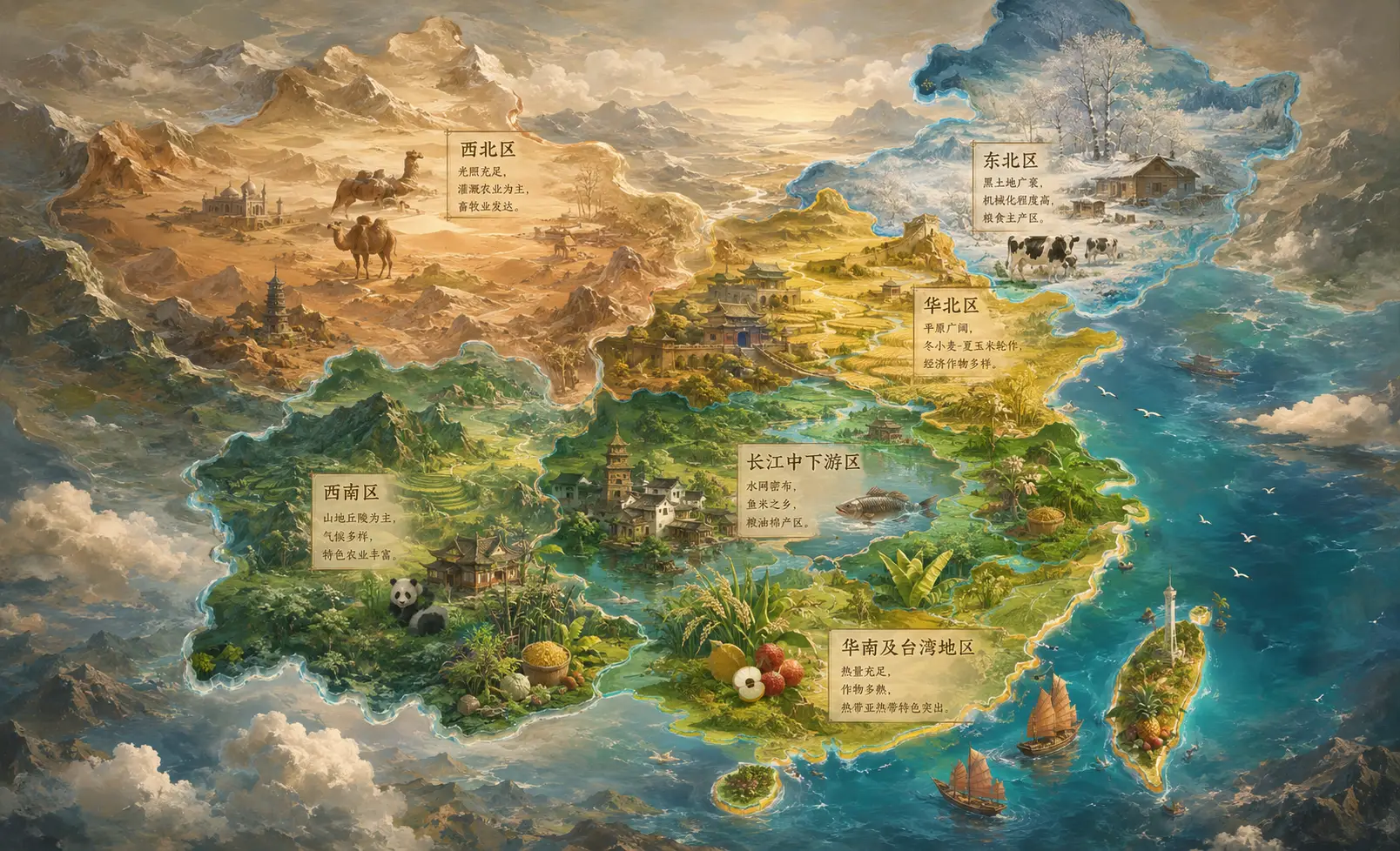
| Agricultural Region | Major Provinces | Keywords |
|---|---|---|
| Northeast | Heilongjiang, Jilin, Liaoning, eastern Inner Mongolia | 备耕冲刺 (*final spring-preparation push*), machinery calibration, seed coating, lambing in pastoral areas |
| Northwest | Xinjiang, Gansu, Ningxia, western Inner Mongolia, Qinghai | Spring-wheat sowing, 顶凌播种, winter-wheat jointing, pastoral lambing |
| North China | Hebei, Shanxi, Beijing, Tianjin, Shandong, northern Henan | Winter-wheat jointing, spring irrigation, topdressing weak stands, rolling to control excessive growth |
| Middle and Lower Yangtze | Hubei, Hunan, Jiangxi, Anhui, Jiangsu, northern Zhejiang, Shanghai | Rapeseed full bloom, early-rice seedlings, wheat jointing, ditch clearing and waterlogging prevention |
| Southwest | Sichuan, Chongqing, Guizhou, Yunnan, southeastern Tibet | Early-rice transplantation, stripe-rust control, potato planting, spring-tea budding |
| South China and Taiwan | Guangdong, Guangxi, Hainan, southern Fujian, Taiwan | Early-rice transplantation, seedling management, spring-peanut emergence, fruit retention |
Heilongjiang, Jilin, Liaoning, eastern Inner Mongolia
During Awakening of Insects, Northeast China remains frozen, with the frozen-soil layer still around 50–100 centimeters thick. Yet warming now accelerates noticeably. Daytime highs can rise above 0°C, snow begins melting across broad areas, and cracks appear in river ice. Agricultural work remains centered on preparation, but the pace becomes markedly faster.
The region enters the final sprint of 备耕 (*spring-farming preparation*). Purchases of seed, fertilizer, pesticides, agricultural film, and other inputs approach completion. The standards of Heilongjiang’s state-farm system are particularly rigorous: seed germination is retested, fertilizer nutrient content inspected, and pesticide expiration dates checked under strict procedures. Large tractors, seeders, sprayers, and other core machinery complete all servicing and calibration so they can enter the fields immediately once the ground thaws.
Large-scale 种子包衣 (*seed coating*) also begins during Jīngzhé. Seeds are coated with insecticides, fungicides, micronutrients, and other materials in order to control seedling-stage pests and diseases and support early growth.
Pastoral areas enter the busiest lambing season of the year. Around Awakening of Insects, sheep in eastern Inner Mongolia give birth in concentrated numbers. Herders remain near the pens almost around the clock, ready to receive newborn lambs and assist difficult births. Newborns are physically weak and require special warmth and care. Supplemental feeding after lambing is equally important: protein and mineral content in the ewe’s ration must be increased to ensure sufficient milk production.
In protected agriculture, peak production continues in southern Liaoning. Cucumbers and tomatoes remain in active harvest, while strawberries enter the peak of their second fruiting cycle. Longer daylight causes greenhouse temperatures to rise faster, so daytime ventilation and cooling become essential to prevent heat injury to leaves and fruit.
Xinjiang, Gansu, Ningxia, western Inner Mongolia, Qinghai
At Awakening of Insects, Northwest China enters the critical period for spring sowing. Gansu and Ningxia begin spring-wheat planting on a broad scale, winter wheat in southern Xinjiang reaches jointing, and pastoral areas enter lambing season.
顶凌播种 (*sowing while deeper soil remains frozen*) of spring wheat expands fully. The Hexi Corridor in Gansu and the Yellow River irrigation districts of Ningxia are among China’s main spring-wheat regions, and the period around Jīngzhé—from early to mid-March—is regarded as the golden sowing window.
Farmers sow when only the top 2–4 centimeters of soil have thawed while deeper layers remain frozen. This timing allows seed to draw on moisture stored in the frozen subsoil and supports reliable emergence. If farmers wait until the ground has completely thawed, much of the moisture may already have evaporated and emergence can decline sharply.
The saying captures this timing precisely:
“麦种在冰上,收在火上。”
*Wheat is sown on ice and harvested in fire.*
Seed is placed 3–5 centimeters deep and the field is immediately 镇压 (*rolled or pressed*) so the seed makes close contact with moist soil. Seeding rate varies with variety and soil fertility, but is generally 15–20 kilograms per *mu*.
Winter wheat in the southern Tarim Basin enters jointing. Stem internodes lengthen while young ears differentiate and develop inside the stems. This is a peak period of both water and nutrient demand and a decisive stage for final ear size. Farmers irrigate promptly at around 40–60 cubic meters per *mu* and apply 拔节肥 (*jointing fertilizer*) at 8–10 kilograms of urea per *mu*. Cold tolerance drops sharply once jointing begins, making weather forecasts essential for guarding against 倒春寒 (*late spring cold spells*).
The lambing season also reaches full scale across the northern Tianshan, the Ili Valley, and pastoral districts of Qinghai. Herders reinforce lambing sheds, prepare birthing equipment, and stock supplemental forage. The survival rate of newborn lambs directly affects pastoral income for the entire year. This is also the closing period of 白灾 (*“white disaster”*), and sudden blizzards still require vigilance.
In orchards and specialty-crop areas, winter pruning of apples, fragrant pears, grapes, and other fruit crops in southern Xinjiang must be fully completed during Jīngzhé. Once sap begins to flow, pruning can cause 伤流 (*sap bleeding from fresh cuts*) and weaken the tree. Seed-potato cutting and sprouting continue in Dingxi, Gansu, in preparation for planting from late March into early April.
Hebei, Shanxi, Beijing, Tianjin, Shandong, northern Henan
During Awakening of Insects, North China enters the most critical period of winter-wheat management. Jointing arrives on a broad scale, and water and nutrient management directly shape yield.
The 拔节期 (*jointing stage*) becomes the central task. Winter wheat across the North China Plain begins elongating its stem internodes while young ears differentiate rapidly inside. This is the critical period determining the number of kernels per ear and one of the moments when the crop’s demand for water and nutrients is most urgent.
Farmers make precise decisions according to crop vigor and soil moisture. Weak stands—yellow leaves and few tillers—require prompt 拔节肥, generally 8–10 kilograms of urea per *mu*, together with irrigation. Strong stands with dark-green leaves and sufficient tillering may delay irrigation slightly to encourage deeper rooting and avoid excessive vegetative growth. Overly vigorous fields with dense populations and slender stems require strict control of both water and fertilizer. If necessary, growth regulators such as paclobutrazol or chlormequat chloride are applied to shorten the lower internodes and prevent lodging.
Farmers describe the importance of this stage with the expression:
“一水一肥定乾坤。”
*One irrigation and one application of fertilizer can decide the outcome.*
The phrase emphasizes how precisely water and fertilizer management at jointing can influence the final harvest.
Spring irrigation reaches its annual peak. North China is dry and short of rainfall in spring, so millions of *mu* of wheat fields across Shandong, Hebei, Henan, and neighboring areas enter concentrated irrigation. Farmers coordinate the irrigation sequence according to field condition: weak crops before strong crops, sandy soils before clay soils, ensuring that each field receives its 返青拔节水 (*irrigation supporting spring regrowth and jointing*) at the proper time.
In recent years, North China has expanded water-saving irrigation systems such as drip irrigation, sprinkler irrigation, and small-border irrigation, greatly improving water-use efficiency.
Pest and disease surveillance also begins in earnest. Rising temperatures activate wheat diseases and insects. Key targets include sharp eyespot, visible as brown lesions at the stem base; wheat mites, which leave white spotting on leaves; and aphids, which can cause curling and yellowing. Farmers should inspect fields at least once each week and respond promptly when problems appear.
Orchards enter critical flowering management. In the apple, pear, and peach regions of North China, flower buds swell visibly and some early cultivars begin flowering. Growers watch forecasts closely. If 倒春寒 brings nighttime temperatures below -2°C, protective measures may include orchard irrigation, which uses water’s high heat capacity to slow cooling, or 熏烟 (*smoke protection*) using crop residues or specialized smoke materials to raise near-ground temperatures by 2–3°C.
At the same time, lime-sulfur mixture is applied before bud break, followed by insecticides and fungicides to reduce overwintering pests and pathogens.
After Awakening of Insects, open-field vegetable sowing begins on a broad scale. Cold-tolerant crops such as spinach, lettuce, radish, and peas can now be planted. Greenhouse tomatoes, cucumbers, and peppers enter peak flowering and fruiting and require stronger water, nutrient, and pest-management programs.
Hubei, Hunan, Jiangxi, Anhui, Jiangsu, northern Zhejiang, Shanghai
At Awakening of Insects, the middle and lower Yangtze enters one of the busiest agricultural periods of the entire spring. Rapeseed is in full flower, early-rice seedling raising reaches its peak, and winter wheat enters jointing. Three major farming tasks overlap, filling the countryside with activity.
Rapeseed reaches the peak of full flowering, turning the fields golden. This is the single most critical stage of the crop’s annual cycle. Full bloom generally lasts 10–15 days and determines pollination and pod set. The ideal weather is mild, sunny, and lightly breezy, with temperatures around 10–18°C and relative humidity of 60%–70%, encouraging bees and other pollinating insects.
Persistent rain can wash away pollen and lead to “花而不实”—*“flowers without fruit,”* where flowering is abundant but pod set is poor. A 倒春寒 can freeze flower buds and cause them to fall, bringing serious yield losses. Farmers therefore monitor forecasts closely and may apply foliar fertilizer—boron together with monopotassium phosphate—before a cold wave to strengthen stress resistance.
Early-rice seedling raising reaches its height in the southern Jiangnan region, including Jiangxi, southern Hunan, and southern Zhejiang. Germinated rice seed is sown into seedbeds and covered with film to retain warmth and moisture. Management is highly precise: temperatures beneath the film are checked daily and ventilation is required if they exceed 35°C. Seedbeds must remain moist but free of standing water, while 绵腐病 and 立枯病 are carefully prevented.
The agricultural saying goes:
“秧好半年稻。”
*Good seedlings are half the rice harvest.*
Strong seedlings form the foundation of high early-rice yield. Seedling age is generally kept to 25–30 days, with transplantation at the “三叶一心” stage.
Winter wheat in the middle and lower Yangtze also enters 拔节期. Stem internodes elongate while young ears develop. Farmers apply 5–8 kilograms of urea per *mu* as jointing fertilizer according to crop condition, encouraging thicker stems and stronger young-ear development. Cold tolerance falls sharply at this stage, so 倒春寒 requires special vigilance. If nighttime temperatures are forecast below 0°C, fields may be irrigated in advance to retain heat—thoroughly wetted, but without allowing standing water.
清沟防渍 (*keeping drainage ditches open to prevent waterlogging*) remains essential. Spring rain increases during Jīngzhé and field humidity stays high. Farmers repeatedly inspect drainage networks and make sure the “三沟”—main, central, and perimeter ditches—remain unobstructed. Rice-stubble fields planted to wheat or rapeseed have particularly high groundwater and require the closest attention.
Greenhouse solanaceous crops across the Yangtze basin enter flowering and fruit set, requiring stronger temperature, humidity, and light management. In the tea regions of Jiangnan—Zhejiang, Anhui, and Jiangxi—spring buds accelerate their emergence. Only around 20–30 days remain before the harvest of 明前茶 (*tea picked before Qingming*). Tea growers intensify garden clearing, apply 催芽肥 (*bud-promoting fertilizer*), mainly quick-acting nitrogen, and inspect tea-processing equipment.
Sichuan, Chongqing, Guizhou, Yunnan, southeastern Tibet
Agriculture across Southwest China retains a clear “海拔梯度” (*altitudinal gradient*) at Awakening of Insects. Warm lowland valleys enter early-rice transplantation, winter wheat in the Sichuan Basin reaches jointing, while high-altitude areas remain in the spring-preparation stage.
Early-rice transplantation begins in southern Yunnan—Xishuangbanna and Honghe—and in the Panxi region of Sichuan. Seedlings reach the “三叶一心” standard and begin moving into the main fields.
Before transplantation, paddies are prepared carefully: fields are flooded and soaked, leveled, and supplied with sufficient basal fertilizer, generally 20–25 kilograms of compound fertilizer per *mu*. Planting density varies by variety but is typically 12,000–15,000 hills per *mu*. After transplantation, fields are maintained under a shallow water layer of 3–5 centimeters to encourage 返青 and tillering.
Pressure to control wheat stripe rust remains intense. Winter wheat in the Sichuan Basin enters jointing, while stripe-rust management reaches its most decisive stage. Spores move with the air, and the Sichuan Basin is regarded as a national “锈病源头” (*source region for rust disease*). Failure to control the disease here can directly threaten northern wheat regions.
Sichuan’s agricultural authorities fully activate “带药侦查” (*field scouting with treatment products already in hand*) during Jīngzhé. Plant-protection personnel inspect fields and, upon finding even a single infected leaf, immediately spray the infection center and the surrounding 50-meter area. Farmers should enter their fields at least twice each week and look closely for yellow stripe-like spore pustules on the undersides of leaves.
Spring-potato planting approaches completion in major production regions such as Zhaotong in Yunnan, Weining in Guizhou, and Liangshan in Sichuan. Seed-potato cutting and sprouting are largely finished, and fields are covered with plastic film after sowing to retain warmth and soil moisture. Planting acreage reaches its annual peak around Awakening of Insects.
Rapeseed in Sichuan and Guizhou enters full bloom and requires attention to pollination conditions, while broad beans enter pod formation and require adequate water.
Tea gardens in Sichuan, Guizhou, and Yunnan begin producing spring buds, and growers apply 催芽肥. In higher-elevation tea regions such as Pu’er and Lincang in Yunnan, spring budding comes later, generally in mid- to late March, making Awakening of Insects the key period for preparing fertilizer, labor, and materials.
Guangdong, Guangxi, Hainan, southern Fujian, Taiwan
#### (1) Mainland South China
Early-rice transplantation enters its peak. Across South China, seedlings generally reach the “三叶一心” to “四叶一心” stages—*three or four developed leaves with one central emerging leaf*—and large-scale transplantation begins.
Before transplantation, fields are prepared carefully. Paddies are flooded to a depth of 5–8 centimeters, leveled so that differences across the field surface remain under 3 centimeters, and supplied with sufficient basal fertilizer combining well-decomposed farm manure and compound fertilizer. Planting density depends on variety and soil fertility. Conventional varieties are generally transplanted at 15,000–18,000 hills per *mu*, while hybrid rice may be planted somewhat more sparsely.
After transplanting, fields remain under 3–5 centimeters of shallow water to encourage seedlings to 返青 and develop low-position tillers. In southern Hainan, where heat resources are abundant, some early rice has already entered peak tillering.
Seedling management enters its final push in beds not yet transplanted. Temperatures beneath the film are controlled at 30–35°C and the bed surface remains moist without standing water. Three to five days before transplantation, growers begin “炼苗” (*hardening the seedlings*) by gradually uncovering the film, increasing ventilation, and reducing watering so the plants adapt to open-field conditions.
Spring peanuts and maize begin emerging. Farmers promptly 查苗补缺 (*inspect emergence and fill missing stands*), reseeding or transplanting wherever gaps appear. Spring peanuts receive their first intertillage and soil loosening to encourage root growth. Spring maize enters seedling management: plants are thinned to leave one or two strong seedlings per hill, 苗肥 (*seedling fertilizer*) is applied at 3–5 kilograms of urea per *mu*, and seedling pests such as cutworms are controlled.
Tropical fruit trees enter a period of fruit retention and floral management. Mangoes in Hainan and Guangxi reach the young-fruit stage and require 保果 (*fruit-retention management*), including retention sprays and control of mango gall midges and thrips. Early lychee varieties such as “三月红” and “白糖罂” enter fruit development and need stronger water and nutrient supply. Banana flower-bud differentiation accelerates and high-potassium compound fertilizer is applied to support bunch development.
Open-field vegetables in South China enter vigorous growth. Choy sum, Chinese kale, lettuce, spinach, and other leafy vegetables grow rapidly and require timely quick-acting nitrogen fertilizer. At the same time, rising temperatures activate pests and diseases: diamondback moth, aphids, downy mildew, and powdery mildew all require stronger control.
In aquaculture, fish enter a more active feeding period. Feed amounts are increased gradually, while farmers strengthen pond patrols and monitor water temperature and dissolved oxygen.
#### (2) Taiwan
For rice, the first crop in central Taiwan—including Changhua, Yunlin, and the Chianan Plain—enters peak tillering. Fields maintain a shallow water layer of 3–5 centimeters to encourage low-position tillers. Tillering is the decisive stage determining the number of effective panicles, so 分蘖肥 (*tillering fertilizer*) is applied according to crop condition, usually 5–8 kilograms of urea per *mu*.
In the south, particularly the Kaohsiung–Pingtung region, seedlings develop more quickly; some fields have already entered the later tillering stage and are approaching young-panicle differentiation. In northern Taiwan, including Taoyuan and Hsinchu, seedlings remain in nurseries, with transplantation expected from late March to early April.
Vegetable acreage continues to expand across Taiwan. Watermelon, cucumber, muskmelon, and other cucurbits enter full-scale sowing and seedling raising in central Taiwan, while ginger and 越瓜 reach peak transplantation in the south. Tomatoes remain in peak fruiting and require close water, fertilizer, and pest management, particularly against late blight and whiteflies.
The peak season for citrus moves toward its end, while kumquat harvest is essentially complete. Spring pruning also reaches completion during Jīngzhé: mature trees are finished and young-tree pruning enters its final stage. Application of 春肥 / 催芽肥 (*spring or bud-promoting fertilizer*), mainly nitrogen, expands fully to encourage spring shoots and flower-bud differentiation.
In the tea regions of central and southern Taiwan, including Nantou and Chiayi, spring budding accelerates as temperatures rise. Growers hurry to apply quick-acting nitrogen fertilizer so buds emerge evenly. Irrigation demand also rises, because the dry season has not yet ended and water supply directly affects both spring-tea yield and quality. Northern tea districts such as Wenshan and Sanxia bud somewhat later, generally in late March, making Awakening of Insects an important period for garden management and preparation of labor and materials.
In fisheries, seasonal catch patterns around Taiwan continue. Mackerel, Spanish mackerel, black pomfret, and other species remain available. The spring fishing season begins in earnest, fishing-vessel departures become more frequent, and both the variety and quantity of catches gradually increase.
Taiwanese tradition preserves the saying:
“驚蟄聞雷米如泥。”
*If thunder is heard at Awakening of Insects, rice will be as plentiful as earth.*
The expression predicts favorable winds and rains and abundant grain—so much rice, in the proverb’s imagery, that it becomes as common and inexpensive as soil.
Conversely:
“未到驚蟄先打雷,四十二日天烏烏。”
*If thunder comes before Awakening of Insects, the sky may remain dark for forty-two days.*
The saying associates unusually early thunder with an early northward advance of warm, moist air and the possibility of prolonged cloudy and rainy weather unfavorable to spring cultivation.
Awakening of Insects is also traditionally associated in Taiwan with 驱虫避害 (*driving away insects and warding off harm*). One folk custom is “炒虫”—literally *“frying insects”*—in which maize or soybeans are roasted on the day of Jīngzhé. The symbolic act represents driving pests from the fields and praying for an abundant harvest.
Global Extreme Weather · Risks & Responses
Temperate Northern Hemisphere: Late Frost — the Greatest Agricultural Threat at Awakening of Insects
The 倒春寒 of Beginning of Spring and Rain Water can certainly be damaging, but at those earlier solar terms many crops remain “asleep” or only “half awake,” retaining some tolerance to freezing. By Awakening of Insects, however, crops are fully active: winter wheat has begun jointing, with young ears developing inside the stems; fruit trees are in bud or flower; rapeseed is in full bloom and pollination.
At this point, crops are at one of their least frost-resistant stages of the entire year.
A single late frost bringing nighttime temperatures down to -2 to -3°C can freeze large numbers of young wheat ears, causing yield losses of more than 30%; it can destroy entire fruit crops and cut rapeseed yields by more than half. For temperate Northern Hemisphere agriculture, Jīngzhé is therefore one of the highest-risk solar terms of the year.
Northern China preserves the proverb:
“惊蛰寒,冷半年。”
*If Awakening of Insects is cold, half the year will feel cold.*
It expresses the traditional observation that unusually low temperatures at Jīngzhé may foreshadow a colder spring and prolonged pressure on agricultural production.
Temperate Northern Hemisphere: Wind Damage — Another Threat to Flowering Crops
At Awakening of Insects, warm and cold air masses meet frequently. When cold fronts pass, they are often accompanied by strong winds and gusts of force 6–8.
For fruit trees in bloom, strong wind can strip petals and disrupt the activity of pollinating insects. Newly sown vegetables and field crops may have plastic film lifted or torn away, while inadequately reinforced greenhouses can suffer structural damage.
Jīngzhé is therefore not only the season of “hearing thunder,” but also a season for guarding against wind.
Temperate Southern Hemisphere: Early-Autumn Drought and Sowing Risk
Early autumn in the Southern Hemisphere, around early March, is often dry and sunny with little rainfall. Newly sown winter wheat and rapeseed may emerge unevenly if soil moisture is insufficient, and in severe cases large areas may experience “炕种”—*seed lying dormant in dry soil and failing to germinate*.
For farmers in Australia and Argentina, the great anxiety of this autumn sowing period is often simply “waiting for rain.” A timely autumn rainfall can allow sowing to proceed smoothly; without it, farmers may have to delay planting or switch to more drought-tolerant varieties.
Tropical Regions: Extreme Heat and Forest Fires
In the tropical Northern Hemisphere—Southeast Asia and India—the dry season reaches its peak. Prolonged heat and drought sharply increase the risk of forest and agricultural fires. Peatland fires in Indonesia and forest fires in Thailand often reach their annual peak in March. Dense smoke not only damages ecosystems but can also generate transboundary air pollution.
Across the tropical Southern Hemisphere, including Brazil and Africa, the harvest season is at its height while the rainy season is ending. Pest pressure, however, increases noticeably. Storage pests become a particular problem for soybean and maize after harvest. If temperature and humidity are not controlled properly, an entire store of grain may be severely damaged by insects within only a few weeks.
A Shared Global Trend: Thunderstorm Seasons Are Arriving Earlier and Becoming More Extreme
Against the background of global warming, the date of the season’s first thunder across temperate regions of the Northern Hemisphere has shown a marked tendency to occur earlier. Data cited from the China Meteorological Administration indicate that over the past 50 years, the average date of first thunder in the Yangtze River basin has advanced by 2–3 days per decade.
This means that the thunderstorm season is becoming longer, and with it the risk window for extreme weather associated with thunderstorms—sudden strong winds, hail, and short-duration intense rainfall—is also expanding.
For ordinary people, the period around 惊蛰 (Jīngzhé, Awakening of Insects) increasingly calls for closer attention to the weather forecast. A sudden thundershower may arrive at any moment and disrupt the day’s plans.
----
Readers’ Comments
Calendar and traditional culture enthusiasts from around the world, sharing the same moon.
Sign in or register to join the conversation. Your comment account is created automatically the first time you use a connected account.
No comments yet
Share your thoughts with readers around the world.