
Cold Dew Farming
「寒露时节天渐寒,农夫天天不停闲。」
During 寒露 (Hánlù, Cold Dew), temperatures fall noticeably across most of China. The dew turns cold, the feeling of autumn gives way to a distinct chill, and autumn harvesting and sowing enter their final intensive stage. On the North China Plain, winter-wheat sowing reaches its peak—“寒露种麦正当时”—while cotton picking also enters peak season and the autumn harvest is largely complete. Across the Yangtze River basin, late rice enters maturity and harvest, and rapeseed sowing reaches its peak. In South China, late rice moves from grain filling toward maturity, while tropical-fruit harvesting continues. In Northeast China, the autumn harvest is largely complete, autumn land preparation enters its closing stage, and grain drying and storage are carried out on a broad scale. In Northwest China, cotton picking reaches its peak, management of newly emerged winter wheat proceeds steadily, and orchard harvesting continues. In the temperate Southern Hemisphere, it is mid-spring; winter wheat in southeastern Australia and Argentina progresses from heading and flowering into grain filling, while spring cultivation and sowing approach completion. Across the tropical Northern Hemisphere, the dry season begins and the rice harvest enters its final stage. In the tropical Southern Hemisphere, the dry season continues.
Global Agriculture
Temperate Regions of the Northern Hemisphere
Phenological Signs
Temperatures fall noticeably across most of China. The chill deepens in northern regions, while cool autumn weather becomes increasingly evident in the south. The southward migration of wild geese reaches its peak, chrysanthemums are in full bloom, and maple leaves turn red. Japan’s Kantō region enters the autumn foliage season, while autumn deepens across South Korea.
Farming Activities
On the North China Plain, winter-wheat sowing reaches its peak. The saying “寒露种麦正当时” reflects the fact that the period from Cold Dew to Frost’s Descent is a critical sowing window for winter wheat in North China. Farmers sow whenever soil moisture is favorable, aiming to establish strong seedlings before winter. Cotton picking also reaches its peak, while the autumn harvest is largely complete. Drying and storage of autumn grain are carried out on a broad scale.
Across the Yangtze River basin, late rice enters maturity and harvest. Panicles turn yellow and grains become full, and farmers seize clear weather to cut, dry, and store the crop. Rapeseed sowing also reaches its peak. The Yangtze River basin is China’s largest rapeseed-producing region, and the period from Cold Dew to Frost’s Descent is a critical sowing window. Farmers sow while soil moisture is favorable to achieve uniform emergence, and autumn harvesting and sowing proceed simultaneously.
In South China, late rice moves from grain filling toward maturity. Kernels continue to fill, and fields need to remain moist without cutting off water too early. Pest and disease control continues, while typhoon preparedness remains necessary because South China can still be affected by typhoons in October.
In Northeast China, the autumn harvest is largely complete, with maize, rice, and soybeans brought into storage. Autumn land preparation enters its final stage, including deep loosening, straw incorporation, and straw removal. Grain drying, storage, and marketing are carried out on a broad scale.
In Northwest China, cotton picking reaches its peak and continues through late October. Farmers take advantage of clear weather to harvest. Management of newly emerged winter wheat proceeds steadily through seedling inspection, gap filling, and control of seedling-stage pests and diseases. Orchard harvesting also continues: late-maturing apple cultivar “富士” enters harvest, Xinjiang red dates reach peak harvest, and grape harvesting approaches completion.
Phenological Signs
Temperatures continue to fall across Western Europe and autumn colors deepen. Maize harvesting is fully complete in France and Germany, and winter-wheat sowing is fully underway. Autumn becomes pronounced across Central Europe, with widespread leaf coloration, while daylight shortens noticeably in Northern Europe.
Farming Activities
In France and Germany, maize harvesting is fully complete and winter-wheat sowing proceeds on a broad scale, with plowing, basal fertilization, and sowing carried out together. In Bordeaux, Rheinhessen, and other wine-producing regions, grape harvesting enters its final stage. The wine-grape harvest is largely complete, and wineries enter the closing phase of the annual crush season. In Ukraine’s chernozem region, maize harvesting is fully complete and winter-wheat sowing is fully underway, making this one of the busiest periods of autumn sowing.
Phenological Signs
Spring-wheat harvesting is fully complete across the winter-wheat belt of Kansas, Nebraska, and surrounding areas. Orchards in California’s Central Valley remain at peak maturity and harvest. In the U.S. Midwest, spring-maize harvesting enters its final stage and the fields become increasingly open. In Ontario, Canada, crop harvesting also approaches completion.
Farming Activities
In the U.S. Midwest, spring-maize harvesting enters its final stage and winter-wheat sowing is fully underway. Orchards in California’s Central Valley remain at peak maturity and harvest. In the southeastern United States, cotton picking reaches its peak while peanut harvesting approaches completion. Across Canada’s Prairie Provinces, spring-wheat harvesting is fully complete.
Temperate Regions of the Southern Hemisphere
Phenological Signs
It is mid-spring, with temperatures rising to 15–20°C and spring firmly established. Winter wheat, barley, rapeseed, and other autumn-sown crops move from heading and flowering into grain filling. Pastures are lush and the spring landscape is at its fullest.
Farming Activities
Autumn-sown crops—winter wheat, barley, and rapeseed—progress from heading and flowering into grain filling. This is a critical stage for determining both grains per ear and thousand-grain weight. Field management needs to be strengthened through topdressing during heading and early grain filling, mainly with potash, adequate water supply, and control of aphids, rust, powdery mildew, and other pests and diseases entering critical control periods. Spring cultivation and sowing enter their final stage. Spring pasture management continues.
Phenological Signs
It is mid-spring, with temperatures rising to 15–20°C. Winter wheat, barley, rapeseed, and other autumn-sown crops progress from heading and flowering into grain filling. Grasslands are lush and green.
Farming Activities
Autumn-sown crops—winter wheat, barley, and rapeseed—move from heading and flowering into grain filling and require stronger field management through reproductive-stage topdressing, adequate water supply, and pest and disease control. Spring cultivation and sowing enter their final stage.
Tropical and Subtropical Regions
Phenological Signs
The dry season begins and clear, dry weather becomes more frequent. Rice harvesting in Thailand, Myanmar, Laos, and neighboring regions enters its final stage. India’s Southwest Monsoon is fully over and the dry season begins. In southernmost China, late rice moves from grain filling toward maturity.
Farming Activities
Rice harvesting enters its final stage. Across Southeast Asia, the rice harvest approaches completion and farmers take advantage of clear weather to harvest, dry, and store the grain. In India, rice harvesting also approaches completion. In southernmost China, late rice moves from grain filling toward maturity. Fields should remain moist without premature water withdrawal, while pest and disease control and typhoon preparedness continue.
Phenological Signs
The dry season continues under clear and dry conditions. The dry-season landscape remains pronounced across central-western Brazil.
Farming Activities
Fields remain in the dry-season fallow stage. Farmers use the dry season for land maintenance, repair of agricultural water infrastructure, and servicing of farm machinery.
China’s Six Major Agricultural Regions
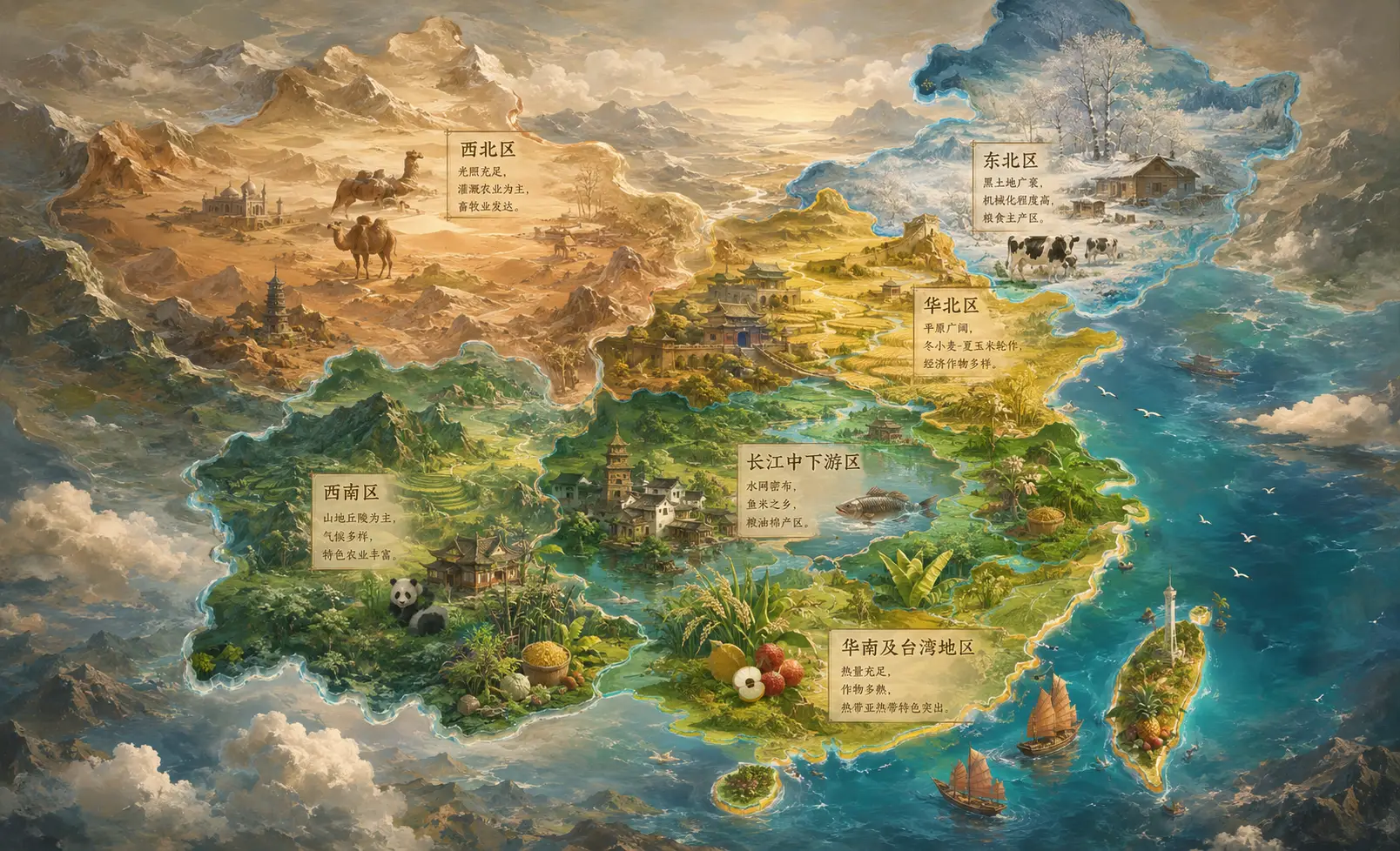
| Agricultural Region | Major Provinces | Keywords |
|---|---|---|
| Northeast | Heilongjiang, Jilin, Liaoning, eastern Inner Mongolia | Harvest complete, final autumn land preparation, grain storage, straw management |
| Northwest | Xinjiang, Gansu, Ningxia, western Inner Mongolia, Qinghai | Cotton harvest, winter-wheat emergence, orchard harvest, autumn-sowing management |
| North China | Hebei, Shanxi, Beijing, Tianjin, Shandong, northern Henan | Winter-wheat sowing, cotton harvest, autumn harvest complete, drying and storage |
| Middle and Lower Yangtze | Hubei, Hunan, Jiangxi, Anhui, Jiangsu, northern Zhejiang, Shanghai | Late-rice harvest, rapeseed sowing, autumn harvest and sowing, drying and storage |
| Southwest | Sichuan, Chongqing, Guizhou, Yunnan, southeastern Tibet | Rapeseed sowing, orchard harvest, autumn harvest ending, autumn-sowing management |
| South China and Taiwan | Guangdong, Guangxi, Hainan, southern Fujian, Taiwan Province | Late-rice grain filling, tropical fruit, typhoon preparedness, field management |
Heilongjiang, Jilin, Liaoning, eastern Inner Mongolia
During Cold Dew, the autumn harvest in Northeast China is largely complete and autumn land preparation enters its closing stage. The focus of farm work shifts decisively from harvesting to storage and field preparation.
The autumn harvest is largely complete. By Cold Dew, harvesting of Northeast China’s three major crops—maize, rice, and soybeans—is almost entirely finished. Grain has been brought into storage and the autumn harvest is largely complete. Only a very small number of late-maturing cultivars and fields delayed by adverse weather remain to be harvested.
Autumn land preparation enters its final stage. By Cold Dew, autumn field preparation across Northeast China is nearing completion. Deep loosening and land preparation, carried out to a depth of 30–35 cm to break the plow pan, has been completed across most fields, with the remaining area to be finished before the ground freezes. Straw incorporation, in which shredded maize stalks are returned to the field, is also largely complete, while remaining areas must be finished before freeze-up. Straw removal, involving baling and removing stalks from the field, is similarly close to completion. The quality of autumn land preparation directly affects spring sowing and annual yield the following year, so all work needs to be completed before the soil freezes.
Grain drying and storage are fully underway. During Cold Dew, storage of autumn grain—maize, rice, and soybeans—is carried out on a broad scale across Northeast China. Harvested grain must first be thoroughly dried: maize moisture needs to fall below 14%, rice below 14%, and soybeans below 13% before storage. Delayed drying can cause mold and deterioration. Once adequately dried, grain is moved into storage facilities that need to be protected against moisture, insects, and rodents. Some grain is sold directly after harvest, with farmers deciding when to sell according to market prices and their own needs. The quality of grain storage directly affects farm income for the year and investment in the following production season.
Straw management. Northeast China produces large quantities of maize straw, and Cold Dew is the final window for handling it. Straw incorporation involves shredding the residues and plowing them deeply into the soil to increase organic matter, although excessive incorporation may cause temporary nitrogen deficiency in the following crop during the seedling stage. Straw removal involves baling and removing residues for use as livestock feed, biomass fuel, or papermaking material. Straw management needs to be completed before the soil freezes, otherwise spring sowing the following year may be affected.
Winter forage reserves in pastoral areas. In eastern Inner Mongolia, winter forage preparation enters its final stage. Cutting, drying, baling, and storage are completed to ensure livestock can overwinter safely.
Protected agriculture. Around Cold Dew, greenhouse vegetables in Northeast China enter the transplanting stage, and autumn and winter greenhouse production becomes fully established.
Xinjiang, Gansu, Ningxia, western Inner Mongolia, Qinghai
During Cold Dew, Northwest China enters a critical stage of autumn management. Cotton picking reaches its peak, management of newly emerged winter wheat proceeds steadily, and orchard harvesting continues.
Peak cotton harvest. Cotton across Xinjiang reaches peak harvest during Cold Dew, with large numbers of bolls opening and white lint exposed. Farmers take advantage of clear weather to pick. Manual harvesting remains predominant in Xinjiang cotton areas, with strict standards: only fully opened white cotton is collected; incompletely opened green cotton and contaminated cotton are left unpicked; and foreign matter must be kept out during harvesting. After picking, cotton is promptly dried, graded, baled, and stored or sold.
Cotton harvesting continues through late October, and the period from Cold Dew to Frost’s Descent is the most concentrated picking season. Weather forecasts need to be followed closely. If rain or early frost is expected, cotton needs to be harvested beforehand because both rainfall and frost can reduce fiber quality. Picking too early means the fibers are not fully developed, reducing both quality and yield; picking too late increases the risk of wind damage, cotton being blown from the plants, and deterioration in fiber quality, including yellowing.
Winter-wheat seedling management. During Cold Dew, management of newly emerged winter wheat proceeds steadily across Northwest China. Winter wheat sown in mid- to late September has emerged and entered the seedling stage.
Key management measures include checking emergence and filling gaps, with missing rows or patches resown promptly; resowing cannot be delayed too long, otherwise seedlings may not survive winter safely. Seedling-stage pest control focuses on aphids, cutworms, and other pests that damage young plants and require timely treatment. Pre-winter weed control is also necessary because weeds compete with wheat seedlings for water and nutrients.
Farmers also work to develop strong seedlings before winter. Ideally, plants should form 3–5 tillers and a well-developed root system before winter, providing the basis for successful overwintering and a good harvest the following year. Weak stands may receive 3–5 kg of urea per *mu* as a seedling-stage topdressing to promote growth. Seedling establishment directly affects overwinter survival and final yield.
Continued orchard harvest. Harvesting continues in orchards across southern Xinjiang. Late-maturing apple cultivar “富士” enters harvest in October. It is one of China’s principal late-maturing apple cultivars, generally harvested in mid- to late October and forming the closing stage of the apple season. Growers determine harvest timing according to fruit coloration and sugar content, then promptly precool, grade, pack, refrigerate, or sell the fruit.
Xinjiang red dates enter peak harvest in October. Red dates are among Xinjiang’s most distinctive orchard products, with harvesting concentrated in mid- to late October. After picking, they are promptly dried, graded, packed, and sold. Grape harvesting enters its final stage: table-grape harvesting is largely complete and wine-grape harvesting is fully finished.
Growers need to harvest fruit at the proper stage according to maturity. Apple harvest standards are skin coloration ≥80%, firmness ≥8 kg/cm², and sugar content ≥13%. Postharvest management includes prompt precooling, grading, packing, cold storage or sale, followed by pruning and autumn fertilization, mainly with organic fertilizer, which is crucial for tree growth and fruiting the following year.
Specialty crops. Potato harvesting around Dingxi, Gansu, is fully complete. Goji harvesting in Ningxia is fully complete. Processing-tomato harvesting in Xinjiang is also fully complete.
Hebei, Shanxi, Beijing, Tianjin, Shandong, northern Henan
During Cold Dew, North China enters the most critical stage of autumn sowing. Winter-wheat sowing reaches its peak—“寒露种麦正当时”—cotton picking reaches its peak, and the autumn harvest is largely complete.
Winter-wheat sowing reaches its peak. “寒露种麦正当时”—winter-wheat sowing in North China reaches its peak during Cold Dew, from early to mid-October. This is one of the most important agricultural milestones of the year in North China, and sowing quality directly affects overwinter survival and yield the following year.
Key techniques include plowing and seedbed preparation, with deep plowing to 20–25 cm followed by fine leveling; a level field is fundamental to good sowing quality. Basal fertilization consists of 20–25 kg of compound fertilizer per *mu* plus farmyard manure, with rates adjusted according to soil fertility.
Seed selection focuses on cold resistance, drought resistance, disease resistance, and yield potential; for late sowing, cultivars suited to delayed planting are required. Timely sowing is carried out at a depth of 3–5 cm. Sowing too shallow increases frost risk, while sowing too deep reduces emergence. Row spacing is 15–20 cm and the seeding rate is 10–15 kg per *mu*, adjusted according to soil fertility, cultivar, and sowing date. For delayed sowing, the seeding rate is increased by 0.5 kg for each day of delay.
After sowing, the soil is firmed to conserve moisture. This is a key measure for uniform emergence and can increase emergence by more than 10%. The period from Cold Dew to Frost’s Descent is the critical sowing window for winter wheat in North China. Sowing later than Frost’s Descent can result in weak seedlings because accumulated temperatures before winter are insufficient, reducing overwinter survival and yield the following year.
Peak cotton harvest. Cotton across North China reaches peak picking during Cold Dew. Large numbers of bolls open, and farmers take advantage of clear weather to pick, dry, grade, bale, and sell the cotton. Harvest continues through late October.
The autumn harvest is largely complete. By Cold Dew, harvesting of autumn crops across North China—including summer maize, spring maize, soybeans, peanuts, and others—is almost entirely finished. Grain has been stored, straw management is completed, and the autumn harvest is effectively over.
Continued orchard harvest. Apple and pear harvesting continues across North China. Late-maturing “富士” apples enter harvest in October, with the main harvest period in mid- to late October, while mid-season cultivars approach completion. Pear harvesting enters its final stage or is largely finished. Growers need to pay attention to proper harvest timing, postharvest management, and autumn fertilization. Autumn fertilization is crucial for growth and fruiting in the following year and is based mainly on organic fertilizer at 2–3 tonnes per *mu*, supplemented with compound fertilizer.
Vegetable management. Autumn-sown vegetables—including Chinese cabbage, radish, and spinach—enter critical growth and harvest stages. Chinese cabbage moves from head formation toward harvest and requires stronger water and nutrient management, including 5–8 kg of urea per *mu* as a head-forming topdressing, together with pest and disease control. Autumn radish enters rapid fleshy-root enlargement and likewise requires stronger water and nutrient management.
Hubei, Hunan, Jiangxi, Anhui, Jiangsu, northern Zhejiang, Shanghai
During Cold Dew, the middle and lower Yangtze enters the busiest stage of autumn harvesting and sowing. Late rice enters maturity and harvest, while rapeseed sowing reaches its peak.
Late-rice maturity and harvest. Across the Yangtze River basin, late rice enters maturity and harvest during Cold Dew. Panicles turn yellow, grains become full and hard, and the crop reaches physiological maturity. Farmers take advantage of clear weather to harvest with rice combines. After harvest, grain is promptly dried until moisture falls below 14% before storage, or mechanically dried.
The late-rice harvest window generally lasts only 1–2 weeks, requiring close attention to weather forecasts. If rainfall from persistent autumn rains in western China or a typhoon is expected, harvesting should be completed beforehand. Harvesting too early leaves grains insufficiently filled, reducing thousand-grain weight and increasing unfilled grains; harvesting too late increases the risk of shattering or sprouting after rain. The period from Cold Dew to Frost’s Descent is the critical harvest window for late rice across the Yangtze River basin.
Rapeseed sowing reaches its peak. During Cold Dew, rapeseed sowing reaches its peak across the Yangtze River basin, China’s largest rapeseed-producing region and one of its most important agricultural periods of the year.
Key techniques include deep plowing and fine seedbed preparation to 20–25 cm, with fields prepared promptly after the rice harvest to avoid soil compaction. Basal fertilization consists of 20–25 kg of compound fertilizer per *mu* plus boron fertilizer. Rapeseed is highly sensitive to boron deficiency, which can cause flowers to form without proper pod and seed development. In areas with low plant-available boron in the soil, an additional 1–2 kg of boron fertilizer per *mu* is applied.
Farmers select high-yielding, high-quality, disease-resistant cultivars such as the “中油” and “华油” series. Timely sowing is carried out at a depth of 2–3 cm, since rapeseed should be sown relatively shallowly. Row spacing is 25–30 cm and direct-seeding rate 0.3–0.5 kg per *mu*. Transplanted rapeseed is raised in nurseries in advance and transplanted when seedlings are 30–35 days old.
After sowing, the soil is firmed to conserve moisture. Drainage is essential. Farmers establish a three-level drainage network of main ditches, cross-field ditches, and perimeter ditches. Because autumn is rainy across the Yangtze River basin and young rapeseed is vulnerable to waterlogging, this drainage system is crucial to safe crop establishment. The respective ditch depths should reach at least 80 cm, 60 cm, and 40 cm. Sowing quality directly affects emergence and the development of strong seedlings before winter.
Transition from late-rice harvest to rapeseed sowing. In rice–rapeseed rotation areas of the Yangtze River basin, the transition from late-rice harvesting to rapeseed sowing is one of the most important links in autumn farm work. Immediately after the late-rice harvest, fields are plowed and prepared and rapeseed is sown. The shorter the interval between harvest and sowing, the better farmers can use autumn light and heat resources and ensure that rapeseed develops strong seedlings before winter.
Pest and disease control. During Cold Dew, late-rice pest and disease control enters its final stage. Major targets include rice blast, especially panicle-neck blast, controlled with tricyclazole or isoprothiolane; sheath blight, controlled with validamycin or difenoconazole + propiconazole; and rice planthoppers, controlled with imidacloprid or buprofezin. Farmers need to strengthen field inspections and intervene promptly when pests or diseases are detected.
Vegetables and aquaculture. Autumn-sown vegetables across the Yangtze River basin—including Chinese cabbage, radish, lettuce, spinach, and celery—enter critical growth and harvest stages. In aquaculture, temperatures continue to fall and fish feeding gradually decreases. Feeding rates therefore need to be adjusted and preparations made for overwintering.
Sichuan, Chongqing, Guizhou, Yunnan, southeastern Tibet
During Cold Dew, Southwest China enters a critical stage of autumn harvesting and sowing. Rapeseed sowing reaches its peak, orchards enter maturity and harvest, and the autumn harvest approaches completion.
Rapeseed sowing reaches its peak. During Cold Dew, rapeseed sowing reaches peak intensity across Southwest China. Sichuan and Guizhou are important rapeseed-producing areas, and rapeseed accounts for the largest share of autumn-sown acreage. Farmers take advantage of favorable soil moisture to plow, apply basal fertilizer, sow, firm the soil, and establish effective drainage, aiming for uniform emergence from a single sowing. Sowing quality directly affects emergence and the development of strong seedlings before winter.
The autumn harvest approaches completion. Harvesting of middle-season rice, maize, soybeans, and other autumn crops across Southwest China enters its final stage during Cold Dew. Grain is brought into storage and autumn harvesting is largely complete.
Orchard management. Citrus-growing areas across Southwest China move from fruit coloration toward pre-maturity. Fruits continue coloring and sugar accumulation continues, making this a critical stage for determining citrus quality. Farmers apply 5–8 kg of potassium sulfate per *mu* to promote sugar accumulation and coloring; this is the most important fertilizer application for improving citrus quality. Water is moderately restricted to promote sugar accumulation, but excessive drought must be avoided because it can impair fruit enlargement. Citrus red mites, leaf miners, canker, anthracnose, and other pests and diseases enter their final control period.
Guangdong, Guangxi, Hainan, southern Fujian, Taiwan Province
#### (1) Mainland South China
Late-rice management from grain filling to maturity. During Cold Dew, late rice in South China moves from grain filling toward maturity. Grains become full and begin transitioning toward maturity, making this the final stage determining thousand-grain weight. Fields should remain moist under appropriate irrigation and should not be drained too early, because premature water withdrawal during grain filling can leave grains underfilled.
A grain-filling topdressing, mainly potash, is applied at 3–5 kg of potassium chloride per *mu*. Rice blast, sheath blight, rice planthoppers, and other pests and diseases enter their final control stage. Typhoon preparedness remains necessary because South China can still be affected by typhoons in October, and strong winds and torrential rain can cause rice lodging. Management from grain filling through maturity directly affects thousand-grain weight and final yield.
Tropical-fruit management. Bananas in Guangdong, Guangxi, and Hainan move from fruit development toward pre-maturity and require stronger water and nutrient management. Potash is applied to promote fruit growth, while banana plants are reinforced and drainage ditches cleared in preparation for typhoons. Citrus moves from fruit coloration toward pre-maturity and requires stronger water and nutrient management, including potash application to promote sugar accumulation and coloring, together with control of citrus red mites, leaf miners, canker, and other problems.
Typhoon preparedness. South China may still be affected by typhoons during Cold Dew. October marks the closing stage of the typhoon season in the region; although frequency declines, vigilance remains necessary. Farmers need to follow typhoon warnings closely and prepare in advance.
Vegetables and aquaculture. Open-field vegetables across South China enter rapid growth and peak harvest. In aquaculture, temperatures gradually fall, requiring adjustments to feeding rates and preparations for overwintering.
#### (2) Taiwan
Rice: In central Taiwan—including Changhua, Yunlin, and the Chianan Plain—the second rice crop enters maturity and harvest during Cold Dew. In southern Taiwan, particularly the Kaohsiung–Pingtung region, the second crop enters harvest. In northern Taiwan, including Taoyuan and Hsinchu, the second crop moves from grain filling toward maturity.
Vegetables: During Cold Dew, autumn-sown vegetables across Taiwan enter critical growth and harvest stages.
Fruit trees: Citrus moves from fruit coloration toward pre-maturity, while bananas move from fruit development toward pre-maturity.
Tea: Autumn management continues in tea gardens across central and southern regions such as Nantou and Chiayi through autumn-tea picking, pruning, and fertilization. Autumn management also continues in northern tea districts such as Wenshan and Sanxia.
Fisheries: Fishing continues in waters around Taiwan during Cold Dew. Typhoon season enters its final stage.
Farmer’s proverbs and folk customs: Taiwanese folk tradition preserves the saying “寒露過,十月涼”, expressing that after Cold Dew, the weather turns cool in the tenth month. Another saying, “寒露霜降,胡豆麥子在坡上”, describes Cold Dew and Frost’s Descent as the season for sowing broad beans and wheat. There is also the custom of “寒露吃芝麻”, eating sesame during Cold Dew as part of seasonal health practices.
Global Extreme Weather · Risks & Responses
Temperate Northern Hemisphere: Early Frost—the Greatest Threat to Winter-Wheat Seedlings in Northwest and North China
During Cold Dew, the risk of early frost remains across Northwest China—including northern Xinjiang and Gansu’s Hexi Corridor—and northern parts of North China, where frost may occur from early to mid-October. Early frost threatens newly emerged winter-wheat seedlings, which have relatively weak cold tolerance and are particularly vulnerable at the 2–3-leaf stage. Frost can kill young plants.
Preventive measures include selecting cold-resistant cultivars as a long-term strategy; sowing at the proper time so that strong seedlings form before winter; pre-frost irrigation, which can raise surface temperature by 2–3°C; and application of cold-resistance agents.
Temperate Northern Hemisphere: Persistent Autumn Rains in Western China—the Greatest Threat to Late-Rice Harvesting and Rapeseed Sowing
During Cold Dew, persistent autumn rains continue across western China, affecting Sichuan, Chongqing, Guizhou, southern Shaanxi, western Hubei, and surrounding areas.
These prolonged wet conditions can significantly disrupt agricultural production. Continuous rain during late-rice harvesting can prevent grain from drying properly, causing sprouting, mold, and quality deterioration. Excessive soil moisture during rapeseed sowing can make tillage and sowing difficult, cause seed rot after planting, and result in uneven emergence. High humidity during storage of harvested autumn grain can also promote mold.
Farmers need to follow weather forecasts closely, take advantage of clear spells for harvesting and drying, and ensure grain is brought safely into storage. Rapeseed should be sown during favorable weather, with adequate drainage provided through main, cross-field, and perimeter ditches.
Temperate Northern Hemisphere: Typhoons—the Final Threat to Late Rice in South China
South China may still be affected by typhoons during Cold Dew. October marks the final stage of the regional typhoon season, but storms can still bring strong winds and torrential rain, causing late rice to lodge and grains to shatter. Farmers need to follow typhoon warnings closely and prepare in advance by rapidly harvesting mature late rice and strengthening measures against crop lodging.
Temperate Southern Hemisphere: Spring Drought and Pest-and-Disease Pressure
In mid-spring in the Southern Hemisphere, during early October, winter wheat progresses from heading and flowering into grain filling and its water demand increases. If spring rainfall is insufficient, spring drought may develop and affect heading, flowering, grain filling, and final yield. At the same time, warmer spring temperatures increase pest and disease pressure. Aphids, rust, powdery mildew, and other problems require stronger field inspection and control.
Tropical Regions: Beginning of the Dry Season and the Final Harvest Stage
Across the tropical Northern Hemisphere—including Southeast Asia and India—the dry season begins and rice harvesting enters its final stage. Farmers still need to watch for weather changes during harvest, as occasional rainfall may occur at the beginning of the dry season. Across the tropical Southern Hemisphere—including Brazil and Africa—the dry season continues and fields remain in the dry-season fallow stage.
----
Readers’ Comments
Calendar and traditional culture enthusiasts from around the world, sharing the same moon.
Sign in or register to join the conversation. Your comment account is created automatically the first time you use a connected account.
No comments yet
Share your thoughts with readers around the world.