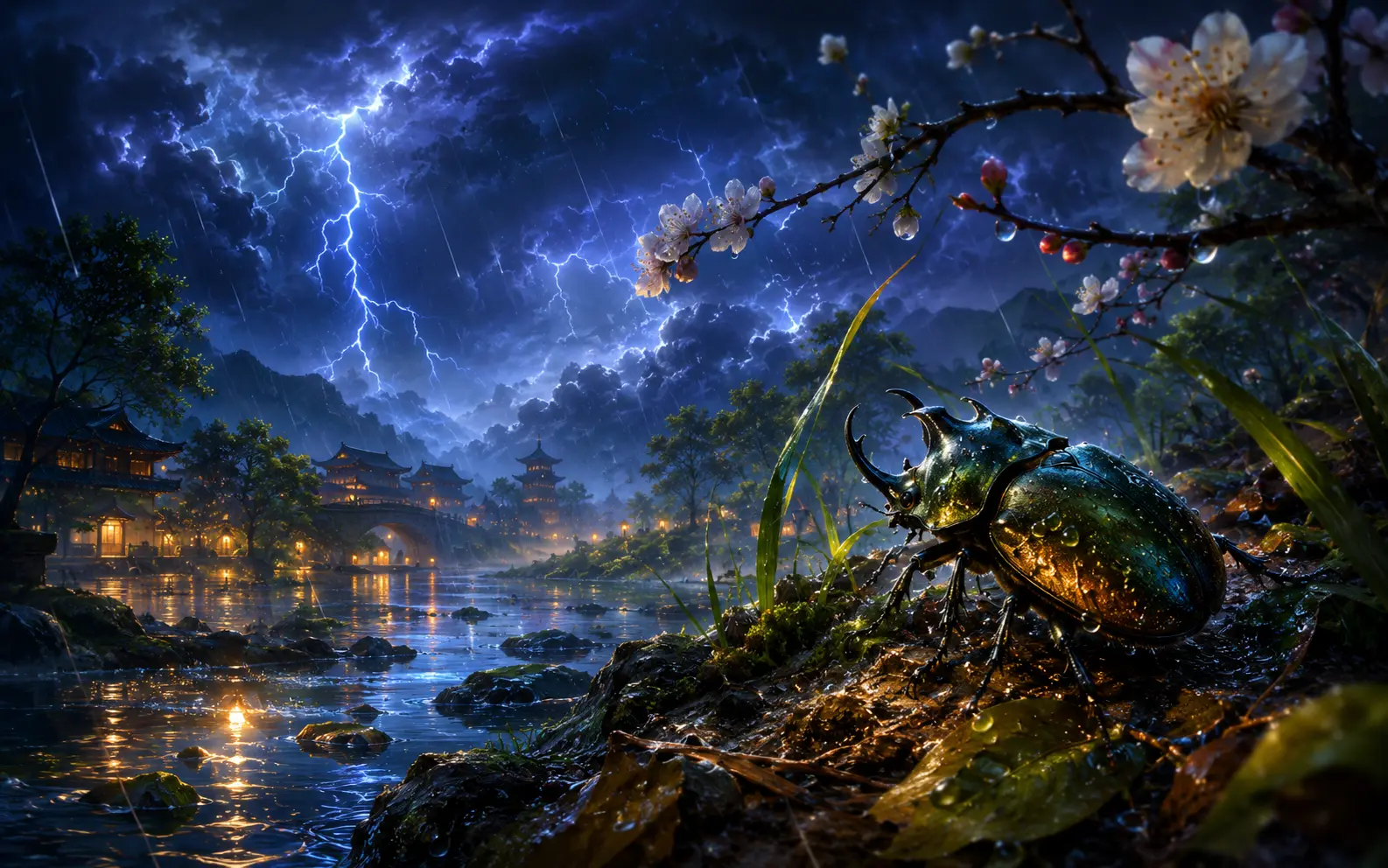
Awakening of Insects Customs
「惊蛰春雷响,农夫闲转忙」
If the customs of Beginning of Spring revolve around “welcoming” and “beginning,” and those of Rain Water around “affection” and “prayer,” then the customs of Awakening of Insects unfold around “warning” and “expulsion.” The sudden roll of spring thunder awakens the natural world; insects begin to stir, and human ritual turns toward driving away harm. The season’s customs can be summarized through six actions: offering, striking, covering, eating, fumigating, and calling. Offering refers to the rite of the White Tiger, whose paper image is fed pig’s blood or raw pork so that its mouth will be too well fed to injure others, thereby averting gossip and conflict; striking refers to villain-hitting, in which paper effigies are beaten with an old shoe to drive away ill fortune; covering refers to stretching a new hide over a drum in response to the season, echoing the Thunder God beating the celestial drums; eating refers to pears, whose homophonic association with “separation” expresses the wish to part from pests and disease; fumigating refers to burning mugwort in the corners of the home to drive away snakes, insects, mosquitoes, rodents, and stale odors; and calling refers to tea-growing regions where farmers beat drums and shout toward the mountains to awaken tea gardens from their winter sleep. The rites of the White Tiger and villain-hitting center on averting evil and calamity; renewing drumheads and calling to the tea mountains express a correspondence between human action and the movements of Heaven; while eating pears and fumigating with mugwort bring the logic of protection into everyday health and domestic life. Together they form a complete seasonal landscape extending from the expulsion of harm to the seeking of blessings, and from formal ritual to ordinary practice. Three cultural principles run through them: responding to the proper season, as people answer heavenly thunder through drums and the ritual awakening of tea mountains, recalling the old injunction “凡冒鼓必以启蛰之日”; expelling evil and averting calamity, as the White Tiger rite, villain-hitting, and mugwort fumigation symbolically drive away both newly awakened “pests” and troublesome “petty people”; and praying for abundance, whether by eating pears in hopes of keeping crop pests away, calling for vigorous tea growth, or reading spring thunder as an omen of a plentiful year. Awakening of Insects is therefore one of the most dynamic and cautionary of the Twenty-Four Solar Terms: a single roll of spring thunder is at once nature’s alarm and humanity’s signal to cast out misfortune and welcome good fortune.
Regional Customs of This Solar Term
| Region | Signature Customs | Notable Features |
|---|---|---|
| Guangdong | Offering to the White Tiger | A paper tiger is fed pig’s blood or smeared with raw pork so that it cannot “open its mouth to harm people” |
| Hong Kong | Villain-hitting | The space beneath the Canal Road Flyover near Causeway Bay is a famous center of the practice, where ritual specialists beat paper effigies with old shoes |
| Macao | Offering to the White Tiger | Usually performed at Earth God shrines, community altars, and sites dedicated to Shigandang |
| Wuyi Mountains, Fujian; Hangzhou, Zhejiang | Calling to the mountains and offering to tea | Tea farmers beat drums and shout “茶发芽”, calling the tea mountains awake |
| Shanxi | Eating pears | Associated with a legend of the Qu merchant family; pears symbolize leaving home to build a livelihood while remembering one’s ancestors |
| Ningbo, Zhejiang | Insect-Sweeping Festival | Farmers carry brooms into the fields and perform symbolic insect-sweeping rites |
| Western Hubei | Notching fruit trees | Seven cuts are made down a fruit tree on Awakening of Insects, a practice called “放水”, or “releasing water,” intended to guard against pests and disease |
| Northeastern Sichuan | Refraining from working cattle | Oxen are not put to work on Awakening of Insects because folk belief holds that doing so can injure their joints |
Awakening of Insects Customs
Offering to the White Tiger
Popular Regions:
Activities:
Offering to the White Tiger is one of the most regionally distinctive customs associated with Awakening of Insects and is practiced chiefly in Guangdong, Hong Kong, and Macao. According to folk tradition, the White Tiger is a deity associated with quarrels, gossip, and interpersonal conflict and is believed to emerge on this day in search of food, opening its mouth to bite people. Those who offend it are thought likely to encounter malicious “petty people,” constant disputes, and repeated frustrations during the year; the ritual therefore seeks to pacify the White Tiger before it can cause harm.
The ritual tiger is usually made from paper, with a yellow body marked by black stripes and a pair of fangs painted at the corners of its mouth. During the offering, fatty pork smeared with pig’s blood may be rubbed over the tiger’s mouth, or small pieces of raw pork placed directly between its jaws, expressing the idea that once it has been well fed, it will no longer open its mouth to injure people. After the rite, the paper tiger may be burned or symbolically beheaded with a bronze sword, while participants often recite blessings such as “may good people draw near and petty people stay far away.” In Macao, the rite is commonly performed at Earth God temples, public community altars, local Earth God shrines, and Shigandang sites.
Cantonese opera also preserves a traditional ritual piece entitled 《祭白虎》, performed by a troupe before appearing on a newly opened stage; during the performance, the actors are required to remain silent.
Historical Origins:
The custom is closely connected with old folk legends concerning the White Tiger’s activity on the day of Awakening of Insects, but its deeper roots can be traced to much older forms of tiger-totem worship. In agrarian society, spring thunder was believed to awaken the many insects that could damage crops, and offering to the White Tiger came to symbolize using the foremost of beasts to suppress harmful creatures and dispel calamity.
Within traditional Chinese culture, the White Tiger also occupies a more complex symbolic position. As the divine beast guarding the west, it can represent protection and auspicious power, yet in some regional traditions it is treated as an ominous force whose encounter brings misfortune. As society changed, the rite gradually shifted from an agricultural ceremony concerned with pests and disaster prevention toward an urban ritual aimed at resolving interpersonal conflict and driving away troublesome “petty people.” Hong Kong’s custom of offering to the White Tiger during Awakening of Insects has been included in its inventory of intangible cultural heritage.
How to Take Part:
On Awakening of Insects, the rite can be observed at Earth God temples and community altars in Guangdong. Some temples and roadside shrines in Hong Kong also conduct related ceremonies, allowing visitors to watch worshippers offer raw pork to paper tigers. In Macao, the Shigandang shrine is a popular place to observe the tradition.
Recommended Places:

Villain-Hitting
Popular Regions:
Activities:
Villain-hitting, or “打小人”, is a form of folk ritual magic practiced in Hong Kong and the Pearl River Delta. Participants seek symbolically to drive away or retaliate against the so-called “小人”, the “petty people” opposed to the auspicious “贵人”, or benefactors—usually understood as those who spread gossip, create trouble behind one’s back, or obstruct one’s affairs. Although the rite may be performed at other times, Awakening of Insects is considered its principal occasion.
The ritual is generally conducted in shadowed or liminal places such as beneath bridges, beside roads, or near junctions. In Hong Kong, the area beneath the Canal Road Flyover between Causeway Bay and Wan Chai has become the best-known center of the practice, drawing large crowds every year on Awakening of Insects.
The ceremony generally comprises eight stages: inviting the deities, reporting the petitioner’s circumstances, striking the villain, offering to the White Tiger, resolving harmful influences, seeking benefactors, inviting wealth, and casting divination blocks. The ritual specialist first asks the client’s name and the identity of the person or problem to be struck, then places a paper effigy on a brick and repeatedly hits it with an old shoe—sometimes a high heel or slipper—while reciting formulas such as “打你个小人头,打到你有气无得透;打你只小人手,打到你有眼都唔识偷”. The gestures appear punitive, yet the rite is also filled with hopes for blessing: rather than functioning simply as a malicious curse, it often serves as a structured way for the petitioner to release resentment and regain psychological relief. Folk belief holds that if the villain is struck before the White Tiger on Awakening of Insects, the White Tiger will subdue the harmful person and prevent further injury.
Historical Origins:
The precursor of villain-hitting can be traced to the old Awakening of Insects practice of fumigating the home with mugwort to drive away pests. The solar term marks the beginning of the second lunar month, when a sudden roll of thunder was believed to awaken snakes, insects, rats, ants, and other creatures dormant through winter. People once carried incense and mugwort through the four corners of the house, using the fragrance to expel pests and damp odors; over time, this practical and symbolic act of insect removal gradually developed into the practice of striking representations of troublesome people and driving away bad luck.
In earlier times, such rites were also described as “厌胜”, a form of ritual magic with cursing functions in which a ritual specialist invoked spiritual power so that hidden adversaries might receive punishment. The custom of villain-hitting was included in the intangible cultural heritage inventories of Hong Kong and Macao in 2014 and 2020 respectively.
How to Take Part:
On Awakening of Insects, visitors may observe villain-hitting beneath the Canal Road Flyover near Causeway Bay in Hong Kong. Large queues form at individual stalls, with some well-known practitioners attracting close to a hundred people. Foreign visitors may also queue to experience the rite; one Taiwanese visitor who waited two hours later described it as “蛮舒服” and remarked “传统文化ok㗎我觉得.” Visitors are advised to arrive early, respect the ritual sequence, and follow the instructions of the ritual specialist.
Recommended Places:
Stretching New Drumheads
Popular Regions:
Activities:
Awakening of Insects is a solar term traditionally associated with thunder. The ancients imagined the Thunder God as a great winged deity with a bird’s beak and a human body, holding a hammer in one hand while striking the many celestial drums that surrounded him with the other, producing the rolling thunder that shook the human world. For this reason, rituals honoring the Thunder God were once performed on this day.
If the Thunder God beats the drums of Heaven at Awakening of Insects, people on earth likewise take the occasion to stretch new skins over their drums. The custom known as “蒙鼓皮” consists of fitting a drum with a fresh hide so that it can once again be sounded, and performing this work on Awakening of Insects was regarded as an act of conforming human activity to the proper season. People might also display images of the Thunder God and arrange offerings before them, praying for favorable winds and timely rain.
Historical Origins:
The custom has extremely ancient roots. Volume Forty of the *Zhouli*, in the section on the Huiguan, explicitly states: “凡冒鼓必以启蛰之日.” A commentary explains: “惊蛰,孟春之中也,蛰虫始闻雷声而动;鼓,所取象也;冒,蒙鼓以革。” This shows that as early as the Zhou period, the renewal of drumheads was already associated with the seasonal awakening of insects. Not only were the life cycles of hibernating creatures understood as corresponding to the movement of the four seasons; the drum, regarded as a commanding instrument, was likewise brought into alignment with the same natural rhythm.
Ancient people understood the spring thunder of Awakening of Insects as Heaven’s call to awaken all living things. By renewing drumheads at the same moment, the human world imitated celestial thunder, expressing reverence toward the Thunder God while also borrowing the power of Heaven and Earth to pray for favorable agricultural conditions in the coming year. Today, many forms of drumming, dance, and traditional drum-making craftsmanship across China have been included in national- and provincial-level intangible cultural heritage lists.
How to Take Part:
During Awakening of Insects, some folk-culture villages and intangible heritage centers organize drum-making demonstrations in which visitors can watch traditional craftsmen stretch hide over a drum frame. Some activities also allow participants to strike the newly finished drum themselves.
Recommended Places:
Eating Pears
Popular Regions:
Activities:
Eating pears is one of the best-known customs of Awakening of Insects. Because “梨”, pear, and “离”, to leave or separate from, are homophones in Chinese, eating pears symbolizes separation from pests and illness. As spring thunder begins to sound and insects gradually emerge from dormancy, the pear also carries the wish that destructive creatures will stay away from the crops and that the year’s harvest will remain secure. A closely related interpretation uses the same homophony to express the desire that both pests and disease may be kept at a distance.
Awakening of Insects also falls during a season when warmth and cold still alternate and the air can be comparatively dry, leaving people susceptible to dryness of the mouth and general discomfort. In traditional dietary thought, pears are believed to nourish yin and clear the lungs, support spleen *qi*, and help harmonize the five viscera, thereby strengthening the body against illness. Traditional Chinese medicine further holds that liver *yang* becomes vigorous during this period and that dryness of the mouth may therefore occur. Eating pears at Awakening of Insects is thus understood not only as a folk custom but also as consistent with traditional seasonal health principles.
Historical Origins:
Although no definitive record survives of how the custom began, a widely circulated story connects it with the merchant culture of Shanxi. According to tradition, the ancestors of the Qu merchant family came from Zhangzi County in Changzhi. In the early Hongwu reign of the Ming dynasty, Qu Ji and his son exchanged pears and Lu hemp from their native region for coarse cloth and red dates from Qixian, making profits from the price differences between the two places and accumulating their first commercial capital.
During the Yongzheng reign of the Qing dynasty, the fourteenth-generation descendant Qu Baichuan was preparing to “走西口”, setting out along the trading route beyond the western pass, and happened to leave on Awakening of Insects. His father gave him a pear and reminded him that their ancestors had built the family enterprise through the pear trade and endured great hardship; by eating the pear before departure, he was to remember his forebears, work hard, establish his own career, and bring honor to the family. Qu Baichuan later prospered in business, and others setting out beyond the western pass began to imitate the practice, eating pears on Awakening of Insects to signify leaving home to establish a livelihood while striving to honor their ancestors.
Chinese festive culture ordinarily avoids pears on some occasions because the homophony between “梨” and “离” can suggest separation. Awakening of Insects reverses that taboo deliberately: here, separation is precisely what is desired—separation from crop pests and separation from illness.
How to Take Part:
Eating a pear is one of the easiest Awakening of Insects customs to practice. It may be eaten fresh, simmered into pear water, or stewed with rock sugar. Many northern households prepare pears for the whole family on the day itself, while pear soups are more common in some southern regions. Visitors can simply buy fresh pears and experience the custom wherever they are.
Recommended Places:
Fumigating with Mugwort / Scattering Lime
Popular Regions:
Activities:
As temperatures rise after Awakening of Insects, snakes, insects, rodents, ants, and other creatures begin to become active. In earlier times, people in some regions burned fragrant herbs and mugwort in the four corners of the home, using their scent to drive away “蛇虫蚊鼠” as well as damp and musty odors. Alongside mugwort fumigation, lime might also be scattered in corners to repel snakes, insects, ants, and other creatures and symbolically purify the household. In some places, lamps were lit in dark corners in a practice known as “照虫头蚂蚁”.
Around Ningbo in Zhejiang, farmers regard Awakening of Insects as an “Insect-Sweeping Festival” and carry brooms into the fields to perform symbolic sweeping rites. Elsewhere, taro with its skin and fibers intact may be boiled in hot water, or beans and grains roasted in a pan, in the belief that these actions symbolically destroy different kinds of insects. Although the forms vary, their common purpose is to remove pests, cleanse the environment, and give both agricultural production and domestic life a clean beginning for the new year.
Historical Origins:
Mugwort fumigation at Awakening of Insects is explicitly recorded by the Song dynasty. The *Mengliang Lu* describes the practice of “惊蛰熏室”, fumigating rooms at this time; residents of Lin’an, present-day Hangzhou, used aromatic plants to counter dampness and insects, and the custom has continued in various forms into the present.
Fumigating with mugwort was therefore not only a practical response to insect activity but also came to carry the symbolic meanings of dispelling bad luck and cleansing the household. Over time, this logic of driving out harmful creatures gradually contributed to the later custom of villain-hitting, in which misfortune itself was personified and symbolically expelled.
How to Take Part:
On Awakening of Insects, some people burn mugwort or moxa sticks briefly in the corners of the home, taking appropriate precautions against fire, or scatter a small amount of lime in corners. Some folk-culture villages also organize collective mugwort-fumigation activities during the solar term.
Recommended Places:
Calling to the Mountains and Offering to Tea
Popular Regions:
Activities:
For tea farmers, Awakening of Insects is an important moment for awakening the tea mountains. To this day, tea regions such as the Wuyi Mountains in Fujian and Hangzhou in Zhejiang preserve the custom known as “喊山祭茶”, calling to the mountains and offering rites to tea. During the ceremony, tea farmers beat drums whose sound rolls through the valleys and shout together “茶发芽、茶发芽”—“Tea, sprout! Tea, sprout!” Through this old act of calling, they symbolically awaken tea bushes that have slept through the winter and pray for vigorous vegetation and abundant new shoots.
The ceremony expresses gratitude for fine tea bestowed by nature while also embodying hopes for a plentiful harvest. With drums sounding like thunder and human voices filling the mountain valleys, the spectacle is deliberately powerful, transforming the spring awakening of the tea gardens into a collective ritual.
Historical Origins:
The tradition has a long history. As early as the Song dynasty, Zhao Ruli wrote in the *Beiyuan Bielu*: “春虫震蛰,千夫雷动,一时之盛,诚为壮观”, describing the magnificent scene of large numbers of people beating drums and calling to the tea gardens. Ancient people believed that spring thunder awakened all living things at Awakening of Insects and that tea bushes likewise needed to be ritually “awakened” before they could send out strong new shoots.
The practice therefore binds seasonal phenology directly to agricultural production and embodies the central tea-cultural idea of the unity of Heaven and humanity: only when human wishes and actions move in harmony with the rhythms of nature can the best harvest be hoped for.
How to Take Part:
Around Awakening of Insects, visitors may travel to the Wuyi Mountains in Fujian, the West Lake Longjing tea-growing region of Hangzhou, and other tea districts to observe drum-beating and tea-calling ceremonies. Some tea areas also allow visitors to take part in tea-picking activities after the ritual. Specific schedules are best checked in advance through local tea-culture tourism organizations.
Recommended Places:
Notching Fruit Trees (“Releasing Water”)
Popular Regions:
Activities:
In western Hubei, Awakening of Insects is traditionally regarded as a kind of festival for fruit trees. On this day, orchard farmers make seven cuts from top to bottom on a fruit tree, a practice known locally as “放水”, or “releasing water,” which folk belief associates with protection from pests and disease. While making the cuts, people recite: “惊蛰节,惊蛰节,年年砍,年年结。虫砍死,风吹绝,花果满树树不歇。” Afterward, they hang a broken jar and a strip of red material from the branches. Through symbolic “injury,” the rite seeks to protect the tree, reflecting a folk logic of countering harm with harm while expressing an intense hope for abundant fruit.
Historical Origins:
The precise origin of this western Hubei custom is no longer known, but it is closely related to the defining seasonal image of Awakening of Insects: all things returning to life as insects begin to stir. After this point, fruit trees enter active growth and pests and diseases also become more active. By making cuts in the trunk, farmers believed they could release part of the tree’s internal vitality or moisture—the so-called “releasing water”—while verbal formulas symbolically drove away imagined pests.
The custom resembles the practice of “marrying trees” found around Beginning of Spring in Sichuan and other regions. Both reflect an older agricultural habit of reasoning through symbolic analogy, using enacted images to influence or protect the natural world while expressing hopes for a rich harvest.
How to Take Part:
Visitors to rural western Hubei during Awakening of Insects may observe the custom under the guidance of local orchard farmers. Because the practice involves specialized handling of living fruit trees, visitors are better advised to observe rather than imitate it independently.
Recommended Places:
Closing Note
The customs of Awakening of Insects arose from the collective imagination and cultural responses stirred by the first thunder of spring. When the earth began to warm and dormant creatures stirred beneath the soil, early communities transformed this startling natural phenomenon into a series of ritual actions carrying both traces of ancient magic and a great deal of practical wisdom. Awakening of Insects is not a season that seems to arrive by gentle degrees; it is a moment of sudden arousal, and its customs accordingly possess a certain decisiveness—the sense that, once the thunder sounds, something must be done.
Across the centuries, those customs continued to send out new branches. As early as the pre-Qin period, people used fragrant mugwort smoke in the corners of their homes to drive away snakes, insects, rats, and ants; this simple act of household pest control gradually acquired symbolic meanings and, in later times, contributed to the ritual of striking paper “villains” to drive away bad luck. Renewing drumheads answered the thunder of Heaven; offering to the White Tiger sought to resolve quarrels and malicious interference; eating pears answered seasonal dryness while also symbolically separating people and crops from disease and pests. Each of these customs can be understood as a cultural response to the same natural event: spring thunder awakening the hundred creatures. In agriculture, the saying “到了惊蛰节,锄头不停歇”—once Awakening of Insects arrives, the hoe never rests—captures the season’s decisive turn toward full spring cultivation; in the south, paddy work moves into action, while communities offer rites to local earth deities and pray for a plentiful year.
When pale-green mugwort smoke begins to curl through the corners of a house, and when a farmer’s hoe breaks open the damp soil for the first time that spring, the customs of Awakening of Insects offer a simple lesson: every sleep eventually ends, and the way human beings awaken together with Heaven and Earth has always been through action. The thunder will fade into the distance, but the life it has awakened will continue to pulse through every corner of the land.
—-
Readers’ Comments
Calendar and traditional culture enthusiasts from around the world, sharing the same moon.
Sign in or register to join the conversation. Your comment account is created automatically the first time you use a connected account.
No comments yet
Share your thoughts with readers around the world.