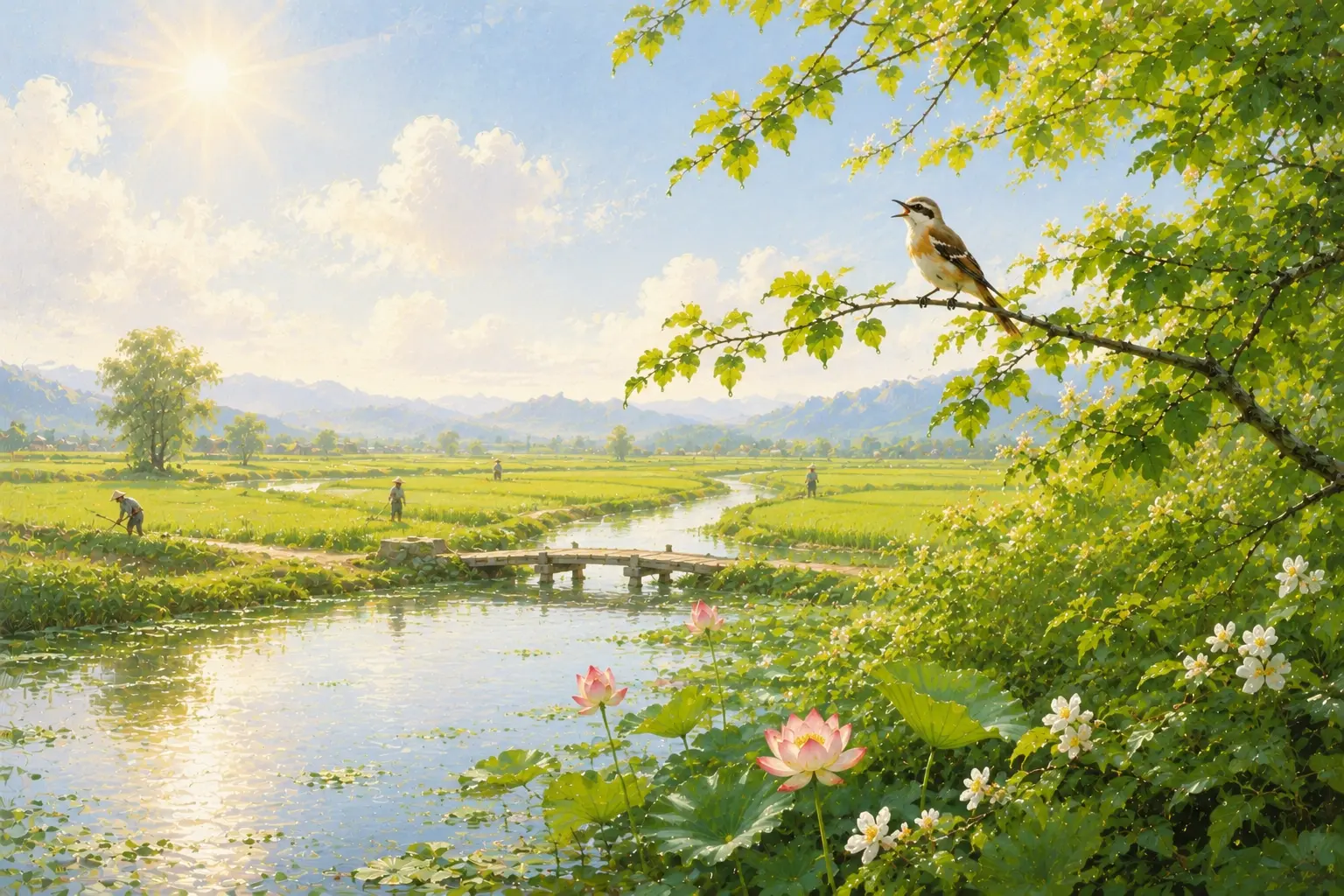
Grain in Beard Customs
「芒种碟仔讨无食」
The customs of Grain in Ear revolve around two central ideas: bidding farewell and cultivating the fields—seeing the Flower Deity back to her place in gratitude for the grace of spring, while bending to the soil to sow the hopes of autumn. Their core can be summarized through five actions: 送、安、煮、打、开 — to send off, settle, cook, play, and open the ploughing season. Sending off refers to bidding farewell to the Flower Deity: as blossoms fade at Grain in Ear, people prepare offerings to see the deity back to her celestial place and hope to meet her again the following year. Settling refers to Anmiao, when farmers in southern Anhui shape freshly milled wheat flour into the forms of grains, domestic animals, fruits, and vegetables, steam them, and present them in sacrifice to pray for abundance. Cooking means preparing green plums, which ripen in southern China at this time and are simmered with sugar or alcohol into refreshing summer foods and drinks. Playing refers to the Mud-Fighting Festival of the Dong people in Guizhou, where young men and women throw mud at one another while transplanting rice seedlings, and the person covered in the most mud is considered the most popular. Opening, finally, refers to the Plough-Opening Festival held in the Meiyuan mountain region of Yunhe, Zhejiang, where people reward working cattle, worship agricultural deities, and formally begin summer cultivation.
Among these five groups of customs, bidding farewell to the Flower Deity and cooking plums center on literary elegance and seasonal sentiment; Anmiao and the Plough-Opening Festival focus on agricultural sacrifice and prayers for a prosperous year; while mud fighting turns minority agricultural labor into entertainment and strengthens community bonds. Together they form a complete cultural landscape extending from scholar to farmer, from the central plains to frontier communities, and from refined seasonal feeling to physical labor. Three cultural ideas run through them. The first is reverence for nature: farewell rites for the Flower Deity express gratitude toward a deity of the natural world, while Anmiao and the Plough-Opening Festival answer the gifts of the land through sacrifice. The second is following the proper time of nature: the rapid transition between harvesting and sowing is one of the most direct responses to climatic rhythm. The third is finding joy amid hardship: the Dong mud-fighting custom transforms the heavy labor of rice transplanting into an exuberant collective game. Grain in Ear can therefore be regarded as one of the solar terms richest in both busyness and poetry. On one side lies the joy of harvest expressed in the line “家家麦饭美,处处菱歌长”; on the other, the toil of cultivation evoked by “时雨及芒种,四野皆插秧”. Between “reaping” and “sowing,” people offer one of their deepest tributes to the land.
Regional Customs of This Solar Term
| Region | Signature Customs | Notable Features |
|---|---|---|
| Jiangnan, including Suzhou and Hangzhou | Farewell to the Flower Deity | As flowers fade at Grain in Ear, offerings are prepared to see the Flower Deity back to her place; petals and willow branches are fashioned into sedan chairs and horses, while colored threads are tied to flowering branches |
| Southern Anhui, especially Jixi and Shexian | Anmiao, “settling the seedlings” | Dating from the early Ming period, newly milled wheat flour is shaped into grains, domestic animals, fruits, and vegetables, then steamed and offered in sacrifice for a plentiful harvest |
| Southern China, including Jiangsu, Zhejiang, Guangdong, Guangxi, and Fujian | Cooking plums | Green plums ripen around Grain in Ear and are prepared with sugar or alcohol as plum wine, plum drink, and candied plums |
| Liping County, Guizhou, among the Dong people | Mud fighting | Young Dong men and women throw mud at one another during rice transplanting, and the person with the most mud on their body is considered especially popular |
| Meiyuan mountain region, Yunhe County, Zhejiang | Plough-Opening Festival, also called the Cattle King Festival | A national intangible cultural heritage tradition marking the beginning of summer cultivation, including rewarding cattle, worshipping sacred fields, opening the plough, and antiphonal mountain singing |
Grain in Beard Customs
Bidding Farewell to the Flower Deity
Popular Regions:
Activities:
Bidding farewell to the Flower Deity is one of the most elegant and refined traditional customs associated with Grain in Ear. The ancients believed that a particular deity governed all the flowers of the human world and commonly called her the Flower Deity. During spring, she descended to arrange the blossoming of the myriad flowers; once Grain in Ear had passed and the hot season began, the weather was no longer suitable for flowers to remain in bloom, so the deity returned to the celestial realm. People therefore held sacrificial ceremonies on the day of Grain in Ear, offering a formal farewell in gratitude for her favor and expressing the hope that she would return the following year.
The custom is vividly described in Chapter 27 of *Dream of the Red Chamber*: “凡交芒种节的这日,都要设摆各色礼物,祭饯花神,言芒种一过,便是夏日了,众花皆卸,花神退位,须要饯行”. The novel describes the girls of the Grand View Garden rising early and dressing carefully, fashioning sedan chairs and horses from flower petals and willow branches, or folding silk, brocade, gauze, and other fabrics into banners and standards, then fastening colored cords to branches and blossoms. The whole garden becomes a scene of fluttering embroidered ribbons and brilliant flowering branches.
Historical Origins:
The custom is often said to have originated during the Southern Dynasties. Some accounts cite Cui Ling’en’s *Sanli Yizong* as recording a gathering held at Grain in Ear to sacrifice to and bid farewell to the Flower Deity. Later textual examination, however, has not found this passage in the surviving fragments of the work, and the clearest verifiable records appear mainly from the Ming and Qing periods.
The custom corresponds to the Flower Morning Festival on the second day of the second lunar month, when the Flower Deity is welcomed. Together, the two form a complete seasonal ritual of one welcome and one farewell. Although the traditional rite itself has largely disappeared, some regions continue to organize cultural activities inspired by it.
How to Take Part:
During Grain in Ear, reconstructed Flower Deity ceremonies can sometimes be seen in Suzhou, Hangzhou, and other Jiangnan cities. Some folk-culture villages and scenic areas organize seasonal performances in which visitors can watch scenes inspired by *Dream of the Red Chamber*, such as tying colored threads to flowering branches.
Recommended Places:

Anmiao — Settling the Seedlings
Popular Regions:
Activities:
Anmiao, literally “settling the seedlings,” is an important agricultural custom of southern Anhui and is said to date from the early Ming period. Each year around Grain in Ear, after rice seedlings have been transplanted, villages hold ceremonies to pray for a good autumn harvest.
Every household uses newly harvested wheat flour to make steamed buns and sculptural offerings in the shapes of the Five Grains, Six Domestic Animals, fruits, and vegetables. The figures are then colored with vegetable juices and presented as sacrificial offerings. During the ceremony, villagers carry Anmiao banners and parade through the fields to the sound of gongs and drums, praying for favorable weather and plentiful grain. By blending artistry and belief into agricultural life, the rite expresses the farmers’ most direct and unadorned gratitude toward the land.
The Anmiao Festival is also described as having origins in the late Tang and early Song periods and as being especially prevalent around Jixi and Shexian. It is held during Grain in Ear after rice transplanting has been completed, on an auspicious Dragon-and-Tiger Day. The commemorative focus is Lord Wang, identified with Wang Hua, a peasant leader of the late Sui period. Activities include the rite of “Lord Wang inspecting the rice,” dragon and lion dances, and the making of Anmiao flour offerings, all intended to pray for the safety and healthy growth of the seedlings.
Historical Origins:
The Anmiao custom is described as having been spontaneously organized by local people from the Tang period onward and as reaching its height during the Daoguang reign of the Qing dynasty. On the day of Grain in Ear, clan elders in the village selected a respected senior figure to determine an auspicious time. Each household ground newly harvested wheat into flour, kneaded it into different shapes, placed the figures in bamboo baskets as offerings, and gathered before the village shrine for the ceremony. Afterwards, households exchanged the flour cakes and ate them together.
The practice reflects a cultural tradition of collective prayer and communal sharing within agricultural society.
How to Take Part:
During Grain in Ear, visitors can travel to Jixi, Shexian, and other parts of southern Anhui to observe Anmiao ceremonies. Local residents display a wide variety of sculpted offerings made from new wheat flour and hold processions through the villages and fields. Visitors may watch from designated areas, and some folk-culture villages also offer hands-on flour-sculpting experiences.
Recommended Places:
Cooking Green Plums
Popular Regions:
Activities:
Cooking green plums is one of the most representative food customs of Grain in Ear in southern China. Around this time, plums ripen in succession, but fresh green plums are generally too sour and astringent to eat directly and must first be processed. This preparation is traditionally called “cooking plums.”
There are many methods. The simplest is to simmer the fruit with sugar, or to mix sugar evenly with dried green plums and allow the juices to seep out. Other methods use salt for pickling, while more elaborate preparations may also include perilla. Northern smoked plums, when simmered with licorice, hawthorn, and rock sugar, become the classic summer drink known as sour-plum soup. Modern products such as green-plum wine, preserved plums, milk-flavored plums, and licorice plums all continue this tradition of processing the fruit.
Green plums contain a variety of naturally occurring organic acids and abundant minerals and are traditionally associated with benefits such as cleansing the blood, regulating the intestines, lowering blood lipids, relieving fatigue, supporting the complexion, balancing acidity and alkalinity, and strengthening immunity.
Historical Origins:
The custom of cooking plums at Grain in Ear is said to date back to the Xia dynasty and to possess a history of several thousand years. The Three Kingdoms period gave rise to the famous story of “discussing heroes while warming wine with green plums.” In *Romance of the Three Kingdoms*, Cao Cao and Liu Bei “随至小亭,已设樽俎;盘置青梅,一樽煮酒;二人对坐,开怀畅饮”—they arrive at a small pavilion where food and wine are prepared, green plums lie on a plate beside warmed wine, and the two sit facing one another and drink freely.
For more than four thousand years, plums have remained an important summer fruit as well as one endowed with refined literary associations. Southern Chinese communities still preserve the custom of preparing green plums around Grain in Ear. During the humid and oppressive plum-rain season, a refreshing green-plum drink that stimulates the appetite is regarded as a particularly welcome way to awaken the senses on a languid summer day.
How to Take Part:
During Grain in Ear, fresh green plums can be purchased in markets throughout southern China and used to make green-plum wine, sour-plum soup, or candied plums. This is one of the easiest Grain-in-Ear customs to practice at home. Processed plum products such as preserved plums, milk-flavored plums, and licorice plums are also widely available.
Recommended Places:
Mud Fighting
Popular Regions:
Activities:
The Mud-Fighting Festival is a traditional celebration of the Dong people of Liping County in the Qiandongnan Autonomous Prefecture of Guizhou and is held each year around Grain in Ear. During the festival, newly married couples join groups of close young male and female friends in collective rice transplanting, with the young people divided into teams for friendly competition.
As the transplanting proceeds, participants begin throwing mud at one another. Men and women compete while working, creating an energetic atmosphere. After the seedlings have been planted, the mud throwing becomes more playful: young men often begin by teasing or provoking the women, who retaliate, and sometimes participants push one another down into the flooded paddy and roll about in the mud. At the end, everyone inspects the “battle results,” and the person covered with the most mud is considered the most popular. Afterwards, the group goes to the river to wash and continues the fun with a water fight.
The bride traditionally brings five-colored glutinous rice and red eggs, while on the return journey the sisters of the husband’s family give her even more five-colored rice and red duck eggs. The custom transforms the exhausting labor of transplanting rice into a lively collective game and fills agricultural work with humor and vitality.
Historical Origins:
The festival is closely connected with the Dong marriage custom known as “zuojia,” in which a bride does not immediately take up permanent residence in her husband’s household, as well as with the collective rice-transplanting work of Grain in Ear. Traditionally, a newly married Dong woman continued to live for a time with her natal family after marriage and returned to her husband’s family for several days during busy agricultural periods or festivals.
Grain in Ear is one of the busiest periods for rice transplanting, so brides returned to participate in farm work, while young men and women strengthened their relationships through working and playing together. Being covered in the most mud became a playful sign of popularity and affection. The China Meteorological Administration has listed mud fighting among the principal customs associated with Grain in Ear.
How to Take Part:
During Grain in Ear, visitors can travel to Dong villages around Liping County in Guizhou to observe the Mud-Fighting Festival. Rice transplanting and mud play can be watched from safe areas, and some villages may allow visitors to join selected activities. Exact dates should be checked in advance through local cultural and tourism authorities.
Recommended Places:
Plough-Opening Festival
Popular Regions:
Activities:
The Meiyuan Grain-in-Ear Plough-Opening Festival is a folk celebration held by farmers in the Meiyuan mountain region of Yunhe County, Zhejiang, to mark the beginning of summer cultivation. Locally it is also known as the Cattle King Festival. The tradition is concentrated mainly around eighteen villages centered on Meizhu and Xiayang in Chongtou Township, southwest Yunhe.
The festival follows a complete and established sequence of activities, including sounding the lawei instrument, calling out mountain-opening work chants, rewarding cattle at Grain in Ear, sacrificing at the sacred field and distributing red pork, firing ceremonial salutes, opening the plough, and singing mountain songs in antiphonal exchange. The program encompasses Han folk traditions of worship, blessing, thanksgiving, and celebration, with additional elements including welcoming deities, blessing processions, ceremonial ploughing, thanksgiving opera, and Xianniang rice. Recreational activities such as catching fish and ducks, agricultural temple fairs, football played in muddy fields, and rice-transplanting adoption activities are also held.
Farmers sound the mountain-opening call, reward their working cattle, and conduct a solemn rite to the field deity. Through singing and dancing, they express gratitude to the ancestors who first cultivated the land and pray for abundant grain, thriving livestock, and harmony within the family. A pig is also slaughtered for the festival and offered whole to Shennong, after which the pork is divided among the households, symbolizing plentiful grain and flourishing livestock.
Historical Origins:
The Meiyuan Grain-in-Ear Plough-Opening Festival has a history of more than eight hundred years. The high mountain region around Yunhe and Meiyuan has relatively low temperatures, so the plough-opening ceremony is held annually around Grain in Ear, signaling that the busy agricultural season has begun and providing an occasion for prayer.
In the early Tang period, She people migrated into the Yunhe region, creating a mixed She and Han settlement pattern and contributing to the distinctive local combination of She culture and agricultural traditions. Residents of the terraced mountain region have preserved relatively traditional modes of production and daily life, allowing many ancient customs and sacrificial activities to survive. In 2021, the Twenty-Four Solar Terms tradition — Meiyuan Grain-in-Ear Plough-Opening Festival was approved by the State Council for inclusion in the fifth batch of China’s national intangible cultural heritage list.
How to Take Part:
During Grain in Ear, visitors can travel to the Meiyuan mountain area of Yunhe County to observe the Plough-Opening Festival. Activities include worship at the sacred field, rewarding cattle, opening the plough, and antiphonal mountain singing, as well as catching fish and ducks and playing football in muddy fields. Visitors can watch from designated areas, and some activities may be open to participation. Specific dates should be checked in advance through Yunhe County’s cultural and tourism authorities.
Recommended Places:
Eating Juntacai
Popular Regions:
Activities:
Some regions preserve a Grain-in-Ear custom of eating Juntacai, a seasonal vegetable found in southern China. Around Grain in Ear, it is at its freshest and most tender. People traditionally believe that eating it at this time can clear heat, remove toxins, relieve summer heat, and reduce internal fire. The custom corresponds to the seasonal need to adjust the body as temperatures rise and internal heat is believed to become more common.
Historical Origins:
As a seasonal vegetable of Grain in Ear, Juntacai belongs to the same tradition as the dietary principle “不时不食”—do not eat what is out of season. As the weather becomes hotter, people use fresh seasonal vegetables traditionally associated with clearing heat to regulate the body, reflecting the health-preserving idea that medicine and food share the same origin.
How to Take Part:
During Grain in Ear, Juntacai can be purchased in some southern markets and prepared by stir-frying or in soup.
Recommended Places:
Drying Small Shrimp
Popular Regions:
Activities:
Around Grain in Ear, fishing communities in coastal areas traditionally dry small shrimp. At this time, *Acetes* shrimp are in their spawning season, their bodies plump and nutritionally rich. Fishermen dry the newly caught shrimp to make dried shrimp skin, an important marine product for storage and sale. The practice is both a practical part of fishing production and a distinctive seasonal activity of coastal communities at Grain in Ear.
Historical Origins:
Drying small shrimp is a production technique passed down through generations in coastal fishing villages. Around Grain in Ear, water temperatures are suitable and *Acetes* shrimp are especially plump, making this an ideal period for processing them. The custom reflects the careful use of marine resources by coastal communities and their sensitive awareness of seasonal timing.
How to Take Part:
During Grain in Ear, visitors to some coastal fishing villages may observe scenes of shrimp being spread out to dry. Certain villages are open to visitors.
Recommended Places:
Closing Note
The customs of Grain in Ear grew from a culture of racing against time, shaped by the double pressure of summer harvesting and summer sowing within agricultural civilization. The “busyness” of Grain in Ear lies not only in the fact that wheat with awns is ready to be harvested, but also that rice with awns is ready to be planted. It is a solar term in which “reaping” and “sowing” are tightly interlocked. At this special point in the seasonal calendar, people compete with time through labor, yet amid that intensity they also developed warm and expressive customs such as bidding farewell to the Flower Deity and settling the seedlings, creating moments of emotional release within the rush of agricultural work.
Across the centuries, Grain in Ear has accumulated a rich body of folk traditions, including Anmiao, cooking plums, and bidding farewell to the Flower Deity. In southern Anhui, the Anmiao rite is traced to the early Ming period: people shape freshly milled wheat flour into grains, domestic animals, fruits, and vegetables, steam them, and offer them to the field deity in hopes of another abundant harvest in autumn. The custom of cooking plums is associated with stories from the Three Kingdoms period and remains alive in places such as Nanjing. The famous episode of Daiyu burying fallen flowers in *Dream of the Red Chamber* is itself set against the old Grain-in-Ear custom of sending the Flower Deity back to her place—when blossoms fall, people arrange offerings and formally see the deity off.
When freshly milled wheat flour is shaped into offerings for the field deity, and green plums simmer together with yellow rice wine in an earthenware jar, the customs of Grain in Ear become more than a story of busyness. They reveal a Chinese way of life in which, even at the most demanding moment of the agricultural year, people never cease to converse with Heaven and Earth.
—-
Readers’ Comments
Calendar and traditional culture enthusiasts from around the world, sharing the same moon.
Sign in or register to join the conversation. Your comment account is created automatically the first time you use a connected account.
No comments yet
Share your thoughts with readers around the world.