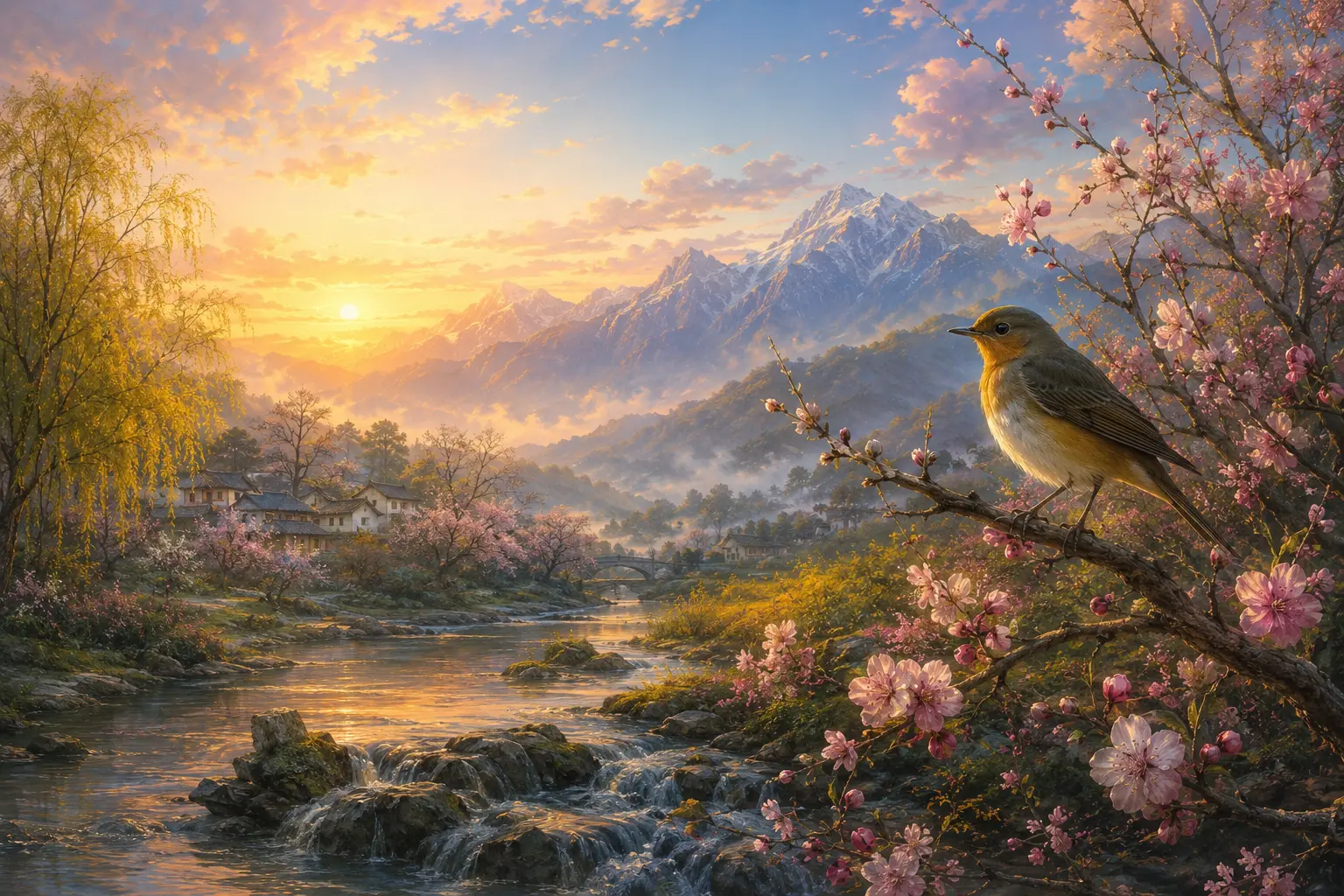
Beginning of Spring Poetry
「春日春盘细生菜,忽忆两京梅发时。」
Poetry of the Beginning of Spring often combines the joy of welcoming spring with reflections on time and circumstance. Du Fu’s “春日春盘细生菜” uses the spring platter to evoke memories of the former splendor of the two capitals; Su Shi’s “春牛春杖,无限春风来海上” records the custom of welcoming spring by striking the spring ox. The Beginning of Spring stands at the transition between old and new. Some poets write hope into the spring breeze; others, at the opening of the year, lament a life of wandering. “明年何处看升平” gives full voice to the thoughts of a traveler far from home at the coming of spring. Spring banners, colorful ornaments, earthen oxen, and plowmen together form the most vivid picture of seasonal custom on the day of the Beginning of Spring.
Beginning of Spring Poetry
立春偶成
Original Verse:
律回岁晚冰霜少,春到人间草木知。
便觉眼前生意满,东风吹水绿参差。
Modern Translation:
Near the year’s end, the cycle turns and yang begins to return; ice and frost gradually diminish. Spring arrives in the human world, and the grasses and trees are the first to know. Suddenly, everywhere before the eyes seems filled with life. The east wind blows across the water, where green ripples rise and overlap in uneven layers.
Commentary:
With the particular sensitivity of a Neo-Confucian thinker, Zhang Shi captures the subtle instant in which winter gives way to spring. “律回岁晚” points to the distinctive timing of the Beginning of Spring, which often falls in the twelfth lunar month, while the three characters “冰霜少” vividly convey the gradual retreat of winter cold. “春到人间草木知” has become a celebrated line through the ages. Rather than writing that people recognize the coming of spring, the poet lets the plants and trees know it first, transferring human feeling into the natural world as though vegetation itself were the first to sense the breath of spring. In doing so, he gives spiritual vitality to the Beginning of Spring as the opening of a new year. The final couplet turns to the scene before his eyes. The three characters “生意满” form the poetic eye of the entire poem: they describe not only green spring water and rippling waves, but also an inward, vigorous force of life, revealing the poet’s Neo-Confucian understanding of the living vitality inherent in all things.
立春日
Original Verse:
江花江水每年同,春日春盘放手空。
天地无私生万物,山林有处著衰翁。
牛行已辨泥香动,鸟语方知日暖融。
老去情怀非宿昔,尚因书卷答春风。
Modern Translation:
The flowers by the river and the river waters seem the same year after year. On the day of the Beginning of Spring, the spring platter is before me, yet I have no desire to taste it and simply leave it untouched. Heaven and Earth show no partiality, giving life to all things; in the mountains and forests, there is still a place where this aging old man may dwell. From the footsteps of the plow ox, one can already sense the fragrance of the soil stirring; from the voices of the birds, one knows that the sunlight has begun to soften and grow warm. In old age, my feelings are no longer what they once were, yet I still answer the spring breeze through books and the written word.
Commentary:
Beyond the joy of the Beginning of Spring, Lu You brings into this poem the deep reflections of his later years. “江花江水每年同” expresses the permanence of nature’s recurring cycle, while “春日春盘放手空”, through the single word “空”, reveals the poet’s detachment from the seasonal delicacy set before him. The couplet “天地无私生万物” draws upon Daoist thought to praise the impartial generosity of nature; “山林有处著衰翁” then turns inward, suggesting that although the poet has grown old, the mountains and forests still offer him a place to dwell—a form of contented openness.
“牛行已辨泥香动” approaches the coming of spring plowing through the sense of smell, while “鸟语方知日暖融” uses sound to reveal the growing warmth of the season. Together, the two lines capture the phenology of the Beginning of Spring from both field and sky. In the final couplet, “老去情怀非宿昔,尚因书卷答春风”, the poet admits that the feelings of old age are no longer those of former days, yet his habit of answering the spring breeze through poetry and books remains unchanged. The image of Lu You, who never ceased writing throughout his life, is especially moving here.
立春
Original Verse:
春日春盘细生菜,忽忆两京梅发时。
盘出高门行白玉,菜传纤手送青丝。
巫峡寒江那对眼,杜陵远客不胜悲。
此身未知归定处,呼儿觅纸一题诗。
Modern Translation:
On the day of the Beginning of Spring, the spring platter is filled with delicate fresh greens, and suddenly I remember the days when plum blossoms opened in Chang’an and Luoyang. In those years, noble households brought forth spring platters gleaming like white jade, while slender hands passed around fine strands of green vegetables. Now I am in the Wu Gorge, facing the cold river. A distant traveler from Duling, I can scarcely bear my sorrow. My wandering life still has no settled place of return; all I can do is call my son to bring paper and write down this poem.
Commentary:
Du Fu takes the Beginning of Spring as his point of departure and turns it into an expression of the sorrow of wandering. In the first four lines, “忽忆” becomes the hinge that sets the “春盘细生菜” before his eyes against memories of the flourishing spring scenes of the two capitals. “盘出高门行白玉,菜传纤手送青丝” recalls, in delicate detail, the luxurious custom of noble households exchanging spring platters during the prosperous Kaiyuan era. The colors are bright—white jade and green silk—and the memory is filled with warmth and splendor.
In the latter four lines, the poem turns abruptly. “巫峡寒江那对眼” places the cold river of the Wu Gorge against the earlier white jade platters: cold and warmth, present and past, stand in sharp contrast. “杜陵远客不胜悲” speaks the sorrow directly. The final line, “呼儿觅纸一题诗”, closes with a simple action. Yet beneath its ordinariness lies profound grief: in a life of displacement with nowhere to settle, poetry and writing remain the only place to which the poet can entrust himself.
减字木兰花·立春
Original Verse:
春牛春杖,无限春风来海上。
便丐春工,染得桃红似肉红。
春幡春胜,一阵春风吹酒醒。
不似天涯,卷起杨花似雪花。
Modern Translation:
The spring ox and the spring whip—the boundless spring wind comes in from the sea. I would ask the spirit of spring to dye the peach blossoms a vivid flesh-like red. Spring banners and colorful spring ornaments flutter in the wind; a gust of spring air blows away the lingering effects of wine. This does not feel like the farthest edge of the world: look, the wind lifts the poplar catkins until they fly like snowflakes.
Commentary:
Su Shi wrote this lyric while exiled in Hainan, yet there is no despondency of banishment in it. Instead, the poem is filled with delight in the coming of spring. Six compounds beginning with “春” appear in rapid succession—spring ox, spring whip, spring wind, spring artisan, spring banner, spring ornament—creating an intensely seasonal atmosphere.
“无限春风来海上” captures the distinctive breadth and force of the sea wind at the Beginning of Spring in Hainan. “染得桃红似肉红” turns the ordinary into the elegant: the phrase “肉红” is simple, earthy, and vividly alive. “一阵春风吹酒醒” describes the strength of the spring wind while also faintly suggesting the background of the poet, exiled at the far edge of the realm and drinking to relieve his sorrow.
The final line, “不似天涯,卷起杨花似雪花”, is the finishing touch of the lyric. Hainan has no snow, yet the whirling poplar catkins resemble snowflakes. Rather than finding the sight desolate, Su Shi discovers in it something familiar from the spring landscapes of the north. The line reveals the breadth of spirit associated with his famous outlook: “此心安处是吾乡”—where the heart finds peace, there is home.
立春
Original Verse:
青帝东来日驭迟,暖烟轻逐晓风吹。
罽袍公子樽前觉,锦帐佳人梦里知。
雪圃乍开红菜甲,彩幡新翦绿杨丝。
殷勤为作宜春曲,题向花笺帖绣楣。
Modern Translation:
The Green Emperor, spirit of spring, comes from the east, while the chariot of the sun moves slowly across the sky; warm mist drifts lightly with the morning breeze. A young nobleman in a splendid fur robe senses spring before his wine cup, while a beautiful woman behind embroidered curtains perceives it even within her dreams. In the snowy garden, red vegetable shoots have just broken through the earth; freshly cut colorful banners flutter beside the tender green strands of willow. With care, I compose this “Song of Welcoming Spring,” write it upon flower-patterned paper, and paste it upon the embroidered lintel.
Commentary:
Wei Zhuang uses sumptuous language to portray the courtly and aristocratic life of the Beginning of Spring. “青帝东来日驭迟” opens with mythology: the spring god comes from the east, and even the sun’s chariot seems to slow its course, creating a solemn yet leisurely seasonal atmosphere. “暖烟轻逐晓风吹” uses the image of warm mist to render the softness of an early-spring morning with remarkable visual delicacy.
The couplet “罽袍公子樽前觉,锦帐佳人梦里知” presents two ways of perceiving spring: the young nobleman senses it while drinking, while the woman in the embroidered bedchamber knows it in a dream. One is real, the other dreamlike; one awake, the other asleep. The balance is exact and the parallelism refined.
“雪圃乍开红菜甲” echoes the custom of eating a spring platter at the Beginning of Spring, while “彩幡新翦绿杨丝” records the seasonal customs of cutting colorful spring banners and wearing spring ornaments. The final line, “题向花笺帖绣楣”, closes the poem with the poet’s own act of writing, fixing the poetry of the Beginning of Spring between flower-patterned paper and an embroidered doorway.
汉宫春·立春日
Original Verse:
春已归来,看美人头上,袅袅春幡。
无端风雨,未肯收尽余寒。
年时燕子,料今宵、梦到西园。
浑未办、黄柑荐酒,更传青韭堆盘?
却笑东风从此,便薰梅染柳,更没些闲。
闲时又来镜里,转变朱颜。
清愁不断,问何人、会解连环?
生怕见、花开花落,朝来塞雁先还。
Modern Translation:
Spring has already returned. Look at the graceful spring banners swaying from the women’s hair. Yet unbidden wind and rain are still unwilling to gather away the lingering cold of winter. The swallows from last year, I imagine, must tonight be dreaming of the Western Garden. I have not even prepared the wine to be offered with yellow tangerines, let alone a spring platter piled high with green chives.
And yet I smile at the east wind: from now on it will be busy warming the plum blossoms and dyeing the willows green, without a moment to spare. But when it does find time, it comes again into the mirror, revealing how my youthful complexion has changed. This quiet sorrow continues without end. Who can untangle such an interlocking chain of grief? What I fear most is watching flowers bloom and fall—and seeing, at dawn, the wild geese from the northern frontier return home before I do.
Commentary:
Xin Qiji takes the Beginning of Spring as the point of departure for a lyric filled with reflections on his country and personal fate. In the first stanza, the detail “美人头上,袅袅春幡” announces spring’s return to the human world, while “无端风雨,未肯收尽余寒” also serves as an implied metaphor for the political “lingering cold” of the Southern Song court, confined to one corner of the realm with little prospect of recovering the lost territories.
“年时燕子” uses the returning swallow to express longing for the old homeland, while “黄柑荐酒” and “青韭堆盘” refer to Beginning of Spring customs of offering new wine and eating the spring platter.
In the second stanza, “却笑东风从此,便薰梅染柳,更没些闲” personifies the spring wind as endlessly busy, indirectly setting off the poet’s own idle sorrow. “闲时又来镜里,转变朱颜” moves suddenly from the spring wind transforming all living things to the poet’s own aging face in the mirror. The shift in time and space is exceptionally sharp.
The final line, “生怕见、花开花落,朝来塞雁先还”, carries the deepest grief. The “returning frontier geese” have already made their way back from the north, while the poet’s dream of recovering the Central Plains remains far from realization. The geese have “returned first”; the man himself has not returned. The contrast gives the ending its profound sorrow.
Closing Note
Poetry of the Beginning of Spring begins with the sound of “一二三四五六七.” In his *京中正月七日立春*, the Tang poet Luo Yin opens with seven numbers in succession, counting the days on his fingers—the impatience and delight of someone who has remained indoors through an entire winter and has finally waited long enough for spring to arrive.
The Beginning of Spring in Tang poetry is full-bodied and ardent. “春日春盘细生菜,忽忆两京全盛时”—Du Fu writes of the spring platter, but what he remembers is an age of prosperity. Bai Juyi walks hand in hand with friends beside Qujiang, looking toward the hills as they return. The Tang Beginning of Spring is the feast of “盘出高门行白玉”, and the open-hearted breadth of “一鞭分与万家春.”
In Song poetry, the Beginning of Spring turns inward, toward contemplation. “律回岁晚冰霜少,春到人间草木知”—with the single character “知”, Zhang Shi writes of grasses and trees sensing spring even before human beings do. Xin Qiji offers one of the most distinctive voices in Song lyric poetry: “春已归来,看美人头上,袅袅春幡.” He writes of the customs of the Beginning of Spring, yet what occupies his thoughts is the lost land of his country. The Ming poet Yu Qian writes with vigorous strokes, “击罢泥牛物候新,一鞭分与万家春,” while the Yuan poet Yang Weizhen sings aloud, “今朝立春好天气,况是太平朝野时.”
From the Tang poets’ “春日春盘”, to the Song poets’ “春牛春杖”, and then to the Ming poets’ “一鞭分与万家春”—poetry of the Beginning of Spring is a collection of different answers written by poets on the same day, each carrying its own hopes, sorrows, and joys. Generations of poets have come and gone, yet the spring wind in their poems still returns faithfully every year.
When poems of the Beginning of Spring are gently opened on a desk at winter’s end, those sleeping words awaken once again, reminding everyone who reads them:
Spring has returned.
The grasses and trees know it first.
And it is time for us to awaken as well.
—–
Readers’ Comments
Calendar and traditional culture enthusiasts from around the world, sharing the same moon.
Sign in or register to join the conversation. Your comment account is created automatically the first time you use a connected account.
No comments yet
Share your thoughts with readers around the world.