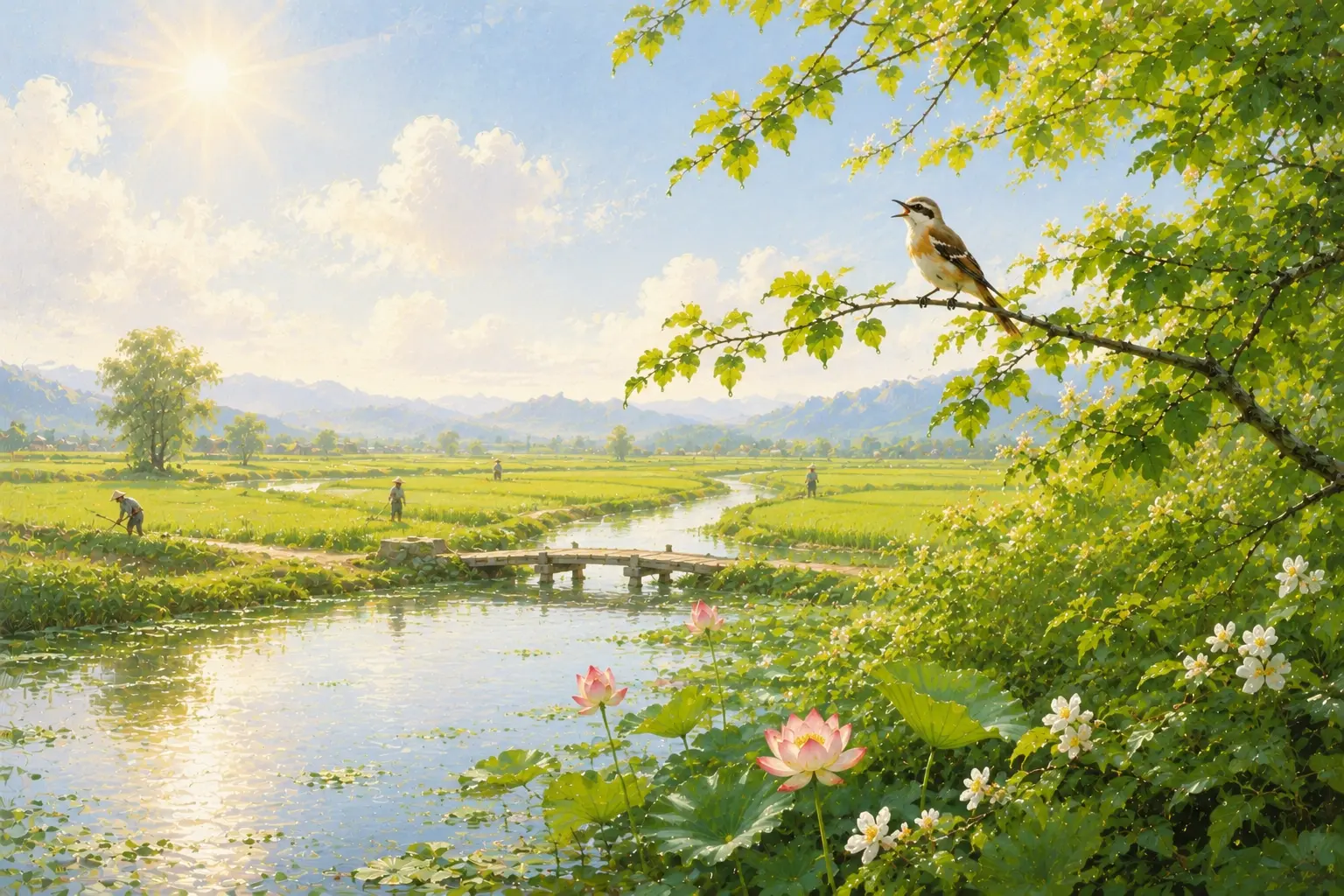
Grain in Beard Poetry
「时雨及芒种,四野皆插秧。」
Poetry of Grain in Ear often portrays the intense agricultural work of the “Three Summer Labors”—harvesting, planting, and field management. Lu You’s “时雨及芒种,四野皆插秧” records the toil of rice farmers racing against the season to transplant seedlings; Yuan Zhen’s “芒种看今日,螳螂应节生” writes of changes in seasonal phenomena. Poets describe green plums simmered with wine, the fragrance of fresh wheat meals, and mantises emerging in accordance with the season, blending the urgency of farm work with cultivated pleasures. At Grain in Ear, harvesting and sowing proceed side by side, labor and joy intertwine, and under the poets’ brush it becomes one of the busiest yet most abundant moments of the year.
Grain in Beard Poetry
时雨
Original Verse:
时雨及芒种,四野皆插秧。
家家麦饭美,处处菱歌长。
老我成惰农,永日付竹床。
衰发短不栉,爱此一雨凉。
Modern Translation:
Timely rain arrives with Grain in Ear, and across the fields farmers are everywhere transplanting rice seedlings. Every household enjoys fragrant meals made from new wheat, while long songs of water-chestnut gatherers drift from place to place. As for me, old and weakened, I have become a lazy farmer, spending the entire day on a bamboo couch. My thinning hair is too short to need combing; I care only for the coolness brought by this rain.
Commentary:
In the first four lines, Lu You uses broad strokes to sketch a vivid agricultural scene at Grain in Ear. “时雨及芒种” points to the seasonal conjunction of busy sowing and the plum rains, while “四野皆插秧” depicts the intense labor of rice cultivation in southern paddies. “家家麦饭美” writes the joy of the wheat harvest, while “处处菱歌长” evokes the character of the southern water country. One is field and food, the other water and song; together they vividly present both harvest and labor at Grain in Ear. In the final four lines, the poem turns from agriculture to the self. “老我成惰农” uses self-mockery to express the helplessness of old age, while “爱此一雨凉” returns to the poet’s fondness for the coolness brought by seasonal rain. The poem creates a subtle tension between agricultural busyness and personal leisure, making it representative of Lu You’s later pastoral poetry.
芒种后经旬无日不雨偶得长句
Original Verse:
芒种初过雨及时,纱厨睡起角巾欹。
痴云不散常遮塔,野水无声自入池。
绿树晚凉鸠语闹,画梁昼寂燕归迟。
闲来只共僧争席,抵掌饶他一笑时。
Modern Translation:
Grain in Ear has only just passed, and timely rain has already arrived. I wake from sleep inside the gauze-curtained bed, my headcloth sitting askew. Stubborn clouds linger without dispersing, often hiding the distant pagoda; water from the fields flows soundlessly into the pond. In the evening cool beneath green trees, doves call noisily; during the quiet daytime, the painted rafters remain still, and the swallows return late. In my leisure I do nothing but vie with monks for a seat, clapping hands in conversation and laughter, letting them laugh at my foolishness.
Commentary:
Han Biao sets this poem against the continuous plum rains that follow Grain in Ear, portraying the leisurely life of a literatus in damp and oppressive weather. “芒种初过雨及时” echoes the characteristic timely rains of the season, while “纱厨睡起角巾欹” captures the languid posture of someone just awakened from an afternoon nap, full of everyday intimacy. “痴云不散常遮塔” personifies the clouds, conveying the low, persistent heaviness of the plum-rain season; “野水无声自入池” uses movement to write stillness, the flowing water silent yet following its own course. The final two couplets move from seasonal signs—“鸠语闹” and “燕归迟”—to the poet’s interactions with monks. With delicate brushwork, the poem captures the moisture, quietness, and ease peculiar to the plum-rain season.
芒种
Original Verse:
一把青秧趁手青,轻烟漠漠雨冥冥。
东风染尽三千顷,白鹭飞来无处停。
Modern Translation:
Handful after handful of green rice seedlings rests fresh and vivid in the hand; light mist spreads across the fields beneath fine, dim rain. The east wind seems to have dyed all three thousand qing of paddies green, until even the white egrets that fly in can find nowhere untouched by seedlings to land.
Commentary:
This quatrain uses extremely concise brushwork to portray the magnificent scene of rice transplanting at Grain in Ear. The opening “一把青秧趁手青” captures the immediate action of planting: the fresh green of the seedlings and the tactile sensation of holding them merge, as though the green in the hands and the green of the fields had become one. The next line, “轻烟漠漠雨冥冥”, describes fine rain like mist and a world softened into haze, creating the humid, vaporous atmosphere of the season. The final two lines are the poem’s most brilliant strokes. “东风染尽三千顷” personifies the east wind through the character “染”, as though the wind were a painter brushing vast fields green in a single stroke; “三千顷” emphasizes their immense extent. The closing “白鹭飞来无处停” is especially inspired: an egret searches for a place to settle, only to find every paddy already filled with seedlings. Through this small detail, the poem indirectly conveys the density, speed, and completeness of the transplanting. Not one character explicitly says “busy,” yet busyness is everywhere—subtle and full of tension.
伊犁记事诗
Original Verse:
芒种才过雪不霁,伊犁河外草初肥。
生驹步步行难稳,恐有蛇从鼻观飞。
Modern Translation:
Grain in Ear has only just passed, yet the snow has still not cleared. Beyond the Ili River, the grasslands are only beginning to grow lush. A newborn foal walks unsteadily, stumbling at every step; one even fears that a snake might suddenly dart past its nostrils.
Commentary:
Hong Liangji writes of Grain in Ear in Ili on China’s northwestern frontier, a scene entirely different from that of the Central Plains or Jiangnan. “芒种才过雪不霁” surprises from the opening line: while Jiangnan at Grain in Ear is already deep in plum rains and beginning to feel the heat of summer, snow in Ili has still not fully melted. The regional contrast is striking. “伊犁河外草初肥” shows how late spring arrives on the frontier grasslands; “初肥” captures grasses just beginning to grow and gradually becoming lush. “生驹步步行难稳” describes the charming awkwardness of a newborn foal learning to walk, full of everyday life. The final “恐有蛇从鼻观飞” uses exaggeration to suggest the abundance and fierceness of snakes and insects on the frontier, making the scene at once dangerous and curious. Through this borderland perspective, the poem redefines Grain in Ear and broadens the geographical and cultural range of seasonal poetry.
田间杂咏(其一)
Original Verse:
芒种忙忙种,南风日日催。
新秧初出水,宿麦已登台。
蚕老叶稀尽,蚕眠人未回。
日长农事急,无计避尘埃。
Modern Translation:
At Grain in Ear, everyone is busy planting, while the south wind urges the farming season onward day after day. Newly transplanted rice seedlings have only just emerged above the water, while the overwintered wheat has already been harvested and brought in. The silkworms are growing old and the mulberry leaves are nearly exhausted; even while the silkworms sleep, those tending them have not yet returned. The days are long and farm work grows ever more urgent; there is simply no way to escape the dust and exhaustion that cover the body.
Commentary:
In plain language, this poem offers a panoramic view of agricultural busyness during Grain in Ear. “芒种忙忙种” opens by repeating the idea of “busy”, directly striking at the seasonal core of Grain in Ear—being busy with sowing. “南风日日催” personifies the progression of the season, as though the south wind were urging farmers not to delay. “新秧初出水” describes rice transplanting, while “宿麦已登台” describes wheat being harvested; one emerges, the other comes in, showing different life stages of crops within the same season. “蚕老叶稀尽” writes the nearing end of silkworm work, while “蚕眠人未回” shows that those tending the silkworms are still laboring. The final “无计避尘埃” expresses deep sympathy for the hardships of farming life. At Grain in Ear, when harvesting and sowing overlap, farmers have no escape but to lower their heads and keep working. The poem records their hardship and resilience with realistic brushwork.
芒种
Original Verse:
芒种节序近,新秧绿未齐。
田家勤动苦,耘耨望云霓。
麦秋蚕亦老,桑柘叶初低。
妇姑荷箪食,童稚携壶浆。
Modern Translation:
Grain in Ear is drawing near, and the newly transplanted seedlings have not yet grown into an even stretch of green. Farming families labor diligently and endure hard fieldwork, hoping for timely rain. The wheat has reached its harvest season, like autumn, and the silkworms too have grown old; leaves on the mulberry trees are beginning to droop. Women carry baskets of food on their shoulders, while children bring jars of water to the fields.
Commentary:
Lou Shu uses simple brushwork to portray a vivid scene of rural labor during Grain in Ear. “芒种节序近” establishes the season, while “新秧绿未齐” records the detail that newly transplanted rice seedlings have not yet grown into an even green field. “田家勤动苦” directly describes the hardship of farming households, and “耘耨望云霓” writes their earnest hope for rain as they weed and cultivate. “云霓” refers to the rainbow; the ancients believed its appearance could signal the end of rain, and here it is used to express the longing for timely rainfall. The third couplet, “麦秋蚕亦老”, describes wheat ripening as though autumn had arrived and silkworms reaching maturity, while “桑柘叶初低” writes the beginning of decline in the mulberry leaves. The final “妇姑荷箪食,童稚携壶浆” is the warmest scene in the poem: women carry food, and children bring jars of water to family members laboring in the fields. Through plain description, the poem records the whole texture of farming life at Grain in Ear—simple, direct, and moving.
Closing Note
Poetry of Grain in Ear begins with a single character: “忙” — busy. Lu You writes, “时雨及芒种,四野皆插秧。家家麦饭美,处处菱歌长”, making Grain in Ear sound lively and abundant. But he immediately turns the brush: “老我成惰农,永日付竹床.” The whole world is busy, while he alone steals a little leisure on his bamboo couch. Busyness and idleness can exist side by side in the poetry of Grain in Ear.
When the Tang poet Yuan Zhen writes Grain in Ear, his attention is on seasonal phenomena and natural rhythm: “芒种看今日,螳螂应节生。彤云高下影,鴳鸟往来声.” Mantises hatch, shrikes call through summer, lotus blossoms face the sunlight, and silkworms and wheat await harvest. Yet the most moving lines are the final two: “相逢问蚕麦,幸得称人情”—when people meet in the fields, they ask nothing else, only: how much silk has been gathered, how much wheat has been cut? It is a kind of concern born directly from the land. Bai Juyi writes “田家少闲月,五月人倍忙”, seeing the hardship of farmers with their “足蒸暑土气,背灼炎天光”, and from it arises his self-reflection: “念此私自愧.”
The Song poet Fan Chengda places Grain in Ear within the plum rains: “乙酉甲申雷雨惊,乘除却贺芒种晴”—after thunder and rain, the sky clears, and it is time to transplant the new seedlings. From Lu You’s “四野皆插秧” to Yuan Zhen’s “相逢问蚕麦”, from Bai Juyi’s “五月人倍忙” to Fan Chengda’s “乘除却贺芒种晴”—in the poetry of Grain in Ear, half is the salt of sweat and half the coolness of rain. It is both the agricultural rhythm of “what one sows, one reaps” and the literati’s way of finding leisure within busyness. When the poems of Grain in Ear are opened, those words about wheat meals, water-chestnut songs, thunder rain, and lotus blossoms come alive again—reminding us that busyness is the natural rhythm of summer, while poetry is the little patch of coolness people leave for themselves within it.
———


Readers’ Comments
Calendar and traditional culture enthusiasts from around the world, sharing the same moon.
Sign in or register to join the conversation. Your comment account is created automatically the first time you use a connected account.
No comments yet
Share your thoughts with readers around the world.