Minor Snow Poetry
「花雪随风不厌看,更多还肯失林峦。」
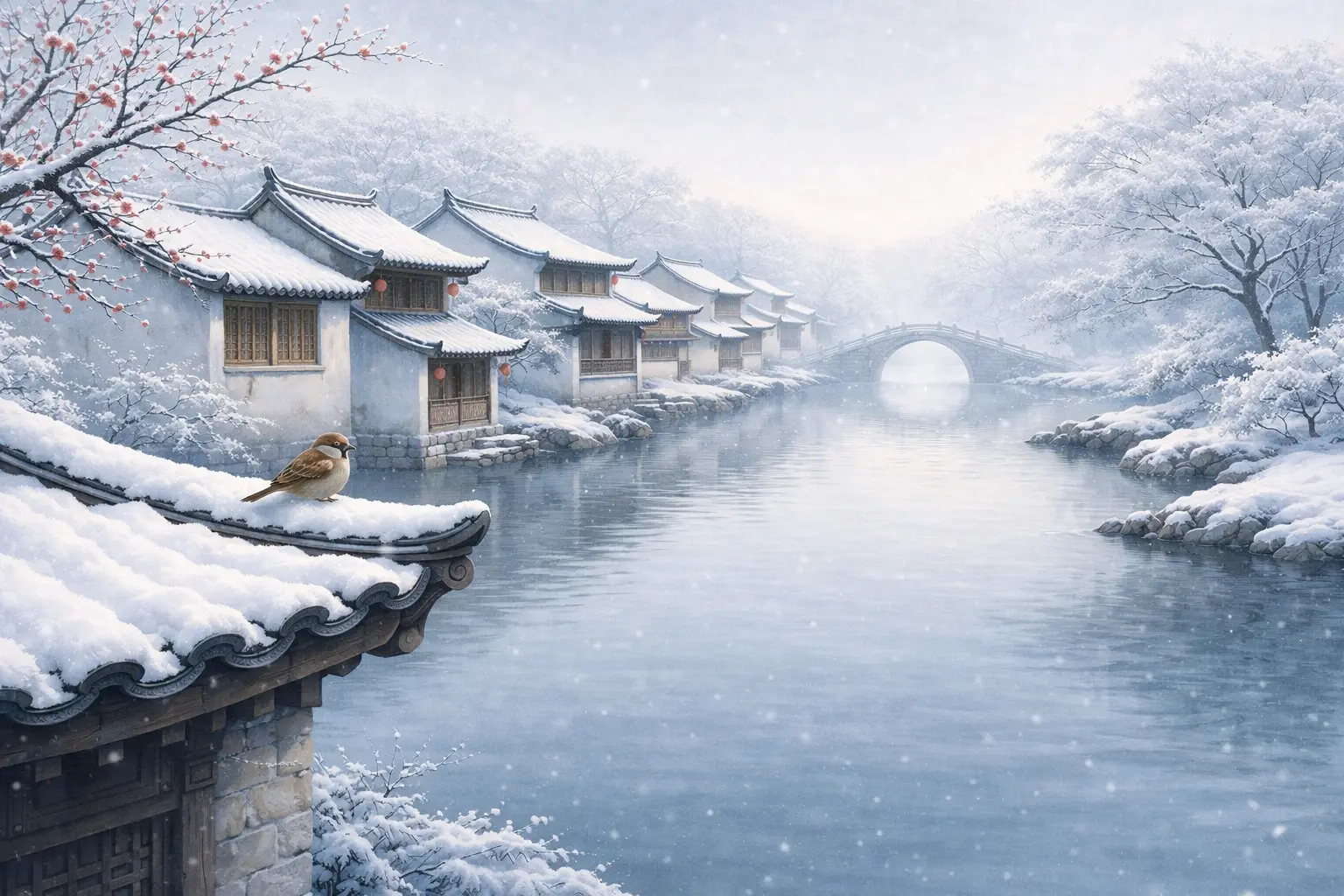
Poetry of Minor Snow takes the falling of the season’s first snow and the deepening cold of Heaven and Earth as its underlying tone. Dai Shulun’s “花雪随风不厌看” captures the lightness of Minor Snow; Yuan Zhen’s “小雪十月中,风落雪间” records the scene of the first snowfall. Poets write of rainbows disappearing from sight, the qi of Heaven rising while the qi of Earth descends, and Heaven and Earth becoming closed off as winter takes shape, tracing the deepening of the season through the three seasonal phases of Minor Snow. The first snow of Minor Snow is light and delicate, drifting across the pages of poetry for a thousand years. Poets watch the snow, admire it, melt it for tea, and leave upon that first snowfall the opening line of winter.
Minor Snow Poetry
小雪
Original Verse:
散漫阴风里,天涯不可收。
压松犹未得,扑石暂能留。
阁静萦吟思,途长拂旅愁。
崆峒山北面,早想玉成丘。
Modern Translation:
Snowflakes scatter freely through the dark wind, spreading to the ends of the world beyond all gathering. They are not yet heavy enough to bend the pine branches, though when they strike the rocks they can linger there for a moment. In the quiet pavilion, thoughts of poetry circle the mind; along the long road, the snow stirs the sorrow of travel. On the northern face of Mount Kongtong, I imagine the snow must already have gathered into hills of jade.
Commentary:
Li Xianyong’s poem is a celebrated work on the solar term Minor Snow. The opening couplet, “散漫阴风里,天涯不可收”, describes light snow scattering through a gloomy wind and spreading across the farthest reaches of the world. The phrase “不可收”, “impossible to gather in,” captures how Minor Snow, though slight, seems to diffuse everywhere. The second couplet, “压松犹未得”, shows how little snow has fallen—it is not yet enough even to bend the branches of a pine. “扑石暂能留”, by contrast, catches the brief instant when a snowflake strikes a stone and remains there for a moment. The contrast between “未得”, “not yet able,” and “暂能”, “able only briefly,” precisely conveys the still-light character of Minor Snow. “阁静萦吟思” writes of poetic thoughts gathering in the stillness of a pavilion, while “途长拂旅愁” describes the long journey and the traveler’s sorrow stirred by snow. The final couplet, “崆峒山北面,早想玉成丘”, closes through imagination: the poet pictures the northern face of distant Mount Kongtong already covered in snow like hills of jade. The slight snowfall before his eyes is set against the imagined abundance of snow far away, opening the poem outward across both space and distance.
小雪
Original Verse:
花雪随风不厌看,更多还肯失林峦。
愁人正在书窗下,一片飞来一片寒。
Modern Translation:
Flower-like snow drifts with the wind, and I never tire of watching it; more and more flakes willingly disappear among the distant woods and mountain ridges. A sorrowful man sits beneath the study window, and with every snowflake that flies past, another measure of cold seems to arrive.
Commentary:
Dai Shulun writes with a plain and restrained brush of watching snow from beneath a study window during Minor Snow. “花雪随风不厌看” calls the flakes “花雪”, “flower-like snow,” emphasizing their beauty, while “不厌看” expresses the poet’s delight in watching them drift. “更多还肯失林峦” describes still more snowflakes falling among the distant woods and mountain ridges. The expression “肯失” personifies the snow, as though the flakes willingly chose to lose themselves among the mountains. The first two lines write of the beauty and abundance of snow, but the final two suddenly turn inward: “愁人正在书窗下,一片飞来一片寒.” The more beautiful the snow outside the window, the deeper the sorrow within. Each flake that comes drifting past seems to bring another degree of cold. “一片飞来一片寒” uses the simplest language to express both the most immediate physical sensation and the most intimate emotional response. Snowfall should be beautiful, yet to a sorrowful observer it becomes the accumulation of cold and loneliness. The poem forms a striking contrast between objective beauty and subjective sorrow.
和萧郎中小雪日作
Original Verse:
征西府里日西斜,独试新炉自煮茶。
篱菊尽来低覆水,塞鸿飞去远连霞。
寂寥小雪闲中过,斑驳轻霜鬓上加。
算得流年无奈处,莫将诗句祝苍华。
Modern Translation:
In the residence of the Western Expedition command, the sun inclines toward the west; alone, I try a new stove and brew tea for myself. The chrysanthemums by the fence have all withered and hang low over the water; wild geese from the frontier fly away, joining the distant evening clouds. I pass the lonely day of Minor Snow in quiet idleness, while mottled traces of light frost seem to gather upon my temples. Thinking over the helpless passage of the years, there is no need to offer poems to Heaven in the hope that youth might remain.
Commentary:
Xu Xuan takes the day of Minor Snow as his background and writes of solitude and the helpless passage of time. “征西府里日西斜” establishes both place and time: within the Western Expedition residence, the poet watches the sun sink toward the west. The repeated sense of westwardness intensifies the feeling of evening and solitude. “独试新炉自煮茶” writes of trying a new stove and making tea alone, one of the warmest ways to spend Minor Snow in solitude. “篱菊尽来低覆水” shows the chrysanthemums by the fence already spent and drooping over the water, while “塞鸿飞去远连霞” writes frontier geese disappearing into distant evening clouds. One image is near and one far; one speaks of decay and the other of departure, together forming the spatial landscape of a Minor Snow day. The third couplet, “寂寥小雪闲中过”, directly names the loneliness of Minor Snow, while “斑驳轻霜鬓上加” shifts from frost in nature to the “frost” of whitening hair, completing the metaphorical movement from seasonal change to human aging. The final couplet, “算得流年无奈处,莫将诗句祝苍华”, recognizes the helplessness of passing time: there is no need to use poetry to pray for youth to endure. This is a calm acceptance of aging, and throughout the poem, a quiet clarity emerges from its subdued sense of resignation.
小雪
Original Verse:
云暗初成霰点微,旋闻蔌蔌洒窗扉。
最愁南北犬惊吠,兼恐北风鸿退飞。
梦绕长松寒未醒,心随飞絮共纷飞。
故人若问今何似,只道先生不是非。
Modern Translation:
The clouds darken, and at first only tiny pellets of sleet appear; soon I hear their soft rustling as they scatter against the window. What troubles me most is that dogs to the north and south may be startled into barking, and I also fear that the wild geese may turn back before the north wind. In dreams, my thoughts circle tall pines, and I have not yet awakened from the cold; my mind scatters together with the flying flakes. If an old friend were to ask how I am now, I would simply say that this gentleman no longer concerns himself with right and wrong.
Commentary:
Shi Shanzhen writes of Minor Snow from the perspective of a monk, with close observation and a detached state of mind. “云暗初成霰点微” describes the earliest stage of Minor Snow, when the precipitation first appears as tiny pellets of sleet. “旋闻蔌蔌洒窗扉” then records the faint sound of those pellets falling against the window. “旋闻”, “soon one hears,” conveys how quickly the snow arrives, while “蔌蔌” is onomatopoeic, reproducing the delicate sound of sleet striking the window. The second couplet, “最愁南北犬惊吠,兼恐北风鸿退飞”, expresses two concerns amid the snow: dogs barking in alarm at unfamiliar sounds, and wild geese turning back before the north wind. The words “愁”, “worry,” and “恐”, “fear,” reveal compassion for living creatures. “梦绕长松寒未醒” writes the image of tall pines lingering in a cold dream, while “心随飞絮共纷飞” describes thoughts scattering like flying catkins. The final couplet, “故人若问今何似,只道先生不是非”, says that if an old friend should ask after him, the only answer is that he no longer judges right and wrong. This is the detachment of a monk: rather than concern himself with worldly disputes, he simply watches the snow fall. Through the clear cold of Minor Snow, the poem reveals the serenity of one who has stepped beyond ordinary worldly concerns.
小雪
Original Verse:
檐飞数片雪,瓶插一枝梅。
童子敲清磬,先生入定回。
Modern Translation:
A few snowflakes drift past the eaves; in a vase stands a single branch of plum blossom. A young attendant strikes the clear-toned chime, and the master returns from meditation.
Commentary:
This five-character quatrain uses an exceptionally pure and spare brush to portray the quiet atmosphere of a meditation room on the day of Minor Snow. “檐飞数片雪” captures the movement of snowflakes drifting beneath the eaves. The phrase “数片”, “a few flakes,” perfectly expresses the “minor” quality of Minor Snow: there are only several flakes, neither abundant nor absent. “瓶插一枝梅” presents the still image of a plum branch in a vase. “一枝”, “one branch,” answers “数片”, “a few flakes”; one is snow and one plum, one in motion and one still, together creating an image of extreme winter elegance. The final two lines, “童子敲清磬,先生入定回”, show a young attendant striking the chime to mark the time or summon someone, while the master has just emerged from meditation. The clarity of the chime responds to the stillness of meditation. Through four images—snow, plum blossom, chime, and meditation—the poem completes a perfect circle from outer scenery to inner mind. Lu You governs complexity through simplicity: in only twenty characters, the poem contains seasonal phenomena, contemplative meaning, and the pleasures of daily life, making it a model of the Song poetic art of revealing the great through the small.
小雪
Original Verse:
小雪纤纤落,寒风剪剪吹。
梅开香渐远,酒熟味初宜。
拥褐添炉火,开窗对竹枝。
岁寒知节换,聊复醉清卮。
Modern Translation:
Fine and delicate snow falls lightly, while sharp cold winds blow in gusts. Plum blossoms open and their fragrance travels gradually farther; the wine has matured and its flavor is just right. Wrapped in coarse winter clothing, I add fuel to the fire; opening the window, I look out toward the bamboo branches. In the cold of the year, one senses the changing of the season; for now, let me drink a cup of clear wine and become pleasantly drunk.
Commentary:
Chen Yuan writes in plain language of everyday life on the day of Minor Snow, filling the scene with winter warmth and ease. “小雪纤纤落” describes the snow as fine, delicate, and soft, while “寒风剪剪吹” captures the sharp cutting force of the cold wind. The paired reduplicative expressions “纤纤” and “剪剪” form a neat verbal balance while distinguishing the different textures of snow and wind. “梅开香渐远” writes of the pure fragrance of newly opened plum blossoms spreading into the distance, while “酒熟味初宜” describes freshly matured wine whose flavor has reached just the right point. One appeals to fragrance and the other to taste, one travels outward while the other is immediately pleasing, together conveying the double sensory pleasure of winter. The third couplet, “拥褐添炉火”, describes the practical acts of wrapping oneself in coarse clothing and adding fuel to the fire, while “开窗对竹枝” writes the leisurely gesture of opening the window to admire bamboo. One belongs indoors and the other looks outside; one is warm and the other cold, together creating a complete domestic space for winter. The final couplet, “岁寒知节换,聊复醉清卮”, writes of sensing the seasonal transition through the year’s cold and, for the moment, drinking a cup of clear wine into gentle intoxication. Within the clear cold of winter, the poem preserves the warmth of human life, finding genuine feeling in ordinary simplicity.
—-
Readers’ Comments
Calendar and traditional culture enthusiasts from around the world, sharing the same moon.
Sign in or register to join the conversation. Your comment account is created automatically the first time you use a connected account.
No comments yet
Share your thoughts with readers around the world.