RatOrigin
「 Notice change in the smallest details,<br>and seize the moment before it speaks. 」
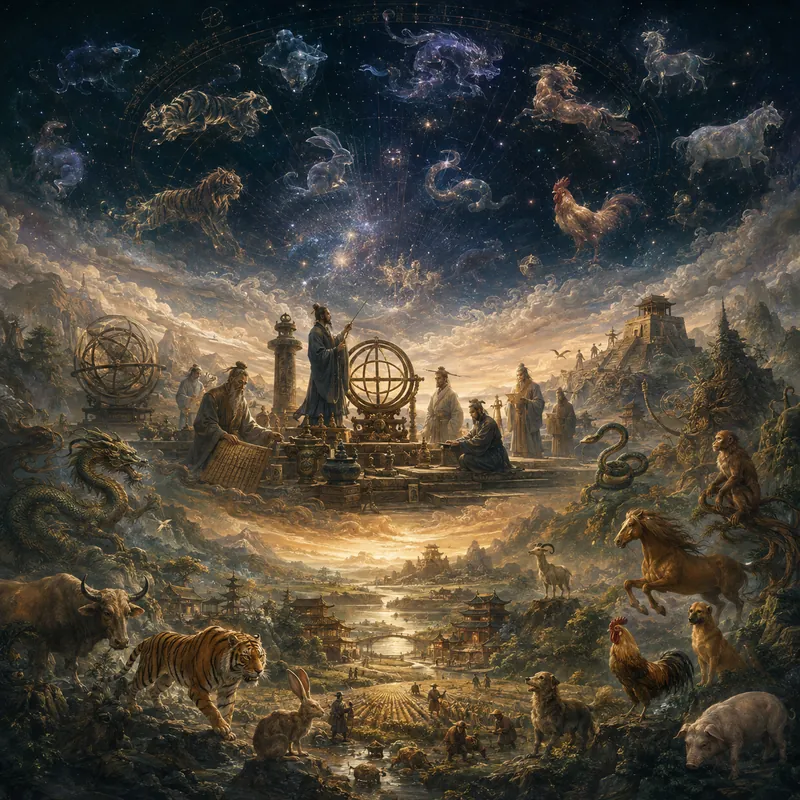
Zi — The First Earthly Branch
In oracle-bone inscriptions, the character “Zi” (子) takes the pictographic form of a young child with a head, body, and legs, or of an infant wrapped in swaddling clothes. Its original meaning is a young child—the earliest stage of human life—and by extension it signifies a beginning or point of origin.
By the Eastern Han dynasty, Xu Shen explained the character in the *Shuowen Jiezi* (《说文解字》) as follows: “子,十一月,阳气动,万物滋。” As the earth returns to spring and all things begin to grow, “Zi” is understood through “滋”, to nourish—signifying both the water that nourishes all things and the new life that germinates after receiving that nourishment. “Zi” is also the first of the Twelve Earthly Branches. The Song-dynasty Neo-Confucian scholar Shao Yong once wrote: “天开于子,地辟于丑,人生于寅。” The ancients regarded “Zi” as the beginning of the stirring of all things, even as the point at which Heaven itself first opened.
On a philosophical level, “Zi” is the primal point from which things develop and transform. It is the “One” in “道生一,一生二,二生三,三生万物”, corresponding to Kan (坎) in the Later Heaven Eight Trigrams, Water among the Five Phases, and Yin within the Yin-Yang polarity. It is both the point from which development and transformation begin and the point at which they return and conclude, much like the seed of a plant.
Rat — The Evolution of the Character
In oracle-bone inscriptions, the character “鼠” (rat) resembles a small rat opening its mouth to gnaw at something. It is a pictograph: the upper portion depicts the rat’s teeth and mouth, while the lower portions represent its belly, claws, and tail. The *Book of Songs · Xiang Shu* (《诗经·相鼠》) says: “相鼠有皮,相鼠有齿,相鼠有体。”—“Look at the rat: it has skin, teeth, and a body.” Over the more than one thousand years from the Shang to the Qin dynasty, the character evolved from pictorial representation toward abstraction: Qin small-seal script had already become more linear, the rat’s head became square in clerical script, and regular script subsequently absorbed features of clerical script. In oracle-bone form, the rat has a small body, a long tail, and prominent incisors, while small dots beside its mouth represent fragments it has gnawed apart, vividly capturing the defining traits of a rodent.
Two Explanations for the Zi–Rat Pairing
The Double-Hour Theory
The Twelve Earthly Branches divide the day into twelve double-hours. Zi hour runs from 23:00 to 1:00 the following morning. The ancients observed that this was precisely when rats were most active—deep in the quiet of night, beneath a sky filled with stars. Li Changqing of the Ming dynasty wrote directly in *Songxiaguan Zhuiyan* (《松霞馆赘言》): “鼠,耗虫也。于是夜尚未央,正鼠得令之候,故子属鼠。” Liu Xianting of the Qing dynasty later cited this view in *Guangyang Zaji* (《广阳杂记》). Zi hour marks both the end of one day and the beginning of the next, and rats emerge to move about at precisely this time; Zi hour therefore became associated with the rat. “Zi” signifies a beginning, while the rat is active during Zi hour—the two naturally correspond within the logic of time, and the rat consequently came to occupy the first position in the zodiac.
The Odd-and-Even Toe Theory
Beyond the correspondence with the hours of the day, ancient Chinese scholars also classified animals according to Yin-Yang concepts, using the odd or even number of their toes as the criterion. The Song-dynasty scholar Hong Xun, in *Yanggu Manlu* (《旸谷漫录》), held that the physical forms of animals determined their sequence. The ancients regarded Zi, Yin, Chen, Wu, Shen, and Xu among the twelve double-hours as Yang, and therefore associated them with odd numbers: the rat, tiger, dragon, monkey, and dog were all said to have five toes, while the horse has a single hoof, all odd numbers. By contrast, Chou, Mao, Si, Wei, You, and Hai were Yin Earthly Branches and were therefore associated with even numbers: the ox, goat, rooster, and pig each have four claws, the rabbit two claws, and the snake’s tongue forks into two, all even numbers.
For the overwhelming majority of animals, the number of toes is the same on the front and hind feet. The rat, however, has four toes on its forefeet—an even number and therefore Yin—and five on its hind feet—an odd number and therefore Yang, combining odd and even within a single body. Because rarity confers distinction, Hong Xun believed that the twelve zodiac animals were selected and ordered according to the odd or even number of their toes: the rat, with four toes in front and five behind, uniquely possesses both odd and even numbers and therefore comes first; it is followed in sequence by the ox (four toes), tiger (five), rabbit (four), dragon (five), snake (no toes, but an even-numbered forked tongue), horse (single hoof), goat (four toes), monkey (five), rooster (four), dog (five), and pig (four). Lang Ying of the Ming dynasty recorded a similar explanation in *Qixiu Leigao · Volume Four* (《七修类稿·卷四》), while also noting that rats are most active during Zi hour and that “Zi” was therefore paired with the rat.
The ancients believed that “子者阳生之初” and “阴阳合德,气钟于子,化生万物者也”. The rat active during Zi hour was thus thought to be the first to receive the “primordial life force” (初生气). Its small yet vigorous nature was seen as corresponding to the qualities of this force, while its sharp teeth and claws were even imagined to possess the divine power to break open primordial chaos.
Records in Classical Texts
The Qin Bamboo-Slip *Rishu*
In 1975, the *Daozhe* (《盗者》) section of the bamboo-slip *Rishu* (《日书》), excavated from Qin Tomb No. 11 at Shuihudi in Yunmeng County, Hubei, was found to contain pairings related to the twelve zodiac animals. The tomb dates to the era of Qin Shi Huang in the third century BCE, while the *Rishu* may have been compiled before Qin Shi Huang proclaimed himself emperor. The sequence of zodiac animals discovered there is: 子鼠、丑牛、寅虎、卯兔、辰龙、巳虫、午鹿、未马、申环、酉水、戌老羊、亥豕. Compared with the twelve zodiac animals in their later standardized form, the differences are substantial. Only half of the animal–Earthly Branch pairings correspond to those commonly used today, but the system can nevertheless be said to have already taken preliminary shape during the Qin period. Similar discoveries were made among Qin bamboo slips excavated at Fangmatan in Tianshui, Gansu. These finds demonstrate that records related to the twelve zodiac animals already existed in *Rishu* texts during the Warring States and Qin periods—at least by the third century BCE—and provide important clues for investigating the origins of the zodiac.
Pre-Qin Texts
The *Book of Songs · Xiaoya · Jiri* (《诗经·小雅·吉日》) records: “吉日庚午,既差我马。” This means that the day Gengwu was an auspicious one and the horses for the hunt had already been selected. Here, “差” means to choose or select. This indicates that an embryonic form of the twelve zodiac animals had already begun to emerge during the Western Zhou period. The *Dayu* (《达郁》) chapter of the Qin-dynasty *Lüshi Chunqiu* (《吕氏春秋》) also recounts the story of a horse-treading-on-a-rat motif cast on a Zhou bronze tripod, using it to illustrate how pent-up frustration could bring ruin to a state.
Eastern Han *Lunheng*
Among transmitted texts, the earliest record of the same twelve zodiac animals used today appears in Wang Chong’s Eastern Han work *Lunheng* (《论衡》). In the *Wushi* chapter (《论衡·物势篇》), Wang Chong wrote: “寅,木也,其禽虎也。戌,土也,其禽犬也。丑、未,亦土也,丑禽牛,未禽羊也。……亥,水也,其禽豕也。巳,火也,其禽虵也。子亦水也,其禽鼠也。午亦火也,其禽马也。” He also wrote: “午,马也。子,鼠也。酉,鸡也。卯兔也。……亥,豕也。未,羊也。丑,牛也。……巳,虵也。申,猴也。” This shows that by the Eastern Han dynasty, the conception of the twelve zodiac animals had already become essentially standardized. Wang Chong listed all twelve animals.
The Northern Nomadic-Origin Theory
According to earlier research by Chinese and French scholars, the twelve zodiac animals first arose within the culture of nomadic peoples in northern China. In 48 CE, a leader of the Southern Xiongnu led his people to settle in what is now the Yulin region of Shaanxi Province. They gradually integrated with the local Han population, thereby beginning the history of combining zodiac-year reckoning with the Heavenly Stems and Earthly Branches system.
Zodiac Figurines and Rat-Shaped Artifacts
The Zodiac-Figurine Tradition from the Northern Wei to the Tang Dynasty
The twelve zodiac figurines, also known as the Twelve Earthly-Branch deity figurines, arose from the ancient practice of associating the twelve zodiac animals with a person’s destiny and deifying them as figurines. Arranged in tombs according to prescribed orientations, they were believed to ward off evil, protect the tomb, and safeguard the spirit of the deceased. The earliest zodiac figurines yet discovered archaeologically were excavated from the Northern Wei Cui-family tomb at Linzi, Shandong. The earliest textual record of zodiac figurines being used as burial objects appears in the *Tang Huiyao* (《唐会要》): “三品以上明器九十事,四神十二时在内园宅方五尺下,帐高方三尺共置五十。……五品以上明器六十事,四神十二时在内园宅方三尺下,帐高方一尺共置三十。” This indicates that by the Tang dynasty, ritual regulations governing the burial of zodiac figurines had already taken shape.
Tang-Dynasty Painted Ceramic Zodiac Figurines
Among excavated rat artifacts, the rat figurine from the Tang-dynasty set of painted ceramic zodiac figures now housed in the Shaanxi History Museum is among the most representative. Its body takes the form of a human civil official, dressed in a wide-sleeved robe with an open collar, its hem falling to the feet, with a knee covering in front; both hands hold a court tablet respectfully before the chest, and the feet are shod in boots. The figure is vivid and lifelike, elegant yet slightly comical, amusing without losing its solemnity. A complete set of painted ceramic zodiac figurines excavated from a Tang tomb in the suburbs of Xi’an is distinguished by its lively modeling and ranks among the finest examples of zodiac figurines. Measuring 40 to 42 centimeters in height, all have animal heads and human bodies: the heads depict the twelve respective animals, while the bodies are human, dressed in open-collared, wide-sleeved robes falling to the feet, with both hands clasped before the chest, combining refinement with a subtly comic air.
A set of twelve ceramic zodiac figurines was excavated in 1955 from a Tang tomb at Hansenzhai in Xi’an, Shaanxi Province, and is now housed in the National Museum of China. It is a representative example of Tang-dynasty zodiac figurines. Experts have stated that only through Tang sculptors’ long-term, meticulous, and accurate observation of different animal forms, combined with their consummate sculptural skill, could the characteristics of the rat have been rendered with such lifelike vitality.
The Rat-Head Bronze from the Old Summer Palace
The bronze heads of the twelve zodiac animals formed part of a hydraulic clock system from the Qianlong reign of the Qing dynasty, designed under the direction of the Italian missionary Giuseppe Castiglione and supervised by the Frenchman Michel Benoist. Twelve statues with animal heads and human bodies were arranged in two diverging rows on either side of the fountain before Haiyantang. At each double-hour, the corresponding animal head spouted water from its mouth to mark the time. During Zi hour (23:00 to 1:00 the following morning), a column of water issued from the mouth of the rat-head bronze. In 1860, the Anglo-French forces burned the Old Summer Palace, and the twelve zodiac bronzes were looted and dispersed overseas. In 2013, the rat and rabbit heads were donated by the French Pinault family and returned to the National Museum of China.
Treasures in Museum Collections Across China
Zodiac figurines with animal heads and human bodies are frequently found in tombs dating from the Sui and Tang dynasties through the Five Dynasties period. Among them, the “Zi figurine”, or rat-headed human-bodied zodiac figure, typically has a pointed snout, narrow eyes, and small ears, and may stand upright with hands respectfully clasped or sit solemnly erect. Four Tang-dynasty ceramic zodiac figurines are displayed in the Gaoyou Museum—replicas of originals now housed in the Nanjing Museum—representing a rooster-headed human figure, a rat-headed human figure, a goat-headed human figure, and a tiger-headed human figure. They were excavated in 1957 from a Tang tomb on the eastern embankment of the Grand Canal near Cheluo in Gaoyou. Museums across China also preserve a rich variety of rat-related artifacts, including Tang sancai rat-headed human-bodied zodiac figurines, Han- and Tang-dynasty bronze mirrors with rat motifs, ceramic rats from the Northern and Southern Dynasties, and black-glazed ceramic jars with rat designs from the Ming and Qing dynasties.
Rodent Fossils
The rat is an ancient animal. In recent years, rodent fossils dating back 55 million years have been unearthed in Anhui. Fossils of the now-common genera of voles and house mice have also been found from the Middle Pleistocene, several hundred thousand years ago. Yet throughout the long Pleistocene epoch, the geographic ranges and population sizes of these genera remained quite limited.
Since the beginning of the Holocene around 10,000 years ago, and particularly after crop cultivation techniques emerged and gradually spread, rodents rapidly adapted to the changes brought about by agricultural production. They became commensal species living alongside humans, even entering human dwellings, and spread to different regions together with human migration.
Rodent-Bone Remains at Archaeological Sites
To date, zooarchaeologists have conducted qualitative and quantitative analyses of animal bones excavated from hundreds of Neolithic sites in China, yet relatively few sites were found to contain rodent bones. The principal reason is that, in the past, archaeological animal remains were often collected without water-screening or sieving. Because rodent bones are extremely small, they are difficult to detect unless soil from archaeological features is water-screened during excavation. In recent years, as accumulated soil from individual archaeological contexts has increasingly been water-screened, rodent bones have proved to be relatively common finds.
The archaeological site yielding the greatest number of rodents discovered to date is the Mancheng Han Tombs in Hebei, the Western Han tombs of Liu Sheng, Prince Jing of Zhongshan, and his wife. In addition to such precious artifacts as jade burial suits sewn with gold thread, archaeologists and zoologists found approximately 130 Père David’s rock squirrels and 30 Korean field mice in each of two pottery jars buried in Liu Sheng’s tomb—a total of around 260 rock squirrels and 60 field mice. In two pottery jars buried in the tomb of his wife, Dou Wan, each contained approximately 70 field mice and 30 brown rats, totaling around 140 field mice and 60 brown rats. Another pottery vessel in Dou Wan’s tomb contained approximately 50 field mice, 25 brown rats, and 25 greater long-tailed hamsters.
Because Père David’s rock squirrels reproduce only once a year, unlike rodents that can breed frequently throughout the year, the fact that identical quantities of around 130 rock squirrels and other rodents were found separately in two pottery jars and additional ceramic vessels suggests that they were deliberately placed there as grave goods rather than animals that entered the tomb later. Researchers believe this may indicate that Liu Sheng and his wife enjoyed eating small mammals during their lifetimes, to the extent that large numbers of rodents were included among their burial offerings after death.
With the widespread application of scientific archaeological methods to excavation and research, rodent bones have become ideal material for strontium-isotope studies. The international archaeological community widely accepts rodent strontium-isotope ratios as one of the best local baselines for strontium-isotope values because rodents are most likely to have been born and lived locally, whereas both humans and domesticated animals may have arrived in a settlement through cultural exchange or migration.
The twelve zodiac animals serve as zoomorphic representations of the Twelve Earthly Branches. The pairing of “Zi” (子) with the rat rests on deep philological and astronomical foundations.
Creation and Heroic Narratives
The First Ray of Light in Chaos
This is one of the oldest and most divine legends associated with the rat. At the beginning of primordial time, Heaven and Earth had not yet opened; the universe resembled a sealed bag, enveloped in darkness and chaos, with Yin and Yang still undivided. The rat was a creature of darkness, ordinarily emerging around midnight during Zi hour. Wandering through chaos, one rat reached its edge and gnawed a breach into the primordial world of undifferentiated confusion. From that moment, a fissure opened between Heaven and Earth, allowing their qi to circulate, and the universe first took shape. At last, the light of the sun streamed through; Yin and Yang separated, and the myriad things were able to arise.
The rat thus became a hero who opened Heaven and established Earth. Zi hour is the beginning of the day, the moment at which darkness and light meet and divide: “子属鼠,天开于子”. In folk belief, the rat is known as the “Zi Deity” (子神), a divinity that opened Heaven and Earth and brought forth the myriad things. “子神鼠破混玄,天开;从警,戒身以平安;从捷,迅足以登先;应万物之灵,吐物华天宝之兽。” In only a few words, this passage vividly encapsulates both the rat’s spiritual qualities and the myth of “the rat biting open Heaven” (鼠咬天开).
Textual Records and Philosophical Interpretation
A written record of the legend of “the rat biting open Heaven” appears in Liu Xianting’s Qing-dynasty *Guangyang Zaji* (《广阳杂记》). Liu Xianting quotes Li Changqing’s Ming-dynasty *Songxiaguan Zhuiyan* (《松霞馆赘言》): “天开于子,不耗则其气不开。鼠,耗虫也。于是夜尚未央,正鼠得令之候,故子属鼠。” The meaning is that Heaven began as undifferentiated chaos, and this chaos had to be consumed before its qi could open; the rat, being a creature that gnaws and consumes, emerges around midnight and bites a fissure between Heaven and Earth. “Heaven opens at Zi” (天开于子) is therefore credited to the rat, which is why it stands first among the zodiac animals.
An ancient saying declares: “自混沌初分时,天开于子,地辟于丑,人生于寅,天地再交合,万物尽皆生。” After “Heaven opens at Zi”, the earth must next be opened: “Earth is established at Chou” (地辟于丑). Because the ox plows the fields and opens the earth, Chou belongs to the ox; Yin hour is then the time when humans are born… From this logic, the zodiac sequence unfolds. Zi hour marks the beginning of the six Yang hours—Zi, Chou, Yin, Mao, Chen, and Si—and the *Leijing Tuyi* (《类经图翼》) states: “子者阳生之初。”
Pangu Opens Heaven and the Rat Bites Open Heaven
The legend of “the rat biting open Heaven” has circulated no less widely than that of “Pangu opening Heaven.” In folk tradition, the rat’s achievement is considered as great as Pangu’s: it was the rat that gnawed open the chaotic Heaven and Earth. Which of these two legends came first? The earliest written record of “Pangu opening Heaven” appears in Xu Zheng’s *Sanwu Liji* (《三五历纪》) from the Three Kingdoms period. Although the written record of “the rat biting open Heaven” dates only to the Qing dynasty, its underlying idea—“Heaven opens at Zi”—arose together with the Heavenly Stems and Earthly Branches, which themselves appear in ancient texts dating back to the pre-Qin period.
Another intriguing version merges the two traditions: Pangu was a giant who slept inside a gourd for eighteen thousand years, accompanied by a small rat. The rat awoke first and scratched Pangu awake. Another version says that before Pangu opened Heaven and Earth, everything was chaos, and the rat helped him gnaw open that chaos so that the world could separate into the clear and the turbid. In these versions, the rat becomes Pangu’s assistant, or even his forerunner, in the creation of the world.
The Savior in the Gourd
The motif of “the rat biting open Heaven” appears in the creation myths of many of China’s ethnic minorities. Their shared narrative framework is that primordial chaos was enclosed within an egg-shaped or gourd-shaped vessel; the rat gnawed open this cosmic egg or gourd, allowing chaos to divide into Heaven and Earth and humanity to come into being.
The Lahu creation epic *Mupamipa* (《牡帕密帕》) describes how the deity Esha cultivated a gourd in which humans were nurtured. They grew inside it but had no way to escape. Esha first summoned a small millet bird to peck at the gourd. It pecked continuously for three days and three nights until its beak was worn blunt, yet still could not break it open. Esha then summoned a pair of rats, which gnawed for three days and three nights and finally opened two large holes in the gourd, allowing the ancestral Lahu siblings Zhadi and Nadi to crawl out. Because the rats had rendered this service to humanity, they naturally earned the right to eat the grain produced by humans. Similar narratives also appear in the myths and legends of the Yi, Bai, Jingpo, and other ethnic groups.
In a myth circulating among the Yi people, a great flood engulfed the world in ancient times. Fuxi survived by hiding inside a water gourd, but when the flood receded he found himself trapped; only after a rat gnawed open the gourd was he able to escape, allowing humanity to multiply and flourish thereafter. The legend signifies that the rat brought the first ray of dawn to the human world. In the conceptions of many early peoples, including the Wa, Yi, and Bai, Heaven and Earth were originally a gourd, and before chaos opened, humans and other living beings were trapped inside it; other versions say that during a great flood, humans and animals took refuge inside gourds or golden drums. The rat gnawed open the gourd, allowing the world to form, and thus “the rat biting open Heaven” portrays the rat as a creator deity.
In the Pumi myth *The Sun, the Moon, and the Stars* (《太阳、月亮和星星》) from Sichuan, the rat becomes a messenger of light. In ancient times, the earth was engulfed in complete darkness. The rat and the owl were good friends, and together they decided to seek light for all living things. The owl carried the rat into the sky, flying for 99 days until a thick wall of clouds separated Heaven from Earth. The rat began tunneling through the cloud wall and gnawed for another 99 days before opening a hole through which a cold white light appeared—the light of the moon. It then tunneled through another cloud wall, gnawing for 99 more days until a hole opened to reveal a scorching red light—the light of the sun. Although the sunlight left the owl and rat unable to open their eyes or endure daylight, forcing them to remain hidden during the day, the earth thereafter possessed both the sun and the moon.
Stealing Grain to Save the People — The Heroic Rat of Southern Rice-Growing Culture
Legends of “the rat stealing grain seeds” are widespread throughout the rice-growing regions of southern China, with rich variations found in Yunnan, Taiwan, Zhejiang, Fujian, Guangdong, Shandong, and elsewhere. In the tale *The Rat Releases the Grain Seeds* (《老鼠放谷种》), humans in ancient times had no grain, and the seeds were kept inside the cosmic bag of Budai Heshang. A rat went to steal food from it, but in its haste dropped several grains into the human world, thereby giving humankind grain seeds.
A story from Shunchang in Fujian recounts that after Pangu opened Heaven, the rat went in search of rice seed for humankind, on the condition that when people cultivated grain they would allow it a share. The rat found rice seed in Heaven, covered its entire body with grains, and stole them back to the human world. A story from the Lishui area of Zhejiang says that in ancient times people failed to cherish grain seed, so a heavenly deity ordered Budai Heshang to gather all the grain and take it up to Heaven. The rat went to Heaven and stole the seeds back; when the zodiac animals were subsequently ranked, the rat was therefore made the eldest and took the first seat. The She people of Ningde in Fujian tell *The Rat and the Grain Seeds* (《老鼠和谷种》): in ancient times rice ripened four times a year, producing more than people could harvest, yet humans failed to value it. Angered, a heavenly deity gathered all the grain into a cloth sack and took it back to Heaven. With no other solution, humans asked the rat to steal the seeds. The rat ascended to Heaven, waited until the deity fell asleep, rolled first in yellow mud, gnawed open the sack, and returned to the human world with rice grains clinging all over its body; only from then on did humans possess rice seed. Another legend from Zhejiang says that long ago humans lived in the forests and could survive only on wild fruit. When they heard that Maitreya Buddha possessed rice seed, they sent the rat to steal it. Undeterred by hardship, the rat traveled more than a hundred *li* before reaching its destination. It gnawed through a hemp sack and cleverly stole the seeds back. Because the rat had rendered a service to humankind, it was placed first in the zodiac.
The myths say that in the primordial age of chaos, humanity had no grain seed, and the grain on which human life depended was stolen by the rat from another world. Other myths say that the rat personally delivered the seeds to the human world and even taught people how to till the soil and plant grain. Such cultural-hero myths of animal creation are particularly abundant in the rice-growing regions of southern China.
The Rat Brings Fire
In these ancient myths, the courageous little rat also overcomes countless difficulties to bring fire to the human world, bringing warmth to Heaven and Earth when they had only just separated and still lay in darkness. In these legends, the rat is not only a creator deity but also a cultural hero—the benefactor who brought humanity the fire of civilization and the means of subsistence.
The Bai Rat-Clan Legend
In a Bai legend from Bijiang, Yunnan, the rat not only steals celestial rice for humankind but is also an ancestor of a clan. The story tells of a flood lasting ninety-nine days, survived only by a brother and sister hiding inside a gourd. They had five daughters but no sons. The eldest daughter married a bear, the second a tiger, the third a snake, the fourth a rat, and the fifth a caterpillar. Thus arose the bear, tiger, snake, and rat clans. The fourth daughter of the Bai ancestral deity married a great rat and produced descendants.
In ancient De’ang belief, the Rat King governs such animals as oxen, horses, tigers, leopards, and elephants. The Rat King passed grain seeds to humankind, enabling people to cultivate food. The Dai people likewise preserve a myth in which their ancestors obtained grain seed from the Rat King.
Many clans and tribes in ancient times believed that their own ancestors were rats and took pride in being descendants of rats. They depicted and carved rat images and offered elaborate sacrifices during rituals or festivals, praying for the protection of their rat ancestors. These ethnic-minority myths and legends show that the rat was originally a “cultural hero” and “creation hero.”
Legends of the Zodiac Ranking
The Jade Emperor’s Race
The most widely circulated account of how the twelve zodiac animals were ranked is the story of an animal race organized by the Jade Emperor—or, in some versions, the Buddha.
According to legend, the Jade Emperor wished to select twelve animals as representatives by which the mortal world could reckon time. He sent immortals down to notify the animals that they were to arrive at the heavenly palace at a designated time to compete, with earlier arrivals receiving higher positions. Another version says that on his birthday, the Jade Emperor held an animal river-crossing race, and the first twelve animals to reach the finish line became the twelve zodiac animals. The animals rushed toward the heavenly palace, each displaying its own abilities.
In this legend, the cat and the rat were good friends and agreed to enter the competition together. Unable to swim, the rat discussed the matter with the cat, and they planned to ask the honest and dependable ox to help them cross the river. Yet on the day of the race, the rat deliberately failed to wake the cat—another version says that the rat drugged the cat with a sleeping potion—and by the time the cat awoke, it had already missed the zodiac ceremony. From then on, the cat harbored a bitter hatred for the rat.
During the race, the rat hid on the body of the fastest-running ox—or, in another version, inside its ear—and only when they were nearing the finish line did it leap down and sprint forward with all its strength, ultimately winning first place. The ox was naturally displeased by this turn of events but could do nothing except accept second place.
The Yellow Emperor Xuanyuan Selects His Guards
Another widely circulated version derives from the legend of the Yellow Emperor Xuanyuan selecting twelve animals to serve as palace guards. The cat asked the rat to register on its behalf, but the rat forgot, causing the cat to miss selection and become the rat’s bitter enemy. The elephant also entered the competition but was driven away when the rat crawled into its trunk. The other animals originally supported the ox as their leader, but the rat sprang onto the ox’s back, while the pig joined in the commotion. The rat was therefore ranked first and the pig last. The tiger and dragon objected and were appointed King of the Mountains and King of the Sea respectively; the rabbit, also dissatisfied, raced the dragon and finished ahead of it; the dog protested and bit the rabbit, for which it was punished with the second-to-last position. After this series of contests, the zodiac order known today finally took shape.
Jiang Ziya’s Ranking and the Qiang Legend
In a Qiang story about the twelve zodiac animals, when Jiang Ziya determined the order of the twelve animals, he required them to compete by swimming, with their rankings decided according to the order in which they crossed the river. As all the animals leapt into the water, the clever rat suddenly bit onto the ox’s tail and, relying on the ox’s strength, secured first place, while the ox came second. The order of the twelve zodiac animals was thereby established.
The Folk Debate over “The Rat Is Big, the Ox Is Small”
Another version says that the Jade Emperor intended to rank the animals according to their size and, believing the ox to be the largest, planned to place it first. The rat objected, claiming that in human eyes the rat was larger than the ox, and went down to the human world to prove it. When the ox passed by, people showed no reaction; but when the rat appeared, they exclaimed, “What a big rat!” Exploiting the double meaning of the word “big,” the rat thereby won first place.
Multiple Versions of the Cat–Rat Feud
Different versions offer different explanations for the feud between cat and rat: one says they agreed to set out together but the rat failed to wake the cat the following morning; another says the rat drugged the cat with a sleeping potion; another recounts that when the Yellow Emperor Xuanyuan sought twelve animals to serve as palace guards, the cat entrusted the rat with registering its name, but the rat forgot and the cat was not selected; still another says the rat did try to wake the cat, but the cat refused to get out of bed and later mistakenly believed that the rat had deliberately left it sleeping. Consumed by anger, the cat thereafter bit any rat it encountered, forcing rats to emerge only after midnight and making the “Zi Rat” (子鼠) true to its name.
The Rat’s Daughter Marries and Belief in the Zi Deity
“The Rat’s Daughter Marries” (老鼠嫁女), also known as “鼠娶亲” and “鼠纳妇”, is an influential folk custom in traditional Chinese culture, widely circulated throughout the Yellow River and Yangtze River regions. It originated in China’s ancient agrarian society and is a product of oral folk creation.
The Classic Search-for-a-Son-in-Law Story
The legend of “The Rat’s Daughter Marries” primarily recounts a rat couple’s search for the most powerful husband for their daughter. They first approach the sun, only to find that it can be obscured by clouds; the clouds are then scattered by the wind, while the wind is blocked by a wall; the wall can be pierced by rats, and eventually they discover that the cat is the most powerful being of all. On the wedding night, the cat eats the bride.
Yu Yue’s Qing-dynasty *Chashi Congchao* (《茶室丛钞》) records that a rat had a daughter whom her parents loved dearly and wished to marry to a fine husband. They believed that because the sun hung high in the sky, it must be the noblest being in the world, and so they asked the sun to become their son-in-law. The sun replied: “I cannot; when the clouds come, they cover me.” The rats then went to ask the clouds… and so the questioning continued until at last they came to the cat.
The “Rat Aspires Above Its Station” Variant
There are many folk tales about the Rat zodiac, among which “The Rat’s Daughter Marries” is particularly widespread. One amusing version is known as “The Rat Aspires Above Its Station” (老鼠想高攀). A rat wishes to marry its daughter to the sun, but the sun says it can be covered by clouds; the rat then asks the clouds, which say they can be scattered by the wind; the rat asks the wind, which says it can be blocked by a wall; the rat asks the wall, which says what it fears most is rats digging holes through it. After thinking it over, the rat decides that the cat is still the most formidable—and marries its daughter to the cat.
The Reconciliation Variant
In another version, the rat seeks to resolve its feud with the cat and asks a weasel to act as matchmaker, promising its most beautiful daughter to the cat. The cat readily agrees. The rat then chooses an auspicious date and steals a child’s tiger-head shoe to serve as the bridal sedan chair, sending its daughter to the cat’s den. In the end, the rat’s daughter is married straight into the tomcat’s belly.
Regional Variations in the Wedding Date
The story of the rat’s daughter marrying exists in many versions, and the specific date varies by region. In some places it is observed on the seventh day of the first lunar month, in others on the twenty-fifth; many regions observe it on the tenth, while elsewhere it falls at midnight on the fourteenth day of the first lunar month. In folk traditions of the Jiangnan region, rats were regarded as harmful and inauspicious, so they were to be married off on the night of the thirtieth day of the old lunar year to ensure peace and good fortune in the coming year. In some areas on the outskirts of Shanghai, the rat’s daughter is said to marry on the sixteenth day of the first lunar month. That evening, every household fries sesame candy as wedding sweets for the rats. In Pingyao County, Shanxi, flatbreads are placed at the foot of walls on the tenth day of the first lunar month, a custom known as “congratulating the rat on marrying off its daughter” (贺老鼠嫁女).
The legend of the rat’s daughter marrying embodies the ancients’ reverence for natural forces and their accumulated wisdom for survival. Through an anthropomorphic marriage narrative involving rats, it reflects both the agrarian society’s ritual mentality of sending away calamity through courtesy and an implicit satire of the social phenomenon of currying favor with the powerful.
Folk Belief in the “Zi Deity”
The Tang-dynasty writer Liu Zongyuan wrote the story *The Rats of a Certain Family in Yongzhou* (《永某氏之鼠》). According to the tale, a household in Yongzhou suffered a rat infestation because of superstition. The master of the household had been born in a Zi year. According to superstitious belief, the rat was the zodiac deity of the Zi year. The man therefore associated his own birth year with the rat and regarded rats as his protective deity, treating them with reverence. He forbade his family from killing rats and, even more strictly, prohibited them from keeping cats. The story reflects Tang-dynasty folk belief in the “Zi Deity” (子神)—people born in a Zi year called the rat their “Zi Deity” and, out of affection for rats, refrained from keeping cats.
In the Qing-dynasty *Xu Zi Buyu* (《续子不语》), Yuan Mei recorded a story set in a Jiazi year, or Year of the Rat. During the Jiangnan provincial examination, one of the examiners was Magistrate Huang of Fanchang, and rats displayed supernatural powers in the examination compound while taking on the positive role of “repaying kindness with gratitude.” The *Qingbai Leichao* (《清稗类钞》) contains a similar record: “盐城有何姓才,其家主人自以为本命肖鼠也,乃不畜猫。” These literary works indicate that in traditional Chinese culture, people born in the Year of the Rat refraining from keeping cats was a folk custom with a long history.
The Rat Kingdom of the Western Regions and Literary Records
*Great Tang Records on the Western Regions*
According to Xuanzang’s *Great Tang Records on the Western Regions* (《大唐西域记》), there were tribes in Turpan, Xinjiang, that worshipped rats. The work contains a story involving rats: a Xiongnu king led an army of 100,000 men intending to plunder the Kingdom of Qusadanna. On hearing the news, the king was terrified and, having no other recourse, burned incense and respectfully appealed to the rats of the desert for help. At midnight, the Rat King appeared to the king of Qusadanna in a dream and told him that if he attacked at dawn, he would prevail. Following the Rat King’s instructions, the king led his army in a surprise assault against the Xiongnu forces. Caught unprepared, the Xiongnu soldiers hurried to saddle their horses and don their armor, only to discover that every fastening used on their saddles, military garments, bowstrings, and other equipment had been gnawed through by rats. The Qusadanna army therefore won a great victory. In gratitude to the Rat King for saving them, the king of Qusadanna established a shrine to worship the rats, a practice maintained for generations. People passing the rat burrows in the desert were required to dismount and proceed on foot to worship them; failure to do so was believed to bring disaster. The rat deity had gnawed through the Xiongnu soldiers’ battle robes and armor, enabling the local people to defeat them. This may have been one of the origins of the Rat zodiac.
*Yiyuan*
Liu Jingshu of the Southern Dynasties recorded in *Yiyuan* (《异苑》) that there was a Rat Kingdom in the Western Regions, where the largest rats were as big as dogs, medium-sized ones as large as rabbits, and the smallest the size of ordinary rats. The large rats had entirely white heads and even wore golden-ringed cangues. Traveling merchants reported that when people passed through the Rat Kingdom, the rats would gnaw at their clothing unless they prayed and offered sacrifices; if they chanted Buddhist scriptures, however, they could pass through safely.
These myths and legends indicate that the twelve zodiac animals belong fundamentally to folk or grassroots social culture. Understandings of the rat’s original form that are difficult to find in traditional written sources can instead be discovered in folk narratives. The place of origin of the twelve-zodiac concept now in common use may well not have been the Central Plains. Myths and legends among ethnic minorities frequently portray the rat as a “cultural hero” and “creation hero.”
Throughout successive periods of Chinese history, the rat has possessed an extraordinarily complex and multifaceted image. There are admonitory works such as “Shuo Shu” (《诗经·硕鼠》) in the *Book of Songs*, as well as popular folk tales with auspicious meanings such as “The Rat’s Daughter Marries” (老鼠嫁女) and “The Rat Takes a Bride” (老鼠娶亲). The rat’s vigilance, cunning, spirituality, and courage assume radically different forms across different narratives: it is at once a creator deity that opens Heaven and Earth and a petty thief; a hero that brings light and a pest reviled by humankind. This contradictory yet unified image is precisely what makes the myths and legends of the Rat zodiac so compelling.
A vast number of myths and legends concerning the origins of the Rat zodiac circulate among the people in many different versions. From creation myths and cultural-hero narratives to animal races and marriage allegories, the rat assumes a rich diversity of identities in the traditions of different regions and ethnic groups. In his book *The Rat Bites Open Heaven* (《鼠咬天开》), scholar Ma Changyi collected seventeen different versions of the “rat steals grain seeds” legend alone.
Japan
The order of the twelve zodiac animals in Japan is exactly the same as in China, with the rat likewise occupying first place. In Japanese culture, however, the rat has acquired a more explicit auspicious meaning: it is a symbol of good fortune, representing luck and the blessing of numerous offspring. This derives from the Japanese myth of Ōkuninushi, in which rats once aided the deity and helped him escape danger; the rat is therefore regarded as an auspicious spirit that rescues others from peril and as an embodiment of intelligence and quick-wittedness. The Japanese also regard the rat’s strong reproductive capacity as a symbol of abundant harvests and expanding wealth. A Japanese zodiac stamp issued by Japan Post depicts an elegant little white rat holding a gold coin in its mouth. The only significant difference in Japan’s twelve zodiac animals is that the twelfth animal is the wild boar rather than the domestic pig.
Vietnam
The composition and order of Vietnam’s twelve zodiac animals are broadly the same as China’s, and the rat likewise occupies first place. Vietnamese attitudes toward the rat are notably positive: it symbolizes the wisdom, creativity, adaptability, and courage that emerge in the face of adversity. Because rats reproduce prolifically, in rural Vietnam they are respectfully called “Master Zi” or “Grandfather Rat.” Places where rats are found are places rich in food, and the Year of the Rat is therefore often regarded by Vietnamese people as a year of abundant harvest. The principal difference in the Vietnamese zodiac is that the cat replaces the rabbit. Scholars believe this may be because the ancient Vietnamese pronunciation of “Mao” (卯), the Earthly Branch corresponding to the rabbit, sounded similar to the word for “cat,” resulting in a substitution during the process of translation.
Western Perspectives
In some versions of the zodiac’s origin story, the rat deceives the cat during the race, explaining the hostility between cats and rats. One historical explanation is that cats may not yet have been introduced into China when the zodiac first came into use.
In the West, the word “zodiac” ultimately derives from ancient Greek and refers to a “circle of little animals.” The various zodiac signs are understood as symbolizing personality traits of people born in the corresponding year—for example, the rat is the first animal, and those born in the Year of the Rat are regarded as leaders of great charm and intelligence. During wars in the Western Regions in the Han and Tang periods, the rat was a means of aiding the good, eliminating evil, and defeating enemies; in the lives of Ming- and Qing-dynasty literati, it was a delightful creature associated with concealing blessings, attracting auspiciousness, and adding playful charm. Rats are regarded as highly intelligent animals that repay the good deeds of others. In the past, the rat represented blessings, and the Year of the Rat was called “Zi Rat” (子鼠)—Zi being the first of the Twelve Earthly Branches and *shu* the Chinese pronunciation of “rat.”
As the tradition spread, the Rat retained its position as the first of the twelve zodiac animals throughout East Asia, while its cultural meanings developed different emphases: China stresses the rat’s wisdom and quick-wittedness, Japan highlights good fortune and wealth, and Vietnam invests it with the symbolism of solidarity and courage. These differences vividly demonstrate the vitality and adaptability of zodiac culture in cross-cultural transmission.
As zodiac culture spread, it absorbed local cultural elements in different countries, and the image of the Rat likewise took on different forms.
Readers’ Comments
Calendar and traditional culture enthusiasts from around the world, sharing the same moon.
Sign in or register to join the conversation. Your comment account is created automatically the first time you use a connected account.
No comments yet
Share your thoughts with readers around the world.