
Beginning of Winter Farming
「立冬种麦正当时。」
During 立冬 (Lìdōng, Beginning of Winter), temperatures fall noticeably across most of China and winter formally begins. The chill intensifies in the north, while autumn deepens further in the south. On the North China Plain, winter-wheat sowing is fully complete and management shifts to emergence and tillering; across the Yangtze River basin, the late-rice harvest is largely finished and management of newly emerged rapeseed proceeds steadily; in South China, late-rice harvesting enters its final stage while sowing of winter crops such as potatoes and vegetables begins progressively. In Northeast China, both the autumn harvest and autumn field preparation are fully complete and agricultural activity enters the traditional winter slack period known as “猫冬”; in Northwest China, management of newly emerged winter wheat continues while winter irrigation, autumn fertilization, land leveling, and other basic farmland improvements are carried out on a broad scale. In the temperate Southern Hemisphere, the season is shifting from late spring toward early summer: winter wheat in southeastern Australia and Argentina enters grain filling and maturity, while sowing of summer crops becomes fully established. Across the tropical Northern Hemisphere, the dry season is in place and field maintenance and dry-season planting expand, while in the tropical Southern Hemisphere the rainy season begins and rice sowing proceeds alongside the harvest of dry-season crops.
Global Agriculture
Temperate Regions of the Northern Hemisphere
Phenological Signs
Temperatures fall noticeably across most of China. The cold strengthens in northern regions, while autumn deepens in the south. First frost becomes widespread across the north, leaves fall in large numbers, and the first signs of winter begin to appear. Japan’s Kantō region enters late autumn, while the chill grows more pronounced in South Korea.
Farming Activities
On the North China Plain, winter-wheat sowing is fully complete and management shifts to emergence and tillering. Farmers inspect stands and fill gaps, control seedling-stage pests such as aphids and cutworms, remove weeds before winter, and work to establish strong plants with 3–5 tillers, which form the basis of safe overwintering. Where wheat has grown excessively vigorously, fields are firmed to suppress top growth and prevent premature stem elongation before winter. Around Beginning of Winter, winter irrigation also starts progressively: water is applied before soil freeze-up to help seedlings survive the cold season, a practice vividly summarized in the proverb “立冬不浇地,麦苗冻在地.”
Across the Yangtze River basin, the late-rice harvest is largely finished and grain has been brought into storage, while paddy fields are plowed and prepared. Rapeseed enters full seedling-stage management, including stand inspection, gap filling, control of aphids, flea beetles, and other pests, drainage management, and the development of strong plants. Because winters in the Yangtze basin are damp and cold and young rapeseed is highly sensitive to waterlogging, farmers maintain a three-level drainage system of main ditches, cross-field ditches, and perimeter ditches to keep water moving and provide secure overwintering conditions.
In South China, late-rice harvesting enters its final stage and the autumn harvest is nearly complete once grain is safely stored. Fields freed after the late-rice crop are then brought into winter production with potatoes, winter vegetables, and other crops, improving land-use efficiency. In Northeast China, with both autumn harvesting and land preparation finished, agricultural activity moves into the traditional “猫冬” period, when attention shifts to grain storage and marketing, agricultural-input purchases, machinery maintenance, and planning for the following year. In Northwest China, management of newly emerged winter wheat continues in parallel with widespread winter irrigation, particularly important in the arid areas of Xinjiang and Gansu, as well as autumn fertilization, land leveling, and maintenance of irrigation infrastructure.
Phenological Signs
Temperatures continue to fall across Western Europe. Autumn sowing is largely complete in France and Germany, and winter wheat enters emergence and tillering, while the chill becomes increasingly pronounced across Central Europe.
Farming Activities
In France and Germany, winter wheat moves into emergence and tillering, with management focused on checking stands, filling gaps, controlling seedling-stage pests and diseases, removing weeds before winter, and establishing vigorous plants. In Ukraine’s chernozem region, winter wheat is at the same stage, where strong establishment before the onset of winter is fundamental to successful overwintering.
Phenological Signs
Across the winter-wheat belt of Kansas, Nebraska, and neighboring areas, winter wheat enters emergence and tillering. Orchard harvesting in California’s Central Valley approaches completion, farmland across the U.S. Midwest enters the winter slack period, and crop harvesting in Canada is fully finished.
Farming Activities
Across the United States, winter wheat enters emergence and tillering and is managed through stand inspection, gap filling, seedling-stage pest and disease control, pre-winter weed management, and the development of strong plants. Orchard harvesting in California’s Central Valley enters its final stage, while field activity in the Midwest declines and attention turns to machinery maintenance, agricultural-input purchases, and preparation of planting plans for the following year.
Temperate Regions of the Southern Hemisphere
Phenological Signs
The season is shifting from late spring toward early summer, with temperatures rising to 20–25°C. Winter wheat, barley, rapeseed, and other autumn-sown crops enter grain filling and maturity, while pastures remain lush and the landscape still carries a strong sense of spring.
Farming Activities
Autumn-sown crops—winter wheat, barley, and rapeseed—enter grain filling and maturity, the final stage determining thousand-grain weight. Adequate water supply therefore remains essential, as drought during grain filling can sharply reduce grain weight, while aphids, rust, and other pests and diseases enter their final control period. Early-maturing cultivars begin to be harvested at the same time that sowing of summer crops becomes fully established: maize, sorghum, sunflower, and other crops are planted following land preparation and basal fertilization. Spring pasture management also enters its final stage.
Phenological Signs
The season moves from late spring toward early summer, with temperatures rising to 20–25°C. Winter wheat, barley, rapeseed, and other autumn-sown crops enter grain filling and maturity, while grasslands remain green and lush.
Farming Activities
Autumn-sown crops advance toward maturity and require continued attention to water supply and pest and disease control, while early-maturing cultivars begin to be harvested. At the same time, summer-crop sowing becomes fully established.
Tropical and Subtropical Regions
Phenological Signs
The dry season continues under clear and dry conditions. Rice harvesting in Thailand, Myanmar, Laos, and neighboring areas is fully complete and rural communities enter the dry-season slack period. India is also in the dry season, while in southernmost China the late-rice harvest approaches its end.
Farming Activities
Once rice harvesting is fully complete, agricultural work shifts toward field maintenance, land rehabilitation, irrigation-infrastructure upkeep, and machinery servicing. In irrigated areas, sowing of dry-season crops such as wheat, maize, and pulses begins progressively. In southernmost China, the final stage of the late-rice harvest overlaps with the beginning of winter-crop planting.
Phenological Signs
The rainy season begins, rainfall increases, and humidity rises. Central-western Brazil enters the wet season and the landscape starts to turn green, while southern Africa likewise enters the opening phase of the rainy season.
Farming Activities
With the return of seasonal rains, rice sowing and seedling raising begin on a large scale, while harvesting of dry-season crops such as wheat, barley, and rapeseed enters its final stage. In Brazil, soybean sowing becomes fully established as the onset of the rainy season opens the optimal planting window and improves soil moisture conditions; in southern Africa, maize sowing likewise expands on a broad scale.
China’s Six Major Agricultural Regions
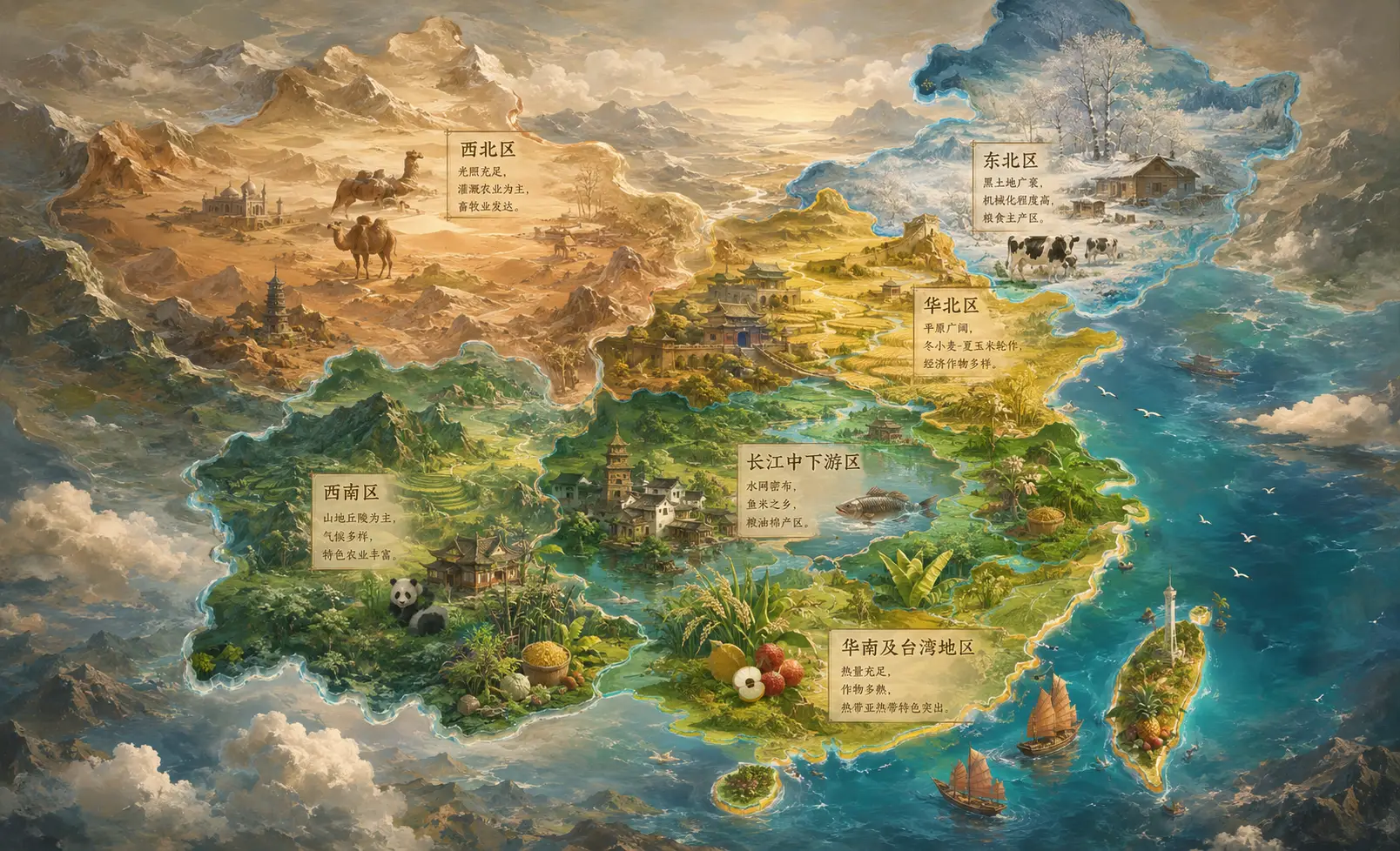
| Agricultural Region | Major Provinces | Keywords |
|---|---|---|
| Northeast | Heilongjiang, Jilin, Liaoning, eastern Inner Mongolia | “猫冬”, grain storage, agricultural-input purchasing, machinery maintenance |
| Northwest | Xinjiang, Gansu, Ningxia, western Inner Mongolia, Qinghai | Winter-wheat seedlings, winter irrigation, farmland improvement, autumn fertilization |
| North China | Hebei, Shanxi, Beijing, Tianjin, Shandong, northern Henan | Winter-wheat management, winter irrigation, strong seedlings, overwintering preparation |
| Middle and Lower Yangtze | Hubei, Hunan, Jiangxi, Anhui, Jiangsu, northern Zhejiang, Shanghai | Late-rice harvest ending, rapeseed seedlings, winter vegetables, drainage and waterlogging prevention |
| Southwest | Sichuan, Chongqing, Guizhou, Yunnan, southeastern Tibet | Rapeseed seedlings, winter-wheat seedlings, winter potatoes, drainage and waterlogging prevention |
| South China and Taiwan | Guangdong, Guangxi, Hainan, southern Fujian, Taiwan Province | Final late-rice harvest, winter crops, tropical-fruit harvest ending, field maintenance |
Heilongjiang, Jilin, Liaoning, eastern Inner Mongolia
During Beginning of Winter, both the autumn harvest and autumn land preparation are fully complete across Northeast China. The ground begins to freeze, temperatures fall below 0°C, snowfall becomes more frequent, and agricultural activity enters the traditional “猫冬” period, when the focus moves away from the fields and toward storage, maintenance, and preparation for the year ahead.
The “猫冬” period fully begins. This traditional winter slack season does not mean that agricultural work stops; rather, it changes location and form. Farmers regularly inspect maize, rice, soybeans, and other grain already in storage, protecting it from moisture, insects, and rodents, since storage quality directly affects annual farm income, while market-price movements are watched closely to determine the timing of sales. Seeds, fertilizers, pesticides, agricultural film, and other inputs are purchased in advance, often at lower off-season prices, while large tractors, seeders, harvesters, and other machinery are inspected and serviced during winter so they will be ready for spring sowing. This is also the time to formulate planting plans for the coming year, using market conditions, policy direction, and soil conditions to determine crop areas and cultivar choices for maize, soybeans, and rice. Thus, although field activity is limited during “猫冬”, indoor preparation remains equally important.
Winter management in pastoral areas. In eastern Inner Mongolia, livestock move into housed feeding and supplementary feeding becomes fully established. Shelters are reinforced, bedding is added, and drafts are kept out, while herders calculate forage reserves and daily feed requirements carefully to ensure that animals can endure the long winter safely. During heavy snowfall, they must also guard against “白灾”, when blizzards cover grazing land and prevent livestock from feeding.
Protected agriculture. Greenhouse vegetables enter a busy production period, with cucumbers, tomatoes, leafy vegetables, and other crops reaching fruiting or harvest. Temperatures need to be maintained at 25–28°C during the day and 12–15°C at night, while insulation is strengthened with straw curtains or thermal covers and cold-air intrusion is prevented. Because winter days are short, light management also becomes important, and insulation covers should be opened at appropriate times to extend the available period of illumination.
Xinjiang, Gansu, Ningxia, western Inner Mongolia, Qinghai
During Beginning of Winter, Northwest China enters a critical stage of winter-wheat overwintering management. Seedling care continues, winter irrigation becomes fully established, and basic farmland improvement—including autumn fertilization, land leveling, and maintenance of irrigation infrastructure—advances on a broad scale.
Winter-wheat seedling management continues. Wheat sown from mid-September through early October has fully emerged and enters tillering. Management centers on promptly resowing or transplanting areas with missing plants, controlling aphids, cutworms, and other seedling-stage pests, and removing weeds before winter so they do not compete with wheat for water and nutrients. Aphids require particular attention because they transmit wheat yellow dwarf disease, while pre-winter weed control is more effective than spring treatment. The objective is to establish strong plants with 3–5 tillers and a well-developed root system before winter, forming the basis of safe overwintering and a good harvest the following year; weak stands may receive 3–5 kg of urea per *mu* as a seedling-stage topdressing. By contrast, fields with excessive growth are firmed to suppress the canopy, encourage root development, and reduce the risk of both premature stem elongation and winter freezing injury. The quality of this seedling-stage management directly affects overwinter survival and the following year’s yield.
Winter irrigation becomes fully established. In the arid regions of Northwest China, winter irrigation is one of the key measures for ensuring winter-wheat survival. It is carried out before soil freeze-up, when the ground freezes at night and thaws during the day, allowing the water to infiltrate deeply before the surface refreezes and forms a protective layer. The irrigation rate is 40–60 cubic meters per *mu*, enough to wet the soil thoroughly without leaving standing water; after irrigation, there should be neither ponding nor exposed ice on the surface. By increasing soil heat capacity and slowing the decline in ground temperature, this practice helps protect wheat seedlings through winter. The proverb “立冬不浇地,麦苗冻在地” captures its importance in vivid terms.
Basic farmland improvement advances fully. During the agricultural slack period, farmers apply farmyard manure or compound fertilizer in preparation for spring sowing or winter-wheat green-up, with organic fertilizer incorporated before the soil freezes. Land leveling is used to improve irrigation conditions and increase water-use efficiency, while canals, wells, reservoirs, and other water-conservancy facilities are repaired in preparation for spring irrigation. Shelterbelts are also established, as winter is considered a favorable period for tree planting aimed at reducing wind, stabilizing sand, and improving the agricultural environment.
Specialty crops. Cotton harvesting in Xinjiang is fully complete and processing and marketing are broadly underway; red-date harvesting has also ended, giving way to drying, grading, packing, and sales.
Hebei, Shanxi, Beijing, Tianjin, Shandong, northern Henan
During Beginning of Winter, North China enters a key stage of preparing winter wheat for overwintering. Plants move from emergence into tillering, winter irrigation begins progressively, and with autumn harvesting and sowing fully complete, agricultural activity shifts as a whole toward winter preparation.
Winter-wheat management from emergence through tillering is fully underway. Wheat sown from late September through early October has fully emerged and enters tillering. Gaps in plant stands should be resown or transplanted promptly, since weak seedlings from late sowing face greater overwintering risk. At the same time, aphids, cutworms, and other seedling-stage pests are controlled and weeds are removed before winter to reduce competition for water and nutrients. The aim is to establish strong plants with 3–5 tillers and a well-developed root system; weak stands may receive 3–5 kg of urea per *mu* as a seedling-stage topdressing, while excessively vigorous fields are firmed to restrain aboveground growth, encourage root development, and reduce the risk of premature stem elongation and freezing injury. Strong pre-winter establishment is the foundation of safe overwintering and a good harvest the following year.
Winter irrigation begins progressively. Around Beginning of Winter, when temperatures fall to approximately 0°C and the soil freezes at night and thaws during the day, winter irrigation begins. The irrigation rate is 40–50 cubic meters per *mu*, enough to wet the soil deeply without causing waterlogging. Besides increasing soil heat capacity and slowing soil cooling, this irrigation helps protect the seedlings and stores moisture for spring green-up, so its quality directly affects both overwinter survival and the strength of spring recovery.
Agricultural work enters the overwintering-preparation stage. With autumn harvesting and sowing fully complete, farmers turn more attention to autumn fertilization, land leveling, repair of irrigation infrastructure, machinery maintenance, and advance purchase of seeds, fertilizers, and other inputs needed for the coming spring.
Winter orchard management. In apple, pear, and other orchards, work centers on orchard sanitation after leaf fall, winter pruning, and autumn fertilization. Dead branches, fallen leaves, diseased fruit, and infected shoots are removed and either burned together or buried deeply to reduce overwintering pests and pathogens. Winter pruning is carried out from leaf fall until bud break and involves removing dead, diseased, and crossing branches while adjusting tree structure; young trees are pruned mainly for training, while mature trees are pruned primarily for renewal and rejuvenation, and pruning wounds are coated with healing agents to prevent pathogen entry. Autumn fertilization, based mainly on organic fertilizer, should be completed before leaf fall to restore tree vigor and build nutrient reserves for growth and fruiting the following year. Winter pruning is one of the most important orchard operations, and its quality directly affects both yield and fruit quality in the next season.
Vegetable management. Storage of Chinese cabbage, radish, scallions, and other winter vegetables is fully complete, while greenhouse production enters its busiest period. Cucumbers, tomatoes, leafy vegetables, and other crops reach fruiting or harvest and require tighter temperature control, with 25–28°C during the day and 12–15°C at night, together with strengthened insulation and protection from cold.
Hubei, Hunan, Jiangxi, Anhui, Jiangsu, northern Zhejiang, Shanghai
During Beginning of Winter, the middle and lower Yangtze shifts from the closing stage of autumn harvesting and sowing toward overwintering preparation. The late-rice harvest is largely complete, rapeseed seedling management becomes fully established, and sowing of winter vegetables begins progressively.
The late-rice harvest is largely complete. Grain has been safely stored and the autumn harvest comes to an end, while paddy fields are plowed and prepared both for rapeseed overwintering and for spring planting in the following year.
Rapeseed seedling management is fully underway. Rapeseed sown in early to mid-October has fully emerged and enters the seedling stage. Fields with missing plants should be resown or supplemented through transplanting as soon as possible, while aphids, flea beetles, cabbage white caterpillars, and other pests are controlled without delay; aphids in particular require attention because they transmit viral diseases of rapeseed. Drainage is equally critical. Winters in the Yangtze basin are damp and cold, and young rapeseed tolerates waterlogging poorly, making it necessary to maintain a system of main ditches, cross-field ditches, and perimeter ditches with minimum depths of 80 cm, 60 cm, and 40 cm, respectively, so that water can drain rapidly once rain stops. Before winter, plants should develop 8–10 leaves and a well-established root system, and weak stands may receive 3–5 kg of urea per *mu* as a seedling-stage topdressing. The quality of management at this stage directly affects overwinter survival and yield the following year.
Winter-vegetable sowing begins progressively. Fields left free after the late-rice harvest are planted with Chinese cabbage, radish, lettuce, spinach, celery, and other winter vegetables, increasing land-use efficiency and farm income.
Winter orchard management. In citrus and other orchards, harvesting is followed by pruning and fertilization to restore tree vigor. Orchards are also cleaned by removing dead branches, fallen leaves, diseased fruit, and infected shoots to reduce overwintering pests and diseases, while winter pruning is carried out from leaf fall until bud break.
Sichuan, Chongqing, Guizhou, Yunnan, southeastern Tibet
During Beginning of Winter, agricultural activity across Southwest China enters the overwintering-preparation stage. Rapeseed seedling management becomes fully established, winter-wheat seedling management proceeds steadily, and winter-potato planting begins progressively.
Rapeseed seedling management is fully underway. Farmers inspect stands, fill gaps, control aphids, flea beetles, and other seedling-stage pests, and pay particular attention to drainage. Because winters in Southwest China are damp and cold and rapeseed is sensitive to excess water, fields need well-maintained main ditches, cross-field ditches, and perimeter ditches. The goal is to establish strong plants with 8–10 leaves and a well-developed root system before winter, since the quality of this stage directly determines overwinter survival and yield the following year.
Winter-wheat seedling management proceeds steadily. Farmers inspect stands and fill gaps, control seedling-stage pests and diseases, remove weeds before winter, and work to establish strong wheat plants with 3–5 tillers.
Winter-potato planting begins progressively. On fields available during winter, especially in Sichuan, Guizhou, and Yunnan—important production areas—winter potatoes are planted to improve land-use efficiency and increase farm income. Seed potatoes are carefully selected, cut, and pre-sprouted; each piece weighs 25–30 g and carries 1–2 eyes, while the cut surface is disinfected with wood ash or carbendazim powder. Planting is carried out at a depth of 8–10 cm, with 60–70 cm between rows, 20–25 cm between plants, and a seed-potato rate of 150–200 kg per *mu*. Fields are then covered with plastic film to conserve heat and moisture and promote emergence and growth. Winter potatoes are an important cold-season cash crop in Southwest China.
Guangdong, Guangxi, Hainan, southern Fujian, Taiwan Province
#### (1) Mainland South China
Late-rice harvesting enters its final stage. Grain is progressively brought into storage and the autumn harvest comes fully to an end. As soon as the late-rice harvest is finished, paddy fields are plowed and prepared for winter crops.
Winter-crop sowing becomes fully established. Fields freed after the rice harvest are used for winter potatoes, winter maize, winter soybeans, winter vegetables, and other crops. The relatively mild winter climate of South China allows these crops to grow through the cold season, making winter production an important part of regional agriculture and a means of improving both land-use efficiency and farm income.
Tropical-fruit management. Banana harvesting enters its final stage and is followed by postharvest management such as field sanitation and fertilization. Citrus enters maturity and harvest, and early cultivars such as “十月橘” and “砂糖橘” begin to be picked in November; farmers take advantage of clear weather to harvest, grade, pack, and market the fruit. Overall, tropical-fruit harvesting approaches completion.
Field maintenance. After late rice is harvested, fields are plowed and prepared for winter crops and the following spring. Irrigation channels, reservoirs, and other water-conservancy facilities are repaired, while soil improvement is carried out through applications of organic fertilizer, lime, and other amendments.
#### (2) Taiwan
Rice: In central Taiwan—including Changhua, Yunlin, and the Chianan Plain—the second rice harvest is fully complete; the same is true in the south, particularly in the Kaohsiung–Pingtung region. In northern Taiwan, around Taoyuan and Hsinchu, the second harvest enters its final stage.
Vegetables: During Beginning of Winter, sowing and transplanting of winter vegetables continue across the island.
Fruit trees: Citrus enters maturity and harvest, while banana harvesting approaches completion.
Tea: In central and southern tea-growing areas such as Nantou and Chiayi, tea gardens enter winter management through pruning, fertilization, and field sanitation; the same applies in northern areas such as Wenshan and Sanxia.
Fisheries: Fishing continues in waters around Taiwan, but the strengthening northeast monsoon requires greater attention to safety during offshore operations.
Farmer’s proverbs and folk customs: Taiwanese folk tradition preserves the saying “立冬補冬,補嘴空”, referring to the custom of eating nourishing foods around Beginning of Winter to replenish the body. “立冬吃羊肉,一冬暖洋洋” expresses the idea of eating mutton at this time as a warming and nourishing food for the season. Another weather proverb, “立冬晴,一冬晴;立冬雨,一冬雨”, uses the weather observed on Beginning of Winter to predict the overall pattern of the coming winter.
Global Extreme Weather · Risks & Responses
Temperate Northern Hemisphere: Cold Waves and Freezing Injury—the Greatest Threat Around Beginning of Winter
From Beginning of Winter onward, cold waves become more frequent across northern regions and sudden temperature drops may cause freezing injury. Winter-wheat seedlings, still relatively vulnerable immediately after emergence, can be severely damaged or killed by strong frost, so irrigation before a cold wave helps retain soil warmth and reduce losses. In protected agriculture, greenhouses need stronger insulation to prevent cold-air intrusion, while fruit trees, although increasingly cold-hardy after entering dormancy, still require protection when young or when carrying late-autumn shoots. In pastoral areas, livestock move into housed feeding and require effective cold protection, while herders must also guard against “白灾”, when blizzards cover grazing land and prevent animals from feeding. Farmers therefore need to follow forecasts closely and take preventive action before cold waves arrive, including winter-wheat irrigation, greenhouse reinforcement and insulation, and protective wrapping of fruit trees.
Temperate Northern Hemisphere: Persistent Autumn Rains in Western China and Cold, Damp Weather
Around Beginning of Winter, persistent autumn rains in western China may continue into early November, affecting the middle and lower Yangtze as well as Southwest China. Prolonged cloudy and rainy weather raises humidity, reduces sunshine, and creates distinctly cold and damp conditions. In rapeseed seedlings, excessive soil moisture increases the risk of root rot and downy mildew, making it essential to keep main ditches, cross-field ditches, and perimeter ditches clear and functional. Harvested autumn grain requires careful moisture management in storage, with regular checks of grain-pile temperature and humidity, while vegetables grow more slowly in open fields and greenhouse crops require stronger ventilation and humidity reduction. The priority is therefore to maintain both effective field drainage and good moisture control during storage.
Temperate Northern Hemisphere: Early Frost—the Final Threat to Winter-Wheat Seedlings
During Beginning of Winter, the risk of early frost remains across northern China, where first frost has already become widespread. These frosts threaten newly emerged winter-wheat seedlings, and irrigation before the arrival of a cold wave remains one of the most effective protective measures.
Temperate Southern Hemisphere: Hot, Dry Winds and Heavy Rain During Harvest
During the transition from late spring to early summer, around early November, winter wheat enters grain filling and maturity and must be protected from both hot, dry winds and heavy rain during harvest. High temperatures, low humidity, and strong winds can interrupt grain filling and reduce thousand-grain weight, while heavy rain during harvest may cause sprouting and mold in wheat ears. Farmers in southeastern Australia and Argentina need to follow forecasts closely, apply foliar fertilizer before hot, dry wind events to improve crop stress resistance, and take advantage of clear-weather windows to harvest.
Tropical Regions: Alternating Drought and Flood Risk
Across the tropical Northern Hemisphere—including Southeast Asia and India—the dry season is now established and attention needs to be paid to drought effects on dry-season crops. Across the tropical Southern Hemisphere—including Brazil and Africa—the rainy season begins, requiring farmers to guard against flooding from heavy rainfall while also taking advantage of favorable soil moisture to sow within the seasonal planting window.
----
Readers’ Comments
Calendar and traditional culture enthusiasts from around the world, sharing the same moon.
Sign in or register to join the conversation. Your comment account is created automatically the first time you use a connected account.
No comments yet
Share your thoughts with readers around the world.