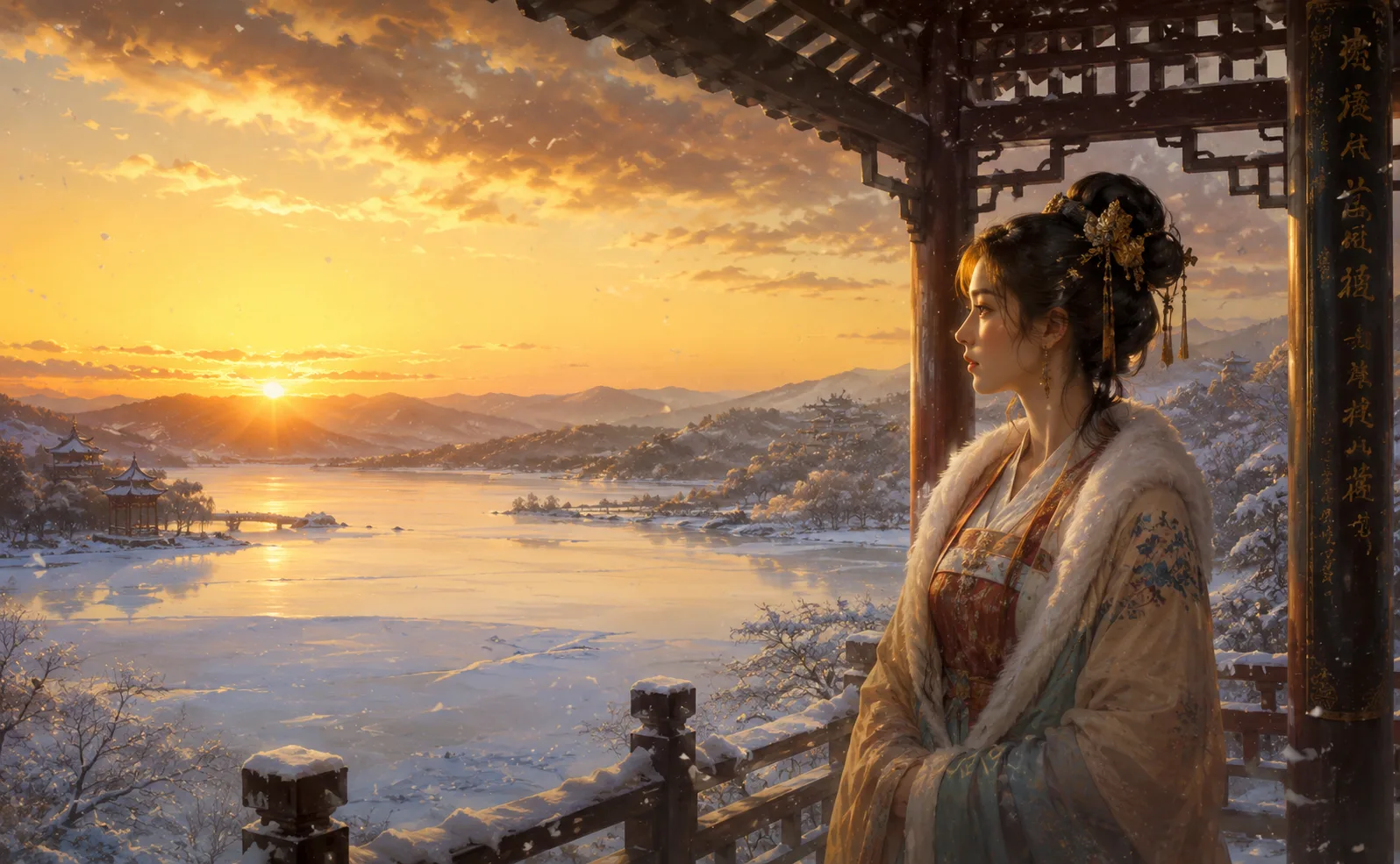
Beginning of Winter Poetry
「冻笔新诗懒写,寒炉美酒时温。」
Winter poetry takes the withdrawal of all things and the first arrival of cold as its underlying tone. Li Bai’s “冻笔新诗懒写,寒炉美酒时温” captures the languor of the Beginning of Winter through a frozen brush and a cold brazier; Yuan Zhen’s “霜降向人寒,轻冰渌水漫” records the chill of early winter. Poets write of water beginning to freeze, the earth beginning to harden, and pheasants entering the great waters to become clams, marking the opening of winter through the three seasonal phases of the Beginning of Winter. The Beginning of Winter is winter’s first step, and poets answer the first cold with frozen brushes and cold braziers—a single cup of warmed wine becomes the finest opening to the season.
Beginning of Winter Poetry
立冬
Original Verse:
冻笔新诗懒写,寒炉美酒时温。
醉看墨花月白,恍疑雪满前村。
Modern Translation:
On the day of the Beginning of Winter, the weather is so cold that even the brush has frozen stiff, giving me the perfect excuse to be lazy and leave new poems unwritten. Fine wine is kept warm from time to time over the cold-season brazier. Through drunken, blurred eyes, I look at the flower-like patterns of ink upon the inkstone beneath the pale moonlight and, in a daze, imagine that snow has covered the village ahead.
Commentary:
Li Bai’s poem captures the distinctive languor and ease of a winter day. The opening line, “冻笔新诗懒写”, reveals a spontaneous, unrestrained sense of leisure: the weather is cold, the brush has frozen, and that becomes a convenient reason not to write poetry. The next line, “寒炉美酒时温”, brings warmth into the winter scene; fire and fine wine make an especially comforting pair in cold weather. “醉看墨花月白” describes the poet, hazy with drink, watching moonlight fall across the ink patterns on his inkstone and experiencing a strange visual illusion. The final line, “恍疑雪满前村”, is the poem’s inspired stroke: in his drunken state, he mistakes the ink-like patterns before him for white snow covering the village ahead. This illusion merges indoors and outdoors, ink and snow, drunken perception and actual scenery. It conveys both the cold of a Beginning of Winter night and a dreamlike, romantic poetic beauty. The poem begins with the smallest details of everyday life, yet almost casually captures the distinctive state of mind that accompanies a seasonal transition.
立冬
Original Verse:
秋风吹尽旧庭柯,黄叶丹枫客里过。
一点禅灯半轮月,今宵寒较昨宵多。
Modern Translation:
The autumn wind has stripped the branches of the old courtyard bare; yellow leaves and crimson maples drift past through my years as a traveler far from home. A single meditation lamp, half a moon—tonight is colder than last night by yet another degree.
Commentary:
Wang Zhideng sets this poem against the Beginning of Winter and writes of loneliness and cold while living away from home. “秋风吹尽旧庭柯” describes autumn winds stripping the courtyard trees of all their leaves; the word “尽”, “completely,” captures both the force of the wind and the thoroughness with which autumn has passed. “黄叶丹枫客里过” writes yellow leaves and crimson maples drifting by during the poet’s sojourn away from home, while “客里” directly reveals his identity as one living in a foreign place. The final two lines, “一点禅灯半轮月”, use extremely spare images to describe a winter night: one solitary lamp and half a moon. The lamp is a “禅灯”, a meditation lamp, suggesting that the poet may already be seeking calm of mind through a contemplative state. “今宵寒较昨宵多” uses the plainest language to convey how the cold deepens day by day after the Beginning of Winter. The phrase “较昨宵多”, “more than last night,” makes the gradual climatic change tangible and immediate. The poem is restrained yet resonant, merging seasonal transition with the solitude of life away from home.
立冬即事二首 · 其一
Original Verse:
细雨生寒未有霜,庭前木叶半青黄。
小春此去无多日,何处梅花一绽香。
Modern Translation:
Fine rain brings a chill, though frost has not yet appeared; before the courtyard, the leaves are half green and half yellow. There are not many days left of this brief spell of Little Spring. From where does a single breath of fragrance come, as a plum blossom begins to open?
Commentary:
Qiu Yuan observes with great delicacy the transitional state of the Beginning of Winter. The first line, “细雨生寒未有霜”, captures the subtle climate when winter has just begun: rain brings cold, but frost has not yet arrived, placing the scene precisely at the threshold between autumn and winter. The second line, “庭前木叶半青黄”, gives this state of “half” a concrete color: the leaves are half green and half yellow and have not yet completely withered. In the final two lines, “小春此去无多日”, “小春”, “Little Spring,” refers to a brief period of warmer weather around the tenth lunar month, near the Beginning of Winter, also known as “小阳春”. Saying that only a few days remain reminds us that this warmth will soon end. “何处梅花一绽香” closes with a question. Plum blossoms have not yet opened widely in early winter, yet the poet already seems to catch a faint trace of their fragrance. The word “绽”, “to open,” conveys both the preciousness of the first plum blossom and the poet’s anticipation of winter flowering. The entire poem takes this sense of “half” as its eye, capturing the transitional nature of the Beginning of Winter.
立冬
Original Verse:
早久何当雨,秋深渐入冬。
黄花独带露,红叶已随风。
边思吹寒角,村歌相晚舂。
篱门日高卧,衰懒愧无功。
Modern Translation:
The drought has lasted so long—when will the rain finally come? Autumn has grown deep and is gradually entering winter. Yellow chrysanthemums alone still bear the dew, while red leaves have already gone with the wind. Thoughts of the frontier rise with the sound of cold horns, while village songs mingle with the evening pounding of grain. Day after day I lie late behind the fence gate; old and indolent, I am ashamed to have achieved nothing.
Commentary:
Lu Wengui sets this poem against the Beginning of Winter and writes both the seasonal phenomena and his state of mind at the meeting of autumn and winter. “早久何当雨” writes of prolonged dryness around the Beginning of Winter: autumn receives little rain, and rainfall becomes still scarcer as winter begins. “秋深渐入冬” directly marks the Beginning of Winter as the boundary between autumn and winter. The second couplet, “黄花独带露”, writes chrysanthemums alone still bearing morning dew; the word “独”, “alone,” emphasizes their solitary endurance after other flowers have faded. “红叶已随风” describes red leaves already falling with the autumn wind. One bears, the other follows, creating a contrast between stillness and movement at the turn of the seasons. “边思吹寒角” writes the sound of cold horns at the frontier stirring thoughts of those stationed there, while “村歌相晚舂” describes village songs mingling with the evening sound of pounding grain. One belongs to a distant frontier, the other to the nearby countryside, creating spatial tension between far and near. The final couplet, “篱门日高卧,衰懒愧无功”, turns toward the poet himself: still lying down long after sunrise, aged and indolent, he closes on the word “愧”, “ashamed,” reflecting upon his own life as the season changes.
立冬
Original Verse:
独倚危楼望北风,寒鸦栖尽暮烟中。
霜凋万木千林瘦,雪压孤山一径通。
为客十年心已懒,逢人四海眼先空。
立冬时候添萧瑟,欲把新愁寄远鸿。
Modern Translation:
Alone, I lean against a high tower and gaze into the north wind; cold crows settle into their roosts amid the evening haze. Frost has withered countless trees, leaving a thousand forests gaunt; snow presses upon the lonely mountain, where only a single narrow path remains open. After ten years as a traveler, my heart has grown weary; after wandering the four seas and meeting so many people, my gaze already feels empty. The Beginning of Winter adds another layer of desolation, and I wish to entrust this new sorrow to the wild geese flying far away.
Commentary:
Zhu Shuzhen sets this poem against the Beginning of Winter and writes the desolate state of mind that has followed ten years of living away from home. “独倚危楼望北风” opens with the loneliness of standing high above the world in the cold, while “寒鸦栖尽暮烟中” depicts cold crows settling into the dusk haze. The second couplet, “霜凋万木千林瘦”, uses the word “瘦”, “gaunt,” to describe the spare, emaciated appearance of forests after countless trees have withered under frost. “雪压孤山一径通” writes a lonely mountain pressed beneath snow, with only one narrow path still passable, creating a sense of both severity and isolation. “为客十年心已懒” directly describes the weariness that comes after ten years of living as a traveler, while “逢人四海眼先空” writes the detachment and emptiness that follow years of wandering across the world. The final couplet, “立冬时候添萧瑟,欲把新愁寄远鸿”, adds new sorrow to the already desolate Beginning of Winter. The poet wishes to entrust it to distant wild geese, yet does not even know where that sorrow might be sent. Throughout the poem, the coldness of the season is layered with the coldness of life itself, making it an exceptionally sincere expression of the poet’s inner state.
立冬夜舟中作
Original Verse:
人逐年华老,寒随雨意增。
山头望樵火,水底见渔灯。
浪影生千叠,沙痕没几棱。
峨眉欲还观,须待到晨兴。
Modern Translation:
A person grows older as the years pass, while the cold deepens with the gathering rain. From the mountain tops I see the fires of woodcutters; reflected in the water below are the lamps of fishing boats. Shadows of waves rise in a thousand overlapping folds, while the rising water submerges several ridges of sand. I wish to look back once more at Mount Emei, but must wait until morning comes.
Commentary:
Fan Chengda writes here of what he sees and feels while traveling by boat on the river during the night of the Beginning of Winter. “人逐年华老” expresses his awareness of growing older as the year advances toward its end, while “寒随雨意增” conveys the physical sensation of cold intensifying with the rain on this winter night. The second couplet, “山头望樵火,水底见渔灯”, sketches the nocturnal river landscape with extreme simplicity: woodcutters’ fires on the mountain and fishermen’s lamps reflected in the river, one high and one low, one on land and one on water, forming warm points of light within the Beginning of Winter night. “浪影生千叠” describes layer upon layer of wave shadows across the river, while “沙痕没几棱” shows the rising water covering the ridges left in the sand. One moves while the other lies still, together capturing the changing surface of the water. The final couplet, “峨眉欲还观”, writes of the poet passing Mount Emei but being unable to see it clearly in the darkness, while “须待到晨兴” places his hope in the coming morning. Throughout the coldness of travel, the poem retains an expectation of the road ahead, reflecting the balance of realism and detachment often found in Fan Chengda’s poetry.
—
Readers’ Comments
Calendar and traditional culture enthusiasts from around the world, sharing the same moon.
Sign in or register to join the conversation. Your comment account is created automatically the first time you use a connected account.
No comments yet
Share your thoughts with readers around the world.