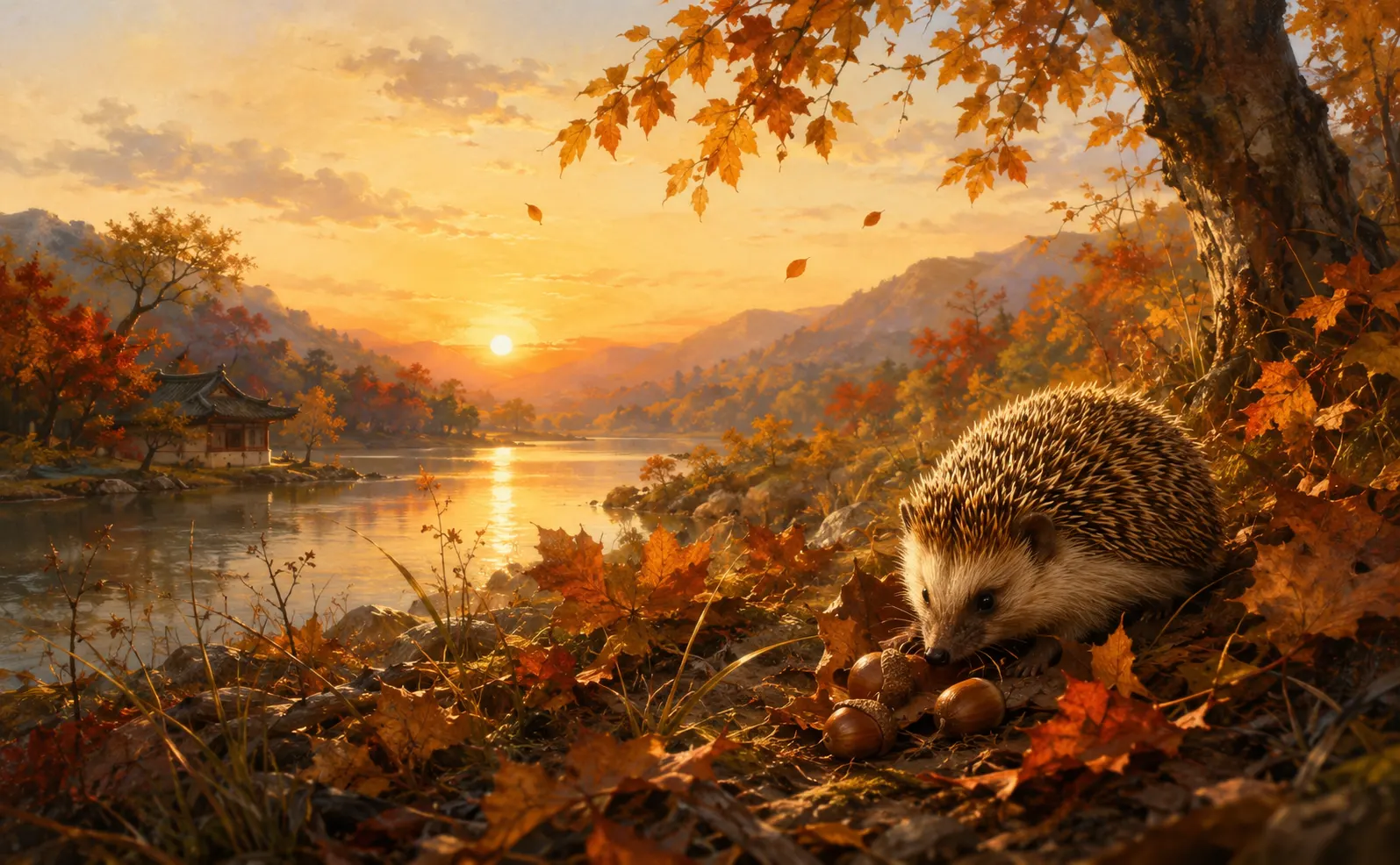
Autumn Equinox Poetry
「金气秋分,风清露冷秋期半。」
Poetry of the Autumn Equinox often writes of day and night being equally divided and of autumn at its most agreeable. Xie Yi’s “金气秋分,风清露冷秋期半” captures the beauty of autumn divided evenly at the equinox; Yuan Zhen’s “琴弹南吕调,风色已高清” records the season of clear winds and cold dew. Poets write of thunder beginning to fall silent, hibernating insects sealing their shelters, and waters beginning to recede, tracing the deepening of autumn through the three seasonal phases of the Autumn Equinox. The Autumn Equinox is among the most pleasant periods of the Twenty-Four Solar Terms—winds are clear, dew is cold, osmanthus fragrance drifts through the air, and the moon is full. On this day, poets divide the beauty of autumn evenly, and divide the beauty of Heaven and Earth into verse.
Autumn Equinox Poetry
晚晴
Original Verse:
返照斜初彻,浮云薄未归。
江虹明远饮,峡雨落馀飞。
凫雁终高去,熊罴觉自肥。
秋分客尚在,竹露夕微微。
Modern Translation:
The slanting light of the setting sun has just broken through the clouds, while thin floating clouds still linger without fully dispersing. A bright rainbow arches over the river like a long dragon drinking from afar; in the gorge, the last remnants of rain are still falling and scattering through the air. Wild ducks and geese eventually rise high and fly away, while bears seem to sense themselves growing steadily fatter. The Autumn Equinox has already arrived, yet I, a traveler, still remain far from home; at dusk, the dew upon the bamboo leaves glimmers faintly.
Commentary:
Du Fu sets this poem against the scenery of an evening at the Autumn Equinox and writes of the feeling of living away from home. “返照斜初彻” describes the setting sun newly breaking through the clouds after rain, while “浮云薄未归” writes the thin clouds still drifting and not yet dispersed. “江虹明远饮” compares the rainbow spanning the river to a long dragon drinking from the water, creating a magnificent image, while “峡雨落馀飞” captures the lingering traces of rain in the gorge as the shower begins to end. Rainbow and rain, distance and nearness, together create a broad sense of space. “凫雁终高去” writes wild geese flying south, one of the seasonal signs of the Autumn Equinox; “熊罴觉自肥” writes animals sensing the autumn chill and accumulating fat in preparation for winter. The final couplet, “秋分客尚在”, reveals that the poet remains a traveler in a foreign place even though the Autumn Equinox has arrived; “竹露夕微微” closes the poem with dew glimmering faintly on bamboo leaves at dusk, the chill of the dew quietly echoing the traveler’s loneliness. The poem weaves personal feeling into the natural seasonal phenomena of the Autumn Equinox, restrained yet substantial.
秋分日忆用济
Original Verse:
秋分一夜雨,残暑几时清。
燕去将何适,鸿来亦有情。
月明千里共,砧动万家声。
遥忆同游处,空山落木平。
Modern Translation:
Rain falls throughout the night of the Autumn Equinox; when will the last of the summer heat finally disappear? Where will the departing swallows go, while the arriving wild geese seem themselves to carry feeling? The bright moon shines upon people a thousand li apart, and the sound of pounding cloth rises from ten thousand households. I think from afar of the places where we once traveled together; in the empty mountains, fallen leaves must now lie level across the ground.
Commentary:
Qu Dajun begins with rain on the night of the Autumn Equinox and writes of his longing for his friend Yongji. “秋分一夜雨” establishes the specific season of an autumn-equinoctial rainy night, while “残暑几时清” writes of autumn deepening after the rain and the remaining summer heat nearing its end. “燕去将何适” writes the seasonal departure of swallows around the Autumn Equinox, while “鸿来亦有情” gives the arriving geese a subjective sense of feeling. “月明千里共” draws upon the idea of Su Shi’s “千里共婵娟”, writing of moonlight linking two people separated by great distance; “砧动万家声” describes the repeated sound of cloth being pounded throughout countless households, conveying both the widespread chill of autumn and the longing associated with the season. The final couplet, “遥忆同游处,空山落木平”, closes with memory: the poet imagines that the places where they once traveled together are now empty mountains covered evenly with fallen leaves. Natural scenery and longing for a friend become one.
点绛唇 · 金气秋分
Original Verse:
金气秋分,风清露冷秋期半。
凉蟾光满,桂子飘香远。
素练宽衣,仙仗明飞观。
霓裳乱,银桥人散,吹彻昭华管。
Modern Translation:
The metal qi of autumn fills the Autumn Equinox; the wind is clear, the dew is cold, and autumn has reached its midpoint. Cool moonlight spreads everywhere, while the fragrance of osmanthus drifts far into the distance. Clad in loose robes of plain white silk, immortal processions shine brightly among lofty towers. The *Nishang* dance grows scattered, people disperse from the Silver Bridge, while the music of the Zhaohua pipes continues to sound through the night.
Commentary:
This lyric, *Dian Jiang Chun · Jin Qi Qiu Fen*, writes the Autumn Equinox in the form of a *ci*, with an atmosphere at once elegant and ethereal. “金气秋分” associates the element metal in the Five Phases with autumn and marks the arrival of the Autumn Equinox. “风清露冷秋期半” describes the season’s clear winds and cold dew, while also stating that autumn has reached its midpoint—pointing directly to the astronomical meaning of the equinox as dividing autumn equally. “凉蟾光满” writes of the moon, represented by the toad, filling the world with cool radiance; “桂子飘香远” describes the fragrance of flowering osmanthus drifting far away. Together, these lines capture the familiar scene around the Autumn Equinox, as the Mid-Autumn period approaches: bright moonlight and osmanthus perfume. In the second stanza, the writing turns toward an immortal realm. “素练宽衣” describes the garments of immortals, while “仙仗明飞观” shows an immortal retinue gleaming among elevated towers. “霓裳乱,银桥人散” writes of music and dance dispersing and people leaving the bridge, creating a sense of emptiness after festivity. The final “吹彻昭华管” closes with lingering music, its echoes continuing into the distance. The lyric moves freely between reality and an immortal world, giving the Autumn Equinox both worldly radiance and transcendent grace.
秋分
Original Verse:
秋分一夜晴,月满桂花清。
露气凝衣湿,天风拂面轻。
雁来沙渚冷,萤去草堂明。
谁念羁栖客,徘徊独夜情。
Modern Translation:
The night of the Autumn Equinox is clear and fine; the moon is full, and the osmanthus blossoms are pure and fragrant. Dew condenses until it dampens my clothes, while a heavenly breeze brushes lightly across my face. Wild geese arrive at the cold sandbars, while the fireflies depart, leaving the thatched hall still bright. Who thinks of me, a traveler lodging far from home, wandering alone through the night with a heart full of feeling?
Commentary:
Xu Wei sets this poem on the night of the Autumn Equinox and writes of the emotions of a traveler away from home. “秋分一夜晴,月满桂花清” depicts a clear autumn-equinoctial night, with a full moon and pure osmanthus blossoms, creating an expansive and luminous scene. “露气凝衣湿” writes the heaviness of the dew, gathering until the clothes are almost wet; “天风拂面轻” writes the lightness of the autumn breeze brushing gently against the face. One is heavy, the other light, together giving the autumn night its distinctive tactile quality. “雁来沙渚冷” writes wild geese arriving at the cold sandbars, a seasonal phenomenon, while “萤去草堂明” shows fireflies departing even as the thatched hall remains bright. One arrives, the other leaves, creating movement among the living creatures of the autumn night. The final couplet, “谁念羁栖客,徘徊独夜情”, directly expresses the traveler’s loneliness. The night of the Autumn Equinox, under a full moon, should be a time of reunion, yet the poet wanders alone, with no one thinking of him. The poem uses bright and beautiful autumn scenery to set off an isolated state of mind, writing sorrow through joyful scenery and thereby deepening the sorrow.
秋分
Original Verse:
秋分才过半,凉意已先秋。
叶落惊残梦,虫吟动客愁。
天高云自远,露重月如钩。
欲寄相思字,鸿飞不可留。
Modern Translation:
The Autumn Equinox has only just passed its midpoint, yet the coolness already seems to anticipate deep autumn. Falling leaves startle me from a lingering dream, while the singing of insects stirs the sorrow of a traveler far from home. The sky is high and the clouds naturally distant; the dew is heavy, and the moon is curved like a hook. I wish to send words of longing, but the wild geese have already flown away and cannot be made to stay.
Commentary:
Zheng Xiaoxu sets this poem against the Autumn Equinox and writes of a traveler’s sorrow and longing. “秋分才过半” marks the season, while “凉意已先秋” writes of the deepening coolness after the equinox, as though deep autumn had arrived in advance. “叶落惊残梦” describes falling leaves startling the poet from an unfinished dream, while “虫吟动客愁” shows autumn insects stirring the sorrow of one living away from home. The verbs “惊”, “startle,” and “动”, “stir,” convey the psychological force of autumn sounds upon the human heart. “天高云自远” describes the openness of the high autumn sky and distant clouds, while “露重月如钩” writes the coldness of heavy dew and a crescent moon like a hook. High and low, distant and near, these images create a three-dimensional autumn night. In the final couplet, “欲寄相思字,鸿飞不可留”, the Autumn Equinox is precisely a season when wild geese fly south. The poet wishes to entrust a letter to them, but the geese have already flown beyond reach. The helplessness of a letter that cannot be sent and longing that cannot arrive appears vividly. The poem uses the seasonal signs of the Autumn Equinox as successive triggers, gradually revealing the many layers of a traveler’s sorrow.
秋分后十日得暴雨
Original Verse:
秋分已过十日期,雨声连夜响空枝。
老夫卧听檐溜急,起看庭树半倾欹。
天公似欲补夏旱,一夜滂沱百谷滋。
明朝晴霁秋光好,且喜新凉入鬓丝。
Modern Translation:
Ten days have already passed since the Autumn Equinox, and all night the rain beats against the bare branches. This old man lies listening to water rushing from the eaves, then rises to see the trees in the courtyard bent halfway over by the storm. Heaven seems intent on making up for the summer drought; one night of torrential rain nourishes all the grains. Tomorrow, when the sky clears, the autumn light will be even finer—and I am glad that this new coolness has quietly entered even the strands of hair at my temples.
Commentary:
Fan Chengda takes a violent rainstorm ten days after the Autumn Equinox as his subject and weaves concern for agriculture into his description of the scene. The opening couplet, “秋分已过十日期,雨声连夜响空枝”, establishes the time and writes the sound of autumn rain striking bare branches throughout the night. “老夫卧听檐溜急” describes the poet lying at ease and listening to the rapid runoff from the eaves, while “起看庭树半倾欹” shows him rising to see the courtyard trees leaning in the wind and rain. “天公似欲补夏旱” interprets the storm as Heaven’s benevolent attempt to compensate for the drought of summer, while “一夜滂沱百谷滋” writes how one night of torrential rain nourishes the crops. Around the Autumn Equinox, late rice is at a crucial stage of grain filling, and sufficient rainfall is therefore vital to the harvest. The final couplet, “明朝晴霁秋光好”, anticipates still finer autumn light after the rain clears, while “且喜新凉入鬓丝” closes on the word “喜”, “delight”: the storm has brought fresh coolness, as well as hope for a good harvest. The poem achieves a natural balance between personal ease and concern for agricultural life.
—-
Readers’ Comments
Calendar and traditional culture enthusiasts from around the world, sharing the same moon.
Sign in or register to join the conversation. Your comment account is created automatically the first time you use a connected account.
No comments yet
Share your thoughts with readers around the world.