Grain Buds Farming
「小满小满,麦粒渐满。」
During 小满 (Xiǎomǎn, Grain Buds), summer-harvest crops across most of China enter a crucial yield-determining stage, while rainfall increases markedly. On the North China Plain, winter wheat enters grain filling and the kernels begin to become full and plump, marking the final stage in determining thousand-kernel weight; across the Yangtze River basin, rapeseed harvesting reaches its peak and early rice enters peak tillering; in South China, early rice advances from young-panicle differentiation into booting, while spring peanuts and spring maize enter vigorous growth. In Northeast China, spring sowing approaches completion, maize and soybean planting is largely finished, and rice transplantation begins; in Northwest China, spring wheat enters the seedling-management stage and cotton emergence management proceeds in an orderly manner. In the temperate Southern Hemisphere, early winter has arrived: autumn-sown crops in southeastern Australia and Argentina enter overwintering, while vineyards enter winter dormancy. Across the tropical Northern Hemisphere, the rainy season expands fully and large-scale rice transplantation begins; in the tropical Southern Hemisphere, the dry season deepens and fields enter dry-season fallow.
Global Agriculture
Temperate Regions of the Northern Hemisphere
Phenological Signs
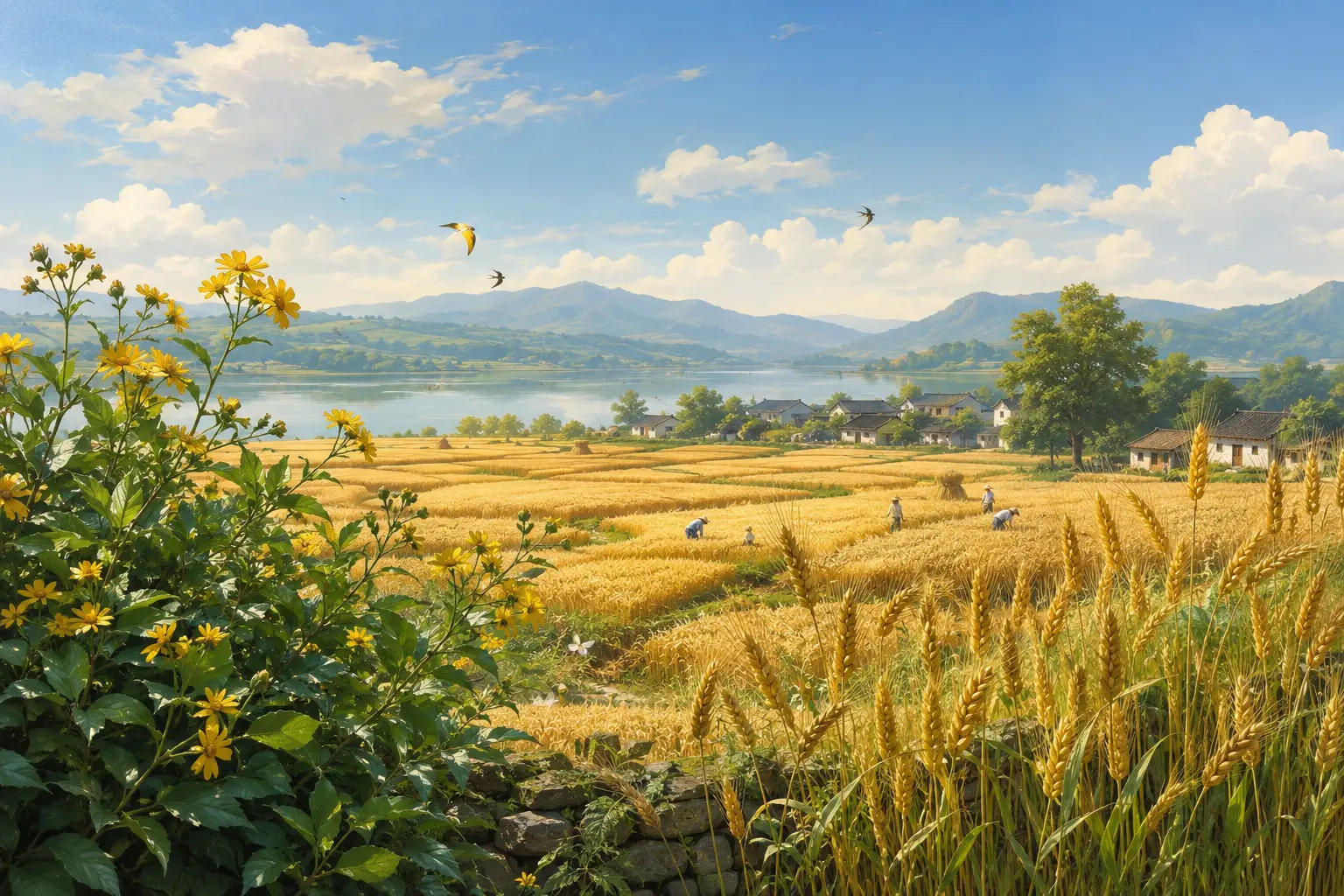
In the middle and lower reaches of China’s Yellow River, wheat fields begin shifting from green to yellow as the ears start filling and becoming plump. 苦菜, a wild edible green, enters vigorous growth, while 靡草, a delicate shade-loving herb, begins to wither under increasingly strong sunlight. Across the Yangtze River basin, the 梅雨 (*plum-rain season*) is about to begin, humidity rises markedly, and fields and roadsides are lush with green. Japan’s Kantō region enters the period immediately before the rainy season, with fresh foliage growing dense; in southern South Korea, wheat fields begin to yellow as spring deepens.
Farming Activities
Winter wheat on the North China Plain enters grain filling, with kernels beginning to become full and plump in the final stage that determines thousand-kernel weight. Farmers need to secure water supply by irrigating promptly where 墒情 (*soil-moisture conditions*) is inadequate, guard against 干热风 through foliar fertilizer applications that strengthen stress resistance, and control pests and diseases including wheat rust, aphids, and wheat midges; management during grain filling directly affects both thousand-kernel weight and final yield, making close attention to weather and field conditions essential. Across the Yangtze River basin, rapeseed enters large-scale harvest as pods turn from green to yellow and seeds become full, prompting farmers to seize clear weather for harvesting, drying, and storage. Early rice enters peak tillering and requires stronger water and nutrient management, including 分蘖肥 (*tillering fertilizer*) and the maintenance of a shallow water layer, to lay the foundation for effective panicle number. In South China, early rice moves from young-panicle differentiation into booting and requires 穗肥 (*panicle fertilizer*), generally 5–8 kilograms of potassium chloride per *mu*. Northern orchards enter fruit enlargement, with young apples, pears, peaches, and other fruits developing rapidly; growers intensify thinning, apply 膨果肥 (*fruit-enlargement fertilizer*), mainly potash, and strengthen pest and disease control. Spring planting in Northeast China approaches completion, maize and soybean sowing is largely finished, and rice transplantation begins, with the rice-growing regions of Heilongjiang and Jilin entering the peak transplanting period. In Northwest China, spring wheat enters seedling management while cotton emergence management proceeds steadily.
Phenological Signs
Temperatures across Western Europe remain stable at 15–20°C, winter wheat enters grain filling and fields begin turning yellow. Across France and Germany, the countryside shifts from pure emerald green toward a mixture of gold and green. In Central Europe, temperatures rise to 15–18°C, forest canopies close fully, bird breeding remains active, and fledglings begin leaving their nests. Farmland along the Danube remains vigorous and full of life.
Farming Activities
Winter wheat in France and Germany enters grain filling, with kernels beginning to fill and plump in a crucial stage for thousand-kernel weight. Farmers strengthen water and nutrient management by securing moisture and irrigating promptly where soil moisture is insufficient, guard against hot, dry winds through foliar fertilizer applications that improve stress resistance, and control pests and diseases as wheat rust and aphids enter key treatment windows. Winter wheat across Ukraine’s chernozem belt likewise enters grain filling and water and nutrient management becomes increasingly precise. In Bordeaux, Rheinhessen, and other wine-producing regions, grapevines move from flowering into fruit set as inflorescences open and fruit begins to form, while spring tying, lateral-shoot removal, flower thinning, and fruit thinning proceed together. In Northern Europe, spring wheat enters seedling management and spring-barley sowing is largely complete.
Phenological Signs
Across the winter-wheat belt of Kansas and Nebraska, temperatures rise to 20–25°C and wheat enters grain filling, while the countryside shifts from green toward yellow. Orchards in California’s Central Valley enter fruit enlargement and young fruit develops rapidly. Across the U.S. Midwest, spring maize enters the seedling stage and fields are covered in fresh green. In Ontario, Canada, forest canopies close fully and the colors of spring deepen into dark green.
Farming Activities
Winter wheat across Kansas, Nebraska, and neighboring areas enters grain filling, with kernels becoming full as water and nutrient management reaches its final critical phase. Farmers need to secure adequate water and guard against hot, dry winds through foliar fertilizer applications. Orchards in California’s Central Valley enter fruit enlargement, prompting growers to strengthen fruit thinning, apply 膨果肥, primarily potash, and control pests and diseases, with codling moth and oriental fruit moth entering key treatment windows. Across the U.S. Midwest, spring maize enters seedling management, including stand inspection and gap filling, thinning and final stand establishment, application of seedling fertilizer, and control of seedling-stage pests. Cotton and peanuts in the southeastern United States enter the seedling-management stage. Across Canada’s Prairie Provinces, spring wheat enters seedling management and spring planting is largely complete.
Phenological Signs
Winter wheat on Turkey’s Anatolian Plateau enters grain filling and wheat fields begin turning yellow. Along Iran’s Caspian coast, fruit trees enter fruit enlargement. In Morocco and Algeria, winter wheat enters grain filling and the colors of the countryside gradually shift.
Farming Activities
Winter wheat in Turkey, Iran, and other parts of the Middle East enters grain filling, spring irrigation reaches its final stage, and farmers need to secure water supply while guarding against hot, dry winds. Along the Mediterranean coasts of Israel, Morocco, and other parts of North Africa, winter wheat likewise enters grain filling and water and nutrient management reaches its last critical phase. In South Africa’s Cape region, vineyards enter winter dormancy and winter pruning expands fully.
Temperate Regions of the Southern Hemisphere
Phenological Signs
Early winter has arrived. Average daily temperatures fall to 5–10°C and the weather is cool. Pastures have turned completely yellow and the winter landscape is clearly established. Autumn-sown crops enter overwintering and growth largely stops. Morning frosts are frequent and daylight is shorter than night.
Farming Activities
Autumn-sown crops—winter wheat, barley, and rapeseed—enter overwintering, with growth largely ceasing as the plants become dormant. Strong plants established before winter provide the foundation for spring recovery and tillering in the following year, while weak stands need supplemental fertilization before winter to strengthen the crop. Vineyards enter full winter dormancy and winter pruning expands widely, removing excess canes, adjusting vine structure, and regulating the following year’s crop load. Pastures enter winter management, grazing density is reduced to a minimum, supplementary feeding begins fully, and livestock move into housed management to ensure safe overwintering.
Phenological Signs
Temperatures fall to 5–10°C and winter formally arrives. Grasslands turn completely yellow and the countryside becomes open and bare. Autumn-sown crops enter overwintering. Morning frosts become frequent and daylight remains shorter than night.
Farming Activities
Autumn-sown crops—winter wheat, barley, and rapeseed—enter overwintering as growth largely stops and the plants become dormant. Before winter fully arrives, farmers need to complete stand inspection and gap filling, irrigation to strengthen seedlings, and other work needed to ensure strong stands before overwintering. Storage and sales of summer crops are completely finished. Vineyards enter winter dormancy and winter pruning expands fully, while orchards also enter winter dormancy and winter pruning begins in succession.
Phenological Signs
Temperatures fall to 3–8°C and winter arrives. Pasture growth stops and grass turns yellow. Deciduous fruit trees lose all their leaves and kiwifruit vines enter dormancy. Morning frosts are frequent and snowfall increases at higher elevations.
Farming Activities
Pastures enter winter management, grazing density falls to its lowest level, supplementary feeding expands fully, and livestock move into housed management. Kiwifruit orchards enter winter dormancy and winter pruning expands widely in preparation for the following year’s growth. Vineyards also enter full winter dormancy and winter pruning begins on a broad scale. The export season remains at its peak, with large volumes continuing to supply Northern Hemisphere markets.
Phenological Signs
The Central Valley enters early winter and temperatures continue to decline. Orchard trees have shed all their leaves and the winter landscape is clearly visible. Morning frosts are frequent.
Farming Activities
Orchards enter winter dormancy, winter pruning expands fully, and cold-protection measures are put in place. Vineyard winter pruning also spreads widely in preparation for the next year’s growth. Wineries enter the wine-aging stage as the crushing season comes entirely to an end.
Tropical and Subtropical Regions
Phenological Signs
The rainy season expands fully, rainfall is abundant, and atmospheric humidity remains high. Thailand, Myanmar, Laos, and neighboring areas receive plentiful rainy-season precipitation and the landscape turns intensely green. India’s Southwest Monsoon becomes fully established, bringing a marked increase in rainfall along the southern and eastern coasts. In southernmost China, early rice enters vigorous growth and fields are covered in fresh green.
Farming Activities
Large-scale rice transplantation gets underway as rainy-season rice seedlings across Southeast Asia reach transplanting standards and enter the main transplanting period. Vietnam’s Mekong Delta, Thailand’s central plain, and Cambodia’s Tonlé Sap Plain enter their busiest rice-transplanting period, with farmers preparing fields, transplanting seedlings, and applying fertilizer simultaneously. As India’s Southwest Monsoon becomes fully established, rice transplantation expands on a large scale there as well. In southernmost China, early rice advances from young-panicle differentiation into booting, while spring maize and spring peanuts enter vigorous growth and field management becomes increasingly precise.
Phenological Signs
The dry season deepens, clear and dry conditions persist, and rainfall falls to zero. Fields across central-western Brazil remain bare and the dry-season landscape is pronounced. In southern Africa, fields remain open and the dry season continues. The air is dry and the difference between daytime and nighttime temperatures becomes marked.
Farming Activities
Harvesting of summer crops is entirely complete and the dry-season fallow period begins. Farmers use the dry season to rest and prepare fields, maintain irrigation and water-conservancy infrastructure, and service agricultural machinery. In areas with irrigation, dry-season crops such as wheat, barley, and rapeseed enter growth management and available irrigation water must be used fully. In central Brazil, second-season maize enters tasseling and silking and requires stronger water and nutrient management, including 穗肥 and adequate moisture supply; this is a critical water-demand stage for maize, and drought can cause poor pollination and reduce kernel number per ear. In northern Australia, sugar-mill crushing operations come fully to an end and facilities enter inspection and maintenance.
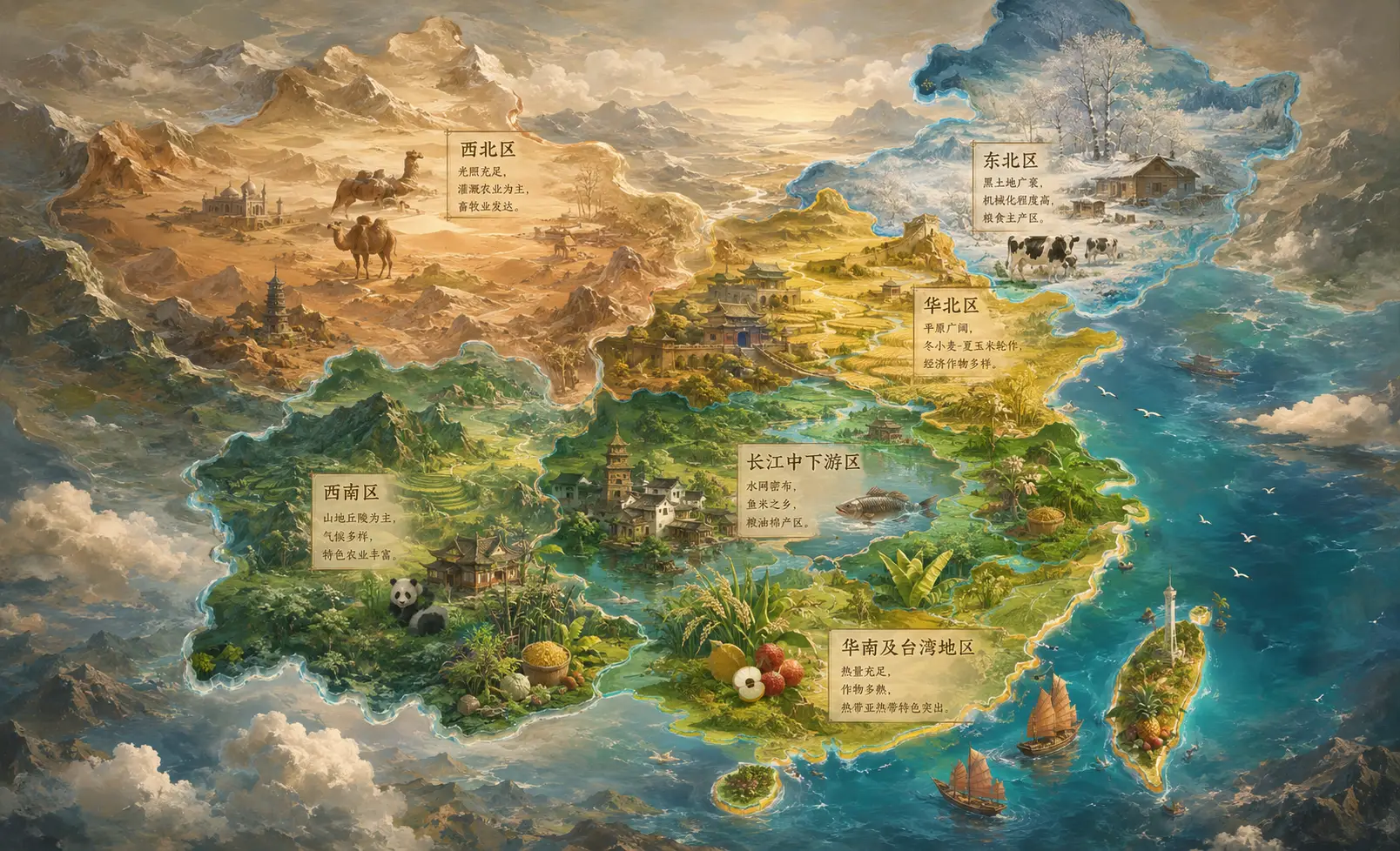
China’s Six Major Agricultural Regions
| Agricultural Region | Major Provinces | Keywords |
|---|---|---|
| Northeast | Heilongjiang, Jilin, Liaoning, eastern Inner Mongolia | End of spring sowing, rice transplantation, maize seedling stage, soybean emergence |
| Northwest | Xinjiang, Gansu, Ningxia, western Inner Mongolia, Qinghai | Spring-wheat seedlings, cotton emergence, winter-wheat grain filling, spring irrigation |
| North China | Hebei, Shanxi, Beijing, Tianjin, Shandong, northern Henan | Winter-wheat grain filling, hot dry wind prevention, spring-maize seedlings, pest and disease control |
| Middle and Lower Yangtze | Hubei, Hunan, Jiangxi, Anhui, Jiangsu, northern Zhejiang, Shanghai | Rapeseed harvest, early-rice tillering, plum-rain preparation, ditch clearing and waterlogging prevention |
| Southwest | Sichuan, Chongqing, Guizhou, Yunnan, southeastern Tibet | Winter-wheat grain filling, rapeseed harvest, potato management, end of spring tea |
| South China and Taiwan | Guangdong, Guangxi, Hainan, southern Fujian, Taiwan Province | Early-rice panicle differentiation, peanut and maize growth, fruit retention, aquaculture |
Heilongjiang, Jilin, Liaoning, eastern Inner Mongolia
Around Grain Buds, spring sowing across Northeast China is largely complete, with maize and soybean planting fully finished and rice entering large-scale transplantation, shifting the agricultural rhythm from “sowing” to “seedling management.”
Spring sowing comes fully to an end. By Grain Buds, spring planting across Northeast China is basically complete, with maize and soybean sowing both finished. Crops planted during the spring sowing period emerge successively and enter seedling management. Spring-sown acreage in Jilin, Heilongjiang, Liaoning, and neighboring provinces reaches its seasonal maximum, and planting quality directly affects the harvest for the entire year.
Large-scale rice transplantation. Around Grain Buds, rice across Northeast China enters large-scale transplantation as seedlings reach the “四叶一心” stage—four developed leaves and one central emerging leaf—and begin moving into the main field. Rice-growing regions of Heilongjiang and Jilin enter the peak transplanting period, with rice transplanters operating throughout the fields; after transplantation, a shallow water layer of 3–5 centimeters is maintained to promote 返青 (*post-transplant recovery*) and low-position tillering. Rice transplantation is generally completed between Grain Buds and 芒种 (Mángzhòng, Grain in Ear).
Maize seedling management. After emergence, spring maize enters a crucial seedling-management stage that includes 查苗补缺 (*checking stands and filling gaps*), with missing plants or broken rows replanted or supplemented promptly; thinning and final stand establishment at the 3–4 leaf stage, leaving 1–2 strong plants per hill; the first intertillage at 5–8 centimeters deep to weed, loosen the soil, raise soil temperature, and encourage root development; application of 苗肥 (*seedling fertilizer*) at 5–8 kilograms of urea per *mu* to promote young-plant growth; and prompt control of seedling pests such as cutworms and mole crickets that feed on young plants.
Soybean emergence management. Soybeans emerge successively after sowing and enter seedling management, including stand inspection and gap filling, thinning and final stand establishment with 2–3 strong plants per hill, intertillage and soil loosening, and control of seedling-stage pests.
Pasture management. Pastures in eastern Inner Mongolia enter rapid growth and livestock move fully into grazing. Herders implement rotational grazing systems to use grassland resources rationally and prevent overgrazing.
Protected agriculture. Peak greenhouse-vegetable production continues in southern Liaoning, while open-field vegetables enter rapid growth and harvest.
Xinjiang, Gansu, Ningxia, western Inner Mongolia, Qinghai
Around Grain Buds, Northwest China moves into the spring agricultural-management stage: spring wheat enters seedling management, cotton emergence management advances in an orderly manner, and winter wheat in southern Xinjiang enters grain filling.
Spring-wheat seedling management. In the Hexi Corridor of Gansu and the Yellow River irrigation districts of Ningxia, spring wheat enters a critical management stage after emergence. Farmers inspect stands and fill gaps by promptly resowing missing sections, carry out the first intertillage at 5–8 centimeters deep to weed, loosen the soil, and raise soil temperature, apply 苗肥 at 5–8 kilograms of urea per *mu* to promote tillering and root development, and control seedling-stage pests and diseases such as aphids and cutworms. Seedling growth directly affects the proportion of tillers that ultimately form ears and therefore final yield.
Cotton emergence management. Cotton seedlings emerge successively across Xinjiang’s cotton-growing areas and enter a critical management period that includes stand inspection and gap filling through resowing or transplanting where plants are missing, the first intertillage at 5–8 centimeters deep, and control of seedling pests and diseases such as cutworms, aphids, and cotton thrips. The quality of cotton emergence is directly related to annual yield and requires precise management.
Winter-wheat grain-filling management in southern Xinjiang. Winter wheat in the Tarim Basin enters grain filling around Grain Buds, with kernels beginning to become full and plump in a crucial stage for determining thousand-kernel weight. Water supply must be secured by irrigating promptly where soil moisture is inadequate, generally at 40–50 cubic meters per *mu*; farmers also need to guard against hot, dry winds through foliar fertilizer applications that improve stress resistance and control wheat rust, aphids, and other pests and diseases. Management during grain filling directly affects both thousand-kernel weight and final yield.
Final stage of spring irrigation. Spring irrigation in Gansu, Ningxia, and western Inner Mongolia enters its final stage around Grain Buds. Wheat fields where irrigation has not yet been completed need to finish promptly to secure adequate water during winter-wheat grain filling. Spring irrigation is largely completed around Grain Buds.
Orchard management. Apples, fragrant pears, grapes, and other fruit crops in southern Xinjiang move from fruit set into the early stage of fruit enlargement. Growers need to thin and set fruit by removing overly dense, malformed, or pest-damaged young fruit, apply 膨果肥, mainly potash, and control pear psylla, aphids, spider mites, codling moth, and other pests entering key treatment windows.
Specialty crops. Potatoes around Dingxi, Gansu, enter seedling management; goji in Ningxia moves from flowering into the young-fruit stage and requires stronger water and nutrient management; and processing tomatoes in Xinjiang enter seedling management.
Hebei, Shanxi, Beijing, Tianjin, Shandong, northern Henan
Around Grain Buds, North China enters the final critical stage for determining winter-wheat yield, with grain filling fully underway while spring maize enters seedling management.
Winter-wheat grain-filling management. Winter wheat across the North China Plain enters full grain filling, with kernels beginning to become full and plump in the final stage determining thousand-kernel weight. Farmers need to secure water supply by irrigating promptly where soil moisture is inadequate, generally at 40–50 cubic meters per *mu*; guard against hot, dry winds by immediately applying foliar fertilizer when temperatures reach 30°C or higher, relative humidity falls to 30% or lower, and wind speed reaches at least 3 meters per second; and control wheat rust, powdery mildew, aphids, wheat midges, and other pests and diseases. Management during grain filling directly affects thousand-kernel weight and final yield, so farmers need to follow weather forecasts and field conditions closely. 干热风 is the greatest threat to wheat during grain filling in North China and can leave kernels shriveled and thin, reducing yield by 10–20%.
Spring-maize seedling management. After emergence, spring maize enters a critical seedling-management stage that includes stand inspection and gap filling through prompt resowing or transplanting where rows are broken, thinning and final stand establishment at the 3–4 leaf stage with 1–2 strong plants per hill, the first intertillage at 5–8 centimeters deep, application of 苗肥 at 5–8 kilograms of urea per *mu*, and control of seedling-stage pests including cutworms, mole crickets, and aphids. Seedling growth directly affects ear number and final yield.
Pest and disease control. As temperatures rise, wheat pests and diseases enter a high-incidence period. The principal targets are wheat rust, treated with triadimefon or tebuconazole; wheat powdery mildew, treated with triadimefon; aphids, treated with imidacloprid; and wheat midge, treated with lambda-cyhalothrin. Farmers need to inspect fields at least once a week and intervene promptly when problems are detected.
Orchard management during fruit enlargement. Apple-, pear-, and peach-growing areas across North China enter fruit enlargement, with young fruit developing rapidly. Growers need to thin and set fruit by removing overly dense, malformed, or pest-damaged young fruit; apply 膨果肥, mainly potash, to promote development and improve quality; and strengthen control of apple ring rot, pear scab, peach aphids, oriental fruit moth, and other pests and diseases entering key treatment windows.
Vegetable management. Open-field vegetables across North China enter rapid growth. Spring radish, spring Chinese cabbage, spring cabbage, yardlong beans, and other crops enter harvest or crucial growth stages in succession and require stronger water and nutrient management together with pest and disease control.
Hubei, Hunan, Jiangxi, Anhui, Jiangsu, northern Zhejiang, Shanghai
Around Grain Buds, the middle and lower Yangtze enters the closing stage of spring agriculture and prepares for the approaching plum-rain season, as large-scale rapeseed harvesting, peak early-rice tillering management, and rainy-season preparations overlap.
Large-scale rapeseed harvesting. Rapeseed across the Yangtze River basin enters large-scale harvest around Grain Buds as pods turn fully yellow and the seeds become plump and brown, reaching physiological maturity. Farmers seize clear weather to harvest—either manually or mechanically—then dry, thresh, clean, and store the crop. Rapeseed harvesting generally takes place between Grain Buds and Grain in Ear. Harvesting too early produces insufficiently filled seed and lower thousand-kernel weight, while harvesting too late increases losses from pod shattering, making precise timing essential. Fields are plowed immediately after harvest in preparation for the next crop, generally middle-season or late rice.
Management of early rice at peak tillering. Early rice across the Yangtze River basin enters peak tillering around Grain Buds, having fully completed 返青 after transplantation and begun producing large numbers of tillers. Tillering is the key stage determining effective panicle number, so management centers on maintaining a shallow water layer of 3–5 centimeters without allowing fields to dry; applying 分蘖肥 at the beginning of tillering, generally 5–8 kilograms of urea per *mu*; and carrying out 晒田控苗 (*draining and drying the paddy to regulate crop growth*) once the target tiller number is reached, with the field drained and dried for 7–10 days to suppress unproductive tillers and encourage deeper rooting. Paddy drying is an important rice-management technique: drying too early reduces productive tillering, while drying too late allows excessive unproductive tillers to consume nutrients.
Preparing for the plum-rain season. Around Grain Buds, the 梅雨 season is about to begin across the middle and lower Yangtze, generally between Grain Buds and Grain in Ear. Before it arrives, farmers need to complete ditch clearing and field drainage management by inspecting drainage systems and ensuring that the “三沟” drainage system remains unobstructed, thereby preventing water accumulation and waterlogging during the plum rains. Because field humidity becomes high and pests and diseases occur readily during this period, preventive preparations need to be made in advance.
Ditch clearing and waterlogging prevention. Rainfall continues increasing around Grain Buds and field humidity remains high. Farmers need to keep drainage systems under continual inspection and ensure that the “三沟” remain unobstructed so that waterlogging does not develop.
Greenhouse and open-field vegetables. Fruiting vegetables under greenhouse production enter peak harvest, with tomatoes, cucumbers, and peppers reaching the market in large quantities. Open-field vegetables—including yardlong beans, green beans, eggplants, peppers, and other summer crops—also begin reaching the market in succession.
Sichuan, Chongqing, Guizhou, Yunnan, southeastern Tibet
Around Grain Buds, agricultural activity across Southwest China enters summer management, centered on winter-wheat grain filling, rapeseed harvesting, potato tuber enlargement, and the complete end of spring-tea picking.
Winter-wheat grain-filling management. Winter wheat in the Sichuan Basin enters grain filling around Grain Buds, with kernels becoming full and plump in a crucial stage for determining thousand-kernel weight. Farmers need to secure adequate water by irrigating where soil moisture is insufficient, guard against hot, dry winds through foliar fertilizer applications that strengthen stress resistance, and control wheat rust, aphids, and other pests and diseases. Grain-filling management directly affects thousand-kernel weight and final yield.
Rapeseed harvest. Rapeseed in Sichuan and Guizhou enters large-scale harvest as pods turn fully yellow and seeds become plump, prompting farmers to seize clear weather for harvesting, drying, and storage.
Potato management during tuber enlargement. Spring potatoes in the main producing areas of Yunnan, Guizhou, and Sichuan enter tuber enlargement around Grain Buds, with underground tubers expanding rapidly in a crucial stage for both yield and marketable quality. Management centers on carrying out the final intertillage and earthing-up to prevent tubers from being exposed to light and turning green; applying 结薯肥 (*tuber-development fertilizer*), primarily potash, at 8–10 kilograms of potassium sulfate per *mu*; controlling late blight, the crop’s most important disease, which enters its peak treatment period around Grain Buds and is treated with mancozeb or metalaxyl; and irrigating at the proper time to secure water during tuber enlargement without allowing waterlogging. Management during this stage directly affects both yield and quality.
Spring-tea picking ends completely. Spring-tea harvesting across Sichuan, Guizhou, and Yunnan is fully completed around Grain Buds. Tea growers shift entirely into summer garden management, carrying out pruning immediately after spring harvest to encourage summer and autumn shoots, applying summer fertilizer primarily based on nitrogen, and controlling pests such as tea green leafhoppers and tea geometrid moths as they enter treatment windows.
Orchard management. Citrus- and loquat-growing areas of Southwest China enter fruit enlargement, with young citrus fruit developing rapidly and loquats approaching maturity. Water and nutrient management needs to be strengthened through applications of 膨果肥, mainly potash, together with pest and disease control.
Guangdong, Guangxi, Hainan, southern Fujian, Taiwan Province
#### (1) Mainland South China
Management of early rice from young-panicle differentiation to booting. Early rice across South China advances from young-panicle differentiation into booting around Grain Buds, with young panicles rapidly differentiating and developing and approaching emergence. This is a crucial stage for determining kernel number per panicle. Management centers on maintaining a shallow water layer of 3–5 centimeters without allowing the field to dry, applying 穗肥, mainly potash, at 5–8 kilograms of potassium chloride per *mu*, and carrying out 晒田控苗 once unproductive tillers have been brought under control. Young-panicle differentiation and booting form a critical stage of rice yield formation, and the precision of management directly affects kernel number and final production.
Growth management of spring peanuts and spring maize. Spring peanuts enter pod setting, with large numbers of pods developing and enlarging underground, requiring stronger water and nutrient management through applications of 结荚肥 (*pod-setting fertilizer*) at 10–15 kilograms of compound fertilizer per *mu*, together with control of peanut leaf spot, aphids, cotton bollworm, and other pests and diseases. Spring maize moves from tasseling and silking into grain filling: tassels emerge, female ears produce silks and are pollinated, and kernels begin filling. Water supply must be secured because this is a critical water-demand stage and drought can cause poor pollination and reduced kernel number; 穗肥 is also applied at 8–10 kilograms of urea per *mu*.
Fruit retention and development in tropical orchards. Mangoes in Hainan and Guangxi enter fruit development and require stronger water and nutrient management through 膨果肥, mainly potash, together with control of mango gall midges and thrips. Early lychee cultivars move from fruit enlargement toward the stage just before maturity and require stronger water and nutrient supply, while middle- and late-season cultivars advance from young-fruit development into fruit enlargement and require careful fruit retention. Citrus in Guangdong and Guangxi moves from the young-fruit stage into early fruit enlargement; excessive summer-shoot growth needs to be controlled, while citrus red mites, leaf miners, and other pests require treatment.
Vegetables and aquaculture. Open-field vegetables across South China enter rapid growth and peak harvest. Rising temperatures bring pests and diseases into a high-incidence period and require stronger control. In aquaculture, fish enter rapid growth, feed quantities increase gradually, and water-quality management and disease prevention need to be strengthened. Heavy rainfall also increases during South China’s early flood season, making flood prevention necessary in aquaculture operations.
#### (2) Taiwan
Rice: The first rice crop in central Taiwan—including Changhua, Yunlin, and the Chianan Plain—enters peak grain filling around Grain Buds, with kernels filling rapidly and becoming plump in a crucial stage for determining thousand-kernel weight. Fields should maintain a shallow water layer of 3–5 centimeters, receive 粒肥 (*grain-filling fertilizer*), mainly potash, and remain under close observation for panicle-stage pests and diseases such as rice blast, sheath blight, and stem borers. In southern Taiwan, particularly the Kaohsiung–Pingtung region, rice moves from peak grain filling toward the stage just before maturity and some early cultivars begin turning yellow. In northern Taiwan, including Taoyuan and Hsinchu, rice advances from young-panicle differentiation into booting.
Vegetables: Vegetable sowing and transplantation continue across Taiwan during Grain Buds. In central areas, cucurbits such as watermelon, cucumber, and muskmelon enter flowering and fruiting and require stronger water and nutrient management. In the south, ginger, 越瓜, and other crops enter vigorous growth.
Fruit trees: Mangoes in southern Taiwan enter fruit development and require attention to fruit retention and mango gall midge control. Lychees enter fruit enlargement and require both fruit-retention management and control of fruit borers. Citrus advances from the young-fruit stage into early fruit enlargement, and excessive summer-shoot growth needs to be controlled.
Tea: Spring-tea harvesting in central and southern tea-growing areas such as Nantou and Chiayi is fully complete, and growers move into summer garden management through pruning, fertilization, and pest and disease control. In northern tea districts such as Wenshan and Sanxia, spring-tea harvesting is also largely finished.
Fisheries: Catches in waters around Taiwan continue to increase during Grain Buds, with the spring fishing season entering its peak and mackerel, Spanish mackerel, pomfret, and other species continuing to be landed.
Farmer’s proverbs and folk customs: Taiwanese folk tradition preserves the saying “小滿小滿,雨水相趕”—around Grain Buds, the plum-rain season is approaching and rainfall becomes abundant—as well as “小滿不下,乾斷田坎”—if it does not rain around Grain Buds, spring drought may continue and affect rice growth.
Global Extreme Weather · Risks & Responses
Temperate Northern Hemisphere: Hot, Dry Winds—the Greatest Threat of Grain Buds
Around Grain Buds, the extreme-weather event requiring the greatest attention across the temperate Northern Hemisphere remains 干热风 (*hot, dry wind*). Winter wheat is in grain filling, the crucial stage when kernels become full, and is highly sensitive to high temperatures, low humidity, and strong winds; hot, dry winds cause overly rapid leaf transpiration, disrupt photosynthesis, and reduce grain filling, lowering thousand-kernel weight and potentially cutting yield by 10–30%. The North China Plain, the Kansas wheat belt in the United States, and Ukraine’s chernozem region are all areas of frequent occurrence. Farmers need to apply foliar fertilizer—monopotassium phosphate plus amino-acid water-soluble fertilizer—before hot, dry winds arrive and irrigate at the proper time to raise field humidity.
Temperate Northern Hemisphere: Severe Convective Weather and Preparation for the Plum Rains
Severe convective weather continues to increase around Grain Buds, with thunderstorms, hail, short-duration heavy rain, and strong winds occurring frequently. Hail can damage young fruit and tender shoots and leaves, as well as greenhouse structures; strong winds can lodge winter wheat during grain filling; and heavy rainfall may cause field ponding and waterlogging. Across the middle and lower Yangtze, the plum-rain season is about to begin, so farmers need to inspect drainage systems comprehensively before its arrival and ensure that the “三沟” drainage system remains unobstructed. Because field humidity is high and sunshine limited during the plum rains, pests and diseases occur readily and preventive measures need to be prepared in advance.
Temperate Northern Hemisphere: Continuing Spring Drought in Northern China
Rainfall remains relatively limited across North and Northwest China during Grain Buds, leaving spring drought as a major threat. Winter wheat enters its peak water-demand stage during grain filling, while spring maize at the seedling stage also requires moisture. Persistent drought can seriously affect thousand-kernel weight in winter wheat and seedling growth in spring maize. Farmers need to make full use of available irrigation resources, arrange watering in a rational order, and give priority to grain-filling irrigation for winter wheat.
Temperate Southern Hemisphere: Preparing Crops and Livestock for Winter
In the Southern Hemisphere’s early winter, around mid- to late May, winter becomes fully established. Autumn-sown crops—winter wheat, barley, and rapeseed—enter overwintering and need to establish strong plants before winter. Weak seedlings have higher winter mortality and can reduce yield in the following year, so farmers need to complete stand inspection and gap filling, irrigation to strengthen seedlings, and pest and disease control before winter arrives. Pastures also enter winter management, livestock move into housed systems, and supplementary feeding becomes fully established.
A Shared Global Trend: the Meaning of “Fullness” in Grain Buds Is Changing
The “满” in 小满 traditionally refers to the kernels of wheat and other summer-harvest crops beginning to fill and become plump. Against the background of global climate warming, however, the grain-filling period of winter wheat in northern China shows a tendency to begin earlier: grain filling starts sooner and the grain-filling period becomes shorter, potentially reducing thousand-kernel weight. At the same time, the onset, end, and intensity of the 梅雨 season in southern China—which begins between Grain Buds and Grain in Ear—show increasing interannual variability; an excessively early plum-rain season can reduce sunlight available to early rice, while an excessively late onset can cause drought and water shortages, and both may affect yields. The climatic experience embodied in the Grain Buds solar term therefore needs to be applied flexibly in combination with actual contemporary weather conditions.
----
Readers’ Comments
Calendar and traditional culture enthusiasts from around the world, sharing the same moon.
Sign in or register to join the conversation. Your comment account is created automatically the first time you use a connected account.
No comments yet
Share your thoughts with readers around the world.