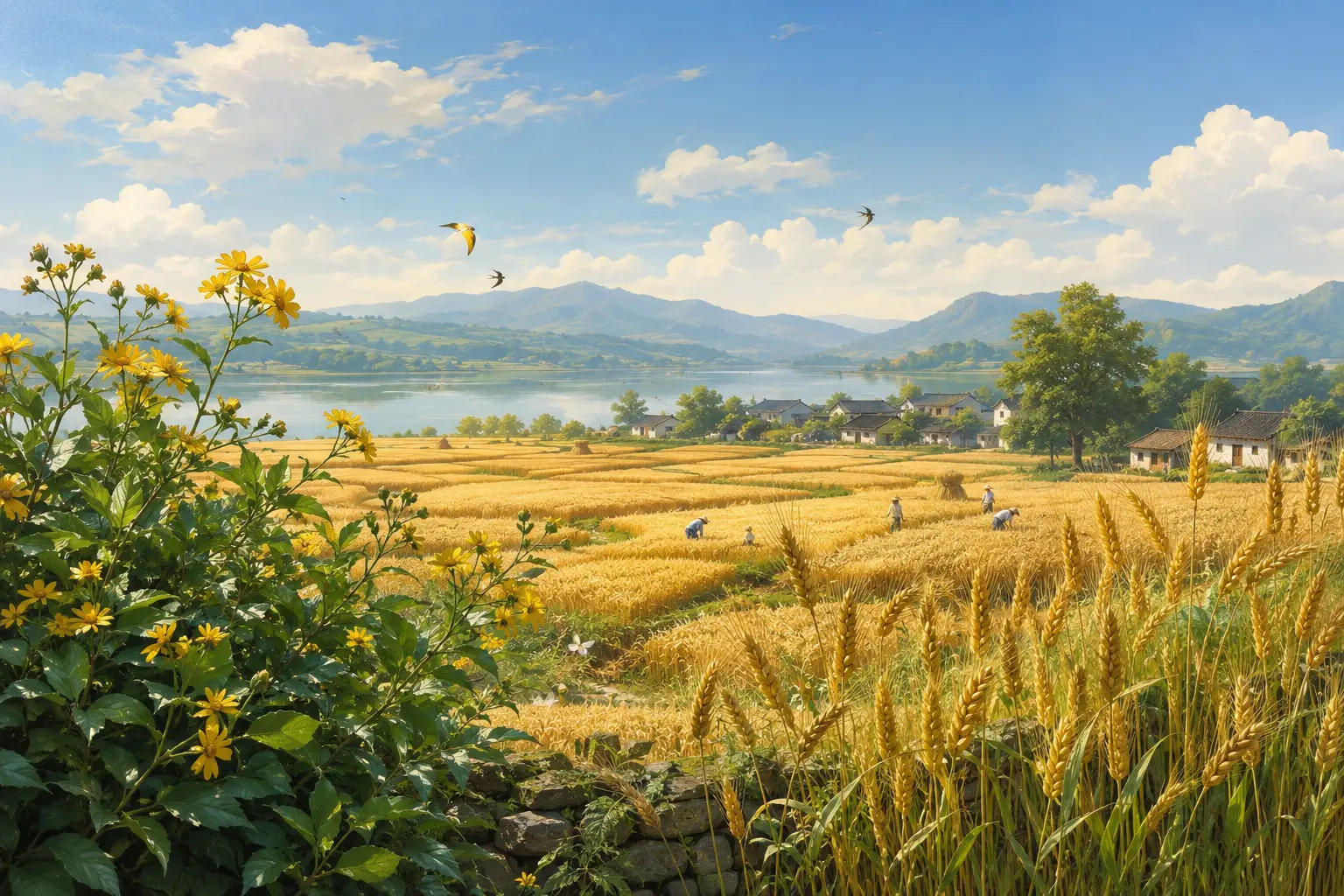
Grain Buds Customs
「小满动三车,忙得不知他」
The customs of Grain Buds can be summarized through five actions: 祭、祈、抢、食、动 — to sacrifice, pray, race for water, eat, and set in motion. Sacrificing refers to worshipping the wheel deity: when the waterwheel is first put into operation, offerings are made to the deity, traditionally imagined as a white dragon, in hopes that water will flow abundantly. Praying refers to the Silkworm-Prayer Festival, when sericulture communities in Jiangsu and Zhejiang celebrate the birthday of the silkworm deity and ask for a plentiful cocoon harvest. Racing for water means that farming households gather at dawn and tread the waterwheels, drawing river water into the fields to relieve drought. Eating means eating bitter greens, which once helped people through the lean interval between old provisions and the new harvest and were also traditionally valued for clearing heat and reducing internal fire. Setting in motion means putting the Three Wheels to work together—the waterwheel, oil press, and silk-reeling wheel—signaling the arrival of one of the busiest agricultural periods of the year.
Among these five groups of customs, worshipping the wheel deity and racing for water focus on irrigation, drought relief, and safeguarding the harvest; the Silkworm-Prayer Festival centers on Jiangnan sericulture and the silk economy; while eating bitter greens belongs more closely to everyday subsistence and seasonal nourishment. Together they form a complete cultural landscape extending from south to north, from field to silkworm house, and from ritual to ordinary life. Three cultural ideas run through them. The first is following the proper time of nature: the saying “小满动三车”—at Grain Buds, the Three Wheels begin to turn—is a direct agricultural response to seasonal climatic rhythms. The second is reverence for nature: sacrifices to the wheel deity and the silkworm deity both express gratitude toward natural powers and prayers for their favor. The third is living with diligence and thrift, embodied in the eating of bitter greens during the difficult interval before the new harvest. Grain Buds is therefore one of the solar terms richest in both agricultural feeling and philosophical reflection. Among the Twenty-Four Solar Terms, there are Lesser Heat and Greater Heat, Lesser Snow and Greater Snow, Lesser Cold and Greater Cold—yet there is only Xiaoman, literally “Lesser Fullness,” and no corresponding “Greater Fullness.” The ancients were wary of becoming too full, holding to the wisdom that “满招损,谦受益”—fullness invites loss, while humility brings benefit. Xiaoman, when things are approaching fullness but have not yet become completely full, is precisely the state they considered most desirable in life.
Regional Customs of This Solar Term
| Region | Signature Customs | Notable Features |
|---|---|---|
| Jiangnan rice-growing regions, including Jiangsu, Zhejiang, and Shanghai | Worshipping the wheel deity | Before the waterwheel is started, fish, meat, incense, and candles are offered at its base; a cup of clear water is poured into the field to pray for an abundant water supply |
| Haining, Zhejiang, and surrounding areas | Racing for Water | Villagers gather at dawn, light torches, eat wheat cakes, and operate dozens of waterwheels together to draw river water into the fields |
| Sericulture regions of Jiangsu and Zhejiang, including Suzhou, Huzhou, Jiaxing, and Hangzhou | Silkworm-Prayer Festival and Silkworm Flower temple fairs | Grain Buds is regarded as the birthday of the silkworm deity; farmers offer sacrifices for abundant cocoons, with the Ya Canhua Temple Fair at Hanshan especially celebrated |
| Northern wheat-growing regions across China | Xiaoman Fair | Rural market fairs for exchanging farm tools, seeds, livestock, and other agricultural goods |
| Nationwide | Eating bitter greens | Bitter greens flourish around Grain Buds and were traditionally gathered as wild food, also associated with clearing heat and reducing internal fire |
| Lingnan | Eating bitter melon | Bitter melon is eaten to clear heat, reduce internal fire, and relieve summer discomfort |
Grain Buds Customs
Silkworm-Prayer Festival
Popular Regions:
Activities:
The Silkworm-Prayer Festival is a folk celebration found in the sericulture regions of Jiangsu and Zhejiang and held during Grain Buds to pray for a plentiful harvest of silkworm cocoons. Tradition regards Grain Buds as the birthday of the silkworm deity, so the festival is usually observed during this solar term. Each household celebrates it on the particular day when its own silkworms are formally set out, and there is therefore no single fixed date.
The ancients regarded the silkworm as a “heavenly creature.” To express gratitude for the deity’s gifts and to ask for prosperity in sericulture, farmers developed numerous forms of worship. Rice flour was shaped into cocoon-like offerings, incense was burned, and prayers were made for thick cocoons and abundant silk. Some regions also preserved rites intended to remove harmful influences, such as wearing decorative Silkworm Flowers in the hair, sweeping the ceremonial Silkworm Flower ground, and posting images of the silkworm deity. The Qing-dynasty *Qing Jia Lu* records: “小满乍来,蚕妇煮茧,治车缫丝,昼夜操作”—as Grain Buds arrives, women boil cocoons, prepare the silk-reeling wheels, and work day and night. New silk is about to enter the market at this time, and with the silk trade poised to grow busy, silkworm farmers and silk merchants alike are filled with expectation.
Historical Origins:
Written evidence for the worship of silkworm deities can be traced back to the Shang dynasty. Oracle-bone inscriptions already contain the phrase “蚕示三牢”, referring to the sacrifice of the Three Victims—ox, sheep, and pig—to the silkworm deity. The *Rites of Zhou · Offices of Heaven · Neizai* records the Zhou institution in which the queen personally participated in sericulture and worshipped the First Silkworm deity. The *Book of Rites · Monthly Ordinances* likewise describes how “后妃齐戒,亲东向躬桑”, with imperial consorts observing ritual purification and personally tending mulberry trees to encourage sericulture.
Leizu, later revered as the First Silkworm Ancestress, is traditionally said to have been the principal consort of the Yellow Emperor and to have pioneered the raising of silkworms and the production of silk. From the Song dynasty onward, royal courts attached great importance to ceremonies honoring the First Silkworm, and many dynasties established a dedicated Altar of the First Silkworm within the imperial sphere. In 2009, Chinese Sericulture and Silk Craftsmanship was inscribed on UNESCO’s Representative List of the Intangible Cultural Heritage of Humanity. The Silkworm-Prayer Festival thus reflects both agrarian society’s reliance on an important economic crop and a cultural attitude of reverence for nature and gratitude for its gifts.
How to Take Part:
During Grain Buds, visitors can travel to sericulture regions such as Tongxiang, Huzhou, and Suzhou to observe Silkworm-Prayer celebrations. The Ya Canhua Temple Fair at Hanshan in Tongxiang is particularly grand, with Silkworm Flower festivities and performances of the ritual sweeping of the Silkworm Flower ground. Some museums devoted to sericulture and silk culture also organize seasonal experiences related to worship of the silkworm deity.
Recommended Places:

Worshipping the Wheel Deity
Popular Regions:
Activities:
Worshipping the wheel deity is an ancient Grain Buds custom once practiced in a number of rural areas. In traditional farming communities, using waterwheels for irrigation and drainage was a major event, and the machines were customarily put into operation around Grain Buds. The agricultural saying “小满动三车”—at Grain Buds, the Three Wheels begin to turn—vividly summarizes the work of the season. The Three Wheels are the waterwheel, the oil press, and the silk-reeling wheel, and tradition accordingly speaks of three deities associated with these machines.
The wheel deity is often described in legend as a white dragon. Ceremonies are generally performed at the base of a waterwheel, where people arrange offerings of fish, meat, incense, candles, and other items. One offering is particularly distinctive: a cup of clear water. During the sacrifice, the water is poured into the field, symbolizing a blessing that the water supply will remain abundant. In some northern wheat-growing regions, worship of the wheel deity is also incorporated into the seasonal Xiaoman Fair.
Historical Origins:
The custom has a long history and is explicitly recorded in the Qing-dynasty *Qing Jia Lu*. Traditional belief held that all things possessed spirit, and the Three Deities corresponded to the three essential machines of the season: the waterwheel, oil press, and silk-reeling wheel.
Around Grain Buds, rainfall increases and rivers gradually rise, making this a critical moment for starting waterwheels and irrigating farmland. Through offerings to the wheel deity, people expressed their hope for favorable weather and a plentiful water supply. The custom reveals the great importance that traditional agricultural civilization placed on irrigation and drainage.
How to Take Part:
During Grain Buds, wheel-deity rituals can sometimes be observed in rural Jiangnan. Some folk-culture villages reconstruct traditional scenes of waterwheel worship around the solar term, allowing visitors to watch from designated areas. Xiaoman fairs in northern wheat-growing regions are another place where related customs may be encountered.
Recommended Places:
Eating Bitter Greens
Popular Regions:
Activities:
Eating bitter greens is one of the traditional food customs of Grain Buds. These greens are among the earliest wild vegetables known to have been eaten in China and flourish especially strongly around this solar term. The *Book of Zhou* records: “小满之日苦菜秀”—on the day of Grain Buds, the bitter greens flourish. The *Book of Songs* likewise contains the line “采苦采苦,首阳之下”. Bitter greens grow throughout China and have many regional names: people in Ningxia call them “kuku cai,” those in Shaanxi call them “kuma cai,” while Li Shizhen referred to them as “Tianxiang Cao.”
Although Grain Buds suggests the approach of abundance, it historically fell precisely within the difficult interval when old grain reserves were running low and the new harvest had not yet fully arrived. Many ordinary people therefore relied on wild bitter greens to satisfy hunger. They could be stir-fried, served cold, cooked with meat, pickled, made into soup, or used as a filling. A folk saying declares “小满食苦,一夏不苦”—eat bitter food at Grain Buds, and summer will not be bitter. People believed that eating more bitter greens at this time would make the hard agricultural labor of summer easier to endure. Because the beginning of summer is hot and dry enough to cause restlessness, eating bitter greens to clear heat and reduce internal fire became a long-standing form of seasonal nourishment.
Historical Origins:
Bitter greens have an extremely long history as food in China and were already familiar and widely gathered before the Qin dynasty. In earlier times, when Grain Buds fell during the lean period between harvests, they were an important source of food for ordinary households.
During the Long March, Red Army troops also ate bitter greens to relieve hunger and endure repeated hardships. Although material conditions have changed greatly today, eating bitter greens remains a traditional Grain Buds food custom, carrying both memories of difficult times and an enduring identification with seasonal approaches to nourishment.
How to Take Part:
Around Grain Buds, bitter greens—identified in the source tradition as baijiangcao—can be bought in markets or supermarkets and prepared as a cold salad or soup. Wild plants may also be gathered in the countryside, provided they are correctly identified and free from pesticide contamination. In Lingnan, bitter melon is another seasonal choice and can be prepared in dishes such as bitter melon and pork-rib soup.
Recommended Places:
Racing for Water
Popular Regions:
Activities:
“Racing for Water” was a traditional agricultural custom once practiced around Haining in Zhejiang. Drought could occur during Grain Buds and pose a serious threat to crops, so farmers used waterwheels to draw water for irrigation and relieve dry conditions. Waterwheel irrigation and drainage were major matters in rural life, reflected in the saying “小满动三车”, with the Three Wheels referring to the silk-reeling wheel, oil press, and waterwheel. The waterwheel was customarily started at this time.
The ceremony was usually organized by senior village stewards, who gathered the households, selected the date, and arranged preparations. At dawn, villagers set out together carrying lit torches and ate wheat cakes and wheat dumplings at the base of the waterwheels. When the organizer gave the signal with drums and gongs, everyone struck instruments in response and stepped onto waterwheels that had already been installed along the branches of a small river. Dozens of wheels began turning at once, drawing river water into the fields, and the work continued until the river water was exhausted.
Historical Origins:
The custom arose from the heavy dependence of traditional agriculture on irrigation. Before modern irrigation and drainage systems existed, the waterwheel was among the most important tools for supplying farmland with water.
Rainfall around Grain Buds was uneven between north and south: the south entered its flood season, while the north often suffered drought. Racing for water was a collective response by rice-growing communities to dry conditions and the urgent need to seize the proper agricultural moment. It was both a practical farming operation and an expression of village cooperation. Although irrigation no longer depends on waterwheels today, the custom survives in some places as a form of cultural performance and collective memory.
How to Take Part:
During Grain Buds, reconstructed Racing for Water ceremonies may occasionally be seen in Haining and surrounding areas of Zhejiang. Some folk-culture villages also organize traditional waterwheel experiences, allowing visitors to tread a waterwheel themselves and experience something of the labor and ingenuity of historical irrigation.
Recommended Places:
Setting the Three Wheels in Motion
Popular Regions:
Activities:
The saying “小满动三车” is a vivid Jiangnan description of agricultural work during Grain Buds. The Three Wheels are the waterwheel, oil press, and silk-reeling wheel. Waterwheels irrigate farmland, and with rainfall increasing around Grain Buds, this is an important period for drawing water into the fields. Oil presses process rapeseed, which has now matured and is ready to be pressed. Silk-reeling wheels come into use because silkworms begin forming cocoons, and women boil the cocoons, prepare the equipment, and reel the silk. With all three machines operating at once, agricultural life enters one of the busiest periods of the year.
Historical Origins:
The agricultural saying “小满动三车” has circulated in Jiangnan for generations. The Qing-dynasty *Qing Jia Lu* records: “小满乍来,蚕妇煮茧,治车缫丝,昼夜操作”—as Grain Buds arrives, women boil cocoons, prepare the silk-reeling wheels, and work day and night.
The saying vividly captures the simultaneous activation of three lines of rural production in Jiangnan: paddy irrigation, oilseed processing, and silk production. The movement of all three wheels reflects both adaptation to the rhythms of nature and the highly organized character of traditional agrarian society.
How to Take Part:
During Grain Buds, visitors to rural Jiangnan may observe the busy agricultural scenes associated with the season. Some agricultural tourism parks organize displays and hands-on experiences with traditional farm equipment, including waterwheels, oil presses, and silk-reeling wheels.
Recommended Places:
Xiaoman Fair
Popular Regions:
Activities:
Some northern wheat-growing regions hold traditional Xiaoman fairs around Grain Buds. These are rural market gatherings where farmers take advantage of the brief interval before the wheat harvest to exchange farm tools, seeds, livestock, and other agricultural supplies.
The fairs also feature local opera, acrobatics, and other entertainments. They serve not only as places for trade but also as opportunities for villagers to relax and socialize. In some northern wheat-growing regions, rituals honoring the wheel deity are incorporated into the Xiaoman Fair.
Historical Origins:
Xiaoman fairs grew out of the rural market traditions of traditional agricultural society. As the wheat harvest approached, farmers needed to prepare sickles, baskets, and other harvesting tools while also exchanging seeds for summer sowing and draft cattle.
The fair emerged as a temporary market designed to meet these seasonal needs. It closely connects the solar-term calendar with rural economic activity and was an important part of production and everyday life in traditional farming communities.
How to Take Part:
During Grain Buds, visitors can attend Xiaoman fairs in rural parts of North China. Alongside trade in farm tools, seeds, and livestock, the gatherings may feature local opera, acrobatics, and regional snacks, offering a vivid experience of traditional northern rural market culture.
Recommended Places:
Eating Bitter Melon
Popular Regions:
Activities:
Lingnan and areas farther south have their own distinctive Grain Buds food custom: eating bitter melon. Lingnan has a hot and humid climate, and temperatures rise further around Grain Buds, making people more susceptible to what traditional dietary thought describes as internal heat. Bitter melon, traditionally valued for clearing heat and reducing internal fire, therefore becomes a common ingredient on seasonal tables.
Bitter melon and pork-rib soup is a popular summer soup in the Chaoshan region. Bitter yet gently sweet and refreshing, it is traditionally associated with relieving summer heat, clearing internal heat, benefiting the eyes, and removing toxins. The classical herbal work *Diannan Bencao* describes bitter melon as follows: “泻六经实火,清暑,益气,止渴”.
Historical Origins:
Bitter melon has a long history of consumption in southern China and has long been an important food for coping with summer heat. Around Grain Buds, higher temperatures combine with humidity. Traditional Chinese medicine holds that such hot and damp conditions may produce discomfort such as chest oppression, palpitations, and low spirits.
Using fresh seasonal vegetables as part of a balanced diet became a traditional means of responding to “heat pathogens” and “dampness pathogens.” The custom embodies both the dietary philosophy of “不时不食”—do not eat what is out of season—and the traditional Chinese medical idea that medicine and food share the same origin.
How to Take Part:
During Grain Buds, fresh bitter melon can be bought in markets throughout southern China and prepared as bitter melon and pork-rib soup, stir-fried bitter melon, and other seasonal dishes. Restaurants across Lingnan also commonly offer bitter-melon dishes at this time.
Recommended Places:
Closing Note
The customs of Grain Buds are a vivid seasonal expression of the Eastern wisdom of “fullness without overflowing.” Among the Twenty-Four Solar Terms, there are Lesser Heat and Greater Heat, Lesser Snow and Greater Snow, Lesser Cold and Greater Cold—yet only Xiaoman, “Lesser Fullness,” with no corresponding “Greater Fullness.” This is not treated in traditional reflection as a gap in the calendar, but as a deliberate cultural space left open by the ancients. The ears of wheat are beginning to fill, but are not yet completely plump; rivers are starting to rise, but have not yet overflowed. This is precisely the state long admired in Chinese thought: everything still holds promise, and everything retains room to grow.
Across the centuries, Grain Buds has preserved in popular custom the agricultural rhythm expressed by “setting the Three Wheels in motion.” The waterwheel, oil press, and silk-reeling wheel all begin turning, carrying the joy and expectation of harvest through human labor. Worshipping the wheel deity, honoring the silkworm deity, setting the Three Wheels in motion, and eating bitter greens are all closely bound to agricultural life. In the sericulture regions of the south, Grain Buds is the moment when new silk is about to enter the market, and silkworm farmers work through the final busy stages of raising silkworms and reeling silk, offering a simple sacrifice to express their gratitude to the silkworm deity.
When the blades of a waterwheel begin to turn slowly in the stream, and a handful of bitter greens is placed on the table of early summer, the customs of Grain Buds become more than the rhythm of agricultural work. They embody a philosophy deeply rooted in Chinese life: to know contentment, to find joy in what is sufficient, and to understand that not yet being completely full can itself be the ideal state. Perhaps the best condition of life is Xiaoman—the flower not yet fully open, the moon not yet completely round.
—-
Readers’ Comments
Calendar and traditional culture enthusiasts from around the world, sharing the same moon.
Sign in or register to join the conversation. Your comment account is created automatically the first time you use a connected account.
No comments yet
Share your thoughts with readers around the world.