Rain Water Poetry
「天街小雨润如酥,草色遥看近却无。」
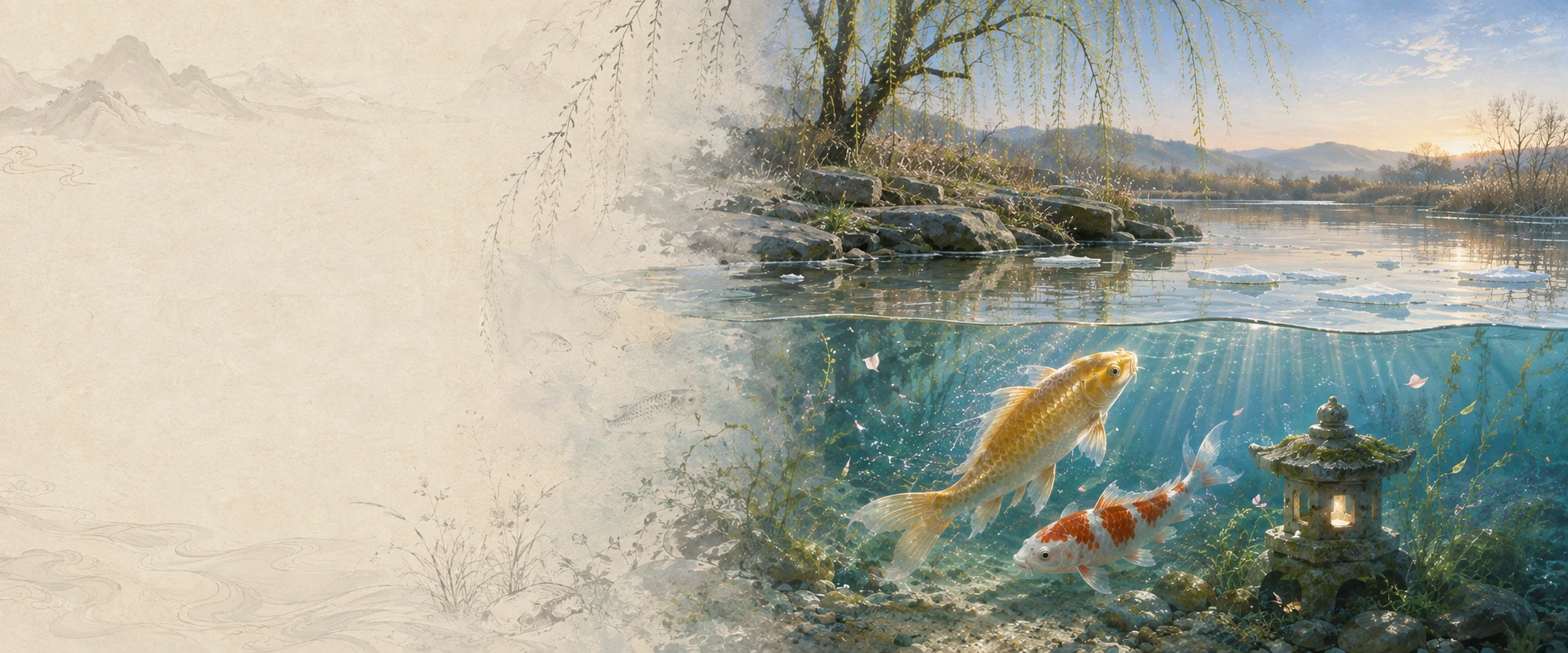
Poetry of Rain Water centers on the value of spring rain and the first awakening of vegetation. Han Yu’s “天街小雨润如酥,草色遥看近却无” captures the beauty of misty early spring rain; Du Fu’s “随风潜入夜,润物细无声” expresses the gentleness with which spring rain nourishes all things. Yuan Zhen writes “雨水洗春容”, while Lu You records “小楼一夜听春雨.” During Rain Water, all things begin to stir, and what appears most often in the poets’ writing is expectation—the expectation of flowers opening, of spring deepening, and of a good harvest in the new year. Poetry of Rain Water is as fine, dense, and gentle as the rain itself, moistening a thousand years of spring.
Rain Water Poetry
春夜喜雨
Original Verse:
好雨知时节,当春乃发生。
随风潜入夜,润物细无声。
野径云俱黑,江船火独明。
晓看红湿处,花重锦官城。
Modern Translation:
The good rain seems to understand the rhythm of the seasons, arriving quietly just as spring begins to awaken all things. It follows the gentle wind into the night, silently nourishing the earth and everything upon it. Country paths and dark clouds merge into blackness, while only the lights of boats on the river shine alone. Tomorrow morning, when one looks at the red flowers drenched with rain, the blossoms throughout the Brocade City will surely hang heavy in brilliant color.
Commentary:
This is one of the supreme poems on the spring rain of the Rain Water season. Not once does the poem use the word “joy”, yet joy fills every line. The opening couplet personifies spring rain through “知时节”, giving it a humane virtue of knowing the right time. “随风潜入夜,润物细无声” is a celebrated line through the ages. The character “潜” conveys the quiet, selfless arrival of spring rain, while “细” captures its fine, continuous, gentle, and almost soundless quality. This is not only an accurate physical description, but also a projection of the poet’s ideal moral character—one that does not seek attention, yet benefits all things. The neck couplet uses the heaviness of “云俱黑” to set off the warmth and hope of “火独明.” In the final couplet, “红湿” and “花重” are inspired touches. The word “重” not only describes blossoms made full and vivid by rainwater, but also quietly contains the joy of an abundant harvest.
江南春
Original Verse:
千里莺啼绿映红,水村山郭酒旗风。
南朝四百八十寺,多少楼台烟雨中。
Modern Translation:
Across a thousand li of Jiangnan, orioles sing while green trees and red flowers reflect one another; waterside villages and towns at the foot of the hills stand beneath wine-shop banners fluttering in the spring breeze. Of the four hundred and eighty temples left from the Southern Dynasties, how many towers and pavilions now lie veiled in mist and rain?
Commentary:
This poem perfectly presents the hazy rain of Jiangnan typical of the Rain Water season. The first two lines depict a bright spring scene. The words “千里” open the space outward without limit; “莺啼” appeals to hearing, “绿映红” to sight; “水村山郭” gives a still scene, while “酒旗风” gives movement. In only fourteen characters, the brightness and prosperity of a Jiangnan spring are fully conveyed. The final two lines suddenly turn from the present scene toward history, and from clear weather toward rain. The words “烟雨” are both realistic—the fine misty rain commonly seen in Jiangnan during this season—and suggestive, carrying with them the uncertainty and distance of history. The grandeur of “四百八十寺” stands in strong contrast to the haziness of “烟雨中”, adding a deep sense of historical reflection to the beauty of the natural scene.
早春呈水部张十八员外二首 · 其一
Original Verse:
天街小雨润如酥,草色遥看近却无。
最是一年春好处,绝胜烟柳满皇都。
Modern Translation:
The fine rain over the avenues of the capital is soft and nourishing like cream; from a distance, the grass seems fresh and green, yet seen up close, it is so sparse that it is almost invisible. This is the finest moment of spring in the whole year, far surpassing the later season when smoky willows fill the imperial capital.
Commentary:
This poem portrays the early-spring scene of the Rain Water season. By describing the spring rain as “润如酥”, Han Yu turns sight into touch and gives the rain an exceptionally tangible softness. “草色遥看近却无” is even more celebrated: the poet captures the unique visual experience of newly sprouting grass, something faintly present from afar yet nearly invisible when approached, containing within it the idea that distance itself can create beauty. The final two lines conclude through contrast. The poet states directly that this early spring of fine rain and barely visible green is far more beautiful than the later spring when smoky willows fill the city, because the former represents the first emergence of life and hope, while the latter already hints that spring is approaching its end. The poem reveals the poet’s special appreciation for life at its very beginning and his distinctive aesthetic preference.
临安春雨初霁
Original Verse:
世味年来薄似纱,谁令骑马客京华。
小楼一夜听春雨,深巷明朝卖杏花。
矮纸斜行闲作草,晴窗细乳戏分茶。
素衣莫起风尘叹,犹及清明可到家。
Modern Translation:
In recent years, the ways of the world and human relations have grown thin as gauze; who made me ride into the capital and live here as a traveler? In the little tower, I listen through the night to the patter of spring rain, and tomorrow morning the deep lanes will surely echo with the cries of those selling apricot blossoms. I spread out short sheets of paper and idly write running lines of cursive script; before the clear window, I carefully boil water and amuse myself by preparing tea. Let my plain white robe not lament the dust of the capital—I can still make it home before Qingming.
Commentary:
Although this poem was not written specifically for the Rain Water solar term, “小楼一夜听春雨” has become one of the great classical lines on spring rain. The opening “世味年来薄似纱” begins in melancholy and expresses the poet’s disappointment with official society and human relations. The couplet “小楼一夜听春雨,深巷明朝卖杏花” writes of listening to rain throughout the night. It conveys both the density and duration of the spring rain, while the imagined cries of apricot-blossom sellers tomorrow morning connect the loneliness of the rainy night with the brightness of the following day. One night and one morning, one act of listening and one cry of selling—the movement of time and space is entirely natural. The neck couplet “矮纸斜行闲作草,晴窗细乳戏分茶” portrays a leisurely life after the rain clears. Cursive calligraphy and tea preparation are both refined pursuits of the literati; the words “闲” and “戏” reveal a form of self-distraction amid deep boredom. The final line, “犹及清明可到家”, identifies the season more clearly—the Rain Water period is followed later by Qingming, and the poet’s longing to return home grows stronger under the lingering spring rain.
春雨
Original Verse:
怅卧新春白袷衣,白门寥落意多违。
红楼隔雨相望冷,珠箔飘灯独自归。
远路应悲春晼晚,残宵犹得梦依稀。
玉珰缄札何由达,万里云罗一雁飞。
Modern Translation:
In melancholy I lie in my white robe at the beginning of spring. White Gate, Jinling, is desolate, and everything seems contrary to my wishes. Through the spring rain I gaze toward the red tower and feel only cold; amid the beaded-curtain-like rain, lamps flicker as I return alone. You, far away, must also grieve that spring is already growing late. In the remaining hours of night, I can at least still see you faintly in dreams. But how can the jade earrings and the sealed letter ever reach you? Across ten thousand li, the clouds spread like a net, and only a solitary wild goose flies through them.
Commentary:
Li Shangyin uses spring rain as the background for a poem of separation and longing. The opening phrase “怅卧新春” establishes both the season and the emotional state, while “白门寥落” suggests that this place is not truly home, giving the scene an air of wandering desolation. “红楼隔雨相望冷” is the most moving image in the poem: through the hazy spring rain, the poet looks toward the building once associated with the beloved. The single character “冷” is both the physical sensation of the spring rain and the temperature of the heart. “珠箔飘灯独自归” uses the image of lamplight wavering in the rain to convey the loneliness of returning alone. The neck couplet “远路应悲春晼晚” extends the poet’s longing toward the distant other, imagining that the person far away must also grieve over spring drawing toward its end; “残宵犹得梦依稀” suggests that the only consolation left in reality is the faint dream of the remaining night. In the final couplet, “玉珰缄札何由达” expresses the impossibility of sending a message, while “万里云罗一雁飞” closes the poem with a lone goose flying through a net-like sky of clouds. The goose may fly, yet the letter cannot arrive; spring may pass, yet longing does not end. The resonance lingers far beyond the poem.
春游湖
Original Verse:
双飞燕子几时回?夹岸桃花蘸水开。
春雨断桥人不度,小舟撑出柳阴来。
Modern Translation:
When did the swallows, flying in pairs, return? Along both banks, peach blossoms open close to the water, as though blooming after dipping themselves into the lake. Spring rain has raised the water and submerged the bridge, leaving travelers unable to cross; just as the way seems blocked, a small boat poles out from deep beneath the willow shade.
Commentary:
This quatrain takes the lakeside scene after spring rain as its subject and writes it with lively ease. The opening “双飞燕子几时回” begins with a question. It records the early-spring phenology of returning swallows while also containing the poet’s expectation and delight at the arrival of spring. In the second line, “夹岸桃花蘸水开”, the two characters “蘸水” are especially ingenious: the peach branches hang low, as though dipping themselves into the lake before blooming, bringing the relationship between blossoms and water vividly to life. The third line, “春雨断桥人不度”, describes the rising lake water covering the bridge. The character “断” is both a factual description and a device that creates an obstacle in the journey. The final line, “小舟撑出柳阴来”, provides the poem’s turn and its renewed vitality—just when there seems to be no way forward, a small boat emerges from the willow shade, creating a sudden sense of openness reminiscent of “山重水复疑无路,柳暗花明又一村.” The first two lines describe scenery, the final two describe an event; feeling lies within the landscape, while delight lies within the action.
Closing Note
Poetry of the Rain Water solar term begins with the exclamation “好雨知时节.” In *咏廿四气诗·雨水正月中*, Yuan Zhen writes “雨水洗春容,平田已见龙”, unfolding the phenological signs of the season one by one—the otter offering fish, wild geese returning north, grasses and trees beginning to sprout. What Rain Water brings is not a thunderstorm that shakes heaven and earth, but a gentle washing. The three characters “洗春容” are especially subtle: spring rain does not merely water the world; it wipes it clean.
Tang poets were masters of writing rain. In *春夜喜雨*, Du Fu turns one spring rainfall into one of the gentlest rains in the history of Chinese poetry: “随风潜入夜,润物细无声.” The character “潜” is exact—the rain does not simply fall; it quietly slips in. The character “润” is equally subtle—the rain does not scour; it soaks and nourishes. Han Yu, another Tang poet, writes instead of the barely visible green that appears after early-spring rain: “天街小雨润如酥,草色遥看近却无.” After the rain, the grass looks tender green from afar, yet becomes almost invisible when approached. This is a scene that belongs only to early spring, and a moment that only an attentive poet could capture.
In Song poetry, Rain Water carries a little more idle melancholy and more of the warmth of ordinary life. In *临安春雨初霁*, Lu You writes “小楼一夜听春雨,深巷明朝卖杏花.” He listens to rain all night, sleepless through the dark hours, yet what he imagines is the sound of flower sellers in the deep lanes the next morning. Xin Qiji, in *浣溪沙*, writes of the hopes rural elders place in the rain: “父老争言雨水匀,眉头不似去年颦.” What farmers care about is not poetic beauty, but whether the rainfall is even and whether the harvest will be good. Liu Chenweng, in *七绝·雨水时节*, writes “郊岭风追残雪去,坳溪水送破冰来”, capturing precisely the clear, cold breath of early spring at the meeting point of winter and spring.
From the Tang poets’ “随风潜入夜” to the Song poets’ “小楼一夜听春雨”, poetry of Rain Water records different states of mind under the same kind of weather. Du Fu hears the selflessness of spring rain, Han Yu sees the subtlety of the grass, Lu You hears the chill of his own circumstances, and Xin Qiji reads in the rain the hopes of farming households. The same rain falls upon different poets and gives rise to different echoes. Rain Water returns each year as promised, and the poems are opened anew each year as well—just as Han Yu wrote: “最是一年春好处,绝胜烟柳满皇都.”
—-

Readers’ Comments
Calendar and traditional culture enthusiasts from around the world, sharing the same moon.
Sign in or register to join the conversation. Your comment account is created automatically the first time you use a connected account.
No comments yet
Share your thoughts with readers around the world.