MonkeyFolklore
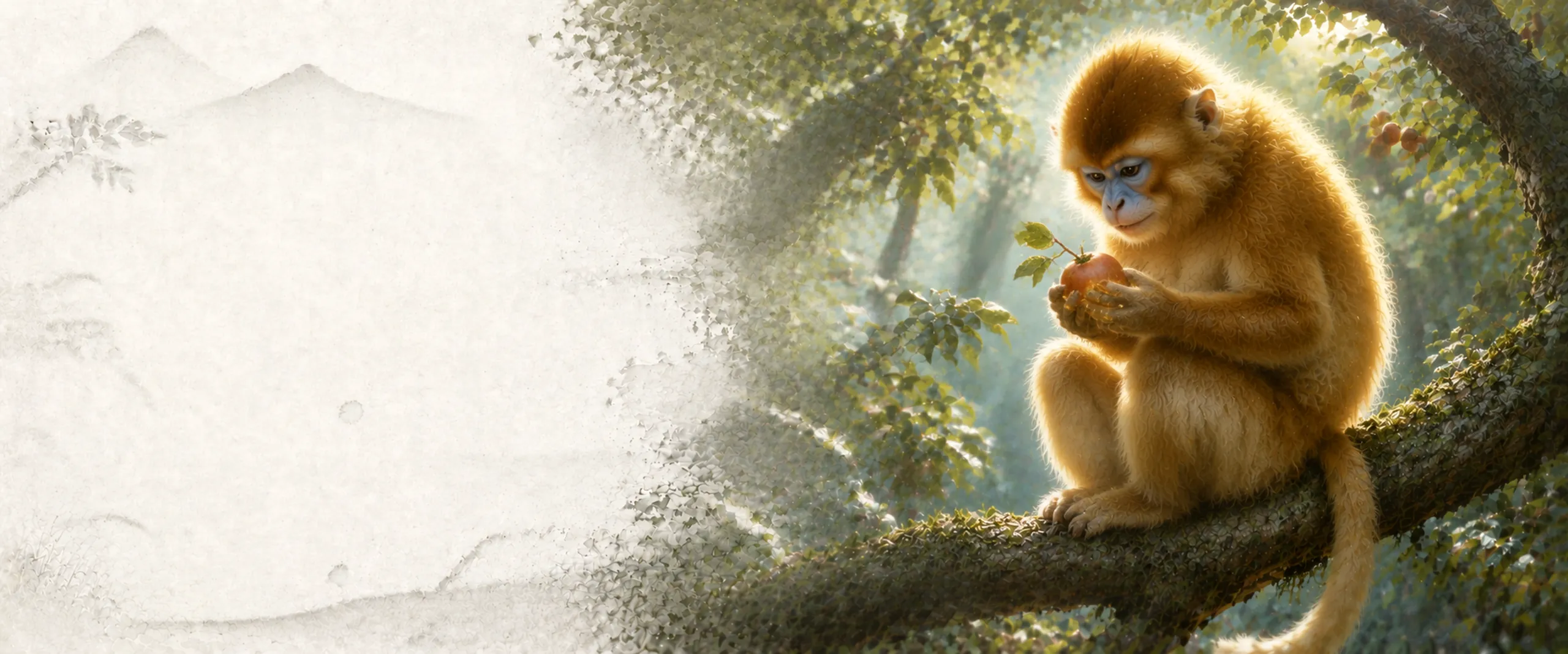
「 金猴献瑞桃,福寿双全来。 」
Seasonal Festivals and Observances:
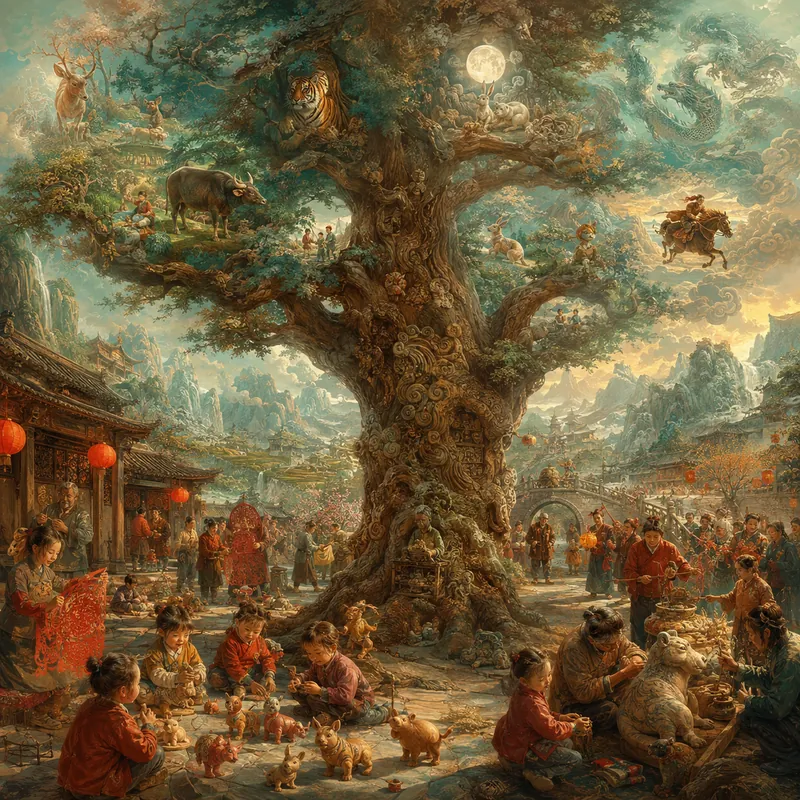
The Monkey occupies a distinctive place in traditional seasonal observances—from the cultural association expressed in “Human Day is Monkey Day,” to the Hani Kuzhazha Festival, the Monkey Sacrifice of Taiwan’s Gaoshan peoples, and the Yi custom of “Binding the Shanhua Monkey,” Monkey-related festivals extend across numerous cultural spheres of both the Han people and ethnic minorities.
Human Day and Monkey Day
According to the ancient calendrical system, the seventh lunar month is established under Shen (申). Ancient Human Day (人日) was observed precisely on the seventh day of the first lunar month—based on the idea that “humans evolved from monkeys, and Human Day is therefore Monkey Day.” This belief closely linked the Monkey with the origin of humankind, granting it a distinctive cultural position within the seasonal calendar. Human Day on the seventh day of the first lunar month thus became a temporal symbol through which ancient people fused ideas of human origins with Monkey worship.
The Year of the Monkey and the Month of the Horse
“The Year of the Monkey and the Month of the Horse” (猴年马月) is one of the best-known Monkey-related expressions in Chinese folk culture.
Examination of Its Etymology
There are several folk explanations for the origin of the phrase. One theory holds that “monkey” was originally “donkey,” producing the expression “the Year of the Donkey and the Month of the Horse.” Because there is no Donkey year among the twelve zodiac animals, “donkey” was later changed to “monkey.” Another possibility is that the phrase developed through corruption from “候年码月.” Here, “候年” means “to wait until the year comes,” that is, to wait until year’s end, while “码” in “码月” carries the sense of anticipating or preparing.
Actual Calendrical Meaning
“The Year of the Monkey and the Month of the Horse” does in fact have a calendrical basis. A Monkey year recurs every twelve years, while a Horse month recurs every twelve months, and one must wait twelve years for a Monkey year to coincide again with a Horse month. The previous “Year of the Monkey and Month of the Horse” occurred in 2004, and the next occurred from June 5, 2016, at Mangzhong, to July 3, just before Xiaoshu. It is therefore unsurprising that the expression came to mean something “indefinitely far off”—it truly requires a long wait.
The Hani “Kuzhazha” Festival
The Hani “Kuzhazha” (苦扎扎) Festival begins on the first Shen Monkey day of the fifth lunar month each year and lasts for three to five days.
Festival Background
At this time, rice transplanting has just been completed and farm work is comparatively light, allowing people to gather together in celebration. The festival’s principal activity is swinging. It is a traditional Hani festival closely linked to the agricultural calendar and marked by strong local ethnic characteristics.
Festival Sequence
On the first day, each village goes into the mountains to select a thick, straight pine tree to serve as the pole for the grinding swing. The pole must conform to prescribed dimensions; it is cut at night and brought back to the village before dawn. On the second day, every household kills two chickens and one duck as offerings to the swing timber, after which the grinding swing is erected, the revolving swing raised, and the throwing swing set up. The grinding swing, revolving swing, and throwing swing are distinctive Hani forms of swinging—the Shen Monkey day serving as the calendrical point that opens the summer revelry.
Taiwan Gaoshan “Monkey Sacrifice”
Among the traditional customs of the Puyuma people of Taiwan’s Gaoshan peoples is the “Monkey Sacrifice” (猴祭), a traditional rite performed when boys of around twelve or thirteen enter the men’s association, intended to ward off misfortune and invite good fortune. It is also known as the “First Entry into the Men’s House Ceremony.”
Time and Content
The rite is usually held after the early-rice harvest in the eleventh lunar month and lasts ten days. On the third day, a monkey is killed. The purpose is to esteem martial courage and cultivate bravery among the boys, and this constitutes the principal ritual of the festival.
Ritual Sequence
Preparations before the sacrifice: the boys clean the roads and the sacred ground where the monkey is to be killed. At dusk, they wrap themselves in banana leaves, smear their faces with soot from cooking pots, carry sticks, and go from house to house creating disturbance, symbolically driving out evil spirits.
Monkey-killing ritual: on the morning of the third day, a wild monkey is captured and confined in a wooden cage. The ritual leader gathers the boys around the cage, and they stab the monkey to death with bamboo poles before throwing away the corpse, symbolizing casting off the old, welcoming the new, dispelling evil, and receiving good fortune.
Monkey-burial ritual: the corpse is carried to the place of enemy heads for burial, while all sing the Monkey Sacrifice Song. The song consists of two sections, “Sacrificing the Monkey” and “Burying the Monkey”—the first sung during the killing ritual and the second during the burial. Its lyrics revolve around mourning the Monkey’s spirit and repeatedly articulate the themes of averting disaster, expelling evil, and bestowing blessing and peace.
Entry and training: after the Monkey Sacrifice, the boys take turns climbing onto the bamboo platform of the men’s house under the supervision of youths holding sticks, joining hands in song and dance until the rite concludes, after which they are permitted to enter the association and receive training.
Taboo: during the ritual period, women are forbidden from entering the men’s house.
Yi “Binding the Shanhua Monkey”
In Shizong County, Yunnan, local Yi communities hold the “Binding the Shanhua Monkey” (绑山花子) activity every first day of the Lunar New Year.
Form of the Activity
“Shanhua Monkey” is the local Shizong name for a monkey. “Binding the Shanhua Monkey” means tying up the “monkey” with mountain vines, while the “monkey” is actually played by a man in the prime of life. On the day of the event, men and women, young and old, spontaneously gather at the village entrance, beating gongs and drums, playing the suona, and setting off firecrackers to welcome the arrival of the “Divine Monkey.” After entering the village, the “Divine Monkey,” surrounded by the crowd, proceeds to a broad open space, where elders make offerings and pray for the entire village to enjoy peaceful livelihoods, abundant harvests, and a flourishing population.
Legendary Origin
Legend holds that in ancient times, the Yi ancestor Anu and his people were attacked by foreign enemies. Unable to resist, they retreated into dense forest. In desperation, Anu tore a piece of bark from a kapok tree and used it to cover his face, thereby escaping pursuit. Later, inspired by the Monkey’s agile movements—jumping and climbing through the forest—the Yi began imitating these motions and were able to capture large amounts of game. “Binding the Shanhua Monkey” commemorates and reenacts this history.
Longdong “Carrying a Lantern and Bearing a Monkey”
In the Longdong region, there is a custom on the fifteenth day of the first lunar month called “Carrying a Lantern and Bearing a Monkey” (端灯背猴). Elders say that carrying the lantern is meant to ensure bright eyes for future generations. The “bearing the Monkey” element draws on the homophony between 猴 and 侯, expressing the wish that a maternal grandson will one day “be ennobled as a marquis”—rising in official rank and achieving distinction. This custom represents a distinctive expression of Monkey culture within the New Year traditions of northwestern China.
Shen Hour and Monkey Hour
Among the twelve double-hours, Shen hour (申时) corresponds to 3:00–5:00 p.m. At this time the sun begins to incline westward, the weather is fresh, and Monkey troops descend the mountains to forage, becoming highly active. The Ming scholar Li Changqing wrote in Songxiaguan Zhuiyan (《松霞馆赘言》): “申时,日落而猿啼,且申臂也,譬之气数,将乱则狂作横行,故申属猴。” Ancient observers associated the time when Monkeys descended to feed, stretched out their arms, and cried with Shen hour, which consequently also came to be known as “Monkey Hour.”
Folk Beliefs:
The Monkey holds an exceptionally exalted place in Chinese folk belief—it is at once a primordial totem (the ancestors of the Yin people were Monkeys), an object of ancestral-deity worship (the Tibetan myth of macaques becoming human), and a protective deity in such forms as the child-guarding Monkey, the voyage-protecting Monkey, and the plague-averting Monkey.
Monkey Totemism — Ancestor of the Yin People and Primordial Worship
Guo Moruo’s Investigation
Guo Moruo argued that because the mythological figure Diku (帝喾) could be understood as a Monkey animal deity, it is possible to infer that the Monkey was once regarded as a primordial totem. He further proposed that the Monkey may originally have been the totem of the Yin people—the Yin believed that the “high ancestor” of their tribe was a Monkey. This argument suggests that the Monkey held the sacred status of a progenitor in the minds of Shang-period ancestors.
Distribution of Monkey Totemism
Even today, some ethnic groups in China revere the Monkey as an “ancestral deity” and preserve corresponding traditions such as prohibitions on hunting and eating Monkeys and festival sacrifices. Among the ethnic groups of southwestern China that retain Monkey-veneration traditions are the Yi, Lisu, Nu, Yao, and Qiang: the Yi have Monkey-revering clans known as “Anupu” (阿奴普); the Lisu have Monkey-worshipping clans called “Mipa” (猕扒); the Nu revere the Monkey under the name “Douhuasu” (斗华苏); the Khmu people of Xishuangbanna and Jinghong in Yunnan worship Monkeys and strictly forbid capturing or eating them; and among the Yao of Nandan County, Guangxi, the female ancestor is called the “Mother Monkey” (母猴).
Tibetan Myth of Macaques Becoming Human
Among Tibetan myths of origin, the most representative is the story of “macaques becoming human.”
Mythic Narrative
According to the Tibetan historical text 《西藏王统记》, Guanyin Bodhisattva of Mount Putuo gave commandments to a macaque and ordered it to travel from the South Sea to the snowy plateau to cultivate the Way. The macaque came to a cave in the Yarlung Valley, where it devoted itself to cultivating a compassionate bodhi mind. During its practice, with Guanyin’s permission, it united with a rakshasa woman, produced descendants, and brought seeds of the Five Grains from Mount Sumeru to scatter across the land. From these descendants, the early Tibetan people arose and developed.
Archaeological Corroboration
In 1990, excavations at the Neolithic site of Qugong Village in Lhasa uncovered an exceptionally rare Monkey-face appliqué attached to pottery. The carved Monkey image is lifelike and vividly modeled. This archaeological discovery corroborates the existence of Monkey-totem worshippers among the ancestors of the Tibetan people.
Surviving Folk Traditions
In the past, Tibetan communities also preserved customs such as “tattooing Monkey faces” and performing Monkey dances. According to the Tangshu and the Zizhi Tongjian, the ancient Tubo people practiced “tattooing Monkey faces.” Even today, grand Tibetan “Cham” ritual dances retain performances in which dancers wear Monkey King masks.
Surviving Traces of Monkey Worship among the Han
Traces of ancestral Monkey reverence are also readily found in the Central Plains inhabited by the Han people.
Huaiyang “Human-Ancestor Monkey” (人祖猴): at the Human Ancestor Temple Fair held in Huaiyang during the second lunar month, large numbers of clay toys known as “Human-Ancestor Monkeys” are sold. Their forms resemble solemn deities wearing crowns. The lower portion of the Monkey body is painted with a female genital fertility symbol, and local people revere these figures as idols of the human progenitor.
Xun County “Numinous Monkey” (灵猴): on the great mountain in Xun County in northern Henan, in addition to a giant painted clay zodiac Monkey deity, the stone railings of all temples are carved with stone Monkeys in many different poses. Large numbers of clay Monkey toys are also sold at the annual first-lunar-month temple fair and are respectfully called “Numinous Monkeys.”
Nanyang “Good Time” Monkey: at Xiaodingshan in Fangcheng, Nanyang, an old temple fair is held every third day of the third lunar month. Small stone Monkeys are sold there and locally called “haoshihou” (好时候), a pun on “good time.” Pilgrims eagerly purchase them and revere them as auspicious objects.
These survivals of Monkey worship in Han regions demonstrate that the idea of the Monkey as a “human ancestor” also became deeply rooted in the Central Plains.
Protective Deity
In Chinese folk tradition, the Monkey is virtually “capable of everything,” taking on multiple functions in protecting people’s safety.
The “child-guarding Monkey” beside the kang: in Shanxi, Shaanxi, Inner Mongolia, and other regions, farm households traditionally placed a small stone Monkey carved from bluestone beside the kang bed-platform, sometimes alongside a kang-side lion. It was specifically used to secure babies of six or seven months who had just learned to crawl. A mother threaded a red cord through a round hole in the Monkey’s leg and tied the other end around the child’s waist. Local people explained: “The Monkey can protect the baby and keep it safe; when the child grows up, it will be clever and capable.”
The “voyage-protecting Monkey” at ferry docks: before the 1970s, at old ferry docks around Sanmenxia and Shanxian, a lively Monkey was carved atop the wooden posts used to tie up boats. Elder boatmen explained: “Sun Wukong is skilled in water and could dive into the Eastern Sea to wreak havoc in the Dragon Palace. Revere him, and he will protect the voyage, keeping people and boats safe.”
The “plague-averting Monkey” atop horse-tethering posts: in northwestern China, especially in Shaanxi and Gansu, including parts of Shanxi, and particularly around Weinan in Shaanxi, villages traditionally had stone posts for tethering horses. Many bore carved stone Monkeys on their tops, known as “averting equine pestilence” (避马瘟), a homophonic play on Bimawen (弼马温). The custom arose from the folk belief that Monkeys could prevent disease among horses. In Journey to the West, the Jade Emperor appoints Sun Wukong “Bimawen” (弼马温) precisely as a pun on “averting equine pestilence” (避马瘟).
Auspicious Meanings:
The Monkey occupies a central position in Chinese folk culture of auspiciousness. Because “Monkey” (猴) and “marquis” (侯) are homophones, the animal symbolizes promotion in official rank and rapid advancement; its inseparable association with the peach also makes it a symbol of longevity. The Monkey’s auspicious meanings are distinctive even among the twelve zodiac animals: they combine the wish for rank and office embodied in “ennoblement as a marquis” with the desire for blessing and longevity expressed in “offering long life.”
“Monkey” and “Marquis”
The word 侯 was used as praise for a fine Monkey and was extended to mean a form of beauty. The Shijing contains the phrase “海直且侯”, while the Han Shi states: “侯,美也。” It was later extended to designate the second rank in the ancient aristocratic hierarchy—namely the “marquis” among “公、侯、伯、子、男.” Thus the concept of “being ennobled as a marquis” added an auspicious layer of meaning to the Monkey.
Immediate ennoblement (马上封侯): a Monkey rides on horseback, expressing the idea of “immediate ennoblement”—to receive noble rank at once and achieve success and distinction.
Ennoblement and hanging the seal (封侯挂印): a Monkey climbs a maple tree and hangs up an official seal, expressing the motif “封侯挂印.” Because “maple” (枫) and “confer” (封) are homophones and the seal symbolizes authority, the image signifies receiving noble rank and wielding power.
Generation after generation ennobled (辈辈封侯): a mother Monkey carries a young Monkey on her back, or two Monkeys sit in a pine tree with one riding on the other’s back, expressing “辈辈封侯.” The word “back” (背) is homophonically associated with “generation” (辈), symbolizing successive generations receiving noble rank and descendants achieving distinction.
Rank, emolument, and ennoblement (爵禄封侯): a Monkey is combined with a deer, sparrow, and bee to express “爵禄封侯.” 雀 and 爵 are homophones, 鹿 and 禄 are homophones, 蜂 and 封 are homophones, and 猴 and 侯 are homophones. Together, the four signify smooth advancement in official career.
“Monkey” and “Peach”
The Monkey’s love of peaches signifies longevity: in Journey to the West, the Jade Emperor assigns Sun Wukong to manage the Heavenly Peach Garden of Immortality. Peaches ripening once every three thousand years make those who eat them light and healthy; those ripening every six thousand years confer immortality; and those ripening every nine thousand years allow one to live as long as Heaven and Earth. Thus, the Monkey’s love of peaches signifies the Monkey’s longevity, and a Monkey offering a peach signifies the offering of long life. Folk paper-cutting therefore frequently features works titled “Two Monkeys Offer Longevity” (双猴献寿).
The peach’s dual symbolism: in Chinese folk legend, the Peach of Immortality has two meanings: longevity and warding off evil. For this reason, the “Monkey Holding a Peach” became an indispensable object in many birthday celebrations. The pairing of Monkey and peach symbolizes both blessing and long life and the dispelling of evil.
Auspicious Expressions for the Year of the Monkey
Every Year of the Monkey inspires blessings that are especially clever and lively: “The Golden Monkey Brings Auspiciousness” (金猴献瑞)—the Golden Monkey brings good fortune; “The Golden Monkey Offers Longevity” (金猴献寿)—the Golden Monkey offers long life; “Great Fortune in the Year of the Monkey,” “Fulfillment in the Year of the Monkey,” “Good Luck in the Year of the Monkey”; “Immediate Ennoblement” (马上封侯)—to receive noble rank at once; “Generation after Generation Ennobled” (辈辈封侯)—successive generations rise to distinction; “Ennoblement and Hanging the Seal” (封侯挂印)—promotion in rank; and “The Golden Monkey Rises with Its Thousand-jun Staff” (金猴奋起千钧棒)—drawing on the poetic image of Mao Zedong and expressing energetic accomplishment.
Auspicious Symbolism of the Monkey
The Monkey carries multiple auspicious meanings in Chinese culture: intelligence and wisdom—Monkeys are naturally clever and quick-witted and thus embody intelligence and spiritual vitality; promotion and ennoblement—because 猴 and 侯 are homophones, the Monkey symbolizes success in official advancement; longevity and blessing—the combination of Monkey and peach symbolizes long life; agility and liveliness—the Monkey’s active temperament symbolizes vitality and life force.
Folk Art:
The Monkey is one of the most common subjects in Chinese folk art. From New Year prints to paper-cutting, from woodcarving to clay sculpture, and from jade carving to embroidery, the Monkey’s image is at once humorous and auspicious.
Monkeys in New Year Prints
Ennoblement and hanging the seal · averting equine pestilence: in New Year prints, Monkey imagery was endowed with meanings of expelling evil and inviting blessing. In the Qing-dynasty Shaanxi New Year print 《封侯挂印·避马瘟》, a Monkey leads a fine horse and climbs a tree trunk, while a precious seal hangs from a branch and a bee flies nearby, expressing the pun “封(蜂)侯(猴)挂印.” In the image on the right, a large Monkey carries a small Monkey on its back and plays under a tree; on one level this signifies “辈(背)辈(背)侯(猴),” and on another, because the ancients believed that keeping Monkeys in stables could avert equine epidemics, the image bears the three characters “疪(避)马瘟.” Such prints were pasted inside horse enclosures in the hope of protecting livestock.
Sun Wukong wreaks havoc in Heaven: Journey to the West is among the most beloved themes of popular New Year prints. The Qing-dynasty Suzhou print 《孙悟空大闹天宫》 depicts Sun Wukong fighting Erlang Shen and other celestial generals, with a full composition and accomplished carving and drawing.
Monkey official with carrying chest: the Qing-dynasty Wuqiang print 《杠箱官》 from Hebei depicts the “chest-carrying official” as a Monkey wearing a feathered court hat and official robe, with gongs clearing the way and another Monkey carrying a banner reading “禁烟.” The image was intended to satirize the Qing court’s ban on opium as nothing more than a Monkey show, and its style is humorous and sharply satirical.
The White Ape steals peaches for his mother: the Fengxiang woodblock New Year-print tradition of Shaanxi includes 《白猿孝母偷桃》. The White Ape’s mother falls gravely ill and longs to eat immortal peaches. The White Ape steals peaches from the orchard but is caught by Sun Bin, its guardian. After learning the reason, Sun Bin gives him the peaches; the White Ape’s mother recovers after eating them, and in gratitude the White Ape presents Sun Bin with six secretly preserved volumes of military writings. The story combines filial devotion with repaying kindness.
Monkeys in Paper-Cutting
Two Monkeys Offer Longevity: because Monkeys love peaches and peaches signify long life, a Monkey offering peaches signifies offering longevity. Folk paper-cutting therefore frequently features works titled “Two Monkeys Offer Longevity.”
Modern Tianjin paper-cutting: in contemporary Tianjin paper-cutting, Shen Monkey designs include lively and endearing images bearing phrases such as “Great Fortune in the Year of the Monkey,” “Fulfillment in the Year of the Monkey,” and “Good Luck in the Year of the Monkey,” expressing the idea that the Monkey is humanity’s closest companion.
Single-Stroke Longevity Monkey: in a Monkey year, paper-cutting artists have ingeniously combined image and text to create works titled 《一笔长寿猴》, offering birthday wishes and prayers for health and longevity to people born under the Monkey sign.
Longdong Monkey paper-cutting: Monkey paper-cutting themes in Longdong include “The Golden Monkey Brings Auspiciousness,” “The Fire Monkey Guards the Gate,” and “The Numinous Monkey Picks Peaches.” Their forms are exaggerated and their meanings rich.
Monkeys in Wood and Stone Carving
Monkey-headed human-form wood carving: a Liao-dynasty Monkey-headed human-form wood carving in the Capital Museum is a round sculpture in cypress wood, with a human zodiac body and Monkey head. It wears a round-collared straight robe, a belt around the waist, and leather shoes. The Monkey face is carved with exceptional vividness and appears almost human. Zodiac figurines primarily served to indicate direction and record years and months, with the twelve divine figures taking turns guarding the tomb owner, protecting peace and warding off evil.
Monkey jade ornament: a Qing-dynasty Monkey jade ornament in the Capital Museum depicts a mother Monkey carrying a young Monkey, symbolizing “generation after generation ennobled.” 背 and 辈 are homophones, while 猴 and 侯 are homophones. The motif reflects the feudal society’s pursuit of rank and material distinction while also carrying an ethical meaning of family affection.
Monkeys in Clay Sculpture
Huaiyang “Human-Ancestor Monkey”: as noted above, the Human-Ancestor Monkey clay figures sold at the Huaiyang Human Ancestor Temple Fair are locally revered as idols of the progenitor of humankind.
Xun County “Numinous Monkey”: large numbers of clay Monkey toys are sold each year at the first-lunar-month temple fair in Xun County, northern Henan, and are respectfully known as “Numinous Monkeys.”
Monkeys in Painting
Bee-and-Monkey Painting: the Qing painter Shen Quan’s 《蜂猴图》, now in the Palace Museum, depicts one Monkey poking at a beehive in a tree while two others watch below. The scene is tense yet amusing. Because 蜂 and 猴 form a homophonic pun on “封侯,” such auspiciously charged subjects were especially favored by Shen Quan.
History of Monkeys in Chinese painting: Monkeys have appeared in Chinese painting for a very long time, with examples traceable to the Western Han dynasty two thousand years ago. Excavated Han pictorial bricks already contain scenes of people leading dogs and playing with Monkeys. According to the Tang text Lidai Minghua Ji, the Song painter Yi Yuanji became world-famous for painting apes and Monkeys.
Taboos and Protective Rites:
Although the Monkey is an auspicious creature, some taboos and avoidances also exist in folk tradition.
The Year of the Monkey as a “Year of Disaster”
The saying “Hungry Monkey Year”: Han tradition generally considers the Monkey an auspicious animal. Yet there is also a folk belief that harvests are poor in Monkey years and that such years are years of disaster. A saying goes: “饥猴年,饿狗年,要吃饱饭是猪年.” As a result, some farmers are comparatively wary of Monkey years.
Reason for the taboo: folk belief holds that crops often yield poorly in Monkey years. This notion may be connected with the Monkey’s image in agricultural society as an animal that steals crops—more Monkeys in a Monkey year would mean greater damage to the fields.
One’s Zodiac Year and Zodiac Conflicts
The Monkey person’s zodiac year: people born under the Monkey are said to “offend the presiding Tai Sui” during their own Monkey year. One’s zodiac year is generally regarded as inauspicious and requiring special caution.
Yin–Shen clash: among the twelve earthly branches, branches separated by six positions are in opposition. Shen lies six positions from Yin, producing the Yin–Shen clash (寅申相冲), which in zodiac terms means Tiger and Monkey are in conflict. People born under the Monkey are said to “offend Tai Sui” in a Tiger year, while those born under the Tiger “sit under Tai Sui” in their own zodiac year.
Marriage taboos for people born under the Monkey: in traditional zodiac marriage culture, a Shen (Monkey) year is said to avoid the Ox sign. Monkey is in conflict with Tiger (寅申冲), in punishment with Snake (申巳刑), and in harm with Pig (申亥害). People of these signs are all regarded as unsuitable for marriage in a Monkey year.
Avoid Tiger-shaped ornaments: people born under the Monkey are advised in their zodiac year to avoid wearing Tiger-shaped ornaments, because Tiger and Monkey are in conflict.
Avoid worshipping Manjushri: in folk belief, there is also a saying that people born under the Monkey “should not worship Manjushri.”
Yao Prohibition on Eating Monkey Meat
To commemorate the Monkey Mother, among the Yao of Dayaozhai, not only the Huang clan but also other surnames continue to observe the taboo against hunting Monkeys or eating Monkey meat. This prohibition derives from Yao Monkey-totem worship.
Female Taboo in the Monkey Sacrifice
During the Monkey Sacrifice of the Puyuma people of Taiwan’s Gaoshan peoples, women are forbidden from entering the men’s house throughout the ritual period. This is the strictest gender taboo associated with the ceremony.
Folk Language and Sayings:
The Monkey has left an exceptionally rich imprint on Chinese folk language. Unlike the overwhelmingly negative language surrounding the Rat, expressions involving the Monkey are mixed in tone—some are laudatory, emphasizing cleverness and intelligence, while others are critical, stressing unruliness and restlessness.
The Monkey in Idioms
Laudatory expressions emphasizing cleverness and agility: 灵猴献瑞—the numinous Monkey brings auspiciousness; 金猴献寿—the Golden Monkey offers longevity.
Derogatory expressions, more numerous: 沐猴而冠—a Monkey wearing a cap, metaphor for someone with only an outward appearance of refinement; 杀鸡儆猴—to punish one as a warning to others; 猴年马月—something indefinitely far off; 尖嘴猴腮—to describe an ugly face with sharp mouth and Monkey-like cheeks; 树倒猢狲散—when the tree falls, the Monkeys scatter, metaphor for followers dispersing when their patron collapses; 猿猴取月—an ape reaching for the moon, metaphor for bringing loss upon oneself.
Neutral expression: 弄鬼掉猴—to play tricks or engage in deceptive schemes.
The Monkey in Proverbs and Sayings
Many Monkey-related sayings circulate in folk speech: “山中无老虎,猴子称大王”—when there is no tiger in the mountain, the Monkey calls itself king, meaning a mediocre person dominates when no capable person is present; “杀鸡给猴看”—to punish one in order to warn another; “猴子掰苞谷——掰一个丢一个”—a Monkey breaks off ears of maize, dropping one whenever it takes another, metaphor for greedily pursuing too much and ending with nothing; “猴子的屁股——坐不住”—the Monkey’s backside cannot sit still, describing someone restless and overactive; “火中取栗”, a foreign allusion associated with the Monkey—taking chestnuts from the fire, meaning to take risks on another’s behalf.
Monkey Xiehouyu
Monkey-related xiehouyu (歇后语) are humorous and lively: “A Monkey climbs a tree—its specialty”; “A Monkey fishes for the moon—joy for nothing”; “A Monkey guards the orchard—stealing while entrusted with guarding”; “A Monkey wears a mask—a human face with a beast’s heart”; “A Monkey performs tricks—the same routine over and over”; “A Monkey’s face—it changes as soon as one says so”; “A Monkey’s backside—it cannot sit still.”
Folk Characterizations of People Born under the Monkey
In popular zodiac personality culture, people born under the Monkey receive characteristic evaluations. Positive traits: clever and quick-witted, resourceful and flexible, lively and active, sociable, and highly adaptable. Negative traits: restless and unstable, insufficiently grounded, and inclined to aim unrealistically high. A folk verse says: “申猴性灵巧,聪明世无双。一生多机遇,富贵自名扬。”
The Monkey in Children’s Folklore:
In the world of children, the Monkey is one of the most beloved figures—it is the affectionate nickname “little Monkey,” the hero Sun Wukong, the protective “child-guarding Monkey” beside the kang, and the “Numinous Monkey” of clay toys.
Monkeys in Nursery Rhymes
Little Monkey: “小猴子,真调皮,树上树下跳来跳去。摘个桃子送给你,祝你新年好运气。”
The Monkey in the “Song of the Twelve Zodiac Animals”: “鼠第一牛第二虎第三兔第四龙第五蛇第六马第七羊第八猴第九鸡第十狗十一猪十二……”—the Monkey ranks ninth in the zodiac song.
The nursery rhyme “Sun Wukong”: “孙悟空,本事大,大闹天宫都不怕。金箍棒,手中拿,妖魔鬼怪全打趴。” Sun Wukong is the greatest Monkey hero in the minds of children.
Monkey Games
“Little Monkeys Pick Peaches”: a common physical game in kindergartens. Children play little Monkeys and jump to “pick peaches,” represented by hanging props, developing their jumping ability and bodily coordination.
“Monkeys Fish for the Moon”: a group game imitating the story of Monkeys trying to scoop up the moon. Children form a line, each holding the feet of the one ahead and bending downward as if trying to “fish out the moon,” developing teamwork.
Monkey Toys
Clay Monkeys: as noted above, Huaiyang’s “Human-Ancestor Monkey” and Xun County’s “Numinous Monkey” are clay toys loved by children.
Stone Monkeys: the small stone Monkeys sold at Xiaodingshan in Nanyang are locally called “haoshihou” (好时候) and function as amulet-like auspicious objects for children.
Cloth Monkeys: small Monkey dolls sewn from fabric, lively and endearing in appearance, are among the earliest media through which children become familiar with Monkeys.
Dough-sculpted Monkeys: common toys at temple fairs, with exaggerated forms and bright colors.
The “Child-Guarding Monkey” beside the Kang
As noted above, in Shanxi, Shaanxi, Inner Mongolia, and other regions, farming households traditionally placed a small bluestone Monkey beside the kang, specifically for securing babies of six or seven months who had just learned to crawl. It was both a toy and an amulet—the Monkey was believed to protect the child and ensure that, upon growing up, the child would be clever and capable.
The Monkey in Literature and Art:
The Monkey is one of the most important subjects in Chinese literature and art—no other animal has produced a literary figure as great as Sun Wukong in Journey to the West. From the Shijing to Journey to the West, from Han pictorial bricks to Monkey paintings across the dynasties, writers and artists have endowed the Monkey with exceptionally rich cultural meanings.
The Monkey in the Shijing and Pre-Qin Texts
Although the Shijing contains no poem devoted directly to the Monkey, it already includes lines related to apes and Monkeys. By the pre-Qin period, apes and Monkeys were already familiar animals.
The Zhuangzi: Xu Wugui records the story of “King Wu Shoots the Skillful Ape” (吴王射巧猿). King Wu ascends Monkey Mountain; all the Monkeys flee in terror except one ape, which calmly climbs and leaps with extraordinary skill, only to be shot dead by the king. Zhuangzi uses the fable to satirize those who rely arrogantly on their talents. It is one of the most vivid Monkey images in pre-Qin literature.
Journey to the West
Sun Wukong in Journey to the West elevated Chinese Monkey culture to the level of a national spirit.
Sun Wukong’s cultural status: American films have all kinds of superheroes, while the Great Sage Sun is unquestionably China’s representative mythic hero. His amusing appearance—a Monkey head paired with human clothing—is today known in virtually every household and recognized by old and young alike. He has become a subject of Chinese painting, New Year prints, dough sculpture, paper-cutting, kites, and other forms of folk craft, while remaining equally active on the opera stage and in film and television.
Origins of the Sun Wukong image: the figure of Sun Wukong combines legends of the Indian divine Monkey Hanuman and the Chinese Wuzhiqi. The character is therefore not only a treasure of Chinese literature but also a crystallization of cultural exchange between China and India.
Monkey Paintings across the Dynasties
Monkeys on Han pictorial bricks: the representation of apes and Monkeys in Chinese art has a long history, traceable to the Western Han dynasty two thousand years ago. Excavated Han pictorial bricks already contain scenes of people leading dogs and playing with Monkeys.
Yi Yuanji of the Song dynasty—the master of Monkey painting: the Song painter Yi Yuanji was famous throughout the world for his paintings of apes and Monkeys. In order to paint them well, he entered deep into the mountains and forests to observe their habits of life. His works combined likeness of form with vitality of spirit and had a profound influence on later generations.
Shen Quan’s Bee-and-Monkey Painting: the Qing master Shen Quan’s 《蜂猴图》, now in the Palace Museum, depicts one Monkey poking at a beehive in a tree while two others watch below. The scene is tense yet amusing. The homophonic pairing of bee (蜂) and Monkey (猴) produces “封侯,” making such auspicious subjects especially favored by Shen Quan.
Modern Monkey painting: among the countless forms of Monkey art, some especially playful themes place greater emphasis on “Monkey nature,” with designs intended primarily for appreciation and amusement. Sly gourd Monkeys, lively groups of young Monkeys at play, mischievous Monkeys teasing one another around dishes, self-satisfied Monkeys riding camels, and absurd Monkey needle-pricking scenes all turn every Monkey expression and gesture into a source of comedy.
Monkeys in Strange Tales and Miscellanies across the Dynasties
Shishuo Xinyu: Chumian records the story of the “Heartbroken Ape” (断肠猿)—a young ape is captured, and its mother follows along the river crying in grief until her intestines rupture and she dies. Deeply moving, it is one of the most poignant episodes in the tradition of ape and Monkey stories.
Volume 23 of Tao Zongyi’s Yuan-dynasty Nancun Chuogeng Lu records the story 《猴盗》, in which a Monkey is trained as a thief, reflecting the folk tendency to view Monkey “cleverness” in both positive and negative ways.
Stories of “apes and Monkeys abducting brides” circulate widely across China. Narratives of the “Monkey-Mother type” generally concern legends of marriage between humans and Monkeys and the birth of children. Because Monkeys possess strong reproductive capacity, this ability came to be worshipped in mythology as a wondrous creative force capable of generating human life.
The Monkey and Folk Dance
Yao Monkey Drum Dance: the Yao Monkey Drum Dance was successfully inscribed as a national intangible cultural heritage item in 2008. It is popular among the Baiku Yao of Yaoshan. During the dance, people form a large circle. A skin drum stands on one side inside the circle, while several to more than ten bronze drums hang on the other. The drummer circles the skin drum while playing it and imitating various Monkey postures and movements, climbing and leaping. The choreography blends softness with strength and strength with softness, with clearly differentiated dynamics, vividly expressing the valiant and martial character of the Yao people.
Tibetan Monkey Dance: during grand Tibetan Cham ritual celebrations, dances performed in Monkey King masks are still preserved.
Yi “Binding the Shanhua Monkey”: as noted above, during the New Year’s Day activity in Shizong County, Yunnan, an adult man dresses as the “Divine Monkey” and parades through the village.
Final Reflections:
The folk culture of the Shen Monkey (申猴) forms one of the cleverest, liveliest, and most brilliantly intelligent chapters in Chinese zodiac tradition. People’s attitude toward the Monkey combines intimacy with reverence: they delight in its clever, mischievous nature while also honoring its sacred status as an “ancestral deity.” The Monkey is not only the primordial totem of the ancestors of the Yin people and the progenitor in the Tibetan myth of “macaques becoming human,” but also the auspicious emblem of “immediate ennoblement” and the protective spirit embodied by the “child-guarding Monkey” beside the kang. From the calendrical association expressed in “Human Day is Monkey Day” to the linguistic imprint of “the Year of the Monkey and the Month of the Horse,” the cultural footprints of the Monkey extend across numerous cultural spheres of both the Han people and ethnic minorities.
From the swinging revelry of the Hani Kuzhazha Festival to the evil-expelling and blessing-inviting rites of Taiwan’s Monkey Sacrifice, from the Yi procession welcoming the Divine Monkey in “Binding the Shanhua Monkey” to Longdong’s wish for noble rank in “Carrying a Lantern and Bearing a Monkey,” from the auspicious motif of “immediate ennoblement” to the blessing of “the Golden Monkey offers longevity,” and from the ancestral worship embodied by Huaiyang’s “Human-Ancestor Monkey” to the protective function of the “child-guarding Monkey” beside the kang, Monkey folklore encompasses almost every sphere of folk culture: seasonal observances, folk belief, auspicious symbolism, folk art, taboos and protective rites, children’s traditions, literature, and the arts. The Monkey is both a sacred being that people worship and make offerings to and a cloth companion held in children’s arms. This sense of closeness—revered like a deity, loved like a companion—is precisely what makes the folk culture of the Shen Monkey so compelling.
The roots of this intimacy lie in the Monkey’s unique dual identity within Chinese culture. In mythology, the Monkey is the human progenitor of the “macaques becoming human” myth and the Great Sage Equal to Heaven who “raises his thousand-jun golden staff” in Journey to the West; in folk tradition, it is the emblem of official advancement embodied in “immediate ennoblement” and the protective spirit of the “child-guarding Monkey”; in popular language, it is a synonym for cleverness and also a warning against restlessness. From the philosophical fable of “King Wu Shoots the Skillful Ape” in the Zhuangzi to the heroic epic of Sun Wukong in Journey to the West, from the tragic tale of the “Heartbroken Ape” to the valiant power of the Monkey Drum Dance, the Monkey’s cultural image has always retained a complex charm that is at once sacred and familiar, intelligent and mischievous. Though the Shen Monkey stands only ninth in the zodiac, it bears the Chinese nation’s deepest aspirations toward wisdom, spirituality, freedom, and quick-wittedness—leaping toward us from the forests of remote antiquity, clad in golden armor and holding an immortal peach, it has left the cleverest and most agile presence upon the spiritual map of Chinese civilization.
----
[Language: es]
Readers’ Comments
Calendar and traditional culture enthusiasts from around the world, sharing the same moon.
Sign in or register to join the conversation. Your comment account is created automatically the first time you use a connected account.
No comments yet
Share your thoughts with readers around the world.