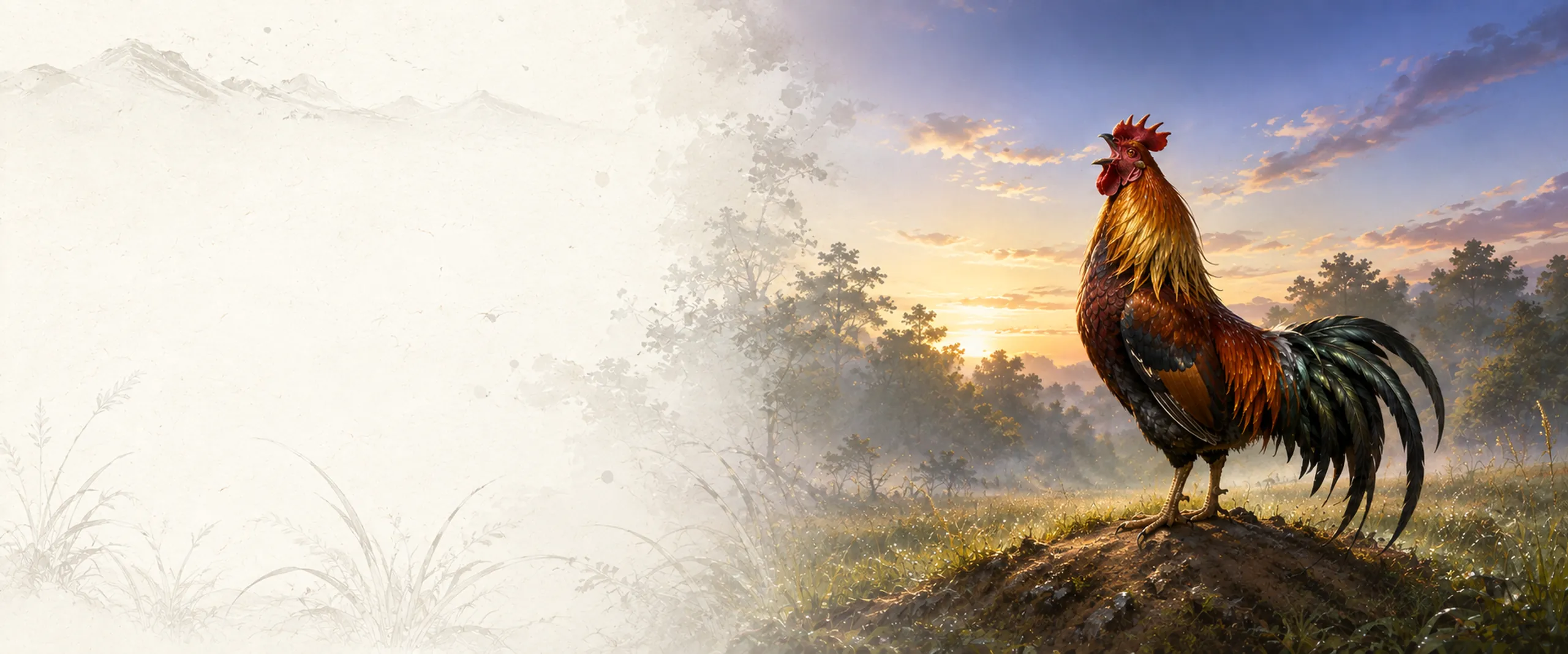
RoosterOrigin
「 One who marks the dawn keeps faith with time;<br>one who fulfills each duty brings work to completion. 」
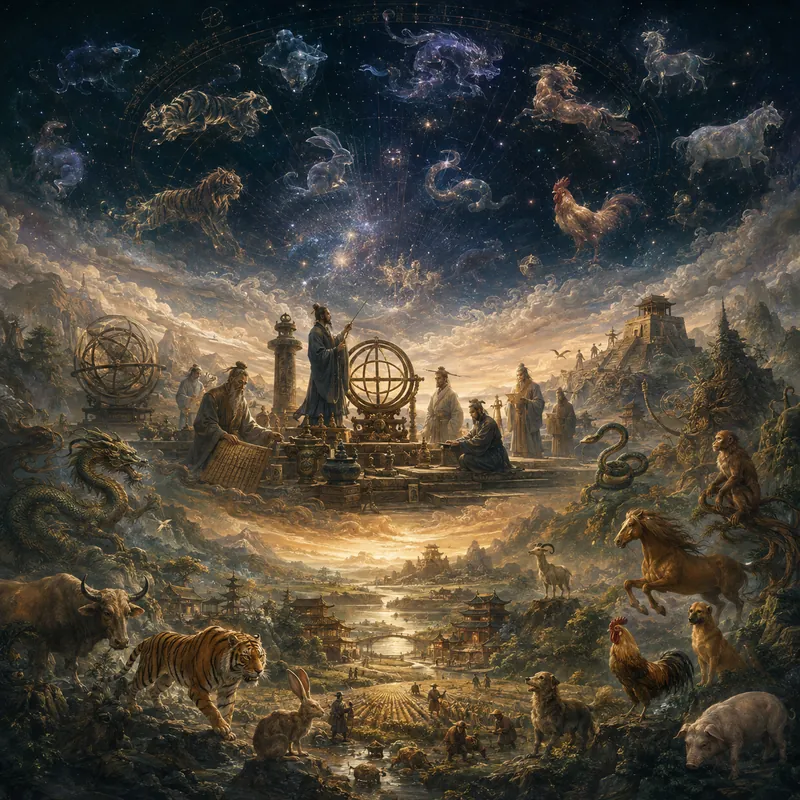
You —— The Tenth Earthly Branch
The character “酉” (You) is one of the Chinese characters most deeply imbued with the culture of wine. In oracle-bone inscriptions, “酉” resembles a wine jar—the mouth of the jar is covered, the body is round and bulging, and the bottom narrows, making it a complete pictograph of a vessel used to hold wine. In fact, “酉” is the original form of the character “酒”—“酉” came first, and only later were the three water dots added to the left to form “酒.”
The original meaning of “酉” was a wine jar or wine itself. In ancient times, wine was brewed primarily in autumn, after the grain had ripened. “酉” therefore became closely associated with autumn, harvest, and maturity. Among the twelve earthly branches, “酉” is tenth and corresponds to the eighth lunar month, the middle month of autumn. At this time, the skies are clear and the air crisp, the Five Grains are abundant, and fruits and melons are fragrant—it is one of the richest and most bountiful periods of the year.
By the Eastern Han, Xu Shen explained the character “酉” in the *Shuowen Jiezi* (《说文解字》) as follows: “酉,就也。八月黍成,可为酎酒。” This means that “酉” is the “就” of accomplishment: in the eighth lunar month, millet ripens and can be used to brew strong wine. Here, “就” carries two meanings: first, “maturity” and “completion”; second, “approaching” and “moving toward”—once the grain has ripened, people approach it, harvest it, and use it to make wine. Xu Shen also wrote: “酉,象酒器之形”—explicitly stating that the form of “酉” is a pictograph of a wine vessel.
The Ming scholar Li Changqing further explained in the *Songxiaguan Zhuiyan* (《松霞馆赘言》): “酉者,月出之时,月本坎体,而中含太阳金鸡之精,故酉属鸡。” The ancients believed that when the moon appeared, daylight was coming to an end and night was about to begin, and the Rooster returned to its roost at precisely this time. “酉” also carries the meanings of “old” and “the maturity of all things”—as the tenth earthly branch, You signifies that all things have developed to the stage of maturity.
From a philosophical perspective, “酉” corresponds to autumn, the eighth lunar month, the west, maturity, and storage. You hour, from 5:00 p.m. to 7:00 p.m., is the time when the sun sets and night descends, when all things move from the activity of daytime into the repose of evening. It is precisely the season of “contraction” and “returning to concealment.”
Rooster —— Evolution of the Character and Philological Extensions
The character “鸡” (Rooster) is a phono-semantic compound, formed from “隹” (*zhuī*, a general term for short-tailed birds) as its semantic element and “奚” as its phonetic element. In oracle-bone inscriptions, the character “鸡” had two forms: one was pictographic, directly depicting a Rooster with a crest on its head and a tail behind its body; the other was phono-semantic, with “奚” on the left as the phonetic component and “隹” on the right as the semantic component. This shows that by the Shang dynasty, the phono-semantic structure of the character “鸡” had already been basically established.
In small-seal script, “鸡” was written as “雞”, with “奚” on the left and “隹” on the right. Its form changed little thereafter until the simplified character “鸡” replaced “奚” with “又.”
Xu Shen of the Eastern Han annotated it in the *Shuowen Jiezi · Zhui Bu* (《说文解字·隹部》): “雞,知时畜也。从隹,奚声。” This means that the Rooster is a domestic animal that knows the time. The ancients believed that the Rooster could announce dawn and knew the hours, and therefore called it “知时畜”—the “domestic animal that knows the time.” The words “知时”, “knowing the time,” precisely summarize the Rooster’s most important biological characteristic—its punctual crowing at dawn—and this is also the most fundamental reason it was able to enter the twelve-animal zodiac.
The pairing of “酉” and “鸡” gave rise to a cultural image rich in auspicious meaning within traditional Chinese culture. “鸡” and “吉” are homophonous—酉鸡有吉,万事如意. Among the people, the Rooster is a symbol of auspiciousness and good fortune. At the reunion dinner during the New Year, Rooster and fish are two indispensable foods, signifying “吉庆有余.” Because the Rooster is the only bird in the zodiac, folk discussions of the zodiac have also bestowed upon the You-Rooster the praise of “十全十美”, “complete perfection.”
Three Explanations for the Pairing of You and the Rooster
The Time-of-Day Theory
You hour runs from 5:00 p.m. to 7:00 p.m. and is also called “日入”, “日落”, “日沉”, or “傍晚”, all referring to the time when the sun sets. As the sky gradually darkens, Roosters that have been foraging and moving about outside begin to return to their coops and roosts, bringing the day’s activity to an end. This habit of returning to the roost at sunset forms a perfect temporal correspondence with the natural rhythm of You hour. The ancients bound the moment when Roosters returned to roost with the earthly branch “酉,” and You hour therefore also came to be known as “鸡时”, “Rooster hour.”
The Rooster’s pairing with “酉” is also profoundly connected with its habit of “司晨报晓”, announcing the dawn. The Rooster crows at daybreak and returns to its roost at dusk—its entire rhythm of life is intimately linked with sunrise and sunset. Since “酉” marks the hour of sunset, its connection with the Rooster naturally became inseparable. “You-Rooster” is therefore both a symbol of time and a true reflection of the Rooster’s natural habits.
The Five-Elements and Directional Theory
From the perspective of Yin-Yang and the Five Elements, “酉” belongs to Yin Metal. Among the directional correspondences of the twelve earthly branches, “酉” corresponds to due west. The west is the direction in which the sun sets, the symbol of autumn, and the season when all things mature, contract, and return to storage. The Rooster’s habit of returning to its roost during You hour accords with the philosophical meanings of “west” and “contraction” embodied in the You position. In addition, the ancients assigned different Five-Element attributes to different Rooster years: Yiyou belongs to Water, Dingyou to Fire, Jiyou to Earth, Xinyou to Wood, and Guiyou to Metal. This gave rise among the people to expressions such as “Water Rooster,” “Fire Rooster,” “Earth Rooster,” “Wood Rooster,” and “Metal Rooster.”
The Pictographic Resemblance between “酉” and the Rooster’s Crest
Another interesting explanation holds that the character “酉” itself resembles the shape of a Rooster’s crest. The Rooster’s crest rises high and is strikingly red, making it the bird’s most distinctive external feature. The form of the character “酉”—with an upper section resembling a crest and a lower section resembling the body—was therefore thought to bear a certain resemblance to a Rooster’s comb. Although this explanation may not conform to rigorous philological scholarship, it has circulated widely among the people and become part of the cultural imagination surrounding “You-Rooster.”
Records in Classical Texts
The Qin Bamboo-Slip *Rishu*
Among surviving materials, the earliest source to record the twelve zodiac animals in a relatively complete list is the Qin bamboo-slip *Rishu* (《日书》). Its records concerning the You-Rooster reveal intriguing differences among Qin bamboo slips from different regions.
The *Daozhe* section of the bamboo-slip *Rishu* from Shuihudi in Yunmeng, Hubei, dating to the era of Qin Shi Huang in the third century BCE, reads “酉,水也.” The scholar Yu Haoliang argued that “水” should be read as “雉”—pheasant or wild Rooster. This indicates that from the late Warring States period into the Qin dynasty, the animal paired with “酉” was not yet the domestic Rooster but the wild pheasant.
Type A of the *Rishu* from the Qin bamboo slips excavated at Fangmatan in Tianshui, Gansu, dating to around the third century BCE, reads “酉,鸡矣.” This means that in different regions of the Qin period, the animal corresponding to the You position had already begun to evolve from pheasant to domestic Rooster—some regions still paired You with the wild pheasant, while others had already adopted the domestic Rooster.
The Western Han bamboo-slip *Rishu* from Kongjiapo in Suizhou, Hubei, also pairs “酉” with either the Rooster or pheasant. The discrepancies among Qin slips from different regions concerning the animal assigned to the You position show that from the late Warring States period into the early Han, the twelve-animal zodiac system had already taken basic shape, but the animal corresponding to You had not yet been completely standardized.
By the Jin dynasty, Ge Hong wrote in the *Baopuzi · Dengshe* (《抱朴子·登涉》): “酉日称将军者,老鸡也;称捕贼者,雉也。” Ge Hong was still speaking of You days, rather than You years, but strikingly, the two animals associated with “酉”—the Rooster and the pheasant—echo precisely the two forms found in the Qin bamboo-slip *Rishu*. This shows that over the several centuries from Qin to Jin, the correspondence between “酉” and the Rooster or pheasant continued to fluctuate between domestic Rooster and wild pheasant, even though the Rooster’s identity as the representative animal of the You position had already been basically established.
The Eastern Han *Lunheng*
The earliest transmitted text to record the same twelve zodiac animals used today is Wang Chong’s Eastern Han *Lunheng* (《论衡》). Wang Chong writes explicitly in the *Lunheng · Wushi Pian* (《论衡·物势篇》): “午,马也。子,鼠也。酉,鸡也。卯,兔也。” He also states: “酉,鸡也。” Wang Chong records all twelve animals in the *Lunheng*, and the pairing of “酉” with the Rooster is already completely identical to the modern system. This shows that by the Eastern Han period, in the first century CE, the Rooster’s position within the twelve-animal zodiac had become fully fixed.
The *Jinshu* and the *Beishi*
The twelve zodiac animals were originally used to mark days—using zodiac animals to designate days formed the “day zodiac.” The evolution from the “day zodiac” to the “year zodiac,” the zodiac system familiar today, was a long process. The *Jinshu* (《晋书》) records a statement by Xie An: “白鸡主酉,今太岁在酉……”—already involving an association between years and zodiac animals. Later still, the *Beishi · Yuwen Hu Zhuan* (《北史·宇文护传》) preserves a letter written in the voice of a mother to her son: “昔在武川镇,生汝兄弟,大者属鼠,第二属兔,汝身属蛇……” Listing the zodiac signs of three children in this way shows that by the Northern Dynasties period, the zodiac had already become a deeply rooted and highly practical folk custom.
Zodiac Figurines and Rooster-Shaped Artifacts
The Tradition of Zodiac Figurines from the Northern Wei to the Tang Dynasty
The twelve zodiac figurines, also known as divine figurines of the Twelve Branches, were distinctive burial objects in ancient Chinese funerary culture. They were frequently placed in Sui and Tang tombs as burial objects used for “压胜” and “辟邪”, suppressing harmful forces and warding off evil. In the directional correspondences of the twelve earthly branches, “酉” corresponds to due west, and Rooster figurines were therefore usually placed in the western part of the tomb chamber. The twelve zodiac figurines followed a fixed arrangement: three were placed in each of the four directions—east, south, west, and north—beginning with the Rat and ending with the Pig, arranged clockwise according to Zi south, Wu north. These zodiac figurines were intended to allow the twelve deities to take turns guarding the tomb occupant, bringing peace and auspiciousness and driving away evil and misfortune, reflecting the ancient Chinese funerary ideal of “serving the dead as one serves the living.”
Rooster-Headed Human-Bodied Figurine from Astana, Xinjiang
In 1972, two large zodiac figurines—a Rooster-headed human-bodied figurine and a Pig-headed human-bodied figurine—were unearthed from Tomb No. 215 at the Astana Cemetery in Turpan, Xinjiang. The Rooster figurine stands 80 centimeters high and is made of painted clay. Its head is that of a Rooster—the eyes are round and wide open, while the ears stand upright at the sides. Below the neck is a human body, wearing a green cross-collared, broad-sleeved long robe over a brown patterned flaring skirt. Both hands are clasped together and concealed within the sleeves. This artifact embodies the fusion of Central Plains culture and the culture of the Western Regions.
Tang Sancai Zodiac Rooster Figurines
In 1984, three Tang sancai zodiac figurines were unearthed at the Yangzhou Institute of Agricultural Sciences, representing the You-Rooster, Chen-Dragon, and Wu-Horse. The figurines stand upright and all have animal heads and human bodies. Their heads are unglazed, exposing the white clay body, while their bodies wear cross-collared, broad-sleeved robes trailing to the ground, with both hands crossed flat before the chest and belts fastened around the waist. The outer garments are covered with pale yellow glaze, while the collars and cuffs of the inner garments are accented with brown and green glazes. The colors are bright, harmonious, and richly layered.
Painted Pottery Zodiac Figurines from a Tang Tomb in Xi’an
A group of painted pottery zodiac figurines was unearthed from a Tang tomb in the suburbs of Xi’an. They stand 40 to 42 centimeters high. Each has an animal head and human body, with the heads respectively representing the twelve zodiac animals; the bodies are human in form, dressed in open-collared, broad-sleeved robes whose hems fall to the feet, with both hands clasped before the chest. The You-Rooster figurine has its head slightly raised, both eyes looking forward, and a high crest rendered in a vivid and lively form.
Rooster-Head Bronze Statue from the Yuanmingyuan
The Rooster-head bronze statue of the Yuanmingyuan formed part of the Haiyantang hydraulic clock system created during the Qianlong reign of the Qing dynasty, with the Italian missionary Giuseppe Castiglione presiding over the design and the Frenchman Michel Benoist supervising the work. Twelve animal-headed human-bodied statues were arranged in an “eight” shape on both sides of the fountain pool in front of Haiyantang. At each traditional hour, the corresponding animal head would spout water to announce the time. During You hour, from 5:00 p.m. to 7:00 p.m., the Rooster head would spray a column of water from its mouth. The twelve zodiac bronze statues were cast from refined red copper used by the Qing court. In 1860, Anglo-French forces burned the Yuanmingyuan, and the twelve zodiac bronze statues were looted and dispersed overseas. The Dragon, Dog, Snake, Goat, and Rooster heads—five bronze statues in total—remain missing to this day.
Neolithic Period —— The Earliest Rooster Images
Dawenkou Culture pottery gui, approximately 5,000 years ago: Unearthed at the Yaoguanzhuang site in Weifang, Shandong, its form closely resembles a Rooster stretching out its beak and neck to crow toward the sky. The archaeologist Zou Heng considered it the earliest Rooster ritual vessel.
Pottery Roosters from the Dengjiawan site at Shihe Town, Tianmen, Hubei: Large numbers of pottery Roosters were unearthed there, vividly modeled and emphasizing the domestic Rooster’s tall crest and short beak.
Longshan Culture orange-yellow pottery gui with nipple-pattern decoration: Its form likewise closely resembles a Rooster stretching out its beak and neck to crow toward the sky.
As early as five or six thousand years ago, images of Roosters already appeared in rock art and pottery. Although early Rooster motifs were primarily realistic in style, they had already acquired a totemic quality, reflecting the early peoples’ recognition of the Rooster’s divine nature.
Han and Jin Periods —— Pottery Roosters and Rooster-Head Ewers
Pottery Roosters from Han tombs: Large numbers of pottery Rooster models have been unearthed from Han tombs. The custom of placing domestic Rooster models among burial figurines inside tombs endured for a long time. Pottery Roosters from Han tombs are vividly rendered, realistic and lifelike in form, finely modeled, and carefully crafted. A green-glazed pottery Rooster unearthed in 1958 from a Han tomb at Dongguhe Village in Gaotang County, Shandong, is particularly vivid and lifelike, capturing both form and spirit—the Rooster has a large, high crest, holds its head and chest proudly erect, has full feathers on both wings, a downward-curving tail, sturdy legs supporting the body, and smooth plumage covering the whole form.
Eastern Han pottery mother Rooster with chicks: Unearthed in 1980 at Jiudaoguai, Taojiadu, Shuangliu County, Chengdu, Sichuan, this Eastern Han pottery group depicts a mother Rooster and her chicks in a scene of familial harmony. Two chicks nestle happily beneath the mother’s wings, while one mischievous chick has jumped onto her back. The mother wears a gentle expression, and an intimate affection is delicately conveyed. The modeling is lively and engaging, with a strong sense of everyday life.
Rooster-head ewers: Rooster-head ewers, also known as Tianji ewers, were popular during the Western and Eastern Jin and the Six Dynasties, taking their name from the Rooster-head decoration forming the spout. They first appeared in the Western Jin and were pioneered by the Yue kilns. On early examples, the spout was often solid and could not pour water. By the Eastern Jin, the Rooster head shifted from decoration to practical use—the passage was opened so that the Rooster’s neck connected with the body of the vessel and water could flow through it. A Western Jin Yue ware celadon Rooster-head ewer with a yellow-weasel-shaped handle has two foreign human heads supporting the rim of the vessel, seated cross-legged. The Rooster-head decoration on the body is finely rendered, while a small Rooster tail appears at the opposite end. In 1995, it was designated a First-Class Cultural Relic by the National Cultural Heritage Administration.
Sui-Dynasty Green-Glazed Rooster-Head Ewer with Dragon Handle
Unearthed in 1984 at the Yangzhou Institute of Agricultural Sciences. The vessel has a shallow dish-shaped mouth, long neck, sloping shoulders, and elongated oval body. Two looped attachments decorate the shoulders, and on one side is a Rooster head—the Rooster raises its head and gazes into the distance, vividly brought to life. Opposite the Rooster head is a dragon handle, with the dragon’s eyes wide open, its head lowered, and its mouth gripping the vessel. Both interior and exterior are glazed in a lustrous green, with a smooth, glossy surface. It is a typical Sui-dynasty vessel.
Cultural Meanings of Rooster Artifacts
In ancient Chinese artifacts and works of art, the image of the Rooster underwent a rich evolution—from totem to domestic fowl, from utilitarian vessel to ritual object, from funerary object to zodiac deity. Prehistoric peoples made Rooster-shaped pottery primarily for sacrifice and worship; Han pottery Roosters were funerary objects reflecting the idea of “serving the dead as one serves the living”; the Rooster-head ewers of the Jin period were everyday ceramics combining practical and decorative functions; and Sui and Tang zodiac Rooster figurines were tomb-guardian spirits with powers to ward off evil.
Origins and Domestication of the Rooster
The Rooster belongs to the class Aves, order Galliformes, and family Phasianidae. The principal wild ancestor of the domestic Rooster is the junglefowl, especially the red junglefowl, native to the tropical forests of Southeast and South Asia. China is one of the earliest countries in the world to have domesticated the Rooster. The history of Rooster domestication is extremely ancient. Archaeologists have discovered Rooster bones at Yangshao Culture sites dating to four or five thousand years ago. The earliest domestic Roosters for which there is conclusive evidence appeared 3,300 years ago at Yinxu, where Rooster bones and pictographic forms of the character were unearthed at Xiaotun in Anyang.
The initial domestication of the Rooster in China may have been for the purpose of announcing the dawn and marking the time. In an age without clocks, the Rooster’s crow was one of the most important means of judging time. Because it was associated with keeping time, the Rooster was elegantly called “司晨” and “知时畜.” The early peoples first domesticated junglefowl in order to have them announce the hours. Chinese people long relied upon “鸡鸣报晓” to begin the day’s work.
Roosters at Prehistoric and Pre-Qin Sites
Neolithic sites: By the middle period of the Dawenkou Culture around 5,000 years ago, pottery *gui* vessels shaped like Roosters had already appeared. Customs emphasizing the Rooster emerged very early in both the Yangtze and Yellow River regions. At the Dengjiawan site in Shihe Town, Tianmen, Hubei, large numbers of pottery Roosters were unearthed, vividly modeled and emphasizing the tall crests and short beaks of domestic fowl.
Roosters in Yinxu oracle-bone inscriptions: Oracle-bone inscriptions already contain both pictographic and phono-semantic forms of the character “鸡,” indicating that Roosters were already common animals in people’s lives during the Shang dynasty.
Rooster raising in the Spring and Autumn and Warring States periods: During the Spring and Autumn and Warring States periods, China saw the emergence of its earliest Rooster farm, known as “鸡坡.” By this time, the Rooster had already become an indispensable domestic bird in the lives of the early peoples.
Biological Characteristics of the Rooster and Their Relationship to Zodiac Culture
The Rooster’s inclusion among the twelve zodiac animals, and its status as the only bird among them, are closely related to its distinctive biological characteristics. The Rooster crows punctually before dawn and never fails to do so—this is its core cultural value and also the symbol of keeping faith. 鸡鸣日出—the Rooster’s crowing is intimately connected with the rising sun, leading it to be regarded as a “Yang bird” and “solar bird.” The Rooster has strong reproductive capacity, with many chicks hatching in a single brood, symbolizing the continuation of life and the flourishing of the family. The Rooster is also one of the Six Domestic Animals, closely connected with everyday human life and one of the earliest domesticated birds raised by humans.
Among the myths and legends surrounding the You-Rooster, both their abundance and the vividness of their plots rank among the foremost of the twelve zodiac animals. From the celestial timekeeping bird that was banished for drinking too much, to the Rooster King who competed fiercely to become a zodiac animal; from the Chongming Bird that drove away evil and harm to the New Year painting tradition of the Rooster King guarding the household; and then to the Mao Ri Star Official in *Journey to the West*, who subdued demons and monsters—the Rooster’s mythological image spans the celestial and human realms, the sacred and the secular.
Creation and Heroic Narratives
The Timekeeping Bird Is Banished to the Human World
This is a classic legend explaining how the Rooster came from Heaven to the human world, with a plot full of twists and emotion.
The Origins of the Timekeeping Bird —— The Most Beautiful Divine Bird in Heaven
Legend says that long ago there was a divine bird in Heaven specifically responsible for announcing the time, called the “Timekeeping Bird.” It had a light, graceful body and brilliantly colored feathers. When it spread its wings and flew high, it was extraordinarily beautiful, far surpassing even the sight of a peacock displaying its tail. The Timekeeping Bird’s daily task was simply to announce the hours in the morning and evening—calling the dawn at daybreak and announcing the approach of night at dusk. In principle, this was a rather easy job. Yet trouble arose precisely because of the bird’s light and beautiful plumage.
The Centipede’s Temptation —— Drinking Causes Neglect of Duty
One morning, after announcing the time, the Timekeeping Bird had nothing to do and flew down to the human world, hoping to show mortals its beautiful feathers. As soon as it arrived below, it faintly heard someone praising its beauty. The bird stopped in midair and looked around—only to discover that it was a Centipede praising it. Seeing the bird looking toward it, the Centipede called out: “漂亮的报时鸟,下来一起喝几杯吧!” The Timekeeping Bird hesitated for a moment, but in the end could not resist the temptation of fine wine and accepted the Centipede’s invitation. The two talked more and more happily, like old friends reunited after a long separation, drinking until they lost all sense of time. As a result, the bird missed the evening announcement. Time in Heaven was thrown into disorder, seriously disrupting celestial order.
The Jade Emperor Punishes It —— Banished to the Human World
When the Jade Emperor learned what had happened, he flew into a rage. He dismissed the Timekeeping Bird from its duties, stripped away its beautiful plumage, condemned it to possess a plump and heavy body forever, and deprived it of the ability to fly. He then banished it to the human world to suffer the cycle of rebirth. When humans first saw the banished Timekeeping Bird, it seemed both like a bird and not like one—it resembled a bird, yet could no longer fly. In the end, people gave it the name “鸡.”
The Rooster’s Mission —— Timekeeping and Revenge
After coming down to the human world, the Rooster remembered only two things. The first was that it must announce the time in the morning—even though it had been banished from Heaven, it never forgot its original duty of marking the hours. The second was that it bore an irreconcilable hatred toward the Centipede. Having been ruined so badly by the Centipede, the Rooster thereafter pecked and ate every Centipede it encountered. These two tasks have been carried on forever by generation after generation of Roosters—to announce the dawn when daybreak comes, and to peck whenever they see a Centipede.
Entering the Zodiac Selection —— Arriving Tenth
Later, when it heard that Heaven was selecting the twelve zodiac animals, the Rooster also went to take part. It was the tenth animal to reach Heaven, corresponding precisely to “酉,” the tenth of the twelve earthly branches. Thus, it ranks tenth among the twelve zodiac animals and is known as the You-Rooster.
Chongming Bird —— The Mythic Origin of the Rooster King Guarding the Household
In ancient Chinese mythology, the Rooster was regarded as an incarnation of the Chongming Bird.
The Chongming Bird Is Presented to Yao —— The Four-Eyed Divine Bird
Legend says that after Yao established his capital at Pingyang, present-day Linfen in Shanxi, the realm enjoyed favorable winds and timely rains, the Five Grains flourished, and large and small states appeared throughout the land. One day, an envoy from the kingdom of Zhizhi came to see Yao and brought a divine bird. The bird was kept inside a cage. When the cage door was opened, the bird emerged, shook its wings, and gave a cry—melodious, graceful, clear, and bright. Looking more closely at the bird, everyone saw bright yellow feathers, a vivid blue long tail, and a striking red crest upon its head. As everyone stared in fascination, the envoy said: “请大王和众臣看看它的眼睛。” They looked—and discovered that the bird actually had four pupils. Seeing the curiosity of Yao and his ministers, the envoy said: “这是只神鸟,它有四只眼珠,所以都叫它重明鸟。它一飞冲天,可以和凤凰对唱,也可以掠杀恶鸟猛兽。特作为宝物献给大王。”
The Chongming Bird Guards the Household —— Driving Away Evil and Harm
As these words were being spoken, the Chongming Bird flapped its wings and flew out of the hall. Everyone followed it outside. The bird had already landed in a parasol tree in the courtyard, stretching out its neck and crying loudly, its voice resounding through the heavens. Before the Chongming Bird’s call had faded, a golden Phoenix came flying toward it. The two birds met, beat their wings, and danced together. Light and color shimmered across the parasol tree, while their songs floated melodiously through the sky. Yao felt that such a divine bird should not be kept in the palace for his enjoyment alone, so he ordered his ministers to release it to rid the people of calamities and harm. The Chongming Bird spread its wings and flew into the sky, circled once, then returned to perch in the parasol tree. It repeated this journey many times each day. People in the surrounding area began saying that since the Chongming Bird had arrived, not only had jackals, wolves, Tigers, and leopards disappeared, but even pests such as scorpions and Centipedes were gone. Everyone said that the Chongming Bird was a divine bird that guarded the household.
The Rooster King Guards the Household —— Origin of the New Year Painting
Several days later, the Chongming Bird gave a long cry from the parasol tree, spread its wings, and soared away, failing to return for a long time. Only then did everyone understand that its long call had been a farewell before departing on a distant journey. After the Chongming Bird flew away, people feared that wild beasts and poisonous creatures would once again bring harm, so they painted its likeness and pasted the image inside their homes. This gave rise to the New Year painting tradition of “鸡王镇宅”, “the Rooster King guarding the household,” which has been passed down to the present day. The Rooster thus became a protective object for driving away evil and misfortune. The Southern Dynasties *Jingchu Suishiji* (《荆楚岁时记》) records: “正月初一'贴画鸡户上,悬苇索于其上,插桃符其旁,百鬼畏之。'” The Rooster was invited onto household doors, using its supernatural power to suppress evil and acting as a door guardian. Among the twelve zodiac animals, only the Rooster and the Tiger received this treatment.
Legends of Zodiac Ranking
The Rooster King’s Competitive Spirit
This is another classic and widely circulated legend explaining how the Rooster entered the twelve-animal zodiac.
The Rooster King’s Frustration —— Land Animals Included, Birds Excluded
Legend says that the Rooster King was highly competitive, always causing trouble and getting into fights—a trait said to survive even today. When the Jade Emperor selected the zodiac animals, he considered only domestic beasts that had rendered service to humanity, and the Rooster, being a domestic bird, was not even considered. At that time, the Jade Emperor’s standard for the zodiac included only land animals—among the Six Domestic Animals, the Horse, Ox, Goat, and Dog were all chosen, but not the Rooster. The Rooster King grew red in the face and shouted until its neck thickened, but to no avail. One day, the Rooster King saw that the Horse, already selected for the zodiac, was greatly favored by humans and adorned with a golden saddle and silver stirrups. The Rooster felt deeply envious. The Horse advised it: “想当年,我也是因为对人类有功才入选的。你要想入选,也得对人类做出贡献才行。”
The Rooster King Awakens —— Winning Merit by Announcing the Dawn
After hearing the Horse’s words, the Rooster King sank into thought. It wondered: what ability do I possess that I can contribute to humanity? After thinking it over, the Rooster King remembered its natural gift—announcing the dawn. It resolved to serve humanity by crowing punctually every morning. From then on, at daybreak every day, the Rooster King rose early and sang loudly, using its resonant crow to awaken sleeping people. When people heard the Rooster crow, they knew that dawn was approaching and that it was time to rise and begin work. Day after day, year after year, the Rooster King continued without interruption and without ever being late.
Human Gratitude —— Petitioning for Zodiac Recognition
Over many years, the Rooster King’s tireless effort was gradually seen and remembered by humanity. Grateful for the Rooster King’s daily announcement of dawn, its tireless service, and unwavering punctuality, the people decided to petition the Jade Emperor to choose the Rooster as one of the zodiac animals. Yet difficulties remained. Besides requiring animals to have contributed to humanity, the Jade Emperor had another standard: only land animals were accepted, not birds. Since the Rooster was a bird, it still did not qualify under this rule.
The Jade Emperor Makes an Exception —— The Rooster as Representative of Birds
Humanity pleaded on behalf of the Rooster King, and after repeated consideration, the Jade Emperor finally made an exception and admitted the Rooster into the twelve-animal zodiac. The Jade Emperor declared: “鸡为鸟属,与酉相配。” In other words, the zodiac Rooster would serve as the representative of birds, while the Three-Legged Bird, Vermilion Bird, Phoenix, and others would not be included among the zodiac year-stars. Everyone cheered and congratulated the decision. In his happiness, the Jade Emperor casually plucked a red flower and placed it upon the Rooster’s head as a reward. This flower became known as the “御前花,” and was said to be an ornament from the Phoenix’s crown. The Golden Rooster entered the twelve-animal zodiac through the merit of announcing the dawn and replaced the Vermilion Bird, one of the southern Four Symbols. Because “鸡为鸟属”, and because it wears the “御前花” upon its head, it also possesses the majesty of the Phoenix.
The Rooster and Dog Race —— Competing for Tenth Place
On the day when the zodiac animals competed for their order, the Rooster and Dog woke at the same time and set out together. As they approached Heaven, the Rooster feared that the Dog might get ahead, so it flew and lunged forward, rushing into the lead. The Dog hurried after it. In the end, the Rooster finished ahead of the Dog and ranked tenth, while the Dog followed immediately behind in eleventh place. This is said to be the origin of You-Rooster before Xu-Dog.
Folk Beliefs and Folk Customs
The Rooster as the “Bird of the Five Virtues”
In ancient China, the Rooster was praised as the “Bird of the Five Virtues.” Han Ying of the Western Han, in the *Hanshi Waizhuan* (《韩诗外传》), summarized the Rooster’s virtues as civil refinement, martial prowess, courage, benevolence, and trustworthiness. It has a crest upon its head, which represents civil virtue—“冠” and “官” are homophonous, and the Rooster’s high crest resembles an official’s ceremonial headwear, symbolizing civilization and ritual propriety. It has spurs behind its feet and can fight, representing martial virtue—the Rooster’s keratinous spurs can be used in combat and symbolize martial strength. It dares to fight before an enemy, representing the virtue of courage—a Rooster does not retreat in conflict and dares to face a powerful opponent. When it finds food, it calls its companions, representing benevolence—upon discovering food, it makes sounds to summon others to eat together. It keeps watch through the night without losing track of time and crows at dawn, representing trustworthiness—the Rooster announces daybreak punctually every day and is never late, making it the most faithful of animals. The Rooster thus appears almost like a cultivated gentleman who possesses both civil and martial virtues and also honors trust and righteousness. Precisely because of this image, the Rooster stood out among all birds and became the only avian member of the twelve-animal zodiac.
Rooster Crow and Sunrise —— The Myth of the Solar Bird
In ancient Chinese mythology, the Rooster was closely associated with the sun. Legend held that the Rooster was the bird within the sun: the Rooster crows and the sun rises, bringing light. This natural coincidence between the Rooster’s biological habit of crowing at dawn and the movement of the sun caused early peoples to imagine the Rooster as a messenger capable of transforming darkness into light. Light brought the revival of all things, and so the Rooster also came to signify the beginning and continuation of life. Yang Shen of the Ming dynasty wrote in the *Yilin Fashan* (《艺林伐山》): “日中有金鸡.” The Rooster also represented the sun. Textual records and archaeological discoveries alike support the idea that a three-toed bird served as a symbol of the solar deity—the Three-Legged Crow was in fact regarded as an incarnation of the Rooster. “金乌西坠,玉兔东升”—the Rooster representing the sun combines precisely with “酉,” representing the west, to form the You-Rooster. The Rooster represents light and the sun, while You represents the west and sunset—the god of light guarding the place of sunset. This is the deepest cultural code of the You-Rooster.
The Rooster as a Source of the Phoenix
In traditional Chinese culture, the image of the Phoenix originated from the Rooster. The Rooster became one of the models from which the ancients imagined and depicted the divine Phoenix. The *Hanshi Waizhuan* (《韩诗外传》) discusses six “components” that together form the image of the Phoenix, one of which comes from the Rooster. The *Shanhaijing* (《山海经》), when describing the Phoenix, directly says “其状如鸡.” The *Xiaozizhuan* (《孝子传》), traditionally attributed to Liu Xiang of the Han dynasty, states: “舜父夜卧,梦见一凤凰,自名为鸡。” The Song-dynasty *Taiping Yulan* (《太平御览》) records: “黄帝之时,以凤为鸡。” The idea that the Rooster was a source of the Phoenix became deeply rooted among the people. People regarded the Rooster as an earthly incarnation of the Phoenix and bestowed upon it the dignity and status of a divine bird. Thus, one zodiac song sings: “申猴尊为九,酉鸡若凤凰。”
The Rooster in Literature and Historical Records
Mao Ri Rooster in *Journey to the West*
In the classical novel *Journey to the West*, the Rooster is portrayed in especially vivid terms. The Mao Ri Rooster, or Mao Ri Star Official, is one of the Twenty-Eight Lunar Mansions and specializes in subduing demons and monsters. The Mao Ri Rooster is the Mao Mansion (昴宿, mǎo xiù), a star that ancient emperors were required to sacrifice to, believing it to be a protective star of the imperial city. In ancient Chinese astronomy, the Mao Mansion is one of the seven mansions of the western White Tiger and belongs to the system of the Twenty-Eight Lunar Mansions. Around the Yuan dynasty, Chinese people modeled the Twenty-Eight Lunar Mansions after the zodiac and attached animals to them, giving rise to the Mao Ri Rooster.
In *Journey to the West*, when Tang Monk and his disciples pass by Pipa Cave, they encounter a Scorpion Demon. The Scorpion Demon possesses immense magical power and wounds both Sun Wukong and Zhu Bajie with her “倒马毒桩.” Even Guanyin Bodhisattva is unable to subdue her. When Sun Wukong is at a loss, Guanyin instructs him to seek the help of the Mao Ri Star Official. After descending to the mortal world, the Mao Ri Star Official reveals his true form as a great Rooster. He crows once toward the Scorpion Demon, and her entire body goes limp so that she can no longer move. He crows a second time, and the Scorpion Demon returns to her original form and dies on the slope. Roosters eat scorpions, and Roosters eat Centipedes—this biological characteristic is magnified without limit in mythology, endowing the Mao Ri Rooster with the divine power to subdue demons and eliminate monsters.
In the famous Yuan drama *Taohuanü Pofa Jia Zhougong* (《桃花女破法嫁周公》), the fortune-teller Zhougong becomes jealous of Taohuanü and pretends to seek her hand in marriage so that she can become his daughter-in-law. During the wedding, he devises seven schemes intended to kill her, but Taohuanü resolves every one of them. The fourth trial is to make Taohuanü offend Guijin Goat and Mao Ri Rooster, causing her to die suddenly. Yet Taohuanü is already prepared—she scatters grass and grain. The two inept Star Officials become so busy eating that they have no time to harm her.
Folk Legends of the Rooster —— Zhu Jigong and the Long-Crowing Rooster
Ancient Chinese folk tradition contains many extraordinary legends concerning the Rooster.
Zhu Jigong: Liu Xiang’s Han-dynasty *Liexianzhuan* (《列仙传》) records that there was a man in Luoyang named Zhu Jigong who raised more than one hundred Roosters. Whichever type of Rooster he called, that type would immediately run to him in response. He sold Roosters and eggs and earned an enormous fortune. Zhang Hua’s *Bowuzhi* (《博物志》) further says that after his time, one needed only to call “祝祝” to the Roosters, and they would come at the sound.
The Long-Crowing Rooster: Liu Yiqing’s Southern Dynasties *Youminglu* (《幽明录》) records that Song Chuzong, governor of Yanzhou in the Jin dynasty, bought a “长鸣鸡” and kept it in a cage in front of his window, speaking to it every day. The Rooster unexpectedly learned human speech and chatted with Song Chuzong daily, gradually improving Song Chuzong’s eloquence.
These legends endowed the Rooster with spirituality and supernatural qualities, giving it a mysterious aura of “understanding human nature” within folk belief.
As zodiac culture spread, it incorporated elements of local cultures, and the image of the Rooster took on different forms across East Asian societies.
Japan
Japan’s twelve zodiac animals are exactly the same as China’s—Rat, Ox, Tiger, Rabbit, Dragon, Snake, Horse, Goat, Monkey, Rooster, Dog, and Wild Boar. The Rooster likewise occupies tenth place. In Japanese culture, the Rooster is regarded as an auspicious symbol. The famous Japanese deity Amaterasu Ōmikami also has a certain association with the Rooster in Japanese mythology. In Japan, the Rooster is considered an auspicious symbol of the opening of a new era. Among the zodiac stamps issued by Japan Post, Rooster-Year stamps form an important series. Japan has its own tradition of domesticating Roosters, and in Japanese folk culture the Rooster has long been regarded as an important domestic bird for marking time.
Vietnam
In Vietnam’s twelve-animal zodiac, the Rooster likewise occupies tenth place. Vietnam’s zodiac system is basically the same as China’s—the only difference is that the Cat replaces the Rabbit. Apart from this, the order of Rat, Ox, Tiger, Dragon, Snake, Horse, Goat, Monkey, Rooster, Dog, and Pig is exactly the same as in China. In Vietnamese culture, the Rooster is likewise an auspicious symbol and an important avian representative among the twelve zodiac animals.
Korean Peninsula
The twelve zodiac animals of the Korean Peninsula—North Korea and South Korea—are exactly the same as those of China. In Korean culture, the Rooster is likewise a symbol of trustworthiness and auspiciousness. Images of Roosters also appear in many forms of Korean folk art.
Commonalities and Differences
The Rooster occupies tenth place in the zodiac systems of East Asian countries, and this shared ranking reflects the Rooster’s widespread importance throughout the East Asian cultural sphere. Yet differences exist in the details: China emphasizes the Rooster’s status as the “Bird of the Five Virtues,” its identity as a prototype of the Phoenix, and the auspicious homophonic association between “鸡” and “吉”; Japan highlights the Rooster as an auspicious symbol and emblem of the beginning of a new era; Vietnam and the Korean Peninsula largely continue Chinese traditions of Rooster culture. These differences precisely demonstrate the vitality and adaptability of zodiac culture in cross-cultural transmission.
Viewed across the origins and evolution of the You-Rooster zodiac, one theme emerges throughout: among all twelve zodiac animals, the Rooster is the only bird, and also the only animal to which the ancients attributed the “Five Virtues”—civil refinement, martial prowess, courage, benevolence, and trustworthiness. Possessing all five virtues, it appears almost as a cultivated gentleman.
Characters and texts tell us that because the Rooster returns to its roost during You hour and, as a “Yang bird,” belongs to Metal, it forms a perfect correspondence in behavior and rhythm with the meanings of “maturity” and “contraction” embodied in the earthly branch “酉.” Particularly noteworthy is that the animal corresponding to the You position in the Qin bamboo-slip *Rishu* underwent an evolution from “pheasant” to “Rooster”—the Shuihudi Qin slips pair it with the pheasant, while the Fangmatan Qin slips already use the Rooster. This shows that before the political unification of the Qin and Han empires, the zodiac identity of the You position underwent a domestication-like process of selection from wild to domestic. It was not until Wang Chong’s Eastern Han *Lunheng* that the pairing of “酉” with the Rooster became fully standardized—the “知时畜,” through its merit of announcing the dawn and marking the hours, became the only bird among the twelve zodiac animals.
Archaeology reveals the long history through which the Rooster and Chinese civilization developed side by side. From pottery *gui* of the Neolithic Dawenkou Culture to the character “鸡” in Yinxu oracle-bone inscriptions, from pottery Roosters in Han tombs to Rooster-head ewers of the Jin dynasties, from Tang sancai zodiac Rooster figurines to the Rooster-headed human-bodied figurine from Astana in Xinjiang—the Rooster’s image in Chinese history continually expanded, from totem to domestic fowl, from utilitarian vessel to ritual object, and from funerary object to zodiac deity, without interruption. As the “Bird of the Five Virtues,” the Rooster occupies an irreplaceable position among the Six Domestic Animals.
What truly gives the You-Rooster its soul is the vast world of myths and legends. In these narratives born among the people, the Rooster is the celestial timekeeping bird banished to the mortal world because of its love of wine; the Rooster King who earned its place in the zodiac through the merit of announcing the dawn day after day; the Chongming Bird of Emperor Yao’s era that drove away evil and harm; the Golden Rooster within the sun in the image of “金乌西坠”; the earthly incarnation of the Phoenix; and the Mao Ri Star Official of *Journey to the West*, whose single crow subdued the Scorpion Demon. The image of the Rooster moves from Heaven to the human world, from divine bird to domestic fowl, from supernatural creature to gentleman. This richness of identities spanning myth and reality makes the Rooster one of the most culturally distinctive members of the twelve-animal zodiac.
When the Rooster zodiac traveled beyond the Central Plains to Japan, Vietnam, and the Korean Peninsula, it retained in different cultures its honored tenth-place position and its auspicious meanings—Japan has legends connecting Sanbō Kōjin with the Rooster, while Vietnam and the Korean Peninsula continue the cultural core of the Rooster as a creature that keeps faith and announces the hours. This perhaps suggests that the vitality of a cultural symbol lies not in whether it is reproduced without alteration, but in whether the morality and emotion it carries can cross geographic boundaries. The You-Rooster is precisely such a symbol. It comes from the dawn of remote antiquity, crowned with a red comb and clothed in multicolored feathers, leaving in the spiritual sky of Chinese civilization its most faithful and most resonant cry.
----
Readers’ Comments
Calendar and traditional culture enthusiasts from around the world, sharing the same moon.
Sign in or register to join the conversation. Your comment account is created automatically the first time you use a connected account.
No comments yet
Share your thoughts with readers around the world.