
OxFolklore
「 鞭春劝农耕,牛王佑丰年。 」
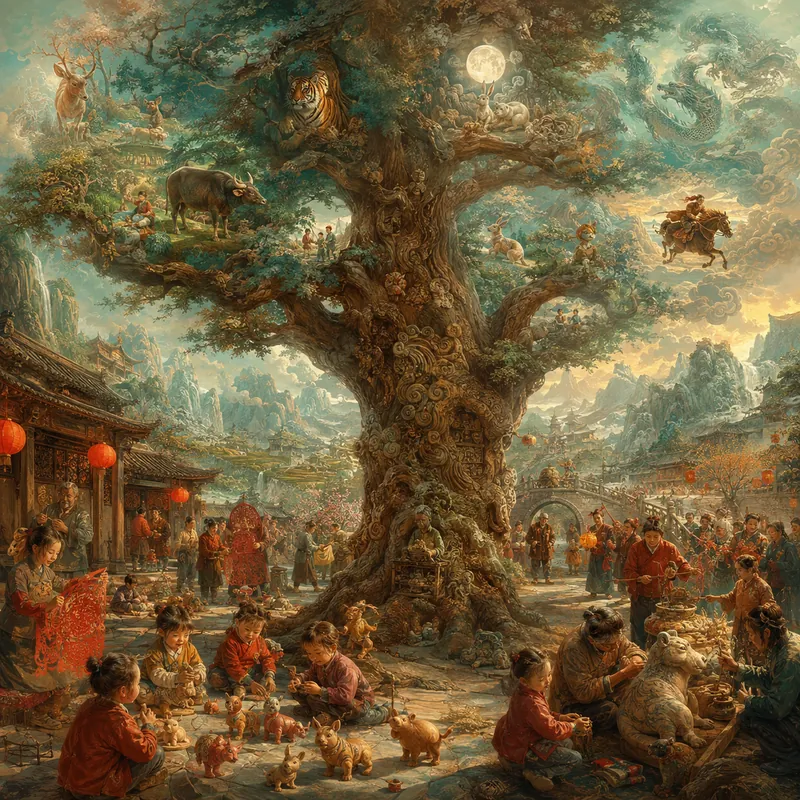
Seasonal Festivals and Observances
In the traditional lunar calendar, festivals and seasonal practices directly associated with the ox are extraordinarily numerous and extend through almost the entire year.
Ox King Festival — The Ox’s Birthday / Festival of the Ox Spirit
The Ox King Festival, also known as the Ox’s Birthday or Festival of the Ox Spirit, is one of the most important ox-related folk festivals among ethnic communities in southern China. Some Han regions also traditionally observed it. Dates vary from place to place, and local customs have distinct characteristics.
Zhuang Ox King Festival — Eighth Day of the Fourth Lunar Month
The Zhuang Ox King Festival is one of the most important agricultural festivals of the Zhuang people and is held each year on the eighth day of the fourth lunar month. According to legend, this day is the birthday of the Ox King, a divine ox who descended from Heaven specifically to help humanity plow the fields.
Principal customs:
In Zhuang areas of Guangxi, the Ox King Festival is regarded as an important festival second only to the Spring Festival. On this day, people not only allow cattle to rest, feed them well, wash them, and decorate their horns, but also burn ritual paper before the cowshed in gratitude for the Ox King’s protection over the past year.
Miao Ox King Festival — Eighth Day of the Fourth Lunar Month
The Miao also celebrate the Ox King Festival on the eighth day of the fourth lunar month. According to legend, the ancestral figure Chiyou was a warrior deity with a human body and an ox head. The ancestors of the Miao revered the ox as a totem; the eighth day of the fourth month was regarded as Chiyou’s birthday and also as the Miao Ox King Festival.
Principal customs:
Dong Ox Deity Festival — Eighth Day of the Fourth Lunar Month or Sixth Day of the Sixth Lunar Month
The Dong Ox Deity Festival, also known as the Ox-Washing Festival, is held each year on either the eighth day of the fourth lunar month or the sixth day of the sixth lunar month. Legend holds that the Ox Deity descends to the human world once a year to inspect agricultural production and protect cattle from disease.
Principal customs:
Bouyei Ox King Festival — Eighth Day of the Fourth Lunar Month
The Bouyei likewise celebrate the Ox King Festival on the eighth day of the fourth lunar month. According to legend, during an ancient migration their ancestors were aided by a divine ox, which helped them overcome hardship and eventually settle down in peace. To commemorate this beneficent animal, Bouyei communities give cattle a day of rest each year on the eighth day of the fourth month, feed them glutinous-rice cakes, and hang red cloth strips from their horns.
Han Ox King Festival — Dates Vary by Region
Some Han regions also observe the Ox King Festival, though the date is less standardized than among many ethnic minority communities. In parts of northern China, the Ox King is worshiped on the twenty-third day of the sixth lunar month, traditionally said to be the Ox King Lord’s birthday, with prayers for strong and healthy cattle and horses. In parts of the South, the festival is celebrated on the eighth day of the fourth lunar month together with neighboring ethnic communities.
Common Themes of the Ox King Festival
Regardless of ethnicity or region, the central themes of the Ox King Festival are gratitude toward cattle, humane treatment of cattle, and prayers for their health and strength. The festival gives concentrated expression to the agrarian conviction that “the ox is the farmer’s treasure.”
Giving oxen a holiday
all work oxen rest for the day; they neither plow fields nor pull carts.
Feeding them the finest food
cattle are given especially good feed, including glutinous rice, rice porridge, eggs, and rice wine. In some places, glutinous rice is formed into balls and placed directly into the ox’s mouth so that it may “eat its fill.”
Bathing the ox
cattle are washed with warm water, their coats are groomed, and parasites are removed.
Decorating the horns
red silk or red cloth strips are tied around the horns; in some areas, colored paper flowers are also hung from the head so that the ox is beautifully adorned.
Worshiping the Ox King
an incense table is set up before the cowshed, offerings are arranged, incense and ritual paper are burned, and prayers are made for the Ox King to keep the cattle strong, healthy, and free from misfortune.
Beginning of Spring — Whipping the Spring Ox
Whipping the Spring Ox, also called Beating the Spring Ox, was one of the most important ceremonies for welcoming spring in ancient China and was performed on the day of the Beginning of Spring.
Origins of the Spring Ox
The Beginning of Spring is the first of the Twenty-Four Solar Terms and marks the opening of spring. In an agricultural society, it meant that spring plowing was about to begin. The ancients fashioned an ox from clay — known as the Spring Ox — and held a whipping ceremony before it on the day of Beginning of Spring, both to encourage agricultural labor and to pray for a good harvest.
The size, color, and orientation of the Spring Ox were all governed by convention. According to the Book of Rites: Monthly Ordinances, the Spring Ox was to be eight chi long and four chi high, symbolizing the four seasons and the winds from the eight directions. Its color was determined according to the year’s Heavenly Stems, Earthly Branches, and Five Phases: a year associated with Metal called for white, Wood for blue-green, Water for black, Fire for red, and Earth for yellow.
The Whipping Ceremony
On the day of Beginning of Spring, local authorities erected an altar in the eastern part of the city — the East being associated with spring — and placed the clay Spring Ox upon it. The highest local official, such as the prefect or county magistrate, held a colored whip and struck the ox three times. This was called “Beating Spring” or “Whipping Spring.” Afterward, the crowd broke the Spring Ox apart, scattering fragments across the ground. People scrambled to collect these pieces in a custom known as “Seizing Spring”, then brought them home and placed them in cowsheds or granaries in hopes of flourishing livestock and abundant grain.
Welcoming Spring and the Spring Procession
Before the Whipping of the Spring Ox, a grand Welcoming Spring ceremony was also held. People carried the Spring Ox and the Mang Deity, the divinity governing spring, through the city in procession. Gongs and drums thundered, colorful banners filled the streets, and crowds lined the road to watch. This was known as the Spring Procession or Welcoming Spring. The ceremony welcomed the season while also mobilizing society for the coming agricultural work.
Spring Ox Pictures and the Spring Ox Almanac
Associated with the Whipping of the Spring Ox was the Spring Ox Picture, a type of New Year print depicting the Spring Ox and the Mang Deity together with the year’s agricultural calendar and formulas for seeking good fortune and avoiding misfortune. Folk tradition held that “when the Spring Ox enters ten thousand homes, the whole year will bring good prospects.” Families posted Spring Ox Pictures around the Beginning of Spring, praying for favorable weather and abundant harvests in the year ahead.
Cultural Meaning of Whipping the Spring Ox
The ceremony of Whipping the Spring Ox endured for thousands of years and only gradually disappeared around the end of the Qing dynasty and the beginning of the Republican era. It embodied the ancient Chinese state ideal of “encouraging agriculture and valuing farming”, while also reflecting the irreplaceable centrality of the ox within agrarian civilization. Though the Spring Ox itself was made of clay, it symbolized the value and meaning of real working cattle.
Delivering the Spring Ox
Unlike the official Whipping of the Spring Ox, Delivering the Spring Ox was a spontaneous popular custom for welcoming spring.
Origins of the Custom
Around the Beginning of Spring, villagers known for “delivering the Spring Ox” would carry red- or yellow-paper pictures of an ox from household to household. These images were inscribed with verses encouraging agriculture and with auspicious phrases. The men who delivered them were known as “Spring Officials” or “Spring Singers.” As they distributed the pictures, they chanted blessings in rhymed folk speech:
“The Spring Ox comes, the Spring Ox comes — your harvest this year will overflow. The Spring Ox calls, the Spring Ox calls — your silver and gold will never be spent…”
Spring Singing
Spring Singing was a form of folk recitation and song popular in parts of northwestern and southwestern China. Spring Singers traveled from village to village, standing before Spring Ox pictures while reciting the year’s agricultural tasks, solar terms, and taboos. In doing so, they transmitted practical farming knowledge while also adding festivity to the Beginning of Spring. Their verses could be formulaic or improvised on the spot:
“The Spring Ox walks slowly — your grain bins rise to a peak; the Spring Ox walks swiftly — your gold and silver fill the world.”
Sending Off the Ox King
In some southern regions, there is a custom known as Sending Off the Ox King after the autumn harvest.
In the tenth lunar month — or in some places around the Winter Solstice — the harvest has been completed and cattle have finished their year’s work. People make a straw ox and burn it before the cowshed, a rite called Sending Off the Ox King. The meaning is to send the Ox King’s spirit back to Heaven so that it may rest through the winter and return the following spring to help humanity cultivate the land once more.
During the ceremony, people tie red cloth strips to the straw ox, decorate it with colored paper flowers, burn ritual paper, and offer food, praying that the Ox King will return the next year and continue to protect agriculture. Sending Off the Ox King and Receiving the Ox King — the springtime welcoming rites — thus form the two ends of a complete annual cycle, expressing the dependence and gratitude that agrarian society felt toward cattle.
Ox Day — Fifth Day of the First Lunar Month
In traditional Chinese folk belief, the first through sixth days of the first lunar month correspond respectively to the Chicken, Dog, Sheep, Pig, Ox, and Horse, because Nüwa was said to have created the six domestic animals during those first six days and humanity only on the seventh.
According to the Book of Divination: “The first day of the first month is for the Chicken, the second for the Dog, the third for the Sheep, the fourth for the Pig, the fifth for the Ox, the sixth for the Horse, and the seventh for Human beings.” The fifth day is therefore Ox Day. On this day, slaughtering cattle is forbidden, and cattle are not to be used for plowing, as a sign of respect.
The weather on Ox Day was also used to divine the fortune of cattle for the coming year. If the fifth day was clear, cattle were expected to remain strong and free from disease; if it was rainy or overcast, illness or other misfortune was feared.
Worshiping the Ox at Grain Rain
In some regions, there are traditions of worshiping cattle around the solar term Grain Rain. This is one of the busiest periods of spring cultivation, when plowing, harrowing, and sowing all depend heavily upon oxen. On this day, people give cattle the finest fodder, burn ritual paper before the cowshed, and pray that the animals will remain healthy and work smoothly throughout the spring farming season.
Worshiping the Ox King at Frost’s Descent
Frost’s Descent is the final solar term of autumn. In parts of northern China, a custom known as “Worshiping the Ox King at Frost’s Descent” has long circulated. After Frost’s Descent, the weather turns colder and working cattle enter their winter rest period. People give the ox its final bath of the year and its last special feed, then close and reinforce the cowshed with thicker bedding so that it can pass the winter in comfort.
Folk Belief
In Chinese popular religion, the ox possesses an exalted divine status. The Ox King, Ox Deity, and Lord Ox King all play important roles within the folk religious system.
Worship of the Ox King
Origins of the Ox King
The Ox King is the folk deity believed to govern cattle. Several traditions explain his origin:
Ox King Temples
Across China there once stood numerous Ox King Temples, Ox Deity Temples, and Horse King Temples, with the Horse King and Ox King often worshiped together. On the twenty-third day of the sixth lunar month, traditionally said to be the Ox King Lord’s birthday, cattle owners, cattle dealers, and merchants engaged in the cattle trade visited these temples to burn incense and pray that their animals would remain strong, healthy, and fertile.
Ox King Associations
Some regions also formed organizations known as Ox King Associations. Cattle-owning households took turns serving as association leaders, pooled funds to organize Ox King rites, invited opera troupes to perform, and gathered for communal meals and discussions. These associations were not only religious organizations but also places where cattle owners exchanged husbandry knowledge and conducted cattle transactions.
The Ox Lodge descended from Heaven
according to legend, the Ox King was the celestial Ox Lodge, one of the Twenty-Eight Lunar Mansions. Seeing how hard people labored in cultivation, he volunteered to descend to the human world and help them.
An incarnation of Shennong
another tradition identifies the Ox King with the Divine Farmer, the Flame Emperor. Yandi was described as having a human body and an ox head and as the ancestral founder of agriculture, making him a natural candidate for the role of Ox King.
Laozi’s mount
in Daoist legend, the mount of the Supreme Lord Lao is a blue-green ox. After descending to the human world, this sacred ox was said to become the Ox King.
Worship of the Ox Deity
Totemic Origins of the Ox
The ox was one of the earliest animal totems of ancient China. According to legend, Yandi Shennong had “a human body and an ox head.” The Chronicles of Emperors and Kings records: “Shennong was of the Jiang clan. His mother was named Rensi… she conceived through contact with a divine dragon and gave birth to Yandi, who had a human body and an ox head.” Yandi’s people revered the ox as their totem and became associated with the origins of Chinese agrarian civilization.
In the legendary war between the Yellow Emperor and Chiyou, Chiyou too is depicted as having an ox head and a human body. His people likewise revered the ox as a totem. That both Yandi and Chiyou were leaders of ox-totem peoples indicates the exceptionally exalted status of the animal in ancient Chinese tribal culture.
Ritual Status of the Ox
In Shang and Zhou sacrificial rites, the ox was the highest-ranking sacrificial animal. The Great Sacrifice placed the ox first, followed by sheep and pig; the Lesser Sacrifice used sheep and pig but no ox. Only sacrifices of the highest, sovereign level were worthy of an ox. The ritual system itself thus institutionalized the sacred status of cattle.
Iron Oxen for Suppressing Floods
In ancient Chinese hydraulic culture, iron oxen played an important role in controlling or suppressing water. Legend held that whenever Yu the Great brought a river under control, he cast an iron ox and sank it into the riverbed to restrain floods. This tradition endured for thousands of years, and many places along the Yellow and Yangtze Rivers still preserve iron oxen cast during the Ming and Qing periods.
Among the best-known examples are:
The belief underlying these objects was that the ox belongs to Earth, and Earth controls Water. In Five-Phase theory, Chou belongs to Earth, and Earth overcomes Water. This simple cosmological principle helped make the ox one of the most favored sacred animals in hydraulic engineering.
Kaifeng Iron Rhinoceros for Suppressing the River
cast in 1446 during the Zhengtong reign of the Ming dynasty under the direction of Yu Qian, then governor of Henan.
Jingzhou Iron Ox for Suppressing Water
cast during the Qianlong reign of the Qing dynasty and located beside the Yangtze River in Jingzhou, Hubei.
Li Bing Stone Ox at Dujiangyan
traditionally said to have been placed there by Li Bing during construction of Dujiangyan in the Warring States period. It served both as a hydrological marker and as an object for suppressing water.
Ox Deities and Ox King Worship among Ethnic Minorities
Zhuang: the ancestors of the Zhuang regarded the ox as an important totem. In Zhuang mythology, the Ox King is a celestial star spirit who, moved by human hardship, descended to help people cultivate the land. Strong traditions of reverence for cattle remain among the Zhuang today.
Miao: in Miao legend, the ancestral figure Chiyou had an ox head and a human body, and the ox is one of the Miao totems. Traditions of bull contests, Ox King worship, and the Ox King Festival remain important today.
Tibetan: in Tibetan Buddhism, bovine imagery has sacred significance. Yamantaka, often represented with a buffalo head and a human body, is one of the major protective deities of Tibetan Buddhism and symbolizes the power of the Dharma to subdue all evil.
Yi: among the Yi, the Torch Festival includes traditions of worshiping the Ox Deity. One legend holds that the festival originated from a Yi hero who sacrificed himself to protect cattle. During the festival, people honor not only the hero but also the divine protector of the herd.
Auspicious Symbolism
The ox occupies an important place in Chinese auspicious culture. The word niu can be used in wordplay with expressions suggesting “turning” or “reversing” fortune, while in agrarian society the ox was itself a visible sign of wealth. As a folk saying puts it: “The ox is the farmer’s treasure; with an ox there is land, and with land there is food.”
The Bull Market and Wealth
The modern financial term “bull market” has its roots in the image of the ox. In traditional rural society, an ox market was literally a marketplace for buying and selling working cattle. Since the ox was the farmer’s most important productive asset and could cost the equivalent of many months of household income, a thriving cattle market signaled a thriving agricultural economy. The term was later borrowed into modern financial language to describe a rising and prosperous market.
In traditional Chinese agricultural society, people often said that “an ox is half the household fortune.” A working ox could represent nearly half a family’s assets. With an ox, one could cultivate land; with cultivated land, one could harvest grain; with grain, one could produce a surplus to sell. The ox was therefore both a creator of wealth and a symbol of wealth itself.
In folk culture, the ox also became an auspicious emblem for attracting wealth. The animal’s lowing sound, mou, was associated through wordplay with the idea of planning or seeking advantage. Hence sayings such as “when the ox lows, wealth rolls in.”
Auspicious Expressions for the Year of the Ox
Every Year of the Ox gives rise to an especially rich vocabulary of blessings:
"Ox Spirit Soaring Skyward"
describing flourishing momentum and the arrival of good fortune.
"The Ox Turns the Tide"
a pun on “reversing the course of events,” expressing a dramatic change of fortune for the better.
"Golden Ox Brings Auspicious Fortune"
symbolizing wealth and good fortune.
"Five Oxen Welcome Good Fortune"
“Five Oxen receive the Five Blessings” — five oxen representing the arrival of the Five Blessings.
“Great fortune in the Year of the Ox” and “May all go as you wish in the Year of the Ox.”
Folk Art
The ox is one of the most common subjects in Chinese folk art. From New Year prints to paper-cutting, from clay sculpture to stone carving, its image appears everywhere.
Oxen in New Year Prints
Spring Ox Pictures
The Spring Ox Picture is one of the most common ox themes in New Year prints. At the center stands a powerful bull carrying a flowering plum branch on its back, symbolizing the plum blossom announcing spring. Beside it stands the Mang Deity, or God of Spring, holding a willow whip. The image is often printed together with the Twenty-Four Solar Terms and agricultural sayings, making it both an auspicious picture and a farming calendar. Folk tradition says: “When the Spring Ox enters ten thousand homes, the whole year brings good prospects.” Families paste Spring Ox Pictures around the Beginning of Spring in hopes of favorable weather and abundant harvests.
Five Oxen
The Five Oxen is a classic theme in New Year prints. Five oxen appear in different poses — walking, standing, lying down, eating, or lifting their heads — and together symbolize “Five Oxen bringing blessings.” Such compositions often draw inspiration from Han Huang’s Tang-dynasty painting Five Oxen.
Oxen in Paper-Cutting
The Spring Ox is the most common ox motif in paper-cutting: a strong animal carrying plum blossoms or ingots on its back, accompanied by swallows, willow branches, and other signs of spring. These cut-paper oxen are often pasted on windows or cowshed doors to symbolize welcoming spring and receiving blessings.
Clay and Stone Oxen
Clay oxen: in rural northern China, people traditionally made ox-shaped clay figures from yellow earth and left them to dry on windowsills, either as children’s toys or as seasonal decorations. Clay oxen were also common folk crafts at temple fairs.
Stone oxen: throughout China, ancient ox sculptures survive in many forms — stone, iron, and bronze. Some were used to suppress floods, others to guard tombs, and still others as auspicious decoration.
Oxen in Woodblock Prints
The ox is also a familiar theme in traditional Chinese printmaking, especially in folk woodcuts, where “every cut and every stroke conveys the plain sincerity of peasant art.”
Taboos and Apotropaic Practices
The central principle behind folk taboos concerning cattle is “respect the ox, cherish the ox, and do not harm the ox.”
Taboos Concerning Working Cattle
Do not strike the ox on the head: folk belief holds that “if you strike an ox on the head, it will die.” The head was seen as the animal’s most vulnerable and vital part. Even if an ox was disobedient, one was permitted to strike only its hindquarters or back, never the head.
Do not curse the ox: people believed that cattle could understand human speech. If one called an ox “dead ox” or “diseased ox,” the words might come true. Cattle owners therefore avoided speaking ill of their animals and used only favorable words.
Do not speak words of death or illness before the cowshed: saying things like “the ox is dead” or “the ox is sick” near the cowshed was considered inauspicious. Such words might be overheard by the Ox King and become reality.
Do not whip a pregnant cow: during pregnancy, a cow was not to be beaten or overworked. Folk belief held that doing so would offend the Ox King and could cause miscarriage or a difficult birth.
Taboos Concerning Beef
Do not eat working cattle: in traditional agrarian society, eating the meat of working cattle was strictly forbidden. The plow ox was a farming partner and household asset, not food. Only cattle that died of illness or old age might sometimes be eaten, and even then one was expected to seek the Ox King’s forgiveness beforehand.
Buddhism and the taboo against beef: after Buddhism entered China, abstention from beef became widespread among Buddhists. The ox was regarded as the foremost of the six domestic animals, the foundation of agriculture, and a friend of humanity; eating its flesh was seen as an act of ingratitude. From the Tang and Song periods onward, the Buddhist taboo against beef exerted a deep influence on Chinese society, and many literati and officials regarded abstention from beef as a sign of moral integrity and benevolence.
Popular explanations for avoiding beef: folk tradition offered simple moral explanations such as “if you eat beef, you will become an ox in your next life,” reflecting ideas of karmic retribution, and “the ox plows the fields and the horse carries people; to eat the ox’s flesh is to have no conscience,” reflecting gratitude and compassion.
Taboos in One’s Zodiac Year
People born in the Year of the Ox traditionally observe certain cautions during an Ox year. They may be advised not to make major changes such as moving house, changing jobs, or making large investments; not to travel far, since their zodiac year is considered a time for stillness rather than movement; to wear red belts, red socks, or red undergarments to ward off misfortune; and to wear ox-shaped jade or metal ornaments as talismans associated with their natal sign.
Zodiac Conflicts
In traditional zodiac marriage culture, people born under the Ox are said to clash with those born under the Sheep — the conflict of Chou and Wei — and to be harmed by those born under the Horse — the relation between Chou and Wu. Folk sayings such as “Ox and Sheep do not reach the end together” and “Ox and Horse do not grow old together” express the belief that such marriages may bring disharmony or even separation. These ideas belong to the realm of folk custom and have no scientific basis.
Folk Language and Sayings
The ox has left an exceptionally rich imprint on Chinese folk language. Unlike expressions involving the Rat, which tend strongly toward criticism, language concerning the Ox is predominantly complimentary, though not without negative examples.
Oxen in Idioms
Positive expressions:
Negative expressions — fewer in number:
Ox Spirit Soaring Skyward
describing powerful momentum and flourishing success.
Strength of Nine Oxen and Two Tigers
The strength of nine oxen and two tigers — describing enormous physical force.
Hanging Books on Ox Horns
describing diligent study, from the story of Li Mi reading the Book of Han while traveling with the book hung from an ox horn.
Books Enough to Make Oxen Sweat and Fill the Rafters
Books enough to make oxen sweat and fill a house — describing an enormous library.
A Small Trial of the Ox Cleaver
Trying the ox-cleaver on a small task — a person of great talent displaying skill on a minor matter.
Seeing Beyond the Whole Ox
mastery so complete that one perceives only the internal structure, from the story of Cook Ding.
Butcher Ding Carves an Ox
mastering the underlying principles of something so thoroughly that action becomes effortless.
Using an Ox Cauldron to Cook a Chicken
using great resources for a small task.
Land Where the Ox Sleeps
an auspicious geomantic site, a place peaceful enough for an ox to sleep.
Oxen in Proverbs
"The ox is a farmer’s treasure; where there is an ox, there is land to farm"
“The ox is the farmer’s treasure; with an ox there is land.” — expressing the central role of cattle in agricultural production.
"Better to give up a mu of land than an ox"
“Better to give up one mu of land than one ox.” — emphasizing that an ox could be more valuable than a field.
"You can’t make an ox drink by forcing its head down"
“You cannot force an ox to drink by pressing down its head.” — one cannot compel another person to do what they refuse to do.
"The ox doesn’t know its horns are curved; the horse doesn’t know its face is long"
“The ox does not know its horns are curved, nor the horse that its face is long.” — people often fail to see their own shortcomings.
"If an ox won’t drink, forcing its head down won’t help"
“If the ox will not drink, pressing its head is useless.” — force cannot create willingness.
“老牛拉车
steady in every direction.” — describing calm and reliable conduct.
"The Old Ox Licks Its Calf"
parental love for children.
“黄牛过河
each tends to itself.” — everyone looks after their own affairs.
“牛犊子追母
learning by watching her back.” — younger generations imitate their elders.
Two-Part Allegorical Sayings about Oxen
牛鼻子上的跳蚤
thinking too highly of itself.
牛角上挂把草
A bundle of grass hanging from an ox horn — too reluctant to throw it away.
牛栏里关猫
impossible to keep there.
牛角尖钻到底
stubborn to the point of obsession.
牛尾巴打苍蝇
success by pure chance.
牛蹄子两瓣
unable to come together.
牛吃草、鸭吃谷
each enjoys its own share of fortune.
牛啃草根
take it slowly.
牛拉磨
going in circles.
黄牛角、水牛角
Yellow-ox horns and water-buffalo horns — each has its own horns.
水牛过河
showing both head and horns.
牛背上的鸡
never truly secure.
Folk Characterizations of People Born in the Year of the Ox
In popular zodiac personality culture, people born under the Ox receive characteristic evaluations. Positive traits include diligence, steadiness, honesty, perseverance, willingness to bear hardship, and a strong sense of responsibility. Negative traits include stubbornness — the proverbial “ox temper” — inflexibility, and slow reactions. A folk verse summarizes the idealized Ox personality:
“Chou Ox nature pure and true, a lifetime spent in diligent labor. Plowing sun and moon at the field’s edge, honesty handed down to descendants.”
Oxen in Children’s Folklore
Oxen in Children’s Songs
The Cowherd Boy: “The sun comes out and shines on the hill; the cowherd rides his ox and sings a mountain song. In his left hand he holds a blade of green grass, with his right he swings a willow switch.” The song paints an idyllic pastoral scene of a cowherd boy riding leisurely on an ox while singing.
The Little Calf: “Little calf, so lovable, follows its mother to the field. When mother walks, it walks; when mother stops, it stops.” For many children, such songs form an earliest introduction to the animal.
In the Song of the Twelve Zodiac Animals: “The Rat comes first, followed by the old yellow Ox; the Tiger gives a roar, and the Rabbit trembles all over…” The Ox is second and is one of the first zodiac animals children learn to recognize.
Oxen in Children’s Games
“Bullfighting”: a folk game in which two children imitate fighting bulls by bending over, pressing heads together, and gripping each other’s shoulders. The first to be pushed down or backward loses.
“Riding the Ox”: a group game in which one child plays the ox on hands and knees while another rides on the “ox’s” back. The ox crawls and attempts to shake the rider off. The game was especially common in northern rural communities.
“Old Ox Pulling the Cart”: a pulling game in which several children form a line, each holding the clothing of the child ahead. The first child plays the ox and the rest the cart. The ox pulls forward while the “cart” follows behind. It resembles other line games but emphasizes strength and pulling.
Ox Toys
Clay oxen: common toys at northern temple fairs. Some have holes in the back through which they can make sound when blown. The brightly colored, robustly modeled clay oxen of Gaomi, Shandong, are part of a nationally recognized intangible cultural heritage tradition.
Bamboo oxen: ox-shaped toys woven from bamboo, especially common in southern China.
Cloth oxen: small ox dolls sewn from fabric, usually simple and endearing in appearance and often among a child’s earliest visual encounters with the animal.
Oxen in Literature and Art
The ox is one of the most common subjects in Chinese literature and art. From the Book of Songs to Han Huang’s Five Oxen, artists and writers have endowed the animal with an exalted moral personality.
The Cowherd and the Weaver Girl
The story of the Cowherd and the Weaver Girl is one of China’s Four Great Folk Legends. In this tale, an old ox plays the indispensable role of matchmaker.
The Cowherd loses his parents at an early age and lives with his elder brother and sister-in-law. His sister-in-law treats him harshly, sending him out each day with an old ox and giving him little to eat. The Cowherd and the ox depend upon one another for survival. One day, the old ox suddenly begins to speak and tells him that the Weaver Girl of Heaven will descend to bathe. Following the ox’s advice, he goes to meet her, and the two eventually marry. Later, the Heavenly Emperor takes the Weaver Girl back to Heaven. Before dying, the old ox tells the Cowherd that if he wears the ox’s hide, he will be able to fly to Heaven and seek his wife. The Cowherd puts on the hide, carries his two children in baskets, and flies upward, only to be separated from the Weaver Girl by the Milky Way created by the Queen Mother of the West. Thereafter they can meet only once each year on the seventh night of the seventh lunar month, upon the bridge formed by magpies. In this tale, the old ox possesses multiple divine qualities: it can speak, foresee the future, and after death its hide can enable a human being to fly. It stands between deity and animal and represents the highest expression of the ox’s spiritual power.
Han Huang’s Five Oxen
Five Oxen, painted by the Tang artist Han Huang, is the earliest surviving and most famous Chinese painting on paper devoted to oxen.
Content of the painting: five oxen are arranged from left to right, each with a distinct posture and expression. The first, brown in color, lowers its head to eat grass in complete ease. The second, black and white, strides forward with head raised and lively spirit. The third stands frontally and looks directly toward the viewer, the only frontal animal in the composition. The fourth turns its head as though waiting for a companion. The fifth, yellow in color, lowers its head under a burden and walks with heavy steps.
Artistic features: Han Huang used meticulous brushwork to depict the animals’ hides, muscles, bones, eyes, and expressions, giving each ox a different temperament and emotional presence. The five animals retain their individual independence while also forming an internally coherent sequence, as though an ox procession were moving slowly forward. Zhao Mengfu of the Yuan dynasty praised the work simply as “extraordinary brushwork.”
Cultural meaning: Five Oxen celebrates agrarian civilization while also allowing Han Huang to use the ox as a metaphor for himself. Diligence, endurance, willingness to labor, and asking nothing in return are presented as virtues of both the plow ox and the cultivated gentleman. The painting is now housed in the Palace Museum in Beijing and is regarded as a national treasure.
Poems on Oxen through the Dynasties
Tang dynasty:
Lu Guimeng, Five Songs: Herding Oxen
"By autumn’s end the river grass seems half consumed; ten-horned Wu oxen graze beside the riverbank. Shoulder by shoulder, tail against tail, they cluster briefly, then run crosswise and slanting, suddenly scattering apart."
Du Mu, Qingming
"May I ask where there is a tavern? A shepherd boy points far away to Apricot Blossom Village." The poem does not explicitly mention an ox, yet the figure of the shepherd boy naturally evokes pastoral life with cattle.
Qi Baishi’s Ox Paintings
Qi Baishi painted not only Rats but also oxen. Many of his ox paintings drew upon memories of rural life: cowherd boys riding on oxen, old oxen plowing fields, or cattle resting beneath willow trees. His ox paintings are plain, unadorned, and full of the atmosphere of the earth, expressing his deep nostalgia for the countryside of his childhood.
Final Reflections
The folk culture of the Chou Ox is one of the deepest and most thoroughly agrarian chapters in the Chinese zodiac tradition. People approached cattle with both gratitude and reverence: they thanked them for a lifetime of silent labor, yet also elevated them through sacred worship as the Ox King and Ox Deity. The ox was not only a symbol of wealth, strength, and diligence, but also bore mysterious functions of controlling water and communicating with the divine. From the Whipping of the Spring Ox at the Beginning of Spring to the Sending Off of the Ox King after the autumn harvest, the ox’s presence runs through the entire agricultural year.
From the Ox King Festivals of the Zhuang, Miao, and Dong peoples to the Han custom of Whipping the Spring Ox, from divination on Ox Day to the gratitude expressed in Worshiping the Ox King at Frost’s Descent, ox-related folklore extends across almost every domain of traditional culture: seasonal observances, popular religion, auspicious symbolism, folk art, taboos, and apotropaic rites. The ox was at once a deity to be worshiped and offered sacrifices and a companion to be treated with kindness and gratitude. This deep emotional bond — revering it as a god while loving it as a friend — lies at the heart of the Chou Ox tradition.
The root of this profound bond lies in the inseparable relationship between cattle and agrarian civilization. Throughout the long centuries of traditional agriculture, the ox was the farmer’s treasure, half a family’s property, and the practical foundation behind the saying “with an ox there is land.” Life without cattle was almost unimaginable. Through festivals, rituals, legends, and taboos, people gradually elevated the ox to sacred status. Ox folklore therefore became a mirror reflecting the plain yet profound gratitude with which traditional Chinese society faced the earth: those who live by an animal’s strength must honor its spirit; those who use its strength must repay its labor.
From the official ceremony of Whipping the Spring Ox to the communal celebration of the Ox King Festival, from the brushwork and spirit of Five Oxen to modern New Year blessings such as “Ox energy soaring to the heavens,” ox folklore has continued unbroken through thousands of years of transmission. It reminds us that, during the long centuries before machines replaced animal labor, one ox, one plow, and one pair of human hands formed the most solid foundation of Chinese agrarian civilization. Though the Chou Ox stands second in the zodiac, it carries one of the deepest expressions of the Chinese people’s respect for diligence, abundance, endurance, and selfless contribution.
---
Readers’ Comments
Calendar and traditional culture enthusiasts from around the world, sharing the same moon.
Sign in or register to join the conversation. Your comment account is created automatically the first time you use a connected account.
No comments yet
Share your thoughts with readers around the world.