
Rain Water Farming
「雨水有雨庄稼好,大春小春一片宝。」
During 雨水 (Yǔshuǐ, Rain Water), precipitation across much of China begins to shift from snow toward rain, and overwintering crops quicken their return to life. On the North China Plain, winter wheat enters 返青 (*spring recovery and return to green*) on a broad scale, while preparations for spring irrigation are put in place. Across the Yangtze River basin, persistent spring rains settle in, rapeseed moves into full bloom, and the pressure to clear ditches and drain excess water reaches its seasonal peak. In South China, early-rice seedling raising enters its busiest period, with seedlings emerging one after another. Northeast and Northwest China remain in the preparatory phase: machinery maintenance continues, while land preparation and fertilization for spring wheat move steadily forward.
In the temperate Southern Hemisphere, late summer is turning toward early autumn. Winter-wheat harvests in southeastern Australia and Argentina approach their end, while grape harvesting continues alongside them. In the tropical Northern Hemisphere, the dry season is about to close and water storage and land preparation accelerate. Across the tropical Southern Hemisphere, the rainy season reaches its height; Brazilian soybeans enter the decisive period of pod formation and seed filling, while the burden of preventing field waterlogging becomes heavier.
Global Agriculture
Temperate Regions of the Northern Hemisphere
Phenological Signs
The Yangtze and Huai River systems have completely thawed, and fine mist often rises from the water in the early morning. South of the Qinling–Huaihe line in China, grasslands begin to turn green and willow buds visibly swell. Overwintering geese from Dongting Lake in Hunan and Poyang Lake in Jiangxi begin their northward migration, pausing briefly in wetlands along the Yellow River. In Kyushu, Japan, plum blossoms enter full bloom, while rapeseed fields along South Korea’s southern coast begin to take on their characteristic yellow.
Farming Activities
Winter wheat across the North China Plain enters 返青期 (*the spring regreening stage*) in earnest, and preparations for spring irrigation expand across the region as farmers inspect wells and irrigation channels. Early-rice seedling raising accelerates in the Yangtze basin, southern Japan, and South Korea; seedbeds remain covered to retain warmth, and once seedlings emerge, growers must guard carefully against 低温烂秧 (*seedling rot caused by low temperatures*). In South China, early-rice seedlings enter the “二叶一心” stage—*two fully expanded leaves with one central emerging leaf*—while spring peanuts and spring maize are sown on a broad scale. In the Yangtze basin, rapeseed moves from peak bolting toward early flowering, and farmers apply 薹肥 (*bolting fertilizer*) to promote branching. Across northern Chinese orchards, winter pruning comes fully to an end and lime-sulfur spraying is gradually completed.
Phenological Signs
Winter pastures across Western Europe return fully to green, spreading fresh color across the landscape. Temperatures in France and Germany rise to around 5–8°C; orchard soils begin to thaw and dormant grape buds swell slightly. Along the lower Danube, floating ice has largely disappeared and the river surface opens again.
Farming Activities
Winter wheat in France and Germany begins entering its spring-regrowth stage, and farmers inspect fields to assess overwinter survival and formulate spring water-and-fertilizer plans. Across Ukraine’s chernozem belt, spring regrowth accelerates and 保墒 (*soil-moisture conservation*) work expands. Winter pruning in Bordeaux, Rheinhessen, and other wine regions is completed, while pre-bud spraying progresses. Northern Europe remains frozen; greenhouse vegetable seedlings continue to be raised in an orderly manner, and machinery servicing goes on.
Phenological Signs
In the winter-wheat belts of Kansas and Nebraska, temperatures rise and scattered patches of green begin to appear across the fields. Ice cover around the Great Lakes continues to retreat, and river ice melts more rapidly. In California’s Central Valley, almond flower buds continue swelling, with some early cultivars entering initial bloom.
Farming Activities
Kansas, Nebraska, and other winter-wheat areas enter a period of accelerating spring recovery. Farmers begin field inspections, assess winter survival, and formulate water-and-fertilizer plans for 返青. In California’s Central Valley, orchard winter pruning is fully complete, pre-bud spraying begins successively, and almonds and apricots enter the later stage of flower-bud swelling. Across the U.S. Midwest, spring-planting logistics are now fully underway: seed orders are complete, fertilizer begins arriving, and machinery servicing nears completion. Canada’s Prairie Provinces remain frozen; work still centers on agricultural-input reserves and machinery maintenance, while farmers begin drawing up their planting plans.
Phenological Signs
Snowmelt accelerates across Turkey’s Anatolian Plateau, gradually exposing the ground. Along Iran’s Caspian coast, apricot flower buds continue to swell, with some early cultivars entering initial bloom. Along Israel’s Mediterranean coast, citrus blossoms are poised to open.
Farming Activities
Winter wheat in Turkey, Iran, and other parts of the Middle East gradually enters spring regrowth, and spring irrigation begins on a broad scale. Along the Mediterranean coasts of Israel, Morocco, and other parts of North Africa, winter wheat also enters its regreening stage and farmers begin active field management. In South Africa’s Cape region, grape harvesting continues, while early varieties approach the end of picking.
Temperate Regions of the Southern Hemisphere
Phenological Signs
The region is moving from late summer into early autumn. The weather becomes mild and comfortable, with average daily temperatures falling to around 20–22°C. Wheat fields are completely yellow, while grape sugar accumulation reaches its peak. Pastures shift from deep green toward yellow-green and annual grasses gradually wither. Day–night temperature differences continue to widen, and morning mist becomes more frequent.
Farming Activities
Winter-wheat and barley harvests enter their final stage. Farmers race to finish cutting, drying, and storage; clear weather is the greatest advantage at this point, while unseasonable rain can cause harvested grain to absorb moisture and develop mold in storage. Vineyards across southeastern Australia reach the height of harvest, with wine grapes in the Hunter and Yarra valleys picked in concentrated bursts. The harvest window usually lasts only one to two weeks. Once crops are removed, fields are cleared, deep-plowed, and rested in preparation for winter crops sown in April and May.
Phenological Signs
The grasslands move still farther from the deep green of midsummer toward yellow-green, and the feeling of autumn becomes increasingly pronounced. Day–night temperature differences are clear, and morning dew covers the grass. Late-maturing maize begins to show signs of ripeness, giving the fields richer layers of color.
Farming Activities
The winter-wheat harvest nears completion, and large combines finish their final passes. Farmers begin comprehensive planning for deep tillage and fallow management ahead of autumn sowing, and some early-harvested fields are already being turned. Argentina’s apple and pear regions are at peak harvest, with orchard crews and packing lines continuously busy. Vineyard harvesting progresses at the same time, and wine grapes in Mendoza and other regions enter their picking window.
Phenological Signs
Temperatures fall to around 12–18°C, bringing the clear, crisp feel of autumn. Pasture growth slows across both main islands, and yellowing becomes more obvious in some high-altitude grazing lands. Sugars and flavor compounds in grapes reach optimal levels. Kiwifruit continue their final enlargement, while skin coloration deepens.
Farming Activities
Farmers across the North and South Islands fully launch autumn pasture management—overseeding cool-season ryegrass and white clover, applying autumn fertilizer, adjusting stocking density and rotational grazing cycles, and storing hay for winter. Vineyards in Marlborough and Central Otago reach peak harvest, with Sauvignon Blanc and Pinot Noir gathered in concentrated waves. Kiwifruit orchards enter the final push before harvest: growers check fruit maturity while packing facilities stand ready.
Phenological Signs
Grapes in the Central Valley enter the later stage of ripening, with deeper skin color and fully softened fruit. Blueberry and cherry harvests are essentially complete and orchard leaves begin to turn. Apples and pears continue to enlarge, with some early varieties entering pre-ripening.
Farming Activities
Vineyards in the Central Valley move into concentrated harvest, with Cabernet Sauvignon, Carménère, and other varieties picked successively. Chile’s blueberry and cherry harvests are largely complete, and export packing lines enter their final phase. Apple- and pear-producing areas begin preparing for autumn harvest—assembling picking tools, testing packing lines, and clearing warehouses.
Tropical and Subtropical Regions
Phenological Signs
The dry season is beginning its transition toward the rains. Humidity rises and occasional thundershowers appear. After reaching their annual low, river levels across Southeast Asia begin a slow recovery. Vegetation in the far south of China is fully green, while early-rice seedbeds form expanses of tender green. Dry-season rice in Thailand, Vietnam, and Cambodia reaches the later stages of maturity, turning paddies golden.
Farming Activities
Farmers in Thailand, Vietnam, and Cambodia intensify repairs to irrigation canals, clear reservoirs and ponds, and service pumping equipment in preparation for rice cultivation once the rainy season fully arrives. Dry-season rice in Vietnam’s Mekong Delta enters concentrated harvest, while cutting continues in Cambodia and Thailand. Across northern India’s Ganges Plain, wheat remains in grain filling and requires large quantities of water, keeping irrigation systems running throughout the day. Scattered pre-monsoon rain becomes more frequent along southern and eastern coastal India. In southernmost China, early-rice seedlings progress from “二叶一心” to “三叶一心”—*from two leaves and one emerging central leaf to three leaves and one emerging central leaf*—while spring maize and spring peanuts are sown on a broad scale.
Phenological Signs
The rainy season reaches its peak, with annual rainfall at its highest and humidity extremely high. Soybean fields in central-western Brazil are dense and deep green, with pods full and swelling. Maize in southern Africa enters the later part of grain filling, and cobs continue to fill. Northern Australian sugarcane fields remain intensely green as stalks elongate rapidly. Oil-palm fruit in Indonesia and Malaysia continues to change color and ripen.
Farming Activities
In Mato Grosso, Goiás, and other parts of central-western Brazil, soybeans enter the final push of pod formation and seed filling. Water and sunlight now directly determine final yield. Persistent heavy rainfall, however, also brings a heightened risk of soybean rust; once lesions appear, immediate spraying is required to contain the infection. Planting of Brazil’s second-season maize is fully underway as farmers rush to harvest soybeans and clear the fields. In Zambia, Tanzania, Zimbabwe, and other areas of southern Africa, maize grain filling continues, while disease control dominates field management. Leaf spot and maize borers remain the principal threats, requiring stronger field surveillance. In Queensland, northern Australia, sugarcane remains in its internode-elongation stage and reaches peak annual water demand, while maintenance of sugar-mill crushing equipment nears completion. In Indonesia and Malaysia, oil-palm fruit continues ripening; the harvest peak persists, while palm-oil output begins easing after reaching a smaller seasonal high.
China’s Six Major Agricultural Regions
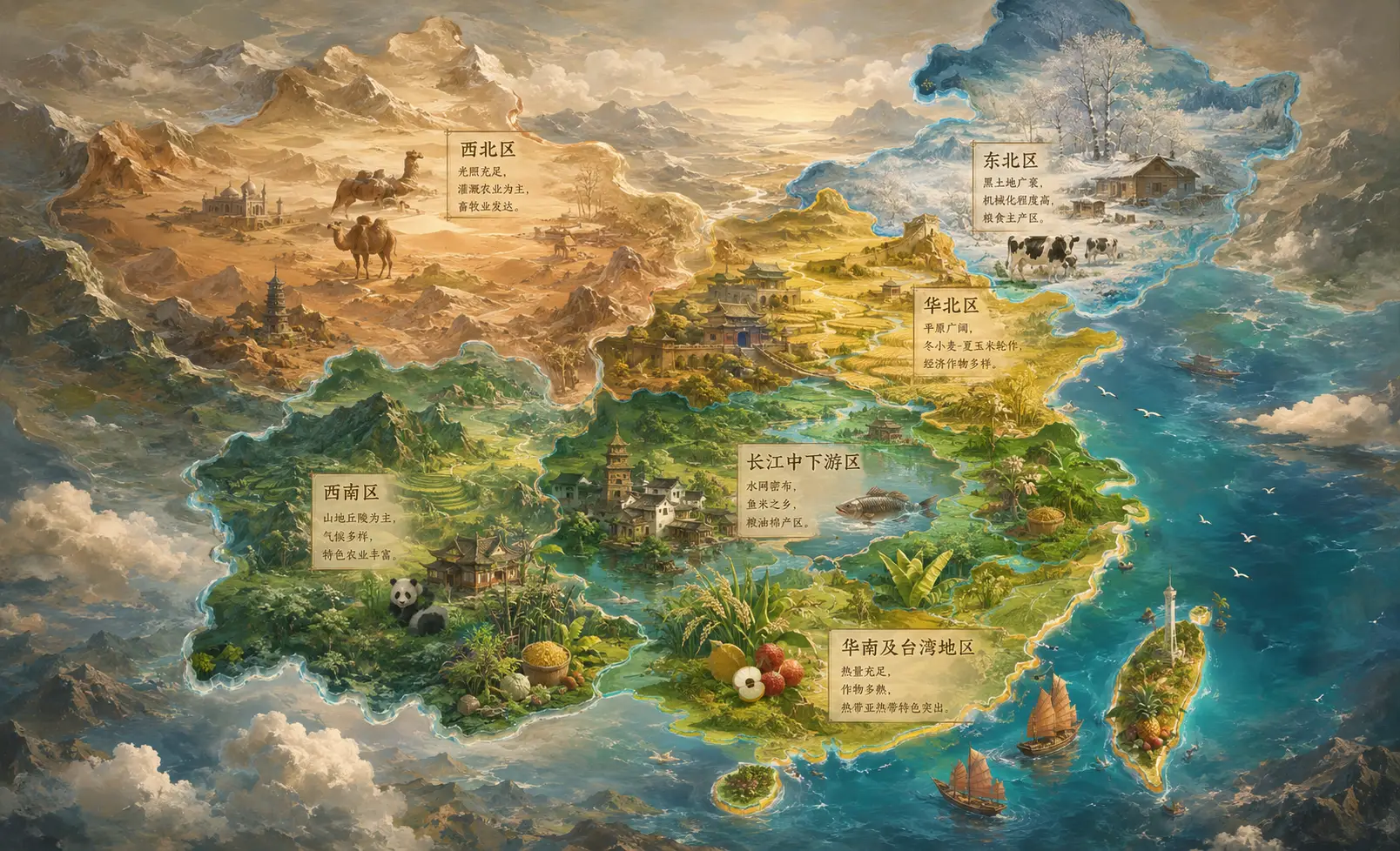
| Agricultural Region | Major Provinces | Keywords |
|---|---|---|
| Northeast | Heilongjiang, Jilin, Liaoning, eastern Inner Mongolia | 备耕 (*spring-farming preparation*), snowmelt, machinery maintenance, pastoral feed reserves |
| Northwest | Xinjiang, Gansu, Ningxia, western Inner Mongolia, Qinghai | Spring-wheat preparation, winter-wheat 返青, pastoral cold protection, 白灾 prevention |
| North China | Hebei, Shanxi, Beijing, Tianjin, Shandong, northern Henan | Winter-wheat 返青, spring irrigation, rolling and 保墒, topdressing weak seedlings |
| Middle and Lower Yangtze | Hubei, Hunan, Jiangxi, Anhui, Jiangsu, northern Zhejiang, Shanghai | 清沟理墒 (*ditch clearing and field-moisture management*), rapeseed full bloom, wheat jointing, waterlogging prevention |
| Southwest | Sichuan, Chongqing, Guizhou, Yunnan, southeastern Tibet | Early-rice seedlings, stripe-rust control, potato planting, rapeseed bolting |
| South China and Taiwan | Guangdong, Guangxi, Hainan, southern Fujian, Taiwan | Early-rice seedlings, spring-peanut sowing, spring-maize sowing, fruit-tree flower promotion |
Heilongjiang, Jilin, Liaoning, eastern Inner Mongolia
At 雨水 (Rain Water), Northeast China remains frozen, yet the first subtle changes in temperature have begun. Daytime highs occasionally climb above freezing, and the surface of the snow starts to melt before freezing again at night, forming a thin crust of ice. Frozen ground remains more than one meter deep, so open-field agriculture is still impossible. 备耕 (*preparation for spring farming*) remains the central theme.
For agricultural supplies, purchases of seed, fertilizer, and plastic film enter their peak period. Northeast China accounts for a very large share of the nation’s maize and soybean acreage, making seed quality directly relevant to the year’s harvest. Farmers retest the germination rate of seed retained from the previous year; lots below 85% must be supplemented or replaced promptly. Black soils across the Northeast are commonly deficient in phosphorus, and purchases of diammonium phosphate reach a seasonal peak at this time.
For machinery, large tractors, seeders, combined tillage machines, and other core equipment enter comprehensive servicing. Standards within Heilongjiang’s state-farm system are particularly strict: engines, hydraulic systems, and the single-seed placement accuracy of seeders—required to reach at least 98%—must all be tested machine by machine. Maintenance must be completed before the early-March thaw.
Across pastoral areas of eastern Inner Mongolia, livestock face the most difficult part of 春乏 (*the late-winter “spring exhaustion” period*). Animals have already spent much of their physical reserves during winter, yet pasture regrowth remains another 40–50 days away. Supplemental feeding for weak animals and pregnant females becomes the foremost concern, and feed reserves must be calculated precisely down to the daily ration for each animal.
In protected agriculture, greenhouses in southern Liaoning enter their first post–Spring Festival harvest peak. Cucumbers, tomatoes, and strawberries continue supplying the market. Increasing daylight causes greenhouse temperatures to rise more quickly, making daytime ventilation and cooling essential; temperatures should be kept below 28°C to prevent heat injury to leaves and fruit.
Xinjiang, Gansu, Ningxia, western Inner Mongolia, Qinghai
Regional contrasts become even more pronounced at Rain Water. Gansu and Ningxia enter the final countdown to spring sowing, while northern Xinjiang remains in deep winter.
For spring-wheat sowing, the Hexi Corridor in Gansu and the Yellow River irrigation districts of Ningxia are major production regions. Sowing usually begins in early March, making Rain Water the final window for land preparation, fertilization, and spring irrigation. Farmers carry out fine preparation—leveling and rolling the soil—apply sufficient basal fertilizer at 2–3 tonnes of farm manure per *mu* plus 20–25 kilograms of compound fertilizer per *mu*, and use spring irrigation from the Yellow River or groundwater to establish adequate base moisture.
The saying “麦种在冰上,收在火上”—literally, *“wheat is sown on ice and harvested in fire”*—vividly describes 顶凌播种, the arid Northwest practice of sowing while the deeper ground remains frozen. When the top 2–3 centimeters have thawed, seed is placed into the soil so that moisture stored in the lower frozen layers can support emergence; once temperatures rise, the crop grows rapidly.
In the southern Tarim Basin and southern Gansu, winter wheat enters a period of accelerated 返青. The proportion of green in the fields rises sharply as new leaves extend. Farmers must check overwinter survival in good time; where survival falls below 90%, resowing or switching crops may need to be considered. Weak fields receive 返青肥 (*spring-regrowth fertilizer*), typically 5–8 kilograms of urea per *mu*, together with the first spring irrigation at an appropriate time.
In pastoral areas along the northern Tianshan, the Altai Mountains, and the Qinghai-Tibet Plateau, severe cold persists. The threat of 白灾 continues: late February through early March is a high-risk period for snow disasters in northern Xinjiang, when blizzards can bury pastures and block transport. Herders therefore continue reinforcing livestock shelters and storing emergency feed, with particular attention to females in the lambing period.
For fruit trees in southern Xinjiang, winter pruning of apples, fragrant pears, grapes, and other crops must be completed before sap begins to move. Mid- to late February is the final window, and pruning wounds should be coated with healing agents to prevent canker pathogens from entering.
Among specialty crops, seed-potato cutting and sprouting proceed steadily in Dingxi, Gansu; goji plantations in Ningxia begin spring pruning and fertilization; and in Turpan, Xinjiang, 开墩 (*digging overwintered grapevines back out from beneath the soil*) generally takes place in early March. Rain Water is therefore the preparatory period for checking tools and irrigation facilities.
Hebei, Shanxi, Beijing, Tianjin, Shandong, northern Henan
The greatest change across North China at Rain Water is simple but profound: winter wheat begins to turn green across broad areas, and agricultural activity shifts from “准备” (*preparation*) to “行动” (*action*).
Managing the spring recovery of winter wheat is the core task. Across the North China Plain, new green leaves push upward through yellowed winter plants and the fields gradually change from yellow to green. The 返青期 is a decisive period for the proportion of tillers that will ultimately form ears, making water and fertilizer management especially important.
Farmers follow the principle of “看天看苗”—*“read the weather and read the crop.”* Fields with sufficient moisture, defined here as relative soil moisture above 65%, may delay spring irrigation so that roots grow deeper. Fields lacking moisture require immediate 返青水 (*spring-regrowth irrigation*), at 40–50 cubic meters per *mu*, together with 返青肥, generally 5–8 kilograms of urea per *mu*. Overly vigorous fields—dense stands with dark-green leaves—need 镇压 (*rolling or pressing the crop*) once or twice to restrain excessive above-ground growth, encourage deeper rooting and young-ear differentiation, and prevent later lodging.
Spring irrigation preparation also moves to the forefront. North China is typically dry and short of rainfall in spring, so irrigation is crucial to protecting yield. At Rain Water, farmers inspect wells, clear irrigation channels, and test pumps. Shandong and Hebei preserve the proverb:
“雨水修渠,春灌不误。”
*Repair the channels at Rain Water, and spring irrigation will not be delayed.*
In recent years, water-saving irrigation has been increasingly promoted across North China, and drip- and sprinkler-irrigation systems are installed and tested during this period.
The 顶凌耙地 begun at Lìchūn now reaches its final stage. Fields where the work has not yet been completed must be finished before the soil thaws entirely; once the ground is fully unfrozen, the effect of 保墒 (*soil-moisture conservation*) drops sharply.
In orchards, buds on apples, pears, and peaches visibly swell. All pruning must be completed before 伤流期 (*the onset of sap flow from pruning wounds*). Growers begin preparing lime-sulfur mixture at 3–5° Baumé for whole-orchard application before bud movement, aiming to destroy overwintering pests and pathogens.
Inside North China’s solar greenhouses, tomatoes, peppers, cucumbers, and other crops enter flowering and fruit set. Temperature management becomes more demanding—25–28°C by day and 12–15°C at night—while ventilation reduces humidity and helps prevent gray mold and leaf mold. Early-spring open-field vegetables such as spinach, rapeseed greens, and Chinese chives begin sowing or transplanting.
Hubei, Hunan, Jiangxi, Anhui, Jiangsu, northern Zhejiang, Shanghai
By Rain Water, the middle and lower Yangtze has fully entered its “春雨季” (*spring-rain season*). Fine, persistent rain becomes the norm, field humidity remains high, and the pace of agricultural work quickens noticeably.
Clearing ditches and drainage is now urgent. Rainfall increases significantly during Rain Water, with average monthly precipitation across the region reaching 50–80 millimeters—around two to three times the level at Beginning of Spring. Standing water, or 渍害 (*waterlogging injury*), is the greatest threat to overwintering crops.
Farmers repeatedly inspect the three-part field drainage network: 主沟、腰沟、围沟—the main, central, and perimeter ditches. These must remain clear and reach depths of at least 80, 60, and 40 centimeters respectively, ensuring “雨止沟干”—*“when the rain stops, the ditches should run dry.”* Fields planted to wheat or rapeseed after rice have particularly high groundwater and therefore face the greatest drainage pressure.
The proverb says:
“雨水修沟,旱涝无忧。”
*Clear the ditches at Rain Water, and neither drought nor flood need be feared.*
For rapeseed, Rain Water brings full bloom. Vast fields turn golden, creating one of the most striking agricultural landscapes of the year. Full flowering is the crucial window for pollination and pod setting and generally lasts 10–15 days. The ideal weather is mild, sunny, and lightly breezy—10–18°C with relative humidity around 60%–70%—conditions favorable to bee activity and pollination.
Persistent overcast and rain, however, can wash pollen away and lead to “花而不实”—literally, *“flowers without fruit,”* when plants bloom profusely but form few pods. Yield losses may reach 20%–30%. If 倒春寒 (*a late cold spell after spring warming*) drives temperatures suddenly below 0°C, flower buds may freeze and fall, causing even greater losses. Farmers therefore follow forecasts closely and may apply foliar fertilizer—boron together with monopotassium phosphate—to strengthen stress resistance.
Winter wheat across the region gradually enters 拔节期 (*the jointing stage*), when stem internodes begin to elongate and the young ear develops inside the stem. This is one of the crop’s peak periods of water and nutrient demand. Farmers apply 拔节肥 (*jointing fertilizer*) according to crop condition, usually 5–8 kilograms of urea per *mu*, to promote stronger stems and young-ear differentiation. Yet once jointing begins, cold tolerance drops sharply; nighttime temperatures below 0°C can damage the developing ear and cause serious yield losses.
Greenhouse tomatoes, peppers, and eggplants move into flowering and fruit set and require tighter control of temperature, humidity, and light. During prolonged rainy weather, greenhouse humidity may exceed 85%, creating ideal conditions for gray mold and blight. Farmers ventilate whenever rain pauses and, when necessary, use fumigant treatments for disease control. Strawberries in Jiangsu and Zhejiang remain in the second-fruiting harvest, and water and fertilizer management is strengthened to prolong the picking period.
Across the tea regions of Jiangnan—Zhejiang, Anhui, and Jiangxi—tea bushes begin pushing new buds. The countdown to spring-tea picking has reached roughly 30 days. Growers clear weeds, apply 催芽肥 (*bud-promoting fertilizer*), mainly quick-acting nitrogen, and inspect tea-processing equipment. If 倒春寒 strikes at this point, tender buds may freeze, directly reducing both yield and quality; the harvest of 明前茶 (*tea picked before Qingming*) may be delayed or even lost.
Sichuan, Chongqing, Guizhou, Yunnan, southeastern Tibet
Southwest China’s complex terrain produces a pronounced “海拔梯度” (*altitudinal gradient*) in agricultural activity during Rain Water. Low, warm valleys are already deep into early-spring work, winter wheat in the Sichuan Basin enters jointing, and higher-altitude areas remain in the preparation stage.
Early-rice seedling raising reaches its peak across southern Yunnan—including Xishuangbanna and Honghe—the Panxi region of Sichuan, and warm lowland valleys in Guizhou. Average daily temperatures have stabilized above 12–15°C, suitable for rice sowing. Farmers use 旱育秧 (*dry-bed seedling raising*): seedbeds are carefully prepared and well fertilized, then covered after sowing with plastic film or small tunnel structures to retain heat and moisture.
Temperatures beneath the covering are kept at 30–35°C. Once seedlings emerge, the film must be opened promptly for ventilation to prevent heat injury. Seedling age is controlled at around 30 days, and transplanting can begin at the “三叶一心” stage—*three leaves and one central emerging leaf*.
Control of wheat stripe rust enters its decisive stage. Winter wheat in the Sichuan Basin reaches jointing at Rain Water, which is also the most critical period for controlling stripe rust. Spores travel north and east on southwesterly air currents, making the Sichuan Basin a national “锈病源头”—*source region for rust disease*. If control fails here, wheat areas in Hubei, Henan, Shandong, and other northern regions may face serious threats.
Agricultural authorities in Sichuan typically activate “带药侦查” (*scouting with treatment materials already in hand*) during Rain Water. Plant-protection personnel enter fields, and when even a single diseased leaf is found, the infection center and the surrounding 50-meter zone are immediately sprayed to contain it. Farmers should inspect their fields at least once a week, paying particular attention to yellow stripe-like spore pustules on the undersides of leaves.
Spring-potato planting enters its peak across Zhaotong in Yunnan, Weining in Guizhou, Liangshan in Sichuan, and other major producing regions. Seed potatoes are cut and sprouted in an orderly process. After cutting, pieces are dried for one to two days so the wounds can heal, then sprouted for seven to ten days in moist sandbeds at 15–20°C. Once shoots reach 1–2 centimeters, they are planted and covered with film to preserve warmth and moisture.
Rapeseed in Sichuan and Guizhou enters full bloom, making pollination conditions important; broad beans enter pod setting and require adequate water. In orchards across the Sichuan Basin, citrus enters spring pruning and fertilization, while loquat begins fruit enlargement. Growers thin fruit, generally leaving three to four fruits per cluster, to maintain even size.
Guangdong, Guangxi, Hainan, southern Fujian, Taiwan
#### Mainland South China
Management of early-rice seedlings is the central task. By Rain Water, seedlings across South China have generally entered the “二叶一心” to “三叶一心” stages, with around 15–20 days remaining before transplanting into the main field.
Seedbed management becomes highly precise. Temperatures beneath the film should remain below 35°C; if they rise higher, the covering must be opened for ventilation. The bed surface should remain moist without standing water. Disease prevention is equally important, as 绵腐病 and 立枯病—seedling rot and damping-off-type diseases—are common threats in early-spring nurseries. In southern Hainan, where heat resources are abundant, some early rice has already been transplanted into the field and entered 返青期.
Spring-peanut planting reaches its seasonal peak in Guangdong, Guangxi, and southern Fujian. Varieties from the “Yueyou” and “Guihua” series are selected, seed is placed 3–5 centimeters deep, and plastic film is applied afterward to preserve warmth and moisture. Spring peanuts are an important oilseed and cash crop in South China, and acreage sown during Rain Water reaches its annual maximum.
Spring-maize sowing advances at the same time. Farmers choose early-maturing, high-density-tolerant varieties and use alternating wide and narrow rows—80 centimeters for the wide rows and 40 centimeters for the narrow ones. Fields are watered and pressed promptly after sowing to ensure full and even emergence.
For tropical fruit trees, flowering and fruit retention become central concerns. Mangoes in Hainan and southern Guangxi enter a critical flowering-management period; nitrogen is restrained, while boron and monopotassium phosphate are applied to promote flower-bud development and pollen vitality. Early lychee varieties such as “三月红” and “白糖罂” move into the young-fruit stage and require 保果 (*fruit-retention management*), including retention sprays and control of fruit-boring pests. Bananas in Guangdong, Guangxi, and Hainan accelerate flower-bud differentiation after Beginning of Spring and require stronger water and nutrient supply, especially high-potassium compound fertilizer, to support bunch development.
Open-field vegetables enter vigorous growth. Choy sum, Chinese kale, lettuce, spinach, and other leafy vegetables grow quickly and require timely topdressing, mainly with quick-acting nitrogen. As temperatures rise, pests and diseases become more active. Diamondback moth, aphids, downy mildew, and powdery mildew enter key control windows. Farmers intensify field inspection and give priority to biological and physical control, including yellow sticky traps and pheromone lures.
South China is also the country’s most concentrated aquaculture region. Temperatures rise during Rain Water but remain unstable. Fish become more active in feeding yet are also susceptible to stress. Farmers inspect ponds at least twice daily, monitoring water temperature and dissolved oxygen to prevent “泛塘”—*mass fish distress or death caused by critically low dissolved oxygen*. Tilapia, grass carp, and Pacific white shrimp enter either stocking or active growth management at this time.
#### Taiwan
For rice, the first crop in central Taiwan enters establishment management after transplanting. Fields are kept under a shallow layer of water, around 3–5 centimeters, to encourage rooting and tillering. When nighttime temperatures fall below 15°C, water depth may be increased to 8–10 centimeters for insulation. In the south—particularly the Chianan Plain and Kaohsiung–Pingtung region—seedlings grow more quickly and some fields already enter early tillering. Northern areas such as Taoyuan and Hsinchu remain relatively cool; transplanting has not yet fully begun and seedbeds remain in the nursery stage.
For vegetables, the range of crops planted is broadly similar to that at Beginning of Spring, but acreage expands. Watermelon, cucumber, muskmelon, and other cucurbits begin sowing and seedling raising in central Taiwan, while ginger and 越瓜 enter transplanting in the south. Tomatoes enter peak fruiting and require stronger water, fertilizer, and pest management, particularly against late blight and whiteflies.
For fruit trees, the peak season for citrus—including sweet oranges, ponkan mandarins, and tankan—continues, while kumquat harvest approaches its end. Pruning proceeds from the work begun at Lìchūn: mature-tree pruning nears completion, while young-tree pruning may continue through March. 春肥 (*spring fertilizer*), mainly nitrogen, is now applied broadly to stimulate spring shoots.
Across Taiwan’s tea regions, winter pruning is essentially complete by Rain Water. The dry season persists in central and southern tea districts, raising irrigation demand. Spring tea budding requires adequate water, and drought can significantly reduce both yield and quality. Growers begin applying quick-acting nitrogen fertilizer to encourage even budbreak. In higher-elevation tea areas such as Nantou and Chiayi, spring budding comes relatively late, generally in mid- to late March; Rain Water therefore becomes the key period for preparing fertilizer and labor.
In fisheries, the seasonal catch pattern around Taiwan remains broadly similar to that at Beginning of Spring. The mullet migration nears its end, while mackerel, Spanish mackerel, black pomfret, and other species continue to be caught. Coastal fisheries gradually return to normal operations, and fishing vessels begin preparing for the spring season by servicing boats and organizing gear.
Taiwanese folk tradition preserves the saying:
“雨水連綿是豐年。”
*Persistent rain at Rain Water foretells a year of abundance.*
Conversely:
“雨水無雨,春雨貴如油。”
*If Rain Water brings no rain, then every drop of spring rain becomes as precious as oil.*
The latter expresses the belief that a dry Rain Water period may foreshadow a spring of scarce rainfall, with direct consequences for spring cultivation and sowing.
Global Extreme Weather · Risks & Responses
Temperate Northern Hemisphere: The Threat of 倒春寒 Intensifies
A late cold spell at Beginning of Spring may be only a warning shot. If 倒春寒 occurs during Rain Water, the damage can be much greater, because winter wheat has already returned to green, fruit-tree buds are swollen, and rapeseed is flowering. Plants are now in one of the most tender and frost-sensitive stages of the entire year.
A single cold wave bringing nighttime temperatures below 0°C may be enough to devastate large orchards and reduce wheat yields. During Rain Water, farmers in the temperate Northern Hemisphere are therefore often less concerned with “whether it will rain” than with “whether the temperature will suddenly collapse.”
The proverb says:
“雨水有雨庄稼好,大春小春一片宝。”
*Rain at Rain Water brings good crops; both the major and minor spring harvests become fields of treasure.*
But if what falls at Rain Water is snow—signaling a severe cold wave—then it is no longer a “treasure,” but a “disaster.”
Across the middle and lower Yangtze, spring rain increases sharply during Rain Water, and prolonged overcast weather may leave fields saturated. Rice-stubble fields and low-lying rapeseed fields face particularly high waterlogging risk. More than 48 hours of standing water can cause root oxygen deficiency, root rot, and even whole-plant death. Farmers therefore need to inspect drainage systems thoroughly around Rain Water and ensure that the “三沟”—main, central, and perimeter ditches—remain unobstructed. Protected agriculture faces the same challenge: prolonged rain can push greenhouse humidity excessively high, favoring gray mold and blight.
Temperate Southern Hemisphere: Severe Convective Weather in Late Summer
Late summer in the Southern Hemisphere, especially mid- to late February, is a high-risk period for strong convective weather—thunderstorms, hail, and tornadoes. Eastern Australia and Argentina can suffer sudden hailstorms at precisely the time when grapes and grain crops are reaching maturity. Once hail strikes, losses can be nearly catastrophic.
Southeastern Australia also remains at the tail end of its high-fire-risk season. Although temperatures begin to ease, dry vegetation still presents a serious fire hazard, and machinery operating during harvest can itself ignite fires.
Tropical Regions: Rainy-Season Intensity and Pest and Disease Pressure
Across the tropical Southern Hemisphere, including Brazil and central Africa, the rainy season reaches its height. Persistent heavy rainfall may trigger localized flooding and landslides. For agriculture, however, the greatest problem is often the explosive spread of disease under hot and humid conditions. Asian soybean rust in Brazil and leaf-spot diseases of maize in Africa can expand rapidly at this time.
In the tropical Northern Hemisphere—Southeast Asia and India—the dry season is nearing its end, and farmers are preoccupied with one question: when will the rains arrive? A delayed rainy season can postpone rice sowing and ultimately affect the entire year’s harvest.
A Shared Global Trend: The “Temperament” of Spring Rain Is Changing
Climate warming is altering the distribution of spring rainfall. Long-term observations by the China Meteorological Administration indicate that in recent decades, total spring rainfall in the Yangtze basin has changed relatively little, yet its “concentration” has increased. Rain that was once spread more evenly across February, March, and April is increasingly compressed into a smaller number of heavy-rain events, separated by longer rainless periods.
For agriculture, this means that drought and waterlogging may alternate within the same season, placing ever greater demands on both irrigation and drainage infrastructure.
For ordinary people, the traditional feeling expressed by “春雨贵如油”—*“spring rain is as precious as oil”*—may be encountered less often. Instead, the sense of “either no rain at all, or a sudden downpour when it comes” is becoming stronger. This changing temperament of spring rainfall is one of the long-term trends worth observing through the solar term of 雨水 (Yǔshuǐ, Rain Water).
---
Readers’ Comments
Calendar and traditional culture enthusiasts from around the world, sharing the same moon.
Sign in or register to join the conversation. Your comment account is created automatically the first time you use a connected account.
No comments yet
Share your thoughts with readers around the world.