
End of Heat Farming
「处暑满田黄,家家修廪仓。」
During 处暑 (Chǔshǔ, End of Heat), the summer heat gradually recedes across most of China and the first signs of autumn emerge, while autumn-harvested crops enter the final sprint of yield formation. On the North China Plain, summer maize enters grain filling and maturity, spring maize enters maturity and harvest, and cotton enters boll opening and harvest. Across the Yangtze River basin, late rice enters jointing and booting, while middle-season rice enters grain filling and maturity. In South China, late rice enters jointing and booting and tropical-fruit harvesting continues. In Northeast China, spring maize enters maturity and harvest, rice enters grain filling and maturity, soybeans enter maturity, and early-frost prevention reaches a critical stage. In Northwest China, cotton enters boll opening and harvest, while orchards enter the peak of fruit maturity and harvest. The temperate Southern Hemisphere is in early spring, with winter wheat in southeastern Australia and Argentina entering jointing and heading and spring cultivation and sowing gradually beginning. Across the tropical Northern Hemisphere, the rainy season continues and rice enters grain filling and maturity management; in the tropical Southern Hemisphere, the dry season continues and harvesting of dry-season crops approaches its end.
Global Agriculture
Temperate Regions of the Northern Hemisphere
Phenological Signs
Across most of China, the summer heat gradually weakens, mornings and evenings become distinctly cooler, and the difference between daytime and nighttime temperatures increases. In northern regions, the skies are high and clear and the air takes on a crisp autumn quality, while southern regions may still experience “秋老虎”, the so-called “autumn tiger” heat. Japan’s Kantō region enters late summer, while South Korea’s rainy season ends completely and the weather turns cooler. Cicada calls weaken, autumn insects begin to sing, and leaves start changing color.
Farming Activities
On the North China Plain, summer maize enters grain filling and maturity, with kernels becoming full and beginning the transition toward maturity. Water supply needs to be secured because drought during grain filling can reduce thousand-kernel weight; corn borer, aphids, leaf spot, and other pests and diseases require control, while premature senescence also needs to be prevented. Spring maize enters maturity and harvest and should be harvested when the husks turn white, kernels harden, the milk line disappears, and farmers seize clear weather to harvest, dry, and store the crop. Cotton enters boll opening and harvest, with bolls splitting and lint emerging, and farmers seize clear weather for picking. Across the Yangtze River basin, late rice enters jointing and booting, with stems elongating and young panicles differentiating and developing. Water and nutrient management needs to be strengthened through application of 穗肥, mainly potash, and maintenance of a shallow water layer, together with control of rice blast, sheath blight, planthoppers, and other pests and diseases. Middle-season rice enters grain filling and maturity, with kernels becoming full; fields need to remain moist and heat-forced maturity needs to be prevented. In South China, late rice enters jointing and booting and requires stronger water and nutrient management and pest and disease control, while harvesting of tropical fruits such as longan and bananas continues. In Northeast China, spring maize enters maturity and harvest and farmers seize clear weather to bring in the crop. Rice enters grain filling and maturity, with kernels becoming full; fields need to remain moist and early frost needs to be prevented. Soybeans enter maturity, with leaves falling and pods turning yellow, and farmers begin preparing for harvest. Early-frost prevention reaches a critical stage, especially in northern Heilongjiang and eastern Inner Mongolia, where forecasts require close attention. In Northwest China, cotton enters boll opening and harvest and farmers seize clear weather for picking, while orchards enter peak maturity and harvest, with apples, fragrant pears, grapes, and other fruits harvested intensively.
Phenological Signs
Temperatures across Western Europe fall from their summer peaks and crops enter maturity and harvest. In France and Germany, maize enters grain filling and maturity and sunflower enters maturity. The first signs of autumn appear in Central Europe as leaves begin changing color. In Northern Europe, daylight becomes noticeably shorter and the autumn atmosphere grows stronger.
Farming Activities
In France and Germany, maize enters grain filling and maturity and requires adequate water because drought during grain filling can reduce thousand-kernel weight, together with pest and disease control. Sunflower enters maturity, with heads turning yellow and seeds becoming full, and farmers begin preparing for harvest. In Bordeaux, Rheinhessen, and other wine-producing regions, grapes enter maturity and harvest. Early cultivars begin to be picked, while middle- and late-ripening cultivars move from veraison toward maturity and sugar accumulation accelerates. Farmers begin preparing for large-scale harvest through preparation of picking tools, adjustment of winemaking equipment, and recruitment of harvest labor. In Ukraine’s chernozem region, maize enters grain filling and maturity and sunflower enters maturity, while farmers begin preparing for autumn sowing through plowing, basal fertilization, and seed purchasing.
Phenological Signs
In the winter-wheat belt of Kansas, Nebraska, and surrounding areas, spring wheat enters harvest. Orchards in California’s Central Valley enter peak maturity and harvest. Across the U.S. Midwest, spring maize enters grain filling and maturity and fields shift from green toward yellow. In Ontario, Canada, crops enter the later stages of growth and autumn becomes clearly visible.
Farming Activities
Spring wheat in the United States enters harvest and farmers seize clear weather for cutting, drying, and storage. Orchards in California’s Central Valley enter peak maturity and harvest, with grapes, citrus, walnuts, and other crops harvested intensively. In the U.S. Midwest, spring maize enters grain filling and maturity, with kernels becoming full. Water supply needs to be secured because drought during grain filling can reduce thousand-kernel weight, while corn borer, aphids, leaf spot, and other pests and diseases require control. Early-maturing cultivars begin harvest. Cotton in the southeastern United States enters boll opening and harvest, while peanuts enter maturity and harvest. Across Canada’s Prairie Provinces, spring wheat enters harvest and farmers seize clear weather for cutting, drying, and storage.
Phenological Signs
Summer crops on Turkey’s Anatolian Plateau enter harvest. Along Iran’s Caspian coast, fruit trees enter maturity and harvest. Along the Mediterranean coast of North Africa, summer crops enter harvest.
Farming Activities
Summer crops in Turkey enter harvest and farmers seize clear weather for harvesting, drying, and storage. Along the Mediterranean coast of North Africa, maize, sunflower, and other summer crops enter harvest. In South Africa’s Cape region, spring vineyard management is fully underway, including spring pruning, fertilization, and pest and disease control.
Temperate Regions of the Southern Hemisphere
Phenological Signs
It is early spring. Temperatures rise to 10–15°C and the first signs of spring emerge. Autumn-sown crops such as winter wheat, barley, and rapeseed enter jointing and heading and their growth accelerates. Pastures begin greening again and the spring landscape gradually takes shape.
Farming Activities
Autumn-sown crops—winter wheat, barley, and rapeseed—enter jointing and heading, with stems elongating and young panicles differentiating and developing. Field management needs to be strengthened through application of 拔节肥 at 8–10 kilograms of urea per *mu*, assurance of adequate water supply, and pest and disease control as aphids, rust, and other problems enter treatment windows. Spring cultivation and sowing gradually begin. Spring crops such as spring wheat and spring barley begin to be sown, while farmers plow fields, apply basal fertilizer, and sow seed. Spring pasture management also begins, with grazing density gradually increased and pasture regreening management, fertilization, and reseeding carried out.
Phenological Signs
It is early spring, with temperatures rising to 10–15°C. Winter wheat, barley, rapeseed, and other autumn-sown crops enter jointing and heading. Grasslands begin turning green and the spring landscape becomes visible.
Farming Activities
Autumn-sown crops—winter wheat, barley, and rapeseed—enter jointing and heading and require stronger field management through application of 拔节肥 at 8–10 kilograms of urea per *mu*, adequate water supply, and pest and disease control. Spring cultivation and sowing gradually begin and spring crops start to be planted. Spring pasture management also begins and grazing density is gradually increased.
Phenological Signs
It is early spring, with temperatures rising to 8–12°C. Pastures begin turning green again and the spring landscape emerges. Kiwifruit vines begin budding and vineyards enter budbreak.
Farming Activities
Spring pasture management begins, with grazing density gradually increased and regreening management and fertilization carried out. Kiwifruit orchards enter spring management through spring pruning, fertilization, and pest and disease control. Spring vineyard management is fully underway through spring pruning, fertilization, and pest and disease control.
Phenological Signs
It is early spring and temperatures rise. Orchards enter budbreak and vineyards also enter budbreak.
Farming Activities
Spring orchard management is fully underway through spring pruning, fertilization, and pest and disease control. Spring vineyard management is likewise fully underway through spring pruning, fertilization, and pest and disease control.
Tropical and Subtropical Regions
Phenological Signs
The rainy season continues with abundant rainfall. Rice in Thailand, Myanmar, Laos, and neighboring regions enters grain filling and maturity and fields begin turning yellow. India’s Southwest Monsoon continues and rainfall increases. In southernmost China, late rice enters jointing and booting and fields remain deep green.
Farming Activities
Rice enters grain filling and maturity management. Across Southeast Asia, rice moves from heading into grain filling and maturity. Fields need to remain moist and water should not be cut off too early, as this can leave kernels poorly filled. Rice blast, sheath blight, planthoppers, and other pests and diseases enter their final treatment stage. Rice management advances fully across India. In southernmost China, late rice enters jointing and booting and requires stronger water and nutrient management through application of 穗肥 and maintenance of a shallow water layer, together with pest and disease control.
Phenological Signs
The dry season continues under clear, dry weather. The dry-season landscape remains pronounced in central-western Brazil. The air is dry and the difference between daytime and nighttime temperatures is marked.
Farming Activities
Harvesting of dry-season crops approaches its end. In irrigated areas, harvest of wheat, barley, rapeseed, and other dry-season crops moves into its final stage, and farmers seize clear weather for cutting, drying, and storage. Harvest of second-season maize in central Brazil also approaches its end. The dry season remains the best period for servicing agricultural machinery and maintaining farmland water-conservancy facilities.
China’s Six Major Agricultural Regions
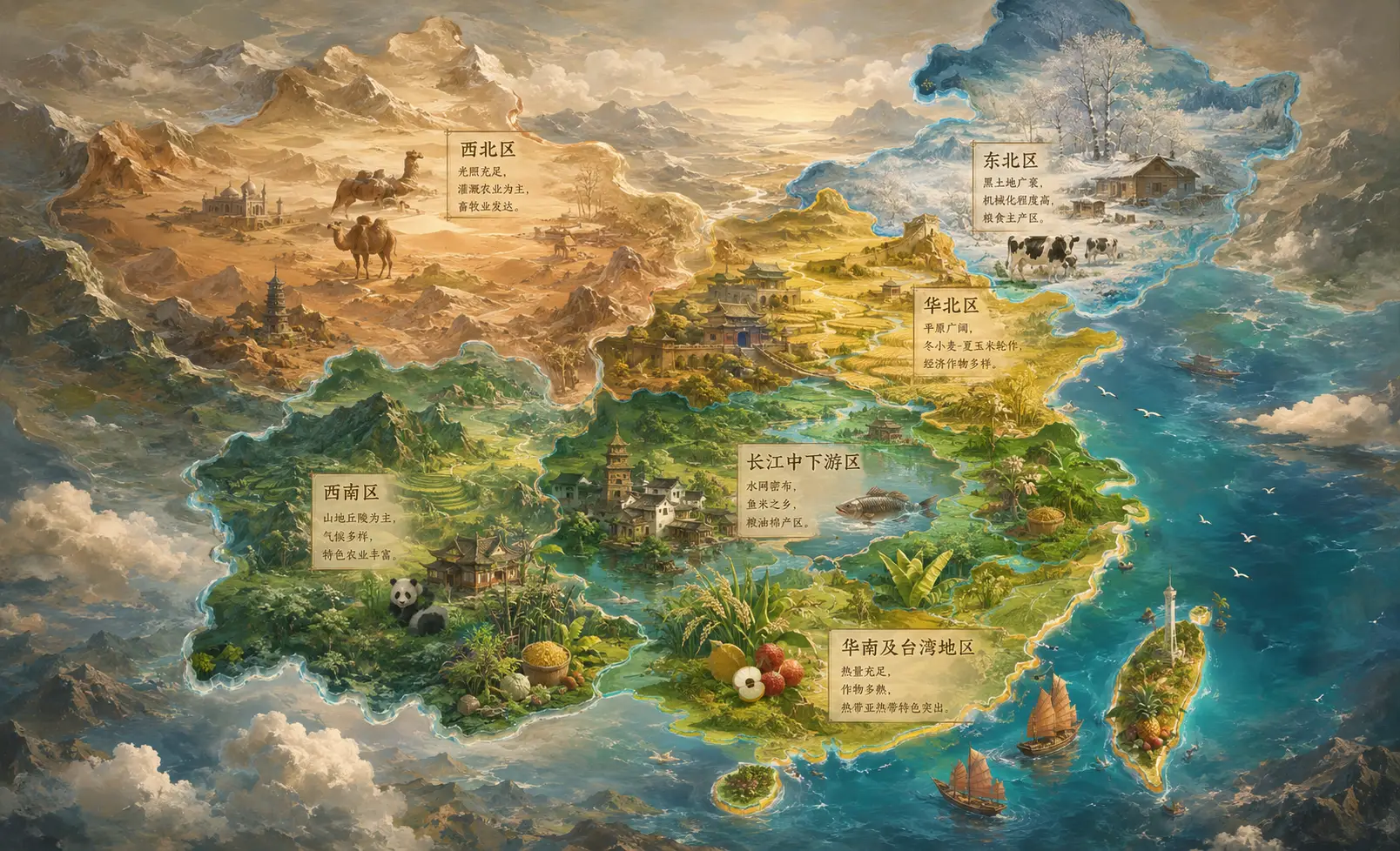
| Agricultural Region | Major Provinces | Keywords |
|---|---|---|
| Northeast | Heilongjiang, Jilin, Liaoning, eastern Inner Mongolia | Maize harvest, rice grain filling, soybean maturity, early-frost prevention |
| Northwest | Xinjiang, Gansu, Ningxia, western Inner Mongolia, Qinghai | Cotton harvest, orchard harvest, autumn-sowing preparation, pest and disease control |
| North China | Hebei, Shanxi, Beijing, Tianjin, Shandong, northern Henan | Summer-maize grain filling, spring-maize harvest, cotton boll opening, field management |
| Middle and Lower Yangtze | Hubei, Hunan, Jiangxi, Anhui, Jiangsu, northern Zhejiang, Shanghai | Late-rice booting, middle-rice grain filling, field management, pest and disease control |
| Southwest | Sichuan, Chongqing, Guizhou, Yunnan, southeastern Tibet | Middle-rice grain filling, maize harvest, potato harvest, orchard management |
| South China and Taiwan | Guangdong, Guangxi, Hainan, southern Fujian, Taiwan Province | Late-rice booting, tropical fruit, typhoon preparedness, field management |
Heilongjiang, Jilin, Liaoning, eastern Inner Mongolia
During End of Heat, crops across Northeast China enter maturity and harvest. Spring maize reaches maturity and harvest, rice moves from grain filling toward maturity, soybeans enter maturity, and early-frost prevention reaches its most critical stage.
Spring-maize maturity and harvest. Spring maize in Northeast China enters maturity and harvest during End of Heat. The husks turn white, kernels harden, the milk line disappears, and the black layer forms, marking physiological maturity. Early cultivars begin to be harvested, and farmers seize clear weather for harvest while machines operate in the fields, combining maize harvest, threshing, and stalk shredding in a single operation. After harvest, grain is promptly dried in the sun until moisture falls below 14% before storage, or mechanically dried. The maize harvest generally lasts 2–3 weeks, so weather forecasts need to be monitored closely. If rainfall is expected, harvesting needs to be completed before the rain or rain protection such as tarpaulin covering should be prepared. Harvesting too early leaves kernels insufficiently filled and thousand-kernel weight low, while harvesting too late increases exposure to bird and rodent damage or mold caused by rain.
Rice management from grain filling to maturity. Rice in Northeast China enters grain filling and maturity during End of Heat, with kernels becoming full and beginning the transition toward maturity. This is the final stage determining thousand-kernel weight. Management centers on keeping fields moist through moist irrigation without cutting off water too early, because premature water withdrawal during grain filling can leave kernels poorly filled and reduce thousand-kernel weight. 粒肥 is applied, mainly potash, at 3–5 kilograms of potassium chloride per *mu* to promote full grain development. Rice blast, sheath blight, planthoppers, and other pests and diseases enter their final control stage, while panicle-neck blast requires tricyclazole after full heading for protection. Early-frost prevention is also important. If an early frost is forecast, deeper irrigation of 5–10 centimeters may be used to retain heat by taking advantage of water’s high specific heat capacity and delaying cooling, or cold-resistant agents may be applied. Management from grain filling to maturity directly affects thousand-kernel weight and final yield.
Soybean maturity. Soybeans in Northeast China enter maturity during End of Heat, with leaves falling, pods turning yellow, and seeds becoming full and hard, reaching physiological maturity. Farmers begin preparing for harvest by servicing combines and preparing storage facilities. Soybean harvest is generally concentrated from early to mid-September, during the period from 白露 to 秋分.
Critical stage of early-frost prevention. After End of Heat, high-latitude areas of Northeast China, including northern Heilongjiang and northeastern Inner Mongolia, enter the most critical period of early-frost prevention. Early frost—frost occurring before early September—is the greatest threat to the autumn harvest in Northeast China and can kill whole maize, rice, and soybean plants, leave grain poorly filled, and cause major yield losses. Preventive measures include promoting earlier maturity by spraying monopotassium phosphate 2–3 times during grain filling at intervals of 7–10 days; irrigating before forecast frost with 5–10 centimeters of water, using water’s high specific heat capacity to delay cooling and raise surface temperature by 2–3°C; harvesting mature crops promptly before frost arrives; and, as a long-term strategy, selecting early-maturing cultivars to avoid the early-frost risk period.
Pasture management. Pastures in eastern Inner Mongolia enter seed maturity and livestock grazing continues. Herders begin preparing winter forage through cutting, drying, baling, and storage.
Xinjiang, Gansu, Ningxia, western Inner Mongolia, Qinghai
During End of Heat, Northwest China enters a critical stage of autumn management. Cotton enters boll opening and harvest, orchards enter peak maturity and harvest, and preparations for autumn sowing gradually begin.
Cotton boll opening and harvest. Cotton across Xinjiang enters boll opening and harvest during End of Heat. Bolls split open, lint becomes exposed, and the crop reaches harvest standards. Farmers seize clear weather for picking. Manual picking remains predominant in Xinjiang cotton areas, with strict standards: only fully opened white cotton is picked, while unopened green cotton and contaminated cotton are not. After harvest, cotton is promptly dried, graded, baled, and stored or sold. The cotton harvest generally lasts 1–2 months, from late August to late October, requiring close attention to weather forecasts. If rainfall is expected, harvesting should be completed before the rain because wetting can reduce fiber quality and cause yellowing or mold. Harvesting too early means the fibers have not fully developed and quality and yield are poor, while harvesting too late increases the risk of wind damage, with cotton blown from plants, or declining fiber quality through yellowing.
Peak orchard maturity and harvest. Apples, fragrant pears, grapes, and other fruit crops in southern Xinjiang enter peak maturity and harvest. Korla fragrant pears enter concentrated harvest in mid- to late August. As one of Xinjiang’s most distinctive fruits, fragrant pears generally have a harvest window of only 2–3 weeks, requiring farmers to seize clear weather for picking, grading, packing, cold storage, or sale. Grapes enter maturity and harvest, with table-grape cultivars harvested intensively in mid- to late August and wine grapes harvested from late August through September once sugar and acidity reach winemaking standards. Harvesting of early apple cultivars such as “嘎啦” and “美国八号” continues. Growers need to pay attention to harvesting at the proper stage according to fruit maturity. For fragrant pears, the harvest standard is yellowing peel, crisp flesh, and sugar content ≥12%; for grapes, it is sugar content ≥18% with appropriate acidity. Postharvest management includes prompt precooling, grading, packing, cold storage or sale, followed by pruning and fertilization to restore tree vigor. Fruit diseases also require attention during harvest.
Preparations for autumn sowing. During End of Heat, preparations for autumn sowing gradually begin across Northwest China. Winter wheat is sown from mid- to late September through early October, and farmers begin purchasing seed, preparing fertilizer, servicing seed drills, and developing planting plans. Preparations for autumn sowing unfold fully between End of Heat and 白露.
Specialty crops. Potatoes around Dingxi, Gansu, enter maturity and harvest and are lifted once the aboveground portions of the plants turn yellow, then promptly dried, graded, and stored. Goji harvesting in Ningxia enters its final stage. Processing-tomato harvest in Xinjiang moves from its peak toward the final stage.
Hebei, Shanxi, Beijing, Tianjin, Shandong, northern Henan
During End of Heat, North China enters a critical stage of autumn management. Summer maize moves through grain filling and maturity, spring maize enters maturity and harvest, and cotton enters boll opening and harvest, while the “七下八上” flood-control period is largely over.
Summer-maize management from grain filling to maturity. Summer maize in North China enters grain filling and maturity during End of Heat, with kernels becoming full and beginning the transition toward maturity. This is the final stage determining thousand-kernel weight. Management centers on securing water supply, because drought during grain filling can sharply reduce thousand-kernel weight. Where soil moisture is insufficient, irrigation should be applied promptly at 20–30 cubic meters per *mu*. Corn borer, aphids, leaf spot, northern corn leaf blight, stalk rot, and other pests and diseases enter their final treatment stage. Corn borer damages ears and stalks and therefore requires particular attention during grain filling. Premature senescence should be prevented through foliar application of monopotassium phosphate + amino-acid water-soluble fertilizer, prolonging leaf function and promoting grain filling. Harvest should be appropriately delayed until maize is fully mature—when the husks turn white, kernels harden, the milk line disappears, and the black layer forms—which can increase thousand-kernel weight by 5–10%. Management from grain filling to maturity directly affects thousand-kernel weight and final yield.
Spring-maize maturity and harvest. Spring maize in North China enters maturity and harvest during End of Heat. When the husks turn white, kernels harden, and the milk line disappears, the crop reaches physiological maturity. Farmers seize clear weather for harvest, drying, and storage.
Cotton boll opening and harvest. Cotton in North China enters boll opening and harvest during End of Heat, with bolls splitting and lint emerging. Farmers seize clear weather for picking, harvesting only fully opened white cotton rather than unopened green cotton or contaminated cotton, followed by prompt drying, grading, baling, and sale. Cotton harvest continues through October.
Orchard maturity and harvest. Apples, pears, peaches, and other fruit crops across North China enter maturity and harvest. Early apple cultivars such as “嘎啦” and “美国八号” continue to be harvested, while mid-season apple cultivars such as “红星” and “金冠” begin harvest. Pear cultivars including “鸭梨” and “皇冠梨” enter harvest, while peach harvest approaches its end. Growers need to harvest according to maturity, then promptly precool, grade, pack, cold-store, or sell fruit, followed by postharvest pruning and fertilization to restore tree vigor. Fruit diseases also require attention during harvest.
Preparations for autumn sowing. During End of Heat, preparations for autumn sowing gradually begin across North China. Winter wheat is sown from late September through early October, and farmers begin purchasing seed, preparing fertilizer, and servicing seed drills.
Vegetable management. Open-field vegetables across North China enter rapid growth and peak harvest, while sowing of autumn vegetables—including autumn Chinese cabbage, autumn radish, and autumn spinach—continues.
Hubei, Hunan, Jiangxi, Anhui, Jiangsu, northern Zhejiang, Shanghai
During End of Heat, the middle and lower Yangtze enters a critical stage of autumn management. Late rice enters jointing and booting, middle-season rice enters grain filling and maturity, and high-temperature midsummer drought conditions gradually ease.
Late-rice management from jointing to booting. Late rice across the Yangtze River basin enters jointing and booting during End of Heat, with stem internodes elongating and young panicles differentiating and developing within the stems. This is a critical stage for determining kernels per panicle. Management centers on maintaining a shallow water layer of 3–5 centimeters without allowing fields to dry, because water shortage during booting can produce small panicles with few grains. 穗肥 is applied, mainly potash, at 5–8 kilograms of potassium chloride per *mu* to promote young-panicle development and grain formation. Potassium demand is high during booting, and insufficient potash can result in small panicles and reduced grain number. Rice blast, sheath blight, planthoppers, stem borers, and other pests and diseases enter critical treatment windows, with sheath blight entering a period of high incidence during jointing and booting and requiring particular attention. After 晒田 is completed, fields are re-flooded and a shallow water layer is maintained. Management from jointing to booting directly affects kernels per panicle and final yield.
Middle-season rice management from grain filling to maturity. Middle-season rice across the Yangtze River basin enters grain filling and maturity during End of Heat, with kernels becoming full and beginning the transition toward maturity. Management centers on keeping fields moist through moist irrigation without cutting off water too early; applying 粒肥, mainly potash, at 3–5 kilograms of potassium chloride per *mu* to promote full grain development; controlling rice blast, sheath blight, planthoppers, and other pests and diseases entering their final treatment stage; and draining and drying fields at the proper time 7–10 days before maturity to promote ripening and facilitate harvest. Management from grain filling to maturity directly affects thousand-kernel weight and final yield.
Easing of high-temperature midsummer drought. After End of Heat, high-temperature 伏旱 conditions gradually ease across the middle and lower Yangtze. Temperatures begin to fall and rainfall increases somewhat. However, “秋老虎” heat may still bring short periods of high temperature, so weather forecasts still require attention.
Pest and disease control. Rice pests and diseases remain at high incidence during End of Heat. Key targets include rice blast, particularly panicle-neck blast, treated with tricyclazole or isoprothiolane; sheath blight, treated with validamycin or difenoconazole + propiconazole; rice planthoppers, treated with imidacloprid or buprofezin; and stem borers, treated with dimehypo or Bt preparations. Farmers need to strengthen field inspections and intervene promptly when pests or diseases are detected.
Vegetables and aquaculture. Sowing and nursery raising of autumn vegetables across the Yangtze River basin—including autumn Chinese cabbage, autumn radish, and autumn lettuce—continue. As high temperatures gradually ease, growing conditions for vegetables improve. In aquaculture, the hottest period gradually passes and fish continue feeding actively, requiring stronger feeding management and water-quality management.
Sichuan, Chongqing, Guizhou, Yunnan, southeastern Tibet
During End of Heat, agricultural activity across Southwest China enters a critical stage of autumn management. Middle-season rice enters grain filling and maturity, spring maize enters maturity and harvest, and potatoes enter harvest.
Middle-season rice management from grain filling to maturity. Middle-season rice in Southwest China enters grain filling and maturity during End of Heat, with kernels becoming full and beginning the transition toward maturity. Management centers on keeping fields moist, applying 粒肥, mainly potash, at 3–5 kilograms of potassium chloride per *mu*, controlling rice blast, sheath blight, planthoppers, and other pests and diseases entering their final treatment stage, and draining and drying fields at the proper time 7–10 days before maturity. Management from grain filling to maturity directly affects thousand-kernel weight and final yield.
Spring-maize maturity and harvest. Spring maize in Southwest China enters maturity and harvest during End of Heat, with husks turning white and kernels hardening, marking physiological maturity. Farmers seize clear weather for harvest, drying, and storage.
Potato harvest. Spring potatoes in the major producing areas of Yunnan, Guizhou, and Sichuan enter harvest during End of Heat. Aboveground plant parts turn yellow and tubers reach physiological maturity. Farmers seize clear weather for harvesting, drying, grading, and storage. Harvest of early cultivars approaches its end, while middle- and late-ripening cultivars begin to be lifted.
Orchard management. Citrus-growing areas across Southwest China move from fruit enlargement into veraison and require stronger water and nutrient management. Potash is applied to promote sugar accumulation and coloring, because citrus has a high demand for potassium during the coloring stage and adequate potash can increase both sugar content and coloration. Citrus red mites, leaf miners, canker, anthracnose, and other pests and diseases also require control.
Guangdong, Guangxi, Hainan, southern Fujian, Taiwan Province
#### (1) Mainland South China
Late-rice management from jointing to booting. Late rice across South China enters jointing and booting during End of Heat, with stem internodes elongating and young panicles differentiating and developing within the stems. This is a critical stage for determining kernels per panicle. Management centers on maintaining a shallow water layer of 3–5 centimeters, applying 穗肥, mainly potash, at 5–8 kilograms of potassium chloride per *mu*, and controlling rice blast, sheath blight, planthoppers, stem borers, and other pests and diseases entering critical treatment windows.
Tropical-fruit management. Longan harvesting enters its final stage. Immediately after harvest, postharvest pruning and fertilization are carried out to restore tree vigor and promote autumn-shoot emergence. Bananas in Guangdong, Guangxi, and Hainan enter fruit development and require stronger water and nutrient management through application of potash to promote fruit growth. Citrus moves from fruit enlargement into veraison and requires control of excessive summer-shoot growth together with citrus red mites, leaf miners, canker, and other pests and diseases. Mango harvesting is fully complete and orchards enter postharvest management.
Typhoon preparedness. South China remains in an active typhoon period during End of Heat. Strong winds and torrential rain associated with typhoons can lodge rice, cause fruit drop, damage greenhouse structures, and harm aquaculture. Farmers need to follow typhoon warnings closely and prepare preventive measures in advance.
Vegetables and aquaculture. Open-field vegetables across South China enter rapid growth and peak harvest. Temperatures remain relatively high and pests and diseases are common, requiring stronger control. In aquaculture, typhoon season brings continued flood risk, and pond inspections and water-quality management need to be strengthened.
#### (2) Taiwan
Rice: In central Taiwan—including Changhua, Yunlin, and the Chianan Plain—the second rice crop enters jointing and booting during End of Heat. In southern Taiwan, particularly the Kaohsiung–Pingtung region, the second crop also enters jointing and booting. In northern Taiwan, including Taoyuan and Hsinchu, the second crop moves from peak tillering toward jointing.
Vegetables: During End of Heat, summer vegetable harvesting continues across Taiwan, while sowing and nursery raising begin for autumn vegetables.
Fruit trees: Longan harvesting enters its final stage, citrus moves from fruit enlargement into veraison, and bananas enter fruit development.
Tea: Autumn management continues in tea gardens across central and southern regions such as Nantou and Chiayi. Autumn management also continues in northern tea districts such as Wenshan and Sanxia.
Fisheries: Fishing continues in waters around Taiwan during End of Heat. Typhoon season continues and coastal areas maintain typhoon preparedness.
Farmer’s proverbs and folk customs: Taiwanese folk tradition preserves the saying “處暑,會熱死老鼠”, describing how the “秋老虎” heat can remain intense during End of Heat. Another saying, “處暑過,暑氣消”, expresses the gradual fading of summer heat after End of Heat. There is also the custom of “處暑吃鴨”, eating duck during End of Heat to nourish yin, moisten dryness, dispel heat, and reduce internal fire.
Global Extreme Weather · Risks & Responses
Temperate Northern Hemisphere: “Autumn Tiger” Heat—the Greatest Threat of End of Heat
Although summer heat begins to fade during End of Heat, “秋老虎” conditions still occur frequently. North China, the Yangtze River basin, South China, and other regions often experience short periods of high temperatures from late August into early September. The agricultural impacts include insufficient grain filling in maize and rice, reducing thousand-kernel weight and increasing unfilled grains; declining fiber quality when cotton encounters hot, dry conditions during boll opening; and sunscald in fruit trees under high temperatures. Farmers need to follow weather forecasts closely and use irrigation for cooling during periods of high heat.
Temperate Northern Hemisphere: Typhoons, Heavy Rain, and Flooding
South China and the southeastern coast remain in an active typhoon period during End of Heat. Strong winds and torrential rain can cause widespread crop lodging, fruit drop, greenhouse damage, and losses in aquaculture. The “七下八上” flood-control period in North China and the Huang-Huai region is largely over, but localized heavy rainfall may still occur. Farmers need to follow typhoon and heavy-rain warnings closely and prepare preventive measures in advance by harvesting mature crops, reinforcing greenhouse structures, and checking drainage systems.
Temperate Northern Hemisphere: Early Frost—the Greatest Threat to High-Latitude Northeast China
After End of Heat, the risk of early frost rises sharply across high-latitude areas of Northeast China, including northern Heilongjiang and northeastern Inner Mongolia. Early frost—frost occurring before early September—has an enormous impact on the maturity and yield of maize, rice, and soybeans. Mild frost can leave kernels poorly filled and reduce thousand-kernel weight, while severe frost can kill entire plants and cause major yield losses. Farmers need to follow early-frost forecasts closely. Before frost arrives, fields may be irrigated with 5–10 centimeters of water, using water’s high specific heat capacity to delay cooling and raise surface temperature by 2–3°C; cold-resistant agents may be applied; and mature crops should be harvested promptly.
Temperate Southern Hemisphere: Spring-Drought Risk
In early spring in the Southern Hemisphere, during late August, winter wheat enters jointing and heading and its water demand begins to rise. If spring rainfall is insufficient, spring drought may develop and affect jointing, heading, and final yield. Farmers in southeastern Australia and Argentina need to monitor spring rainfall forecasts and irrigate promptly when drought occurs.
Tropical Regions: Alternating Flood and Drought and Pest-and-Disease Risks
Across the tropical Northern Hemisphere—including Southeast Asia and India—the rainy season continues and rice enters grain filling and maturity, requiring protection against rice blast, planthoppers, and other pests and diseases as well as typhoon and heavy-rain disasters. In the tropical Southern Hemisphere—including Brazil and Africa—the dry season continues and harvesting of dry-season crops approaches its end, requiring precautions against the effects of heat and drought on harvesting and storage.
----
Readers’ Comments
Calendar and traditional culture enthusiasts from around the world, sharing the same moon.
Sign in or register to join the conversation. Your comment account is created automatically the first time you use a connected account.
No comments yet
Share your thoughts with readers around the world.