
Major Cold Farming
「大寒见三白,农人衣食足。」
During 大寒 (Dàhán, Greater Cold), most of China enters the final phase of the coldest period of the year, but this is also the turning point at which severe cold begins to weaken. The bitter conditions expressed in “小寒大寒,冻成冰团” continue, yet “大寒到顶点,日后天渐暖”—once Greater Cold reaches its peak, the weather gradually begins to warm, and yang energy starts to rise noticeably. On the North China Plain, winter wheat remains in deep overwintering and agricultural activity has stopped completely. Across the Yangtze River basin, rapeseed and winter wheat remain in deep overwintering, while drainage and waterlogging prevention continue alongside cold and frost protection. In South China, winter crops enter peak maturity and harvest, while citrus harvesting continues. In Northeast China, the ground remains deeply frozen, “猫冬” continues, and greenhouse vegetables continue supplying the market. In Northwest China, winter wheat remains in deep overwintering and winter orchard management enters its final stage. In the temperate Southern Hemisphere, it is midsummer, and summer crops in southeastern Australia and Argentina advance from grain filling toward maturity, with field management entering its final critical phase. Across the tropical Northern Hemisphere, the dry season continues and dry-season crop management remains ongoing; across the tropical Southern Hemisphere, the rainy season continues and field management of rice and maize progresses steadily.
Global Agriculture
Temperate Regions of the Northern Hemisphere
Phenological Signs
Most of China enters the closing phase of the coldest period of the year. As the saying “大寒到顶点,日后天渐暖” suggests, severe cold is still present, but yang energy begins to rise noticeably and the season starts to turn from peak cold toward gradual warming. Northern regions remain frozen, while damp cold continues across the south. Northern Japan remains under severe cold and heavy snow, and South Korea enters its coldest period of the year, while plum blossoms begin to open.
Farming Activities
On the North China Plain, winter wheat remains in deep overwintering. The severe cold expressed in “小寒大寒,冻成冰团” continues, while snow cover protects the fields through insulation and frost prevention. Agricultural field activity remains completely suspended. Yet “大寒到顶点,日后天渐暖” also signals that overwintering wheat is approaching the point when green-up will begin, and farmers start planning preparations for spring cultivation.
Across the Yangtze River basin, rapeseed and winter wheat remain in deep overwintering, with growth largely suspended. Drainage and waterlogging prevention continue, as do cold and frost-protection measures.
In South China, winter crops enter peak maturity and harvest. Winter potatoes begin to be harvested around Greater Cold, and farmers take advantage of clear weather to harvest, grade, and sell them. Winter vegetables continue to be harvested, while citrus harvesting also continues, with the period before the Spring Festival marking the final peak of citrus sales.
Across Northeast China, the ground remains deeply frozen and the “猫冬” period continues. Greenhouse vegetables continue supplying the market, with the pre–Spring Festival period becoming a peak sales season. In pastoral areas, Greater Cold is the final critical stage of winter livestock management, and ensuring animals pass through the last severe cold safely remains essential.
In Northwest China, winter wheat stays in deep overwintering, while orchard management moves toward completion. Winter pruning, orchard sanitation, trunk whitewashing, and other tasks are largely finished around Greater Cold, laying the groundwork for fruit-tree growth and fruiting in the coming year.
Phenological Signs
Severe deep-winter cold continues across Western Europe and winter wheat remains in deep overwintering. Temperatures stay low in France and Germany, with frequent snowfall. Ukraine’s chernozem region remains under deep snow and persistent severe cold.
Farming Activities
In France and Germany, winter wheat remains in deep overwintering and agricultural activity stops completely. Winter wheat in Ukraine’s black-soil region likewise remains in deep overwintering.
Phenological Signs
Severe deep-winter conditions continue across the winter-wheat belt of Kansas, Nebraska, and neighboring regions. Farmland across the U.S. Midwest remains covered by snow, while severe cold continues in Canada.
Farming Activities
Winter wheat across the United States remains in deep overwintering. In California’s Central Valley, winter orchard management enters its final stage, while farmland across the Midwest remains in the winter slack period.
Temperate Regions of the Southern Hemisphere
Phenological Signs
It is midsummer, temperatures remain high, and hot weather continues. Summer crops enter the grain-filling-to-maturity stage and the fields begin to turn yellow.
Farming Activities
Summer crops such as maize, sorghum, and sunflower advance from grain filling toward maturity. Adequate water supply remains important because drought during grain filling can sharply reduce thousand-grain weight. Pest and disease management also enters its final stage, with maize borers, aphids, leaf-spot diseases, and other problems still requiring attention. Early-maturing cultivars begin to be harvested, while late-maturing cultivars continue grain filling. Summer pasture management also continues.
Phenological Signs
It is midsummer and summer crops enter the grain-filling-to-maturity stage.
Farming Activities
Summer crops advance from grain filling toward maturity and require continued water and nutrient management together with pest and disease control, while early cultivars begin to be harvested.
Tropical and Subtropical Regions
Phenological Signs
The dry season continues under cool, dry conditions. The dry-season agricultural slack period persists in Thailand, Myanmar, Laos, and neighboring regions. In southernmost China, winter crops enter peak maturity and harvest.
Farming Activities
Dry-season slack and land maintenance continue. In southernmost China, winter crops move fully into the main harvest period: winter potatoes enter concentrated harvest around Greater Cold, and farmers take advantage of clear weather to harvest, grade, and sell them; winter maize begins to be harvested as early cultivars mature; winter vegetables continue to be harvested and marketed.
Phenological Signs
The rainy season continues with abundant rainfall. In central-western Brazil, soybean and maize crops move toward maturity, while maize in southern Africa enters the grain-filling-to-maturity stage.
Farming Activities
Management of rice and other rainy-season crops continues. Rice enters the booting-to-heading stage and requires stronger water and nutrient management, including panicle-stage fertilizer and maintenance of a shallow water layer, while rice blast, sheath blight, and rice planthoppers enter a critical control period. In Brazil, soybeans enter pod development and seed filling and require reliable water supply, while soybean rust remains in a critical control period. Brazilian maize advances from grain filling toward maturity and still requires adequate water and pest and disease control. In southern Africa, maize likewise enters the grain-filling-to-maturity stage.
China’s Six Major Agricultural Regions
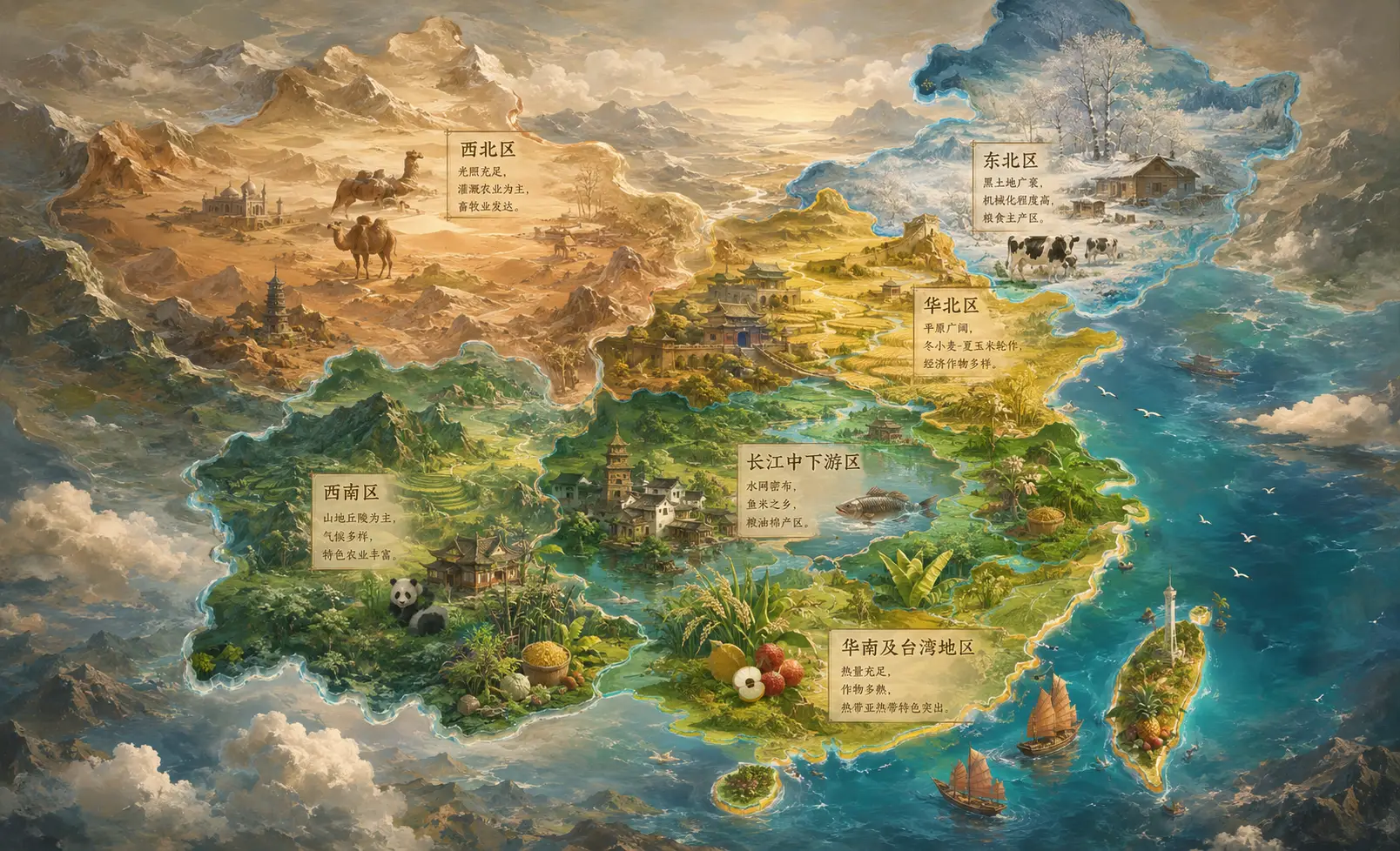
| Agricultural Region | Major Provinces | Keywords |
|---|---|---|
| Northeast | Heilongjiang, Jilin, Liaoning, eastern Inner Mongolia | Greater Cold severe cold, greenhouse management, Spring Festival supply, livestock overwintering |
| Northwest | Xinjiang, Gansu, Ningxia, western Inner Mongolia, Qinghai | Winter-wheat overwintering, final winter pruning, orchard sanitation and trunk whitewashing, farmland improvement |
| North China | Hebei, Shanxi, Beijing, Tianjin, Shandong, northern Henan | Winter-wheat overwintering, Greater Cold severe cold, winter slack season, spring preparation |
| Middle and Lower Yangtze | Hubei, Hunan, Jiangxi, Anhui, Jiangsu, northern Zhejiang, Shanghai | Rapeseed overwintering, winter-wheat overwintering, drainage and waterlogging prevention, spring preparation |
| Southwest | Sichuan, Chongqing, Guizhou, Yunnan, southeastern Tibet | Rapeseed overwintering, winter-wheat overwintering, winter-potato harvest, spring preparation |
| South China and Taiwan | Guangdong, Guangxi, Hainan, southern Fujian, Taiwan Province | Winter-crop harvest, citrus harvest, spring preparation, cold protection |
Heilongjiang, Jilin, Liaoning, eastern Inner Mongolia
During Greater Cold, severe winter conditions continue across Northeast China, marking the closing phase of the coldest period of the year. “大寒到顶点,日后天渐暖”—although bitter cold continues, yang energy begins to rise noticeably and winter starts approaching its end. Temperatures remain around −25 to −35°C, with deep frozen soil and persistent snow cover.
Severe cold continues through Greater Cold, and “猫冬” remains in place. Although winter is beginning to turn, agricultural activity remains indoors. Farmers continue managing stored grain, and with the Spring Festival approaching, grain sales enter a busy season; households sell flexibly according to market conditions, and the pre-holiday period is regarded as one of the times of year when grain prices are relatively high. Off-season purchasing of agricultural inputs continues, with some materials already fully procured. Machinery servicing also continues so that farm equipment will be in good condition for spring cultivation. Farmers further finalize the following year’s crop structure and cultivar choices according to market conditions, policy direction, and climate trends, since preparations for spring farming will move onto the agenda once Greater Cold has passed.
The final critical stage of livestock overwintering in pastoral areas. In eastern Inner Mongolia, livestock management enters the last crucial phase of winter. Although “大寒到顶点,日后天渐暖”, severe cold is still present and winter management cannot yet be relaxed. Shelters must continue to be reinforced, bedding kept thick, and drafts prevented. Feed reserves and daily rations need to be calculated carefully so that livestock can safely pass through the final stage of winter. Weak animals, pregnant females, and young livestock still require special attention, while the risk of “白灾” from blizzards remains and weather forecasts need to be monitored closely. After Greater Cold, temperatures will gradually rise and the hardest part of the pastoral winter will begin to pass.
Greenhouse vegetables enter the Spring Festival supply peak. In Northeast China, Greater Cold coincides with the busiest pre–Spring Festival market period for greenhouse vegetables, and growers strengthen greenhouse management to ensure sufficient holiday supply. Insulation remains essential because Greater Cold is still one of the coldest periods of the year: second-layer curtains or thermal covers should be used at night and cold-air intrusion prevented. Temporary heating equipment should be activated during extreme low temperatures. Daylight begins to increase, but growers still need to maximize exposure to natural light. Vegetables should be harvested promptly before the Spring Festival so they reach the market at the right time and achieve the best economic returns.
Xinjiang, Gansu, Ningxia, western Inner Mongolia, Qinghai
During Greater Cold, Northwest China enters the final stage of winter management. Winter wheat remains in deep overwintering, orchard management approaches completion, and basic farmland improvement is fully complete.
Winter wheat remains in deep overwintering. As “大寒到顶点,日后天渐暖” suggests, severe cold continues but is approaching its end. Wheat fields remain protected by snow cover, which insulates the crop against freezing. Winter irrigation is fully complete. Farmers need to inspect fields regularly during Greater Cold to assess overwintering conditions. After Greater Cold, the weather will gradually warm and winter wheat will begin approaching the green-up stage.
Winter orchard management enters its final stage. After “大寒到顶点”, the principal winter tasks in orchards are largely completed. Winter pruning is generally finished around Greater Cold, which marks the final critical window for pruning. Dead, diseased, crossing, and overcrowded branches are removed and tree structure adjusted to lay the foundation for growth and fruiting in the coming year. Orchard sanitation is fully completed, with dead branches, fallen leaves, diseased fruit, infected branches, and weeds removed and either burned or deeply buried, greatly reducing the overwintering pest and disease load. Trunk whitewashing is also completed, while cold-protection measures for young trees and late-autumn shoots—such as straw wrapping, plastic-film covering, and soil mounding—are already in place. The close of winter orchard management marks the completion of fruit-tree protection through the overwintering period.
Basic farmland improvement is fully complete. By Greater Cold, autumn fertilization, land leveling, irrigation-facility repair, and shelterbelt construction are all finished. Farmland remains in winter rest, awaiting spring sowing.
Hebei, Shanxi, Beijing, Tianjin, Shandong, northern Henan
During Greater Cold, winter wheat across North China remains in deep overwintering, severe cold continues, agricultural field activity is completely suspended, and preparations for spring cultivation gradually begin.
Winter wheat remains in deep overwintering. “大寒到顶点,日后天渐暖”—although severe cold continues, it is approaching its end. Snow remains the best natural protection for winter wheat during Greater Cold, insulating the crop against freezing. Winter irrigation is fully complete. After Greater Cold, temperatures will gradually rise and winter wheat will begin moving toward green-up, so farmers start planning spring farming preparations.
Severe cold continues and agricultural activity remains fully suspended. Although “大寒到顶点,日后天渐暖” marks the beginning of the seasonal turn, outdoor agricultural activity remains completely halted. Indoor work continues through grain-storage management, with grain sales becoming busier as the Spring Festival approaches; continued off-season agricultural-input purchasing; winter machinery servicing to prepare for spring cultivation; and finalization of planting plans for the coming year. As Greater Cold passes, spring cultivation preparations will move fully onto the agenda. With the Spring Festival approaching, North China also enters the broader pre-holiday preparation period.
Winter orchard management approaches completion. In apple, pear, and other orchards, winter pruning is largely finished, orchard sanitation is complete, and trunk whitewashing has also been completed.
Vegetable management. Greenhouse vegetables continue supplying the market, and the period before the Spring Festival is a peak sales season. Temperatures should be maintained at 25–28°C during the day and 12–15°C at night, with strong insulation and cold-protection measures to ensure stable market supply during the holiday period.
Hubei, Hunan, Jiangxi, Anhui, Jiangsu, northern Zhejiang, Shanghai
During Greater Cold, the middle and lower Yangtze enters the closing stage of winter management and the beginning of spring-farming preparation. Rapeseed and winter wheat remain in deep overwintering, drainage and waterlogging prevention continue, and preparation for spring cultivation begins gradually.
Rapeseed remains in deep overwintering. “大寒到顶点,日后天渐暖”—the severe cold continues but is approaching its end. The three-level drainage system must remain clear. Although precipitation is lower during Greater Cold, drainage management cannot be relaxed, and channels should remain open so that once rainfall stops, the ditches themselves drain quickly and dry out. Greater Cold is also the final critical period for protecting rapeseed against cold; in years of extreme low temperatures, insulating covers are still required. Weak stands that did not receive pre-winter topdressing between Winter Solstice and Greater Cold should use this final window to receive a supplementary application. After Greater Cold, temperatures gradually rise and rapeseed begins to approach resumed spring growth.
Winter wheat remains in deep overwintering. Drainage and waterlogging prevention continue alongside cold and frost protection.
Spring cultivation preparations gradually begin. Farmers across the middle and lower Yangtze begin preparing for the coming spring season. Seeds, fertilizers, pesticides, and other production materials are checked and inventoried, with shortages purchased promptly. Winter machinery servicing continues to ensure equipment is ready for spring work. Farmers also inspect winter-fallow fields, checking the quality of winter irrigation, freezing injury, and soil moisture conditions to provide a basis for spring cultivation. After Greater Cold comes Beginning of Spring, and a new agricultural cycle is about to begin.
Winter-vegetable management. Winter vegetables remain either in active growth or in harvest and require continued water and nutrient management together with pest and disease control.
Sichuan, Chongqing, Guizhou, Yunnan, southeastern Tibet
During Greater Cold, Southwest China enters the closing phase of winter management and the beginning of spring-farming preparation. Rapeseed and winter wheat remain in deep overwintering, winter-potato harvesting begins, and preparations for spring cultivation gradually get underway.
Rapeseed remains in deep overwintering. “大寒到顶点,日后天渐暖”—although severe cold continues, it is approaching its end. Drainage and waterlogging prevention remain necessary, while Greater Cold is the final critical period for cold protection. High-altitude areas still require insulating covers against freezing.
Winter wheat remains in deep overwintering. Drainage and waterlogging prevention continue, together with cold and frost protection.
Winter-potato harvesting begins. Around Greater Cold, winter potatoes enter maturity and farmers begin harvesting during clear-weather windows. After harvest, potatoes are promptly graded, packed, sold, or stored. Winter potatoes are an important winter cash crop in Southwest China, and Greater Cold is a key harvest period.
Spring cultivation preparations gradually begin. As “大寒到顶点,日后天渐暖” signals the seasonal turn, farmers start preparing for the coming spring. Seeds, fertilizers, pesticides, and other materials are checked and inventoried; farm machinery continues to receive winter servicing; and fields are inspected for winter-irrigation quality, freezing injury, and soil-moisture conditions. Beginning of Spring follows Greater Cold, and a new year of agricultural activity is about to begin.
Guangdong, Guangxi, Hainan, southern Fujian, Taiwan Province
#### (1) Mainland South China
Winter crops enter peak maturity and harvest. Around Greater Cold, South China reaches the most concentrated harvest period for winter crops. Winter potatoes enter their main harvest window, which is considered an optimal period for maturity and harvest; farmers take advantage of clear weather to harvest, grade, pack, and sell them. Winter potatoes are one of South China’s most important winter cash crops, and the Greater Cold harvest is crucial to annual returns. Winter maize is also harvested, with early cultivars ready while late cultivars continue grain filling and maturation. Winter vegetables such as choy sum, Chinese kale, spinach, and lettuce continue to be harvested and supplied to market. Winter-crop harvesting is the most important agricultural activity in South China during Greater Cold.
Citrus harvesting continues. The period before the Spring Festival is the final peak of citrus sales. “砂糖橘”, “贡柑”, navel oranges, and “沃柑” continue to be harvested and marketed as holiday demand remains strong. Farmers take advantage of clear weather to pick, grade, pack, and sell the fruit. Citrus harvesting and marketing are among the most important agricultural activities in South China during Greater Cold.
Spring cultivation preparations gradually begin. South China begins preparing earlier than the rest of the country because temperatures are relatively high. Farmers start preparing nursery beds for early rice by plowing the seedling fields, applying basal fertilizer, and leveling the soil. Seed preparation also begins through selection of early-rice seed, sun-drying, and germination testing, while fertilizers, pesticides, agricultural film, and other inputs are purchased. Spring farming starts earliest in South China, and by Greater Cold the preparatory work is already gradually underway.
Cold and frost protection. Severe cold during Greater Cold can still bring low temperatures and frost to South China, threatening winter crops and tropical fruit trees, so cold-protection measures must continue.
#### (2) Taiwan
Rice: Rice harvesting is fully complete across Taiwan, and preparations for spring cultivation gradually begin.
Vegetables: During Greater Cold, winter vegetables across Taiwan remain in peak harvest, while preparations for spring cultivation begin gradually.
Fruit trees: Citrus harvesting continues, while banana harvesting is fully complete.
Tea: In central and southern tea regions such as Nantou and Chiayi, winter management enters its final stage. The same is true in northern tea areas such as Wenshan and Sanxia.
Fisheries: Fishing continues in waters around Taiwan during Greater Cold.
Farmer’s proverbs and folk customs: Taiwanese folk tradition preserves the saying “大寒不寒,人畜不安”, meaning that Greater Cold should be cold, and that if it is not, disease may occur in people and livestock in the following year. “大寒到顶点,日后天渐暖” expresses the gradual warming that follows Greater Cold. There is also the custom of “大寒吃萝卜”, with radish eaten during Greater Cold as a food believed to clear internal heat and relieve dryness. Greater Cold is the final solar term of the year, and folk tradition includes “大寒迎新年”—welcoming the New Year during Greater Cold. Beginning of Spring follows immediately afterward, and a new agricultural cycle is about to begin.
Global Extreme Weather · Risks & Responses
Temperate Northern Hemisphere: Extreme Cold and Freezing Injury—the Final Threat of Greater Cold
Greater Cold marks the closing phase of the coldest period of the year across the temperate Northern Hemisphere. As “大寒到顶点,日后天渐暖” suggests, severe cold is beginning to turn toward gradual warming, but extreme low temperatures may still occur. Although winter wheat is relatively cold-tolerant in deep overwintering, severe cold during Greater Cold can still kill seedlings, especially in snow-free fields and in late-sown weak stands. Snow cover remains the best natural protection for winter wheat. Greater Cold is the final critical stage of overwintering, and effective cold protection is essential for ensuring safe survival through winter.
Protected agriculture must continue full insulation and cold protection because Greater Cold remains one of the most difficult periods of the year for greenhouse management. Fruit trees also require continued protection, especially young trees through straw wrapping, trunk whitewashing, and soil mounding. In pastoral areas, Greater Cold is the final critical period of winter livestock management, so cold protection, shelter management, and supplementary feeding must continue without relaxation. Farmers need to monitor forecasts closely and remain prepared throughout the Greater Cold period.
Temperate Northern Hemisphere: Blizzards and Snow Disasters
Heavy snow may still occur across northern regions during Greater Cold. Snow should be cleared promptly to prevent greenhouse collapse, while pastoral areas need to remain alert to “白灾.”
Temperate Northern Hemisphere: Cold, Damp Weather—A Continuing Risk in the Yangtze Basin
The middle and lower Yangtze and Southwest China continue to experience cold, damp conditions during Greater Cold. Drainage and waterlogging prevention, together with cold and frost protection, remain important, and the three-level drainage system must continue to function freely.
Temperate Southern Hemisphere: Summer Drought and Heat-Forced Premature Maturity
In late January, at the height of Southern Hemisphere summer, summer crops enter the grain-filling-to-maturity stage. Persistent heat and drought can cause heat-forced premature maturity, in which grain filling is incomplete and thousand-grain weight declines. Farmers in southeastern Australia and Argentina need to follow forecasts closely, irrigate promptly during drought, and apply foliar fertilizer before extreme heat to strengthen crop stress resistance.
Tropical Regions: Alternating Drought and Flood Risk
Across the tropical Northern Hemisphere—including Southeast Asia and India—the dry season continues and dry-season crops need protection against drought. Across the tropical Southern Hemisphere—including Brazil and Africa—the rainy season continues, creating a need to prevent flooding caused by heavy rainfall while strengthening field management of rice and maize and guarding against rainy-season pests and diseases.
----
Readers’ Comments
Calendar and traditional culture enthusiasts from around the world, sharing the same moon.
Sign in or register to join the conversation. Your comment account is created automatically the first time you use a connected account.
No comments yet
Share your thoughts with readers around the world.