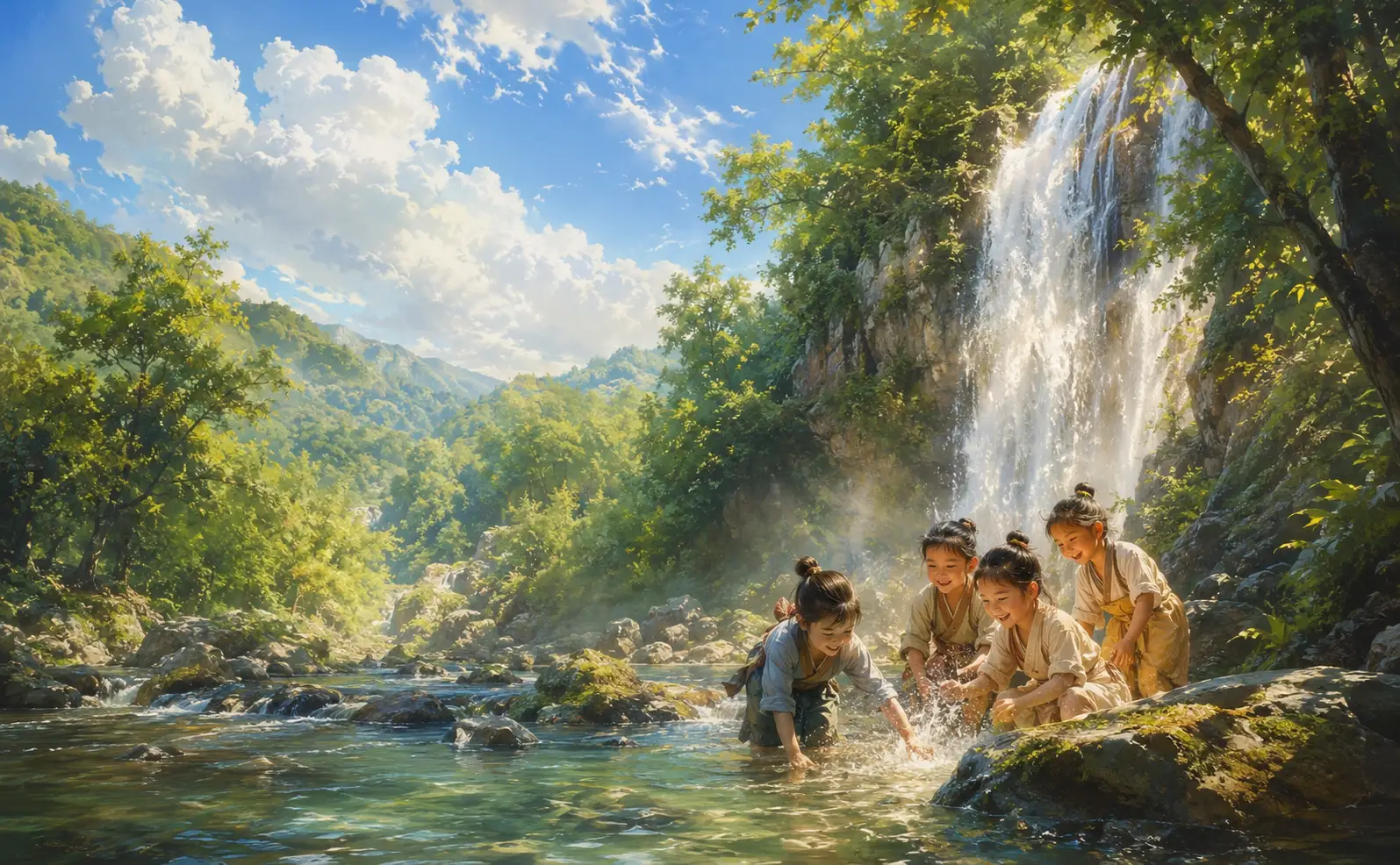
Major Heat Customs
「大暑不暑,五谷不鼓」
The customs of Greater Heat can be summarized through eight ideas: 送、晒、饮、斗、赏、烧、过、食 — sending, drying, drinking, fighting, appreciating, burning, observing, and eating. Sending refers to sending off the Greater Heat Boat: fishermen along the Zhejiang coast place the Five Saints aboard a three-masted sailing vessel and send them out to sea, symbolically carrying away the heat and praying for safety. Drying refers to sun-drying *fu* ginger: in Shanxi, Henan, and other regions, fresh ginger and brown sugar are exposed to the fierce summer sun to make a preparation intended to dispel cold and warm the stomach. Drinking refers to *fu* tea, brewed from herbs such as honeysuckle and self-heal and offered free to passersby to relieve heat and thirst. Fighting refers to cricket fighting: crickets are most abundant around Greater Heat, and people traditionally amuse themselves with matches after meals or over tea. Appreciating refers to viewing lotus flowers and boating among them: lotus blossoms flourish under the burning sun, and the ancients transformed oppressive heat into refined pleasure by drifting through lotus ponds. Burning refers to burning *fu* incense and praying for favorable weather, freedom from illness, and blessings. Observing refers to the Midyear Festival: the fifteenth day of the sixth lunar month marks the midpoint of the year, when families eat round “midyear dumplings” symbolizing reunion and sweetness. Eating, finally, refers to the distinctive seasonal foods of different regions: people drink summer lamb soup in Shandong, eat lychees in Putian, herbal jelly in Guangdong, and pineapples in Taiwan, using seasonal foods to regulate both body and mind.
Among these eight groups of customs, sending off the Greater Heat Boat centers on collective belief, averting calamity, and seeking blessings; sun-drying *fu* ginger and drinking *fu* tea focus on household health practices and mutual aid within the community; cricket fighting and lotus-viewing by boat turn summer leisure into pleasure and refinement; while burning *fu* incense and observing the Midyear Festival revolve around divine worship and reflection on the passage of the year. Together, they form a complete cultural landscape stretching from sea to land, from belief to daily life, and from ritual to ordinary experience. Four cultural ideas run through them. The first is reverence for nature: sending off the Greater Heat Boat uses a grand ritual to send away malevolent forces, expressing both fear of natural disasters and the desire to overcome them. The second is following the proper time of nature: sun-drying ginger and drinking *fu* tea are practical responses to hot and humid weather. The third is countering heat with heat: dietary customs such as drinking lamb soup and eating lychees reflect a health philosophy of using warming foods to dispel internal cold. The fourth is finding pleasure amid hardship: cricket fighting and lotus viewing turn the leisure of the hottest season into sources of enjoyment.
Greater Heat can therefore be regarded as one of the solar terms richest in both ritual significance and philosophical flavor. The saying “大暑不暑,五谷不鼓” reminds us that intense summer heat is not merely suffering; it is also an indispensable catalyst for the ripening of crops. And the ancient imagination expressed in “腐草为萤” — that fireflies arise from decaying grass — allowed people to see light emerging even from decay.
Regional Customs of This Solar Term
| Region | Signature Customs | Notable Features |
|---|---|---|
| Taizhou, Zhejiang, especially Jiaojiang and Jiazhi | Sending off the Greater Heat Boat | A national intangible cultural heritage tradition dating to the Tongzhi reign of the Qing; a three-masted vessel carries the “Five Saints” out to sea to send away the heat and pray for safety |
| Shanxi, Henan, Hunan, and other regions | Sun-drying *fu* ginger | During the dog days, sliced ginger is mixed with brown sugar and exposed to strong sunlight to make *fu* ginger tea |
| Wenzhou, Zhejiang, and other regions | Drinking *fu* tea | Herbal tea made from honeysuckle, self-heal, licorice, and other herbs is offered free to passersby |
| Nationwide, especially northern China | Cricket fighting | Crickets are most abundant during Greater Heat, and matches have long been enjoyed after meals and over tea |
| Nationwide, especially Jiangnan water towns | Viewing lotus flowers and boating | Lotus blossoms flourish under the fierce sun; people boat among lotus ponds, gather seedpods, and enjoy the fragrance |
| Putian, Fujian | “Passing Greater Heat”: eating lychees, mutton, and fermented rice | Seasonal foods are eaten on Greater Heat and are traditionally regarded as highly nourishing |
| Guangdong and Taiwan | Eating herbal jelly | Mesona is cooked into hot herbal jelly or chilled grass jelly as a cooling summer food |
| Taiwan | Eating pineapple | In Southern Min, the pronunciation of pineapple resembles “prosperity comes,” symbolizing peace, good fortune, and flourishing business |
| Zaozhuang, Shandong, and nearby areas | Drinking summer lamb soup | Lamb soup is consumed on Greater Heat to “counter heat with heat” and disperse dampness |
Major Heat Customs
Sending Off the Greater Heat Boat
Popular Regions:
Activities:
Sending off the Greater Heat Boat is a widely transmitted folk tradition among coastal fishing communities in Zhejiang, particularly around Taizhou. Its central meaning is to send the Five Saints out to sea, carrying away the summer heat and praying for the safety and well-being of the people.
The boat is built as a scaled-down version of an old three-masted sailing vessel. It measures approximately eight meters long and two meters wide, weighs about 1.5 metric tons, and carries a variety of sacrificial offerings.
Once the event begins, more than fifty fishermen take turns carrying the Greater Heat Boat through the streets. Drums and horns thunder, firecrackers erupt, and crowds gather along both sides of the road to pray for blessings. The boat is eventually carried to the wharf, where a series of grand rites is performed.
After the ceremonies, a fishing vessel tows the Greater Heat Boat out of the harbor. It is then set alight on the open sea and left to drift and sink, symbolically blessing the people with abundant harvests, peaceful lives, and good health. The ritual is accompanied by a variety of folk performances, creating a spectacular scene.
Historical Origins:
The custom originated during the Tongzhi reign of the Qing dynasty. According to local accounts, epidemics frequently occurred around Jiazhi at the time, becoming especially severe around Greater Heat each year. People believed that malevolent spirits were bringing calamity to the human world, so they built a Temple of the Five Saints beside the Jiazhi River.
Whenever local residents fell ill, they would go to the temple and pray to the Five Saints. It was said that sincere devotion could dispel disaster and cure disease. Later, fishermen decided to designate Greater Heat as a collective day of worship for the Five Saints and used fishing boats to carry offerings downriver and beyond the mouth of the Jiaojiang River.
After the first such ceremony, a boat was built and sent off every year, gradually forming a lasting custom. The tradition declined after 1958 but has been revived in recent years. Today, this custom, which began during the Tongzhi reign, has become a representative national intangible cultural heritage project integrating traditional boatbuilding, folk belief, and solar-term culture. It embodies the people of Taizhou’s reverence for nature and their hopes for a better life.
How to Take Part:
During Greater Heat, visitors can travel to Jiaojiang and other parts of Taizhou to observe the event. Processions can be watched from the roadside, while the blessing ceremony and the boat’s departure can be viewed at the wharf. Specific dates and locations should be checked in advance with local cultural and tourism authorities.
Recommended Places:

Sun-Drying *Fu* Ginger
Popular Regions:
Activities:
Sun-drying fu ginger is an old household health custom associated with Greater Heat. Originating in places such as Shanxi and Henan, it involves slicing or juicing fresh ginger during the dog days, mixing it with brown sugar, placing the mixture in a container covered with gauze, and leaving it to dry under the sun. Once thoroughly blended and matured, it is eaten as a preparation traditionally regarded as especially effective for chronic stomach chill, colds, and coughs, while also warming and strengthening the body.
The pungent compounds in ginger are considered effective in treating abdominal distension, abdominal pain, diarrhea, vomiting, and other discomforts caused by excessive consumption of cold foods. After eating chilled foods, getting soaked in the rain, or spending too long in an air-conditioned room, drinking *fu* ginger is believed to quickly relieve discomfort caused by excessive internal cold.
After consuming it, people often feel their bodies warming. This is explained by the belief that it expands the blood vessels, accelerates circulation, and opens the pores, allowing excess heat to leave while simultaneously carrying out pathogens and cold from within the body.
In some parts of Hunan, aged ginger is placed in winnowing baskets or threaded into strings with cotton cord and hung beneath the eaves, exposed to wind, sun, rain, and dew until the final day of the last dog-day period.
Historical Origins:
The health saying “冬吃萝卜夏吃姜” — eat radish in winter and ginger in summer — has circulated in China for centuries. Greater Heat falls in the middle of the dog days, when the sun is at its strongest, making it the ideal time to dry *fu* ginger.
The custom closely combines the traditional Chinese medical principle of “nourishing yang in spring and summer” with the seasonal rhythm of the calendar and represents an accumulated body of practical wisdom for dealing with summer heat and dampness.
How to Take Part:
During Greater Heat, *fu* ginger can be prepared at home by slicing or juicing fresh ginger, mixing it thoroughly with brown sugar, placing it in a container, and leaving it in the sun for several days. Once dried and matured, it can be eaten directly or infused as a drink. It is one of the most accessible Greater Heat health customs.
Recommended Places:
Cricket Fighting
Popular Regions:
Activities:
Cricket fighting is an ancient form of Chinese folk entertainment. Greater Heat is the season when crickets are most abundant in fields and villages, so in many parts of China people traditionally enjoy cricket matches after meals or over tea.
Cricket fighting is also known by names such as “秋兴,” “斗促织,” and “斗蛐蛐.” Greater Heat is regarded as a “golden period” for crickets, when they grow rapidly and become especially strong. For old Beijing residents, cricket fighting was therefore one of the great pleasures of passing the summer.
Adults traditionally took children out into the fields to catch crickets and then gathered beneath large trees to stage matches. Only crickets of similar grade could be paired against one another, so insects of roughly equal size and weight were selected. A specially prepared blade of grass or horsehair was then used to provoke them into fighting.
After the contest, the defeated cricket withdrew while the victor chirped. In this way, a simple game transformed idle hours during the hottest part of the year into an enjoyable family and community activity.
Historical Origins:
Historical records trace cricket fighting back to the Tang dynasty, although at that time it remained largely an aristocratic pastime. By the Song dynasty, it had become increasingly popular among ordinary people. The practice is also mentioned in the *Fuxuan Zalu*.
Crickets have numerous traditional names, including “促织,” “蛬,” “吟蛩,” and “趣织.” Their natural tendency to chirp and fight made them well suited to this form of entertainment. From an aristocratic diversion under the Tang to a popular pastime under the Song, cricket fighting has been passed down for more than a thousand years and has become a distinctive phenomenon in Chinese folk culture.
How to Take Part:
During Greater Heat, crickets can be caught in rural fields and traditional matches enjoyed with friends. Some folk-culture villages also organize cricket-fighting demonstrations and hands-on activities around this time.
Recommended Places:
Viewing Lotus Flowers and Boating
Popular Regions:
Activities:
Greater Heat is also an excellent season for admiring lotus flowers. As the famous lines say, “接天莲叶无穷碧,映日荷花别样红” — lotus leaves stretch endlessly into the sky, while blossoms glow an exceptional red beneath the sun. Lotus flowers bloom under the fierce summer light and, rising unstained from the mud, became symbols of the character of the gentleman.
The ancients often took boats onto lotus ponds at this time, gathering seedpods, breathing in the fragrance, composing poetry, and painting, turning oppressive heat into refined pleasure. The sixth lunar month is also called the “Lotus Month.” The hotter the weather becomes, the more vigorously the flowers bloom, standing upright and serene amid waves of heat.
Bai Juyi wrote: “何以消烦暑,端坐一院中。眼前无长物,窗下有清风” — how does one dispel oppressive summer heat? By sitting quietly in the courtyard, with nothing excessive before the eyes and a cool breeze beneath the window.
The traditional idea that “a calm mind naturally feels cool” gives lotus viewing a meaning beyond simple appreciation of beauty. It becomes a form of cultivating inner peace. During Greater Heat, lotus blossoms flourish with extraordinary vitality in extreme heat, embodying a philosophy of life: the harder the conditions, the more fully one should bloom.
Historical Origins:
Viewing lotus flowers as a way to pass the summer was a traditional refined pleasure among Chinese scholars and literati. Since Zhou Dunyi of the Song dynasty praised the lotus as “the gentleman among flowers” in his *On the Love of the Lotus*, the flower acquired an increasingly strong association with moral cultivation.
Greater Heat is one of the best times to view lotus blossoms and historically provided an important setting for literary gatherings, poetry, and painting.
How to Take Part:
During Greater Heat, lotus flowers can be enjoyed in parks and ponds throughout China. The lotus scenery of West Lake in Hangzhou, the Humble Administrator’s Garden in Suzhou, and Daming Lake in Jinan is especially famous. Many scenic areas also offer boating and lotus-seedpod gathering experiences.
Recommended Places:
Drinking *Fu* Tea
Popular Regions:
Activities:
As its name suggests, fu tea is tea drunk during the dog days. It is brewed from more than ten medicinal herbs, including honeysuckle, self-heal, licorice, and lotus leaves, and is traditionally used to cool the body and relieve summer heat. Free *fu* tea is generally supplied from the beginning of the sixth lunar month until the end of the eighth.
In earlier times, many rural communities maintained a custom of placing tea in roadside pavilions at the entrance to villages and offering it free to passersby. In the villages of Jiangnan and southern Anhui, residents set up *fu* tea stalls in roadside pavilions and at old-route waystations. Villagers pooled medicinal herbs and brewed the tea voluntarily, offering it free to porters, farmers, and travelers.
The practice expressed both kindness toward strangers and a strong spirit of mutual assistance within the community.
Although such pavilions are now far less common, this centuries-old custom has survived in Wenzhou. Each pavilion has people responsible for brewing tea throughout the day to ensure a steady supply. One account holds that people in Wenzhou have been making *fu* tea from herbs such as self-heal, poria, licorice, and honeysuckle since the Southern Song dynasty, drinking it themselves while also placing it in streets and lanes for passersby to relieve thirst and heat.
Historical Origins:
The custom of drinking *fu* tea can be traced back to the Song dynasty or even earlier. The ancients believed that summer heat reached its height during Greater Heat and that medicinal herbal tea was therefore needed to clear heat, relieve summer discomfort, and prevent illness.
By combining multiple herbs, *fu* tea reflects the traditional Chinese medical principle of “preventing illness before it arises” and the folk idea that medicine and food share a common origin. The custom perfectly joins seasonal health preservation with mutual aid: it is both care for one’s own body and an act of kindness toward travelers.
How to Take Part:
During Greater Heat, visitors can look for *fu* tea stalls on the streets of Wenzhou and sample a free cup. It can also be brewed at home using herbs such as honeysuckle, self-heal, licorice, and lotus leaf. The source recommends choosing the formula under the guidance of a practitioner of traditional Chinese medicine.
Recommended Places:
Burning *Fu* Incense
Popular Regions:
Activities:
Burning fu incense is one of the folk customs of prayer and sacrifice associated with Greater Heat. *Fu* incense is burned during the dog days, when people offer incense and pray for favorable weather, freedom from illness, and divine blessing.
Greater Heat falls at the height of the dog days, and the ancients believed that yang energy was at its strongest. Prayers offered through incense at this time were therefore thought more likely to reach Heaven. The practice expresses reverence for divine powers and reflects the deep longing for peace and health during a season of intense heat.
Historical Origins:
The custom continues the broader tradition of ancient Chinese sacrificial ritual. The dog days are the hottest period of the year and were also regarded as a season when epidemics were especially likely. People therefore burned incense and prayed for divine protection, reflecting the traditional concept of resonance between Heaven and humanity.
How to Take Part:
During Greater Heat, people can visit local Buddhist or Daoist temples to take part in *fu* incense prayers. At home, a single stick of incense may also be lit quietly as an expression of prayer and blessing.
Recommended Places:
Midyear Festival
Popular Regions:
Activities:
The fifteenth day of the sixth lunar month marks the midpoint of the year, and folk tradition observes it as “passing the half-year.” After worshipping the deities, the whole family gathers to eat “midyear rounds.”
These are round foods made by grinding glutinous rice into flour and mixing it with red-colored dough. The family shares the sweet food together, symbolizing reunion and sweetness.
The Midyear Festival marks an important point in the annual cycle. It reminds people that half the year has already passed, inviting them both to reflect on what has been achieved during the first six months and to consider plans for the second half.
Historical Origins:
The custom developed from the importance the ancients placed on significant points in the passage of time. Like the Spring Festival and Mid-Autumn Festival, the Midyear Festival forms part of the traditional annual system of seasonal observances.
In agricultural society, the sixth lunar month coincided with a crucial period of summer harvesting and planting. “Passing the half-year” therefore served both as a summary of the first half-year’s labor and as a prayer for good harvests in the months ahead.
How to Take Part:
Around the fifteenth day of the sixth lunar month, visitors can observe Midyear Festival customs in Fujian, Taiwan, and other regions and taste traditional foods such as the “midyear rounds.”
Recommended Places:
Drinking Summer Lamb Soup
Popular Regions:
Activities:
Southern Shandong has a custom of “drinking summer lamb” — that is, drinking lamb soup — on Greater Heat. In Zaozhuang, many residents visit local lamb-soup restaurants specifically on this day.
Northern tradition favors this custom, and Greater Heat lamb is cooked with Sichuan pepper and ginger. The steaming soup makes the whole body sweat, and old farmers say that afterward “you will not need a padded coat in winter.”
Local people believe that this method of countering heat with heat can disperse cold and dampness accumulated within the body. Steaming fresh flour, slaughtering a sheep, eating new wheat buns, and drinking lamb soup together form one of the most representative Greater Heat food traditions of southern Shandong.
Historical Origins:
The custom is a typical expression of the health philosophy of countering heat with heat. During Greater Heat, people consume warming lamb to induce sweating and remove dampness, embodying the traditional Chinese medical principle of “nourishing yang in spring and summer.”
Passed down for generations in southern Shandong, the custom has become a distinctive element of local seasonal food culture.
How to Take Part:
During Greater Heat, visitors can go to lamb-soup restaurants in Zaozhuang, Linyi, and surrounding areas to try “summer lamb.” Local restaurants often offer seasonal *fu* lamb sets around this time.
Recommended Places:
“Passing Greater Heat” in Putian, Fujian
Popular Regions:
Activities:
People in Putian traditionally eat lychees, mutton, and fermented rice during Greater Heat, a custom known as “passing Greater Heat.”
Lychees contain glucose and various vitamins and are regarded as highly nutritious, so eating fresh lychees is considered nourishing. People first place freshly picked lychees in cool well water and wait until the moment of Greater Heat before taking them out to eat. Folk tradition holds that eating lychees on this day has a nutritional value comparable to eating ginseng.
The fermented rice is made by mixing cooked rice with white rice starter and allowing it to ferment fully. On Greater Heat, it is cut into pieces and cooked with brown sugar and is said to “greatly replenish vital energy.”
The foods eaten during Putian’s Greater Heat observance are predominantly warming in nature, expressing a local health philosophy of using heat to dispel cold.
Historical Origins:
The custom has a long history. Lychees are a specialty of Putian and ripen around Greater Heat. Local people use them both to nourish the body and celebrate the harvest, creating a distinctive seasonal food culture.
In traditional Chinese medical theory, lychee is considered warming and nourishing and is regarded as suitable for replenishing qi and blood even during the hottest season.
How to Take Part:
During Greater Heat, visitors can travel to Putian to taste lychees, mutton, and fermented rice and experience the distinctive local custom. Lychee orchards often open for picking experiences around this period.
Recommended Places:
Eating Herbal Jelly in Guangdong and Taiwan
Popular Regions:
Activities:
Many parts of Guangdong have a tradition of eating mesona herbal jelly during Greater Heat. Mesona, also known as grass-jelly herb or “immortal herb,” is a herbaceous plant of the mint family and an important plant used both as food and medicine.
Because of its powerful cooling effect, it is praised as an “immortal herb.” Once the stems and leaves are dried, they can be prepared as hot *shaoxiancao* or as chilled grass jelly, known in Guangdong simply as *liangfen*.
A folk saying goes: “六月大暑吃仙草,活如神仙不会老” — eat immortal herb during Greater Heat in the sixth month and live like an immortal who never grows old. *Shaoxiancao* is also one of Taiwan’s best-known snacks and can be eaten either hot or cold.
Historical Origins:
The custom of eating mesona has a long history in Lingnan. The plant is traditionally associated with clearing heat, draining dampness, relieving summer discomfort, and removing toxins, making it well suited to the hot and humid climate of Greater Heat.
The custom reflects both the traditional Chinese medical principle that medicine and food share a common origin and the dietary philosophy of eating according to the season.
How to Take Part:
During Greater Heat, hot mesona desserts or chilled grass jelly can be enjoyed in dessert shops throughout Guangdong and Taiwan. Packaged mesona jelly can also be purchased and used to make desserts at home.
Recommended Places:
Eating Pineapple in Taiwan
Popular Regions:
Activities:
During Greater Heat, Taiwan has a custom of eating pineapple. People traditionally believe that pineapples taste especially good at this time.
In Southern Min, the pronunciation of pineapple resembles “旺来”, meaning “prosperity comes,” so the fruit is also used as a symbol of peace, auspiciousness, and flourishing business. In Taiwan, pineapple is therefore more than a seasonal fruit: it also carries wishes for good fortune.
Historical Origins:
The custom arose from Taiwan’s abundant pineapple production and Southern Min linguistic culture. Greater Heat coincides with the peak pineapple season, when the fruit is considered especially flavorful.
Because the Southern Min pronunciation of pineapple echoes “旺来,” prosperity comes, the fruit acquired a strong auspicious cultural meaning.
How to Take Part:
During Greater Heat, fresh pineapples can be purchased from fruit markets across Taiwan. Pineapple cakes and other pineapple products are also widely available.
Recommended Places:
Eating Young Chicken
Popular Regions:
Activities:
Central and northern Hunan have long maintained a tradition of eating young chicken during Greater Heat. The weather is extremely hot at this time and the body is considered to consume large amounts of energy, creating a need for additional nourishment.
Young chicken has tender meat and is easy to digest and absorb, making it a favored food for light nourishment during summer. The custom reflects the Hunan principle of adapting food to the proper time.
Historical Origins:
The tradition has been passed down through generations in Hunan. Traditional Chinese medicine considers chicken warm in nature and attributes to it the functions of warming the middle, replenishing qi, enriching essence, and nourishing marrow, making it suitable for times of heavy physical depletion in summer.
How to Take Part:
During Greater Heat, young-chicken dishes can be sampled in restaurants throughout Hunan.
Recommended Places:
Eating Egg with Ginger Juice
Popular Regions:
Activities:
People in Jiaojiang, Taizhou, also have a tradition of eating egg mixed with ginger juice during Greater Heat. Ginger juice is believed to remove internal dampness, while the egg preparation is regarded as nourishing. Some older people also enjoy chicken congee, which is said to replenish yang.
The custom combines the cold-dispelling properties attributed to ginger with the nutritional value of eggs, reflecting local acceptance of the health principle of using heat to dispel cold.
Historical Origins:
Egg with ginger juice is a traditional seasonal food in Taizhou and is closely connected with the region’s hot and humid climate. Dampness is considered especially heavy during Greater Heat, so people eat this dish to remove internal dampness and replenish nutrition.
How to Take Part:
During Greater Heat, egg with ginger juice can be sampled in local Taizhou restaurants. It can also be made at home by mixing ginger juice with egg and steaming or cooking the mixture.
Recommended Places:
Sun-Drying Sauce During Greater Heat
Popular Regions:
Activities:
When ginger is being dried, sauce jars are also brought out into the sun. Soybeans are mixed with flour and spread on bamboo trays, and beneath the fierce summer sun the fermenting sauce begins to bubble, its aroma carrying far through the air.
Greater Heat brings some of the strongest sunlight of the year and is therefore considered the best time for sun-drying and fermenting flour paste and soy sauce. The custom closely links seasonal timing with household production and represents a simple form of wisdom in using natural conditions to make essential foods.
Historical Origins:
Sun-drying sauce has a long history in northern China. Greater Heat provides strong sunlight and high temperatures, both of which favor fermentation and drying, making it an ideal season for producing traditional sauces.
How to Take Part:
During Greater Heat, traditional sauce-drying scenes can still be observed in some northern villages. Simple flour-based sauces can also be prepared at home, provided proper hygiene and fermentation conditions are maintained.
Recommended Places:
Closing Note
The customs of Greater Heat vividly reveal how Chinese communities sought a balance between belief and enjoyment during the hottest season of the year. Greater Heat is the period when heat and humidity reach their combined peak. Faced with the days when yang energy was considered strongest and life most difficult to endure, people did not simply resign themselves to suffering. Instead, they filled the season with both devout belief and uninhibited enjoyment, bringing freshness and vitality into the fiercest heat.
Across the centuries, Greater Heat accumulated traditions such as sending off the Greater Heat Boat, burning *fu* incense, and sun-drying *fu* ginger. Along the coast of Taizhou in Zhejiang, sending off the Greater Heat Boat is now recognized as national intangible cultural heritage: fishermen build a wooden vessel more than three *zhang* in length, load it with offerings, tow it far out to sea, and set it alight, symbolically carrying away summer heat and epidemic disease while praying for safety on the water. Burning *fu* incense was a public ritual through which ordinary people prayed for favorable weather and abundant harvests. Sun-dried ginger, summer lamb soup, herbal jelly, and pineapple — behind these food customs lies the survival wisdom accumulated through a thousand-year struggle with humid summer heat.
When a Greater Heat Boat filled with prayers bursts into flame far out in the East China Sea, and when a steaming bowl of lamb soup sends up clouds of vapor on a street in Zaozhuang, Shandong, the customs of Greater Heat become more than ways of escaping the summer heat. They express the optimism and resilience of a people who do not forget to live well even through the hardest days of the year.
—
Readers’ Comments
Calendar and traditional culture enthusiasts from around the world, sharing the same moon.
Sign in or register to join the conversation. Your comment account is created automatically the first time you use a connected account.
No comments yet
Share your thoughts with readers around the world.