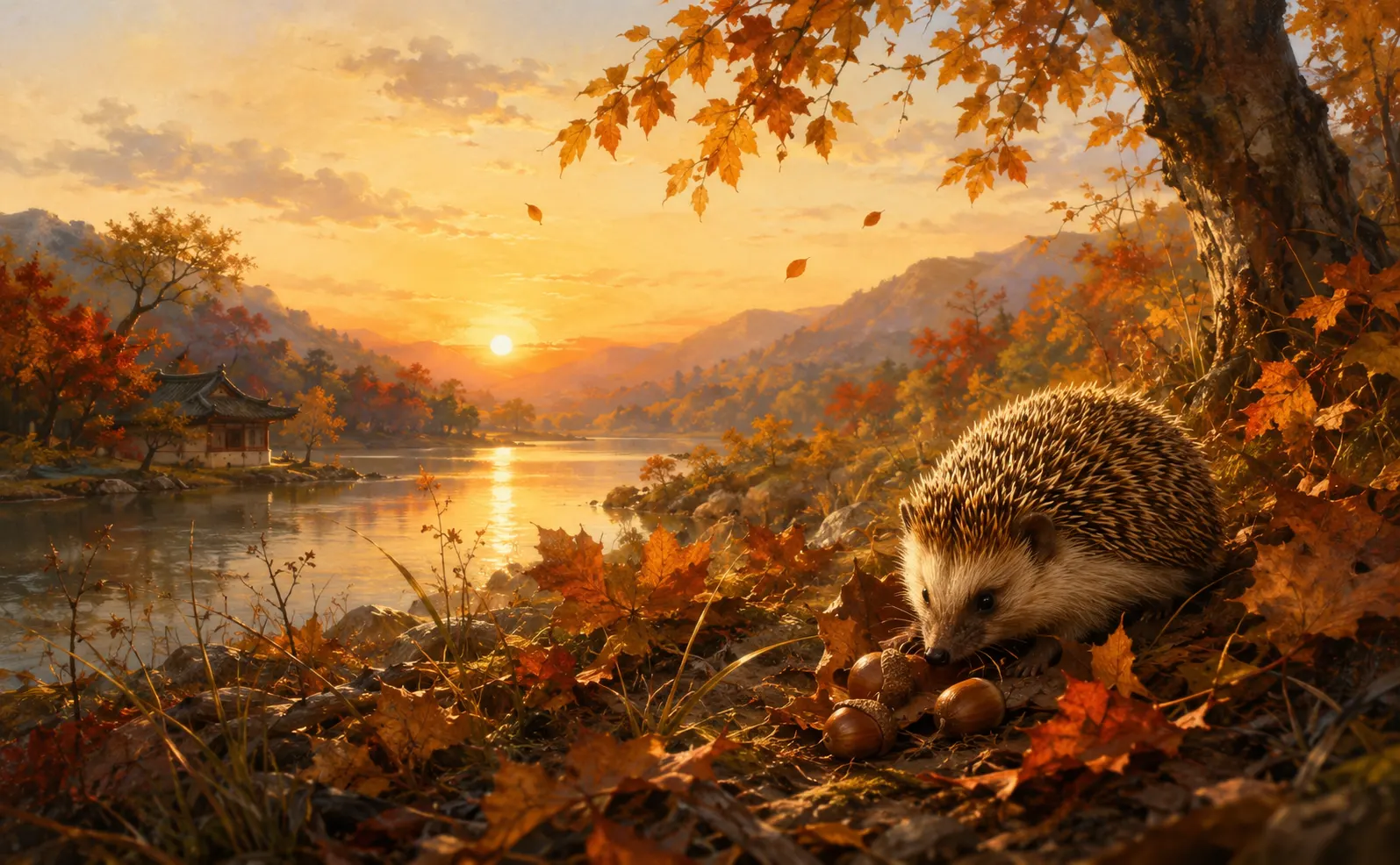
Autumn Equinox Customs
「春分秋分,昼夜平分」
The Autumn Equinox is the sixteenth of the Twenty-Four Solar Terms and the fourth solar term of autumn, usually occurring between September 22 and 24 on the Gregorian calendar. The *Luxuriant Dew of the Spring and Autumn Annals* says: “秋分者,阴阳相半也,故昼夜均而寒暑平。” The character “分”, “division” or “equal share,” carries two meanings here. First, day and night are divided equally: on this day the Sun shines directly over the Equator, and across the world day and night are equal in length, each lasting twelve hours. Second, autumn itself is divided in half: the Autumn Equinox stands at the midpoint of the ninety days of the season, forming a watershed between early and deep autumn. From this point onward, days in the Northern Hemisphere become progressively shorter, nights grow longer, and the weather moves from coolness toward cold.
If the customs of White Dew revolve around “nourishment” and “refinement,” those of the Autumn Equinox revolve around “sacrifice” and “celebration.” Sacrifice means solemnly worshipping the Moon deity and the gods of the land in gratitude for the gifts of Heaven and Earth; celebration means joyfully welcoming the harvest and giving thanks for the abundance of the soil. Among the Twenty-Four Solar Terms, the Autumn Equinox is one of those most closely connected with celestial worship. Its customs can be summarized through eight ideas: 祭、庆、吃、送、粘、竖、放、折 — sacrifice, celebrate, eat, send, stick, balance, release, and pluck. Sacrifice refers to worshipping the Moon: emperors performed the grand “Evening Moon” rite at the Altar of the Moon, while ordinary households set out incense tables and prayed beneath the Moon, a tradition that later became one of the sources of the Mid-Autumn Festival. Celebrate refers to the autumn rites to the God of the Land and to harvest festivals: people thanked the land deity for the harvest, while in modern China the Autumn Equinox has also been designated the annual Chinese Farmers’ Harvest Festival. Eat refers to autumn greens and autumn crabs: in Lingnan, wild amaranth is gathered and cooked into “autumn soup” for health and well-being, while in Jiangnan people eat plump crabs, admire chrysanthemums, and enjoy the fresh flavors of the season. Send means sending the Autumn Ox: folk performers carry images of the Autumn Ox from village to village, singing auspicious verses and urging farmers to cultivate and sow at the proper time. Stick refers to “sticking the sparrows’ beaks”: unfilled glutinous-rice balls are placed on sticks in the fields in the hope that birds will not damage the crops. Balance means standing eggs upright: taking the equality of day and night as its symbolism, people balance eggs for amusement while expressing reverence for life and equilibrium. Release means flying kites: under clear autumn skies and favorable winds, paper kites are sent into the air in harmony with the season. Pluck refers to plucking osmanthus: osmanthus blossoms around the Autumn Equinox, and the traditional image of “plucking the cassia” carries the meaning of success in the imperial examinations. Among these eight groups of customs, Moon worship and the autumn land rites center on divine worship and gratitude toward Heaven and Earth; eating autumn greens, tasting autumn crab, and plucking osmanthus center on seasonal foods and refined living; sending the Autumn Ox and sticking the sparrows’ beaks focus on agricultural production and prayers for a rich harvest; while balancing eggs and flying kites belong to folk games and the pleasures of everyday life. Together, they form a complete cultural landscape extending from court to countryside, from sacrifice to daily life, and from gratitude to celebration.
Several cultural principles run through them. The first is reverence for Heaven and Earth: Moon worship and the autumn land rites use the most solemn ceremonies to thank the Moon, the land, and the powers of nature, embodying the traditional belief in revering Heaven and following the ancestors. The second is gratitude for the harvest: the Autumn Equinox falls during the great “Three Autumns” agricultural season of harvesting, plowing, and sowing, and from the official Harvest Festival to village autumn feasts, gratitude for the gifts of the earth is everywhere. The third is following the proper time of nature: eating autumn greens to moisten the lungs and guard against dryness, and accompanying crab with ginger to dispel cold, are both forms of seasonal health wisdom. The fourth is balance and harmony: standing an egg upright reflects the image of day and night being equally divided, while flying kites responds to the clear and invigorating atmosphere of autumn; throughout these practices can be seen the Chinese philosophical pursuit of the Mean and harmony. The Autumn Equinox can therefore be called the solar term with the strongest sense of balance and the joy of harvest — on this day Heaven and Earth reach a state of perfect equilibrium, while human society welcomes its richest rewards. Spring blossoms become autumn fruits, and every labor finally finds its answer.
Regional Customs of This Solar Term
| Region | Signature Customs | Notable Features |
|---|---|---|
| Beijing, Altar of the Moon | Grand Moon sacrifice | Ming and Qing emperors worshipped the Moon at the Altar of the Moon on the Autumn Equinox as a major state ceremony |
| Nationwide | Autumn land rites | After the autumn harvest, sacrifices are offered to the God of the Land and the Grain God, accompanied by singing, dancing, and communal meals |
| Nationwide | Chinese Farmers’ Harvest Festival | Since 2018, the Autumn Equinox has been designated the annual national Harvest Festival |
| Lingnan, including Kaiping in Guangdong | Eating autumn greens and drinking autumn soup | Wild amaranth is cooked with fish slices into “autumn soup” and eaten as a prayer for health |
| Jiangnan | Tasting autumn crab | Around the Autumn Equinox, crabs are plump and chrysanthemums are yellow, making this the prime season for crab |
| Southern China | Drinking osmanthus wine | Osmanthus blossoms are gathered and made into wine for celebrations or entertaining guests |
| Shandong and Hebei | Sending the Autumn Ox | Folk performers carry Autumn Ox pictures from household to household while singing auspicious farming verses |
| Rice-growing areas of Jiangxi, Hunan, and other southern regions | Sticking the sparrows’ beaks | Unfilled glutinous-rice balls are placed along field ridges to protect crops from birds |
| Nationwide | Balancing eggs | “秋分到,蛋儿俏”; a fresh egg is carefully balanced upright on a table |
| Nationwide | Flying kites | Clear skies and moderate winds make this an ideal season for kite flying |
Autumn Equinox Customs
Worshipping the Moon
Popular Regions:
Activities:
Worshipping the Moon on the Autumn Equinox was one of the most important seasonal ceremonies of ancient China. The *Book of Rites* records: “天子春朝日,秋夕月。朝日之朝,夕月之夕。” Ancient ritual practice prescribed worshipping the Sun at the Spring Equinox, the Earth at the Summer Solstice, the Moon at the Autumn Equinox, and Heaven at the Winter Solstice. The Autumn Equinox Moon sacrifice originated in ancient lunar worship: the Moon represented fertility, reproduction, and abundance, while the Autumn Equinox coincided with the ripening and harvesting of crops.
The ceremony itself was extremely solemn. On the night of the Autumn Equinox, the imperial court established an altar known as “Night Brightness,” that is, the Altar of the Moon. The emperor wore dark ceremonial robes and knelt facing west, while civil and military officials stood in ranks on either side; ritual officers recited the sacrificial text, and wine was presented in sequence according to prescribed rites. Offerings had to be round in shape, echoing the Moon’s symbolism of completeness and fullness. The *Records of the Grand Historian · Treatise on the Feng and Shan Sacrifices* states: “祭日以牛,祭月以羊彘特”. In the Qing dynasty, Pan Rongbi wrote in *Records of Victorious Sights and Seasonal Customs of the Imperial Capital*: “春分祭日,秋分祭月,乃国之大典,士民不得擅祀” — worshipping the Sun at the Spring Equinox and the Moon at the Autumn Equinox were great ceremonies of the state, not rites ordinary people were free to perform on their own authority.
The imperial rite later influenced folk practice. Families would set up a large incense table beneath the Moon and arrange offerings such as mooncakes, watermelon, apples, red dates, grapes, pomegranates, and persimmons, with a tablet of the Moon Deity facing the direction of the Moon. Red candles burned high as members of the household worshipped in turn and prayed for blessings. The *Records of Seasonal Splendor in Beijing* notes: “秋分夜,家家设月光位,于月出方向供月” — on the night of the Autumn Equinox, every household set up a place for the Moonlight Deity and offered worship in the direction of moonrise. According to an old custom, “men do not worship the Moon, and women do not sacrifice to the Stove God,” so the principal worshipper was usually an elderly female relative or the mistress of the household.
Historical Origins:
The tradition of worshipping the Moon at the Autumn Equinox began in the Zhou dynasty and was preserved by successive dynasties as an important part of state ritual. Beijing’s Yuetan, the Altar of the Moon, was built specifically for the Ming and Qing emperors to perform these rites. Because the Twenty-Four Solar Terms follow a solar calendar and do not correspond to the waxing and waning of the Moon, the Autumn Equinox does not necessarily fall on a full-moon night. Folk Moon worship therefore gradually shifted to the fifteenth day of the eighth lunar month, when the Moon is full, eventually giving rise to the Mid-Autumn custom of worshipping the Moon. The Autumn Equinox and Mid-Autumn thus differ in date — one rooted in official state sacrifice, the other becoming a popular festival — yet their cultural lineage remains continuous.
How to Take Part:
On the night of the Autumn Equinox, an incense table can be set up on a balcony or in a courtyard with mooncakes, fruit, and other round offerings, facing the Moon for incense and worship. Around the Autumn Equinox, Yuetan Park in Beijing occasionally stages reconstructed versions of the ancient Moon sacrifice; local cultural-event schedules can be consulted in advance.
Recommended Places:

Tasting Autumn Crab
Popular Regions:
Activities:
“When the autumn wind rises, crab legs itch.” Around the Autumn Equinox, crabs are at their richest: the flesh is tender and the roe full, making crab one of the great seasonal delicacies of autumn. Jiangnan has long had a tradition of eating crab at this time, when chrysanthemums are yellow and crabs are fat. Ginger and vinegar are served alongside to dispel cold and warm the center, while diners enjoy one of the most prized flavors of the season.
Historical Origins:
The custom is closely connected with the abundance of river crabs in the waterways of Jiangnan. As water temperatures fall around the Autumn Equinox, crabs enter their plumpest period. Traditional Chinese medicine considers crab cold in nature, and eating it with ginger and vinegar can dispel cold, warm the center, and protect the spleen and stomach. The custom embodies both the dietary principle of eating according to the season and the health wisdom that medicine and food share a common origin.
How to Take Part:
Around the Autumn Equinox, hairy crab can be sampled at restaurants throughout Jiangnan, or fresh crabs can be purchased from aquatic-product markets and steamed at home. Ginger and vinegar are traditionally served with crab, while cold wine is avoided.
Recommended Places:
Drinking Osmanthus Wine
Popular Regions:
Activities:
The period around the Autumn Equinox is the season when osmanthus blossoms in profusion. In some parts of southern China, large quantities of the flowers are gathered and steeped in baijiu or yellow rice wine to make osmanthus wine, which is then served during the season for celebrations or to welcome guests. In some places, purchasing and drinking osmanthus wine on the day of the Autumn Equinox itself is also customary. Richly fragrant, it is one of the most refined drinks of autumn.
Historical Origins:
The Mid-Autumn period is precisely the season when the scent of orange osmanthus fills the air, and records of drinking osmanthus wine already appear in traditional Han Mid-Autumn banquets. Eating osmanthus and drinking osmanthus wine around the Autumn Equinox carry a restrained but auspicious blessing. According to legend, osmanthus seeds came from the enormous cassia tree in the Moon Palace, said to stand five hundred *zhang* high; for this reason, “plucking the cassia” became a metaphor for success in the imperial examinations.
How to Take Part:
During the Autumn Equinox, osmanthus wine can be sampled in southern China, or fresh osmanthus can be steeped at home in baijiu or yellow rice wine. Some supermarkets and wineries also release seasonal osmanthus wines in autumn.
Recommended Places:
Autumn She Festival
Popular Regions:
Activities:
“She” refers to the God of the Land. Because the Autumn Equinox comes after the autumn harvest, communities hold an Autumn She Festival to worship the God of the Land and the Grain God, thanking them for the harvest while praying for the following year. Folk tradition holds that as spring farming begins, sacrifice is needed to pray for smooth agricultural work; once autumn cultivation is complete, ritual celebrations should likewise be held to express gratitude.
By the time of the Autumn She, a year’s labor has already been rewarded, and the resulting joy is difficult to surpass; men and women therefore visit the She celebrations in even greater numbers than at the Spring She. According to the *Dongjing Meng Hua Lu*, on the Autumn She day of the eighth lunar month in Song-dynasty Dongjing, people ate She cakes, drank She wine, worshipped the land deity, married women returned to their natal homes, and singing, dancing, and many other entertainments took place. On Autumn She day, people worship the gods in gratitude for the harvest, and once the sacrificial rites are complete, everyone shares She wine and She meat together. Singing, dancing, and communal feasting often accompany the rites, making them one of the most important collective ceremonies of village life.
Historical Origins:
The Autumn and Spring She Festivals were important traditional celebrations dedicated to the God of the Land in ancient China. They arose from the old principle of “praying in spring and giving thanks in autumn”: the Spring She prayed for abundance, while the Autumn She thanked the gods for the harvest. The tradition continued from the pre-Qin era into modern times and ranked among the most important sacrificial festivals of agricultural society. The date of Autumn She follows the traditional sexagenary calendar and is fixed on the fifth *wu* day after Beginning of Autumn, approximately between White Dew and the Autumn Equinox.
How to Take Part:
Around the Autumn Equinox, Autumn She activities can be observed in rural areas of southern China. Some traditional villages still preserve these ceremonies, where visitors may watch the sacrifices and ritual theatrical performances from designated safe areas while learning about this ancient agricultural festival.
Recommended Places:
Eating Autumn Greens
Popular Regions:
Activities:
“Eating autumn greens at the Autumn Equinox” is a distinctive seasonal food custom of the Lingnan region. The autumn green is a kind of wild amaranth known locally as “秋碧蒿.” On the day of the Autumn Equinox, villagers go out together to gather it. The freshly picked greens are usually boiled with slices of fish to make a soup known as “autumn soup.” A folk saying goes: “秋汤灌脏,洗涤肝肠。阖家老少,平安健康” — autumn soup cleanses the organs and washes the liver and intestines; young and old throughout the household remain safe and healthy. People believe that autumn greens clear heat and internal fire, and that a bowl of autumn soup at the Equinox can dispel autumn dryness and nourish the body.
Around Kaiping in Guangdong, the tradition of the whole family sharing autumn soup continues today. Lingnan also has the saying “秋分吃秋菜,一年无病灾” — eat autumn greens at the Autumn Equinox and be free of illness and calamity for the year. The dish is simple yet full of the warmth of everyday life: freshly gathered wild amaranth is washed and cooked together with fresh fish, answering the traditional Chinese medical principle of autumn nourishment while also carrying hopes for household peace, safety, and health.
Historical Origins:
In earlier times in the Four Counties of Lingnan, in the Xie-family communities of Cangcheng, Kaiping, in what is now the Jiangmen area of Guangdong, there was an informal seasonal custom called “eating autumn greens at the Autumn Equinox.” It corresponded to the Spring Equinox tradition of “eating spring greens”: wild amaranth eaten in spring was called “spring soup,” while the same plant eaten at the Autumn Equinox became “autumn soup.” Spring and autumn thus answered one another across the year.
How to Take Part:
On the day of the Autumn Equinox, wild amaranth — or ordinary amaranth as a substitute — can be purchased at southern markets and cooked with fish slices into a soup to be shared by the whole family. Restaurants in Lingnan often offer seasonal autumn soup around this time, making it one of the most direct ways to experience the region’s solar-term food culture.
Recommended Places:
Sending the Autumn Ox
Popular Regions:
Activities:
The Autumn Equinox is a major period of autumn plowing and sowing in the Chinese countryside, when draft cattle once again receive special respect, giving rise to the custom of “sending the Autumn Ox.” No real ox is given away. Instead, performers go from household to household presenting Autumn Ox pictures, printed on red or yellow paper with the lunar calendar and solar terms for the whole year together with an image of a farmer driving an ox through the fields.
Those who deliver the pictures are skilled folk singers and speakers. They travel from village to village, improvising auspicious verses about good harvests, autumn cultivation, and the importance of keeping to the proper farming season. At each household they compose their words according to what they see, speaking freely yet always in rhyme and pleasing cadence until the delighted host rewards them with money. This activity is commonly called “speaking autumn,” and the performers themselves are known as “Autumn Officials.” The *Qing Jia Lu* records: “秋分前后,农夫竞作秋牛图,送吉祥语,谓之‘说秋’” — around the Autumn Equinox, farmers eagerly make Autumn Ox pictures and deliver auspicious words, calling the practice “speaking autumn.” Families receiving the picture happily return gifts of rice and grain, celebrating the abundant year together.
Historical Origins:
The custom arose from the respect agricultural society accorded to draft cattle and its close attention to proper farming time. The Autumn Equinox falls during the great “Three Autumns” period — autumn harvesting, autumn plowing, and autumn sowing. Sending an Autumn Ox picture therefore reminded households to seize the agricultural season and prepare their fields while also carrying auspicious blessings. The practice belongs to the same tradition as whipping the Spring Ox at Beginning of Spring and sending the Spring Ox at the Spring Equinox, forming part of a year-round culture of encouraging cultivation.
How to Take Part:
Around the Autumn Equinox, the custom can still be observed in some rural parts of North China. Folk-culture villages may stage performances in which Autumn Ox pictures are delivered and auspicious verses sung, and visitors can sometimes receive a picture themselves. Modern versions are also sold as cultural souvenirs.
Recommended Places:
Sticking the Sparrows’ Beaks
Popular Regions:
Activities:
“Sticking the sparrows’ beaks” is a playful Autumn Equinox custom found in southern rice-growing regions. After the Equinox, rice is close to maturity, and because birds may steal and damage the grain, people developed the idea of symbolically sticking their beaks shut. On this day farmers traditionally take a holiday, and every household eats glutinous-rice balls. In addition to those eaten by the family, more than ten — sometimes twenty or thirty — solid rice balls without filling are cooked, skewered on thin bamboo forks, and placed outside along field edges and ridges. Children push the balls onto the tips of bamboo sticks, carry them into the fields, and plant them one by one along the family’s own paddy ridges.
The custom is called “sticking the sparrows’ beaks” because people hope that the stickiness of the glutinous-rice balls will seal the mouths of sparrows and other birds so that they cannot damage the crops. The rice balls themselves are soft and glutinous; when filled with black sesame they are richly sweet and symbolize family reunion and abundant grain. Although this is ultimately a hopeful folk imagination, it vividly reflects the deep concern agricultural society placed on protecting the harvest.
Historical Origins:
The custom arose from the very real anxiety of farming communities about birds pecking at ripening crops. Around the Autumn Equinox, rice is close to maturity and bird damage becomes particularly direct. People therefore used a symbolic method — countering “pecking” with “sticking” — to protect the fields, reflecting a simple form of sympathetic thinking in which one image overcomes another. A similar custom also exists around the Spring Equinox.
How to Take Part:
Around the Autumn Equinox, the practice can be observed in rice-growing villages in Jiangxi, Hunan, and other southern regions. Local households may place rice balls along the field ridges, and visitors can learn about the symbolism and photograph the scene. At home, unfilled glutinous-rice balls can also be cooked and placed on sticks in a flowerpot as a playful way of experiencing the custom.
Recommended Places:
Balancing Eggs
Popular Regions:
Activities:
“秋分到,蛋儿俏” — when the Autumn Equinox arrives, the eggs stand proud. Balancing eggs upright at the Equinox is a long-standing Chinese custom. The game is simple: choose a smooth, evenly shaped fresh egg laid four or five days earlier, then gently and patiently stand it upright on a tabletop. It is said that once properly balanced, the egg can remain standing. Many attempts fail, but successful eggs make an impressive sight.
People believe that because day and night are equal and yin and yang are in harmony at the Autumn Equinox, the Earth’s axis and the plane of its orbit enter a relatively balanced relationship, making eggs easier to stand upright. The practice is found at both the Spring and Autumn Equinoxes, the two “equal division” days of the year.
Historical Origins:
The tradition of balancing eggs originated in China around four thousand years ago, originally as a way of celebrating the arrival of spring. Egg balancing first belonged to the Spring Equinox, but later came to be practiced at the Autumn Equinox as well. Today, the Chinese custom has become a “worldwide game,” with tens of millions of people around the globe trying the experiment each year at the Equinox. The saying “秋分到,蛋儿俏” has likewise become widely known. The activity expresses reverence and respect for life and fertility.
How to Take Part:
On the Autumn Equinox, choose a smooth, evenly shaped fresh egg, ideally four or five days after it was laid, and patiently adjust its center of gravity on a flat tabletop. Many communities and schools organize egg-balancing contests around the Equinox, making this a custom that visitors from abroad can easily join.
Recommended Places:
Flying Kites
Popular Regions:
Activities:
Around the Autumn Equinox, winds are moderate and skies are clear, making it an excellent season for flying kites. People head outdoors with kites of every kind, sometimes competing to see whose can rise the highest. Traditional types are numerous, including wang-character kites, silver-carp kites, moth kites, thunder-insect kites, and moonlight kites. Large examples may reach two meters in height, while smaller ones are still two or three *chi* tall.
The Equinox is particularly suited to children flying kites, though adults often join as well. Many places organize dedicated kite-flying competitions, adding to the festive atmosphere of autumn. The ancients believed that after the Autumn Equinox, yang qi gradually withdraws while yin qi increases, and that flying kites allows people to respond to the qi of Heaven and Earth while stretching and refreshing body and mind.
Historical Origins:
Kite flying has a history of more than two thousand years in China. Around the Autumn Equinox, the sky is high and lightly clouded and the autumn winds are gentle, making it one of the best times of year for the activity. The custom is both an enjoyment of the natural clarity of autumn and a spiritual gesture carrying the wish to release misfortune and welcome good luck. Among Hakka communities, flying kites at the Autumn Equinox has been passed down through generations.
How to Take Part:
Around the Autumn Equinox, kite flyers can be found in parks and public squares throughout China. Kites can be purchased at park shops or online, and many cities organize public kite-flying activities during the season.
Recommended Places:
Chinese Farmers’ Harvest Festival
Popular Regions:
Activities:
Since 2018, the Autumn Equinox has been designated the annual Chinese Farmers’ Harvest Festival, the first national-level festival established specifically for farmers. In golden September, grain returns to the granaries and the whole country is immersed in the joy of harvest: in southern rice fields, sheaves of grain are piled high, while in northern threshing yards, corn fills the ground in heaps. Agricultural-product fairs, folk performances, and other events are held across the country, while traditional Autumn Equinox customs take on new forms: balancing eggs becomes a seasonal campus game, and Sending the Autumn Ox is transformed into exhibitions of agricultural culture. On this day, rice fields are golden from north to south, fruit weighs down the branches, and laughter and song fill the fields.
Historical Origins:
The tradition of celebrating the harvest around the Autumn Equinox has deep roots. From the “year sacrifices” of ancient communities to the imperial Jitian rites, in which emperors personally plowed ceremonial fields, people have celebrated and prayed for harvests in different ways for thousands of years. Since 2018, this ancient tradition has been continued and elevated through the form of a national festival.
How to Take Part:
On the Autumn Equinox, Harvest Festival celebrations are held throughout the country, including agricultural-product fairs, folk performances, and farming experiences. Information can be found through local agricultural, rural-affairs, cultural, and tourism authorities.
Recommended Places:
Eating Osmanthus / Plucking the Cassia
Popular Regions:
Activities:
The Autumn Equinox is the season when osmanthus comes into full bloom. Chinese culture has long cherished the flower and endowed it with auspicious meanings. Around the Equinox, osmanthus is added to seasonal foods such as osmanthus cakes, lotus root with osmanthus sugar, and osmanthus glutinous-rice balls. At the same time, the expression “plucking the cassia” carries the meaning of success in examinations: passing the highest level of the imperial examination was traditionally called “plucking the cassia in the Toad Palace.” Breaking off a branch of osmanthus at the Autumn Equinox is therefore both a seasonal gesture and a way of expressing good wishes for academic achievement.
Historical Origins:
Osmanthus occupies a special place in Chinese culture. The *Qing Jia Lu* records: “秋分节开者曰早桂,寒露节开者曰晚桂” — those blooming around the Autumn Equinox are called early osmanthus, while those flowering around Cold Dew are called late osmanthus. Legend says that osmanthus seeds came from the enormous cassia tree in the Moon Palace, five hundred *zhang* high. Because “桂” and “贵”, “noble” or “honored,” are homophones, and because of both the flower’s fragrance and the symbolism of “plucking the cassia,” osmanthus became one of the plants richest in cultural meaning during the Autumn Equinox.
How to Take Part:
During the Autumn Equinox, osmanthus can be admired in parks and courtyards, and a small amount may be gathered for making osmanthus cakes, lotus root with osmanthus, and other foods. Families with students may place a sprig of osmanthus on the study desk as an auspicious symbol of “plucking the cassia” and succeeding in one’s studies.
Recommended Places:
Eating Taro
Popular Regions:
Activities:
People in Zhejiang enjoy steaming taro around the Autumn Equinox. Freshly dug from the earth, the taro still carries the dampness of the soil; it is washed, steamed, peeled, and dipped in a little white sugar. Powdery, soft, fragrant, and sweet, it seems to melt in the mouth. Elders say: “Eat taro at the Autumn Equinox and you will not fall ill in autumn or winter.” Taro strengthens the spleen and nourishes the stomach, making it well suited to the dampness of autumn. In the simplest possible way, this custom brings together the seasonal flavor of the Equinox and traditional wisdom about caring for the body.
Historical Origins:
Taro is a traditional autumn ingredient in Jiangnan. Around the Autumn Equinox, it reaches harvest season and is at its best in flavor and texture. Traditional Chinese medicine holds that taro strengthens the spleen, nourishes the stomach, and supplements the center and qi, matching the seasonal need to guard against autumn dryness and care for the spleen and stomach.
How to Take Part:
During the Autumn Equinox, fresh taro can be purchased at markets, steamed whole, peeled, and dipped in white sugar. Restaurants in southern China also often introduce seasonal taro dishes around this time.
Recommended Places:
Eating Autumn Pears
Popular Regions:
Activities:
For people in Beijing, the Autumn Equinox is difficult to imagine without an autumn pear. Fresh pears are selected at fruit shops, peeled, cored, and cut into pieces, then slowly simmered with rock sugar, fritillaria, and white fungus to make autumn pear soup. Once the pear has cooked until tender, the pale white fungus and golden pear pieces float through the broth; a sip soothes both throat and lungs and is especially suited to the dry autumn season. Around the Autumn Equinox, the climate becomes dry, while pears have the effects of moistening the lungs, clearing dryness, relieving cough, and transforming phlegm, making them a natural food for countering autumn dryness.
Historical Origins:
As a seasonal fruit of the Autumn Equinox, the custom of eating autumn pears belongs to the traditional Chinese idea that medicine and food share a common origin. After the Equinox, autumn winds increase and cool dryness grows stronger. Pears are cold in nature and sweet in flavor and have the effect of moistening the lungs and clearing dryness, making them a natural response to the season. Cooking them into autumn pear soup further brings their moistening qualities into full play.
How to Take Part:
During the Autumn Equinox, fresh autumn pears can be purchased from fruit shops and made into pear soup with rock sugar or stewed with fritillaria. It is one of the easiest seasonal health customs to experience.
Recommended Places:
Closing Note
The customs of the Autumn Equinox arose from the way the heavenly order of “day and night equal, cold and heat in balance” was projected into and embodied within human society. The Autumn Equinox stands opposite the Spring Equinox, and both represent moments of greatest equilibrium between Heaven and Earth. It was precisely this balance that made the Autumn Equinox, in ancient China, a fixed day for calibrating measures and adjusting social order. If the central theme of the Spring Equinox is balance, then that of the Autumn Equinox is gratitude: autumn is the season in which people present their answer to Heaven, Earth, and their ancestors for everything entrusted to them during the year.
Across the centuries, the Autumn Equinox had already become a state ceremony of Moon worship by the Zhou dynasty, and during the Ming and Qing dynasties emperors went to the Altar of the Moon at the *you* hour on the day of the Equinox to worship the lunar deity, forming a ritual counterpart to Sun worship at the Spring Equinox. Although popular Mid-Autumn Moon viewing later became more prominent, Moon worship at the Autumn Equinox is the older source. The Autumn Equinox is also now the Chinese Farmers’ Harvest Festival, a modern national festival that continues the thousands-of-years-old tradition of autumn thanksgiving rites: at this time people hold Autumn She ceremonies and offer newly harvested grain to the God of the Land in gratitude for the gifts of the earth.
When incense from the Moon sacrifice rises into the night sky of the Autumn Equinox, and newly harvested grain is reverently offered beside the fields, the customs of the Autumn Equinox become more than the midpoint of a season. They become the most solemn human response to the order of Heaven: if day and night can be equally divided, then fairness too may exist among humankind.
—-
Readers’ Comments
Calendar and traditional culture enthusiasts from around the world, sharing the same moon.
Sign in or register to join the conversation. Your comment account is created automatically the first time you use a connected account.
No comments yet
Share your thoughts with readers around the world.