Grain Buds Poetry
「夜莺啼绿柳,皓月醒长空。」
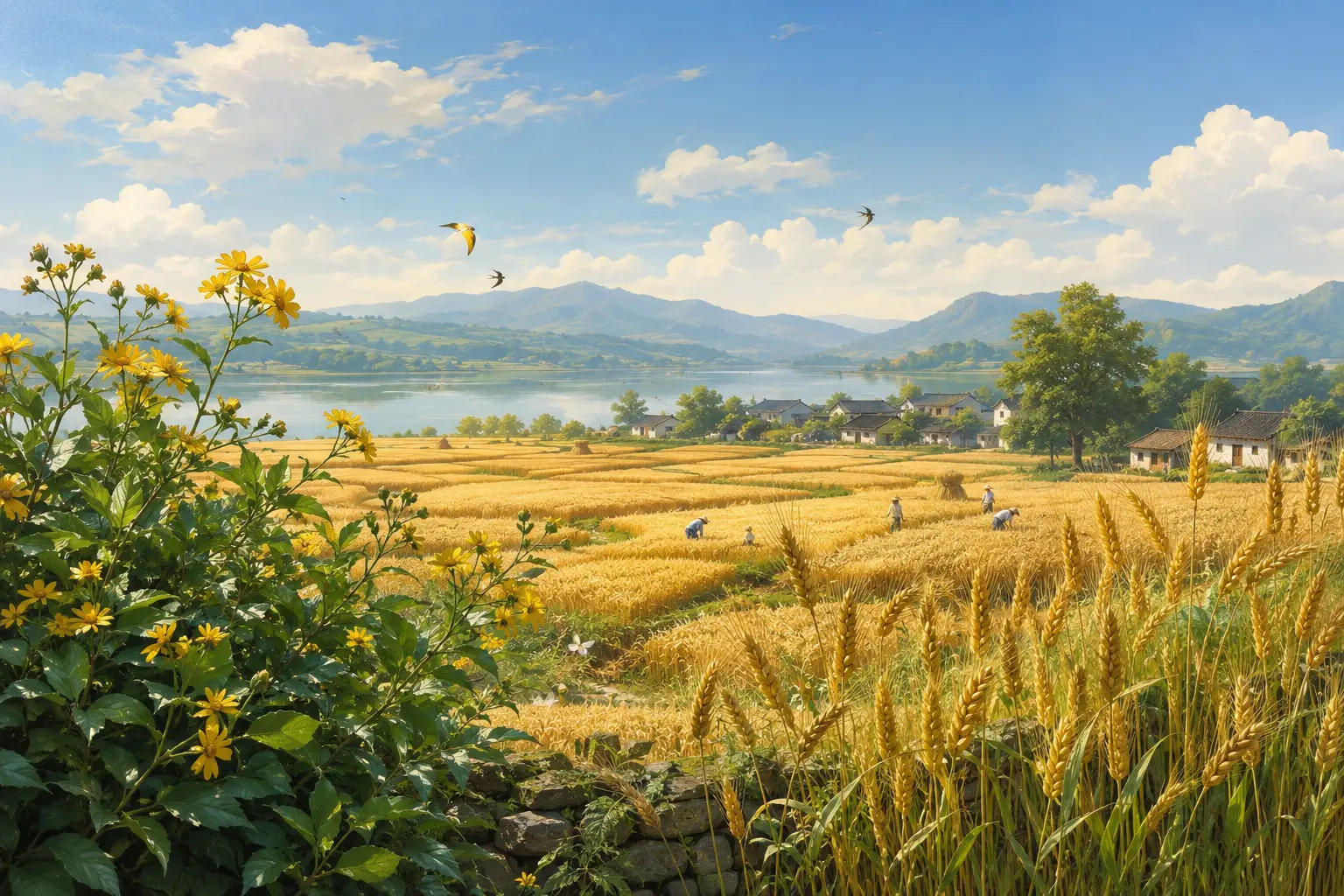
Poetry of Lesser Fullness takes “a modest degree of fullness” as its aesthetic core. Ouyang Xiu’s “最爱垄头麦,迎风笑落红” writes the rural delight of wheat just beginning to ripen; Yuan Zhen’s “小满气全时,田家私黍稷” records the diligence of agricultural work. Poets write of bitter herbs flourishing, shade-loving grasses withering, and the arrival of the wheat harvest, using their brush to capture the subtle changes of the three seasonal signs of Lesser Fullness. Its beauty lies in being almost full but not yet complete, perfectly measured—and the poets understood this deeply. In their writing, Lesser Fullness always leaves a lingering sense of space beyond the words.
Grain Buds Poetry
小满
Original Verse:
夜莺啼绿柳,皓月醒长空。
最爱垄头麦,迎风笑落红。
Modern Translation:
At night, orioles sing among the green willow branches, while a bright moon illuminates the vast sky. What I love most is the wheat along the field ridges, gently swaying in the wind as though laughing at the fallen spring blossoms.
Commentary:
This five-character quatrain captures the distinctive seasonal beauty of Lesser Fullness. The first two lines describe the night scene: “夜莺啼绿柳” appeals to hearing, while “皓月醒长空” appeals to sight. The character “醒” is especially vivid: the clear moonlight seems to awaken the entire sky from sleep. The final two lines mark the poem’s turn and elevation. “最爱垄头麦” directly expresses the poet’s feeling—rather than writing of flowers or moonlight, he chooses the wheat in the fields, revealing his attention to agricultural life. The final “迎风笑落红” is the poetic eye of the whole poem. The wheat is personified: the ears swaying in the wind become a smile, and what they smile at is the fallen “red” of spring blossoms. This smile carries deeper meaning. The fading of spring flowers need not be mourned, because summer wheat is growing vigorously; grains approaching fullness possess a vitality greater than that of fallen blossoms.
咏廿四气诗 · 小满四月中
Original Verse:
小满气全时,如何靡草衰。
田家私黍稷,方伯问蚕丝。
杏麦修镰钐,錋欔竖棘篱。
向来看苦菜,独秀也何为?
Modern Translation:
Lesser Fullness is the time when yang energy reaches abundance and the vital forces of Heaven and Earth are complete—why, then, do the shade-loving grasses begin to wither? Farming households concern themselves with millet and grain, while regional officials inquire after the silk harvest. As apricots ripen and wheat approaches harvest, sickles and other tools must be repaired and sharpened, while rough timber is raised to make thorn fences. Bitter herbs, long regarded as wild vegetables, now flourish alone—why should this be so?
Commentary:
Yuan Zhen structures this poem around questions and agricultural work, presenting the seasonal signs and everyday life of Lesser Fullness with precision and detail. The opening couplet begins with a question: “小满气全时” identifies Lesser Fullness as the moment when yang energy is at its fullest, while “如何靡草衰” introduces “靡草死”, one of the three seasonal signs of Lesser Fullness—the withering of shade-loving grasses when yang energy is at its height. The word “如何” reflects the poet’s contemplation of the waxing and waning of yin and yang. The second couplet, “田家私黍稷,方伯问蚕丝”, shows everyone attending to their proper concerns: farmers care for their crops, while officials inquire about silk production and taxation. The contrast between “私” and “问” conveys how, during Lesser Fullness, people at every level are occupied with the approaching summer harvest. The third couplet, “杏麦修镰钐”, directly records farm work: as apricots yellow and wheat ripens, sickles must be sharpened. The final “向来看苦菜,独秀也何为” corresponds to another seasonal sign, “苦菜秀”, the flourishing of bitter herbs. By asking why the plant alone thrives, the poem in fact affirms that everything in nature has its own proper season.
吴门竹枝词·小满
Original Verse:
调剂阴晴作好年,麦寒豆暖两周全。
枇杷黄后杨梅紫,正是农家小满天。
Modern Translation:
Heaven seems to balance cloudy and clear weather with perfect care, bringing about a prosperous year. Wheat prefers coolness and beans prefer warmth, and the needs of both are fully met. After loquats turn yellow, bayberries deepen to purple—this is precisely the season of Lesser Fullness that farming families value most.
Commentary:
This bamboo-branch song uses the bright, lively language of folk verse to express the joy of farming households during Lesser Fullness. “调剂阴晴作好年” personifies Heaven from the very beginning, as though it were carefully adjusting sunshine and rain to the right degree in order to produce a good harvest. “麦寒豆暖两周全” describes the different needs of crops: wheat benefits from cooler weather during grain filling, while beans prefer warmth. The weather of Lesser Fullness happens to satisfy both, and “两周全” expresses the farmers’ satisfaction with the season. The final two lines, “枇杷黄后杨梅紫”, mark the passage of time through changing fruit colors; yellow and purple set one another off vividly. The closing “正是农家小满天” ends with affirmation. “小满” is both the name of the solar term and a quiet expression of the farmer’s contentment with modest fullness—there is no need for complete fullness; Lesser Fullness is enough.
归田四时乐 · 其二(夏)
Original Verse:
南风原头吹百草,草木丛深茅舍小。
麦穗初齐稚子娇,桑叶正肥蚕食饱。
老翁但喜岁年熟,饷妇安知时节好。
野棠梨密啼晚莺,海石榴红啭山鸟。
田家此乐知者谁?我独知之归不早。
Modern Translation:
The south wind sweeps across the open fields and stirs the hundred grasses; among the dense vegetation, the thatched cottages seem small. The ears of wheat have just grown even, tender like young children, while the mulberry leaves are lush and the silkworms feed their fill. The old farmer cares only that the year may ripen into a good harvest; the woman bringing food to the fields scarcely notices how perfectly suited the season is. Evening orioles sing from the dense wild pear trees, while mountain birds call among the red pomegranate blossoms. Who truly understands the joy of farming life? I alone understand it—and regret that I returned to it too late.
Commentary:
This poem depicts rural life during Lesser Fullness with simple and natural brushwork. “南风原头吹百草” writes the broad south wind of early summer, while “草木丛深茅舍小” shows the quiet thatched cottages almost hidden within luxuriant vegetation. “麦穗初齐稚子娇” compares the newly even ears of wheat to tender children, capturing the fresh delicacy of wheat during grain filling; “桑叶正肥蚕食饱” writes the busy silkworm season, with plentiful mulberry leaves and well-fed silkworms. The middle couplet, “老翁但喜岁年熟”, writes the old farmer’s hope for a good harvest, while “饷妇安知时节好” shows the woman carrying food to the fields, too occupied with daily work to deliberately notice the beauty of the season. This very unawareness of beauty is precisely the most authentic state of rural life. The final “我独知之归不早” closes with reflection: the poet understands and envies the happiness of farming life, but regrets having returned to such a life too late.
晨征
Original Verse:
静观群动亦劳哉,岂独吾为旅食催。
鸡唱未圆天已晓,蛙鸣初散雨还来。
清和入序殊无暑,小满先时政有雷。
酒贱茶饶新而熟,不妨乘兴且徘徊。
Modern Translation:
Looking quietly around, I see that all living things are busy and laboring—am I really the only one driven onward by the need to make a living away from home? Before the cock has finished crowing, dawn has already broken; the frogs have barely fallen silent when the rain comes again. The season has entered a clear and mild phase, with no oppressive heat; before Lesser Fullness, thunder arrives at just the right time. Wine is inexpensive, tea plentiful, both fresh and ready to enjoy—there is no harm in following the mood and lingering along the way.
Commentary:
Gong Feng takes morning travel as the thread of the poem and records what he sees during Lesser Fullness. “静观群动亦劳哉” opens with a philosophical observation: all things labor, not only the traveler. “鸡唱未圆天已晓” conveys the quick pace of dawn, while “蛙鸣初散雨还来” captures the frequent rain and intermittent frog calls of the season. “清和入序殊无暑” describes the pleasant climate of Lesser Fullness—clear, mild, and not yet oppressively hot—while “小满先时政有雷” points to the thunder and rain that often accompany the period. The closing “酒贱茶饶新而熟,不妨乘兴且徘徊” returns to ease: wine is cheap and tea abundant, so there is no reason not to travel and enjoy oneself at leisure. Within the exertion of the journey, the poem discovers composure; within the natural signs of Lesser Fullness, it finds a poetic place of rest.
小满
Original Verse:
子规声里雨如烟,润逼红绡透客毡。
映水黄梅多半老,邻家蚕熟麦秋天。
Modern Translation:
Amid the calls of the cuckoo, fine rain hangs like smoke. The damp air presses into the red gauze and seeps through the traveler’s felt. Yellow plums reflected in the water are mostly ripe, while the neighboring household’s silkworms have matured and the wheat has reached its golden harvest season, like autumn arriving in summer.
Commentary:
This quatrain uses a thoroughly damp brush to depict the Jiangnan scenery of Lesser Fullness. “子规声里雨如烟” opens with the cry of the cuckoo and fine rain like smoke, creating the humid atmosphere typical of the season. The second line, “润逼红绡透客毡”, emphasizes the depth of that moisture: even red gauze and felt are soaked through. The characters “逼” and “透” convey the heaviness of the humidity, foreshadowing the approaching plum-rain season of Jiangnan. “映水黄梅多半老” shows yellow plums reflected in the water, most already mature, with yellow and green mingling in the scene; “邻家蚕熟麦秋天” writes of mature silkworms and wheat turning golden as though it were autumn. The phrase “麦秋天” compares the summer wheat harvest to autumn harvest time and expresses the seasonal sign “麦秋至”, one of the three phases associated with Lesser Fullness. Through moist visual, tactile, and sensory impressions, the poem writes the particular humidity and abundance of Jiangnan at this season.
Closing Note
Poetry of Lesser Fullness begins with a ridge of wheat. Ouyang Xiu writes “最爱垄头麦,迎风笑落红”—spring is fading, yet he feels no regret, because the wheat is filling with grain. He understands the beauty of Lesser Fullness: its beauty lies in being almost full, but not yet complete. Yuan Zhen looks further: “小满气全时,如何靡草衰。田家私黍稷,方伯问蚕丝.” He writes of the subtle contest between yin and yang at Lesser Fullness. Yang energy is abundant, shade-loving grasses begin to wither, farming families tend their millet and grains, and officials inquire about the silk harvest. Some things are growing, while others are dying. “向来看苦菜,独秀也何为” describes bitter herbs spreading everywhere, reminding people that in earlier times they had helped sustain lives through famine. The Song poet Gong Feng captures even finer sounds of the season: “鸡唱未圆天已晓,蛙鸣初散雨还来”—cockcrow, frog calls, and rain together form the soundscape of Lesser Fullness. The Ming poet Li Changqi writes “长是江南逢此日,满林烟雨熟枇杷”, while the Yuan poet Yuan Huai writes “子规声里雨如烟.” Each poet has his own Lesser Fullness.
From Ouyang Xiu’s “最爱垄头麦” to Yuan Zhen’s “小满气全时”, from Gong Feng’s “蛙鸣初散” to Li Changqi’s “满林烟雨”—poetry of Lesser Fullness writes of wheat, rain, loquats, and bitter herbs. Among the twenty-four solar terms there are Lesser Heat and Greater Heat, Lesser Snow and Greater Snow, Lesser Cold and Greater Cold, yet only Lesser Fullness has no Greater Fullness. This is not an omission in the calendar, but a deliberate space left open by the ancients. The poetry of Lesser Fullness is the wisdom that grows from that opening: the flowers need not all be open, nor the moon perfectly round; in life, the finest state is Lesser Fullness.
—-

Readers’ Comments
Calendar and traditional culture enthusiasts from around the world, sharing the same moon.
Sign in or register to join the conversation. Your comment account is created automatically the first time you use a connected account.
No comments yet
Share your thoughts with readers around the world.