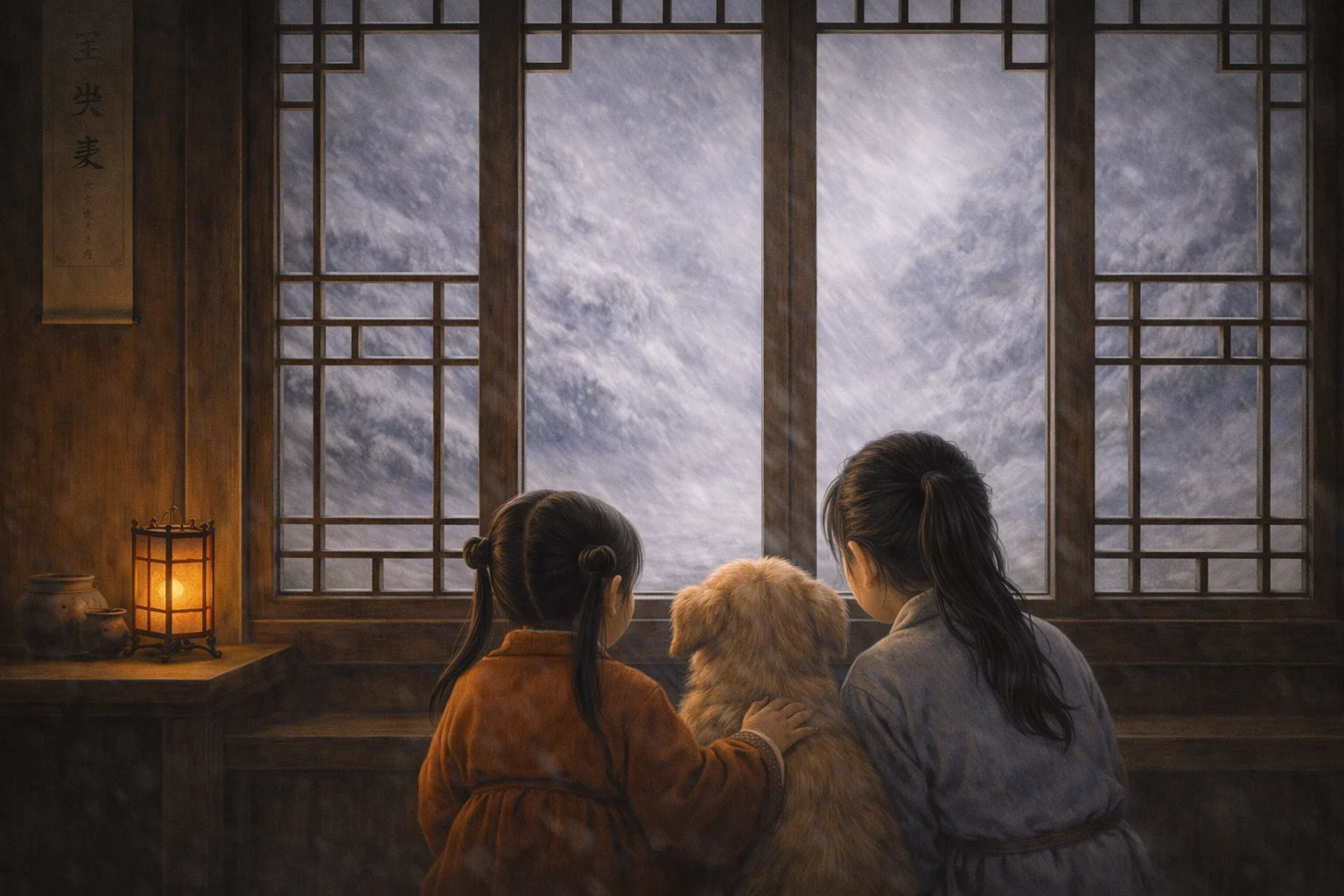
Major Snow Customs
「冬天进补,开春打虎」
The customs of Heavy Snow revolve around “storing” and “playing” — storing carries the wisdom of preserving all things to its fullest expression through curing meat and putting away winter vegetables, while playing transforms the bitter cold of deep winter into the pleasures of snow and ice: admiring the snow, playing on the ice, and delighting in the season. The core customs of Heavy Snow can be summarized in six characters: 腌、赏、滑、补、封、藏 — cure, admire, glide, nourish, freeze, and store. “Cure” refers to curing meat at Heavy Snow: households season pork, chicken, duck, fish, and other foods with salt, Sichuan peppercorns, star anise, and other spices, then hang them beneath the eaves to air-dry for the New Year. “Admire” means enjoying and playing in the snow: during Heavy Snow, the northern landscape is clothed in silver; scholars and refined gentlemen walk through the snow in search of plum blossoms or sit by the stove admiring the snowfall, while children build snowmen and have snowball fights. “Glide” refers to skating and ice play: once northern rivers freeze over, people ride ice sleds, spin ice tops, and play ice hockey on the frozen surface, making this some of the liveliest entertainment of winter. “Nourish” means nourishing the body during Heavy Snow. Folk tradition has the saying “冬天进补,开春打虎” — nourish yourself in winter, and by spring you will be strong enough to fight a tiger. At this time, the body’s yang qi is stored inward, making nourishment especially easy to absorb. “Freeze” refers to rivers sealing over: during Heavy Snow, northern rivers freeze, their icy surfaces becoming natural skating grounds and marking the arrival of severe winter. “Store” means the winter storage of all things: after Heavy Snow, Heaven and Earth enter a state of closure, people go out less, remain quietly at home, and enter the northern winter mode known as “maodong”, staying tucked away through the cold season.
Regional Customs of This Solar Term
| Region | Signature Customs | Notable Features |
|---|---|---|
| Nationwide, especially southern China | Curing meat at Heavy Snow | Households cure meat during Heavy Snow and hang it beneath the eaves to air-dry for the New Year |
| Northern China | Enjoying and playing in the snow: building snowmen and having snowball fights | During Heavy Snow, the landscape is often covered in white, and children build snowmen and throw snowballs |
| Northern China, including Beijing, Hebei, and the Northeast | Skating and ice play: ice sleds and ice tops | Frozen rivers form natural ice rinks; riding ice sleds and spinning ice tops are among the liveliest winter folk activities |
| Nationwide | Heavy Snow nourishment: eating mutton and drinking mutton soup | “冬天进补,开春打虎”; mutton, beef, goji berries, and other warming ingredients are commonly eaten |
| Northern Shandong | Drinking sweet-potato porridge | People in northern Shandong drink steaming sweet-potato porridge during Heavy Snow to warm the body and nourish the stomach |
| Taiwan | Snow-viewing and fishing | Snow is rare in Taiwan during Heavy Snow, while schools of mullet remain active along the southern coast and fishermen profit from the catch |
| Nationwide, especially among scholars and refined gentlemen | Walking through snow in search of plum blossoms; snow-viewing by the stove | Plum blossoms begin to open around Heavy Snow; scholars seek them in the snow or gather around the stove at night to admire the snow and compose verse |
Major Snow Customs
Walking Through Snow in Search of Plum Blossoms
Popular Regions:
Activities:
During Heavy Snow, plum blossoms begin to form buds and open. The plum is one of the “Three Friends of Winter” in Chinese culture and has long been admired for its character of standing proudly against frost and snow. When heavy snow falls, scholars and refined gentlemen put on thick clothing, take up walking staffs, and make their way through the snow to plum groves in search of the first blossoms. This is the cultured pastime known as “walking through snow in search of plum blossoms.” The delicate, secluded fragrance of the plum and the clear purity of snow set each other off, creating a winter scene filled with the distinctive atmosphere of Eastern aesthetics.
Walking through snow in search of plum blossoms is not merely flower-viewing but also a form of spiritual cultivation. In the bleakness of winter, when all things appear desolate, the plum blossoms in the cold without competing with other flowers for spring, embodying qualities of independence, resilience, and humility. By seeking plum blossoms in the snow, the ancients looked for signs of life amid severe cold and sensed beauty amid barrenness. This ability to discover and create beauty in adversity became an important spiritual quality of the Chinese literati. The Song poet Lu Meipo wrote: “梅须逊雪三分白,雪却输梅一段香。” — the plum must yield to snow in whiteness, yet snow falls short of the plum in fragrance — capturing perfectly the way snow and plum blossoms illuminate one another.
Historical Origins:
The custom of seeking plum blossoms in the snow can be traced back to the Wei and Jin periods and became an important pastime among scholars during the Tang and Song dynasties. The story of the Tang poet Meng Haoran seeking plum blossoms in the snow became widely known. According to tradition, he rode a donkey through heavy snow in search of plum blossoms and said: “吾诗思在灞桥风雪中驴背上” — my poetic inspiration lies on the back of a donkey amid wind and snow at Ba Bridge. During the Song dynasty, Lin Bu lived in seclusion on Solitary Hill by West Lake, planting plum trees and raising cranes. The famous image of “taking the plum as wife and the crane as child” closely linked plum blossoms with the ideals of reclusion and moral purity. By the Ming and Qing periods, seeking plum blossoms in the snow had expanded from a refined literary pleasure into ordinary life and became a seasonal winter fashion.
How to Take Part:
During Heavy Snow, visitors can seek plum blossoms in gardens across China. Plum Blossom Hill in Nanjing, Xiangxuehai in Suzhou, Chaoshan in Hangzhou, and Wuxi Plum Garden are all well-known destinations. Plum trees can also be grown in a courtyard or on a balcony at home, allowing one to enjoy their quiet elegance and fragrance in winter.
Recommended Places:

Heavy Snow Nourishment
Popular Regions:
Activities:
“冬天进补,开春打虎。” — nourish yourself in winter, and by spring you will be strong enough to fight a tiger. Heavy Snow is regarded as an ideal season for nourishment. After Heavy Snow, the weather becomes increasingly cold, while the body’s yang qi is stored within and yin qi flourishes outward; nourishment at this time is most readily absorbed by the body. Heavy Snow nourishment emphasizes warming foods, and common ingredients include mutton, beef, chicken, goji berries, red dates, and Chinese yam.
Different regions have their own characteristic forms of nourishment. In northern China, people favor mutton and mutton soup: copper-pot mutton hotpot, mutton stewed with radish, and mutton soup are all classic nourishing dishes. In Inner Mongolia, people simmer mutton into hand-held mutton, traditionally eaten with chive-flower sauce to preserve its original flavor. In Shandong and Hebei, mutton-offal soup is popular during Heavy Snow; after a steaming bowl, the whole body feels warm. In the Northeast, there have also been traditions of eating dog meat — increasingly uncommon in recent years — and venison as forms of game-based winter nourishment. Southern China offers an even wider variety: people in Guangdong favor slow-cooked nourishing soups made with black-bone chicken, codonopsis, astragalus, goji berries, and other ingredients; Fujian has the tradition of eating ginger duck; while Jiangsu and Zhejiang combine mutton with yellow rice wine. As the saying goes, “大雪补得当,一年不受寒。” — nourish yourself properly at Heavy Snow and you will not suffer from the cold all year. Heavy Snow nourishment is not only a bodily need but also an important ritual of winter life.
Historical Origins:
The custom of nourishing the body during Heavy Snow derives from the traditional Chinese medical theory of “winter storage.” The *Huangdi Neijing* states: “冬三月,此谓闭藏……早卧晚起,必待日光……去寒就温,无泄皮肤” — the three months of winter are called the season of closure and storage; go to bed early and rise late, waiting for sunlight; avoid the cold and seek warmth, and do not allow the skin to leak away its qi. This is an important principle of winter health preservation. The ancients believed that because yang qi was concealed within the body during winter, this was the best season for nourishment. Warming foods such as mutton and beef can nourish yang qi and resist cold, while goji berries and red dates can replenish qi and blood. The custom closely combines seasonal timing with traditional Chinese medical ideas of health preservation, embodying the wisdom of “correspondence between Heaven and humanity.”
How to Take Part:
During Heavy Snow, restaurants offer winter dishes such as mutton soup, lamb-spine hotpot, and mutton hotpot. Mutton dishes in Beijing, Inner Mongolia, Shandong, and other regions are especially classic. Warming soups can also be prepared at home with mutton or chicken together with goji berries, red dates, Chinese yam, and other ingredients, slowly simmered over low heat. Northern hotpot restaurants often offer special winter nourishment menus around Heavy Snow.
Recommended Places:
Skating and Ice Play
Popular Regions:
Activities:
During Heavy Snow, rivers across much of northern China begin to freeze. As the saying goes, “小雪封地,大雪封河” — Light Snow freezes the ground; Heavy Snow freezes the rivers. By the Heavy Snow solar term, the river ice has solidified, and people can freely enjoy skating and other ice games. Frozen rivers and lakes become natural ice rinks where people ride ice sleds, spin ice tops, and play ice hockey, creating some of the liveliest folk scenes of winter.
In northern China, skating and ice play are winter activities enjoyed by all ages. Children sit on simple ice sleds and push themselves across the ice with metal ice picks, while adults speed over the frozen surface wearing skates. Spinning ice tops, or *bingga*, is another classic northern winter game: a whip is used to strike the spinning top and keep it turning continuously on the ice. In some places, competitions are also held on frozen surfaces, including ice wrestling and ice archery, producing exceptionally lively scenes. Once the ice rinks at places such as Beihai Park, Shichahai, and the Summer Palace in Beijing open, visitors arrive in great numbers. During the Qing dynasty, ice play was even regarded as a national custom. The Qianlong Emperor personally inspected ice performances, and the scenes were preserved in the famous painting *Ice Games*.
Historical Origins:
Skating and ice play have a long history in northern China. Records of activities on ice among northern peoples already existed during the Song dynasty. Under the Yuan, Ming, and Qing dynasties, ice play flourished both at court and among ordinary people. During the Qing, it was listed among the “national customs.” Each winter, from the Winter Solstice through the coldest period known as *sanjiu*, grand ice ceremonies were held on Taiye Pond, now Beihai. The Qianlong Emperor repeatedly inspected these performances and ordered court painters to create the *Ice Games* painting, vividly recording performers dressed in different colors carrying out difficult feats such as archery, throwing forks, and lifting one another. Popular skating was freer in form: people skated, rode ice sleds, and spun ice tops on frozen rivers, finding a distinctive winter pleasure in the severe cold. The custom transformed harsh climatic conditions into a unique form of sport, expressing the wisdom of northern communities in adapting to and making use of nature.
How to Take Part:
After Heavy Snow, visitors can experience skating at ice rinks in major northern city parks. In Beijing, the ice rinks at Beihai Park, Shichahai, the Summer Palace, the Summer Palace, and Zizhuyuan Park open each winter and provide skate and ice-sled rentals. Ice sleds may also be used on safely frozen river surfaces, though safety must be observed and formal ice rinks should be chosen. Spinning an ice top can be done on ice or other hardened surfaces and is one of the least expensive winter games.
Recommended Places:
Curing Meat at Heavy Snow
Popular Regions:
Activities:
“小雪腌菜,大雪腌肉。” — pickle vegetables at Light Snow and cure meat at Heavy Snow. Once Heavy Snow arrives, households become busy preparing salted provisions. Whether poultry or pork, people process them through traditional methods into richly fragrant foods in preparation for the approaching New Year.
The process of curing meat at Heavy Snow is quite elaborate. Taking pork as an example, salt is fried in a pan together with Sichuan peppercorns, star anise, cinnamon, and other spices. Once the seasoned salt has cooled completely, it is rubbed over the inside and outside of fish, meat, and dressed poultry, again and again, until the flesh darkens from its fresh color and liquid begins to seep from the surface. The meat and remaining salt are then placed together in a jar, pressed down with stones, and stored in a cool, shaded place. After about half a month, the meat is removed and hung beneath sun-facing eaves to dry in preparation for the New Year. An old Nanjing saying goes: “大雪把肉腌,大年把嘴填。” — cure the meat at Heavy Snow, and fill the mouth at New Year. Cured pork, sausages, and salted fish hang beneath the eaves, their surfaces gleaming with oil in the winter sunlight, while their savory aroma announces that the year’s end is drawing near.
In Hunan, cured pork is slowly smoked with cypress branches, orange peel, and other materials, allowing the fragrance of meat and fruitwood to mingle into a distinctive flavor. In Guangdong, cured meats emphasize the clean sweetness of natural sun-drying: the seasoned meat is hung in a ventilated place so that the dry northern wind can gradually carry away its moisture. In Sichuan, chili and Sichuan peppercorns are added during curing to create a numbing and spicy flavor. These cured foods are not only central dishes on the New Year table but also the “taste of home” carried in the hearts of those living far away.
Historical Origins:
The custom of curing meat at Heavy Snow has ancient roots. Before refrigerators and other modern preservation methods existed, people discovered that salting, air-drying, and smoking could extend the storage life of meat. During Heavy Snow, temperatures drop sharply and the weather becomes dry, creating the ideal period in which cured meat is less likely to spoil. The custom closely combines seasonal timing with traditional food-processing techniques and represents the ancient wisdom of “following Heaven and responding to the proper time, and turning waste into treasure.” Nanjing has long had the tradition of curing meat at Heavy Snow: people seize this time to season pork, chicken, duck, fish, and other foods with salt, Sichuan peppercorns, and star anise before hanging them to dry for the New Year.
How to Take Part:
During Heavy Snow, scenes of meat curing can be observed throughout southern China: butcher shops echo with the sounds of meat being cut and bones being chopped while households prepare their cured foods. Nanjing, Hunan, Sichuan, and Guangdong each have distinctive styles. Southern households can also try curing meat at home by rubbing pork belly with toasted Sichuan-pepper salt, allowing it to cure, then air-drying it for several weeks before eating. Finished cured pork and sausages can also be purchased from markets.
Recommended Places:
Enjoying and Playing in the Snow
Popular Regions:
Activities:
During Heavy Snow, the northern landscape is often clothed in silver, making this an ideal time to admire and play in the snow. Falling snow turns mountains, trees, and houses white, leaving Heaven and Earth clear and pure. In Chinese culture, snow carries a deeply poetic aesthetic meaning: after snowfall, scholars and poets walk through snow in search of plum blossoms, warm wine, and compose verse, transforming the cold winter into one of the most elegant times of the year.
For ordinary people, snow is the most generous toy of winter. Children build snowmen and throw snowballs, their cheeks bright red with cold yet their faces filled with radiant smiles. Adults also leave their homes after a snowfall to photograph the scenery, walk through the snow, and listen to the crunching sound beneath their feet. The saying “瑞雪兆丰年” — auspicious snow foretells a good harvest — expresses why people welcome heavy snow: deep snow can protect winter wheat as it passes safely through the cold season, promising a plentiful harvest in the coming year. To the literati, heavy snow was a gift from Heaven and Earth to the land; to farmers, it was a guarantee of next year’s harvest.
Snowfall over Beijing’s Forbidden City is one of the classic scenes of winter appreciation. When drifting white snow settles over red walls and golden roofs, the solemnity of the ancient palaces and the purity of the snow illuminate one another, creating an image of consummate Eastern beauty. Snow in Jiangnan may not be as deep as in the north, yet the famous scene of “Lingering Snow on the Broken Bridge” has a charm of its own. “晚来天欲雪,能饮一杯无” — evening comes and snow is about to fall; will you drink a cup with me? Gathering around the stove on a snowy night and inviting friends to drink together became one of the most beautiful winter images in Chinese literary culture.
Historical Origins:
Snow-viewing has a long history in China. As early as the Wei and Jin periods, scholars had the custom of climbing mountains, visiting waterside places, and composing poetry after snowfall. The Tang poet Bai Juyi’s line “晚来天欲雪,能饮一杯无” inscribed the warmth of a snowy evening by the stove into Chinese cultural memory. From the Song dynasty onward, snow-viewing became an increasingly common theme of refined literary gatherings, while walking through snow in search of plum blossoms came to be regarded as one of the classic elegant pastimes of the literati. During the Ming and Qing dynasties, snow-viewing expanded beyond scholarly circles and became a winter pleasure shared by ordinary people. The custom perfectly combines natural scenery with human feeling, reflecting a Chinese aesthetic of living harmoniously with nature and seeking poetry within the natural world.
How to Take Part:
If snow falls during Heavy Snow, parks, courtyards, mountains, and open countryside all become places to enjoy it. The Forbidden City in Beijing, the Broken Bridge on West Lake in Hangzhou, and the Ming Xiaoling Mausoleum in Nanjing are classic snow-viewing destinations. At home, one can gather around the stove with tea and watch the snowfall through the window. Building snowmen, having snowball fights, and photographing snowy scenery are also ways to participate.
Recommended Places:
Drinking Sweet-Potato Porridge
Popular Regions:
Activities:
In northern Shandong there is a folk custom of drinking sweet-potato porridge during Heavy Snow. After Heavy Snow, temperatures become increasingly cold, and people pay close attention to keeping warm both indoors and outdoors, putting on winter clothing to avoid freezing and developing chilblains. A local saying goes: “碌碡顶了门,光喝红黏粥” — when the cold is such that the stone roller blocks the door, people stop visiting one another and stay home drinking hot sweet-potato porridge. Sweet-potato porridge is fragrant and naturally sweet, strengthens the spleen and nourishes the stomach, and on a cold Heavy Snow day provides both warmth and nourishment.
The preparation is simple and comforting: sweet potatoes are washed, peeled, and cut into small pieces, then slowly simmered together with millet or rice until the sweet potato softens and the grains bloom, producing a thick, sweet porridge. In farming households of northern Shandong, a steaming bowl of sweet-potato porridge on a Heavy Snow morning warms the body from stomach to heart and leaves people full of energy throughout the morning. Sweet potatoes are rich in dietary fiber and a variety of vitamins and can strengthen the spleen and stomach and replenish the center and qi, fitting the seasonal need for winter nourishment.
Historical Origins:
The custom of drinking sweet-potato porridge has long been practiced in northern Shandong. The cultivation of sweet potatoes in China can be traced back to the Wanli reign of the Ming dynasty, when Fujian merchants introduced them from the Philippines. Sweet potatoes are drought-resistant, high-yielding, and highly adaptable and quickly spread across the country. Winters in northern Shandong are long and cold, while sweet potatoes store well, making them an important winter food. Drinking sweet-potato porridge during Heavy Snow was both a response to severe cold and an expression of the simple dietary wisdom of farming communities.
How to Take Part:
During Heavy Snow, sweet-potato porridge can be tasted in farming households of northern Shandong or easily prepared at home by simmering chopped sweet potato with millet or rice over low heat until thick. Sweet potatoes and millet are readily available in supermarkets, making this a simple custom to experience.
Recommended Places:
River Freeze-Up
Popular Regions:
Activities:
“小雪封地,大雪封河。” — Light Snow freezes the ground; Heavy Snow freezes the rivers. By the Heavy Snow solar term, temperatures across much of northern China fall below freezing and rivers and lakes begin to ice over. Frozen surfaces shine silver-white in the sunlight, creating a distinctive winter landscape. People leave their homes and go to the riverbanks to watch the dramatic process of freeze-up: the ice slowly advances from the banks toward the center until the entire river is sealed, as though flowing water itself had been frozen by time. Once the river is sealed, the ice becomes a natural skating ground, providing safe spaces for skating, ice sleds, and other activities. Folk tradition says: “大雪河封住,冬至不行船” — at Heavy Snow the river freezes, and by the Winter Solstice boats no longer travel. Watching the river freeze and looking forward to skating is a distinctive seasonal experience of the northern winter.
Historical Origins:
The phenological observation that “rivers freeze at Heavy Snow” has existed in northern China for thousands of years. The Yellow River, in the Yellow River basin where the Twenty-Four Solar Terms originated, enters its freezing period around Heavy Snow, and through long observation the ancients summarized this climatic pattern. River freeze-up was not merely a natural phenomenon; it had profound effects on ancient transportation and everyday life. When rivers froze, water transport stopped and people turned instead to overland routes and travel across the ice.
How to Take Part:
After Heavy Snow, frozen rivers and lakes in northern China can be observed from their banks. Shichahai, Houhai, and Kunming Lake at the Summer Palace in Beijing offer impressive winter scenery after freeze-up. Skating, ice sleds, and similar activities can be enjoyed on safe ice surfaces, but formal ice rinks should always be chosen and the safety and thickness of the ice carefully observed.
Recommended Places:
Ice Games
Popular Regions:
Activities:
Ice games were among the most representative winter entertainments of ancient northern China. Records of activities on ice among northern peoples already existed during the Song dynasty. By the Qing dynasty, ice games had been listed among the “national customs,” and every year between the Winter Solstice and the coldest days of winter, grand ice ceremonies were held on Taiye Pond, now Beihai. The Qianlong Emperor personally inspected ice games on many occasions and ordered court painters to create the famous *Ice Games* painting, which has survived to the present. The work depicts performers dressed in many colors carrying out difficult feats such as archery, throwing forks, and lifting one another.
Among ordinary people, ice entertainment took even more varied forms. Ice sledding was especially popular with children: simple wooden-board sleds fitted with two ice picks raced across the frozen surface. Spinning ice tops, or *bingga*, was enjoyed by young and old alike: a whip was used to strike the top and keep it spinning continuously across the ice. Ice wrestling, ice races, tug-of-war on ice, and other competitions were also frequently held on frozen rivers. In recent years, winter recreation has become even more varied, with new activities such as ice bicycles, ice go-karts, and ice slides adding new vitality to traditional ice play. Harbin Ice and Snow World and the Shichahai Ice Rink have become famous winter tourism attractions in China and abroad.
Historical Origins:
The tradition of ice games has deep roots in northern China. According to the *History of Song · Treatise on Ritual*, records of ice activities already existed during the Song dynasty. During the Yuan, such activities became even more widespread among ordinary people. Under the Qing, ice games were formally incorporated into state institutions and became an important winter activity at court. The Qianlong Emperor wrote the “Rhapsody on Ice Games,” vividly describing their grandeur. The custom transformed the severe northern climate into a distinctive form of sport and cultural spectacle, embodying the Chinese wisdom of finding enjoyment amid hardship.
How to Take Part:
After Heavy Snow, visitors can experience ice activities at rinks in Beihai Park, Shichahai, the Summer Palace, and other sites in Beijing. Harbin Ice and Snow World and ice rinks on the Songhua River in Jilin are also popular destinations. Ice rinks provide skates and sleds for rental. First-time skaters may prefer an ice sled or ice bicycle, which are relatively safe and easy to learn.
Recommended Places:
“Maodong” — Staying Tucked Away Through Winter
Popular Regions:
Activities:
“Maodong” is a distinctive northern way of life during winter. After Heavy Snow, the weather becomes bitterly cold, snow and ice cover the landscape, and most work in the fields comes to an end. People begin going out less and remain at home to “maodong.” The term vividly describes people curling up in warm houses like cats and passing the long winter indoors. Yet *maodong* does not mean doing nothing: women sit on heated *kang* beds doing needlework, stitching shoe soles, and embroidering; men repair farming tools and weave baskets; children play knucklebones and tell stories on the *kang*. Neighbors visit one another and gather around the stove to chat, creating warm moments throughout the winter.
Historical Origins:
The custom of *maodong* arose from the cold climate of northern China and the traditional agricultural way of life. In farming societies dependent on the weather, winter was the only true agricultural off-season. People used this period to rest, recover, and store physical strength, while maintaining emotional bonds within families and neighborhoods through everyday interaction. The custom reflects a distinctive form of northern wisdom shaped by severe cold: “responding to movement with stillness and making defense one’s strategy,” protecting oneself in the coldest season through the warmest way of living.
How to Take Part:
After Heavy Snow, weekends can be spent going out less, gathering around the stove at home for tea, and spending time with family to experience the ease of *maodong*. Friends and relatives can also be invited over for conversation, recreating the warmth of this northern winter custom.
Recommended Places:
Closing Note
The customs of Heavy Snow arose from the collective ways in which the ancients responded to severe cold with abundant food and solemn ritual at a time when “the sense of snow had grown deep.” Heavy Snow is the third solar term of winter. As the old explanation says, “大者,盛也,至此而雪盛也” — *da* means abundance; by this point, snowfall has become abundant. Midwinter formally begins, and Heaven and Earth are clothed in silver. Unlike Light Snow, when the first snowfall is approaching but has not yet fully arrived, Heavy Snow has entered a true “realm of snow.” In the bleakness of winter, people long all the more for warmth, and these customs are like clusters of firelight illuminating the most tender side of Chinese winter life.
Over the centuries, Heavy Snow accumulated traditions such as curing meat, seasonal nourishment, snow-viewing, and watching rivers freeze. “小雪腌菜,大雪腌肉” — pickle vegetables at Light Snow and cure meat at Heavy Snow — because Heavy Snow is precisely the ideal season for preparing salted provisions. The custom of winter nourishment also reaches a high point at this time, expressed in the saying “冬天进补,开春打虎” — nourish yourself in winter, and by spring you will be strong enough to fight a tiger. Admiring and playing in the snow are among the most poetic activities of Heavy Snow, for the purity and stillness of snowy landscapes always awaken a sense of poetry. Frozen rivers bring the northern world the magnificent scene of “千里冰封,万里雪飘” — a thousand *li* sealed in ice, ten thousand *li* filled with drifting snow — while also providing a natural stage for activities on ice.
When cured meat beneath the eaves takes on a rich fragrance in the cold winter wind, and when the first heavy snowfall covers Heaven and Earth in a single expanse of white, the customs of Heavy Snow become more than simply a point deep within winter. They express a Chinese aesthetic of life in which, even during the coldest season, people continue to live with poetry and abundance.
—-
Readers’ Comments
Calendar and traditional culture enthusiasts from around the world, sharing the same moon.
Sign in or register to join the conversation. Your comment account is created automatically the first time you use a connected account.
No comments yet
Share your thoughts with readers around the world.