
TigerFolklore
「 虎威镇宅舍,百邪尽退藏。 」
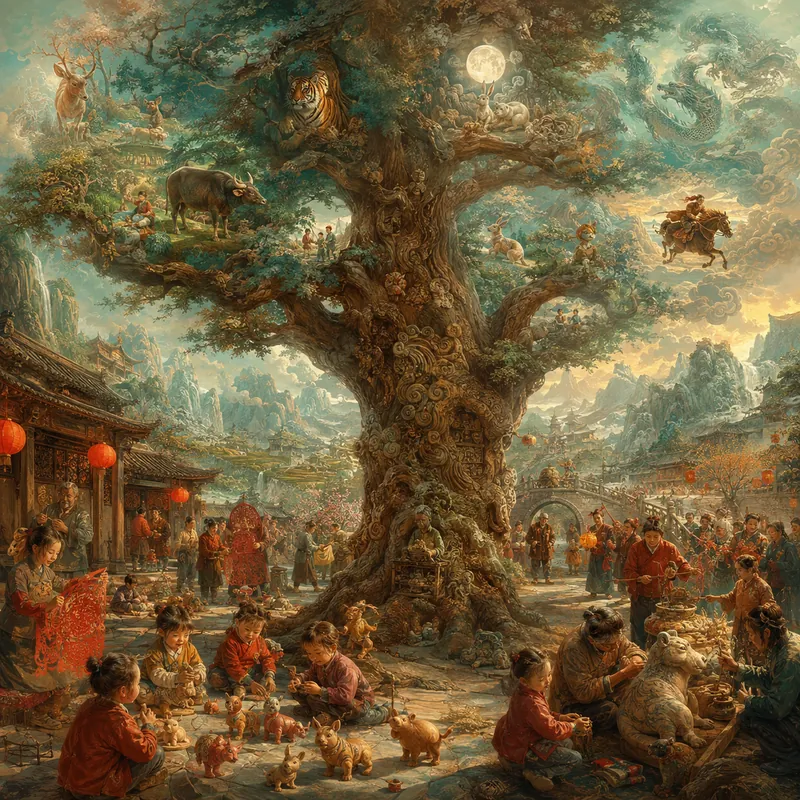
Seasonal Festivals and Calendrical Customs
The tiger plays multiple roles in traditional seasonal life—both as a guardian that drives away evil and pestilence and as an auspicious presence that welcomes renewal and blessing.
Yi Tiger Festival — The Tiger Dance
The Yi Tiger Festival is one of the most complete surviving ritual festivals centered on tiger totem worship and has been inscribed as a national-level item of intangible cultural heritage.
Time and Place
It is held every year from the eighth to the fifteenth day of the first lunar month among the A-luo branch of the Yi people in the Faqiao area of Shuangbai County, Chuxiong Prefecture, Yunnan Province. The festival lasts eight days.
Festival Sequence
The central ritual sequence consists of four stages: receiving the tiger, dancing the tiger, worshipping the tiger, and sending the tiger away.
Cultural Meaning
The Yi call themselves Luoluo, and luo in Yi means “tiger.” Men may refer to themselves as Luopo, meaning male tiger, while women may be called Luoluomo, meaning female tiger. In Yi cosmology, the tiger is regarded as the ancestor of all things in the world. The Tiger Festival is therefore not merely a celebration, but a living continuation of an ancient tiger-centered cultural tradition.
Receiving the Tiger Spirit
on the eighth day of the first lunar month, a Bimo, or Yi ritual specialist, presides over divination and selects eight to fifteen young and middle-aged men from the village to form the tiger-dance group.
Transforming into Tigers
the selected men remove their upper garments and bind black felt around their bodies to resemble tiger skins. Exposed areas of the body are painted with tiger markings, transforming the participants visually into tigers.
Tiger Dancing
from the eighth through the fifteenth day, one additional “tiger” joins the dance each day, reaching a climax when eight tigers perform together. The repertoire is highly varied. Agricultural dances reproduce actions such as ploughing, sowing, weeding, harvesting, and threshing; fertility dances include “tiger kissing,” “tiger mating,” and “tiger guarding the egg”; daily-life dances include “tiger building a bridge” and “tiger building a house.”
Expelling Evil
the tiger-dance group visits households, dancing to drive away harmful influences and to pray for good fortune.
Sending Away the Tiger Spirit
on the fifteenth day of the first lunar month, the tiger spirit is ceremonially returned to the mountains and the festival comes to an end.
Tu Wutu — The Wutu Dance
Wutu (wū tú) is an ancient Chinese term for tiger, recorded in classical sources including the Zuo Zhuan and later dictionaries. The Wutu Dance preserved among the Tu people of Nianduhu Village in Tongren County, Qinghai Province, is regarded as an ancient cultural survival of exceptional vitality.
Time and Place
It is held each year from the fifth to the twentieth day of the eleventh lunar month in Nianduhu Village, Tongren County, Huangnan Tibetan Autonomous Prefecture, Qinghai Province. The twentieth day of the eleventh lunar month is the central ritual date and is known as the “Black Day.” Local Tu communities traditionally regard it as an inauspicious day on which demons and malevolent spirits emerge to cause disturbance.
Ritual Sequence
Cultural Origins
Scholars have proposed multiple explanations for the origins of the Wutu custom. The most influential is the Chu-culture tiger-totem theory, which holds that wutu was an ancient Chu term for tiger and that the Wutu Dance of Nianduhu Village preserves cultural elements dating back to the Spring and Autumn period. For this reason, the village has also become an important field site for anthropological research.
Body Painting and Preparation
men from village households go to the mountain-god temple to burn incense offerings and bow in worship. Seven Wutu participants strip to the waist, roll up their trouser legs, cover their bodies with incense ash, and paint tiger and leopard markings across the torso and legs in ink. Two senior Wutu are painted with tiger patterns, while five junior Wutu bear leopard markings.
Performing the Wutu Dance
after the ritual begins, the Wutu, driven onward by a ritual specialist, dance, run wildly, climb over walls, and move from house to house in order to drive away demons.
Expelling Disease and Evil
prayers for peace are recited, humans and spirits are ritually entertained together, and harmful influences and epidemics are expelled.
Tiger-God Worship in Northeast China
In Northeast China, mountain systems such as the Greater and Lesser Khingan ranges and the Changbai Mountains extend across a vast region historically rich in wildlife. The tiger became an object of worship, reverence, and fear among peoples including the Hezhen, Korean, Manchu, Mongol, and Oroqen communities.
Hezhen people: the Hezhen traditionally uphold an animistic worldview and revere the tiger as a divine being, commonly addressing it as the “Lord of the Mountain.” If a tiger is encountered while hunting, one should retreat and yield; hunting a tiger is itself a taboo.
Korean communities in China: the tiger is regarded as an embodiment of the mountain deity and a protector of the people. In Korean shamanic traditions, many shamans hang Images of the Mountain God or Images of the Tiger God in ritual halls or place them at mountain altars. Around the nineteenth century, a popular New Year picture known as the Tiger and Magpie Picture became widespread and was pasted on household doors on the first day of the lunar year as a prayer for peace.
Tiger Days and Tiger Months
Among some ethnic groups, the tiger also carries calendrical significance. The Yi place the tiger at the head of the calendrical sequence and use it in systems for reckoning years, months, days, and hours. Among Yi communities in Nanjian Yi Autonomous County, a Mother Tiger and Twelve Animals Dance is performed every three years on the first Tiger Day of the first lunar month, itself regarded as a Tiger Month.
Folk Belief
Tiger worship is one of China’s oldest forms of folk belief. Its origins may be traced to prehistoric tribal totemism; during the Shang and Zhou periods it entered the decorative vocabulary of ritual bronzes, and by the Han dynasty it had been incorporated into Daoist divine systems and zodiac culture.
Tiger Totemism and Tiger-Ancestor Worship
Origins of the Tiger Totem
The tiger became one of China’s totemic animals at a very early date. Tiger motifs already appear on jade cong associated with the Neolithic Liangzhu culture and on Shang bronzes. Tiger worship can be traced back to ancient tribal totemism. In early Chinese conceptions, the tiger was revered as an all-powerful guardian deity, protecting the gates of Heaven as well as the human realm.
Legends of Tiger Ancestors
Many peoples in China historically regarded the tiger as a creator deity and as an ancestral source of human reproduction. Different forms of tiger worship may be found among Tibetans, Koreans, Mongols, Manchus, Bai, Lahu, Tujia, Naxi, and other groups.
Tiger Totems in Everyday Life
Among many Yi communities, tiger imagery appears throughout daily life. Gourds painted with tiger heads may hang above doorways; stone tigers may guard entrances; children wear tiger-head hats, elderly people wear tiger-head shoes, women embroider tiger heads on waist garments, and clothing often features tiger-pattern decoration.
Yi
the tiger is regarded as the ancestor of all things in the world.
Hezhen
the tiger is called the “Old Ancestor,” and one traditional account holds that the people descended from the child of a Hezhen woman and a tiger.
Lahu
the Lahu have described themselves as a people who “hunt tigers.” One legend tells that in ancient times nine brothers captured a tiger, roasted and ate its flesh, and from this event derived the group name.
Bai and Tujia
both preserve traditions of White Tiger totem worship.
White Tiger Worship and the Four Symbols
By the Han dynasty, the White Tiger had taken shape as both the king of beasts and the sacred guardian of the West. In the ancient Chinese system of the Four Symbols, the White Tiger is one of four great divine creatures alongside the Azure Dragon, Vermilion Bird, and Black Tortoise. The Azure Dragon guards the East and corresponds to spring and Wood; the Vermilion Bird guards the South and corresponds to summer and Fire; the White Tiger guards the West and corresponds to autumn and Metal; the Black Tortoise guards the North and corresponds to winter and Water.
Within this system, the White Tiger represents the West, autumn, Metal, warfare, punishment, and military force. After the Han dynasty, it was incorporated into Daoist divine traditions as a sacred creature capable of driving away evil and offering protection. The tiger also came to be treated as a guardian deity of the western direction, and people believed it could ward off three major household disasters—fire, theft, and evil influences.
The Tiger as an Agricultural Guardian Deity
The tiger was not only regarded as a protector of the four directions, but also as an agricultural guardian deity. The Book of Rites records: “They welcome the tiger because it eats the wild boars of the fields; therefore they welcome and sacrifice to it.” The idea was that tigers protected crops by hunting wild boars that damaged farmland.
During the Western Zhou period, year-end sacrificial rites to the myriad beings included offerings to tigers. Each year in the twelfth lunar month, the Zhou king conducted the Zha sacrifice, also called the Luo sacrifice. Since luo means tiger in Yi, the rite has also been interpreted as a sacrificial tradition connected with a tiger deity.
The Tiger as a Yang Creature and Expeller of Evil
The Han scholar Ying Shao wrote in the Fengsu Tongyi: “The tiger is a Yang creature, chief of the hundred beasts; it can seize, strike down, break sharp forces, and devour ghosts and demons.” The tiger was therefore regarded as a creature filled with Yang energy, capable of overpowering Yin forces and malevolent spirits.
Tiger images were often hung on walls facing directly toward the main entrance so that evil spirits, frightened by the tiger’s presence, would not dare enter.
Tiger Worship Among Ethnic Minorities
Southwestern ethnic groups: Yi, Naxi, Lahu, Lisu, Hani, Nu, Achang, Tujia, Bai, Pumi, and other peoples preserve traditions of tiger reverence. Historically, many groups speaking Yi-related languages maintained early religious forms centered on tiger worship. Tiger reverence was also widespread among groups historically associated with the Di-Qiang cultural sphere.
The Nanzhao kingdom: during the Tang dynasty, the Nanzhao royal house decorated clothing with tiger skin. In 794, when Tang Emperor Dezong formally invested Yimouxun as king of Nanzhao, Yimouxun came out to receive the Tang envoys wearing “golden armor and draped in tiger skin.” Nanzhao sources called the tiger boluo, a Chinese transcription of a pronunciation associated with ancestors of the Yi.
Tujia people: White Tiger symbolism appears throughout everyday Tujia life. During weddings, for example, a tiger-skin rug may be spread across the large square table in the main hall of the groom’s family, symbolizing reverence for the tiger ancestor.
Auspicious Meanings
Within Chinese auspicious culture, the word “tiger” is associated through popular phonetic play with “good fortune” and “wealth,” giving tiger imagery additional meanings of blessing, prosperity, and favorable destiny.
Auspicious Expressions for the Year of the Tiger
Tiger years are especially rich in auspicious phrases:
The Tiger’s Power to Ward Off Evil and Invite Blessings
In folk belief, the tiger is regarded as an extraordinarily powerful animal capable of warding off three great household disasters: fire, theft, and evil influences. Tiger paintings may be hung on walls directly facing the entrance so that demons, frightened by the image, dare not enter.
Later customs developed in which children wear tiger-head hats and tiger-head shoes to repel evil. Some people also sleep on tiger-head pillows in the hope of strengthening the body.
Auspicious Symbolism of the Tiger
The tiger has long been revered among Han communities as a symbol of justice, courage, and majesty. Popular customs such as painting tigers to suppress evil, praying to tigers for children, and wearing tiger symbols for protection all demonstrate the vitality of tiger culture.
Tiger imagery appears throughout daily life: people sleep on tiger pillows, wear tiger shoes, place tiger hats on children, and dress infants in tiger-bib garments, hoping to borrow the tiger’s divine power to ward off evil, avert disaster, guard the home, and attract blessings.
Folk Art
The tiger is one of the most common subjects in Chinese folk art. From New Year pictures to papercuts, from cloth tigers to clay tiger toys, its image appears both majestic and endearing.
Tigers in New Year Pictures
The Divine Tiger Guarding the Home
The Yangjiabu New Year picture tradition of Weifang, Shandong, is one of China’s most famous centers of woodblock New Year prints. Among its best-known tiger subjects is The Divine Tiger Guarding the Home.
In the image, a fierce tiger guards a treasure basin, symbolizing the protection and accumulation of wealth. A seal reads “Divine Tiger of Mount Tai,” while an inscription praises the tiger’s might. In folk belief, the picture could protect the household, expel evil, and preserve family peace, which is why such prints were widely displayed during the Spring Festival.
The Yangjiabu area also preserves an amusing local explanation. Many print-shop owners bore the surname Yang, which is homophonically associated with yang, “sheep.” Since a sheep encountering a tiger evokes the phrase “a sheep entering the tiger’s mouth,” printmakers regarded the association as inauspicious and therefore paid particular attention to how tigers were represented.
The Tiger in the Mountain Forest
Yangjiabu woodblock printing also includes the subject Tiger in the Mountain Forest. The image is dominated by yellow, with red decorative markings across the tiger’s body. The tiger is shown descending the mountain, massive in form, tail lifted high, fangs fully exposed, and carrying the overwhelming authority of a beast that commands the forest.
In folk belief, the descending tiger is especially powerful and capable of guarding the household.
Wu Song Fights the Tiger
Another popular Yangjiabu theme is Wu Song Fights the Tiger. In such woodblock images, the tiger is rendered as fierce and imposing, emphasizing its power to overawe all directions and its inviolable majesty.
Tigers in Papercutting
In folk papercutting, tigers are often playful, lively, agile, and animated, expressing auspiciousness and intimacy with human life rather than raw danger.
In the Jiaodong region, one protective papercut known as “The Dragon Gives Birth, the Tiger Nurses, and the Eagle Builds the Shelter” depicts a smiling tiger with lowered tail and hidden claws, expressing maternal tenderness. Beneath its belly, a child lies on its back suckling from the tiger.
Here, the tiger becomes a mother to humankind. Folk tradition connects the motif with the birth legend of Xiang Yu, the Hegemon-King of Western Chu, who was said to have been abandoned after birth and nourished by a tiger. The image carries the auspicious wish that “a tiger-like son will arise in the family.”
Cloth Tigers
The cloth tiger is one of the most classic tiger-shaped folk toys in China and is found throughout the country.
Functions of the Cloth Tiger
Its principal functions are warding off evil and disaster, bringing peace, and inviting auspicious fortune. People sew tiger figures from cloth and may fill them with peachwood shavings and other materials to create “obedient tigers,” hoping children will grow up healthy and brave like the tiger and remain protected throughout life.
A folk rhyme says, “Grandmother gives the hat; aunt gives the shoes.” When a child reaches the traditional hundred-day milestone, elder relatives may present cloth tigers, tiger-head shoes, or tiger-head hats in order to invite good fortune and keep misfortune away.
Regional Styles of Cloth Tigers
Cloth tigers vary widely by region. In Shandong and Henan, their eyebrows are often shaped like two mugwort leaves. In Huaiyang, Henan, embroidered tiger-head shoe designs may feature paired birds and paired fish, symbolizing the union of male and female and the continuation of new life.
In Fengxiang, Shaanxi, paired fish are concealed within the vivid colors and ornamentation of the tiger’s brows. In Yuncheng, the cloth fish-tail tiger combines tiger and fish forms: the body and tail incorporate fish imagery, and large fish embroidered on each side connect and intersect at the tail.
Tiger-Head Shoes and Tiger-Head Hats
Tiger-head shoes and tiger-head hats are among the most distinctive forms of children’s dress in Chinese folk culture.
Tiger-head shoes: shoes are stitched in the form of a tiger’s head so that a child may wear footwear with tiger eyes from infancy. This carries the wish that the child will walk the proper and favorable path throughout life. Since the tiger is king of the beasts, elders often place tiger-head shoes on children around one year of age, believing the shoes can ward off evil and preserve peace, protecting healthy growth.
Tiger-head hats: these hats are elaborate in form, rich in color, and filled with auspicious symbolism. Shaped like a tiger’s head, they express the wish that children will become brave and formidable, like warriors wearing tiger-headed armor.
Tiger-head hats are believed not only to drive away evil and guard the household, but also to bless children with a strong, vigorous appearance and a long life. Tiger-head shoes and hats are often worn together. A folk custom also distinguishes red for boys and green for girls, carrying wishes that sons will “become dragons” and daughters “become phoenixes.”
Clay Roaring Tigers and Tiger-Shaped Toys
The clay roaring tiger is a traditional folk toy from Gaomi, Shandong. A tiger is molded from clay and hollowed inside; the front and rear sections are joined with parchment. When pushed and pulled, it produces a distinctive croaking sound.
In village lanes, children wearing tiger-head hats and tiger-head shoes may carry clay roaring tigers while singing and dancing. Other forms include large roaring tigers and seated clay tigers. Tiger-shaped toys across China differ in material, form, and color, but commonly embody wishes for descendants, peace, and health.
Taboos and Ritual Remedies
Although the tiger is an auspicious creature, its immense power has also produced many taboos concerning both tigers and people born under the Tiger sign.
Taboos Concerning Tiger-Sign People
Wedding and funeral taboos: in some folk traditions, because the tiger is the king of beasts and can harm people, those born under the Tiger sign—especially women—may traditionally misreport their age when arranging marriage, concealing their zodiac sign in order to avoid the tiger association.
During wedding ceremonies, Tiger-sign people may also be discouraged from watching, because the tiger is believed not only to injure others but also to have unfavorable associations with fertility. It was feared that this might affect the bride’s ability to bear children.
Tiger-sign people may also be forbidden from entering the bridal chamber casually during another person’s wedding, lest they bring the “White Tiger Sha” to the bride. They may likewise be discouraged from entering birthing rooms, for fear of disturbing the fetal deity or affecting pregnancy.
Special roles in rituals for suppressing harmful forces: despite such taboos, Tiger-sign people are indispensable in certain contexts. During rituals intended to suppress, escort away, or break harmful influences, people born in the Dragon or Tiger years may be invited to assist, since their powerful spiritual presence is believed to help divine forces remove evil beings and restore local peace. In such contexts, the tiger’s fierce energy is treated as a positive force.
Zodiac clashes: in traditional compatibility culture, Tiger-sign people are often advised against pairing with the Snake or Monkey, with the warning that marital conflict and sorrow may follow. The Horse and Dog, by contrast, are regarded as favorable matches, traditionally associated with blessing, harmony, prosperity, and domestic peace.
Taboos of One’s Zodiac Year
People born under the Tiger sign observe a number of traditional precautions during their benmingnian, or zodiac birth year:
Taboos Concerning Tiger Years
Among Han people and some other groups, certain zodiac years were traditionally subject to special taboos, especially Dragon and Tiger years, because dragons and tigers were regarded as fierce beings capable of harming people.
A Tiger year, or Yin year, could therefore be viewed as inauspicious, and there were traditions claiming that those born in such years might encounter poor fortune or possess an unusually fierce temperament.
Folk Rituals for Repelling Tigers and Harmful Forces
During the Han dynasty, tiger images were painted on doors to ward off evil and guard the household. Tiger door gods were used to invite blessings and repel harmful influences, while tiger paintings were hung facing the entrance so that demons would be too frightened to enter.
During the Dragon Boat Festival, children may wear vests embroidered with the Five Poisons, arranged with the five poisonous creatures surrounding a tiger at the center. The tiger is believed to drive the poisons away. Tiger images used on this day are known as “Mugwort Tigers,” because mugwort itself is traditionally associated with expelling evil.
Folk Language and Sayings
The tiger has left an exceptionally rich imprint on Chinese popular language. Unlike the overwhelmingly negative language surrounding the rat, or the mostly positive language surrounding the ox, tiger expressions are shaped by both reverence and ferocity. They can praise majesty and courage while also emphasizing danger and fear.
Tigers in Idioms
Positive expressions, emphasizing courage and power:
Negative or cautionary expressions, emphasizing danger:
Neutral expressions:
Tiger Proverbs
Many tiger-related proverbs circulate in folk culture:
Tiger Xiehouyu
Tiger-related xiehouyu—two-part folk sayings—are vivid, humorous, and memorable.
Expressing courage and majesty:
Expressing danger and fear:
Mocking fake or blustering tigers:
Reflecting tiger habits:
Tigers in Riddles
The tiger is also a common subject in folk riddles.
A riddle reading “A newborn calf is not afraid of a tiger” asks for two names from Water Margin: Tong Wei and Tong Meng.
A riddle reading “Guessing lantern riddles” asks for a nickname from Water Margin: The Tiger-Fighting General.
Another riddle says:
“Clothed in yellow fur, hidden deep in mountain forests; one roar shakes Heaven and Earth, and among the hundred beasts it is called king.”
The answer is: the tiger.
Folk Judgments of Tiger-Sign Personalities
In folk zodiac personality culture, Tiger-sign people are traditionally described in distinctive terms.
Positive evaluations: courageous and decisive, strong in leadership, confident and expansive, deeply concerned with justice, and full of boldness.
Negative evaluations: quick-tempered, autocratic, and insufficiently tactful.
A folk verse says:
“The Yin Tiger’s mighty name shakes the four directions; Who among the hundred beasts can rival the king? A life of boldness and lofty ambition, Wealth and honor descend as if bestowed by Heaven.”
Tigers and Children’s Folk Customs
Within the world of children, the tiger is one of the most important guardian figures, and tiger imagery appears almost everywhere.
Tigers in Children’s Rhymes
A folk rhyme titled Little Monkey Child, Don’t Cry says:
“Little monkey child, do not cry; I’ll buy you a cloth tiger. Hold it and play by day; At night it scares away the ‘Mahu.’”
Ordinary people regarded the tiger as a guardian spirit of children.
Another rhyme, Going Up the Mountain to Fight the Tiger, begins:
“One, two, three, four, five, Up the mountain to fight the tiger; The tiger isn’t found, Instead we meet…”
This modern children’s rhyme was created by children’s writer Gao Hongbo and illustrator Zhu Chengliang. The picture book tells of a young boy wearing a tiger-head hat and tiger-head boots who climbs a mountain to fight a tiger, encountering along the way a little frog, a white rabbit, a chubby pig, a monkey, a squirrel, and other animals. The story uses a nursery-rhyme structure with a repeating duple rhythm, making it easy to recite aloud.
Tiger-year children’s songs also include lines such as:
“In the Year of the Tiger, be a little tiger; Put on tiger clothes, Come to Tiger Mountain and beat the great drum…”
Tigers in Children’s Games
In traditional children’s games, the tiger is a common role:
Tiger-Head Shoes and Hats in Children’s Customs
As noted above, tiger-head shoes and tiger-head hats are among the most important protective garments for children. During the Spring Festival, Lantern Festival, and special milestones such as a newborn’s third-day washing ritual, hundred-day celebration, and first birthday, families may dress children in tiger-head shoes, tiger-head hats, and place them on tiger-head pillows.
Many children’s rhymes concerning tiger-head shoes continue to circulate today.
Tiger Toys
The cloth tiger is the most classic tiger toy for children. During the Spring Festival, Lantern Festival, and milestones such as the third-day washing ritual, hundred-day celebration, and first birthday, it serves both as a gift and play companion for new life and as a festive decoration for the New Year season.
Tigers in Literature and Art
The tiger has left an exceptionally rich imprint on the history of Chinese literature and art. From the Book of Songs to Tang poetry and Song lyrics, from traditional tiger painting to the celebrated modern works of Zhang Shanzi, the tiger has taken on many cultural forms in the hands of writers and artists.
Tigers in the Book of Songs
Several poems in the Book of Songs mention the tiger and represent some of the earliest layers of tiger imagery in Chinese literature.
In “Xiangbo” from the Xiaoya:
“Take those slanderers and cast them to the jackals and tigers. If jackals and tigers will not eat them, cast them to the North.”
The verse imagines slanderers thrown to wild beasts.
In “Hanyi” from the Daya:
“How delightful is the land of Han; Its rivers and marshes are broad, Its bream and silver carp abundant, Its deer numerous; There are bears and great bears, There are wildcats and tigers.”
The poem describes the rich natural abundance of the Han region.
In “Panshui” from the Lu Song:
“The Pan Palace has been built, And the Huai Yi submit. Mighty tiger-like ministers Present severed ears at Pan.”
Here, “tiger ministers” serves as a metaphor for courageous military commanders.
Tiger Poetry Through the Ages
Tiger imagery appears throughout the enormous corpus of Chinese poetry. From the Book of Songs onward, the tiger became an image rich in cultural meaning.
Wei, Jin, and Northern and Southern Dynasties: the Southern Dynasties poet Xie Huilian wrote:
“The fierce tiger hides in the deep mountains; Its long roar raises the wind.”
Tang dynasty: Cen Shen wrote of transforming violent customs and driving away fierce tigers. Du Fu, in Qianxing, used wild-animal imagery to reinforce scenes of desolation.
Song dynasty: Fan Chengda wrote of tigers and rats in relation to human affairs; Chen Shidao used the expression that “many mouths cannot make a tiger” in reflections on reputation and recommendation; Deng Lin, in a tiger painting poem, praised the beast’s saw-like teeth, hooked claws, and mountain-shaking roar.
Ming dynasty: Wang Guangyang, in Painting a Tiger, wrote that “the tiger is honored among the hundred beasts, and none dares provoke its anger.” The Chan master Hanshan wrote of a tiger’s long roar shaking empty mountains and forest trees.
Qing dynasty: Zhao Yi wrote of fractured cliffs, tangled vines, old trees with cracked bark, and tigers rubbing against them.
Tiger Painting Through the Ages
Countless works in meticulous painting, freehand ink painting, lacquer painting, and other media have taken the tiger as their subject. Many painters throughout Chinese history were especially fond of painting tigers.
Zhang Shanzi and Zhang Daqian — Modern Masters of Tiger Painting
Zhang Shanzi (1882–1940), given name Ze, courtesy name Shanzi, sobriquet “Tiger Maniac,” was from Neijiang, Sichuan, and was the elder brother of Zhang Daqian.
Throughout his life, he loved tigers, kept tigers, and painted tigers. In order to observe tiger behavior more closely, Zhang Shanzi once kept a tiger at the Master of the Nets Garden, allowing him to study and sketch the animal at close range.
His painted tigers were exceptionally detailed and vivid. Lin Yutang praised them, saying that every muscle, ridge, shoulder, and claw was filled with energy and rendered with extraordinary truthfulness.
Zhang Shanzi later traveled with 180 works jointly painted with Zhang Daqian to France and the United States for charity exhibitions and sales. French President Albert Lebrun personally attended one exhibition and praised Zhang Shanzi as a “representative of modern Eastern art.”
Zhang Shanzi also once used twelve romantic lines from The Romance of the Western Chamber as themes for twelve tiger paintings, collectively titled The Twelve Beauties, using them satirically to comment on worldly affairs. The series became widely known.
Zhang Daqian often painted together with his elder brother. Zhang Shanzi would paint the tigers, while Zhang Daqian added the surrounding scenery. In collaborative works such as Tigers Roaring in Pine Winds and A Group of Tigers Roaring in the Valley, Zhang Shanzi’s mountain tigers appear in many forms—running through streams, leaping, sleeping, playing, and roaring—each rendered vividly.
Noted tiger painters through history: Tang Yin, also known as Tang Bohu, carried the character “tiger” in his name and was also skilled at painting tigers; the brothers Zhang Shanzi and Zhang Daqian became two of the best-known modern masters associated with tiger painting.
Tigers in Classical Fiction
The tiger in Water Margin: the most famous tiger episode is Wu Song Fights the Tiger. At Jingyang Ridge, Wu Song kills a fierce tiger barehanded, creating one of the great heroic legends of Chinese literature.
Another episode is Li Kui Kills the Tigers, in which Li Kui kills four tigers to avenge his mother. In Water Margin, “fighting the tiger” becomes a mark of heroic identity and a folk expression of the idea that human courage can overcome even the tiger.
The tiger in Journey to the West: the novel includes Immortal Tiger Power, one of the three Daoist masters of the Kingdom of Cart Slow, who competes with Sun Wukong in magical contests and prayers for rain before ultimately being defeated.
Tang Sanzang also encounters General Yin, a tiger spirit, during his pilgrimage. Tigers in Journey to the West often appear as demons, though they may also appear positively as mounts or sacred creatures.
Literary Allusions in Tiger-Related Folk Language
The allusion of “fighting tigers”: during the Eastern Han dynasty, Zong Jun of Nanyang served as administrator of Jiujiang, a region troubled by tiger attacks. Zong Jun believed that the harm caused by tigers reflected the cruelty of corrupt officials, arguing that government should “dismiss the corrupt and greedy and promote the loyal and good.”
After he removed traps and reduced taxes, tiger attacks in Jiujiang reportedly ceased. By directly linking “fighting tigers” with combating corrupt officials, this story may represent one of the earliest cultural precedents for the expression.
Final Reflections
Yin Tiger folk culture is one of the most powerful and protective chapters in the folk traditions of the Chinese zodiac. People’s attitude toward the tiger combines reverence with intimacy: they fear the majesty of the king of beasts, yet at the same time draw upon the tiger’s Yang power to drive away every form of evil.
The tiger is not only a symbol of courage, justice, and majesty, but is also revered as an agricultural guardian deity, protector of children, and guardian of the household. From the Yi people’s Tiger Dance rituals to the Tu people’s Wutu ceremonies of expelling evil, from tiger-ancestor worship among ethnic groups of Southwest China to White Tiger belief within the Han system of the Four Symbols, the cultural traces of the tiger extend across every corner of the Chinese cultural world.
From the Tiger Dance to the Wutu Dance, from the Divine Tiger Guarding the Home New Year print to the cloth tiger toy, from tiger-head shoes and hats to the nursery rhyme “One, two, three, four, five, up the mountain to fight the tiger,” tiger customs appear across nearly every domain of folk culture: seasonal festivals, folk belief, auspicious symbolism, folk art, taboos and ritual remedies, and children’s traditions.
The tiger is both a deity to be worshipped and a companion to be loved. This unique emotion—“revered like a god, loved like a friend”—is perhaps the most captivating feature of Yin Tiger folk culture.
The roots of this distinctive emotional relationship lie in the tiger’s dual identity within Chinese culture. In official and cosmological traditions, the tiger is one of the Four Symbols, guardian of the West, and an emblem of military authority. In folk culture, it becomes a protector of children, guardian of the household, and embodiment of good fortune.
From the boldness of “radiating tiger-like might” to the affection of describing a child as “tiger-headed and tiger-brained,” from the courage of “knowing there is a tiger on the mountain and still going toward it” to the awe contained in “a tiger’s backside cannot be touched,” the tiger refracts a brilliant spectrum of meanings through the lens of folk culture.
Though the Yin Tiger stands only third in the zodiac, it carries some of the deepest Chinese cultural aspirations toward strength, courage, justice, and protection. With a single long roar, it seems to guard the spiritual frontier of Chinese civilization.
----
[Language: es]
Readers’ Comments
Calendar and traditional culture enthusiasts from around the world, sharing the same moon.
Sign in or register to join the conversation. Your comment account is created automatically the first time you use a connected account.
No comments yet
Share your thoughts with readers around the world.