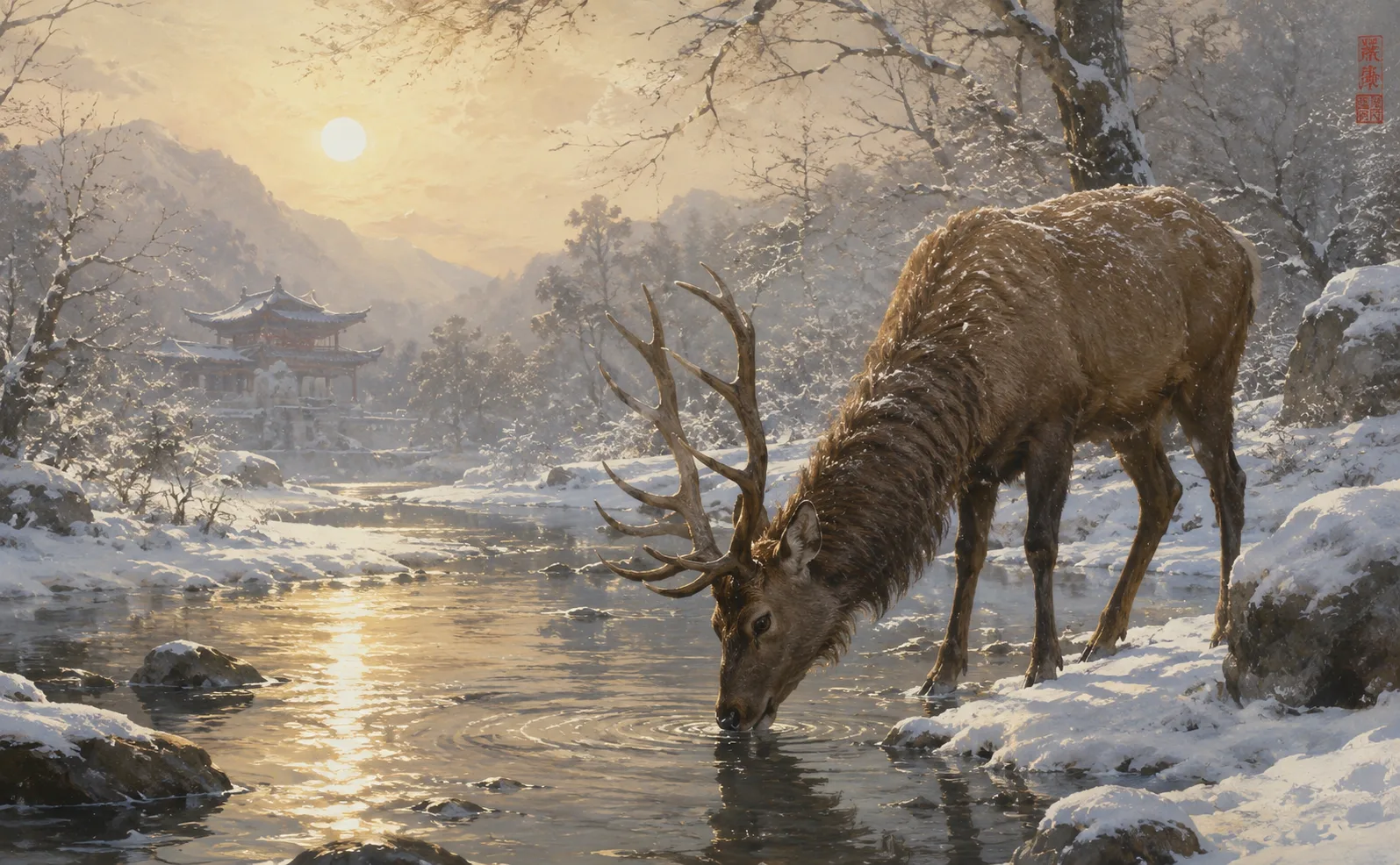
Winter Solstice Food
「冬至大如年。(民间谚语)」
The Winter Solstice was the earliest of the Twenty-Four Solar Terms to be established. As early as the Spring and Autumn period, people used the *tugui*, an ancient gnomon, to observe the sun and determine the date of the Winter Solstice. On this day, the sun shines directly over the Tropic of Capricorn, giving the Northern Hemisphere its shortest day and longest night of the year. From this point onward, daylight gradually lengthens and yang qi begins to rise again, hence the saying “冬至一阳生.” In ancient China, the Winter Solstice was an extremely important festival, and folk tradition held that “冬至大如年”—the Winter Solstice was as important as the New Year. Ancient people regarded it as a crucial point in the transformation of yin and yang and as an auspicious day; throughout successive dynasties, grand ceremonies of sacrifice to Heaven were held at this time. Among ordinary people, those living away from home were expected to return for the Winter Festival, so that “at the end of the year, one has a place to return to.” Winter Solstice food customs revolve around two main themes—bidding farewell to the old and welcoming the new, and warming nourishment to support yang. In the north, people eat dumplings; in the south, tangyuan. Elsewhere, the seasonal table blossoms into countless regional traditions—wontons, mutton soup, red bean glutinous rice, Winter Solstice noodles, seasonal wine, glutinous rice, nian gao, and more. Every dish carries the solemnity and warmth contained in the saying “冬至大如年.”
Regional Foods of This Solar Term
| Region | Signature Foods | Notable Features |
|---|---|---|
| Northern China | Dumplings — “冬至不端饺子碗,冻掉耳朵没人管” | |
| Jiangnan and South China | Tangyuan — “吃了汤圆大一岁” | |
| Tengzhou, Shandong | Mutton soup | |
| Sichuan | Mutton soup — Jianyang mutton soup | |
| Jiangnan | Red bean glutinous rice — to ward off the plague spirit | |
| Anhui | Winter Solstice noodles — “吃了冬至面,一天长一线” | |
| Beijing | Wontons, shuan yangrou | |
| Suzhou, Jiangsu | Winter Solstice Wine — osmanthus rice wine | |
| Hakka regions | Glutinous rice — “冬至大过年” | |
| Hangzhou and Ningbo, Zhejiang | Nian gao | |
| Shanghai | Tangyuan — fresh-pork filling | |
| Ningbo | Tangyuan — lard and black sesame filling | |
| Chaoshan | Ya Mu Nian · Chaoshan Glutinous Rice Balls | |
| Fuzhou | 搓圆 — unfilled tangyuan cooked in brown sugar and ginger soup | |
| Taiwan | 冬节圆 — red and white varieties |
Winter SolsticeFood
Dumplings
Historical Origins:
“冬至不端饺子碗,冻掉耳朵没人管。” Eating dumplings at the Winter Solstice is one of the most deeply rooted food customs of northern China. The connection between dumplings and the “Medical Sage” Zhang Zhongjing has already been discussed in detail in the section on the Beginning of Winter. At the Winter Solstice, however, dumplings carry even deeper meanings. “冬至大如年”: their shape resembles ancient silver ingots, symbolizing wealth and good fortune; moreover, the word “饺” echoes “交”, meaning “to meet” or “to cross.” The Winter Solstice is a moment of “交子”—a crossing not only between seasons, but also between yin and yang—making dumplings especially rich in ritual meaning at this time.
The folk custom of eating dumplings at the Winter Solstice originated in the Han dynasty, flourished during the Tang and Song dynasties, and has continued to the present day. Eating dumplings is not merely a way of commemorating Zhang Zhongjing, but also a ritual of “岁时交子”, the crossing of the annual cycle. After the Winter Solstice, each day grows longer, yang qi begins to rise, and the yang energy of Heaven and Earth gradually awakens and strengthens, marking the beginning of the next cycle. It is therefore regarded as a highly auspicious day.
Regional Evolution:
Dumplings take on different flavors across northern China. People in Beijing favor pork-and-cabbage fillings, with thin wrappers and generous centers; people in the Northeast prefer pickled-cabbage fillings, tart and appetizing; Shandong is known for Spanish mackerel fillings, prized for their freshness; Henan favors mutton fillings for warmth and resistance to cold; and Shaanxi is fond of beef with yellow chives. Dipping sauces also vary from place to place—people in Shanxi prefer aged vinegar, Beijing favors Laba garlic, while the Northeast often serves dumplings with garlic paste and soy sauce.
Cultural Meaning:
Dumplings carry the dual meanings of bidding farewell to the old and welcoming the new, and dispelling cold while praying for blessings. First, “交子之时.” The Winter Solstice is the day with the shortest daylight and longest night; afterward, yang gradually increases and yin gradually declines, just as the 《易经》 says, “冬至一阳生.” The word “饺子” echoes “交子”, perfectly matching this moment of transition. Second, rolling wealth. Dumplings resemble ancient ingots and therefore symbolize prosperity and good fortune. Third, remembrance of the Medical Sage. The story of Zhang Zhongjing’s “祛寒娇耳汤” has been passed down through generations as an enduring remembrance of the great physician. In the hearts of northern Chinese, a plate of Winter Solstice dumplings carries warmth in each bite and a thousand years of memory in every swallow.
Tangyuan
Historical Origins:
“家家捣米做汤圆,知是明朝冬至天。” In southern China, eating tangyuan is one of the grandest Winter Solstice food customs. Tangyuan is an essential food of the festival, and folk tradition holds that “吃了汤圆大一岁”—after eating tangyuan, one becomes a year older. By the Ming and Qing dynasties, eating tangyuan at the Winter Solstice had already become a widespread custom in Jiangnan. People ground glutinous rice into flour and shaped it into round foods known as “冬至团”, symbolizing reunion and completeness.
Tangyuan occupies an irreplaceable place in Winter Solstice food culture. In old Shanghai, eating tangyuan was taken particularly seriously, as the verse says: “家家捣米做汤圆,知是明朝冬至天。” In Fujian, on the night before the Winter Solstice, the whole family gathers to roll “冬节圆”, which are cooked and eaten the following morning. In Taiwan, glutinous rice flour is used to make “冬节圆” as offerings to the ancestors; afterward, the whole family sits together to eat tangyuan, a custom known as “添岁”, adding a year to one’s age.
Regional Evolution:
Tangyuan varies greatly across southern China. Ningbo tangyuan is best known for its lard-and-black-sesame filling, with thin skins, generous centers, and sweetness without heaviness. Shanghai favors fresh-pork tangyuan, savory and rich. In Chaoshan, people make “鸭母捻”, oval-shaped filled dumplings cooked together with white fungus and lotus seeds. In Fuzhou, people make “搓圆”, small unfilled balls of glutinous rice flour simmered in brown sugar and ginger soup. In Taiwan, “冬节圆” comes in red and white, with or without fillings; once cooked, it is first offered to the ancestors and then eaten by the family.
Cultural Meaning:
Tangyuan carries the dual meanings of reunion and completeness, and adding a year while welcoming the new. First, family reunion. The round form of tangyuan symbolizes family togetherness, harmony, and fulfillment. Second, becoming one year older. Folk tradition says “吃了汤圆大一岁”; eating this bowl of tangyuan formally marks the passing into another year of life. A single soft, glutinous, sweet tangyuan is the southern Chinese answer to the solemn meaning of “冬至大如年.”
Mutton Soup
Historical Origins:
“冬至吃羊肉,暖和一冬天。” At the Winter Solstice, the weather enters its coldest phase, and many parts of China observe the custom of eating mutton and drinking mutton soup. The Winter Solstice is the day when yin qi reaches its greatest strength, yet it is also the beginning of “冬至一阳生”, when yang first begins to emerge. At this moment of newly arising yang, warming nourishment is considered especially important. Mutton is warm in nature and is regarded as especially suitable for warming and nourishing kidney yang, dispelling cold, and warming the body.
In Tengzhou, Shandong, drinking mutton soup at the Winter Solstice is an unwavering tradition. Local people believe that mutton warms the center, replenishes deficiency, and strengthens qi; a steaming bowl of mutton soup on this day is said to keep one from fearing the cold all winter. People in Sichuan also value mutton soup at the Winter Solstice, and Jianyang mutton soup is famous far beyond the region. In many northern areas, simmering a pot of mutton soup and gathering around it as a family is one of winter’s warmest rituals.
Cultural Meaning:
Mutton soup embodies the health wisdom of warming nourishment to support yang and dispelling cold to warm the body. The Winter Solstice is the turning point at which yin reaches its extreme and begins to decline, while yang first starts to arise. Eating warming foods such as mutton at this time is believed to help the body pass smoothly through this crucial stage of “一阳初生.” A bowl of piping-hot mutton soup, warming the body from the tongue to the toes, is the most tangible warmth of the Winter Solstice.
Red Bean Glutinous Rice
Historical Origins:
In the water towns of Jiangnan, there is a custom of gathering the whole family together on the night of the Winter Solstice to eat red bean glutinous rice. According to legend, a man of the Gonggong clan had an unworthy son who committed many evil deeds. He died on the day of the Winter Solstice and afterward became a plague spirit, continuing to harm the people. This plague spirit, however, was said to fear red beans above all else. People therefore began cooking and eating red bean glutinous rice on the Winter Solstice to drive away the plague spirit, ward off disaster, and prevent illness.
Cultural Meaning:
Red bean glutinous rice carries the ancient belief in warding off evil and epidemics while praying for safety and blessing. In ancient thought, the red color of the beans was believed to possess the power to repel evil, while the sticky quality of glutinous rice symbolized “sticking” harmful forces in place so that they could no longer cause trouble. A bowl of red bean glutinous rice, red and white, soft, glutinous, and sweet, is both a seasonal Winter Solstice dish and a profound prayer for health and peace.
Winter Solstice Noodles
Historical Origins:
In Anhui and other regions, the custom of eating noodles at the Winter Solstice has a long history. Folk tradition says, “吃了冬至面,一天长一线”. After the Winter Solstice, daylight gradually lengthens; “一天长一线” means that each day becomes longer by roughly the time it would take to measure the length of a sewing thread. Noodles also evoke the image of length, echoing the seasonal extension of daylight while expressing the simple wish for a long life. In the bitter winter cold, when dripping water freezes into ice, only after eating a bowl of steaming egg noodles does it truly feel as though one has observed the Winter Solstice.
Cultural Meaning:
Winter Solstice noodles carry the deeper meaning of perceiving the passage of the seasons and praying for longevity. “一天长一线” is not only a description of growing daylight, but also a poetic perception of time itself. A bowl of Winter Solstice noodles is more than a meal—it is a direct experience of the natural law expressed in “冬至一阳生.”
Wontons
Historical Origins:
In Beijing, Jiangsu, and other regions, there is a custom of eating wontons at the Winter Solstice. Several explanations exist for the origin of this custom. One story says that during the Han dynasty, the northern Xiongnu frequently harassed the frontier, leaving the people in distress. Among the Xiongnu were two especially cruel leaders from the Hun and Tun clans. The people hated them deeply, so they wrapped meat filling in small pieces of dough, took the sounds “浑” and “屯”, and called the food “馄饨”. They ate them in hatred of the two leaders and prayed for the fighting to end so that peaceful life might return. Because the first wontons were said to have been made on the Winter Solstice, households later came to eat them on this day.
Another explanation is more philosophical. “馄饨” echoes “混沌”, primordial chaos. Eating wontons at the Winter Solstice therefore symbolizes breaking through chaos and opening Heaven and Earth, suggesting that at this moment when yin and yang exchange places, everything begins anew.
Cultural Meaning:
Wontons carry the dual meanings of ending warfare and praying for peace, and breaking chaos to welcome renewal and good fortune. A bowl of wontons thus contains both the weight of history and the height of philosophical imagination. At the Winter Solstice, when Heaven and Earth seem to begin anew, biting into a wonton becomes a symbolic breaking of chaos itself, opening the next cycle of the four seasons.
Winter Solstice Wine
Historical Origins:
In Suzhou, drinking “冬酿酒” on Winter Solstice night is one of the most distinctive local food customs. Winter Solstice Wine is a rice wine brewed with osmanthus, giving it a pleasing fragrance and a sweet taste. Suzhou has long had the saying, “冬至不喝冬酿酒是要冻一夜的”. Winter Solstice Wine not only warms the body and dispels the cold, but is also an indispensable drink on the Suzhou Winter Solstice table. In earlier times, it was brewed each year before the Winter Solstice and opened for drinking on the day itself, hence the name “冬酿酒.”
Preparation:
Winter Solstice Wine is made from glutinous rice fermented with a wine starter, then infused with osmanthus harvested in autumn. The resulting wine is pale yellow, rich in osmanthus fragrance, relatively low in alcohol, and sweet and mellow in taste, making it suitable for both young and old.
Cultural Meaning:
Winter Solstice Wine carries the refined pleasure of dispelling the cold, warming the body, and welcoming winter with elegance. A cup of golden, translucent wine, its osmanthus fragrance floating above the surface and its flavor sweet and mellow, is Suzhou’s most graceful way of greeting the Winter Solstice. In the damp cold of a Jiangnan winter, a warm cup of this wine is one of the gentlest forms of comfort.
Glutinous Rice
Historical Origins:
In Hakka regions, there is a custom of eating glutinous rice at the Winter Solstice. Hakka people regard the Winter Solstice as one of the most important solar terms of the year and have the saying “冬至大过年”. On this day, families cook a fragrant pot of glutinous rice with cured pork, Chinese sausage, mushrooms, dried shrimp, and other ingredients. Its rich aroma carries the wish that the coming year will be prosperous and fulfilled.
Glutinous rice is also believed to have a “补冬”, or winter-nourishing, effect. It is considered warm in nature and traditionally associated with warming the stomach, strengthening the spleen, and replenishing qi, making it especially suitable for the cold winter season. In parts of Guangdong, eating glutinous rice at the Winter Solstice is also customary, where it is known as “冬节饭.” People believe that after eating Winter Solstice glutinous rice, the body will remain warm throughout the winter.
Cultural Meaning:
Glutinous rice carries the auspicious meaning of warming and nourishing the body while welcoming winter in abundance. The savory fragrance of cured pork and sausage blends into the soft, glutinous rice, making every mouthful a solid taste of winter abundance. A bowl of glutinous rice is the Hakka people’s most solemn response to the saying “冬至大过年.”
Nian Gao
Historical Origins:
In Hangzhou, Ningbo, and other parts of Zhejiang, there is a custom of eating nian gao at the Winter Solstice. Nian gao is a seasonal winter food of Jiangnan, made by steaming a mixture of glutinous rice flour and japonica rice flour. Soft and glutinous in texture, it can be stir-fried, boiled, pan-fried, or deep-fried in many different ways.
Eating nian gao at the Winter Solstice draws on the homophony between “年糕” and “年高”, expressing wishes for rising higher year after year and for everything to go well. From the Winter Solstice through the New Year, nian gao remains a presence on the winter table.
Cultural Meaning:
Nian gao carries the auspicious wish of rising higher year after year. Because “年糕” sounds like “年高”, eating it at the Winter Solstice expresses the hope that life in the coming year will continue to rise step by step and grow ever better. A piece of soft, glutinous nian gao is one of Jiangnan’s sweetest Winter Solstice blessings.
Evolution of Food Customs
Looking across the development of Winter Solstice food customs, a clear progression can be traced:
Welcoming Winter and Sacrificing to Heaven (Zhou to Han Dynasties) → During the Zhou dynasty, the Winter Solstice was treated as the beginning of the year, and the Son of Heaven led his ministers in sacrifices to Heaven and prayers for blessings. After the Han dynasty, the Winter Solstice became an important festival, and official “贺冬” ceremonies were held.
The Custom of “As Important as the New Year” (Tang–Song Periods) → During the Tang and Song dynasties, the Winter Solstice became a festival comparable in importance to the Spring Festival. Those living away from home were expected to return for the Winter Festival, so that “at the end of the year, one has a place to return to.” The saying “冬至大如年” became widely known.
Food Customs Take Shape (Ming–Qing Periods) → The broad pattern of eating dumplings in the north and tangyuan in the south became established. Regional Winter Solstice food customs took on more fixed forms during this period and were passed down from generation to generation.
Moving with the Times (Contemporary Period) → Winter Solstice food traditions continue to evolve while being preserved. Dumpling fillings have become more varied, tangyuan now appear in many different forms, and Winter Solstice Wine has entered the modern consumer market. Ancient customs have taken on new vitality in the present age.
Throughout this evolution, dumplings and tangyuan have remained the two most representative protagonists of Winter Solstice food culture in north and south. In the north, a plate of dumplings welcomes the Winter Solstice; in the south, a bowl of tangyuan celebrates reunion. North and south, savory and sweet, together form the clearest taste memories of the season. This development reflects the deep-rooted Chinese culinary principle of following the rhythms of Heaven and adapting to local conditions.
Closing Note
The Winter Solstice table forms one of the clearest dividing lines between north and south. In the north, families sit together making dumplings—pork and cabbage, mutton and carrot, each filling carrying the taste of home. In the south, people cook pots of plump white tangyuan filled with black sesame, peanuts, or red bean paste, their round form symbolizing reunion and completeness. Northern dumplings resemble silver ingots and also carry the idea of “饺耳防冻”: according to legend, during the Eastern Han dynasty Zhang Zhongjing wrapped mutton and warming medicinal ingredients in dough at the Winter Solstice and distributed them among the people to treat frostbitten ears, giving rise to the saying “冬至不端饺子碗,冻掉耳朵没人管.” Southern tangyuan are round like the moon and symbolize “团圆圆满”, while folk tradition also says “吃了汤圆大一岁.” Different regions have other customs as well, including eating mutton, wontons, red bean glutinous rice, and nian gao. In the water towns of Jiangnan, families also gather on Winter Solstice night to eat red bean glutinous rice together. In Sichuan, Shandong, and other regions, drinking mutton soup is an indispensable ritual; after one bowl, warmth spreads from head to toe.
“冬至大如年.” During the Western Han dynasty, the Winter Solstice was called “冬节”, and the authorities held ceremonies of “贺冬”. In the Tang dynasty, it was called “亚岁”, and ordinary people worshipped their ancestors and paid respects to their parents. During the Song dynasty, sacrifices to Heaven were held in the southern suburbs, officials offered congratulations at court, and ordinary people exchanged seasonal gifts. In the Ming and Qing dynasties, emperors sacrificed to Heaven in the southern suburbs on the day of the Winter Solstice. The single character “大”, “great,” expresses the weight the Winter Solstice has long held in Chinese hearts. It is the shortest day and the longest night, yet also the day most worthy of celebration—because from this point onward, yang first begins to arise and each day grows longer than the last. “气始于冬至”: it is both the deepest moment of the year and the starting point of a new cycle.
A plate of dumplings is the fingerprint of a family; a bowl of tangyuan is the completeness of a household. When dumplings tumble through boiling water, when tangyuan rise round and smooth in the bowl, and when the steam of mutton soup spreads across the table, Winter Solstice food becomes more than a pleasure of the palate. It becomes the Chinese way, on the longest night of the year, of using the hottest meal to tell time itself: however long the night may be, it can never outlast the warmth hidden within a bowl of dumplings and a bowl of tangyuan.
—-


Readers’ Comments
Calendar and traditional culture enthusiasts from around the world, sharing the same moon.
Sign in or register to join the conversation. Your comment account is created automatically the first time you use a connected account.
No comments yet
Share your thoughts with readers around the world.