
Pure Brightness Farming
「清明前后,种瓜点豆。」
During 清明 (Qīngmíng, Qingming), temperatures rise steadily across most of China, snowfall largely comes to an end, and spring enters its full flourishing stage. On the North China Plain, winter wheat moves from jointing toward booting, while spring-maize sowing begins on a broad scale. Across the Yangtze River basin, early-rice transplantation reaches its peak, and rapeseed at the pod-setting stage reaches its highest demand for water and nutrients. In South China, early rice enters peak tillering, while spring peanuts and spring maize move into vigorous vegetative growth. Across Northeast and Northwest China, frozen ground has largely thawed through and spring sowing enters its final countdown.
Global Agriculture
Temperate Regions of the Northern Hemisphere
Phenological Signs
In the middle and lower reaches of China’s Yellow River, paulownia trees enter full bloom, covering villages and fields in pale violet blossoms. Across the Yangtze River basin and regions farther south, rainbows appear frequently after spring rains, and the air becomes fresh and clear. In Japan’s Kantō region, cherry blossoms reach full bloom and enter their finest viewing period. In Seoul, South Korea, peach and pear blossoms open in succession, while Jeju Island is immersed in the richness of spring.
Farming Activities
Winter wheat across the North China Plain enters the transition from 拔节 (*jointing*) to 孕穗 (*booting*), while spring-maize sowing begins on a broad scale once soil temperatures remain steadily above 10°C. Spring-irrigated acreage continues to expand, and wheat fields with insufficient soil moisture require prompt irrigation.
Across the Yangtze River basin, early-rice transplantation reaches its peak. Rapeseed at the pod-setting stage requires 荚肥 (*pod fertilizer*), generally 3–5 kilograms of potassium chloride per *mu*, together with control of sclerotinia stem rot. In the tea-growing regions of Jiangnan, harvesting of 明前茶 (*tea picked before Qingming*) reaches its seasonal peak. This is one of the busiest harvesting periods of the year for tea growers. Picking standards are strict—generally one bud with one leaf, or one bud with two leaves—and the fresh leaves must be processed immediately after picking to preserve quality.
In South China, early rice enters peak tillering, while spring peanuts and spring maize move into vigorous growth and require increasingly precise field management. Orchards in northern China enter fruit set: peaches, apricots, and pears move into young-fruit development, and growers begin thinning overly dense, malformed, or otherwise unsuitable young fruit to preserve the size and quality of those left on the tree. Across Northeast China, frozen ground has largely thawed through and the countdown to spring sowing begins.
Phenological Signs
Temperatures across Western Europe stabilize around 10–15°C, winter-wheat jointing accelerates, and orchards enter full bloom. Apple and pear blossoms open across France and Germany, while the countryside is covered in fresh green. Across Central Europe, temperatures rise to 8–12°C, forests return fully to green, and birds enter an active breeding period. Golden orioles call frequently in woodland. Water levels on the Danube remain stable and river traffic is busy.
Farming Activities
Winter wheat in France and Germany enters peak jointing. Farmers begin spring field management by applying 拔节肥 (*jointing fertilizer*) and controlling diseases, with wheat rust and powdery mildew entering important treatment windows.
Across Ukraine’s chernozem region, winter wheat moves fully into the jointing-to-booting stage, and spring irrigation expands on a large scale. Nourished by sufficient moisture, the fertile black soils support vigorous crop growth.
In Bordeaux, Rheinhessen, and other wine-producing regions, grape buds accelerate their movement toward budbreak. Spring soil loosening, fertilization, and pest and disease management proceed simultaneously. In Northern Europe, the frozen season ends completely and spring-wheat sowing begins successively, with farmers taking advantage of clear weather to enter the fields.
Phenological Signs
Across the winter-wheat belt of Kansas and Nebraska, temperatures rise to 15–18°C and wheat fields rapidly turn green as crops enter vigorous growth. Almond blossoms in California’s Central Valley have completely fallen and young fruit begins to develop. In the southeastern United States, peach and pear trees move from full bloom toward fruit set, filling the countryside with spring color. In Ontario, Canada, maple-syrup collection approaches its end and new maple buds begin to stir.
Farming Activities
Winter wheat in Kansas, Nebraska, and other producing areas enters the jointing-to-booting stage, requiring increasingly precise water and nutrient management. Fields lacking moisture need prompt irrigation, while weak stands receive 孕穗肥 (*booting fertilizer*).
Orchards in California’s Central Valley enter fruit set. Young fruit begins to expand, and growers start thinning fruit—removing overly dense or malformed young fruit—while applying 坐果肥 (*fruit-setting fertilizer*), primarily potash, and controlling diseases and pests. Apple ring rot and pear scab, among others, enter important prevention windows.
Across the U.S. Midwest, spring planting begins fully. Maize and soybean sowing gets underway, and large seeders work through the fields day and night. Spring cultivation and planting reach their peak in the southeastern United States. Across Canada’s Prairie Provinces, temperatures rise and spring-wheat sowing begins successively as farmers seize the available planting window.
Phenological Signs
Winter wheat on Turkey’s Anatolian Plateau enters rapid growth and the countryside turns deep green. Along Iran’s Caspian coast, apricot blossoms fall and young fruit begins to develop. In Morocco and Algeria, winter wheat enters the jointing-to-booting stage, with the countryside fully immersed in spring.
Farming Activities
Winter wheat in Turkey, Iran, and other parts of the Middle East enters the jointing-to-booting stage. Spring irrigation expands fully, while farmers adjust fertilization precisely according to crop condition.
Along the Mediterranean coasts of Israel, Morocco, and other parts of North Africa, winter wheat likewise moves into jointing and booting. Spring field management begins in earnest, with topdressing, irrigation, and pest and disease control proceeding together. In South Africa’s Cape region, grape harvesting is completely finished and autumn pruning expands across vineyards.
Temperate Regions of the Southern Hemisphere
Phenological Signs
Mid-autumn has arrived. Average daily temperatures fall to around 12–18°C, with crisp, clear weather and little rainfall. Pastures turn fully yellow, autumn colors become distinct, and some trees begin shedding their leaves. Morning frost starts to appear in low-lying areas. Daylight continues to remain shorter than night, and the feeling of autumn deepens.
Farming Activities
Autumn-sown crops—winter wheat, barley, and rapeseed—enter the critical stage of seedling growth after emergence. Farmers carry out 查苗补缺 (*stand inspection and gap filling*), reseeding promptly where plants are missing; irrigate when drought threatens in order to promote seedling growth and tillering; and control seedling-stage pests such as aphids and cutworms.
Seedling management directly influences whether strong plants can become established before winter and is therefore crucial to the following year’s yield.
Autumn pruning expands fully across vineyards. All vineyards that have completed harvest enter the pruning period, with growers removing surplus shoots, reshaping the vine structure, and controlling the following year’s crop load. Tillage and recovery of land after winter-wheat harvest are fully completed, and farmers begin planning the next planting season.
Phenological Signs
Temperatures fall to around 15–20°C and autumn deepens fully. Grasslands turn completely yellow and the countryside gains richer layers of seasonal color. Soybean harvesting enters its final stage, while maize harvesting expands fully. Morning frost begins to appear, daylight becomes shorter than night, and the atmosphere grows increasingly autumnal.
Farming Activities
Autumn-sown crops—winter wheat, barley, and rapeseed—enter the crucial seedling-management stage after emergence. Farmers inspect stands, fill gaps, irrigate when necessary, and control seedling-stage pests and diseases.
Soybean harvesting approaches completion, and large combines make their final passes through the fields. Maize enters full-scale harvest, bringing the Pampas into its busiest harvest season of the year. Vineyard picking is completely finished and autumn pruning expands fully. Apple and pear harvesting enters its final stage.
Phenological Signs
Temperatures fall to around 8–12°C and the atmosphere becomes deeply autumnal. Pasture growth slows markedly on both the North and South Islands, with grasslands turning fully yellow. Grape harvesting is completely finished, while kiwifruit harvesting reaches its peak. Morning frost occurs frequently in low-lying areas and daylight is noticeably shorter than night.
Farming Activities
Farmers expand autumn pasture management across the country—overseeding cool-season ryegrass and white clover, applying autumn fertilizer, adjusting grazing density, and storing hay. Autumn-sown pasture grasses take advantage of seasonal rainfall and mild temperatures to establish rapidly, providing fodder reserves for winter.
Kiwifruit orchards enter peak harvest. Gold and green fruit are picked, graded, and packed in concentrated volumes, while the export season remains in full swing and large quantities are supplied to Northern Hemisphere markets. Autumn pruning also expands fully across vineyards, and pruning quality directly influences grape quality in the following year.
Phenological Signs
Grape harvesting across the Central Valley is completely finished, and orchard foliage has fully changed color. Apple and pear harvesting enters its final stage, with the fruit fully mature. Morning frost becomes frequent, daylight remains shorter than night, and autumn has settled deeply over the landscape.
Farming Activities
Grape harvesting is fully complete, and wineries enter the final stage of the crushing season. Apple- and pear-producing regions approach the end of harvest, and export packing lines complete their final orders. Autumn orchard management expands fully—pruning, fertilization, and pest and disease control proceed together, laying the foundation for growth and fruiting in the following year.
Tropical and Subtropical Regions
Phenological Signs
The dry season comes fully to an end and the rainy season begins. April is the hottest month of the year, with average daily temperatures above 30°C, while the rainy season’s first “透雨”—*a soaking rain sufficient to thoroughly wet the soil*—arrives in mid- to late April. Thailand, Myanmar, Laos, and neighboring areas enter the transitional period between the year’s greatest heat and the beginning of the rains, and cloud cover increases noticeably. Wheat across northern India’s Ganges Plain enters maturity, with full golden ears. In southernmost China, early-rice fields form expanses of green and enter peak tillering.
Farming Activities
Rice sowing and harvesting of dry-season crops proceed simultaneously. Rainy-season rice in Southeast Asia begins sowing and seedling raising in April, awaiting full establishment of the rainy season before transplantation, while dry-season rice harvesting is fully complete.
Farmers enter a period of “双抢”—*two urgent tasks carried out together*: rushing to harvest dry-season crops while rushing to sow rainy-season crops. In Vietnam’s Mekong Delta, dry-season rice harvesting is fully complete and farmers plow the land while waiting for the rains. In Cambodia and Thailand, dry-season rice harvesting is also finished and rainy-season rice seedling raising begins on a broad scale.
Across northern India’s Ganges Plain, wheat enters full-scale harvest and combines work day and night through golden fields. Along southern and eastern coastal India, pre-monsoon rainfall increases and rice sowing and seedling raising begin successively. In southernmost China, early rice enters peak tillering, while spring maize and spring peanuts move into vigorous growth.
Phenological Signs
The dry season becomes fully established. Across central-western Brazil and southern Africa, clear and dry weather becomes dominant and rainfall nearly ceases. Soybean fields have been completely harvested, leaving broad areas of exposed land. Maize in southern Africa enters late maturity, with full golden ears. Sugarcane harvesting in northern Australia approaches its end. Oil-palm fruit harvesting in Indonesia and Malaysia is completely finished.
Farming Activities
Harvesting of soybeans, maize, and other summer crops is approaching completion or has already ended. Farmers concentrate on drying, threshing, storage, and sale.
The dry season is the best period for drying grain: with clear skies and little rainfall, crops can be thoroughly dried before being safely stored. Harvested land either enters fallow or is planted with dry-season crops, such as irrigated wheat, barley, and rapeseed.
In central Brazil, part of the second-season maize crop—sown after soybean harvest—enters active growth management, with topdressing, irrigation, and pest and disease control proceeding together. Sugarcane harvesting in northern Australia enters its final stage, while sugar mills remain busy with crushing. In southern Africa, maize harvesting approaches its end and farmers take advantage of clear weather to dry the crop before storage.
China’s Six Major Agricultural Regions
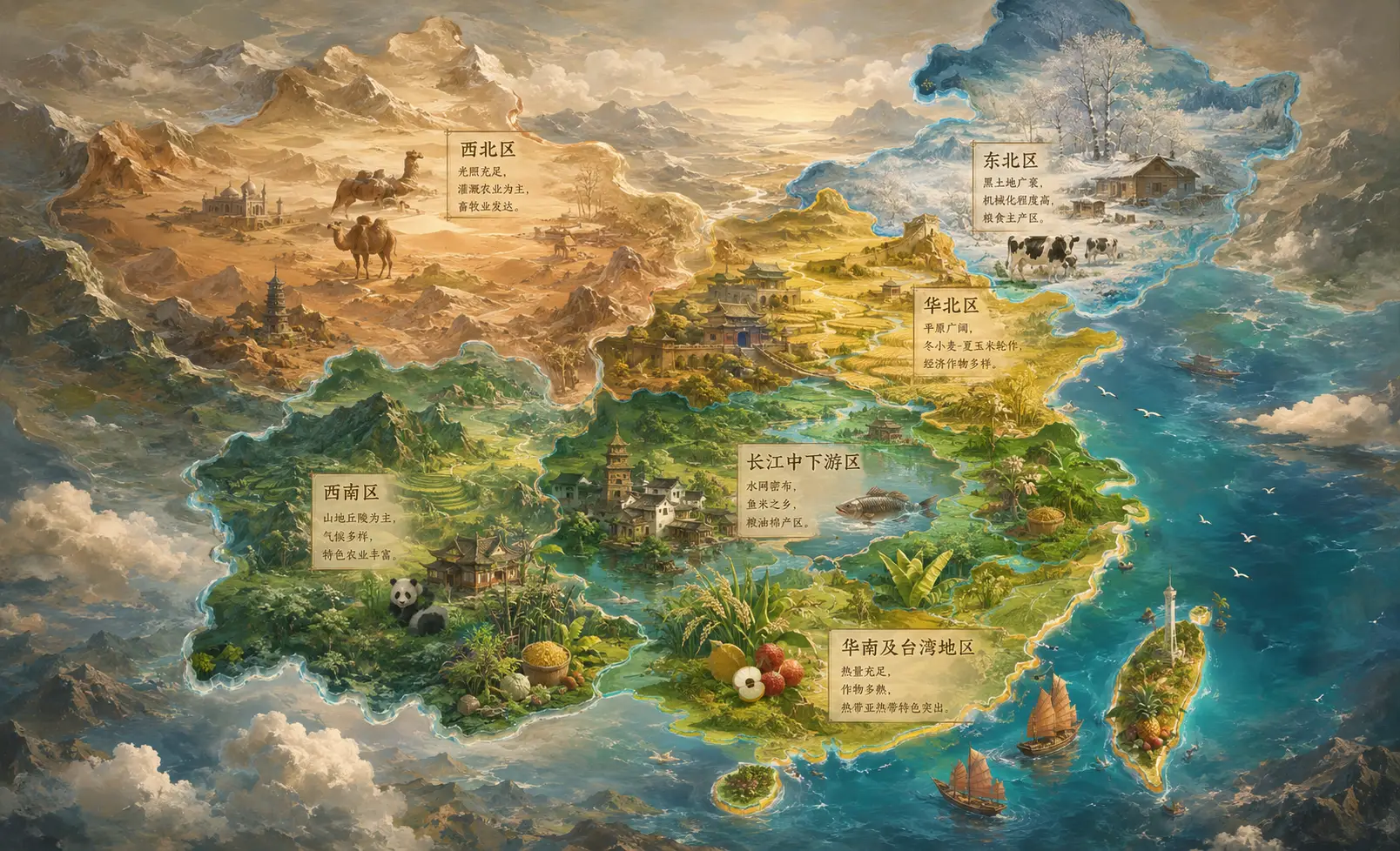
| Agricultural Region | Major Provinces | Keywords |
|---|---|---|
| Northeast | Heilongjiang, Jilin, Liaoning, eastern Inner Mongolia | Frozen-ground thaw, spring-sowing countdown, seed treatment, machinery calibration |
| Northwest | Xinjiang, Gansu, Ningxia, western Inner Mongolia, Qinghai | Spring-wheat sowing, winter-wheat booting, spring irrigation, end of lambing |
| North China | Hebei, Shanxi, Beijing, Tianjin, Shandong, northern Henan | Winter-wheat booting, spring-maize sowing, spring irrigation, pest and disease control |
| Middle and Lower Yangtze | Hubei, Hunan, Jiangxi, Anhui, Jiangsu, northern Zhejiang, Shanghai | Early-rice transplantation, rapeseed pod setting, spring-tea harvest, ditch clearing and waterlogging prevention |
| Southwest | Sichuan, Chongqing, Guizhou, Yunnan, southeastern Tibet | Completion of early-rice transplantation, decisive stripe-rust control, spring-tea picking, potato seedling management |
| South China and Taiwan | Guangdong, Guangxi, Hainan, southern Fujian, Taiwan Province | Early-rice tillering, peanut and maize growth, fruit retention, aquaculture |
Heilongjiang, Jilin, Liaoning, eastern Inner Mongolia
Around Qingming, frozen ground across Northeast China has largely thawed through. The upper soil layer has thawed to a depth of 30–50 centimeters, and spring sowing enters its final countdown. Daytime highs may reach 10–15°C, the surface soil has fully thawed, the muddy-field period comes to an end, and large agricultural machinery can begin entering the fields.
Countdown to spring sowing. Spring planting in Northeast China generally begins from mid- to late April—around April 15–20 in Heilongjiang, April 5–10 in Liaoning, and April 10–15 in Jilin. At Qingming, only one to two weeks remain before sowing, so all preparations must be completed during this period.
Seed coating is fully completed and treated seed is bagged for use. Fertilizer is sorted and positioned according to field and crop type, while large agricultural machinery completes its final calibration and test runs. Planting plans must also be finalized at this stage—including the relative acreages devoted to maize, soybeans, and rice, as well as the choice and spatial arrangement of different varieties.
Monitoring soil moisture. Qingming is a period when Northeast farmers watch 墒情 (*soil-moisture conditions*) particularly closely. Spring drought is one of the greatest threats to spring sowing in the region. Farmers dig into the soil to assess moisture. If relative soil moisture falls below 60%, they may need to create adequate moisture conditions before sowing.
Weather forecasts are combined with field observations to determine the best sowing time. In dry years, irrigation sources—such as wells and reservoirs—must be arranged in advance, or sowing depth adjusted slightly deeper so seed reaches the moist soil layer.
Crop-residue management. If crop stalks were not removed from the fields before winter, Qingming is the final window for dealing with them. Residues must either be shredded and incorporated into the soil or baled and removed before sowing, otherwise planting quality and emergence may be affected.
Lambing ends fully in pastoral areas. By Qingming, lambing in the pastoral districts of eastern Inner Mongolia is fully complete and all newborn lambs have arrived. Herders shift their attention from assisting births toward grazing management. As pasture grasses begin to return to green, livestock gradually move from pens back onto pasture.
Protected agriculture. Peak greenhouse-vegetable production continues in southern Liaoning. Rising temperatures make greenhouse overheating increasingly likely, so daytime ventilation and cooling must be strengthened. Open-field vegetables such as spinach, Chinese chives, and lettuce begin sowing or transplantation around Qingming.
Xinjiang, Gansu, Ningxia, western Inner Mongolia, Qinghai
Around Qingming, spring-wheat sowing in Northwest China approaches completion, while winter wheat in southern Xinjiang enters booting and reaches its annual maximum demand for water and nutrients.
Spring-wheat sowing concludes. Across the Hexi Corridor in Gansu and Yellow River irrigation districts of Ningxia, spring-wheat sowing approaches its end around Qingming. The 顶凌播种 (*sowing while deeper soil remains frozen*) window closes, and any fields not yet planted must be completed quickly; otherwise, the crop’s developmental period and yield may be affected.
The sown area reaches its annual maximum around Qingming, and planting quality directly influences annual grain production across Northwest China.
Management of winter wheat at booting. Winter wheat in the Tarim Basin of southern Xinjiang enters the 孕穗期 (*booting stage*) around Qingming. Young ears differentiate and develop rapidly inside the stems, making this a decisive stage for determining the number of kernels per ear.
Booting is also the peak period of water and nutrient demand. Farmers need to irrigate promptly at 50–60 cubic meters per *mu* and apply 孕穗肥 (*booting fertilizer*) consisting of 8–10 kilograms of urea plus 3–5 kilograms of potash fertilizer per *mu*.
Wheat is particularly sensitive to water stress during booting. Drought can impair young-ear development and reduce kernel number, so farmers must ensure that every wheat field receives irrigation in time.
Spring irrigation expands fully. In Gansu, Ningxia, and western Inner Mongolia, spring wheat needs prompt irrigation after sowing through “蒙头水”—*the first irrigation after sowing to support germination and emergence*. Qingming is a period of concentrated spring irrigation, requiring farmers to coordinate irrigation order and make full use of Yellow River water resources.
The spring grazing season begins. After lambing ends along the northern Tianshan and in the Ili Valley, herders gradually move livestock onto spring pasture. Grasses begin to return to green and animals shift from pen feeding toward grazing.
Spring grazing must be carefully controlled. Grazing intensity should remain moderate so livestock do not overgraze tender new grass and hinder pasture recovery. Grazing time should be increased gradually so animals can adapt to fresh forage.
Orchard management. Apples, fragrant pears, grapes, and other fruit trees in southern Xinjiang enter the period from budbreak to leaf expansion around Qingming. Growers need to focus on several tasks:
Spring pruning—complete all pruning before budbreak.
Fertilization—apply 萌芽肥 (*budbreak fertilizer*), mainly nitrogen, before buds open.
Pest and disease control—apply lime-sulfur before budbreak, then monitor aphids, spider mites, and other pests after emergence.
Specialty crops. Cotton sowing in Xinjiang begins around Qingming. Cotton-growing areas in both southern and northern Xinjiang start planting successively as temperatures rise. Cotton is Xinjiang’s most important cash crop, and both planting acreage and sowing quality directly affect farmers’ annual income.
Hebei, Shanxi, Beijing, Tianjin, Shandong, northern Henan
Around Qingming, North China enters the most critical period of winter-wheat management as the crop moves from jointing toward booting, while spring-maize sowing formally begins.
Management from jointing to booting. Winter wheat across the North China Plain moves from peak jointing toward 孕穗期 (*booting*). Stem internode elongation is largely complete and the young ear develops rapidly inside the stem, approaching full formation.
Booting is the final stage determining kernel number per ear and brings an urgent demand for both water and nutrients.
Key management points include:
Fields with inadequate soil moisture—relative soil moisture below 60%—need prompt irrigation at 40–50 cubic meters per *mu*.
Weak stands require 孕穗肥 at 5–8 kilograms of urea per *mu*.
Overly vigorous fields require reduced nitrogen application in order to prevent excessive vegetative growth and lodging.
Booting is also the final period of serious threat from 倒春寒 (*late spring cold*). Farmers must watch weather forecasts closely. If nighttime temperatures are forecast to fall below 2°C, irrigation may be used to help retain warmth.
Spring-maize sowing formally begins. Across the North China Plain, spring maize enters its sowing period around Qingming. Planting generally takes place from early to mid-April, making Qingming one of the best windows, once soil temperature remains steadily above 10°C and soil moisture is suitable.
Seed is planted 3–5 centimeters deep with row spacing of 60–70 centimeters, followed by rolling to conserve soil moisture. Spring-maize acreage rises rapidly around Qingming as farmers take advantage of clear weather to sow in concentrated fashion.
Pest and disease control. As temperatures rise, wheat pests and diseases enter a high-incidence period.
Key targets include:
Wheat sharp eyespot—brown lesions appear at the stem base; validamycin or triadimefon is used for control.
Wheat spider mites—abamectin is used for treatment.
Aphids—imidacloprid is used.
Wheat powdery mildew—triadimefon is used.
Farmers should inspect their fields at least once every week and intervene promptly when pests or diseases are detected.
Spring irrigation continues. Spring irrigation continues around Qingming but is approaching its end. Wheat fields that have not yet been irrigated need to complete the work quickly in order to secure water supply during booting.
Fruit-set management in orchards. In apple-, pear-, and peach-growing areas of North China, flowering is largely over and orchards enter fruit set.
Growers need to focus on:
Fruit thinning—removing overly dense, malformed, or pest-damaged young fruit so the fruit left behind can reach proper size and quality. Apple clusters retain 1–2 fruits, while pear clusters retain 1–3 fruits.
Fruit-setting fertilizer—mainly potash, to support young-fruit development.
Pest and disease control—apple ring rot, pear scab, peach aphid, and other problems enter important control windows.
Vegetable sowing and transplantation. Open-field vegetable planting reaches its peak in North China. Spring radish, spring Chinese cabbage, spring cabbage, and other major vegetables begin sowing or transplantation. Greenhouse tomatoes, cucumbers, and peppers enter peak harvest and require stronger water, nutrient, pest, and disease management.
Hubei, Hunan, Jiangxi, Anhui, Jiangsu, northern Zhejiang, Shanghai
Around Qingming, the middle and lower Yangtze enters the busiest stage of agricultural activity in the entire year. Peak early-rice transplantation, rapeseed pod setting, and full-scale spring-tea harvesting overlap as three central agricultural tasks.
Peak early-rice transplantation. In southern Jiangnan—including Jiangxi, southern Hunan, and southern Zhejiang—early-rice seedlings reach the “四叶一心” to “五叶一心” stages—*four to five developed leaves with one central emerging leaf*—around Qingming and enter the peak of large-scale transplantation.
After transplantation, farmers maintain a shallow water layer of 3–5 centimeters to encourage 返青 (*post-transplant recovery*) and low-position tillering.
In northern Jiangnan—including Anhui, southern Jiangsu, and northern Zhejiang—early-rice nurseries enter their final pre-transplant push around Qingming. Farmers carry out 炼苗 (*seedling hardening*) by gradually removing covers, increasing ventilation, and reducing watering so seedlings adapt to open-field conditions. At the same time, paddies are prepared through flooding, soaking, harrowing, leveling, and basal fertilization.
Transplantation is generally completed between Qingming and 谷雨 (Gǔyǔ, Grain Rain).
Management during peak rapeseed pod setting. Rapeseed across the Yangtze River basin enters peak pod formation around Qingming. Young pods expand rapidly and the seeds inside begin to develop and fill.
Pod setting is the most decisive stage for rapeseed yield, because both pod number and seed plumpness directly determine the final harvest.
Key management measures include:
Applying 荚肥 (*pod fertilizer*), primarily potash, at 3–5 kilograms of potassium chloride per *mu* to support fuller seed development.
Controlling sclerotinia stem rot, the most important disease affecting rapeseed. Qingming is a peak period for the disease. Carbendazim or sclerotinia-control products are applied once during full flowering and again at early pod formation.
Preventing lodging. Above-ground biomass increases sharply during pod setting, making rapeseed vulnerable to strong winds and heavy rain. Earlier control of excessive growth and appropriate planting density can reduce the risk.
Spring-tea harvesting expands fully. In the tea regions of Jiangnan—Zhejiang, Anhui, and Jiangxi—the first major spring-tea harvest peak arrives around Qingming, and harvesting of 明前茶 expands fully.
明前茶 is regarded as the highest-quality spring tea: the buds and leaves are tender, the aroma is delicate and clear, and bitterness and astringency are light. Picking standards are strict—generally one bud with one leaf or one bud with two leaves. Fresh leaves must be processed immediately after picking through 杀青 (*fixing*), rolling, and drying in order to preserve quality.
Tea growers enter the busiest picking season of the year around Qingming, with harvesting, processing, and sales following one another without interruption.
Keeping drainage ditches open to prevent waterlogging. Spring rainfall continues increasing around Qingming and field humidity remains high. Farmers need to keep inspecting drainage systems and ensure that the “三沟”—main, central, and perimeter ditches—remain unobstructed. Rice-stubble fields bear the greatest drainage pressure and require particular attention to prevent waterlogging damage.
Greenhouse and open-field vegetables. Greenhouse fruiting vegetables across the Yangtze basin enter peak harvest, with tomatoes, cucumbers, and peppers continuing to reach the market. Open-field vegetables—including stem lettuce, celery, garlic, and spring cabbage—enter rapid growth and require stronger water, nutrient, pest, and disease management.
Sichuan, Chongqing, Guizhou, Yunnan, southeastern Tibet
Around Qingming, agricultural activity expands fully across Southwest China. Early-rice transplantation in warm lowland valleys approaches completion; winter wheat in the Sichuan Basin enters booting; stripe-rust control reaches its final decisive battle; and spring-tea harvesting reaches its seasonal peak.
Early-rice transplantation concludes. In southern Yunnan—including Xishuangbanna and Honghe—and the Panxi region of Sichuan, early-rice transplantation approaches completion around Qingming. A shallow water layer of 3–5 centimeters is maintained after transplantation to support recovery and tillering. The warm lowland valleys of Yunnan have abundant heat resources, allowing transplanted rice to grow rapidly, and some fields already enter peak tillering.
Final battle against wheat stripe rust. Winter wheat across the Sichuan Basin is at booting around Qingming, while stripe-rust control enters its final decisive stage.
Stripe-rust spores spread rapidly and can cause severe damage. Qingming is the last major control window. If the disease is not effectively contained at this point, spores may be carried in large quantities by southwesterly air currents toward northern wheat-growing regions, causing widespread outbreaks.
Agricultural authorities in Sichuan launch comprehensive control operations around Qingming. Plant-protection personnel enter each wheat field to inspect and spray. Farmers must inspect their own fields at least twice a week. When yellow stripe-like spore pustules are found, they should be reported and treated immediately.
The decisive control period generally runs from Qingming to Grain Rain, lasting around 2–3 weeks.
Peak spring-tea harvesting. Low-altitude tea areas in Sichuan, Guizhou, and Yunnan enter peak spring-tea harvest around Qingming, with 明前茶 picking expanding fully.
Famous tea regions—including Mount Emei and Mengding Mountain in Sichuan, Duyun in Guizhou, and Pu’er in Yunnan—enter the busiest tea-picking season of the year. Spring budding begins later at high elevations, generally in mid- to late April, making Qingming an important period for tea-garden management and preparation of labor and materials there.
Potato seedling management. Spring potatoes in major production regions of Yunnan, Guizhou, and Sichuan enter a crucial seedling-management stage around Qingming.
Farmers inspect stands and fill gaps by resowing or transplanting where necessary; carry out a second intertillage at 5–8 centimeters deep together with weeding and topdressing; and apply 苗肥 (*seedling fertilizer*) at 5–8 kilograms of urea per *mu* to promote stem and leaf growth and tuber formation.
Seedling growth directly influences tuber number and final yield.
Rapeseed and broad beans. Rapeseed in Sichuan and Guizhou enters peak pod setting and requires pod fertilizer together with control of sclerotinia. Broad beans move from peak pod formation toward maturity and require adequate water.
Guangdong, Guangxi, Hainan, southern Fujian, Taiwan Province
#### (1) Mainland South China
Management of early rice at peak tillering. Early rice across South China enters peak tillering around Qingming. Transplanted seedlings have fully recovered and begin producing large numbers of tillers.
Tillering is the key stage determining the number of productive panicles: the more effective tillers the crop produces, the higher the final yield potential.
Key management measures include:
Maintaining a shallow water layer of 3–5 centimeters without allowing the field to dry.
Applying 分蘖肥 (*tillering fertilizer*) at the beginning of tillering, generally 5–8 kilograms of urea per *mu*.
Carrying out 晒田控苗 (*draining and drying the paddy to regulate crop growth*) once tiller numbers reach the planned target. Fields are drained and allowed to dry for 7–10 days, suppressing unproductive tillers and encouraging deeper root growth.
Paddy drying is an important rice-management technique. Drying too early may reduce productive tillering; drying too late allows excessive unproductive tillers to consume nutrients.
Growth management of spring peanuts and spring maize. Spring peanuts enter vigorous growth around Qingming. Stems and leaves grow rapidly, and the crop begins flowering and 下针—the stage when the fertilized peg extends down into the soil to form a pod.
Key measures include a second intertillage at 8–10 centimeters deep, application of 花针肥 (*flowering-and-pegging fertilizer*) at 10–15 kilograms of compound fertilizer per *mu*, and control of peanut leaf spot, aphids, and other pests and diseases.
Spring maize enters jointing around Qingming. Stems elongate rapidly, making stronger water and nutrient management necessary. Farmers apply 拔节肥 at 8–10 kilograms of urea per *mu*.
Fruit retention and summer-shoot management in tropical orchards. Mangoes in Hainan and Guangxi enter young-fruit development and require attention to 保果 (*fruit retention*). Growers apply fruit-retention treatments, thin overly dense young fruit, and control mango gall midges and thrips.
Early lychee varieties enter fruit development and need stronger water and nutrient supply, while mid- and late-season varieties enter flowering and require careful attention to pollination conditions.
Citrus in Guangdong and Guangxi enters spring-shoot emergence and flowering. Nitrogen application must be controlled to prevent excessive spring-shoot growth from interfering with flowering and fruit set.
Vegetables and aquaculture. Open-field vegetables in South China enter rapid growth and peak harvest. Choy sum, Chinese kale, lettuce, and spinach grow quickly and need timely harvesting.
As temperatures rise, pests and diseases enter a high-incidence period. Diamondback moth, aphids, downy mildew, and powdery mildew require stronger control.
In aquaculture, fish enter rapid growth. Feed amounts are gradually increased, while water-quality management and disease prevention are strengthened.
#### (2) Taiwan
Rice: The first rice crop in central Taiwan—including Changhua, Yunlin, and the Chianan Plain—enters 孕穗期 (*booting*) around Qingming. Young panicles differentiate and develop rapidly within the stem, making this a decisive stage for determining grain number.
Fields should maintain a shallow water layer of 3–5 centimeters, while 穗肥 (*panicle fertilizer*), primarily potash, is applied at 5–8 kilograms of potassium chloride per *mu*.
In southern Taiwan, particularly the Kaohsiung–Pingtung region, rice moves from late booting into heading and requires attention to panicle-stage diseases and pests, including rice blast, sheath blight, and stem borers.
In northern Taiwan, including Taoyuan and Hsinchu, rice seedlings begin transplantation around Qingming.
Vegetables: Vegetable sowing and transplantation continue across Taiwan. In central Taiwan, watermelon, cucumber, muskmelon, and other cucurbits enter peak sowing and seedling raising. In the south, ginger and 越瓜 reach peak transplantation. Tomatoes enter the final stage of harvest and require continued pest and disease control.
Fruit trees: Spring pruning of citrus is fully complete, while management of spring-shoot emergence and flowering expands fully. Mangoes in southern Taiwan enter flowering and young-fruit development and require attention to flower and fruit retention. Lychees move from flowering toward young-fruit development, with pollination and fruit set becoming important. Bananas in southern Taiwan enter flower-bud differentiation and require stronger water and nutrient management.
Tea: Spring tea in central and southern tea regions—including Nantou and Chiayi—enters peak harvest around Qingming. This is the most important production season in Taiwan’s tea industry, and spring-tea quality directly affects annual tea income. Growers intensify harvesting, processing, and sales. In northern tea regions such as Wenshan and Sanxia, spring-tea picking begins around Qingming.
Fisheries: Catches in waters around Taiwan continue increasing during Qingming. The spring fishing season enters its busy phase, with mackerel, Spanish mackerel, pomfret, mullet, and other species continuing to be caught. Coastal fishing vessels go to sea frequently and catch quality remains good.
Farmer’s proverbs and folk customs: Taiwanese tradition preserves the saying:
“清明前,好種田。”
*Before Qingming is a good time to work and plant the fields.*
And:
“清明後,好種豆。”
*After Qingming is a good time to sow beans.*
Qingming is also one of Taiwan’s most important traditional festivals. Grave sweeping and ancestor worship, together with spring outings, are among its principal customs.
The folk expression “清明掃墓,慎終追遠” conveys the tradition of sweeping ancestral graves at Qingming and remembering one’s forebears with reverence and gratitude.
Global Extreme Weather · Risks & Responses
Temperate Northern Hemisphere: the Final Threat of 倒春寒
Although temperatures have risen overall by Qingming, cold air can still move southward. The traditional expression “清明断雪”—*“snow ends by Qingming”*—does not mean that cold itself has ended.
The principal agricultural dangers of 倒春寒 (*late spring cold*) around Qingming include:
Winter wheat is at booting. Young ears are sensitive to cold, and temperatures of -1 to -2°C may already cause frost damage, reducing kernel number per ear.
Fruit trees are at fruit set. Young fruit may suffer frost injury and fall at temperatures below -2°C.
Rapeseed is at pod setting. Young pods may be damaged below 0°C.
Although late cold spells are less common at Qingming than at the Spring Equinox, they can still cause serious damage when they occur.
The farmer’s proverb says:
“清明寒,麦穗短。”
*If Qingming is cold, the wheat ears will be short.*
It expresses the traditional observation that cold weather around Qingming may reduce the number of grains formed in winter-wheat ears.
Temperate Northern Hemisphere: the First Increase in Severe Convective Weather
Around Qingming, as warm, moist air strengthens while remnants of cold air remain, severe convective weather begins to increase. Thunderstorms, showers, strong winds, and hail become more frequent.
These events may affect agriculture in several ways:
Hail can damage fruit-tree blossoms and young fruit and may also damage greenhouse structures.
Strong winds can lodge rapeseed and wheat or overturn greenhouses.
Lightning may ignite forest fires, particularly in dry northern regions.
Farmers need to follow forecasts closely, reinforce greenhouses before strong winds or hail, and harvest mature crops in advance where possible.
Temperate Southern Hemisphere: Continuing Autumn-Drought Risk
In mid-autumn in the Southern Hemisphere—around early April—the weather is often clear and dry with little rainfall.
Seedling growth of autumn-sown crops and newly sown pasture both require adequate moisture. If drought persists, autumn crops may develop weak seedlings, reducing overwintering ability and lowering yield potential for the following year. Autumn pasture sowing may fail, affecting winter fodder reserves.
For farmers in Australia and Argentina, one of the greatest concerns at this time is the continuation of autumn drought. A timely autumn rain is crucial to agricultural production.
Tropical Regions: Extreme Weather During the Rainy-Season Transition
The tropical Northern Hemisphere—Southeast Asia and India—is moving from the dry season into the rainy season.
Several types of extreme weather may occur.
The first is the heat wave. April is the hottest month of the year, and prolonged high temperatures can affect both crop growth and human health.
The second is the sudden downpour. The first rains of the wet season are often intense enough to qualify as heavy rainfall, creating risks of localized flooding and landslides.
In the tropical Southern Hemisphere—including Brazil and Africa—the dry season begins. Clear, dry conditions favor harvesting and grain drying, but the risk of fires in grain-storage facilities rises during the dry season.
A Shared Global Trend: Changes in the Distribution of Spring Rain
Against the background of global climate warming, the distribution of spring rainfall in southern China is changing. Total spring rainfall has changed relatively little, but its “concentration” is increasing: precipitation is increasingly concentrated into a small number of heavy rain events, separated by longer rainless intervals.
This means that spring drought and flooding may alternate within the same season.
The traditional experience captured in the phrase “清明时节雨纷纷”—the image of fine, persistent spring rain around Qingming—is becoming less common, while the more extreme feeling of “either no rain at all, or a sudden downpour when it does rain” is becoming stronger.
This places ever greater demands on irrigation and drainage systems: agriculture must now guard against both drought and excess water.
For farmers, this makes production planning more demanding. It also serves as a reminder that the climatic experience embodied in the traditional solar terms needs to be applied flexibly in light of actual contemporary weather conditions.
-----
Readers’ Comments
Calendar and traditional culture enthusiasts from around the world, sharing the same moon.
Sign in or register to join the conversation. Your comment account is created automatically the first time you use a connected account.
No comments yet
Share your thoughts with readers around the world.