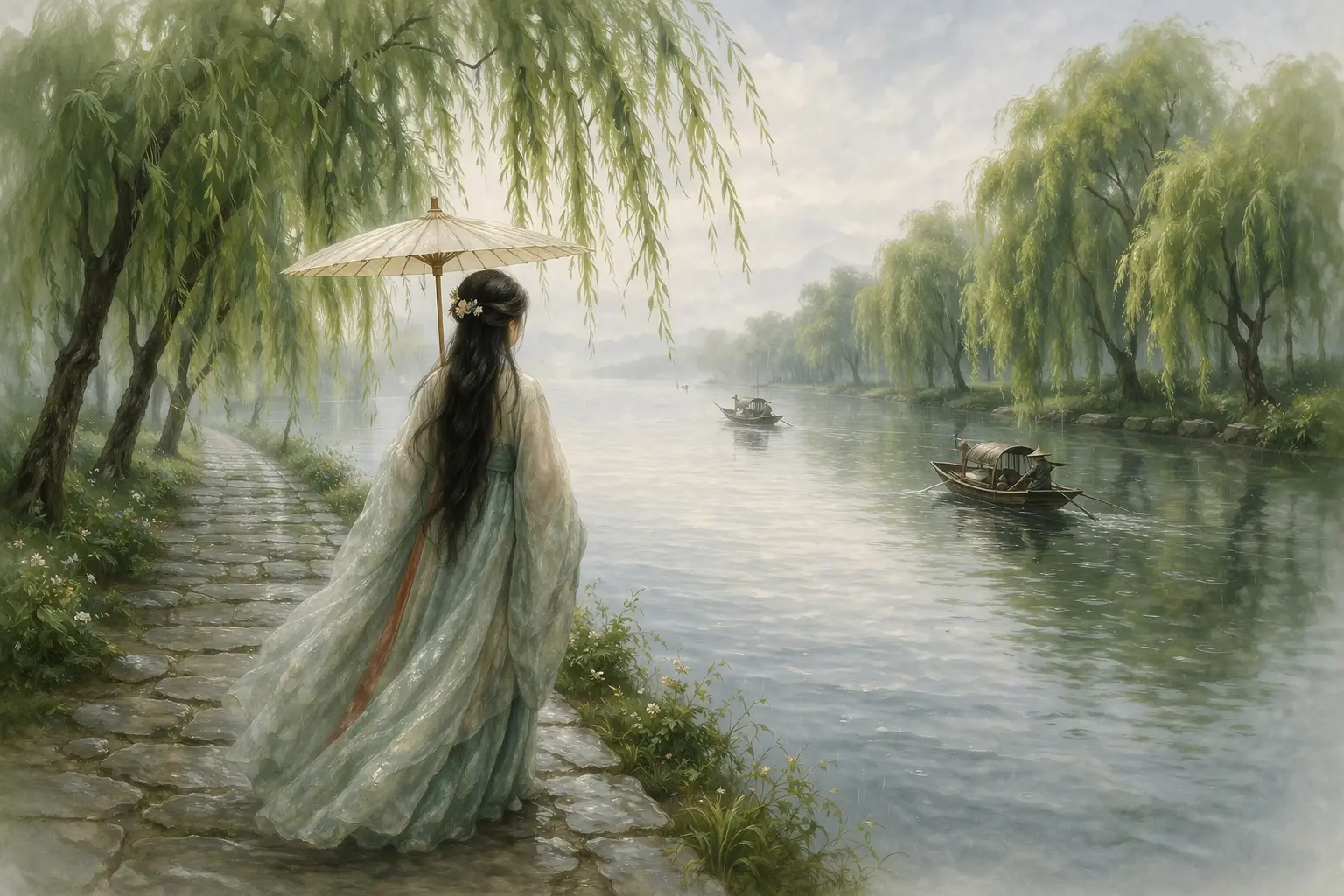
Pure Brightness Poetry
「清明时节雨纷纷,路上行人欲断魂。」
Poetry of Qingming combines the sorrow of ancestral rites with the joy of spring outings, creating a distinctive emotional tension. Du Mu’s “清明时节雨纷纷” gives full expression to the traveler’s melancholy and has become the most widely recited Qingming poem; Bai Juyi’s “风吹旷野纸钱飞” records the grief of tomb-sweeping in the burial fields; Liu Yong’s “清明上巳西湖好” portrays the splendor of spring outings in the capital. On Qingming, poets saw both “纸灰飞作白蝴蝶” and “梨花风起正清明,游子寻春半出城.” The interweaving of life and death, sorrow and joy, gives Qingming poetry its deepest character.
Pure Brightness Poetry
清明
Original Verse:
清明时节雨纷纷,路上行人欲断魂。
借问酒家何处有?牧童遥指杏花村。
Modern Translation:
During Qingming, fine rain falls without end. Travelers far from home move along the road in low spirits, as though their souls were about to break. Asking a shepherd boy where an inn or wine shop might be found, they see him point far into the distance, toward a village hidden among apricot blossoms.
Commentary:
This quatrain is the crowning work of Qingming poetry. In the opening line, “雨纷纷” is both a realistic description of the season and the source of the poem’s misty, sorrowful tone. The second line, “欲断魂”, is the poem’s poetic eye. Qingming is a day for tending ancestral graves; a traveler stranded far from home cannot return to honor the dead, and is caught at the same time in cold rain. His desolation is easy to imagine. In the final two lines, the poem turns. The traveler seeks relief by asking the shepherd boy for directions, and the word “遥指” pushes the scene outward into the distance. The warmth and fragrance of wine from Apricot Blossom Village seem to reach through the curtain of rain, offering comfort to the despairing traveler. The poem moves from grief toward consolation, from the concrete toward suggestion, leaving a long aftertaste.
清明
Original Verse:
无花无酒过清明,兴味萧然似野僧。
昨日邻家乞新火,晓窗分与读书灯。
Modern Translation:
With neither flowers nor wine, I pass Qingming in this way; my spirits are desolate, my life austere, like that of a solitary monk in the wilderness. Yesterday I begged newly kindled fire from a neighbor, and at dawn by the window used it to light my lamp for reading.
Commentary:
Wang Yucheng’s poem presents a different kind of Qingming—the Qingming of a poor scholar. The first two lines describe his poverty. “无花无酒” contrasts with the worldly festivity of the holiday, while the comparison to a “野僧” emphasizes the poet’s solitude and detachment. The final two lines are the poem’s finest touch. “乞新火” refers to the ancient Qingming custom of renewing the fire: after the old fire was extinguished, new fire was kindled by friction. The poet begs new fire from a neighbor, but not to cook food or prepare tea; instead, he “分与读书灯”—uses it for the lamp by which he studies. While countless households go out to enjoy the spring, the poet keeps company with books and makes a friend of the lamp, poor yet unwavering in purpose. The character “分” is especially subtle: it means both sharing the flame and sharing that tiny bean-like light of Qingming, making the diligence and steadfastness of the impoverished scholar vividly present.
苏堤清明即事
Original Verse:
梨花风起正清明,游子寻春半出城。
日暮笙歌收拾去,万株杨柳属流莺。
Modern Translation:
The wind rises through pear blossoms: it is exactly Qingming. People go out seeking spring, and half the city seems to have left its gates. By sunset, the music and singing gradually disperse; then the ten thousand willow trees belong once more entirely to the orioles.
Commentary:
This quatrain uses a light, lively touch to portray the bustling spring scenery of West Lake during Qingming. The opening “梨花风起” marks the season through its natural signs: pear blossoms in full bloom, warm breezes across the face, and bright spring light everywhere. The second line, “游子寻春半出城”, emphasizes the great number of excursionists; the three characters “半出城” suggest that half the city has gone out. The final two lines are the poem’s decisive touch. “日暮笙歌收拾去” describes the crowds departing and the music falling silent, while “万株杨柳属流莺” shows nature returning to quiet. During the day, the willows seem to belong to people; after the visitors leave, they belong to the birds. Within this seemingly ordinary shift lies the poet’s aesthetic attitude toward nature: human bustle is ultimately brief, while the vitality of the natural world—the orioles still singing—endures.
清明日对酒
Original Verse:
南北山头多墓田,清明祭扫各纷然。
纸灰飞作白蝴蝶,泪血染成红杜鹃。
日落狐狸眠冢上,夜归儿女笑灯前。
人生有酒须当醉,一滴何曾到九泉。
Modern Translation:
On the hills to north and south, burial grounds are everywhere, and during Qingming every household comes to sweep and tend the graves. Ashes from burned paper offerings flutter like white butterflies, while tears of grief, red as blood, seem to stain the azaleas scarlet. After sunset, foxes sleep upon the burial mounds; when the children return at night, they laugh again before the lamps. While alive, if there is wine, one should drink deeply—for when has even a single drop ever reached the loved ones beneath the Nine Springs?
Commentary:
Gao Zhu’s poem takes Qingming tomb-sweeping as its subject. The first six lines push the separation between life and death to an extreme, while the final two close with words of broad, defiant acceptance. “纸灰飞作白蝴蝶” compares paper ash to white butterflies, turning a sorrowful ritual scene into something at once light and eerie; “泪血染成红杜鹃” compares blood-like tears to red azaleas, creating a powerful contrast between white and red. The neck couplet, “日落狐狸眠冢上”, writes the desolation of abandoned graves, while “夜归儿女笑灯前” writes the warmth and pleasure of ordinary life. One is cold, one warm; one death, one life—the contrast is stark. The final couplet, “人生有酒须当醉,一滴何曾到九泉”, draws on the spirit of Cao Cao’s “对酒当歌”, but with greater pain: if the dead cannot taste the wine offered to them, then the living should cherish life while they can. From extreme grief the poem turns toward openness, and from profound mourning toward the value of the present.
清明呈馆中诸公
Original Verse:
新烟着柳禁垣斜,杏酪分香俗共夸。
白下有山皆绕郭,清明无客不思家。
卞侯墓上迷芳草,卢女门前映落花。
喜得故人同待诏,拟沽春酒醉京华。
Modern Translation:
Newly rising smoke winds among the willows beside the slanting palace walls; fragrant almond drink is shared and praised by all. Around Jinling, also called Baixia, mountains encircle the city, and at Qingming there is no traveler who does not think of home. Fragrant grasses blur the grave of Lord Bian, while fallen blossoms lie before the gate of Lady Lu. Happily, an old friend is here with me awaiting imperial summons; I plan to buy spring wine and get drunk together in the spring light of the capital.
Commentary:
Gao Qi’s poem writes both the homesickness of a traveler during Qingming and the comfort of companionship with an old friend. The opening “新烟着柳禁垣斜” depicts the capital after the Qingming custom of renewing fire, with new smoke curling among the willows; “杏酪分香” records the seasonal custom of eating or drinking almond preparation. The second couplet, “白下有山皆绕郭”, writes the natural advantages of Jinling, surrounded by mountains, while “清明无客不思家” expresses a feeling shared by travelers through the ages. The third couplet, “卞侯墓上迷芳草”, uses the grave of Bian Kun, a loyal Eastern Jin official, to evoke the changes of history; “卢女门前映落花” invokes Lady Lu, a singing girl associated in literary allusion with exchanges among men of letters, to evoke the elegance of an earlier age. One is a loyal minister and one a courtesan; one scene lies over a grave, the other before a doorway. On Qingming, different layers of time and space meet. The final couplet, “喜得故人同待诏”, turns away from homesickness: with an old friend beside him, the poet can “拟沽春酒醉京华”, finding consolation within exile and warmth within Qingming.
清江引 · 清明日出游
Original Verse:
问西楼禁烟何处好?绿野晴天道。
马穿杨柳嘶,人倚秋千笑,探莺花总教春醉倒。
Modern Translation:
If one asks where best to go during the smoke-free Qingming days by the western tower, the answer is: out beneath the clear sky, along the roads through the green fields. Horses pass among the willows and neigh; people lean on swings and laugh. Seeking orioles and spring flowers always leaves one intoxicated by the season.
Commentary:
This sanqu writes the pleasure of a Qingming outing in a bright, lively rhythm. “问西楼禁烟何处好” opens with a question; “禁烟” refers to the custom of forbidding fire during Hanshi around Qingming. “绿野晴天道” answers with an open, sunlit spring landscape, immediately sweeping away the gloomy associations of the festival. The following three images are linked in succession: “马穿杨柳嘶” writes the pleasure of riding, “人倚秋千笑” the pleasure of play, and “探莺花总教春醉倒” the pleasure of seeking spring. Horse neighs mingle with laughter, willows move beside the swings, and the entire piece is light in rhythm and resonant in sound. It presents the lively vitality of Qingming excursions and forms a very different emotional face of the festival from Du Mu’s “雨纷纷.”
Closing Note
Qingming poetry begins with rain. Du Mu wrote “清明时节雨纷纷,路上行人欲断魂.” In twenty-eight characters, not one explicitly mentions tomb-sweeping, yet everyone who reads them knows at once that this is Qingming. The rain is neither heavy nor light—just enough to dampen the clothes; the sorrow is neither too deep nor too shallow—just enough to hang upon the heart. Tang poets each wrote their own form of Qingming grief. Bai Juyi confronts life and death directly in “棠梨花映白杨树,尽是死生别离处”; Meng Haoran writes the regret of wandering in “帝里重清明,人心自愁思”; Du Fu, in “朝来新火起新烟”, thinks of his homeland.
Song poets add a greater measure of philosophical reflection. Huang Tingjian writes “佳节清明桃李笑,野田荒冢只生愁”—peach and plum blossoms laugh in the spring breeze while neglected graves in the open fields produce only sorrow. The contrast is harsh and exact. At the very moment when all things are flourishing, he sees the destination beneath the yellow earth. “贤愚千载知谁是,满眼蓬蒿共一丘” expresses the desolation of knowing that, whether worthy or foolish, all people eventually become no more than one mound of earth. Yet not all Song poets write sorrow; some write only spring. Wu Weixin writes “梨花风起正清明,游子寻春半出城”, while Cheng Hao writes “况是清明好天气,不妨游衍莫忘归.” Qingming has not only rain but also clear skies; not only grief but also joy.
From Du Mu’s “欲断魂” to Huang Tingjian’s “满眼蓬蒿”, from Bai Juyi’s “死生别离处” to Wu Weixin’s “游子寻春”—in Qingming poetry, sorrow and joy, life and death, rain and clear skies always exist together. Some remember the dead on this day; others go out into the countryside in search of spring. This is the deepest power of Qingming: it allows you to look back toward the past, and also allows you to turn and walk toward spring.
—
Readers’ Comments
Calendar and traditional culture enthusiasts from around the world, sharing the same moon.
Sign in or register to join the conversation. Your comment account is created automatically the first time you use a connected account.
No comments yet
Share your thoughts with readers around the world.