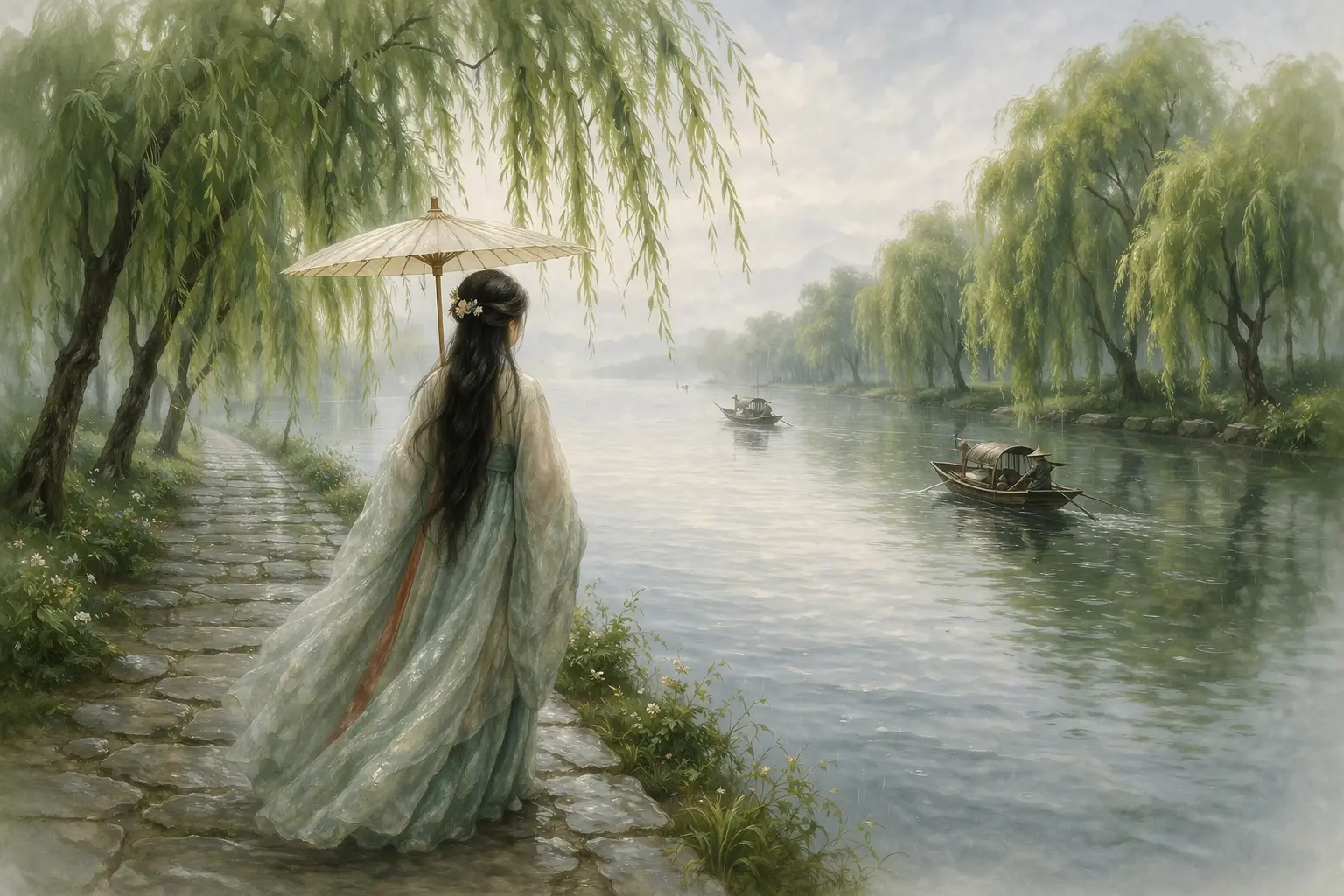
Pure Brightness Customs
「清明不戴柳,红颜成皓首」
Qingming is a festival in which sorrow and joy coexist. On one side are solemn ancestral rites, gratitude, and remembrance; on the other are excursions into nature, the welcoming of spring, and prayers for good fortune. Within this unusual conjunction lies a characteristically gentle Chinese understanding of life and death, as well as a distinctly springtime sense of romance. Its customs can be summarized through six actions: 祭、踏、插、放、戏、食 — to sacrifice, to wander, to insert, to release, to play, and to eat. Sacrifice means sweeping graves and honoring ancestors: repairing burial mounds, presenting offerings, and remembering those who came before. Wandering refers to spring outings, when people leave their homes to enjoy the landscape. Inserting means placing willow branches on doors or wearing them on the body, both to repel harmful influences and to welcome good fortune. Releasing refers to flying kites, allowing misfortune to drift away while inviting better luck. Play encompasses swinging, *cuju*, tug-of-war, cockfighting, and other outdoor amusements. Eating refers to the cold foods associated with the Cold Food tradition, including green *qingtuan* dumplings and crisp *sanzi* pastries.
Among these customs, ancestral grave sweeping centers on remembrance, filial ethics, and the continuity of the family; spring outings and kite flying draw people toward nature while allowing body and mind to open with the season; willow branches concentrate ideas of protection, blessing, and the welcoming of spring; swinging, *cuju*, and other outdoor games emphasize physical vitality and seasonal recreation; while cold foods preserve the culinary memory of the merging between solar term and festival. Together they form a complete Qingming landscape extending from mourning to the welcoming of spring and from solemn ceremony to exuberant pleasure. Four cultural ideas run through it. The first is reverence for the dead and remembrance of distant ancestors, expressed through grave sweeping and ancestral worship and rooted in the Chinese cultural ideal of filial devotion. The second is the unity of humanity and nature, embodied in spring excursions that follow the season’s rising vitality and seek harmony with the natural world. The third is the transition from old to new: the extinguished fires of the Cold Food Festival and the rekindling of new fire around Qingming together suggest the departure of the old and arrival of the new. The fourth is the coexistence of grief and joy. Mourning and delight are not opposites here, but two inseparable dimensions of the human journey. Qingming is therefore one of the solar terms with the greatest emotional tension: on the same day, people shed tears for those who have died and laugh beneath the returning spring, reaching through the interweaving of sorrow and happiness toward a fuller understanding of life.
Regional Customs of This Solar Term
| Region | Signature Customs | Notable Features |
|---|---|---|
| Jiexiu, Shanxi | Cold Food and Qingming customs: Zitui Swallows, coiled snake-and-rabbit foods, willow shooting | Traditionally regarded as the birthplace of the Cold Food Festival; a national intangible cultural heritage tradition, with households displaying willow and preparing ritual flour foods |
| Beijing | Ancestral worship, grave sweeping, spring outings, willow customs, the “Thirteen Cold Food Delicacies” | In old Beijing, men and women throughout the city traditionally went into the suburbs to sweep graves and enjoy spring |
| Jiangnan, especially Suzhou and Hangzhou | Making *qingtuan*, eating Qingming cakes, spring tea gatherings | Jiangnan families use green rice dumplings as ancestral offerings and celebrate the season by “tasting spring” |
| Shanghai | Eating *qingtuan* | Green rice dumplings are indispensable both as Qingming offerings and seasonal food |
| Southern Fujian | *Runbing* filled with spring vegetables; flexible grave-sweeping dates | Traditionally, no cooking is done on Qingming itself and cold *runbing* are eaten; grave sweeping may take place around Qingming or on Shangsi |
| Guangdong | Offering roast suckling pig to ancestors | Local traditions vary greatly from village to village, producing a rich range of ancestral rites |
| Sichuan | Dujiangyan Water-Releasing Ceremony | Since 978 CE, water has ceremonially been released at Qingming in remembrance of Li Bing and his son |
| Taizhou, Jiangsu | Festival boat racing | Qingming boat races create a spectacular public scene |
| Zhenjiang, Jiangsu | Willow-leaf tea | Seven willow leaves are steeped as tea and traditionally believed to brighten the eyes |
| Northern Shandong | Egg fighting | Hard-boiled eggs are knocked against one another; the first shell to crack loses |
| Hengzhou, Guangxi | Washing the eyes with willow leaves and field-snail water | Willow leaves and field snails are soaked in water, which is traditionally used to wash the eyes for brightness |
| Huizhou, Anhui | Brewing wine with fresh spring water; offering rice cocoons to the Silkworm Goddess | Fresh spring water is collected for winemaking, while women make rice “cocoons” for the silkworm deity |
| Sichuan and Chongqing | Qingming herb cakes | A seasonal Qingming snack popular throughout the Bashu region |
Pure Brightness Customs
Sweeping Graves and Honoring Ancestors
Popular Regions:
Activities:
Sweeping graves and honoring ancestors is the central custom of Qingming, expressing what traditional culture calls “思时之敬”, the reverence felt when the season turns and remembrance returns to the ancestors. Families carry wine, food, fruit, ritual paper, and other offerings to burial grounds, where they repair graves, present sacrifices, burn paper money, kneel, bow, and perform other acts of remembrance.
The procedure generally begins by clearing weeds from around the grave, adding fresh earth, and repairing the burial mound—popular tradition explains this as repairing the ancestors’ house so that summer rain will not leak through. Offerings are then arranged and ritual paper burned; finally, fresh earth is added to the mound and paper money may be placed or weighted upon it. The Ming work *Dijing Jingwulüe* records: “三月清明日,男女扫墓,担提尊榼,轿马后挂楮锭,粲粲然满道也。拜者、酹者、哭者、为墓除草添土者,焚楮锭次,以纸钱置坟头。” Some regions also preserve temple-style ancestral worship conducted in lineage halls.
The timing varies geographically. In southern Hebei, graves may be visited during the Cold Food Festival, one day before Qingming. Another Hebei saying is “早清明,晚十一”, and some families begin burning paper as early as a week before Qingming. In southern Fujian, grave-sweeping dates are flexible and may fall several days before or after Qingming or on the third day of the third lunar month, the Shangsi Festival. Hakka communities commonly begin their grave visits after the Spring Festival.
Historical Origins:
The practice has very ancient roots. Archaeological excavation at the Qingtang site in Yingde, Guangdong, has uncovered a burial dating back approximately ten thousand years. Grave-sweeping customs are traditionally traced to the Zhou period, when there was not yet a fixed annual date for such rites; by the Warring States period, worship at tombs had become widespread. During the Qin and Han dynasties, with the growing emphasis on filial piety, caring for ancestral graves became an established custom.
Originally, the Cold Food Festival and Qingming were separate occasions. During the Tang dynasty, however, the court designated the Cold Food period as an official time for ancestral grave rites. In the twentieth year of the Kaiyuan reign of Emperor Xuanzong, 732, the court ordered Cold Food grave sweeping to be incorporated into the *Datang Kaiyuan Li*, the state ritual code, and established an accompanying holiday system. Grave sweeping thereafter became increasingly fixed as a Qingming custom, and by the Song dynasty the basic pattern familiar today had taken shape. In 2008, Qingming was formally established as a national public holiday.
How to Take Part:
Cemeteries throughout China are open for grave visits during Qingming. Visitors interested in observing the tradition may respectfully watch ceremonies at large public cemeteries or attend public memorial services organized by cultural institutions. Local cemetery regulations should be checked in advance, and the solemn nature of the occasion should always be respected.
Recommended Places:
Spring Outings
Popular Regions:
Activities:
踏青, literally “treading the green,” is an indispensable part of Qingming. As spring returns, vegetation revives and the landscape fills with new life, making the season ideal for excursions. Families and friends leave their homes together to walk through the countryside, admire flowers, and feel the arrival of spring. Peach and apricot blossoms compete in bloom while willow trees send out tender green shoots.
Ancient accounts describe how, after crying and making offerings at the graves, people would “不归也,趋芳树,择园圃,列坐尽醉”—instead of immediately returning home, they would seek fragrant trees and gardens, sit together, and drink freely. Few images express more clearly Qingming’s unusual union of mourning and pleasure. Today, parks, museums, and scenic areas in many places organize flower festivals, folk exhibitions, and cultural tourism programs around the season.
Historical Origins:
The tradition of spring outings has deep roots in ancient agrarian rites for welcoming the new season. At Qingming, the world casts off the old and receives the new, all things become fresh and clear, and the earth enters a period of gentle spring light—ideal conditions for going outdoors.
The custom also continues the springtime recreation associated with the ancient Shangsi Festival, revealing a Chinese attitude toward life that values closeness to nature and cherishes vitality. During the Tang and Song dynasties, Qingming outings became especially fashionable: scholars and literati traveled together, drank wine, and composed poetry amid the spring landscape.
How to Take Part:
Parks and scenic areas throughout China are well suited to spring outings during Qingming. Local cultural and tourism departments often publish information about flower festivals and seasonal excursions, while some attractions organize Han-style clothing garden tours, poetry gatherings, and other cultural activities.
Recommended Places:
Displaying and Wearing Willow
Popular Regions:
Activities:
Displaying and wearing willow branches is another important Qingming custom. People place willow twigs above door lintels or under eaves, weave them into rings for the head, or wear them on the body. A well-known saying warns: “清明不戴柳,红颜成皓首。” In Jiexiu, Shanxi, households traditionally place willow branches beneath the eaves and weave willow crowns; in Jingxian, Anhui, Qingming is even known as the “Willow-Planting Festival.” Shandong, Hebei, and other northern areas also preserve similar traditions.
Beyond their decorative role, willow branches are believed in folk religion to possess the ability to repel ghosts and harmful spiritual influences.
Historical Origins:
The custom is closely connected with ancient beliefs about protection against spirits. Willow was thought capable of warding off ghosts, and wearing its branches was therefore believed to protect the body from supernatural harm.
The practice is also linked to the Cold Food legend of Jie Zitui, according to which Jie and his mother died while embracing a willow tree; later generations displayed willow branches in remembrance. Another layer of meaning comes from the homophony between “柳”, willow, and “留”, to remain or retain, allowing the branch to express a desire to hold on to the beauty of spring. Willow customs became especially widespread from the Tang dynasty onward and continued through the Song, Yuan, Ming, and Qing periods to the present.
How to Take Part:
Willow twigs may be gathered in the countryside during Qingming, provided public plantings and protected greenery are not damaged. They can be displayed over a doorway or woven into a simple wreath. Many folk-culture villages also organize collective willow-themed activities during the festival.
Recommended Places:
Flying Kites
Popular Regions:
Activities:
Kite flying is one of the most beloved Qingming activities. Kites were traditionally called “纸鸢” or “纸鹞” and were made chiefly of silk or paper. At Qingming, people flew them not only during the day but also at night: strings of small colored lanterns could be attached beneath the kite or along the flying line, glowing like stars in the darkness and earning the name “神灯”, “divine lamps.”
The ancients also believed that Qingming winds could carry away spiritual impurity and bad fortune. Worries might be written on the kite before it was sent into the sky; once the line broke, those troubles were imagined to leave with the wind. The higher and farther the kite traveled, the farther away the year’s misfortune was thought to be carried.
Historical Origins:
Kites have existed in China for more than two thousand years, and their use as a Qingming pastime was widespread by the Tang dynasty at the latest. From the Song onward, kite flying became still more common and developed into one of the principal entertainments of the spring season.
The mild east winds and rising *yang* energy of Qingming were regarded as ideal conditions for flight. The custom combines an older magical idea of releasing misfortune with the simple pleasure of spring recreation, illustrating how Chinese folk culture often embeds spiritual hopes within ordinary life.
How to Take Part:
During Qingming, kite flyers gather in parks and public squares throughout the country. Kites can easily be purchased locally and flown in suitable open spaces. The international kite festival held annually in Weifang, Shandong, is internationally renowned, while many other cities organize community kite-flying events during the Qingming season.
Recommended Places:

Swinging
Popular Regions:
Activities:
Swinging was one of the major recreational traditions of Qingming in ancient China. Early swings were often constructed from forked tree branches with colored ribbons or ropes attached; over time, they developed into the more familiar form of two ropes and a wooden seat.
The activity became widely associated with Qingming and the Cold Food Festival from the Northern and Southern Dynasties onward. People sat upon the swing, rising and falling through the spring air, feeling the wind against the body and enjoying the exhilarating sensation of flight. Today, swinging is widespread as a recreational sport and has also been included as an official competition event in China’s Traditional Games of Ethnic Minorities.
Historical Origins:
The swing has a very long history. Its earlier name is said to have been “千秋”, later reversed to “秋千” in order to avoid a linguistic taboo. The game was already popular during the Northern and Southern Dynasties, and the *Jingchu Suishiji* contains related records.
During the Tang and Song dynasties, swinging flourished both at court and among ordinary people and became one of the most representative amusements of the Cold Food and Qingming season.
How to Take Part:
Many parks have swings suitable for families and children during Qingming. Some folk-culture villages erect traditional wooden-frame swings, allowing visitors to experience a more historical form of the game.
Recommended Places:
Cuju
Popular Regions:
Activities:
Cuju is an ancient ball game played with the feet and was one of the popular outdoor activities of Qingming. Legend attributes its invention to the Yellow Emperor. Early balls were solid and stuffed with hair; after the Tang dynasty, inflated balls appeared, bringing their form closer to that of a modern football.
By the Song dynasty, *cuju* had reached an unprecedented level of popularity and was played everywhere from the imperial court to urban streets. After spreading to Xinjiang, it evolved into traditional ball-striking games among local ethnic groups, where balls decorated with elaborate colored embroidery became particularly distinctive.
Historical Origins:
*Cuju* originated during the Warring States period and is one of the representative sports of traditional Chinese culture. Its earliest written references appear in the *Strategies of the Warring States* and the *Records of the Grand Historian*.
Tradition also links its Qingming popularity to the Cold Food prohibition on fire: because people were eating cold meals, physical activities such as *cuju* were believed to help strengthen the body and counter the effects of the seasonal diet. In this way, *cuju* became one of the outdoor customs that brought energy and enjoyment to Qingming.
How to Take Part:
During Qingming, some folk villages and organizations promoting traditional sports hold *cuju* experiences. A simpler contemporary version is simply to gather friends on a lawn and play ball, experiencing something of the pleasure ancient people found in spring exercise.
Recommended Places:
Planting Trees
Popular Regions:
Activities:
Around Qingming, the spring sun grows warmer and rainfall becomes more frequent, creating conditions in which newly planted saplings take root readily and grow quickly. China has therefore long had a tradition of planting trees during the Qingming season.
The custom has continued into modern times. In 1979, the Standing Committee of the National People’s Congress designated March 12 as China’s Arbor Day, a measure of considerable importance in mobilizing people of all ethnic groups to participate in national greening campaigns.
Historical Origins:
Qingming tree planting grew out of ancient agricultural traditions of welcoming spring. Rising temperatures and increasing rainfall make this one of the most suitable times of year to plant trees.
The custom joins seasonal timing with ecological cultivation and reflects the straightforward traditional wisdom of following the proper time of nature while planting and restoring woodland.
How to Take Part:
Communities and workplaces often organize voluntary tree-planting activities during the spring and Qingming period, and participants may register through local organizations.
Recommended Places:
Tug-of-War
Popular Regions:
Activities:
Tug-of-war was another traditional Qingming activity. In its early history, it was known as “牵钩” or “钩强”; during the Tang dynasty, the name “拔河”, literally “pulling the river,” came into use. The sport originated in the late Spring and Autumn period and was initially popular as a form of military training before spreading among ordinary people.
Emperor Xuanzong of Tang is said to have organized large-scale tug-of-war competitions during Qingming, after which the game became firmly associated with the festival. It functioned both as an athletic contest and as a collective activity capable of strengthening group cohesion.
Historical Origins:
By the Tang dynasty, tug-of-war had become an important Qingming pastime. Folk explanation once again connected physical exercise with the Cold Food prohibition on fire: to avoid weakness from a cold-food diet, people strengthened themselves through activities such as tug-of-war.
Emperor Xuanzong’s Qingming competitions at court helped popularize the practice, after which it gradually spread from the palace into ordinary society.
How to Take Part:
Schools, communities, and public organizations often hold tug-of-war contests around Qingming. Local event information can be followed for opportunities to participate.
Recommended Places:
Cockfighting
Popular Regions:
Activities:
Cockfighting was one of the traditional games of Qingming in ancient China. The fighting season was said to begin at Qingming and continue until the Summer Solstice. China’s earliest written reference to cockfighting appears in the *Zuo Commentary*.
By the Tang dynasty, the pastime had become extremely fashionable, not only among ordinary people but even at court. Emperor Xuanzong was particularly fond of it, and Dunhuang murals and written materials also preserve evidence of Qingming cockfighting.
Historical Origins:
Cockfighting has more than two thousand years of history in China. It became especially popular during the Tang dynasty, when Emperor Xuanzong established imperial facilities for fighting cocks and reportedly kept thousands of birds, with competitions held around Qingming.
The custom continued through the Song and Yuan periods but gradually declined during the Ming and Qing dynasties.
How to Take Part:
Cockfighting is now comparatively rare. Some folk-culture venues may occasionally stage performances during Qingming, where visitors can observe the tradition.
Recommended Places:
Willow Shooting
Popular Regions:
Activities:
Willow shooting was an archery game and one of the traditional athletic activities of the Qingming season. According to historical descriptions, a pigeon was placed inside a gourd, which was then suspended high in a willow tree. Archers shot at the gourd; when it broke, the pigeon flew out, and the result was judged according to how high the released bird flew.
The Cold Food and Qingming customs of Jiexiu, Shanxi, preserve the tradition of willow shooting and have been included in China’s national intangible cultural heritage.
Historical Origins:
Willow shooting originated in the mounted archery traditions of the Liao and Jin periods. Initially a form of military training among northern peoples, it later evolved into a seasonal folk game associated with Qingming.
The sport was especially popular during the Ming dynasty and became a spring entertainment shared by both the imperial court and the general public.
How to Take Part:
During Qingming, visitors may watch willow-shooting performances at the Mianshan Scenic Area in Jiexiu, Shanxi. Some northern folk-culture villages also offer adapted willow-shooting experiences.
Recommended Places:
The Silkworm Flower Fair
Popular Regions:
Activities:
The Silkworm Flower Fair is a distinctive folk tradition of China’s historic silk-producing regions. In the past, Qingming celebrations of this kind were held in Wutong, Wuzhen, Chongfu, Zhouquan, and other places. Among the most elaborate were the gatherings at Maming Temple in Zhouquan and Shuangmiaozhu in Qingshi.
The fairs included more than ten different activities, among them welcoming the Silkworm Deity, racing fast boats, parading decorated performance platforms, worshipping on incense benches, martial-arts demonstrations, dragon lanterns, high-pole acrobatics, and traditional opera. In Guichi County, Anhui, women also made rice cocoons during Qingming and offered them to the Silkworm Maiden, praying for a successful sericulture season.
Historical Origins:
The Silkworm Flower Fair grew out of worship of the silkworm deity in the sericulture regions of Jiangnan. Qingming falls just before the spring silkworm-raising season begins, and farmers therefore offered sacrifice to the deity in hopes of abundant cocoons.
The custom binds seasonal timing closely to a distinctive regional industry and remains an important expression of Jiangnan’s long-standing silk and sericulture culture.
How to Take Part:
During Qingming, visitors may travel to Wuzhen in Tongxiang, Zhejiang, and other historic silk-producing areas to observe Silkworm Flower Fair activities. Some folk attractions also offer interactive experiences such as fast-boat events and ceremonies welcoming the Silkworm Deity.
Recommended Places:
Closing Note
The formation of Qingming customs represents one of the most distinctive cases of festival fusion within the Twenty-Four Solar Terms. Qingming began simply as a marker in the seasonal calendar; what transformed it into a full festival was the meeting of two separate streams of custom—the Cold Food Festival with its prohibition on fire, and the Shangsi tradition of spring outings. By the Wei and Jin periods, Cold Food was already widely observed, captured in the image “普天皆灭焰,匝地尽藏烟”: fires extinguished everywhere and smoke absent across the land, as households ate only cold food. The Shangsi Festival of the third lunar month, by contrast, possessed the refined pleasures of “曲水流觞”, floating wine cups along winding streams. By the Tang and Song periods, official holidays increasingly joined Cold Food and Qingming together, while Shangsi’s spring excursions were likewise absorbed into the Qingming framework. This convergence became the celebrated phenomenon of “three festivals becoming one.”
Over the course of this evolution, Qingming completed its transformation from seasonal marker to fully developed ritual festival during the Tang and Song dynasties. Wang Wei’s Tang line “少年分日作遨游,不用清明兼上巳” vividly captures a world in which these festival traditions were already overlapping. By the Song dynasty, ancestral grave sweeping and spring outings had become the two inseparable faces of Qingming: on one side, the solemn remembrance evoked by “纸灰飞作白蝴蝶”, paper ashes rising like white butterflies; on the other, the vigorous spring atmosphere of “梨花风起正清明”, when the pear-blossom wind announces Qingming. Wearing willow, playing *cuju*, swinging, and flying paper kites all unfolded alongside visits to ancestral graves without contradiction. This distinctive capacity to hold mourning and delight in the same festival is what gives Qingming its exceptional place within the Chinese ritual calendar.
When the cold foods of the Cold Food Festival yield at last to the rekindling of new fire, and when the incense smoke of ancestral sacrifice mingles across the same spring hills with the laughter of those out walking, Qingming ceases to be merely a collection of rituals. It becomes one of the clearest expressions of the Chinese understanding of life and death: reverence for those who have gone before and delight in the spring that still unfolds before us are not opposites, but two sides of the same whole.
—-
Readers’ Comments
Calendar and traditional culture enthusiasts from around the world, sharing the same moon.
Sign in or register to join the conversation. Your comment account is created automatically the first time you use a connected account.
No comments yet
Share your thoughts with readers around the world.